Automating Partner Engagement: Co-sell Workflows That Scale
Expert advice from Rob Rebholz (CEO, SuperGlue.io) and Will Taylor (Partnerships, AudienceLed).
Snapshot
You know this: Partnerships have always been a high-leverage channel, but today they remain underutilized because partner teams lack systems that make partner signals actionable in real time. And if you continue relying on manual outreach, periodic enablement sessions, and siloed data, you will miss deals, slow momentum, and struggle to prove ROI to leadership.
The big opportunity is to treat partner engagement like modern demand generation and sales: stitch your partner data into your CRM, create event-driven workflows, and meet stakeholders where they already work. When this is done correctly, partners become a predictable revenue engine rather than an unpredictable variable.
If you want to solve scale partner engagement, prove partner ROI to the C-suite, automate co-selling and deal rescue, keep reading to see how Rob and Will can help you do it
I want partnerships to be undisputably the best channel you can have in a business – Will Taylor
Table of Contents
- Snapshot
- Table of Contents
- Why partner automation matters
- Core principles for co-sell workflows
- Workflow example: Triggered partner outreach from overlap signals
- Workflow example: Real-time deal rescue via partner enablement
- Signals, stacking, and the rhythm of the business
- Human-in-the-loop automation: balance and best practices
- Recommended Tools and Tech Stack
- Implementation checklist
- Metrics that prove partner impact
- Common pitfalls and how to avoid them
- FAQs
- Conclusion
- Social Post
Why partner automation matters
Partnerships can drive 50 to 70 percent of a company’s revenue when run well, but most teams leave that upside on the table because engagement is manual and fragmented. You face three persistent constraints:
- Data fragmentation: partner signals live in Crossbeam, PRMs, marketing tools, and CRM records without a single, usable orchestration layer.
- Bandwidth limits: partner managers wear too many hats; they cannot maintain continuous touch with every partner contact.
- Timing mismatches: partner help is only valuable when offered in the moment a seller needs it—late follow ups kill momentum.
Automation closes these gaps by making partner signals actionable at the right time and by routing them to the exact person who can act. When you pair automation with a human in the loop—so messaging still feels personal—you scale impact without losing the nuance partnerships require.
Core principles for co-sell workflows
Rob and Will recommend designing workflows around a few simple, repeatable principles:
- Make data accessible to the right person — route Crossbeam overlaps, product usage, and marketing engagement to the partner manager who owns that relationship.
- Meet people where they work — trigger Slack DMs, calendar invites, or emails from the seller’s own inbox instead of forcing everyone into a PRM portal.
- Right-time, real-time engagement — detect deals that are stuck or accounts showing intent and surface partner help immediately.
- Human-in-the-loop personalization — allow a quick edit step so messages feel authentic and avoid the “automation smell.”
- Track velocity and follow-through — ensure workflows don’t simply open conversations; they track progress and re-trigger nudges when momentum stalls.
Workflow example: Triggered partner outreach from overlap signals
This is the “low-friction referral” workflow that scales partner outreach without spamming your sellers or partners.
Why it works: Crossbeam or similar tools give you account-level overlaps. Traditionally, you load that into a PRM or Salesforce and hope that someone notices. Instead, trigger lightweight outreach whenever a meaningful overlap appears for a partner manager’s portfolio.
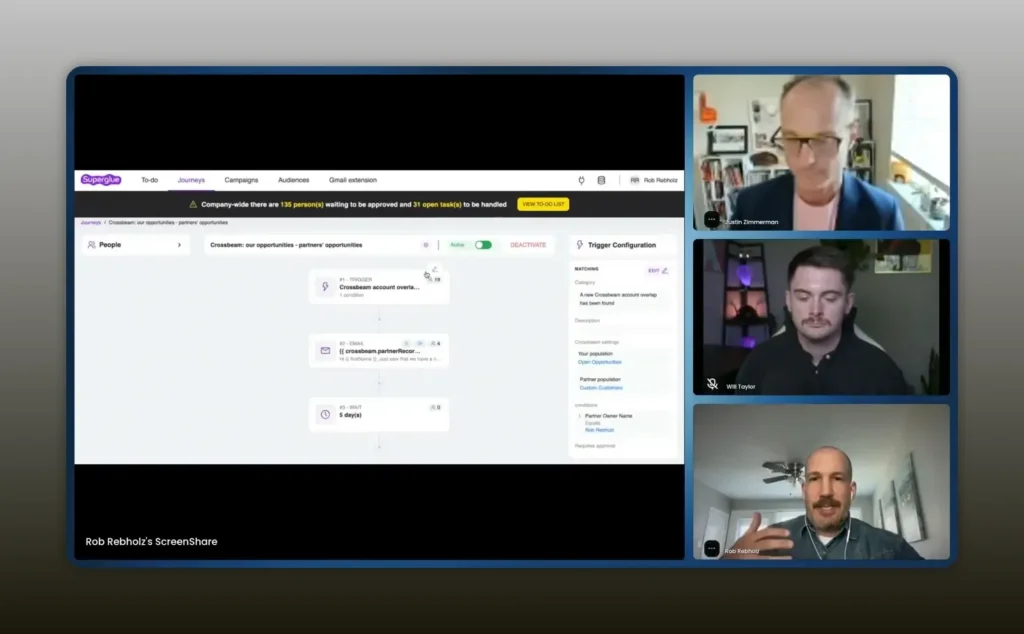
Build triggers for each partner manager so the data is delivered directly to the person who can act – Rob Rebholz
Implementation steps:
- Define overlap criteria: revenue band, account fit, or product match that qualifies as an opportunity.
- Segment ownership: map accounts to individual partner managers so notifications are always personalized.
- Create a workflow that runs until you get a partner response: initial intro email, one follow-up, then a task to the partner manager.
- Send emails from the partner manager’s inbox with editable templates so the message feels personal.
Expected outcomes:
- Higher partner replies because messages feel like a genuine connection.
- Less friction for the seller and partner because the work of finding overlap has been automated.
- Improved tracking of how overlaps convert into conversations and pipeline.
Workflow example: Real-time deal rescue via partner enablement
This second workflow is the most powerful lever for increasing deal velocity. It identifies stalled opportunities, finds attached partners, and empowers sellers to accept help with a single click.
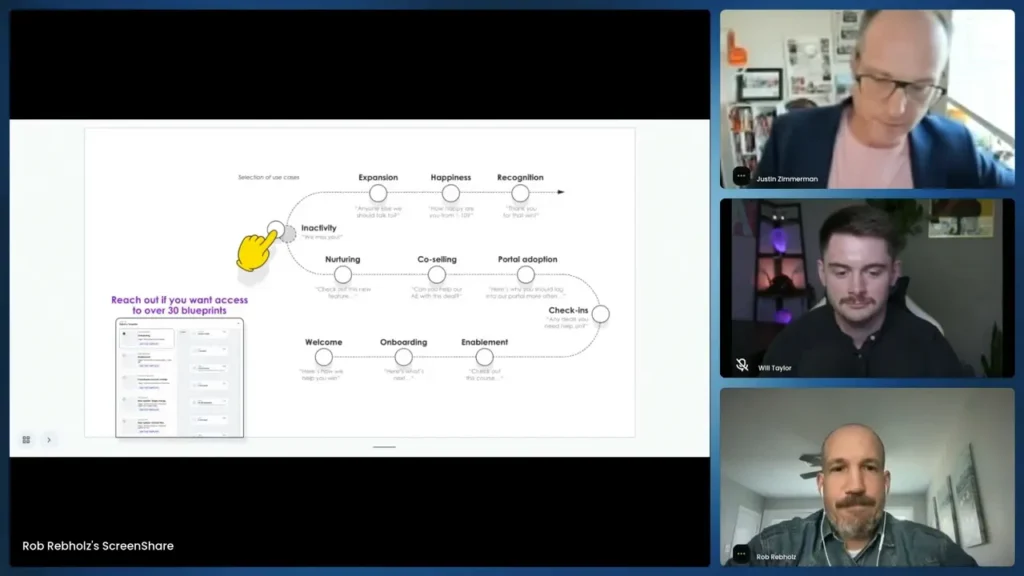
Send messages from the seller’s inbox so the receiving party doesn’t feel like this is automated – Rob Rebholz
Anatomy of the workflow
- Detection: Look for deals in a stage like negotiation or evaluation for longer than a set threshold (for example, 60 days).
- Signal enrichment: Merge CRM data with Crossbeam, custom objects, and partner attachments to identify partners connected to the account.
- Action trigger: Push a contextual, interactive message into the seller’s Slack or email with the option to say Yes or No—no widget hunting required.
- Fast reaction: If the seller clicks Yes, trigger an instant multi-stakeholder message that connects the seller, partner manager, and partner contact in seconds.
- Follow-through: Track the conversation and require next-step updates so momentum does not die.
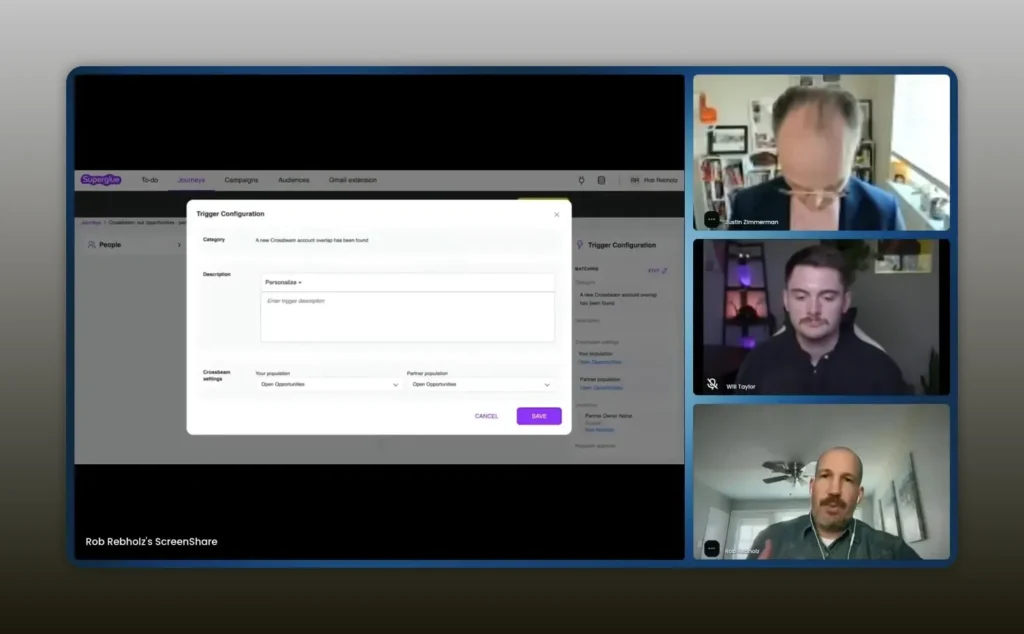
Getting help should be as easy as clicking yes or no – Rob Rebholz
Why this is so effective:
- Sellers get a dopamine hit when you solve a pressing problem in the moment. That trains them to accept partner help.
- Partner managers no longer have to babysit dozens of deals; the system flags the ones where partners can truly add value.
- Execution time drops dramatically: the seller clicks yes and the connection happens in seconds instead of days.
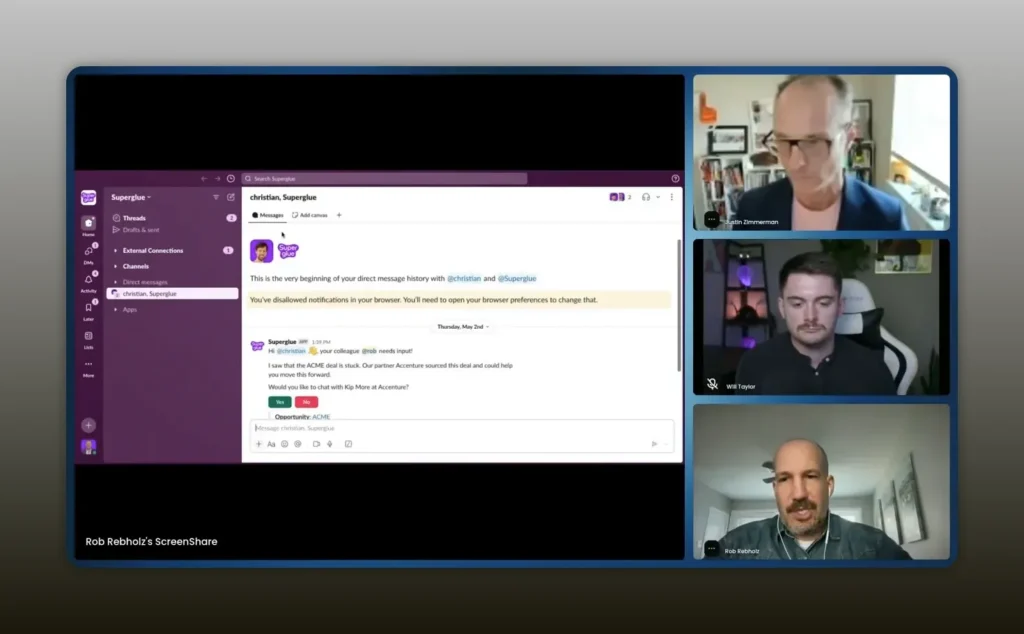
The right time, real time enablement saves meetings and removes bottlenecks – Will Taylor
Signals, stacking, and the rhythm of the business
Signals are more than just overlaps. Will encourages you to think in stacked signals: product activity, marketing engagement, account upgrades, usage spikes, and partner overlap. When you combine these, you can build a probability layer that makes partner introductions higher quality and more compelling to sellers.
How to stack signals:
- Collect: Pull in Crossbeam overlaps, marketing engagement (Demandbase or equivalent), product telemetry, and CRM opportunity metadata.
- Normalize: Ensure fields and identifiers align across systems so you can join data at the account level.
- Score: Create a composite signal score to prioritize partner outreach and deal rescue efforts.
- Automate routing: Push top-ranked signals to partner managers and sellers via the channels they use most.
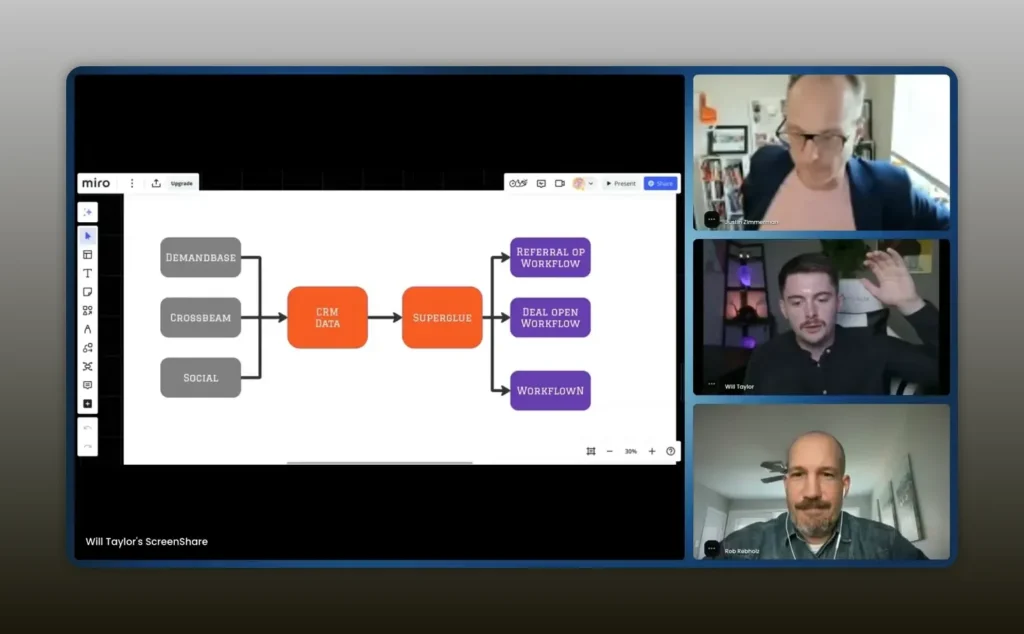
Pair marketing signals with partner context so the seller understands why the partner matters – Will Taylor
Examples of stacked-signal triggers:
- Account downloaded whitepaper + Crossbeam overlap + low product usage = partner-led onboarding outreach.
- Opportunity in negotiation > 60 days + partner attachment = push to partner manager for rescue.
- Recent upgrade with partner + spike in API calls = upsell outreach to seller with partner collaboration suggested.
Human-in-the-loop automation: balance and best practices
Automation without control will fail in partnerships. Partnerships rely on relationships and trust. Rob and Will recommend the following guardrails:
- Always allow a one-click customization step for outgoing messages so the sender can add context.
- Send messages from the sender’s own email address where possible, not from a no-reply address.
- Make opt-outs easy for partners and sellers. If a partner or AE repeatedly declines, adjust rule thresholds.
- Track response behavior and refine triggers—the system should learn which outreach patterns work best.
Practical tips:
- Start small: prototype with a single partner cohort or one sales team before broad rollout.
- Instrument every touch: record when messages are sent, when replies come back, and when pipeline moved.
- Celebrate wins publicly: share quick case studies with execs that show time saved and deals advanced.
- Invest in cleanup: initial data will be messy. A few days of cleanup produce outsized returns in workflow accuracy.
Recommended tools and tech stack
Rob and Will emphasize using existing systems first, then layering orchestration.
- Crossbeam for overlap and partner intel.
- Salesforce or your CRM as the system of record for opportunities and account ownership.
- Slack or MS Teams for conversational, real-time nudges and workflows.
- Marketing intent tools like Demandbase or 6sense to capture account engagement.
- Integration layers (Zapier, Workato, or native APIs) to push signals between systems.
- Partner orchestration platforms like Superglue to build, run, and measure partner workflows.
Platform pattern to follow:
- Source signals in native tools (Crossbeam, product analytics, marketing automation).
- Normalize to CRM and a central integrations layer.
- Trigger human-in-the-loop workflows that execute via email and Slack and track back to the CRM.
Implementation checklist
Use this practical checklist to move from idea to execution.
- Identify the 3 highest-value partner use cases (e.g., lead referral, deal rescue, onboarding).
- Map the systems that contain the signals for each use case.
- Decide routing rules and owner mappings for each account and partner.
- Prototype workflows for one partner manager and one sales pod.
- Measure conversion and velocity improvements for 60–90 days.
- Iterate thresholds and messaging based on response rates and outcomes.
- Scale to additional partner groups once you validate impact.
Metrics that prove partner impact
To convince your CRO and CFO, track metrics that show not just activity but business outcomes:
- Partner-influenced pipeline: pipeline value where partners were involved.
- Deal velocity delta: time-to-close for partner-assisted deals versus baseline.
- Win rate lift: comparative win rates for partner-assisted opportunities.
- Response rates: seller and partner engagement rates with workflow nudges.
- Operational efficiency: time saved for partner managers and reduced meeting requirements.
Common pitfalls and how to avoid them
Beware of these traps when you begin automating partner engagement:
- Over-notification: avoid blind alerts by prioritizing high-signal events only.
- Poor data mapping: inaccurate joins between systems create noisy triggers—invest in data hygiene.
- Too much automation, not enough human touch: preserve a personalization step for credibility.
- No follow-through: build tracking and re-notification so conversations convert into action.
FAQs
What signals should I prioritize to trigger partner outreach?
Prioritize signals that indicate both intent and opportunity: Crossbeam overlaps, marketing engagement (resource downloads, intent scores), product usage spikes or downgrades, and stalled deals in critical stages. Combine two or more signals to reduce noise and increase relevance.
How do I prevent sellers from ignoring partner outreach notifications?
Send contextual, actionable nudges that solve a current problem. Use a one-click accept/decline flow in Slack or email, route messages from the seller’s inbox, and show why the partner is relevant. Train sellers by making help timely and successful so they get conditioned to accept partner assistance.
What if our CRM data is messy—can I still run these workflows?
Yes. Start with conservative rules that use the cleanest fields, or enrich with third-party sources like Crossbeam. Allocate a short data-cleaning sprint to normalize ownership, account IDs, and key fields. Even imperfect data can drive wins when rules are carefully scoped.
How do we measure ROI from partner workflows?
Track partner-influenced pipeline value, deal velocity improvements, and win-rate lift. Also measure time saved per partner manager and reduced meeting hours. Pair quantitative metrics with qualitative seller feedback to build a compelling executive narrative.
Can these workflows work if we don’t use Superglue?
Yes. The concepts are tool-agnostic: enrich signals, route to the right owner, meet people where they work, and instrument outcomes. Superglue bundles integrations and workflow primitives to make implementation faster, but you can assemble the same pattern with integration platforms and in-house automation if you prefer.
Conclusion
Partnerships can be a reliable, measurable growth channel if you move beyond manual processes and invest in signal-driven workflows. Start with two high-impact automations: targeted partner outreach from overlap signals and real-time deal rescue that surfaces partner help at the moment sellers need it. Prioritize human-in-the-loop personalization, route messages into the systems your people already use, and instrument everything back to the CRM. Do this and you’ll scale partner engagement, reduce friction, and build the data story your CRO and CFO can trust.
Social Post
Announcing a new playbook for Head of Partnerships, VP Sales, CRO… Introducing Automating Partner Engagement: Co-sell Workflows That Scale!
You are at an inflection point: partnerships can become the predictable revenue engine your company needs. This playbook distills proven workflows to convert partner signals into immediate seller action and demonstrable ROI. You will learn how to turn Crossbeam overlaps, marketing intent, and CRM indicators into right-time partner enablement that moves deals faster.
- Fragmented partner signals and noisy notifications
- Low seller engagement with partner programs
- Long deal cycles that stall in negotiation
- Difficulty proving partner-influenced revenue to leadership
- Manual workflows that steal partner manager bandwidth
- Inconsistent follow-through and lost momentum
- Poorly instrumented partner outcomes
Grab this playbook if you are Head of Partnerships, VP Sales, or CRO and want to learn how Rob and Will can help you achieve scale partner engagement, increase deal velocity, and prove partner ROI. The playbook is free, no form-fill required, no optin required.
Prove it or lose it – Will Taylor