How Netskope Used Crossbeam to Drive Ecosystem-Led Growth
Expert advice from Kristen Kelly and Elizabeth Whalen.
Snapshot
Can partnerships and integrations can be the single biggest lever to grow revenue, shorten cycles, and unlock new motion in sales? Yes — but only if your teams actually use the data the right way. That means going beyond reports that live on a shelf: you must surface partner overlap and contact intelligence where sellers already work, provide clear next steps they can act on, and bake repeatable plays into CRM, outreach templates, and enablement.
When datasets live in silos — spreadsheets, disconnected partner portals, or tools no one knows how to use — partner relationships stay dormant, warm introductions never happen, and partner-sourced pipeline fails to materialize.
The cost is real: wasted spend on integrations and tools, slower deal velocity, and missed upsell and cross-sell opportunities that erode the business case for partnerships.
Conversely, when you operationalize partner data across the field — with targeted reports, in-context widgets, and simple rules of engagement — the upside is enormous: faster warm intros, higher conversion rates, measurable partner-sourced and partner-influenced revenue, and a repeatable motion that scales.
This article will talk you through starting small, focused on persona-specific wins, spoon-feeding the field, and then layering in CRM templates, Copilots, and tagging so partner equity turns into predictable growth rather than an unrealized promise.
This is an opportunity to convert partner relationships into predictable revenue—put partner intelligence where sellers already work. -Kristen Kelly
Table of Contents
- Why ecosystem-led growth matters
- How to start: crawl, walk, run
- The white-glove play that wins field attention
- Salesforce integration: custom objects and templates
- Copilot in action: account highlights, partner tabs, and actions
- Tagging, ordering, and visual controls for the field
- Augmenting Crossbeam with third-party data
- Measuring ROI and the KPIs that matter
- Operational adoption tips that scale
- Supernode and customer success support
- Chrome extension and low-lift options
- Execution checklist
- Conclusion
- FAQs
Why ecosystem-led growth matters
Partnerships are rarely self-executing. You can sign integration agreements, publish documentation, and create joint collateral, but none of that guarantees that sales reps will actually reach across the aisle and use your partner relationships to win deals.
If you want to convert partnerships into measurable revenue, you must do two things: surface actionable partner intelligence to the people who make decisions, and create a simple, repeatable play for them to take that next step. Kristen put it plainly: the problem before Crossbeam was alignment — sales didn’t always see the tangible value that the tech alliances team was offering.
How to start: crawl, walk, run
Start small and intentional. The pattern that worked at Netskope moves through three stages.
- Crawl: Start with the freemium or basic tier and a few core licenses. Learn how partner overlap data actually looks against your accounts and who on your team finds it immediately useful.
- Walk: Add a mid-tier license (for Netskope this was the connector tier). Expand to a few cross-functional users: sales development, global partner marketing, field marketing, and customer success. Build a handful of sharp, persona-specific use cases.
- Run: Move to the full Supernode license when the initial use cases prove value. Layer in integrations like the Salesforce custom object and crossbeam Copilot for in-context workflows. Scale with templates and enablement that teach teams to self-serve.
That sequence reduces internal friction, makes privacy and legal reviews manageable, and creates early wins to justify broader adoption.
The white-glove play that wins field attention
When you roll out a new platform that touches sensitive account and Salesforce data, adoption is rarely organic. You must earn attention. Kristen used a high-touch approach to light that spark.
Her play had two parts: first, bring concrete, account-specific intelligence to regional teams; second, provide an easy operational path for reps to act on it. She called this “white glove” or “spoon-feeding” — and it worked.
How it looks in practice:
- Run partner overlap reports for a specific sales team and filter to their active targets.
- Identify which partners are already live integrations and which accounts contain joint customers or partner-owned relationships.
- Provide suggested outreach language, email scripts, and a clear next step (for example, “Contact this partner owner at this email”).
- Conduct smaller, regional enablement sessions with this tailored data rather than broad global calls.
Smaller sessions invite more engagement. When the field sees concrete, usable intelligence for the accounts they own, the lightbulb moments multiply and adoption spreads by word of mouth.
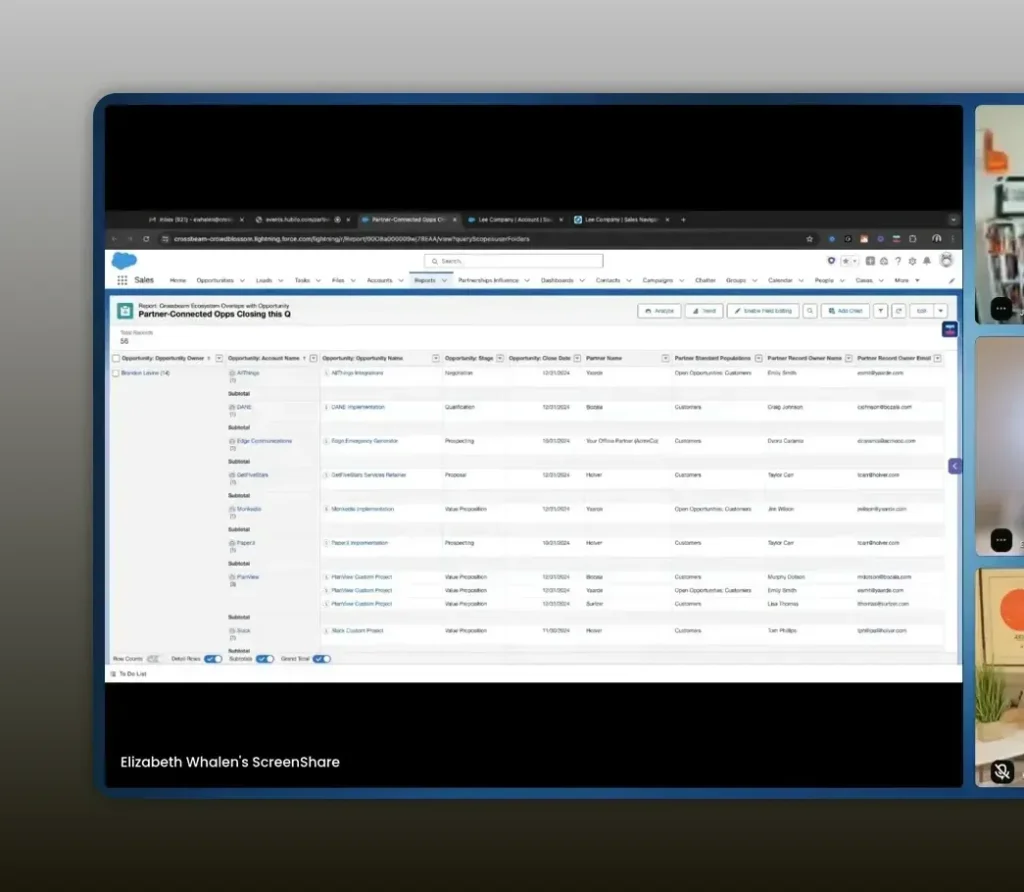
These reports need to be super targeted and relevant to the audience to drive adoption internally. -Elizabeth Whalen
Salesforce integration: custom objects and templates
To scale beyond spoon-feeding, you must push partner intelligence into the systems reps use every day. For many organizations, that system is Salesforce. Using the Salesforce custom object push available with a Supernode subscription allows you to:
- Surface Crossbeam overlap fields on account, opportunity, and lead objects.
- Create persona-specific templates: SDR reports, account owner dashboards, regional director rollups, and marketing lists.
- Automate which partner data appears and which stays hidden until the story is ready.
- Include partner contact details and partner owner emails directly in your CRM reports so reps have one action to take.
Templates make the change repeatable. When you centralize enablement around a few well-built report types, you dramatically lower the barrier for reps to use partner data themselves.
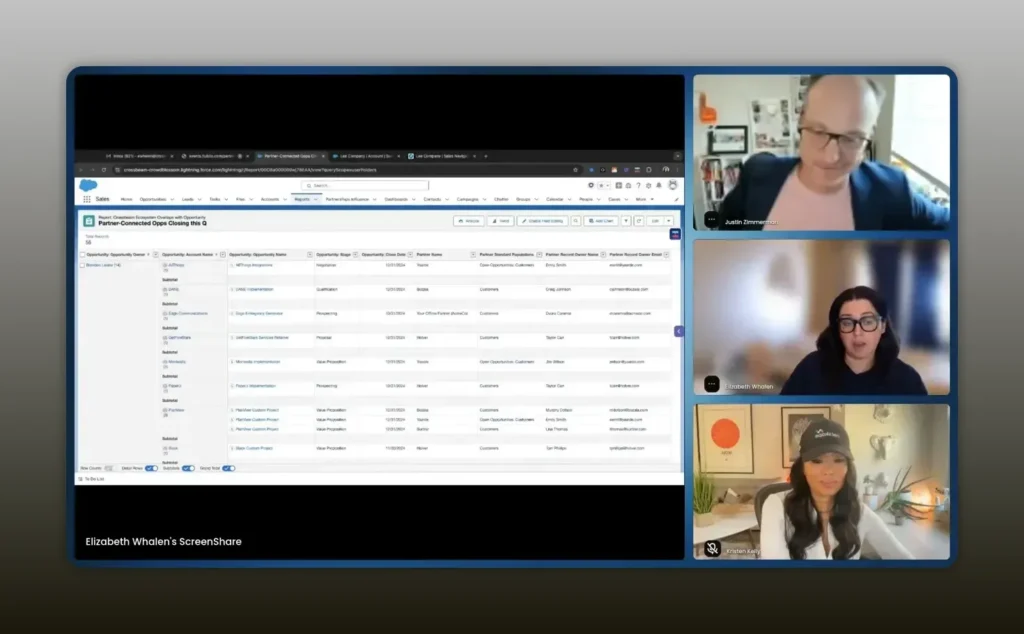
You can centralize your enablement resources and set rules of engagement with your partners. -Elizabeth Whalen
Copilot in action: account highlights, partner tabs, and actions
Copilot is the in-context surface for partner intelligence. It’s built to live where sellers already work — account pages, opportunity screens, and even external surfaces like LinkedIn or Sales Navigator through a Chrome extension.
Key benefits of Copilot:
- Account highlights: Quick, AI-generated plays that give reps a next step — whether that is a warm intro, a suggested outreach angle, or a prioritized partner to involve.
- Partner tab: A clear list of partner relationships attached to the account with an orange badge for customer relationships, contact details, and partner owner info.
- Actionability: Direct links to add shared contacts to your CRM and the ability to see which fields partners are sharing with you.
Copilot removes guesswork. Even reps unfamiliar with co-selling can use the widget to find which partners hold relationships with the account and who to email for a warm intro.
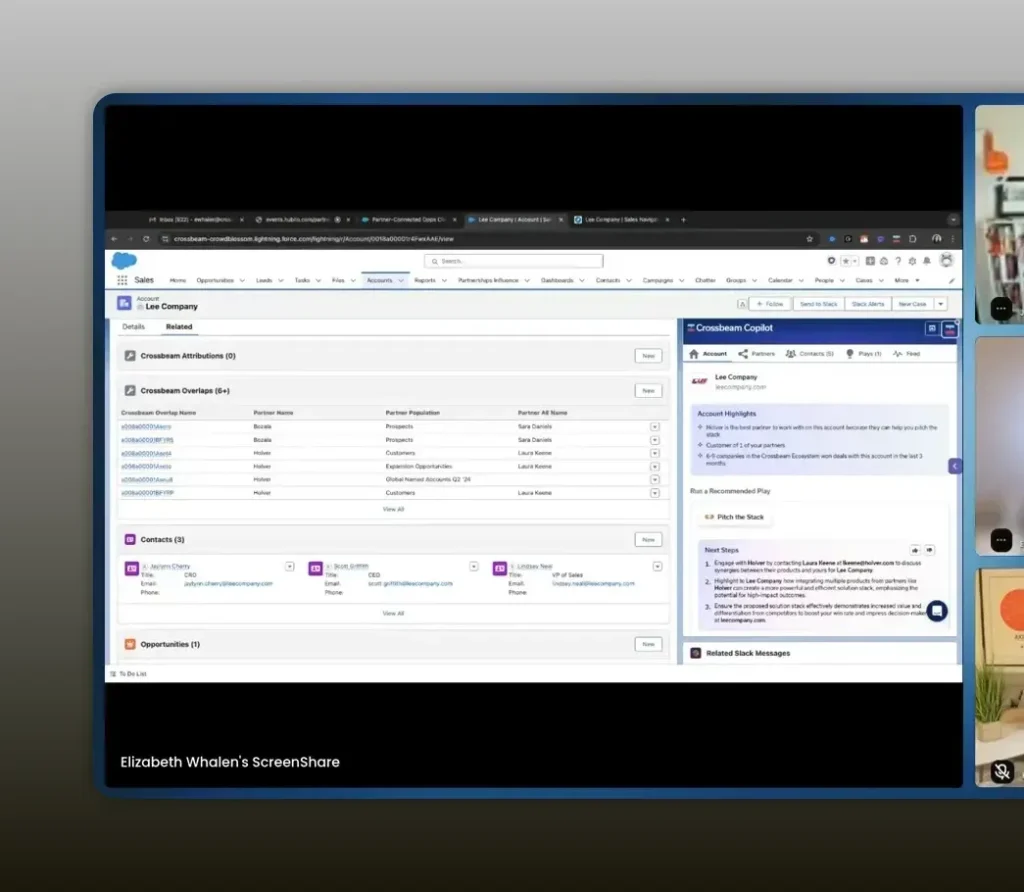
This will point your reps in the right direction and make it so they don’t need to be experts in co-selling. -Elizabeth Whalen
Tagging, ordering, and visual controls for the field
Not every partner should be presented equally. Crossbeam allows you to control visual prominence through ordering and custom tags. Use these controls to prioritize partners and cue reps visually.
- Ordering: Surface strategic partners at the top so reps immediately see the highest-priority relationships.
- Tags: Mark partners by program type, such as integration partner, channel partner, or referral relationship. Use tags to explain how the partner should be engaged.
- Granular visibility: Hide partners that are not yet ready for external outreach or tag them as “in development” so reps don’t waste time.
These small UX controls make the partner list actionable rather than noisy. Instead of asking your reps to interpret the nuance, tell them what to do.
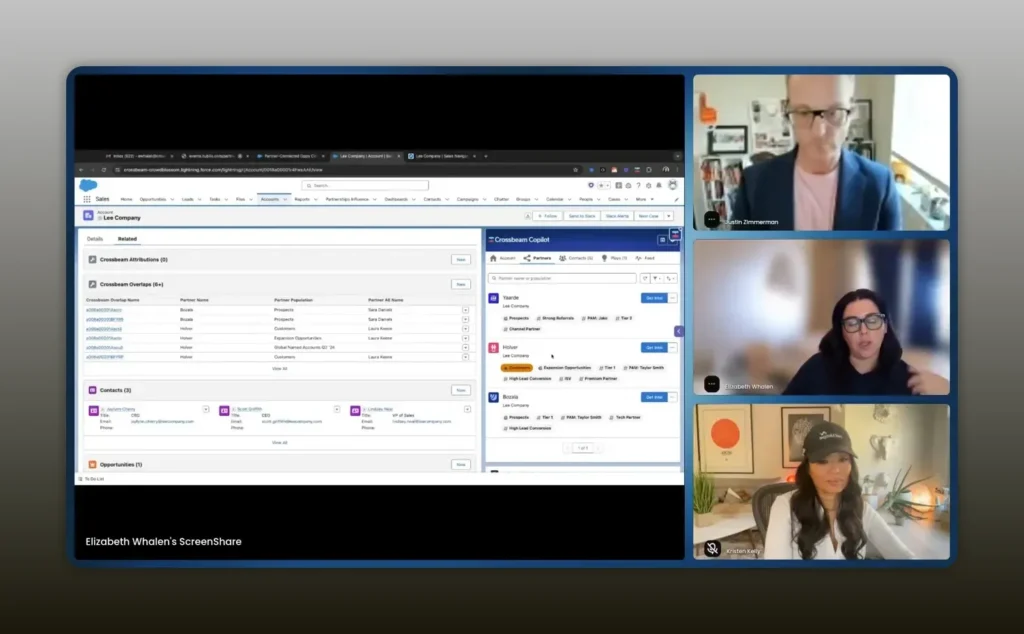
You can curate what shows here and the order in which the partners appear. -Elizabeth Whalen
Augmenting Crossbeam with third-party data
Crossbeam is powerful as a source of overlap intelligence, but its value multiplies when you combine it with other signals. Netskope layers Crossbeam with several third-party data sources to create a nearbound intelligence hub for the field:
- Intent data (6sense): Surfacing accounts that are actively researching or in-market.
- Marketplace propensity (Tackle): Scores that show likelihood to buy via cloud marketplaces.
- Technographic data (HG Insights): Which technologies are present in the account and whether those create a hook for integrated solutions.
- Contact enrichment (ZoomInfo): To fill in missing contacts and accelerate outreach.
- Customer reference fields (Gainsight): To identify public references suitable for co-marketing or event invites.
When you enrich partner overlap reports with intent, technographics, and referenceability, the result is hyper-actionable intelligence. You are not just telling reps that a partner exists in an account; you are telling them why that combination matters right now.
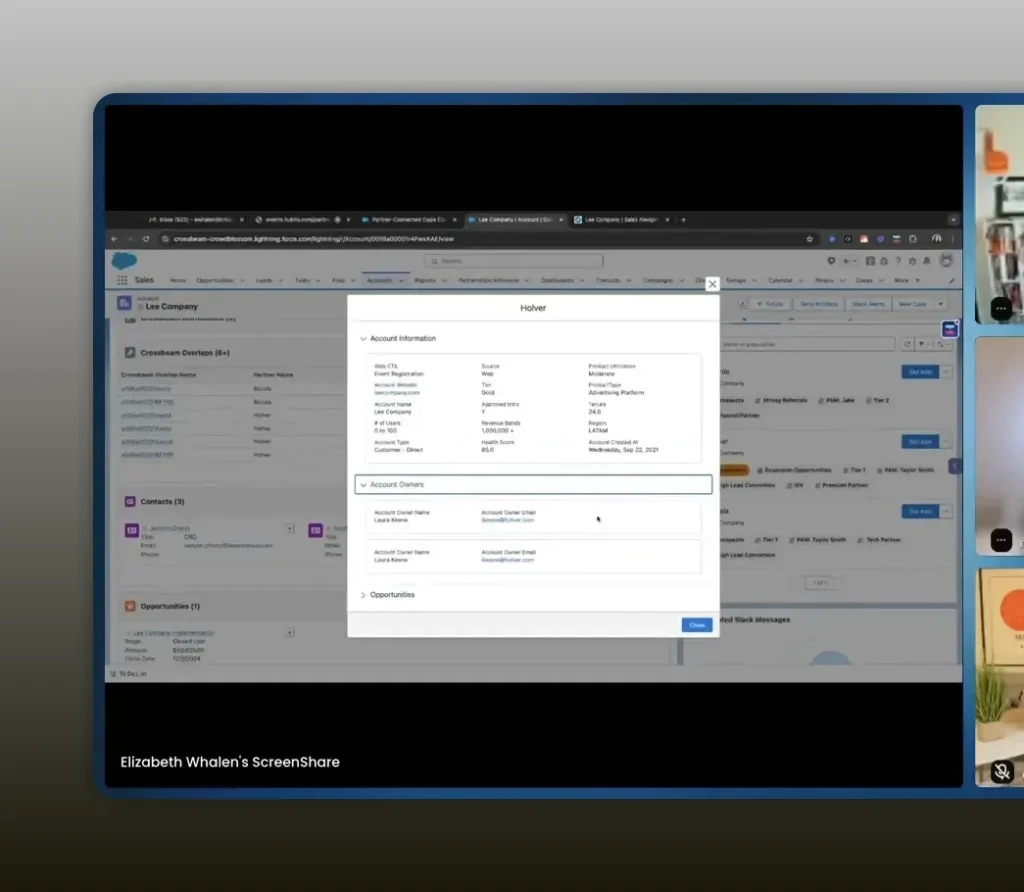
There are so many ways we can add and augment Crossbeam reports that make them 10 or 100 times more actionable. -Kristen Kelly
Measuring ROI and the KPIs that matter
When evaluating the ROI of a partner intelligence platform, tie it to two direct metrics:
- Partner-sourced revenue: Deals originated through partner introductions and joint motions.
- Partner-influenced revenue: Deals where partner involvement improved conversion or deal size.
Kristen emphasizes that Crossbeam has been one of the main ways Netskope scaled partnerships and increased both partner-sourced and partner-influenced revenue. Even without disclosing raw numbers, the qualitative signals were undeniable: improved field engagement, faster partner intros, and more joint go-to-market activity.
To measure your own ROI:
- Define baseline partner-influenced and partner-sourced revenue today.
- Run a pilot with a subset of partners and accounts and capture engagement metrics: number of warm intros, number of co-sells started, and pipeline influenced.
- Map changes in conversion rates and average deal size for opportunities where partner intelligence was used.
- Attribute revenue uplift over a suitable window and compare to the cost of the subscription tier and implementation.
Operational adoption tips that scale
Implementation is half tech and half people. Use these operational techniques to get traction faster:
- Start with low-friction pilot users: Pick a small set of account owners and SDRs to validate use cases before scaling.
- Do regional enablement: Skip large global calls at first. Small, targeted sessions with regional teams produce more questions and better adoption.
- Spoon-feed at first, then teach to fish: Provide curated reports, email scripts, and contact lists initially. Move to templates and self-serve reports as teams mature.
- Embed into new hire training: Build the partner-led mindset early so new hires adopt collaboration from day one.
- Set rules of engagement with partners: Standardize how reps should reach out and what information they must include to make partner collaboration smooth.
- Use Crossbeam Copilot where reps already work: Account pages, opportunity pages, or Sales Navigator reduce context switching and increase usage.
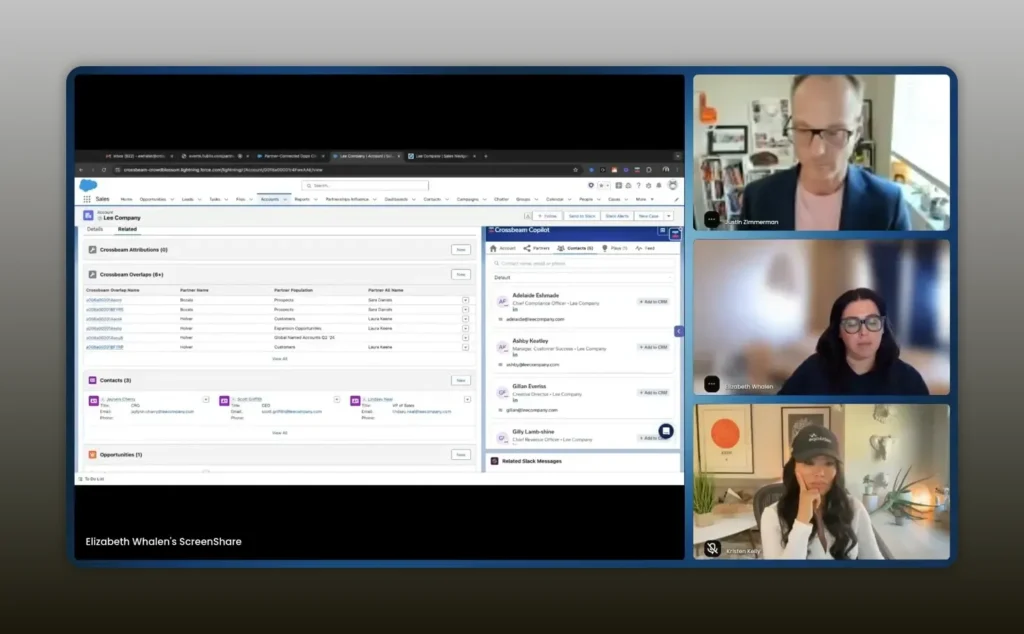
If your partners choose to share contacts, they will be available and you can quickly add them to your CRM. -Elizabeth Whalen
Supernode and customer success support
Upgrading to a full Supernode license provides the features that enable scale: Salesforce custom object pushes, advanced Copilot controls, tagging, and the ability to craft templates that live in your CRM. But the technical features are only one part of the upgrade story.
The Crossbeam customer success team helps you design and embed Crossbeam into your go-to-market motion. Expect hands-on help with:
- Building persona-specific templates
- Designing enablement and adoption plans
- Operationalizing rules of engagement with partners
- Creating reporting to track KPIs
That human lift can shorten the time-to-value and reduce the operational learning curve.
Chrome extension and low-lift options
If your RevOps team is not ready to install CRM widgets or you want to lower initial implementation friction, use Copilot’s Chrome extension. It surfaces partner data over any web page, including LinkedIn and Sales Navigator — places reps actually hunt for prospects.
The extension enables you to:
- Get partner overlap prompts while prospecting on LinkedIn
- See partner owner emails without navigating to Salesforce
- Work with partner data before committing to CRM integration
For organizations that are early in their partner program maturity curve, this is a game-changing, light-lift way to get reps using partner intelligence immediately.
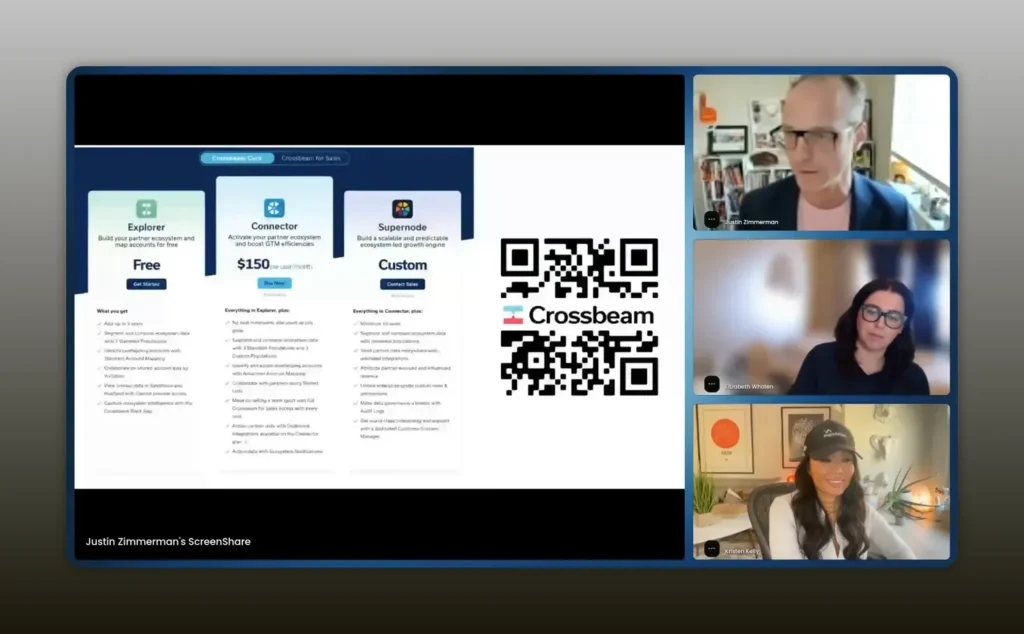
The Chrome extension changes the game because it’s a much lighter lift operationally. -Elizabeth Whalen
Execution checklist
Use this checklist to turn strategy into action:
- Choose your initial partner set (signed technology integrations or trusted partners).
- Run a pilot with 3-5 account owners and 2-3 SDRs.
- Create persona-specific reports and one-page scripts for outreach.
- Hold small, regional enablement sessions using account-specific examples.
- Push Crossbeam fields into CRM using the custom object once pilots prove value.
- Teach teams to use Copilot and install the Chrome extension for prospecting.
- Enrich Crossbeam overlap reports with intent, technographics, and referenceability.
- Track partner-sourced and partner-influenced revenue weekly and iterate the playbook.
Conclusion
Partnerships and integrations are strategic assets only when they are operationalized into the field’s daily workflows. Surface partner intelligence where sellers already work, make the next step explicit, and provide a path from spoon-feeding to self-service. Combining Crossbeam with CRM integration, Copilot in-context guidance, and third-party data creates a powerful ecosystem-led growth engine.
Start small, make data actionable, and scale with templates, tags, and enablement. The payoff is measurable: higher partner-sourced revenue, more partner-influenced deals, and an alliance team that is recognized for driving real business outcomes.
FAQs
How should I decide which partners to connect in Crossbeam first?
Begin with partners that already have a legal integration or development agreement in place and a live integration. These are the relationships where you can safely share live data and where there is a clear joint value proposition. Starting with a small set of trusted partners reduces privacy review complexity and delivers quick wins to justify expansion.
What are the most impactful Crossbeam features to adopt early?
Prioritize the Salesforce custom object (if you use Salesforce), Copilot for in-context guidance, and tagging/order controls. These features make partner data actionable for sellers and allow you to curate partner visibility based on program tiers and readiness.
How do I get sales teams to actually use partner data?
Start with high-touch, regional enablement that includes account-specific overlap reports and outreach scripts. Spoon-feed the first wave of users, then create templates and self-service reports so the rest of the organization can “learn to fish.” Embedding the practice into new hire training accelerates cultural adoption.
Can Crossbeam handle sensitive customer data and privacy concerns?
Yes, Crossbeam is designed with data-sharing controls. Begin with partners where both sides agree on what fields are shared. Use granular visibility settings to hide data that is not ready for prime time, and work with legal and security teams to define rules of engagement before scaling up.
What third-party data should I layer on top of Crossbeam?
Intent data (6sense), marketplace propensity (Tackle), technographics (HG Insights), contact enrichment (ZoomInfo), and reference fields from your customer success platform (Gainsight) are highly complementary. Choose signals that answer the question: Why does this partner/account combination matter right now?
Is the Chrome extension enough before CRM integration?
Yes. The Chrome extension offers a low-lift way to surface partner intelligence on LinkedIn, Sales Navigator, and other web pages. It’s a great fit if your RevOps team needs time to deploy CRM objects or if you want to de-risk the rollout before a full integration.