Partner Automation Playbook: Scale Co-Selling with Processes and Automation
Expert advice from Rob Rebholz (Superglue), Mike Sandoz (Bloomreach), and Chris Lavoie (Partnership Mastermind).
Snapshot
Fact: partner ecosystems are getting more complex, revenue targets are rising, and partner teams remain intentionally small. You can add to that, market dynamics — more channels, blended sales motions, distributed product teams, and cross-border partnerships — means the number of people you need to influence is growing faster than the headcount you can add.
That gap between expectation and capacity is where automation and deliberate process design become not just helpful but essential: they let you detect the right signals, trigger consistent activation plays, and ensure follow-ups happen reliably so valuable opportunities don’t slip through the cracks.
If you want to scale co-selling, increase partner-sourced revenue, and build repeatable motions that survive personnel changes, you must move from ad-hoc relationship management to a programmatic, measurable, data-driven partner-person funnel — a model that treats individual PAMs, AEs, and CSMs, as trackable contacts, maps lifecycle stages, and orchestrates automated journeys so you can prioritize the right people, measure conversion at each stage, and scale influence across your partner base. This article is a brief introduction into how to do it.
Automation is where the real scale comes from – Rob Rebholz (Superglue).
Table of Contents
- Why the old way of partnering breaks down
- The partner-person funnel: rethink partners as people
- How to build the funnel in your CRM
- Key automations and triggers that move people down the funnel
- Concrete Bloomreach examples: automated academy, prospective partners, and campaigns
- Day-to-day playbook for partner managers
- KPIs that matter and how to score the funnel
- Scaling without hiring: roles, tools, and the associate partner manager
- Common pitfalls and how to avoid them
- Practical templates and campaign flows
- A 90-day implementation roadmap
- FAQs
- Conclusion
Why the old way of partnering breaks down
A classic misstep is assuming the relationship at the company level is enough. You might have a partner agreement in place and regular calls between partner managers, but that does not equal influence with the people who actually introduce you to customers. Those introductions come from customer-facing roles: account executives, customer success managers, consultants, solution architects, implementation leads. You need relationships with those people, not just with the partner account owner.
The challenge scales quickly. Manage relationships with 100 partners and you might need to influence thousands of individual reps across those companies. Without a process-driven approach you end up relying on luck, one-off lunches, and manual follow-ups. That work consumes partner managers and prevents them from focusing on big strategic deals.
The partner-person funnel: rethink partners as people
Think of partnership enablement the same way you think about demand generation for prospects. Instead of building a funnel for companies, build one for the individuals within partner companies who actually generate introductions and influence deals.
Label and manage lifecycle stages for partner reps. A simple lifecycle could look like this:
- Prospect — You have identified a partner rep but have not yet engaged them.
- Engage — They have taken an action like booking a meeting or attending a session.
- Activated — They have referred or influenced a sales qualified lead or concrete opportunity.
- VIP — A referred deal closed, or they consistently bring high-quality introductions and are treated as a strategic contact.
The aim is not to convert everyone all the way to VIP. The realistic and high-leverage goal is to create several VIPs inside each strategic partner. If you turn one partner relationship into a handful of influential reps, your access and pipeline density multiply.

Can you even just get a couple VIPs from that really important partner? – Chris Lavoie (Partnership Mastermind).
How to build the funnel in your CRM
The mechanics are straightforward if you use a capable CRM like Salesforce or HubSpot. What matters is data hygiene, lifecycle fields, and a consistent tagging strategy for partner-facing reps.
- Identify target partner accounts and enforce a strict ICP for those accounts.
- Ask partners to expose the list of AEs, CSMs, and other customer-facing reps via a data-sharing tool such as Crossbeam or direct mapping. This is often a mutual value exchange — give data back to partners so they can target your reps in return.
- Create custom contact properties for partner reps: role, geography, ICP match score, relationship stage, and priority.
- Load those partner reps into your CRM as contacts and map lifecycle stages so that activities (booked meetings, clicked links, referrals) update the lifecycle automatically.
- Use calendar tools like Calendly or Chili Piper integrated with your CRM so meetings automatically advance a rep from prospect to engage.
Once you have the contact-level funnel and lifecycle automation, you can instrument conversion metrics, run targeted nurture programs, and prioritize scarce human time where it matters most.
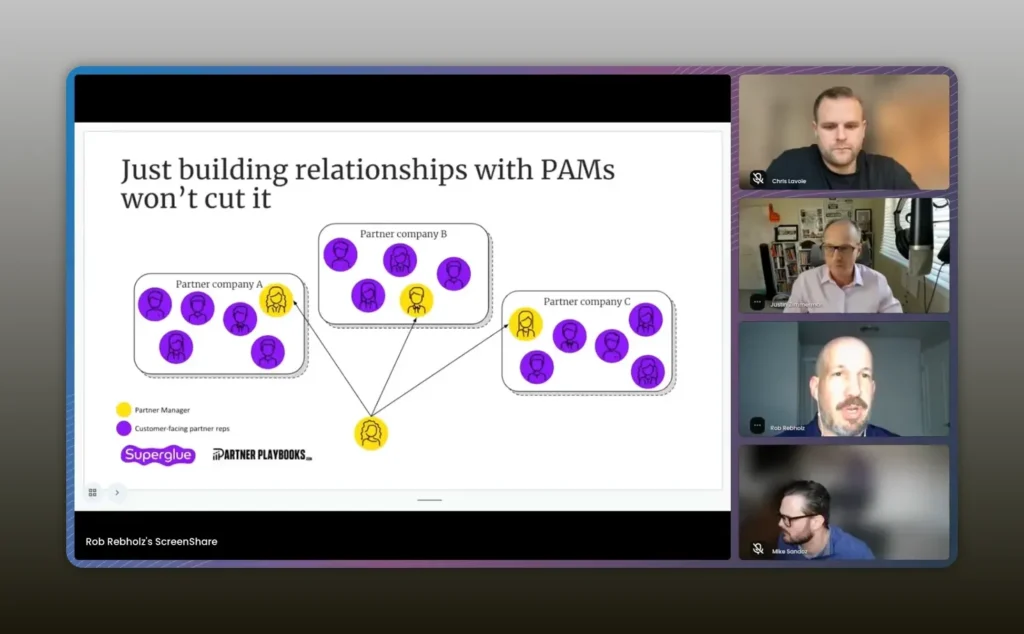
Convincing partners to expose who their AEs and CSMs are in Crossbeam was one of the biggest unlocks – Chris Lavoie (Partnership Mastermind).
Key automations and triggers that move people down the funnel
Automation is not a “set it and forget it” silver bullet. Its role is to create consistent, timely touch points so human relationship time is spent on high-value interactions. Focus automations on three things:
- Detection — Signals such as academy signups, content engagement, or form submissions should generate immediate notifications.
- Activation — Triggered journeys that provide next-step guidance, course recommendations, or simple asks to refer a lead.
- Follow-up and feedback — Keep partners in the loop on the status of any referrals they make and solicit feedback to maintain trust.
Typical triggers you should automate:
- Partner rep creates an academy account
- Partner rep consumes product or marketing content relevant to a target ICP
- Form submission from a prospective partner
- Meeting booked via integrated calendar
- Referral created in CRM (trigger notifications to partner manager and partner rep)
- Deal-stage change for opportunities linked to partner referrals
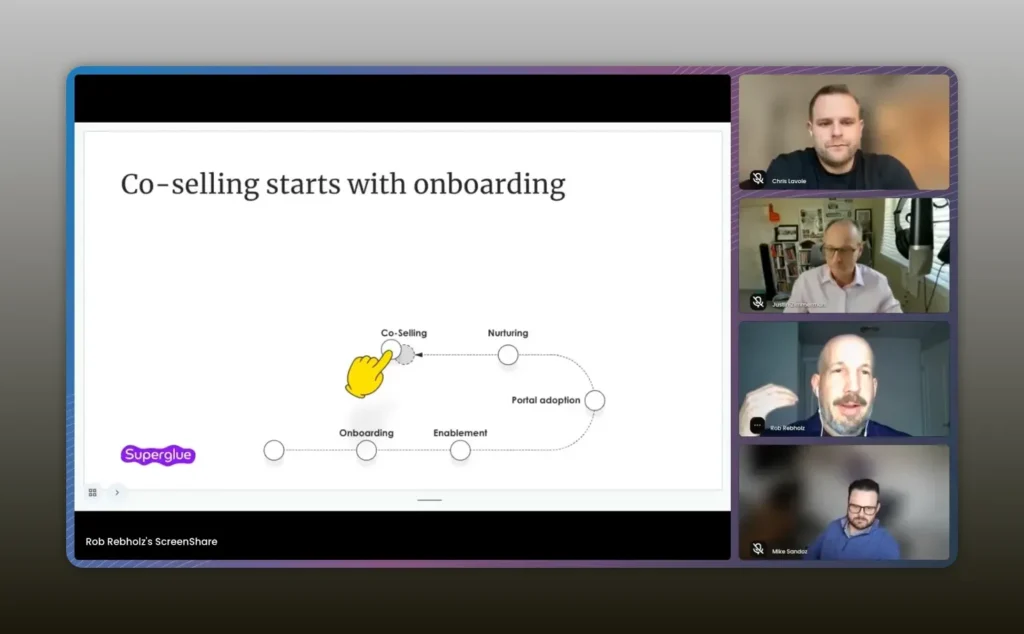
Progressively improve your setup — start small, iterate quickly, and let automation compound into reliable scale. – Rob Rebholz (Superglue)
Bloomreach examples: automated academy, prospective partners, and campaigns
Bloomreach compressed a lot of impact into a short timeframe by applying the funnel approach plus automation. Practical examples illustrate what this looks like in reality:
Academy onboarding and certification nudges
Problem: People sign up for partner academies then forget or don’t know which courses to take. That kills enablement and reduces the number of certified resellers and implementers.
Automation solution: When a partner rep registers, the system notifies the assigned partner manager via Slack. The manager can approve, customize, or discard outreach. An automated templated email walks the rep through recommended courses and next steps. The sequence tracks completion, and subsequent nudges are triggered for those who stall.
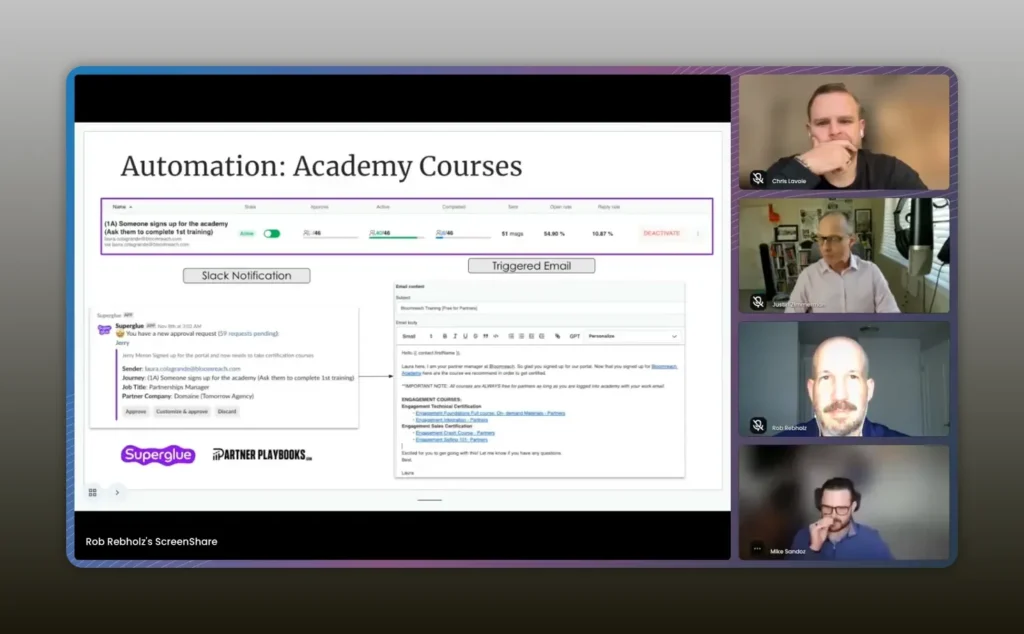
Now your partner knows exactly where to go for the courses – Mike Sandoz (Bloomreach).
Prospective partner qualification flow
Problem: New partner inquiries flood a shared Slack channel and require manual filtering and routing.
Automation solution: When a partner fills out the “become a partner” form, a triggered workflow notifies the regional associate partner manager. The form kicks off an initial auto-email that includes a qualification survey. Approval from the associate manager pushes the lead into a CRM pipeline and schedules a follow-up demo. This reduced friction and moved promising prospects to demo within days.
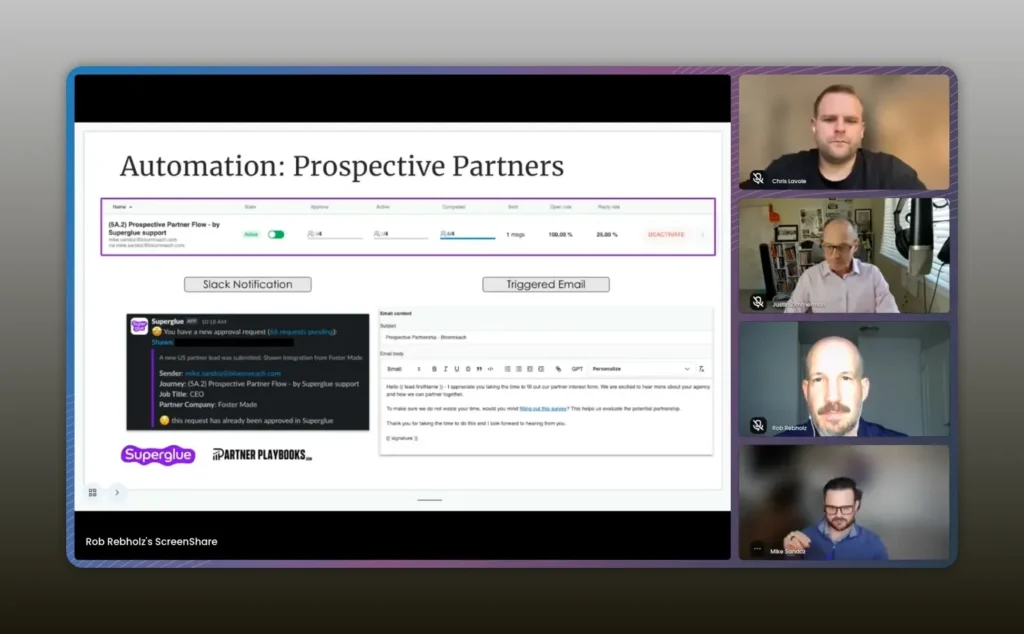
I don’t even have to look in that Slack channel anymore — I get a targeted notification – Mike Sandoz (Bloomreach).
One-off event campaigns and town halls
Problem: Running event campaigns for multiple partner managers meant repetitive work and spreadsheets.
Automation solution: Build a reusable campaign template in your engagement tool. Clone the campaign per partner manager, pull audiences directly from the CRM, and let the system handle sequential emails, reminders, and attendance tracking. Bloomreach used this to drive record attendance for a partner town hall with minimal lift from the partner managers themselves.
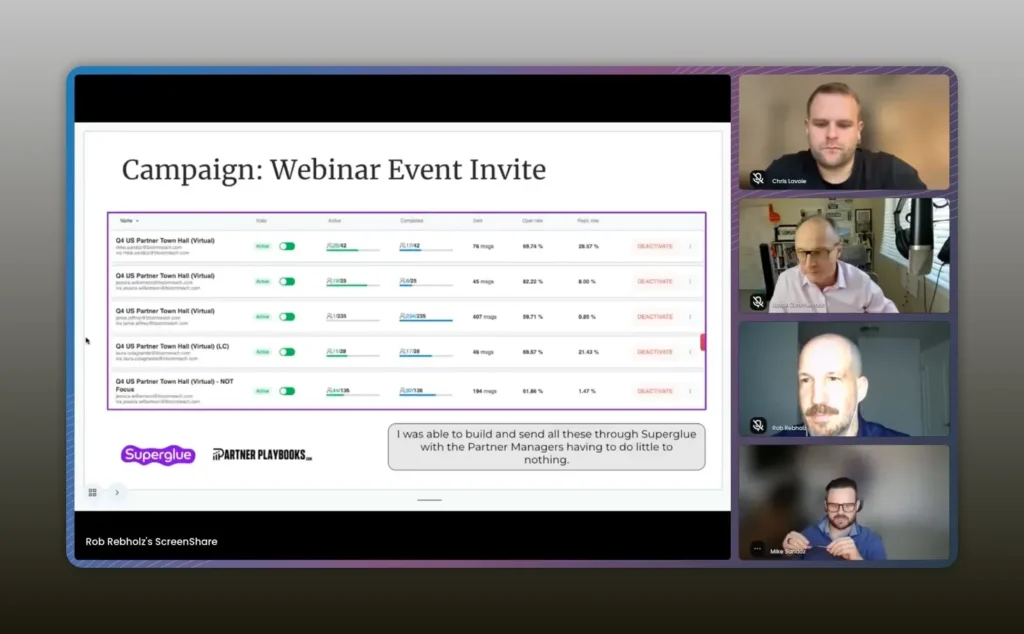
We got record attendance with way less effort — the templates made the difference – Mike Sandoz (Bloomreach).
Day-to-day playbook for partner managers
With automation managing routine touch points, partner managers can focus on strategic engagement. Create a daily and weekly rhythm:
- Daily: Review alerts for inbound signals (academy signups, high-intent content views, referral activity). Prioritize any high-value introductions or stalled deals needing human attention.
- Weekly: Run a partner funnel review — how many prospects entered the funnel, how many engaged, and how many activated. Identify top partner reps trending toward VIP and prepare recognition or incentives.
- Monthly: Look at partner-sourced pipeline attribution and win rates. Update incentives and co-marketing budgets based on performance.
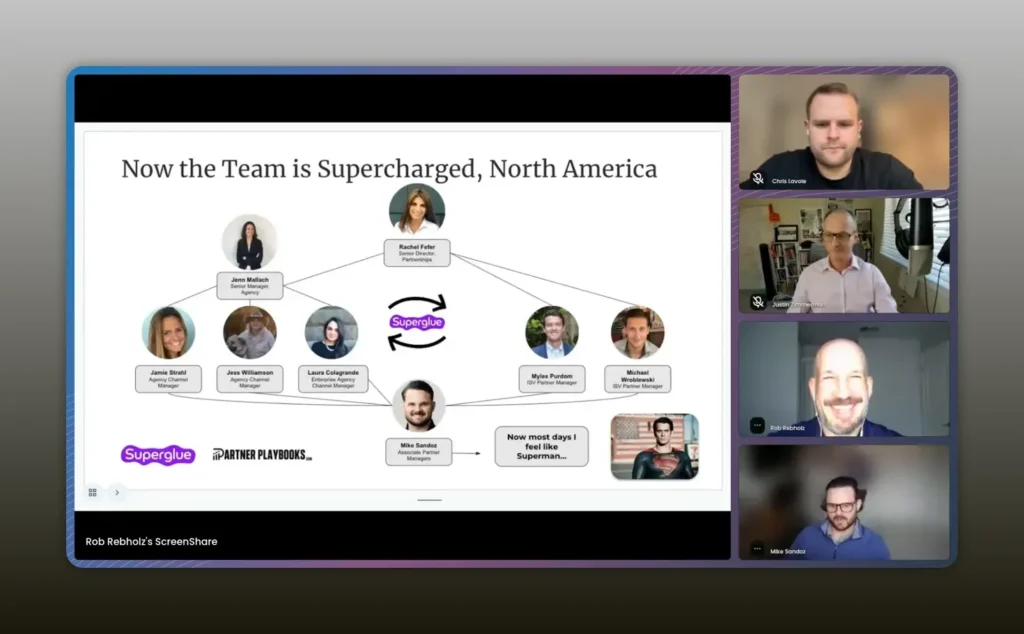
Superglue gave me the ability to support five partner managers efficiently – Mike Sandoz (Bloomreach).
Also consider an associate partner manager role to operate the automation. That person can own notifications, template maintenance, onboarding workflows, and the initial qualification of prospective partners so partner managers can stay focused on closing deals.
KPIs that matter and how to score the funnel
Shift KPIs from vanity metrics to contact-level operational metrics that map directly to pipeline and revenue. Important KPIs include:
- Partner rep meeting activity — The number of meetings you take with AEs, CSMs, and other customer-facing reps. This is a top indicator of influence.
- Engage to Activate conversion rate — The single hardest jump. How many engaged reps actually refer an SQL or opportunity?
- Activated to VIP conversion — How often do referrals close or repeat?
- Certified partner reps — Percentage of prioritized partner reps who completed certification or enablement programs.
- Partner-sourced pipeline and revenue — Dollars attributed to partner referrals and influenced deals.
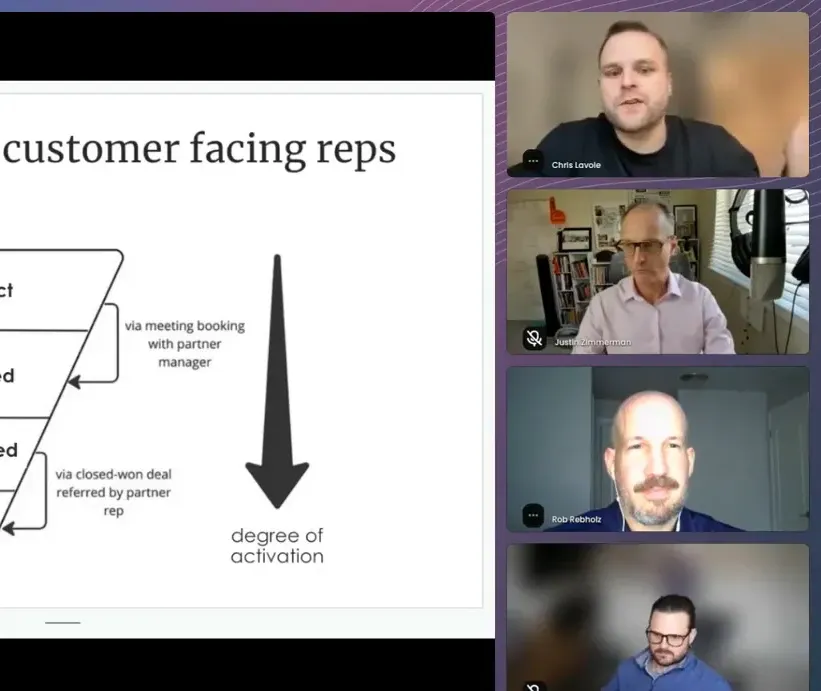
The biggest blocker for partner managers is how many people they are actually talking to. – Chris Lavoie (Partnership Mastermind)
Operational dashboards should show funnel metrics per partner as well as per partner manager. A partner might be “strategic” at the company level, but if you cannot get reps inside that company to engage, the account-level potential won’t translate into pipeline.
Scaling without hiring: roles, tools, and the associate partner manager
Hiring every headcount for growth is expensive. Automation plus a lightweight associate partner manager yields disproportionate leverage. Typical role split:
- Partner manager — Strategic relationships, deal-level influence, and VIP engagement.
- Associate partner manager — Runs automations, triages inbound prospective partners, maintains templates and campaigns, monitors alerts, and nudges for certifications.
Tools to consider:
- CRM: Salesforce or HubSpot for lifecycle stages and reporting.
- Data-sharing: Crossbeam for mapping partner reps to your target accounts.
- Engagement automation: Superglue, a partner-specific tool or a mature engagement platform that can clone campaigns, schedule sequences, and integrate with Slack.
- Calendar: Calendly or Chili Piper to auto-advance lifecycle stages when meetings are booked.
- Slack: For near-real-time notifications to partner managers.
Common pitfalls and how to avoid them
These stumbles are easy to avoid but often overlooked.
- Spray and pray targeting — Don’t engage every rep equally. Use Crossbeam and ICP filters to prioritize reps who manage accounts that overlap with your ICP.
- Poor data hygiene — Inaccurate role fields or stale contact records kill automation. Invest time in cleaning and maintaining partner rep lists.
- Ignoring the follow-up — When a partner rep makes an intro, don’t let them fade into silence. Automated deal status updates and personal thank-you notes keep them engaged for the next opportunity.
- Underinvesting in value exchange — Partners will not expose their rep data or invest time without clear mutual benefit. Share co-marketing credits, pipeline insights, or reciprocal access to your own reps.
- Over-automation — Automate routine touches but preserve human customization for high-value partner reps. Templates should be editable, and the associate manager should have rules that surface partners for manual touch.
Practical templates and campaign flows
Below are distilled examples you can adapt. Use them as frameworks, not final copy.
Academy onboarding flow (high level)
- Trigger: Partner rep registers for academy. Slack notification to assigned partner manager and associate.
- Action: Associate approves and sends templated onboarding email with recommended courses and quick-start checklist.
- Wait 7 days: If no course progress, send a checklist reminder with value points and a calendar link for a 15-minute orientation call.
- Track completion: When certification completed, move contact to Activated stage and notify partner manager for a thank-you and next-step conversation.
Prospective partner qualification flow
- Trigger: Form submission. Send an auto-email with a short qualification survey and proposed next steps.
- Action: Associate reviews responses, approves for regional partner manager or discards if not a fit.
- If approved: Create a CRM record, auto-book a demo if the prospect chooses a time, and send targeted onboarding collateral.
Event / town hall campaign flow
- Clone event campaign template per partner manager. Pull audience from CRM based on role, geography, and ICP overlap.
- Send sequence: Save-the-date, invitation, two reminders, and a final logistics email.
- Track opens, clicks, and registrations. For high-value reps who opened but didn’t register, automatically send a personal note from the partner manager.
A 90-day implementation roadmap
This roadmap gives you practical milestones to put the playbook into motion.
Days 0–14: Audit and design
- Identify top 20 strategic partners and define ICP coverage targets.
- Audit current partner contact data and create a mapping of missing fields.
- Design lifecycle stages and custom properties in CRM.
Days 15–30: Data collection and integration
- Convince partners to share rep-level data via Crossbeam or CSV exchange.
- Load partner reps into CRM and tag them by role and ICP match.
- Set up calendar integrations and basic lifecycle automation rules.
Days 31–60: Build automations and templates
- Create academy onboarding journey and prospective partner qualification flow.
- Build event campaign templates and a cloning process for partner managers.
- Design Slack notification rules for inbound signals and high-intent engagement.
Days 61–90: Pilot and optimize
- Run a pilot with two partner managers and three partners each.
- Measure engage to activate conversion and iterate on messaging and timing.
- Train the associate partner manager to manage day-to-day alerts and requests.
By the end of 90 days you should have active funnels for a pilot set of partners, repeatable campaign templates, and a clear measurement framework to scale across the rest of the partner base.
FAQs
What is the partner-person funnel and why build it?
The partner-person funnel treats individual customer-facing reps at partner companies as the true targets rather than the partner company as a monolith. Building it lets you measure engagement, prioritize reps by ICP overlap, and systematically convert engaged reps into activated referrers and VIPs. It increases pipeline density by creating multiple points of influence inside important partner accounts.
Which tools are essential to implement this playbook?
A robust CRM (Salesforce, HubSpot), a data-sharing tool (Crossbeam) to map rep-level overlap, an engagement automation tool for templates and journeys, calendar integration (Calendly, Chili Piper), and a notification channel like Slack. You do not need an army of specialists — an associate partner manager plus these tools can deliver outsized results.
How do I convince partners to expose their AE and CSM lists?
Offer reciprocity. Share relevant insights back to the partner, co-create campaigns, or provide reciprocal access to your internal reps. Demonstrate the value by piloting with a partner and sharing results like uplifted certification rates or closed referrals. Make it easy for them (Crossbeam or a simple CSV exchange) and protect their data with clear usage agreements.
What KPI should I track first?
Start with partner rep meeting activity — how many customer-facing meetings are being held between your team and partner reps each week. That metric correlates strongly with future referrals. Next, measure the engage-to-activate conversion rate to understand whether meetings result in actionable referrals.
Do I have to use Salesforce to run these automations?
No. Salesforce is common and supported by many automation solutions, but equivalent functionality exists in HubSpot and other CRMs. What matters is lifecycle fields, contact-level properties, and integrations with your engagement and scheduling tools.
How many VIPs should I expect per strategic partner?
Expect to identify a handful of VIPs per strategic partner, not dozens. The goal is to get a few highly engaged reps who consistently refer qualified opportunities. Quality matters far more than quantity.
What messaging works for activating partner reps?
Start with value-based, short messages that make it clear what you are asking for and what’s in it for them. Provide enablement (certification, quick product one-pagers), short ask frameworks (“If you see X, introduce us to Y”), and recognition or incentives for referrals. Keep templates editable so the partner manager can personalize high-value outbound.
How do I maintain relationships after a referral?
Automate status updates: send a quick note when an intro is made, when the opportunity is qualified, when it progresses in the pipeline, and when the deal closes. Add a personal thank-you from the partner manager for closed wins and consider small rewards or public recognition to keep the behavior repeating.
Conclusion
You do not need a massive partner team to scale partner-sourced revenue. You need a disciplined, contact-level approach and the right automations to make every human touch count. Treat partner reps like the buyers you would target directly. Use data to prioritize the right reps, automate routine touch points so partner managers can focus on high-value opportunities, and instrument conversion metrics to measure impact. Small pilots, an associate partner manager, and a handful of well-designed journeys will let you convert cold contacts into VIPs and turn partnerships into a repeatable revenue channel.