Ecosystem-Led Outbound: Turn Partner Data into Predictable Pipeline
Expert advice from Enrique Gutierrez (GTM Architect, BEMO ) and Kristen Kelly (Alliances, Netskope).
Snapshot
Today’s procurement decisions are dominated by one question: how well will this vendor fit into the buyer’s existing ecosystem of tools, vendors, and integrations? Buyers prioritize interoperability, pre-existing relationships, and a vendor’s ability to plug into their workflows — not just a pretty UI or a persuasive pitch. As a result, go-to-market success now favors companies that can tell a credible ecosystem story rather than just win a feature checklist.
What used to be a feature battle has become an ecosystem story battle: buyers care about installed footprints, integration points, partner recommendations, compliance signals, and who already manages that account on their side.
The decisive signals are often second‑party data — an account showing up as an open opportunity in a partner CRM, an upcoming renewal, evidence of a complementary product already installed, or a recommended contact the partner engages with. Those contextual pieces are what create instant relevance and trust during outreach.
If you want to win more deals, you need clear visibility into where your target accounts already sit inside partner CRMs, which partner contacts are engaged with them, and the exact moments when those accounts are heating up. This article walks you through this process.
Ecosystem signals are the single most powerful lead source you can have. – Bob Moore
Table of Contents
- Why ecosystem data matters now
- How the workflow pieces fit together
- Tools you’ll want in your stack
- Step-by-step playbook for ecosystem-led outbound
- Segmentation and list engineering
- Data operations: roles, automation, and enrichment
- Using Crossbeam as a filtration layer
- Running partner events without spamming
- Co-selling: operational steps that close deals
- Metrics and KPIs that prove the model
- Common pitfalls and how to avoid them
- Implementation roadmap
- FAQs
- Conclusion
Table of Contents
- Why ecosystem data matters now
- How the workflow pieces fit together
- Tools you’ll want in your stack
- Step-by-step playbook for ecosystem-led outbound
- Segmentation and list engineering
- Data operations: roles, automation, and enrichment
- Using Crossbeam as a filtration layer
- Running partner events without spamming
- Co-selling: operational steps that close deals
- Metrics and KPIs that prove the model
- Common pitfalls and how to avoid them
- Implementation roadmap
- FAQs
- Conclusion
Why ecosystem data matters now
Buying behavior shifted through three big waves: digital transformation, the API economy, and the AI revolution. Those waves changed not just how buyers evaluate products, but what matters most in their decision. Today the priority is how deeply a vendor is embedded in the buyer’s existing ecosystem.
That changes the entire go-to-market equation. Instead of cold, top-of-funnel blasts, you want to target accounts that are already interacting with your partners. These are not random leads. They are “ecosystem-qualified leads” — accounts where your partners already have contextual product signals, opportunities, renewal events, or installed products.
When you can identify that signal at scale, you both reduce noise and increase conversion. You also make co-selling a predictable, repeatable engine rather than an ad hoc favor exchange.
Ecosystem signals turn scattershot outreach into precise, high-conversion opportunities. – Bob Moore
How the workflow pieces fit together
There are four logical layers in the workflow that generate repeatable pipeline from partner data:
- Intent and third-party enrichment — sources like ZoomInfo and anonymized web traffic that flood the CRM with accounts showing intent signals.
- Ecosystem filtration — a partner-data layer like Crossbeam that tells you if accounts exist in partner CRMs and what stage they are in.
- Enrichment and activation — tools such as Clay that enrich each record with website signals, technologies in use, compliance pages, and recommended contacts.
- CRM orchestration and routing — lists, segmentation, and round-robin assignment rules in your CRM (HubSpot, Salesforce) to send the right accounts to the right sellers or account owners.
Combine these layers and you create a high-signal inbound stream into your outbound engine. Instead of blind outreach you run warm, context-rich conversations that align with what your partner is already doing with that account.
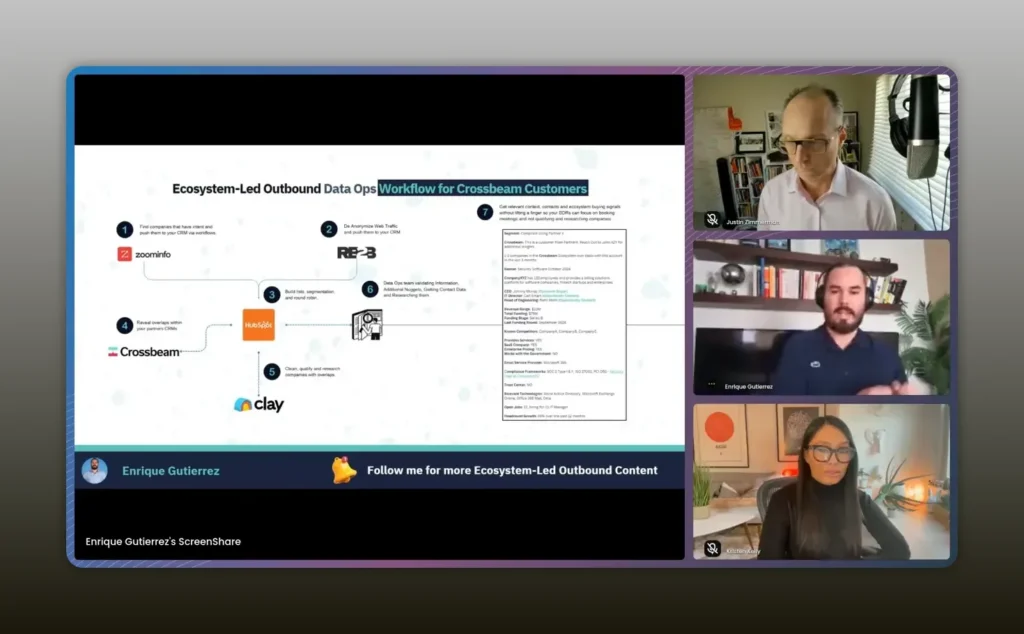
Once we hook Crossbeam to HubSpot we instantly know which incoming accounts overlap with our partners. That changes everything. – Enrique Gutierrez
Tools you’ll want in your stack
Enrique and Kristen both built their playbooks on the same core idea: use partner CRMs as a signal layer. But to operationalize that you need a small, focused stack:
- Crossbeam or a partner-data platform to map partner overlaps and share stage-level signals (prospect, open opportunity, customer, renewal, etc.).
- ZoomInfo or similar intent/data providers to act as the broad intake for accounts showing buying intent.
- HubSpot or Salesforce as the CRM to host lists, workflows, campaign tracking, and round-robin routing.
- Clay or an enrichment/automation layer to pull website signals, tech stack indicators, compliance pages, and recommended contacts into a digestible sheet.
- RB2B or reverse IP tracking tools to catch anonymous website visits and push those contacts into your CRM.
- A data operations function to own enrichment, triage, and list handoff so your sellers focus on outreach and meetings.
Step-by-step playbook for ecosystem-led outbound
The following playbook is intentionally tactical. Use it as a template and tailor the rules and thresholds to your company size and partner complexity.
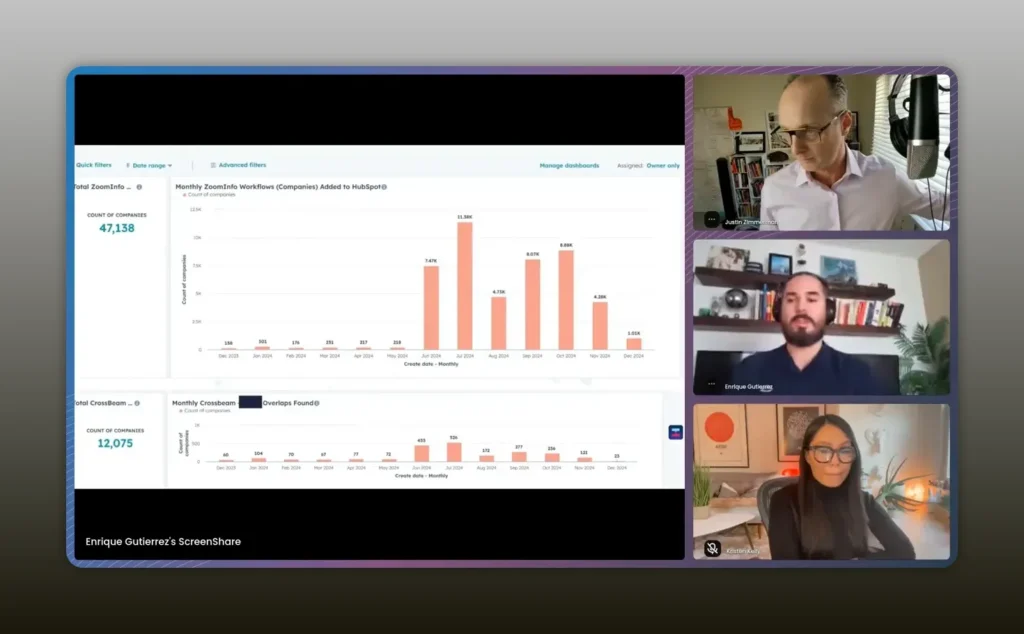
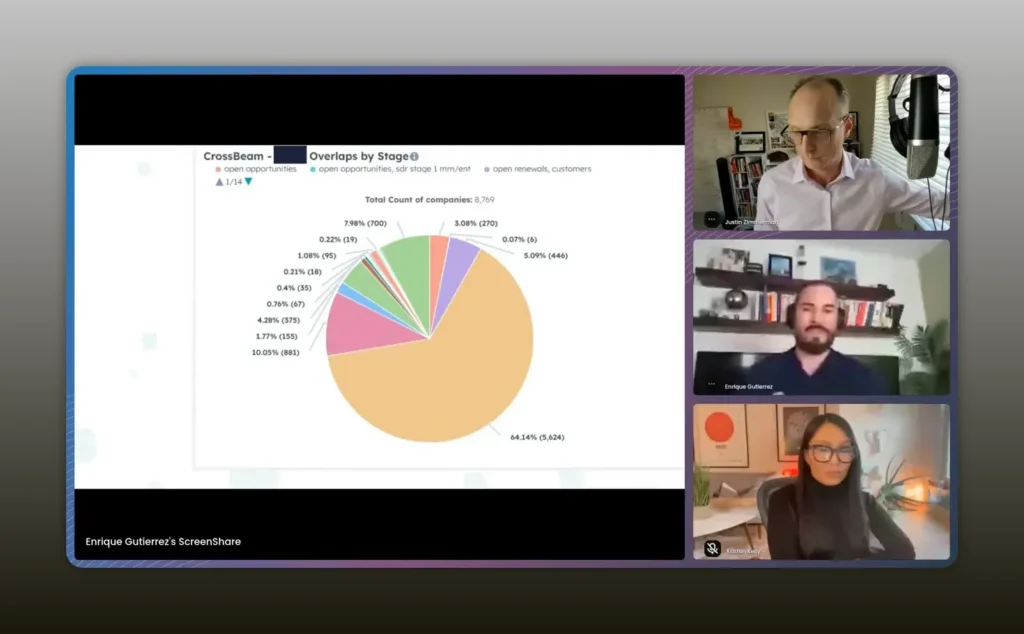
From 47,000 records dropped into our CRM, Crossbeam helped us identify 12,000 that exist in partner CRMs — the accounts we actually care about. – Enrique Gutierrez
1. Flood your CRM with intent accounts
Push intent-driven records from ZoomInfo and RB2B into your CRM. Don’t be stingy — the purpose is to ensure you don’t miss accounts that may have subtle intent signals. Enrique’s team pushed roughly 47,000 company records in a 12-month span to ensure coverage.
2. Run Crossbeam mapping as a filtration layer
Map those incoming accounts against partner data in Crossbeam. Filter to accounts that exist in partner CRMs. That reduces your working set from tens of thousands to a few thousand high-relevance accounts.
3. Segment by partner stage
Crossbeam typically shares stage-level info: customer, open renewal, open opportunity, prospect aware, prospect considering, etc. Use those stages to build separate lists and playbooks. An account that is an open renewal with a partner is a different conversation than a cold prospect.
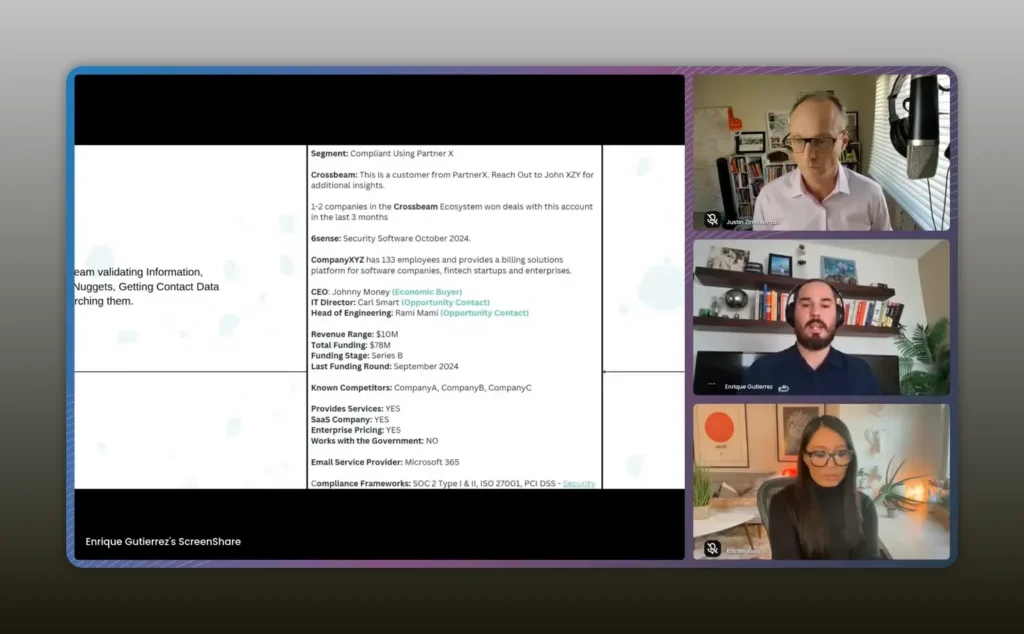
4. Enrich with Clay and other signals
Run the filtered accounts through Clay to gather attributes like:
- What email provider or collaboration suite they use (Microsoft, Google, etc.).
- Does the site mention compliance frameworks or trust center pages?
- Hiring signals and growth metrics.
- Recommended contact roles and titles.
These enrichments let you further prioritize and personalize messaging that matches the account’s actual situation.
5. Route to the right human with context
Use CRM logic to assign accounts based on the partner contact who manages them. This maintains continuity and enables a single point of contact inside the partner and your team — critical for co-selling. Enrique’s model sends accounts to BDRs grouped by which partner manager owns the account on the partner side.
6. Create campaign-level handoffs
When an account is flagged as high-touch (demo requested, hot lead, integration interest), bypass the BDR queue and assign directly to the account owner or escalate to a joint meeting with the partner account manager. Kristen uses Salesforce campaigns to track the end-to-end flow from event invitation to closed deal.
7. Track stage movement and trigger rapid outreach
The next frontier is change detection. When Crossbeam signals that an account moves from prospect to open opportunity, you must treat that as an urgent trigger. It usually indicates a moment of purchase intent. Rapid outreach within that window significantly increases conversion.
Segmentation and list engineering
Good segmentation is not just industry or company size. It is signal-driven and contextual. Use these dimensions:
- Partner stage — customer, opportunity, renewal, prospect-aware.
- Technology footprint — Microsoft, Google, Barracuda, etc.
- Compliance posture — compliant with trust center, compliant without trust center, manually managing compliance, unaware of compliance.
- Event behavior — registered, attended, asked for a demo, no-show.
- Account intent signals — recent website activity, open roles, growth rate.
Example segmentation: focus on accounts that are on Microsoft, are customers of a partner that offers compliance automation, and show open opportunity signals. That combo becomes a high-priority list of 124 open opportunities, 880 customers, and 3,000 prospects — a manageable universe for targeted outbound.
When an account shifts stage in Crossbeam, that’s your cue. That movement equals momentum and an invitation to engage. – Enrique Gutierrez
Data operations: roles, automation, and enrichment
To scale this model you need a dedicated data operations function. Your sellers should be sellers, not data janitors. The data team owns:
- Running the inbound account feeds from ZoomInfo and RB2B.
- Maintaining Crossbeam mappings and custom populations.
- Running Clay missions and attaching enriched notes to each CRM record.
- Flagging hot leads and routing them to account owners or joint partner owners.
With a data ops layer, your BDRs can move from doing research to doing high-quality outreach — increasing output per rep and improving morale.
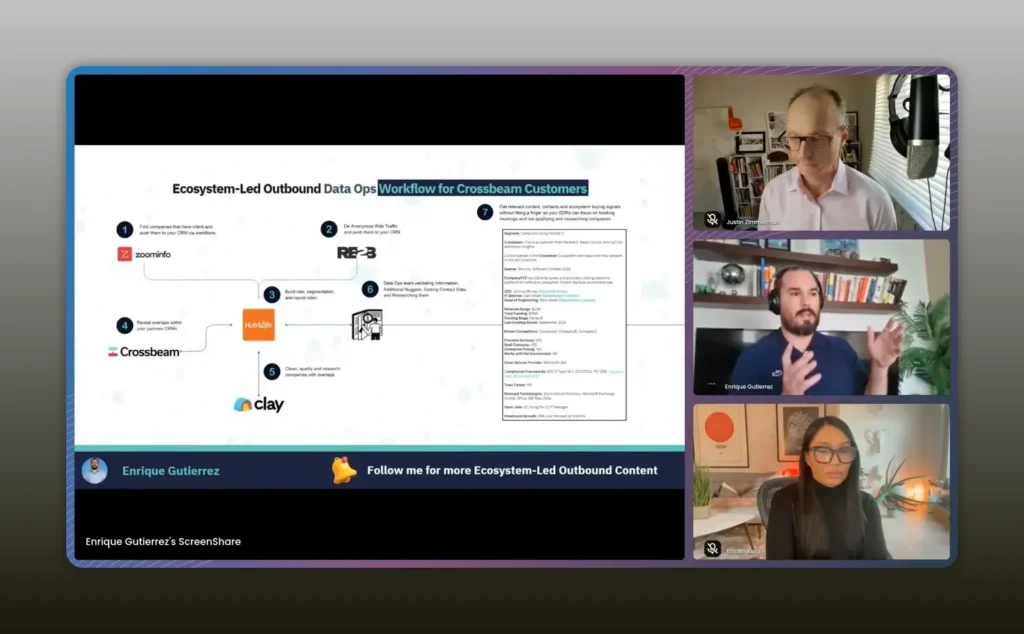
Creating a dedicated data operations team freed our BDRs to focus on booking meetings and having meaningful conversations. – Enrique Gutierrez
Using Crossbeam as a filtration layer
Crossbeam is more than a mapping tool. Use it as a filtration and telemetry layer that tells you:
- If an account exists in a partner CRM.
- Which stage the account is in at the partner (prospect, open opportunity, customer, renewal).
- Recommended contacts and engagement notes from partner CRM entries.
That last piece — recommended contacts — saves massive time. Instead of guessing who to contact, you can align outreach to the same buyer the partner is engaging. That alignment increases trust and shortens sales cycles.
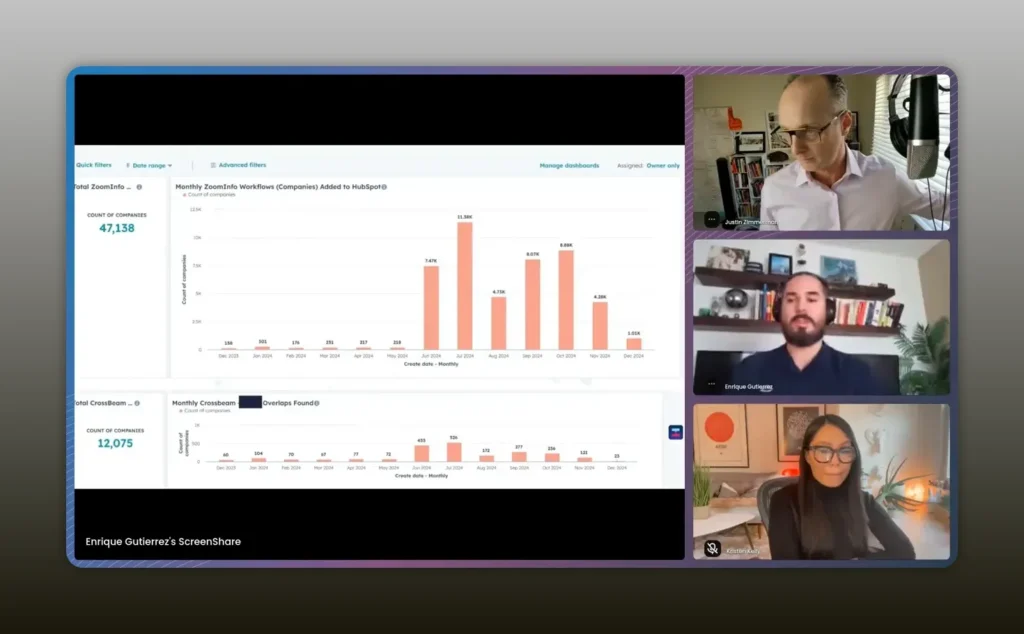
Crossbeam does the filtering work — turning a noisy list into a targetable, action-ready pipeline. – Enrique Gutierrez
Running partner events without spamming
Events with multiple partners are an enormous opportunity to capture and activate shared accounts, but they are frequently mishandled. The usual mistake: everyone aggregates the registration list and everyone fires identical, irrelevant follow-ups that create inbox fatigue and hurt relationships.
Kristen solved this by using Crossbeam before, during, and after events to pull targeted invitations and prioritize attendance.
Pre-event
- Run Crossbeam mapping across partner populations and identify the wish-list accounts that would generate the biggest return if they attend.
- Create a tiered invite list so partners can focus white-glove efforts on top accounts.
During event
- Capture engagement notes centrally. Any attendee who explicitly asks for a demo or integration is labeled hot and excluded from the normal BDR queue.
- Note if attendees express integration interest so you can plan joint follow-ups with partners.
Post-event
- Upload registrations and attendees into Crossbeam custom populations to check their partner statuses.
- Segment the attendees by partner stage and route high-priority ones to account owners for a direct, non-spammy follow-up.
- Flag referral opportunities and attach them to your tech-referral or partner deal registration program for tracking.
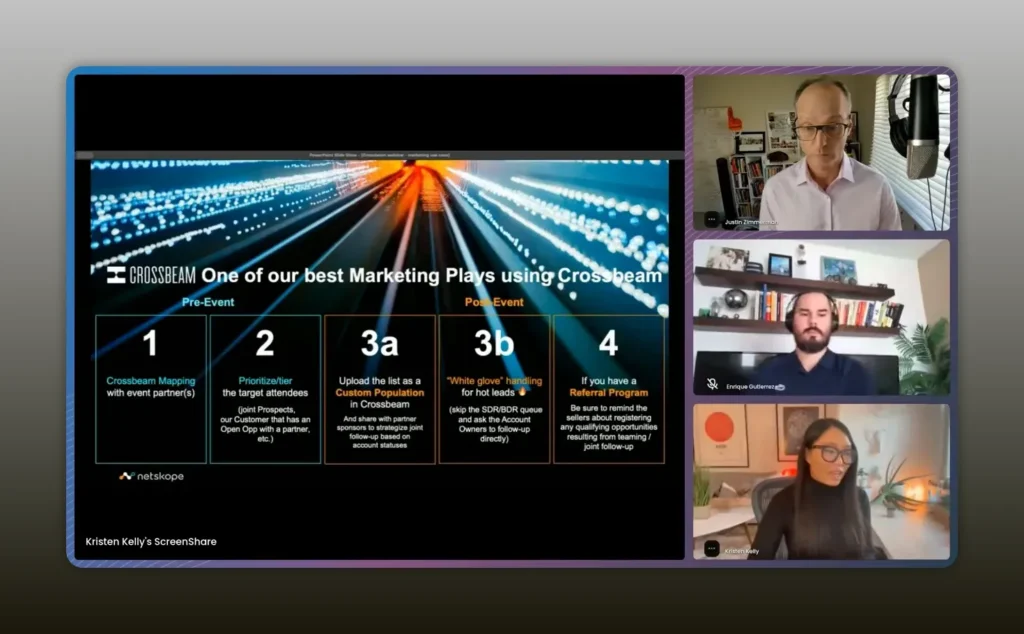
We upload the event lists into custom populations and then pick who needs white-glove follow-up vs. standard nurture. This avoids mass spam and actually drives pipeline. – Kristen Kelly
Co-selling: operational steps that close deals
Co-selling is not just inviting a partner to a meeting. It is an operational rhythm. Use these steps:
- Identify accounts in partner CRMs that map to your target lists.
- Confirm the partner contact who manages the account and set a single owner on your side to maintain relationship continuity.
- Share account notes and proposed next steps with the partner contact — keep it concise and action-oriented.
- Run joint outreach when an account is in an escalation-ready stage (open opportunity or renewal window).
- Track partner-influenced or partner-sourced metrics through campaign IDs or referral tags so you can attribute pipeline and close impact.
When Enrique brings a meeting to life, the partner benefits directly, which reinforces the relationship and creates a virtuous loop of cooperation.
Metrics and KPIs that prove the model
To make this repeatable, track metrics that align with both partner and internal goals.
- Accounts identified via Crossbeam — how many accounts in the CRM map to partner CRMs monthly.
- Hot leads routed directly to account owners — percentage of event or campaign leads bypassing BDR queues.
- Response rate improvement — change in reply rate after introducing ecosystem segmentation (Enrique reports up to 10% reply on targeted emails).
- Calls-to-meeting ratio — before vs after the filtration process (Enrique moved from thousands of emails to 100 calls per booked meeting).
- Partner-influenced pipeline and sourced revenue — tracked via campaign IDs in CRM.
- Time-to-meeting after Crossbeam stage change — measure how quickly you engage after an account moves from prospect to open opportunity.
Common pitfalls and how to avoid them
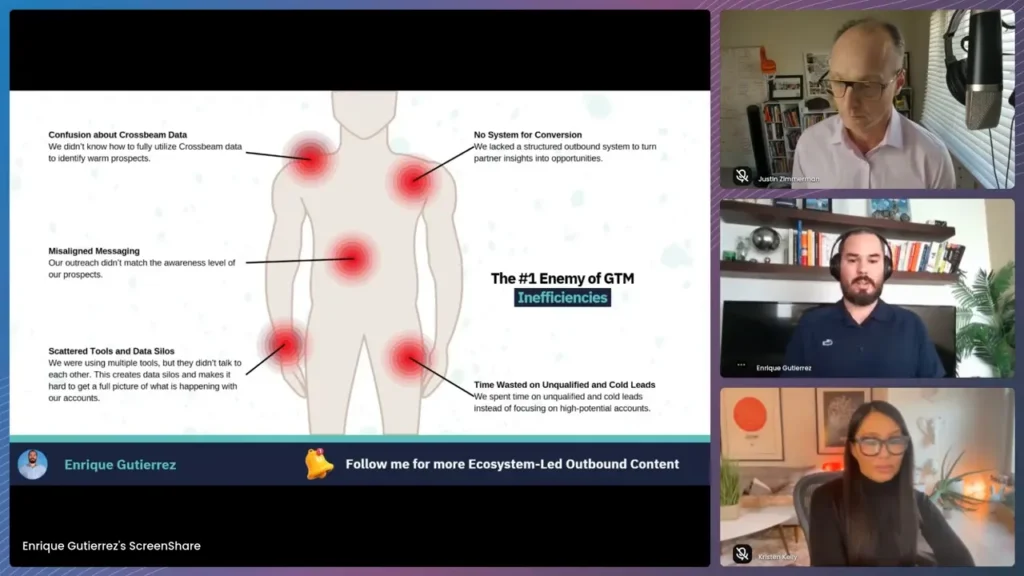
Several predictable mistakes derail ecosystem-led programs:
- Relying on sellers for enrichment — sellers end up doing research rather than outreach. Fix: hire a data operations function.
- Not prioritizing stage movement — ignoring Crossbeam stage changes wastes momentum. Fix: build triggers for stage change notifications and SLA-based outreach windows.
- Mass emailing event lists — spammy follow-ups damage brand and partner relationships. Fix: tier event accounts and route hot leads to account owners for white-glove follow-up.
- Using Crossbeam only for one-off maps — not treating it as an ongoing signal stream. Fix: integrate Crossbeam into daily CRM workflows and run regular syncs.
Implementation roadmap
Here is a practical 90-day roadmap to get started:
- Week 1-2: Connect data sources (ZoomInfo, RB2B) to the CRM and begin feeding accounts.
- Week 3-4: Connect Crossbeam and run an initial map against partner CRMs; identify the first tranche of high-value overlaps.
- Week 5-6: Set up Clay missions for enrichment and define the data ops role to own execution.
- Week 7-8: Build CRM lists and routing logic: partner-based round robin and white-glove assignment rules.
- Week 9-12: Run a partner event or joint campaign using the new flows; measure response uplift, call-to-meeting ratio, and partner-influenced pipeline.
- Post 90 days: Add stage-change triggers and SLA-based notifications; iterate segmentation rules based on performance.
Treat Crossbeam stage changes as real-time triggers — when an account moves to “open opportunity” or “open renewal,” aim to engage within 24 hours. – Enrique Gutierrez
FAQs
What is an ecosystem-qualified lead?
An ecosystem-qualified lead is an account that shows up in a partner’s CRM with context indicating active interest or use — for example, an open opportunity, an upcoming renewal, or being a customer of a partner. These leads carry higher intent and are prioritized for targeted outreach.
How frequently should Crossbeam sync with my CRM?
Sync frequency depends on deal velocity, but daily syncs are recommended if you want to capture movement and act on open opportunities and renewals quickly. At minimum, run daily or near-real-time synchronization for stage movement alerts.
How do you avoid spamming event attendees?
Use Crossbeam to segment event attendees by partner stage and behavior. Tier the list into white-glove follow-up, warm nurture, and standard nurture. Route hot attendees directly to an account owner or partner for a personalized outreach rather than dropping everyone into a mass email blast.
What team structure supports this playbook?
You need three functions: a small data operations team that owns enrichment and automation, a BDR/SDR team focused on outreach to warmed accounts, and account owners or partner managers who handle white-glove co-sell opportunities. Clear SLAs between these groups keep the engine moving.
What are the privacy and data-sharing risks?
Use partner-data platforms that enforce privacy and consent rules. Only surface the signals you are authorized to see. Avoid transferring PII beyond what partner agreements permit. Document data governance and ensure partners opt into agreed sharing scopes and stages.
Which KPIs should I track first?
Start with accounts mapped via Crossbeam, response rate improvement on targeted lists, call-to-meeting ratios, and partner-influenced pipeline. Those metrics will validate that your filtration and routing logic is converting into meetings and revenue.
How do you measure partner-influenced revenue?
Use CRM campaign IDs, referral tags, or partner source fields to mark deals that originated from joint outreach, event co-attendance, or a partner-introduced meeting. Reconcile these markers monthly to attribute pipeline and closed revenue to partner activities.
Conclusion
The future of efficient GTM is not about blasting more people with more messages. It is about unlocking the second-party signal that lives inside partner CRMs and turning it into actionable pipeline. When you combine intent feeds like ZoomInfo, a filtration layer like Crossbeam, an enrichment engine like Clay, and a disciplined data operations function, you transform outbound from a lottery into a predictable machine.
Enrique and Kristen’s approaches show the same truth in two different contexts: sales teams win when they prioritize partner-aligned accounts, route them with context, and act immediately when partner signals change. Put another way, the company that can listen to its ecosystem, enrich that signal, and move faster will win more deals with less wasted effort.
Start small: map one partner, build a targeted list, enrich it, and run a single white-glove campaign. Measure the lift. Then scale. The data is already there in your partners’ systems — your job is to collect it, filter it, and act on it.