How Euler PRM transforms partner programs: Lessons from NextRoll and Rollworks
Expert advice from Lizzie Chapman (Partnership Director) and Greg Portnoy (Founder, Euler PRM).
Snapshot
Incredible fact: you are sitting on a growth channel that almost no one has fully optimized: partnerships. Enter Lizzie at NextRoll. She figured it out. She moved from zero partner tech to a connected stack that found revenue, cut manual hours, stopped payout disputes, and kept partners actively engaged, instead of ignored. Lizzie accomplished this with the help of Greg Portnoy, the mastermind at Euler PRM. Together they figured out how to eliminate attribution errors, clumsy onboarding flows, complicated payouts, and poor partner engagement.
If you want to stop missing deals to bad attribution, actually engage partners where they work, and automate commission reconciliation, keep reading. This article walks you through the concrete ways Lizzie and Greg solved those problems. You’ll get a practical blueprint (tools, workflows, and implementation tips) so you can move from spreadsheets and firefights to a repeatable, measurable partner engine that scales.
Design the system, not the workaround. – Greg Portnoy
Table of Contents
- Snapshot
- Why partnerships deserve better
- The spreadsheet trap and what it costs you
- Building a partner tech stack that scales
- Why euler prm stands out
- Core features that change the game
- Onboarding, contracting, and eSign flows
- Attribution and found revenue
- Partner engagement without portals
- Payments, reconciliation, and finance
- Implementation tips from practitioners
- Tools and tech stack
- FAQs
- Conclusion
- Social post
Why partnerships deserve better
Partnerships are the most efficient growth channel you rarely prioritize. When done correctly they deliver lower customer acquisition cost, higher win rates, larger contract sizes, and shorter sales cycles. Yet most teams run partner programs the same way they did a decade ago: lots of manual work, fragmented data, and tools that treat partners as an afterthought.
Greg built Euler PRM because he kept seeing the same pattern: partnership teams with outsized impact were being starved of tools that matched their needs. They had CRMs for sales, product analytics for product, and martech for marketing, but no operating system for partnerships. That gap means you can either accept friction and lost revenue or design a system to reclaim it.
The spreadsheet trap and what it costs you
Running a partner program on spreadsheets is cheaper on Day 1 and wildly expensive by Day 90. Typical failure modes include:
- Referral leakage: partners submit deals, nobody tracks them, partners don’t get paid.
- Bad attribution: salespeople forget to tag partner-sourced deals in the CRM, so commissions never happen.
- Partner frustration: partners must visit five different places for collateral, forms, and status updates.
- Finance headaches: manual payout work, missed invoices, and reconciliation errors.
Lizzie’s team at NextRoll experienced each of those. They used Google Sheets for referrals, a marketing site for collateral, and an agency-made directory for listings. The result was missed payouts and partners emailing the team angrily about commissions. The fix: centralize, automate, and connect.
Building a partner tech stack that scales
The modern partner tech stack is rarely one tool. It’s a set of connected systems that each solve a specific problem and sync smoothly. At NextRoll, the stack evolved like this:
- Start with discovery: Crossbeam to find overlapping accounts and joint opportunities.
- Public presence: PartnerFleet for partner listings and front-facing pages that deep link into tools and program pages.
- Operating system for partners: Euler PRM for onboarding, referrals, attribution, contracts, payments, and reporting.
Each piece has a role. Crossbeam surfaces partners and mutual customers. PartnerFleet gets your program visible and simplifies how partners find you. Euler PRM becomes the connective tissue: it accepts referrals, creates CRM records, tracks commission rules, and keeps partners informed.
PartnerFleet made our partner pages easy to update and gave us a front door for partners. – Lizzie Chapman
Why Euler PRM stands out
There are lots of PRMs and portals, but Euler PRM is designed as a partnership operating system. That distinction matters. A portal is a place to host content and hope partners visit. An operating system actively manages the partner lifecycle, bi-directionally syncs with your CRM, automates workflows, and pushes notifications where partners already work.
Euler PRM’s product choices were informed by being a practitioner-first tool. Greg and his team built the product with feedback from active partner leaders like Lizzie. That partnership meant features were prioritized that actually solved real operational headaches, not just glossy dashboards.
Core features that change the game
Below are core capabilities that shift partnerships from reactive to proactive. These are the features that made Lizzie move from Google Sheets to a scalable stack.
1. Bidirectional CRM integrations
Euler PRM connects deeply with Salesforce, HubSpot, PipeDrive, and more. Data flows both directions so you never enter the same field twice. Approve a referral in Euler PRM and it creates accounts, contacts, and opportunities in your CRM. Update stages in the CRM and partners see status updates automatically. That single integration cuts manual entry and reduces attribution gaps.
Bidirectional CRM sync: create once, surface everywhere — no duplicate entry, no lost credit. – Greg Portnoy
2. Embedded forms and referral capture
Partners can submit referrals, register deals, or apply to your program via embeddable forms. They do not need to sign in to the portal to register a lead. That reduces friction and increases submission rates.
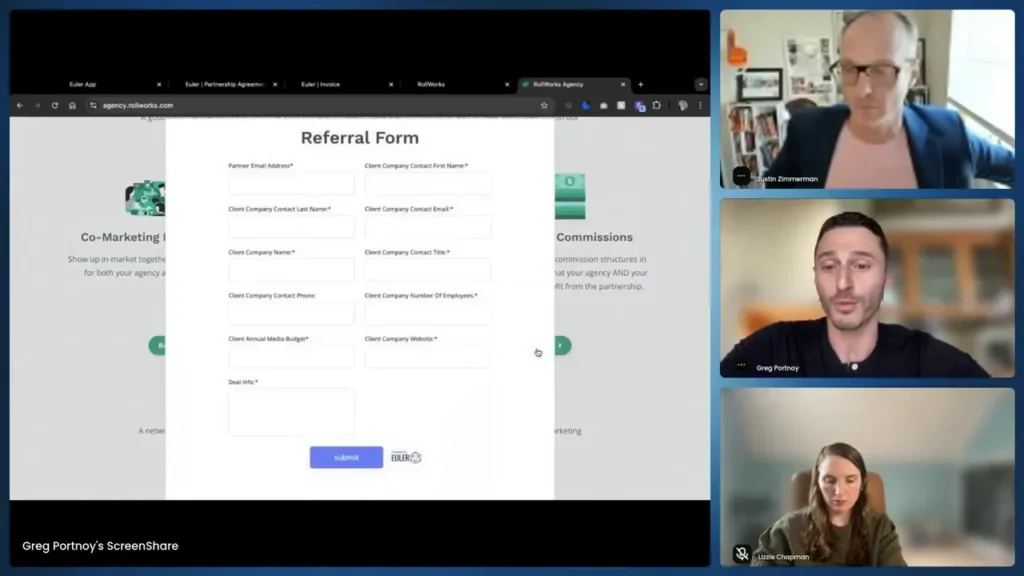
Referral forms must be frictionless — capture deals where partners work and credit them automatically. – Greg Portnoy
3. Onboarding flows and eSign
Euler PRM lets you create partner applications, qualify partners through a dashboard, onboard in seconds, and send agreements with built-in eSign. That single flow moves partners from prospect to active without throwing tasks at your legal or sales ops teams.
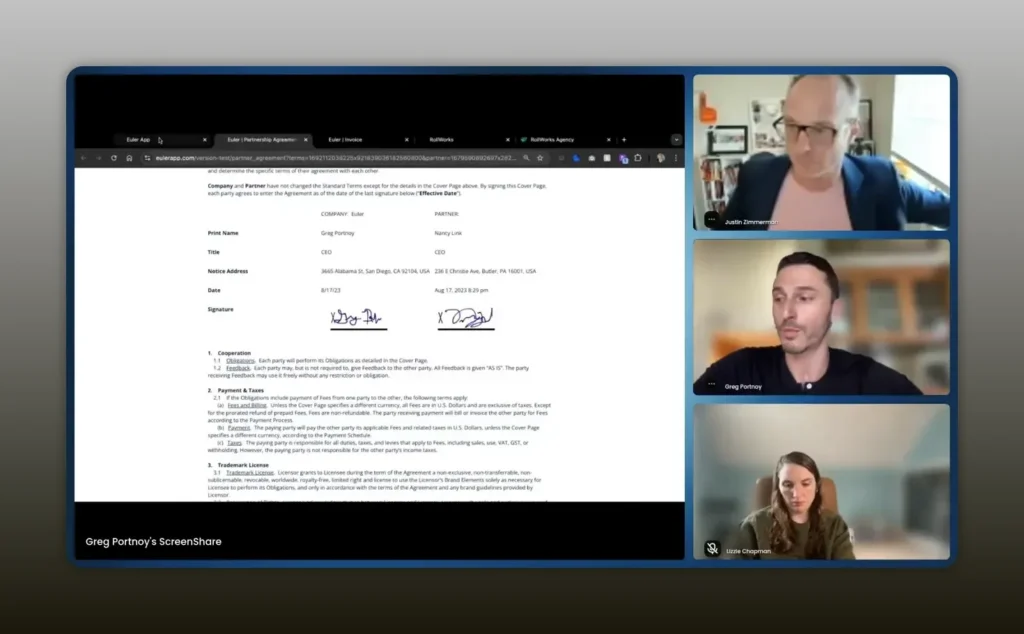
Built-in e-signature turns weeks of paperwork into one click. – Greg Portnoy
4. Commission rules and payments reconciliation
Many companies have complex compensation: SaaS commission versus media commission, different rates by partner tier, and mixed revenue streams. Euler PRM can model those rules, show what’s owed, and integrate with billing and finance systems for reconciliation. The partner sees an itemized invoice of what they were paid and why.
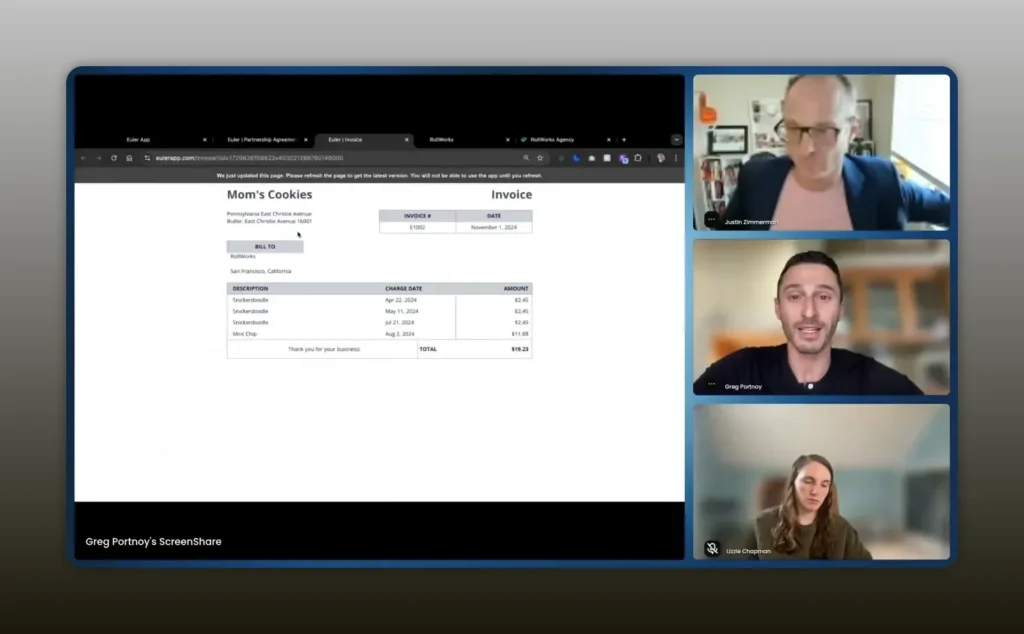
Seeing an itemized invoice in the partner portal stopped a lot of angry emails. – Lizzie Chapman
5. Attribution and found revenue
Attribution is the single most persuasive metric when asking for budget. Euler PRM captures attribution either via referral forms, tracking links, or CRM tagging. When salespeople forget to tag a partner, automated deal updates sent to partners surface the error earlier so partners can flag un-attributed deals. That means more deals correctly credited to partners and fewer end-of-quarter fights.
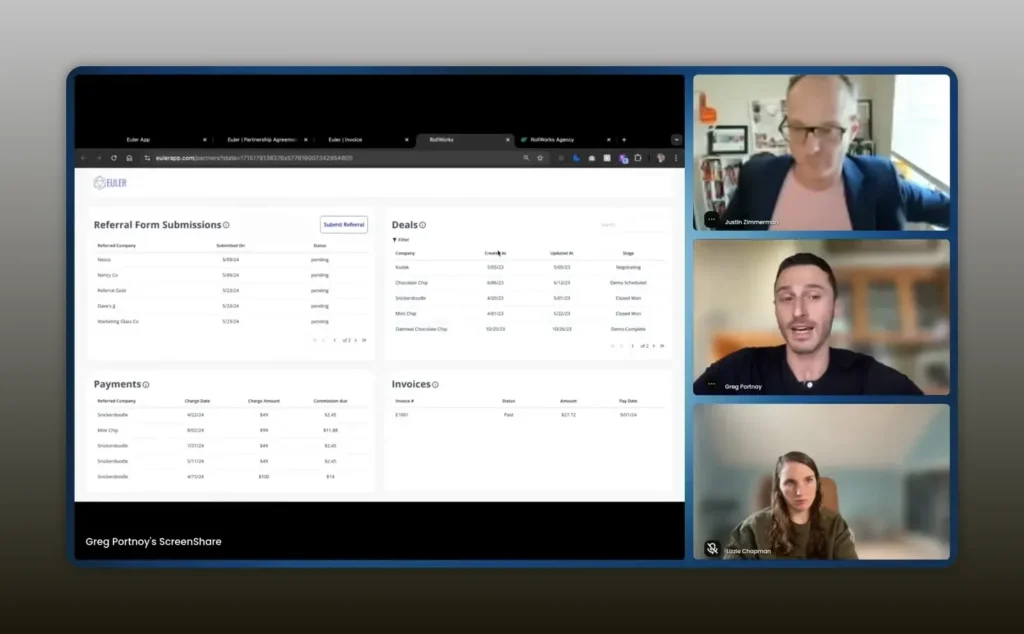
Proper attribution — via tracking links and CRM audits — converts missed deals into found revenue. – Greg Portnoy
6. Partner engagement without forcing portal logins
The stats are clear: most partners will not log into a portal regularly. Euler PRM assumes that and pushes updates via email, Slack, and Microsoft Teams, and even offers a Chrome extension to register deals where partners work. Meeting partners in their workflow increases engagement and keeps you top of mind.
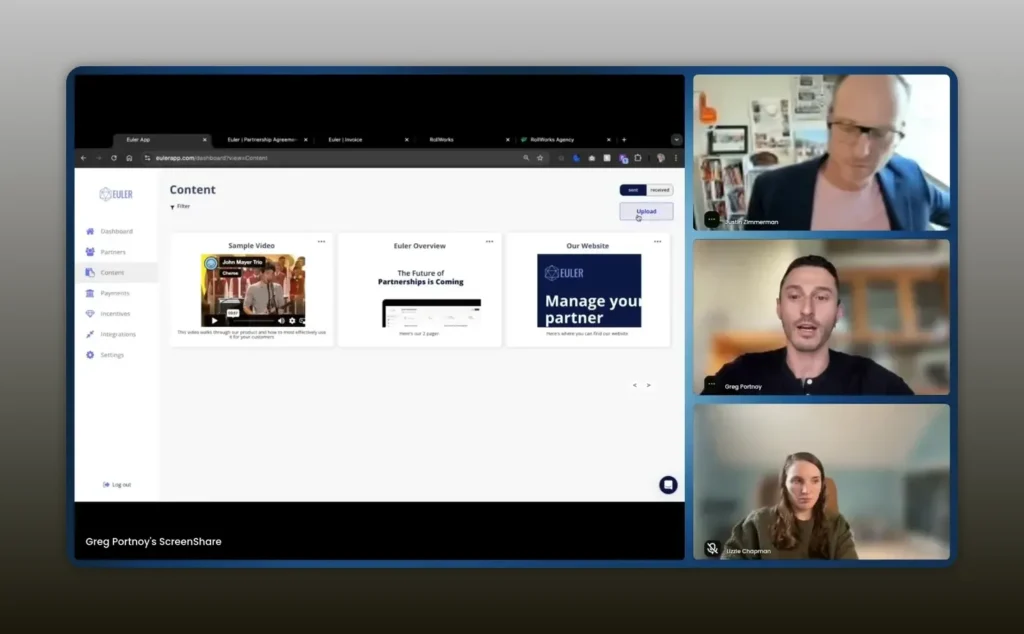
If you meet partners where they work, you don’t need to force them into a portal. – Greg Portnoy
7. Reporting and analytics as a home screen
Instead of making partners or your team dig through CRM filters, Euler PRM starts with an analytics dashboard. You can see referrals submitted, deals closed, which partners are active, and commission liabilities. That baseline reporting makes program management and budget conversations far easier.
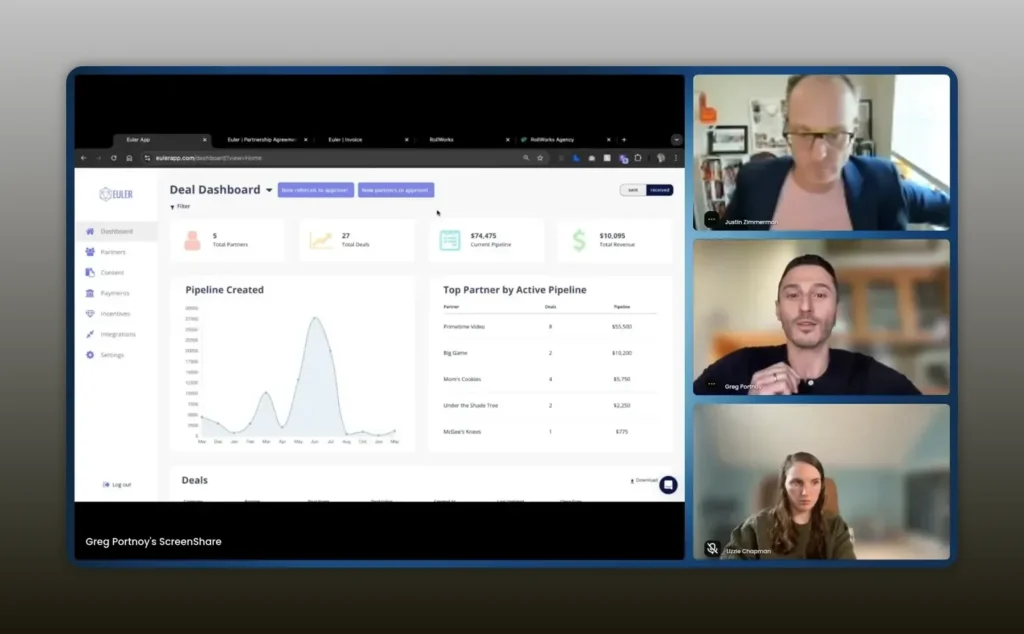
Weekly deal updates stopped reconciliation surprises and helped us capture missed attribution. – Greg Portnoy
Onboarding, contracting, and eSign flows
Onboarding should be frictionless. Euler PRM lets you:
- Publish a partner application embedded on your partner listing or website.
- Qualify applications from a dashboard and accept in one click.
- Send agreements with dynamic fields and saved signatures via built-in eSign.
- Automatically create partner records in your CRM and invite partner users to their portal.
That one-click flow means partners are ready to send referrals on Day 0 rather than weeks later. It also centralizes contracts so legal and finance don’t have to chase paperwork across multiple tools.
Attribution and found revenue
Attribution is a daily operational problem disguised as a data problem. The reason? Deals enter the CRM through many paths: partner referrals, inbound website leads, demos, or sales prospecting. If attribution depends on a salesperson tagging a partner or remembering to select a checkbox, you will lose deals.
Euler PRM approaches attribution three ways:
- Direct capture: partners submit referrals via forms and get automatic credit.
- Tracking links: affiliate links track sources for marketing and co-marketing channels.
- CRM sync and partner audit: deals created or updated in the CRM that match partner criteria get pulled into Euler PRM and shown to partners for weekly verification.
That third method is the secret sauce for many teams. Partners receive weekly deal digests showing new and updated opportunities. When they see un-attributed deals, they flag them immediately. That reduces late-stage attribution disputes and creates found revenue — deals you would not have claimed otherwise.
Partner engagement without portals
Portal logins are a losing bet for most programs. Instead of expecting regular visits, push the right content to partners. Euler PRM’s engagement model includes:
- Targeted content distribution by partner segment.
- Automated notifications for referrals, deal stage changes, and payments.
- Tracking to see who views enablement assets and which pieces drive action.
You can still host a clean single-page portal for high-value partners, but the day-to-day pointer to action will most often be the email, Slack message, or browser extension that surfaces the task where the partner already works.
Payments, reconciliation, and finance
One pain point that kills partner relationships is slow or opaque payments. Finance teams also dislike manual reconciliation in spreadsheets. Euler PRM bridges operations with finance:
- Define commission structures per partner, program, or deal type.
- Integrate to billing systems to determine customer payments and trigger commission calculations.
- Generate itemized partner invoices and reconcile payouts.
- Keep partners informed with itemized statements showing exactly how their commission was calculated.
The result is happier partners, fewer support escalations, and clean audit trails for finance.
Implementation tips from practitioners
Lizzie and Greg shared pragmatic advice based on real rollouts.
- Start with the smallest pain point that unlocks revenue. For NextRoll it was referrals and payouts. Solve that first.
- Pick a design partner model. If your vendor will build with you, you get features you actually need and a faster time to value.
- Integrate your CRM first. The CRM sync is the backbone and prevents duplicate data entry.
- Segment partners from Day 1. Not every partner needs the same content or commission model.
- Automate partner updates. Weekly digests reduce reconciliation friction and surface attribution gaps earlier.
- Measure found revenue. Report the deals that were captured only after implementing partner workflows — that’s the budget justification metric.
Tools and tech stack
A recommended stack based on NextRoll’s experience:
- CrossBeam / Reveal — for partner discovery and account overlap.
- PartnerFleet — for partner listings and front-facing program pages.
- Euler PRM — for referrals, onboarding, attribution, payments, and reporting.
- CRM — Salesforce or HubSpot for core customer records and opportunities.
- Billing/Finance — your ERP or billing system integrated for payout reconciliation.
The goal is not tool envy. It is a connected ecosystem where each piece solves a distinct problem and syncs data instead of creating silos.
FAQs
How does Euler PRM integrate with my CRM?
Euler PRM offers truly bidirectional CRM integrations with Salesforce, HubSpot, and PipeDrive. It maps into any object or field you use so that actions in the CRM flow into Euler PRM and approvals or referrals in Euler PRM create or update accounts, contacts, and opportunities in the CRM. That eliminates duplicate entry and preserves attribution.
Can partners submit referrals without logging in?
Yes. Euler PRM supports embeddable forms and browser extensions so partners can submit referrals or register deals without portal logins. This reduces friction and increases submission rates.
How does Euler PRM handle complex commission models?
Euler PRM models variable commission structures: different rates by product line, by revenue type (SaaS vs media), by partner tier, or by campaign. It can integrate with billing systems to reconcile how much the customer paid and then calculate what the partner is owed.
Will partners actually use the portal?
Most partners will not consistently log into a portal. Euler PRM is built with that reality in mind: it pushes notifications via email, Slack, and Teams and provides a Chrome extension so partners can act where they work. The portal still exists for deep interactions and asset management.
How long does it take to implement Euler PRM?
Implementation time depends on scope. For basic referral capture and CRM sync, teams often see value in weeks. Larger rollouts that include payments reconciliation and billing integration take longer. Being a design partner can accelerate timelines since you actively shape the product during setup.
Can Euler PRM surface found revenue for budget justification?
Absolutely. One of Euler PRM’s strengths is reporting that surfaces deals captured through partner workflows that were previously un-attributed. Those found revenue numbers are excellent evidence when you ask for budget for more partner headcount or marketing dollars.
What ongoing operations do partnerships need after Euler PRM?
You still need partner management: segmenting partners, creating campaigns, tracking engagement, and nurturing top partners. Euler PRM reduces operational friction but does not replace the strategic work of partner leadership.
Is Euler PRM suitable for channel-heavy businesses?
Yes. Channel- and agency-heavy businesses benefit greatly because Euler PRM handles partner onboarding, referral capture, attribution, and payouts at scale. It was designed to support programs that have mixed revenue types, such as SaaS plus media, common in ad tech and martech businesses.
Conclusion
Partnerships can be your most reliable, cost-effective growth engine if you treat them like a core go-to-market motion. The difference between leaving revenue on the table and scaling a predictable partner channel comes down to systems, not charm. Start by freeing referrals from spreadsheets, connecting your CRM bidirectionally, and adopting a partner operating system that automates attribution, payments, and partner communications. Work with your vendor as a design partner, focus on quick wins that show found revenue, and use those wins to fund broader program investment. When you do the hard work of operationalizing partnerships, the upside is faster growth, happier partners, and a repeatable channel your company can scale.
Social post
Announcing a new playbook for partner managers / channel sales leaders / partner ops leads…
Introducing How Euler PRM transforms partner programs: Lessons from NextRoll and Rollworks!
Inside it you will find a strategic view of why partnerships deserve better systems, practical steps to end spreadsheet chaos, and an operational blueprint you can implement with the tools described.
- Why spreadsheets cause missed referrals and angry partners
- A checklist to build a partner tech stack that scales
- How to use CRM sync to stop attribution leakage
- Implementation playbook for onboarding, eSign, and contract flows
- How to reconcile payments and keep finance happy
- Engagement tactics that meet partners where they work
- Metrics to measure found revenue and justify budget
Get this playbooks if you are a partner manager, channel leader, or ops lead and want to learn what Lizzie and Greg do, so you can achieve lower CAC, better attribution, and happier partners. It is free, no form-fill required, no optin required.
Design the system, not the workaround. – Greg Portnoy