Unlock an Open Platform Strategy and Crowdsource 800+ Integrations
Expert advice from Cody Sunkel (Head of Growth, PartnerFleet).
Snapshot
You have two choices: build integrations one at a time, concede ground to competitors, or make the leap to an open platform and grow exponentially. The stakes are high — this is not a product roadmap trade-off so much as a go‑to‑market inflection point. Companies that ignore ecosystems risk being outmaneuvered by platform‑native competitors who leverage partner networks to deliver broader use‑case coverage, faster time‑to‑value for customers, and stronger retention.
Conversely, organizations that invest in an open platform create a durable moat: developer momentum that continually expands capabilities, partner‑led distribution that amplifies reach without proportional headcount increases, and a marketplace effect where each new integration increases the platform’s attractiveness to both buyers and builders.
Done well, ecosystems turn integrations from a linear cost center into a self‑reinforcing growth engine — unlocking co‑selling, co‑marketing, and new revenue streams. This article will talk you through how to make deliberate investment in APIs, developer enablement, governance, and the tooling to onboard and support third‑party contributors.
Opening a platform should not be a multimillion dollar bet—there is a repeatable, scalable way to get there. -Cody Sunkel
Table of Contents
- Why integrations are now a strategic growth lever
- A case study: how one $2B observability company scaled to 800+ integrations
- The three strategic choices for integrations
- What it really takes to open a platform
- Why the developer portal is the missing link
- Designing a developer workflow with pipelines
- Developer enablement: resources, SDKs, and sandboxes
- Automations and low-touch programs that scale
- Multi-step app review and approval as a control point
- Recruiting developers and creating an inbound flywheel
- Metrics that matter for ecosystem success
- Implementation checklist for launching fast
- Common pitfalls and how to avoid them
- FAQs
- Conclusion
Why integrations are now a strategic growth lever
Integrations are no longer just technical conveniences. They are a primary factor in purchase decisions, retention, and expansion. Buyers frequently list integration availability as a gating factor. Customers demand tools that play well with their stack; if you can’t connect, you don’t get the deal.
Key shifts that make ecosystems strategic:
- Stacks are larger and more heterogeneous than ever.
- Customers prefer platforms that let them keep existing investments.
- Partner-built integrations allow you to cover more use cases faster than internal teams can.
- Marketplaces and ecosystems produce network effects that become defensible advantages.
Cody points out that while giants like HubSpot, Salesforce, and ServiceNow invested millions early, a much larger pool of companies cannot afford that upfront cost. That means there is an enormous opportunity to democratize platform capabilities and enable many more companies to build ecosystems without a multimillion-dollar bet.
A case study: how one $2B observability company scaled to 800+ integrations
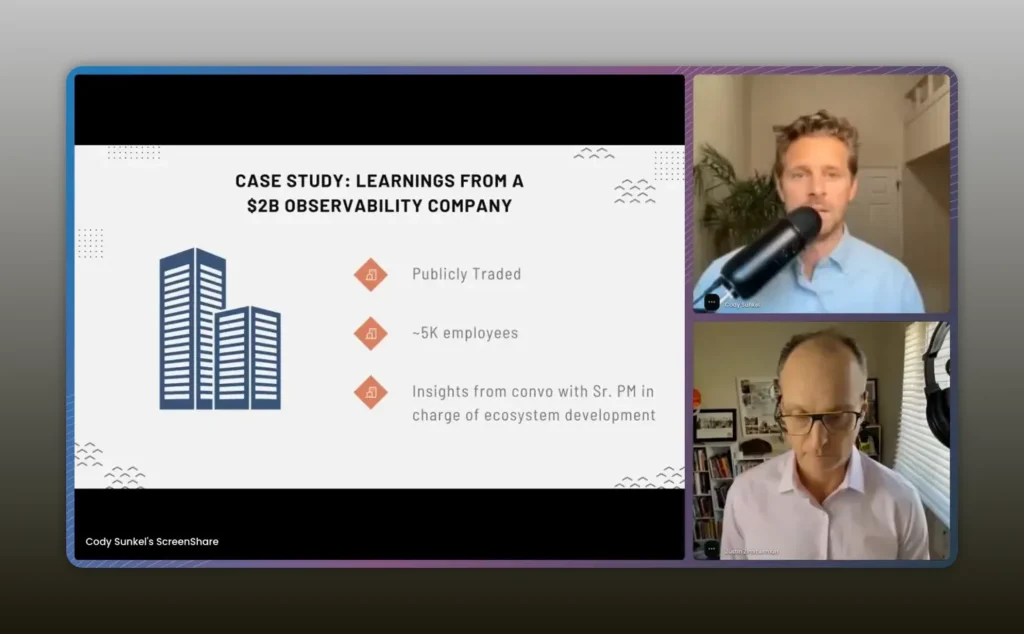
Customers told us what they needed and we started building integrations to win deals and keep customers. Then we realized integrations were actually a growth strategy. -Cody Sunkel
This company began the familiar way: listen to prospects, build the required integrations to close deals, then build more to retain customers. Over time they understood a larger truth: integrations increased product value, broadened use-case coverage, and provided a competitive edge that contributed directly to revenue.
They invested heavily: eight teams of five to ten engineers each plus product management oversight. That translated to millions of dollars annually—back of the napkin estimates put it between seven and thirteen million. The investment bought velocity and control, but only yielded dozens of integrations per year.
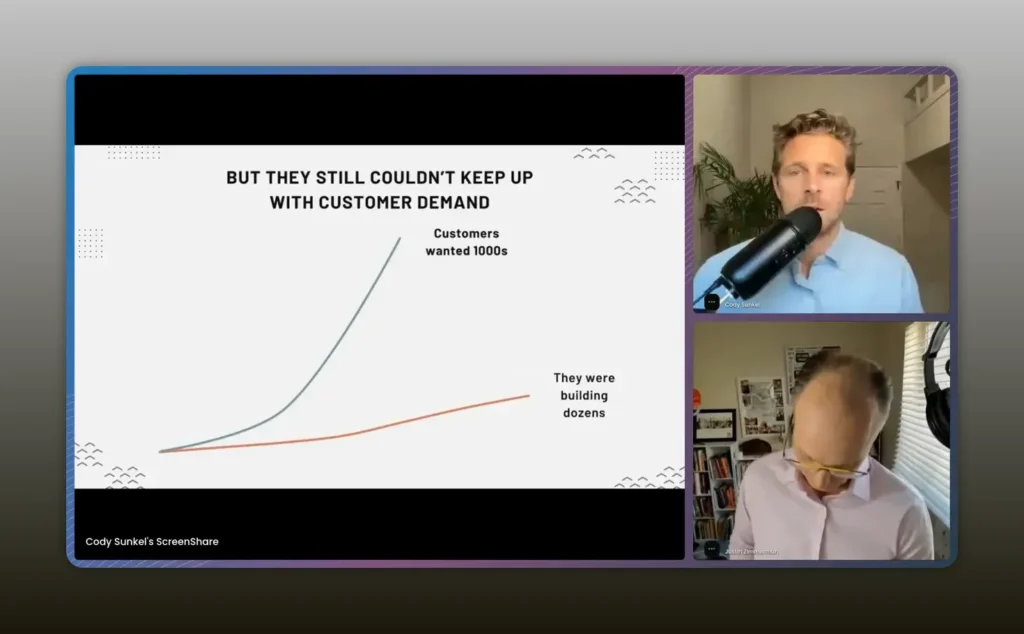
We upgraded our velocity but we were only delivering dozens of integrations while customers wanted thousands. -Cody Sunkel
The result was a mismatch between supply and demand. Customers asked for hundreds or thousands of third-party connections, but an in-house model only produced a few dozen annually. They also encountered:
- Long build times: three to six months per integration with a full team.
- Limited subject-matter expertise about each third-party platform.
- Low adoption for many internal integrations because they didn’t land the use cases precisely.
- Scaling constraints: headcount and cost scaled linearly with integrations delivered.
Faced with options, they made the strategic choice to open their platform and crowdsource integrations from third-party developers. That shift unlocked a path from linear, in-house growth to exponential growth via partner-created inventory. Today they surpassed 800 integrations and continue to climb.
The three strategic choices for integrations
When grappling with integration needs you essentially have three choices. Each choice has clear trade-offs.
1. Stop building integrations
Benefit: immediate cost savings and simplified product roadmap.
Risk: competitors will fill the gap. Bob Moore’s oft-cited example shows how a company that declined to invest in an ecosystem lost billions in exit value compared to a rival that did invest.
2. Continue building integrations in-house
Benefit: predictable work streams, product control, and prioritized roadmap alignment.
Risk: delivery capacity remains limited by headcount and budget. Expect three to six months per integration and a trade-off with core product feature velocity.
3. Open your platform
Benefit: integrations scale faster than your headcount. Third-party developers extend use-case coverage and create network effects that compound value.
Risk: requires upfront investment in APIs, developer enablement, governance, and long-term developer support. If you build poorly, you may burn budget and underdeliver to partners.
Cody and Justin agree that opening the platform is the most generative option when you want exponential outcomes, but it needs a practical, affordable way to get started.
What it really takes to open a platform
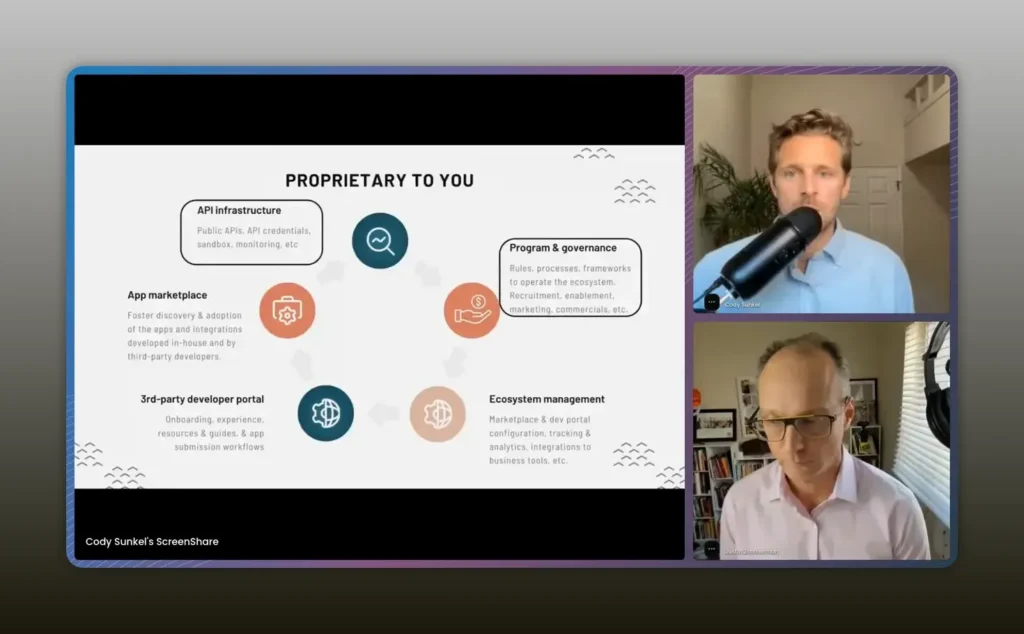
Opening a platform is not just making APIs public. It is building infrastructure across five domains: APIs, developer enablement, program governance, ecosystem management and marketplace. -Cody Sunkel
There is a common misperception that a platform equals public APIs and documentation. Reality is more nuanced. To open a platform you need to coordinate five capabilities:
- API infrastructure — credentials, rate limits, sandboxes, monitoring, API gateways.
- Developer enablement — docs, SDKs, example apps, guides, code samples, and a sandbox environment.
- Program and governance — program rules, partner tiers, onboarding flows, legal terms, and commercial models.
- Ecosystem management — back-office tooling to manage partners, apps, listings, and approvals.
- App marketplace — a public storefront embedded on your site and inside your app, with listing pages, installs, and purchases.
Two parts are inherently proprietary: the API infrastructure and the program/governance decisions. How you monetize, which program rules you create, and which partners you prioritize are strategic choices. The other three elements are operational and can be enabled with the right tooling.
Why the developer portal is the missing link
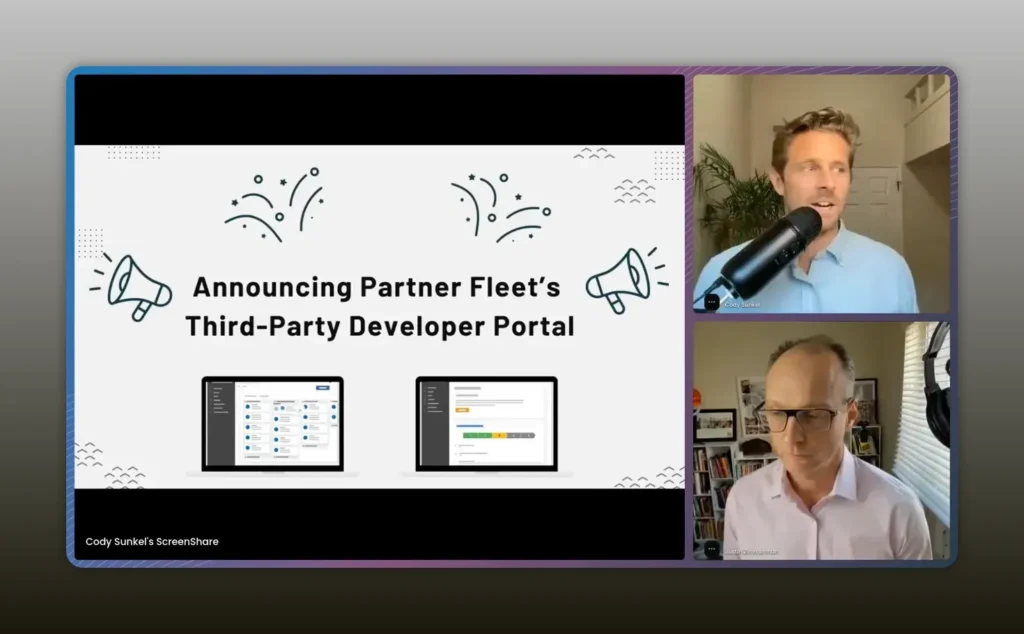
Without a purposeful developer portal you have no way to convert interest into production-ready apps that populate your marketplace. -Cody Sunkel
Many organizations build marketplaces before they create a developer experience to feed it. That leads to a populated platform in name only. The marketplace sits empty because there is no developer onboarding, clear requirements, or a frictionless submission process.
The developer portal is the bridge between your API infrastructure and your marketplace listings. It must perform three functions:
- Onboard and provision developer accounts quickly.
- Consolidate all resources and documentation into a single, discoverable hub.
- Surface a clear, actionable workflow that takes a developer from idea to an approved listing.
Without those elements, throughput stalls. Developers get stuck, partner managers drown in manual requests, and your marketplace never reaches the critical mass required to drive an inbound flywheel.
Designing a developer workflow with pipelines
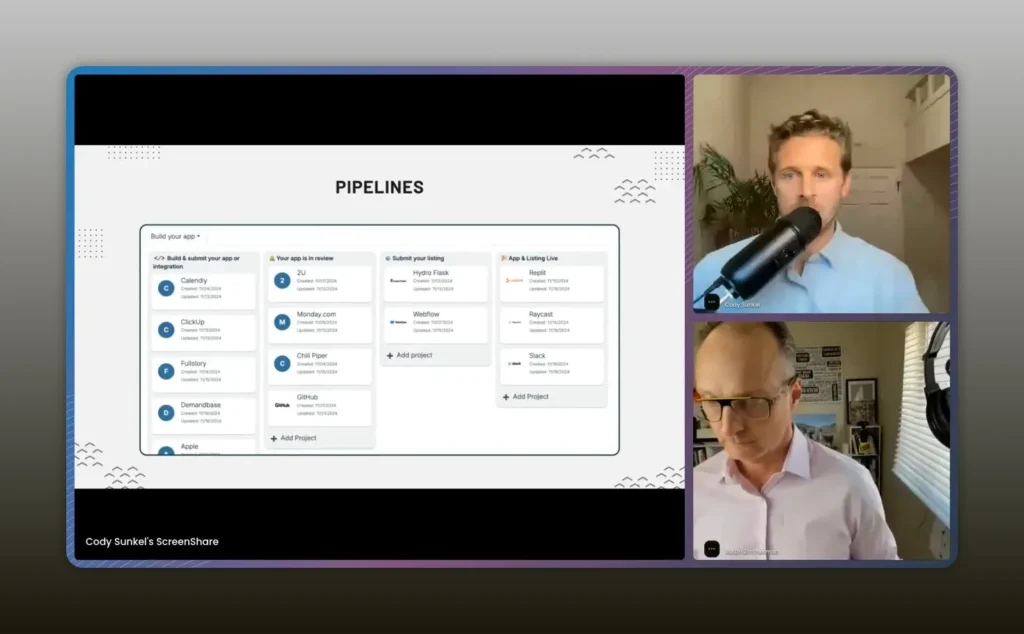
Set up stage-based pipelines so developers know what is required, and you get visibility into where projects stall. -Cody Sunkel
Make the developer journey explicit. Map out stages such as:
- Interest registered
- Developer account provisioned
- Sandbox access granted
- Build in progress
- App submission
- Technical review
- Security review
- Legal review
- Listing published
Implement pipelines that let you create stage gates, show required action items at each stage, and let developers self-serve as much of the journey as possible. Pipelines provide two big advantages:
- Clarity for developers — they see what is next and what deliverables are expected.
- Visibility for program managers — you can measure throughput and identify bottlenecks across your entire developer funnel.
Developer enablement: resources, SDKs, and sandboxes
Centralize your developer resources. Scattered documentation creates friction and repeated support requests. A unified developer hub should include:
- API reference linked to code examples
- Quickstart guides and tutorials
- SDKs for common languages
- Sample apps and pattern libraries
- Sandbox environments with test data
- FAQ and troubleshooting guides
Make resources discoverable and keep them up to date. Embed or link docs directly in your portal and organize them by topic and maturity. That reduces back-and-forth with developers and increases the chance their app will reach production and be adopted.
Automations and low-touch programs that scale
High-touch partner programs consume scarce partner management bandwidth. The answer is to automate routine communications, nudges, and handoffs so that your team focuses on high-value work.
Examples of automations that scale:
- Time-delayed email nudges when projects stall (for example, more than 30 days in app submission).
- Webhook triggers to notify Slack channels or ticketing systems when a review step completes.
- Automated provisioning of sandbox credentials after account verification.
- Auto-generation of marketplace drafts once an app clears technical review.
These automations allow you to support the long tail of developers and partners without hiring a large team. Self-serve flows convert interest into active integrations while partner managers intervene only where value-added touch is needed.
Multi-step app review and approval as a control point
A marketplace still requires controls. A consistent, auditable app review process ensures quality, security, and legal compliance. Adopt a multi-step review that routes submissions sequentially:
- Initial technical review for API alignment and functional correctness.
- Security review including authentication, data handling, and vulnerability checks.
- Legal review for terms, privacy implications, and compliance.
- Marketing review for listing quality: descriptions, screenshots, and proper categorization.
When each step is tracked in your portal, approvals move automatically to the next reviewer, and you maintain a clear audit trail. That eliminates ad hoc email chains and escape hatches that slow launches.
Recruiting developers and creating an inbound flywheel
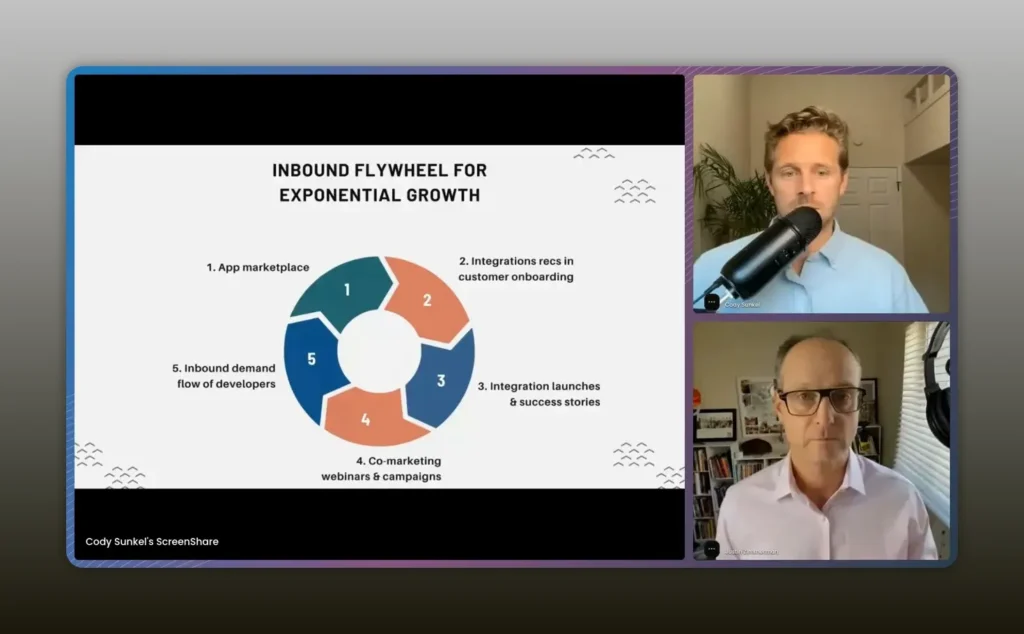
Publish apps, enable customer-facing teams, and run co-marketing so developer interest becomes self-sustaining. -Cody Sunkel
Recruitment has two phases: proactive outreach and inbound attraction. Here are practical tactics:
Proactive recruitment
- Create a visible developer section on your website.
- Run targeted campaigns announcing API launches, incentives, and bounties.
- Reach into competitor marketplaces to find already-integrated partners and invite them to build on your platform. Justin suggests direct outreach to companies already integrated with your competitors—if they serve similar customers they may be open to expanding.
- Run developer-focused webinars and hackathons to spark interest.
Inbound flywheel
Once you have apps published, you can leverage them to attract more developers and customers:
- Customer-facing teams recommend marketplace apps during onboarding and support calls.
- Co-marketing launches, case studies, and success stories amplify impact.
- Marketplace visibility signals investment and stability, which increases developer confidence that their effort will pay off.
Metrics that matter for ecosystem success
Measure both supply- and demand-side metrics. Important KPIs include:
- Number of listed integrations and active integrations.
- Time to first production install after app submission.
- Developer conversion rates at each pipeline stage.
- Marketplace installs, purchases, and revenue share performance.
- Average time to resolve app review blockers.
- Customer satisfaction and churn delta for customers using integrations versus those who do not.
Use pipeline visibility to spot where projects bottleneck. If many developers stall at the sandbox stage, your sandbox or docs may need improvement. If apps fail security review frequently, consider providing security patterns or a preflight checklist.
Implementation checklist for launching fast
Here is a practical sequence to move from zero to a functioning open platform without a multimillion-dollar bet.
- Audit your APIs and identify high-value endpoints for partners.
- Set up a sandbox and developer credentials system with basic monitoring.
- Create a minimal developer hub that consolidates docs, SDKs, and quickstarts.
- Build a simple pipeline for developer onboarding and app submission.
- Implement basic automations: account provisioning, nudges for stalled projects, and review routing.
- Stand up a lightweight marketplace or listing page where approved apps can live.
- Define program rules and basic governance (pricing, partner tiers, SLAs for developer support).
- Run a recruitment pilot: invite 10–20 partners to validate the flow end to end.
- Measure the pilot: conversion rates, time to publish, and initial adoption.
- Iterate and expand the program, adding deeper automation, API gateways, and advanced tooling as you scale.
Common pitfalls and how to avoid them
Many programs stall for avoidable reasons. Watch for:
- Underinvesting in developer enablement — fragmented docs and lack of examples kill momentum.
- Over-centralizing integrations — assuming your internal team can deliver everything slows speed to market.
- Neglecting review automation — ad hoc approvals create delays and confusion.
- Forgetting to market the marketplace — a great app store buried on your site does not attract developers or customers.
Address these by committing a minimal viable set of developer tools, automations, and marketplace primitives—and iterate from there.
FAQs
How much does it cost to open a platform?
Cost varies by depth and ambition. Building a comprehensive platform in-house can run into millions of dollars per year in headcount and infrastructure. However, you can get a functional, scalable platform off the ground at a fraction of that by using marketplace and developer portal tooling, automations, and a phased implementation approach. The goal is to avoid a single large upfront bet and instead invest iteratively.
What should be my first priority when starting an ecosystem?
Prioritize the developer experience and a minimal set of API endpoints that unlock the most partner value. Provide a sandbox, clear quickstarts, and a submission workflow so partners can start building. Without this, a marketplace will remain empty.
How do I attract developers if I have a small customer base?
Start by recruiting partners who already integrate with competitors; they already have the expertise and customer overlap. Offer incentives or co-marketing to lower their friction for joining your platform. Over time, as you publish success stories, inbound interest will grow.
How do I manage app security and legal risk?
Implement multi-step reviews that incorporate technical and security checks. Create clear policies and a legal review stage for privacy and terms. Provide guidelines and checklists to partners so they can self-assess before submission and reduce back-and-forth during reviews.
What metrics should I track first?
Start with developer funnel metrics: conversion at each pipeline stage, time to publish, and the percentage of published apps that receive at least one install. Track marketplace installs and revenue after you have inventory. Use these metrics to find bottlenecks and optimize developer throughput.
Conclusion
Opening your platform is the most powerful lever for turning integrations from a cost center into a growth engine. You can choose to stay conservative and accept slow, linear growth, or you can create the conditions that let third-party developers multiply your product’s reach. The pragmatic path is to build incrementally: prioritize developer enablement, create clear pipelines, automate the mundane, and implement measured governance.
Cody experience shows that the path to 800+ integrations is achievable when you remove friction upstream. With the right developer portal, marketplace tooling, and recruitment playbook, you can democratize ecosystem building and unlock exponential outcomes without an unconscionable upfront investment.