How Platforms Win: Embracing the Exploding Long Tail of Apps
Expert advice from Scott Brinker (VP Ecosystems, HubSpot).
Snapshot
Integrations have become the new currency as AI races faster than organizations can reorganize to take advantage of it. That gap is the defining strategic challenge of this decade and the biggest opportunity for any company that acts with intention. I
It’s not just about integrating an app or two — it’s about rethinking operating models, talent, and incentives so your organization can stitch together capabilities across many vendors, partners, and internal teams. The winners will be the teams that treat integration, composability, and partner-led innovation as core product priorities rather than optional add-ons.
Going forward, it’s all about investing in APIs, data models, observability, security, and partner enablement, so you can turn technological velocity into repeatable business outcomes.
If you can treat this AI explosion as a tailwind instead of a threat — and capture trust through marketplaces, embedded experiences, and clear governance — you will capture disproportionate value and turn a chaotic landscape into a durable competitive advantage. Keep reading to learn more.
Integration is the opportunity — enable these technologies to work together and customers win. -Scott Brinker
Table of Contents
- Why the MarTech landscape keeps exploding
- The long tail explained
- Why integration has become the currency
- AI and the acceleration of niche apps
- How platforms should respond
- Practical steps for app and integration partners
- HubSpot’s ecosystem approach and lessons
- The blue curve vs the yellow curve: managing change
- Common integration models and trade-offs
- Checklist for platform and partner readiness
- FAQs
- Conclusion
Why the MarTech landscape keeps exploding
Over roughly a decade, the number of marketing technology products ballooned from hundreds to tens of thousands. Scott tracked that growth and observed compound annual growth rates in the 40 percent range for market entrants. In one recent snapshot the landscape topped 14,000 MarTech products, and directories that track broader software ecosystems account for many times more.
Why does this keep happening? Three structural forces are at play:
- Extremely low barriers to software creation — Building an app today is cheap. Cloud infrastructure, APIs, no-code tools, and pre-trained AI models let small teams or even individual consultants ship a product and reach customers quickly.
- Niching economics — Many solutions target very specific verticals, use cases, or regions. Being number one in a small pocket is a viable business. That explains why regional leaders exist instead of a single global monopolist in every category.
- Services-to-product paths — Agencies, consultancies, and services firms increasingly productize parts of their expertise. Those products may primarily serve the firm’s clients, yet they also become commercial offerings in an ecosystem.
All of these dynamics mean the inflow of new products rarely fully counterbalances consolidation. You will see M&A and company attrition, but new entrants continue to flood the market, especially as AI reduces development costs and shortens time to market.

Showing the full landscape is not meant to frighten, it is meant to change how you think about resourcing and operations. -Scott Brinker
The long tail explained
When you sort companies by size or adoption, you get a classic long-tail distribution: a small head of big, dominant platforms; a torso of mid-size, category-leading vendors; and a vast tail of thousands of niche players.
The tail is not homogeneous. You will find several distinct classes of tail companies:
- Ambitious startups aiming to climb the tail and become torso or head players.
- Vertical specialists with deep domain knowledge for categories like healthcare clinics, local retail, or niche e-commerce platforms in specific countries.
- Platform-focused builders that target a major ecosystem to reach customers inside that platform.
- Service-first productizers where software is a vector to win and retain consulting accounts rather than the primary revenue engine.
- Hobby projects and utilities that solve a genuine small problem and gain a steady but limited user base.
Each has different incentives for integrating, pricing, and go-to-market strategy. Your response as a platform or partner should account for that heterogeneity instead of treating the long tail as a single target.
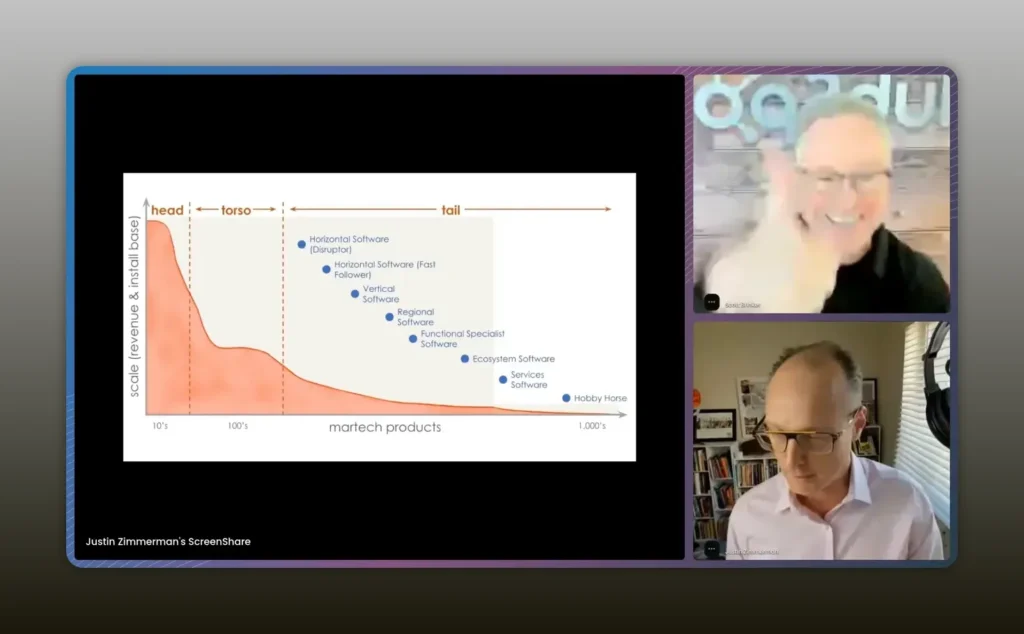
Many products in the tail are self-funded and delight customers precisely because they solve a narrow but acute problem. -Scott Brinker
Why integration has become the currency
Customers don’t want to be product managers of their tech stack. The most common refrain is that teams want the best tools for each job, but they want those tools to work together seamlessly. Integration reduces friction and unlocks composite use cases that single products cannot deliver alone.
Two perspectives clarify why integration matters:
- Operational cost — Each disconnected tool forces manual work, data reconciliation, and error handling. Those costs multiply with scale.
- Value creation — When tools share a coherent data model and workflow, you can automate sequences, create richer analytics, and deliver personalized experiences that drive measurable business outcomes.
For partnerships teams, that creates twin opportunities. On the product side, invest in robust, reliable integration points and well-documented APIs. On the go-to-market side, create co-sell, co-marketing, and discoverability programs that make it easy for customers to find and adopt integrated solutions.
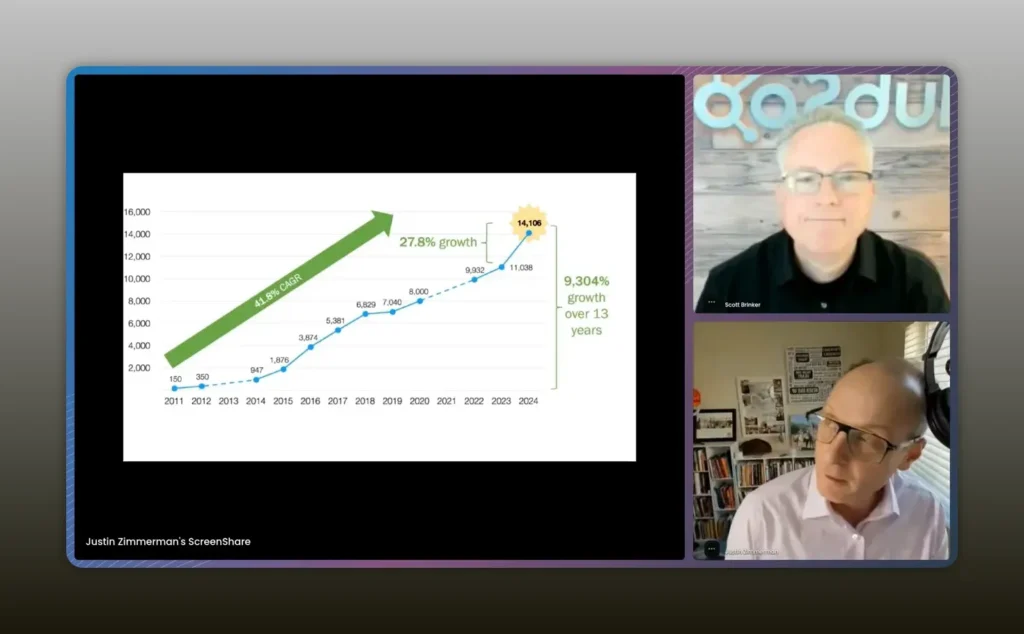
Roughly a 40–42% compound annual growth rate in new integration — that kind of CAGR fuels the long‑tail explosion. -Scott Brinker
AI and the acceleration of niche apps
AI is the accelerator that lit a new burst of long-tail creation. Pre-trained models, fine-tuning, and AI agents reduce the engineering effort to create specialized capabilities. As Scott pointed out, AI is now present in the head, the torso, and everywhere in the tail.
What does that mean for you?
- Speed of innovation — Features that once took months to build can be delivered in weeks, which dramatically shortens product cycles and increases the number of viable product launches.
- Customizability becomes pervasive — AI enables faster tailoring of features to vertical or customer-specific needs, increasing the viability of very narrow solutions.
- Composability increases — AI components are often modular and exposed via APIs, making it easier to stitch AI-powered experiences across multiple systems.
Expect to see many more micro-solutions built around AI capabilities — automated copywriting for dental clinics, predictive appointment systems for local services, intelligent product description generators for regional e-commerce platforms, and more. Each of those has little total addressable market in isolation but can be very valuable to the customers who need them most.
AI is everywhere. It accelerates the explosion of long-tail products and increases the need for intelligent integration. -Scott Brinker
How platforms should respond
Platforms that treat the long tail as a threat will spend resources trying to replicate every new niche feature and lose. Platforms that treat the long tail as a tailwind win. Here are the strategic mindsets that create advantage.
1. Be the connective tissue
Offer robust integration infrastructure. Make it easy to connect third-party products with clear authentication flows, event hooks, webhooks, embedded UIs, and standardized data models. Reduce the cognitive load for both developers and customers.
2. Prioritize discoverability and governance
Give customers a reliable way to find and trust third-party apps. Provide clear listings, reviews, security audits, and standardized metadata that surfaces which integrations are best for specific verticals or use cases.
3. Build partnership-friendly go-to-market mechanisms
Create simple commercial programs that allow partners to earn, co-sell, and support integrated solutions. Offer technical resources, co-marketing funds, and easy paths to joint case studies so partners can scale their efforts.
4. Lean into composability and extension points
Provide extension points that allow partners to customize experiences inside the platform rather than forcing them to bolt on separate UIs. When partners can deliver solutions that feel native, customers adopt faster.
5. Be selective and strategic
Scott makes a practical point: you cannot do everything. Choose which classes of integrations and partner programs to prioritize based on customer demand and the platform’s strategic strengths. Being intentional beats trying to be everything to everyone.
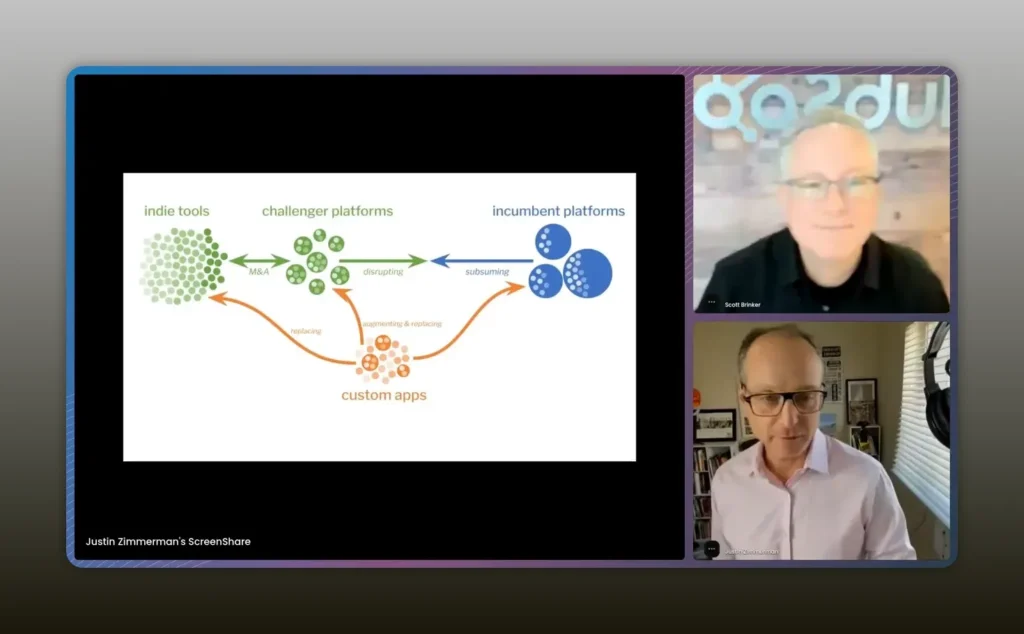
Instead of fighting innovation, embrace it; treat the ecosystem as a tailwind. -Scott Brinker
Practical steps for app and integration partners
Whether you are building an app that plugs into a platform or you run partnerships at a product, the following steps help you move from idea to healthy integration quickly.
- Start with a tiny, well-defined use case. Solve one urgent problem for a narrow customer segment. Demonstrate measurable impact before expanding your scope.
- Document the integration contract. Define the data exchange, events, and edge cases. Good documentation reduces support costs and accelerates adoption.
- Automate setup and authorization. Reduce the manual steps for customers to install and configure your app. The fewer clicks, the higher the conversion.
- Build observability. Provide logs, health checks, and usage metrics that help both you and customers diagnose issues quickly.
- Provide clear upgrade and migration paths. Customers will want consolidation and migration options. Make it painless and provide tools to help with mapping and data migration.
- Partner commercially. Negotiate co-marketing and lead-sharing arrangements. Collect joint success stories that demonstrate how the integrated solution delivers outcomes.
- Plan for AI responsibly. If your app uses AI, be explicit about data usage, model behavior, and ways customers can customize or opt out. Trust matters.
HubSpot’s ecosystem approach and lessons
HubSpot’s response to the growing MarTech landscape provides a concrete illustration of platform strategy in action. Rather than treating the explosion of specialty apps as a problem, HubSpot leaned into the opportunity to become the foundation where those apps could deliver customer value.
Some lessons you can take from HubSpot’s journey include:
- View ecosystem as a product. Building platform infrastructure, partner experience, and discoverability is itself a product that requires investment and product management.
- Build mutual incentives. Help partners grow by providing marketplace visibility, technical support, and go-to-market programs that align success.
- Accept early-stage humility. Platforms rarely launch with perfect partner programs. HubSpot admitted it was early in its ecosystem journey and progressively expanded technical extensibility and co-sell mechanisms.
- Design for scale. Make it straightforward for dozens or thousands of small partners to publish integrations, while still providing paths for bigger partners to build deeper integrations.
If you are a platform builder, prioritize developer experience and straightforward partner economics. If you are a partner, choose platforms that have both technical openness and a realistic commitment to partner success.
The blue curve vs the yellow curve: managing change
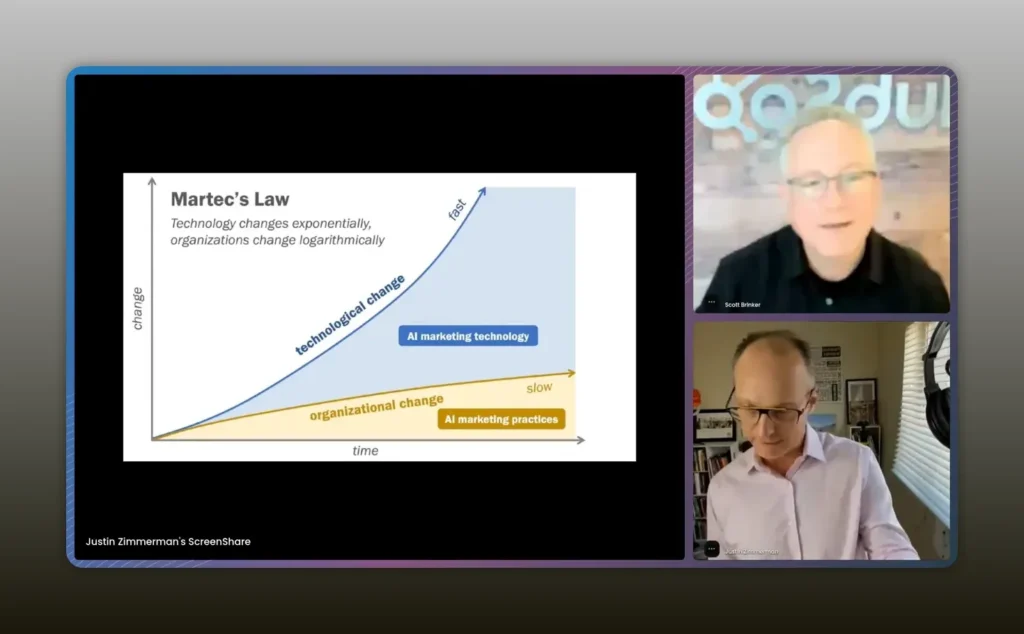
One of the most useful frameworks Scott shared is the tension between the blue technology curve and the yellow organizational change curve. Technology changes exponentially; organizations change logarithmically. That divergence creates the stress you feel in every roadmap meeting and strategic offsite.
Two practical strategies help you bridge the gap.
1. Choose changes intentionally
You cannot chase every innovation. Prioritize changes that will move your business metrics and that align with your core strengths. Be ruthless about which projects get runway and which do not.
2. Become faster than competitors
You may never match the technology curve, and you do not need to. What matters is being faster and more adaptive than your competition. That requires organizational practices like rapid experiments, modular architecture, clear decision rights, and strong feedback loops.
A simple mental model helps: you do not need to outrun the bear; you just need to outrun your competitor in the woods. The point is not to be perfect. The point is to be relatively more agile.
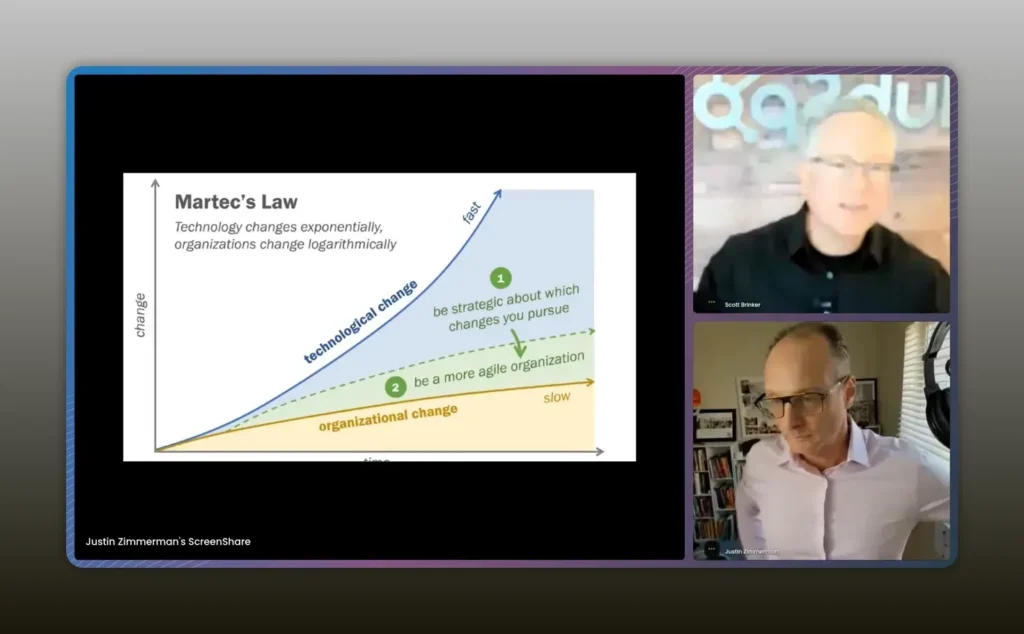
You will never match exponential tech change, but you can be more agile than your competitors. -Scott Brinker
Common integration models and trade-offs
There is no single right integration architecture. Choose the model that fits the problem you are solving and the type of integration you need.
- Shallow integrations (data syncs and webhooks) are quick to implement and perfect for basic workflows. They are easy to maintain and discover, but they limit deep UX integration.
- Embedded integrations (surface partner UI within your platform) provide a native experience and higher adoption but require more control over security and lifecycle management.
- Platform extension (SDKs, apps that run within the platform) allow partners to leverage platform services and deliver seamless workflows but demand higher quality and support standards.
- Composite AI services stitch multiple AI components together to create new capabilities. These accelerate value but increase complexity in data governance and observability.
Each model has trade-offs for time-to-market, ongoing support, security, and the degree of control you retain. Make those trade-offs explicit when you design partner programs.
Checklist for platform and partner readiness
- Technical readiness: Clear APIs, sandbox environments, SDKs, and sample apps.
- Developer experience: Documentation, quickstart guides, example code, and support forums.
- Security and compliance: App vetting, data handling standards, and transparent policies.
- Discoverability: Marketplace listings, metadata, reviews, and curated collections.
- Commercial model: Clear revenue share, referral programs, and co-marketing support.
- Operations: Monitoring, SLA agreements, and joint support processes.
- AI governance: Data usage disclosures, model behavior documentation, and controls for customization.
Make it easy for third parties to plug in. The easier it is, the faster the ecosystem grows. -Scott Brinker
FAQs
Why are there so many small MarTech products instead of a few dominant platforms?
Low development costs, niche market economics, and services firms productizing their IP lead to many specialized solutions. These small products often succeed by solving very targeted problems for specific customer segments or regions that big platforms either overlook or are slow to address.
Will consolidation eventually shrink the number of apps?
Consolidation will continue, but it has not outweighed the steady stream of new entrants. Many long-tail products are self-funded or purpose-built for small markets, so the influx of new apps continues despite mergers and shutdowns.
How should I prioritize which integrations to build?
Start with customer demand and measurable outcomes. Focus on integrations that remove real operational friction or unlock clear value for customers. Use pilots and metrics to validate before scaling.
How does AI change the integration landscape?
AI reduces development time for niche capabilities and encourages modular, composable services. This increases the number of viable integrations and raises the bar on observability, data governance, and trust mechanisms.
What makes a platform attractive to long-tail partners?
Attractiveness comes from a mix of technical openness, a healthy customer base, straightforward partner economics, and effective discoverability channels. Partner enablement and predictable operational support are also critical.
How fast should organizations change to keep up with technology?
You cannot change at the same rate as technology. Instead, prioritize agility and strategic selection. Focus on being faster than competitors in adopting the few changes that matter most to customer outcomes.

The goal is not to control every innovation but to make it easy for innovation to plug into your platform. -Scott Brinker
Conclusion
The future of platforms is not to be the one-stop shop that replicates every niche capability. It is to be the connective tissue that enables this new era of specialization to flourish. If you are building a platform, invest in integration infrastructure, discoverability, and partner economics. If you are building integrations or niche products, pick small, painful problems to solve, make installation effortless, and align commercial incentives with platforms.
AI will continue to accelerate this transformation and create countless specialized solutions. The winners will be those who accept the long tail as a force to harness and who build the systems and relationships that let many small innovations combine into much larger customer value. Make your choices intentionally, move faster than peers, and design for composability. That is how you turn an exploding landscape into a strategic advantage.