How to Find and Build High-Value Partnerships Using AI
Expert advice from Delya Jansen (Founder, PartnerUtopia) and Jason Scott (COO, PartnerUtopia).
Snapshot
Ask around and you’ll hear: Discovering and activating new partners is a grind. Reasons include, weak joint value proposition and internal stakeholders can’t agree on what “value” looks like. Add mismatched resource commitments and weak governance after a partner is engaged, and you have a recipe for slow cycles and stalled initiatives.
The downstream effects are painful: missed revenue opportunities, months of wasted research, duplicated work across sales and marketing, and burned relationships that make future recruiting harder.
Equally damaging is the internal cost—frustrated partner managers, skeptical product and marketing teams, and leadership that asks for proof instead of patience. To help, this article will talk you though a repeatable, evidence-based approach that turns scattered processes into prioritized opportunities, so you can operationalizes those relationships into measurable results.
AI can save months of work and help you identify partnership opportunities that you would have missed on your own. – Jason Scott
Table of Contents
- Why partnerships matter now
- The common partnership discovery problem
- The two-part solution: partner sourcing and partner workspaces
- How partner sourcing works in practice
- Reading and using the partner priority matrix
- Starter kits and initial outreach templates
- Managing partnerships with partner workspaces
- Integrations and reporting that keep you honest
- Pricing, adoption, and democratizing partner work
- KPIs to measure partnership success
- Common pitfalls and how AI helps avoid them
- Case study: launching a new product with partners
- Getting started checklist
- FAQs
- Conclusion
The common partnership discovery problem
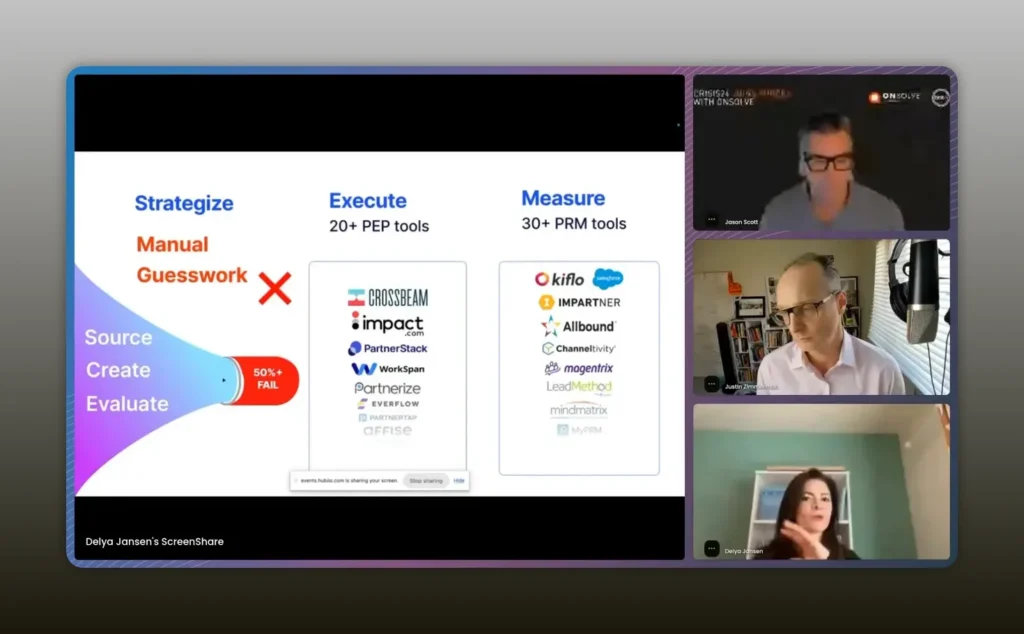
Most teams start sourcing partners with one or two familiar tactics: search marketplaces, scan app ecosystems, and hope that product listings or PRs point to partners worth engaging. That manual approach is slow and incomplete. You often end up with a long list of names but no clear way to prioritize them.
Common symptoms you recognize immediately:
- You spend weeks building a stack-ranked spreadsheet with sparse evidence and gut-feel scores.
- Internal stakeholders disagree about which partner category to pursue because everyone uses a different definition of value.
- Your initial outreach fails because you lack a compelling joint value proposition or the right contact at the partner.
- Once a partner is engaged, you lose momentum due to lack of project governance, resources, or measurable KPI alignment.
These are exactly the gaps that lead to the widely cited failure rates in partnerships.
The two-part solution: partner sourcing and partner workspaces
A pragmatic solution splits the problem into two complementary phases: discovery and execution.
- Partner sourcing gives you a fast, evidence-based list of who to target and why. It reveals quick wins, strategic investments, reactive plays, and future bets, all scored and explained.
- Partner workspaces provide the execution layer: clear playbooks, joint value propositions, content, project tracking, and integrations with the systems where deals and campaigns live.
Applied together, they reduce time-to-first-value and increase the odds that partnerships turn into measurable outcomes.
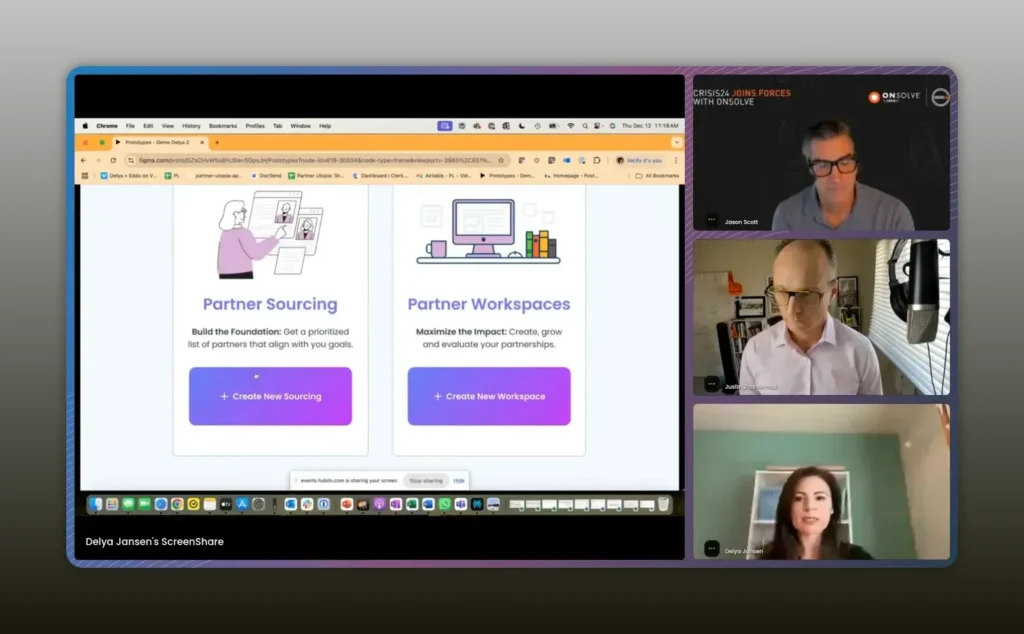
We built a playbook that identified niche players we would not have found for months. It saved us literal months of research. – Jason Scott
How partner sourcing works in practice
Start by asking two questions that matter to outcomes, not labels:
- What does your company need to accomplish with this partnership? Examples: broaden product capabilities, gain distribution, enter a new vertical, or improve customer retention.
- What resources can your team actually invest back into the partnership? Time, marketing budget, engineering capacity, or sales enablement.
Feed these two inputs into an AI-enabled engine trained on a constantly updated knowledge base. The engine does several things:
- Scans current public and private data sources to identify candidate partners and their relevant behaviors.
- Scores each candidate against five parameters, such as partner fit, go-to-market behavior, potential impact, execution effort, and partnering maturity.
- Provides an evidence-backed rationale for each recommendation, including links and supporting documents you can use in internal conversations.
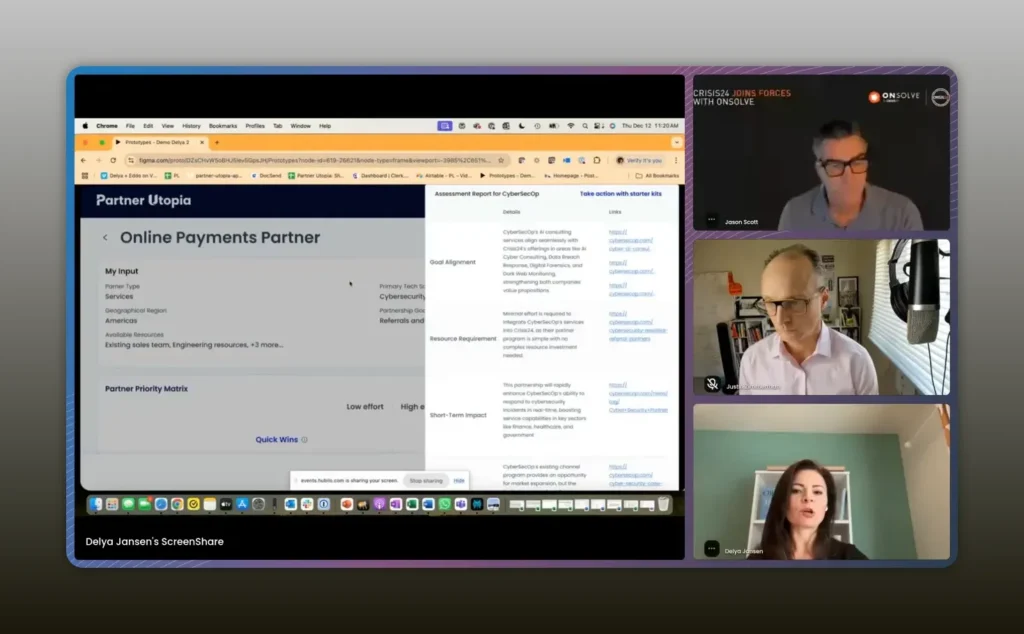
We expose the logic so you see why a partner landed in quick wins versus future bets. – Delya Jansen
Reading and using the partner priority matrix
The single most useful deliverable from a sourcing exercise is the partner priority matrix. It maps potential partners on two axes: impact and effort. From that, you get four actionable quadrants:
- Quick wins: Low effort and high impact. These are the immediate opportunities that tend to surprise teams because they often come from consulting firms or specialized service providers that already have clients you need.
- Strategic growth: High impact but requires investment and nurture. Plan to engage these over 6 to 12 months with a tailored co-selling and co-marketing program.
- Reactive execution: Low to medium impact where partners are doing the minimal work, like listing on a marketplace. These require a proactive strategy if you want results.
- Future bets: Low readiness today but potentially transformative later. Monitor and cultivate selectively.
Use the matrix as an internal alignment tool. It converts opinion into a data-driven plan that you can present to product, marketing, and sales.

Starter kits give you the exact phrasing and approach for that first outreach so you do not waste the opening conversation. – Delya Jansen
Starter kits and initial outreach templates
One thing that kills early progress is a weak first touch. You need a concise, credible reason for the outreach and a clear joint value proposition statement that hooks the partner.
Starter kits should include:
- A tight joint value proposition summary that explains why customers will buy the combined offering.
- Suggested target contacts and the recommended channel for engagement—sometimes that is the CEO for boutique consultancies and sometimes it is the partner program manager for larger platforms.
- A list of collateral suggestions for a first meeting: a one-pager, suggested demo agenda, and KPIs to propose.
The AI engine can draft these items instantly based on the partner profile, saving you the manual back-and-forth that typically takes days or weeks.
Managing partnerships with partner workspaces
Discovery is only half the battle. Once you start conversations you must operationalize the partnership with repeatable processes. That is where partner workspaces shine.
Think of partner workspaces as project management optimized for partnerships. They combine three capabilities:
- Playbooks and rules aligned to the partnership objective. For example, if the objective is brand amplification, enablement and joint marketing tasks are automatically prioritized.
- AI-generated content and assets. Landing page copy, joint playbooks, onboarding templates, and enablement sheets are drafted for you.
- Predictive analytics and integrated reporting. Connect your CRM, marketing automation, and product systems so the workspace shows in-time impact.
Workspaces make it possible to run partner programs without ad hoc spreadsheets. They keep the partnership on track and make it easy to report up to stakeholders.
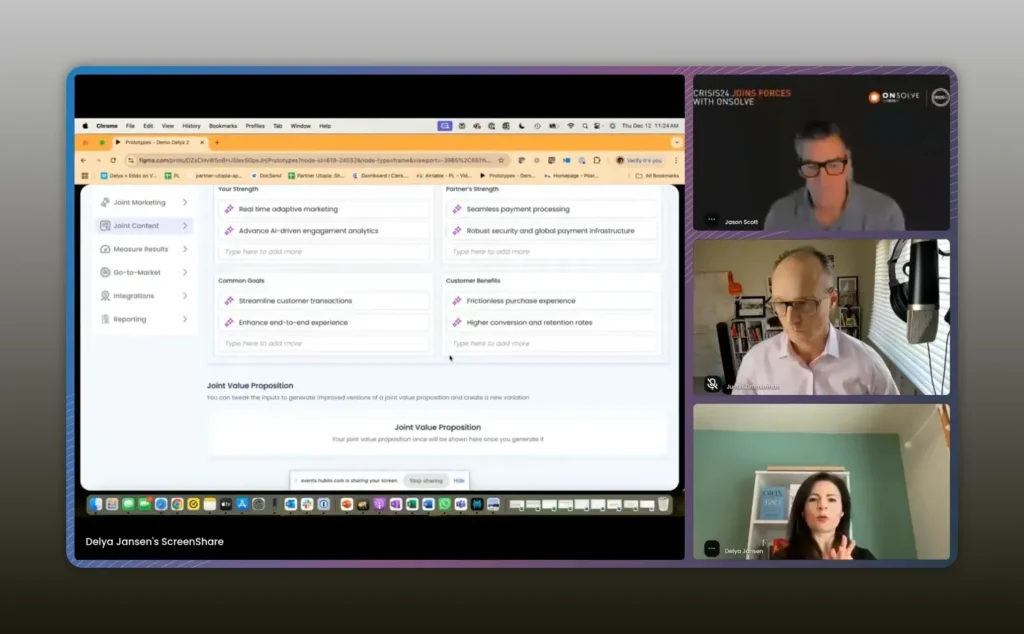
You do not need templates; you need buttons that create the work for you. – Delya Jansen
Integrations and reporting that keep you honest
If you want to prove that partnerships move revenue, you must link partnership activities to the systems where outcomes are recorded. That requires pragmatic integrations:
- CRM for joint deals and pipeline attribution.
- Marketing automation for campaign leads and attribution.
- Issue and product tracking systems for co-developed features and integrations.
With these integrations in place, you can build scheduled executive reports. For example, a weekly CMO report that shows partnership-generated leads and conversion rates. That level of measurement reduces the “Partnerships are nice” conversation and moves it toward “Partnerships deliver X ARR.”
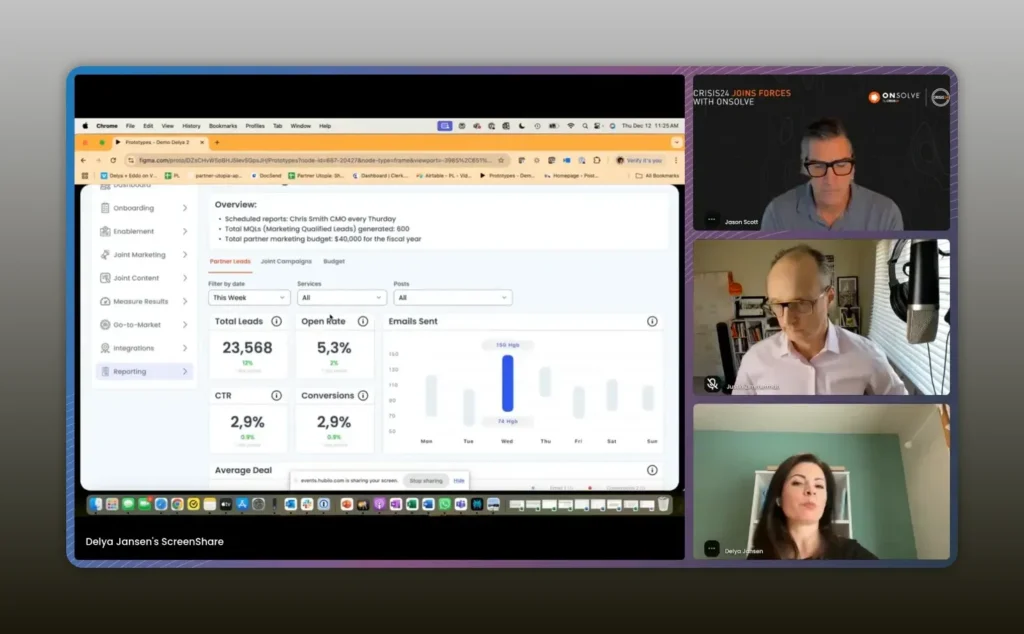
When marketing asks what partnerships are doing for them, you should have the report ready—not three days of data collection. – Delya Jansen
Pricing, adoption, and democratizing partner work
Adoption friction kills modern tools. The easier you make it for partner managers to sign up and become productive, the faster you’ll get internal buy-in. Practical pricing approaches to consider:
- A free tier that provides immediate value to an individual partner manager without requiring partner participation.
- Low-cost tiers for small teams to experiment and build initial proof of value.
- Enterprise tiers with advanced integrations and governance for large programs.
When the tool is accessible to front-line partner managers for as little as the cost of a coffee per month, you remove a major barrier to experimentation. Encourage small teams to pilot the platform on a handful of partnerships and harvest the results to scale internally.
KPIs to measure partnership success
Define KPIs that reflect both near-term traction and long-term strategic value. A balanced KPI set might include:
- Number of partner-sourced qualified leads
- Partner-influenced pipeline value
- Time-to-first-joint-marketing-campaign
- Number of integrations or co-developed features shipped
- Win rate on partner-influenced opportunities
- Partner satisfaction and renewal metrics
Match KPIs to the quadrant of the partner priority matrix. Use quick-win KPIs for low-hanging fruit, and an investment-focused KPI set for strategic growth partners.
Common pitfalls and how AI helps avoid them
Learn the pitfalls so you can design around them:
- Pitfall: Starting with the wrong question. If you start by listing preferred partner types without defining outcomes and resources, you will create noise. AI forces you to state the desired business outcome and your resource constraints first.
- Pitfall: Over-relying on marketplaces. Marketplace listings are passive. They often fall into the reactive execution quadrant and won’t generate pipeline unless you build an active GTM plan.
- Pitfall: Missing follow-through. Discovery without execution is worthless. Partner workspaces create the work items and follow-ups that keep momentum alive.
- Pitfall: Measurement gaps. If partnership work does not connect to CRM and marketing systems, you can’t prove impact. Integrations solve that problem.
AI reduces manual effort and surface-level mistakes by providing evidence, contact intelligence, and ready-to-use outreach assets so you can act quickly and with confidence.
Define the beachhead, then prioritize partners that help you win that beachhead faster. – Jason Scott
Case study: launching a new product with partners
Imagine you just inherited a newly acquired product called Dynamic Risk Library. It provides AI-driven daily intelligence for supply chain and operational risk. Your company does not have a mature go-to-market motion for such a product.
Here is a pragmatic approach that mirrors what worked for one team:
- Clarify the beachhead use case. Example: help large logistics customers improve supply chain resiliency.
- Identify the resources you can commit: marketing budget for co-branded campaigns, one product engineer for integrations, and two sellers to support partner outreach.
- Run partner sourcing to produce a partner priority matrix. Expect a mix of quick wins (regional consultancies), strategic growth (global logistics platforms), reactive execution (cloud marketplaces), and future bets (adjacent intelligence providers).
- Use starter kits to draft a joint value proposition and initial outreach. Target the consultancies first for rapid deployment and case studies.
- Open partner workspaces for each engaged partner. Assign tasks, create onboarding assets, and connect the workspace to CRM and marketing automation.
- Measure: track partner-sourced leads and time-to-first-pilot. Use those wins to create internal momentum and to pursue strategic growth partners next.
This staged approach reduces risk, produces quick evidence, and scales into a broader partner ecosystem.
Getting started checklist
Use this checklist to move from uncertainty to momentum:
- Define the core outcome you need a partner to help achieve.
- Estimate the resources you will dedicate to the partnership.
- Run a partner sourcing exercise to create a prioritized list with evidence and rationale.
- Use starter kits to craft your opening outreach and joint value proposition.
- Open a partner workspace to manage onboarding, enablement, and joint campaigns.
- Integrate the workspace with your CRM and marketing systems to capture outcomes.
- Set KPIs and schedule executive reporting cadence.
- Iterate based on feedback and early results—double down on what works.
FAQs
How do I choose between quick wins and strategic growth partners?
Prioritize based on your short-term goals and runway. If you need proof-of-concept and revenue quickly, prioritize quick wins that require low effort but provide immediate impact. If you have the resources and a multi-quarter plan to reshape the market, invest in strategic growth partners while maintaining a pipeline of quick wins for momentum.
Can I get value from partner sourcing without forcing partners onto a platform?
Yes. Effective sourcing is designed for your internal use. You do not need partners to sign up for you to get the benefit. You use the evidence, starter kits, and contact intelligence to run outreach in the channels your partners prefer.
What data inputs are required to run an effective AI-driven partner discovery?
The most important inputs are the outcome you want to achieve and the resources you can commit. The AI engine will combine those with public and proprietary datasets to identify and prioritize partners. The more precise you are about outcomes and constraints, the higher the signal in the results.
How do you measure a partner’s ‘partnering behavior’?
Partnering behavior is inferred from signals such as whether a company has a published partner program, marketplace listings, historical co-marketing activity, consulting engagements, executive statements about partnerships, and evidence of prior integrations. These signals are scored to indicate how likely a partner is to move from passive to active engagement.
What resources should I commit to ensure partnership success?
At minimum, allocate one dedicated point person, basic marketing budget for co-branded activities, and some product or engineering support for integrations or pilots. For strategic partners, plan to invest in joint enablement, co-selling, and executive alignment over 6 to 12 months.
How do partner workspaces integrate with existing PRM or CRM systems?
Partner workspaces are designed to complement PRMs and CRMs by handling the strategy and execution playbooks. They integrate to push joint deals into CRM, funnel leads into marketing automation, and surface support tickets into product trackers. This ensures that the partnership work is reflected in the systems where outcomes are recorded.
Conclusion
Partnerships are no longer a series of hopeful experiments. With the right framework and tools you can treat partnerships like repeatable, measurable GTM channels. Start by defining the outcome and the resources you can commit. Use AI to quickly find and prioritize partners based on evidence. Then operationalize each relationship with a workspace that provides playbooks, content, and integrated reporting.
The result: faster wins, clearer internal alignment, and a path to scale partnership-driven revenue. You will turn guesswork into a predictable pipeline and make it easy for leadership to see the value of investing in an ecosystem strategy.