Ecosystem Orchestration: How to Activate a Partner-First Growth Engine
Expert advice from Gina Batali-Brooks, Allan Adler, Rachael Rogers
Introduction
You are building more than a partner program. You are building a new growth engine — a coordinated set of people, processes, and technology — that can materially reduce acquisition costs, accelerate deal velocity, and multiply customer lifetime value — but only if you get the orchestration right.
That orchestration is the combination of clear strategy, frictionless tech (APIs, SSO, integrated workflows), aligned incentives, and cross‑functional governance that makes partner-led motions repeatable and measurable. The stakes are high: a poorly executed ecosystem wastes budget, burns partner goodwill, creates operational debt, and fails to move the KPIs your leadership cares about.
Conversely, when you design the right plays — from marketplace listings and integrated solutions to joint onboarding and shared customer success — ecosystems become durable differentiators that expand market reach, unlock new channels, and scale revenue without a linear increase in fixed cost.
In short, you aren’t just launching programs; you’re creating a financed, measurable growth lever that requires intentional sequencing, tooling, and executive storytelling to realize its full value. Keep reading, this article will tell you how it’s done.
Ecosystem orchestration is about aligning people, processes, and technology so partners become a repeatable, measurable growth engine. -Rachael Rogers
Table of Contents
- Why orchestration matters
- Four pillars for successful implementation
- Tier 1 ecosystem maturity model explained
- Three stabilizing dimensions you must get right
- Three activation and actualization dimensions that drive outcomes
- Designing a partner-friendly tech stack
- How to operationalize go-to-market excellence
- Key metrics and building an executive dashboard
- Engagement metrics and partner experience
- Common pitfalls and how to avoid them
- Prioritization: marrying vision, execution, and expectations
- Practical next steps and activation checklist
- FAQs
- Conclusion
Why orchestration matters
Your ecosystem is not a side program. It is a cross-functional motion that touches sales, product, customer success, marketing, operations, and leadership. When you treat partners as an afterthought—adding them on top of disjointed tools and processes—you create islands that frustrate sellers, confuse customers, and slow revenue. Orchestration transforms that fragmented state into a coherent platform of shared responsibilities, shared metrics, and shared wins.
Orchestration is the work of making the partner experience feel native to your company. It is the playbook, the tooling, and the cross-functional governance that turns partnerships from one-off deals into predictable, repeatable pathways for growth.
Four pillars for successful implementation
When you plan to activate or scale your ecosystem, focus less on doing everything and more on doing the right things in the right order. There are four pillars that determine whether implementation succeeds or stalls:
- Dimension-based roadmap – Use a maturity model to sequence outcomes and investments instead of chasing every shiny tactic.
- Business alignment – Align your partner strategy to executive priorities such as CAC reduction, new market expansion, or improved retention.
- Prioritization – Choose high-impact initiatives with clear milestones and measurable outcomes.
- Cross-functional orchestration – Embed partners into the operating model across sales, product, CS, and marketing so handoffs are seamless.
Rachael emphasizes that you should use the maturity framework not only to assess but to sequence initiatives. If you try to do everything at once, you dilute impact and confuse stakeholders. Prioritization creates momentum and credibility.
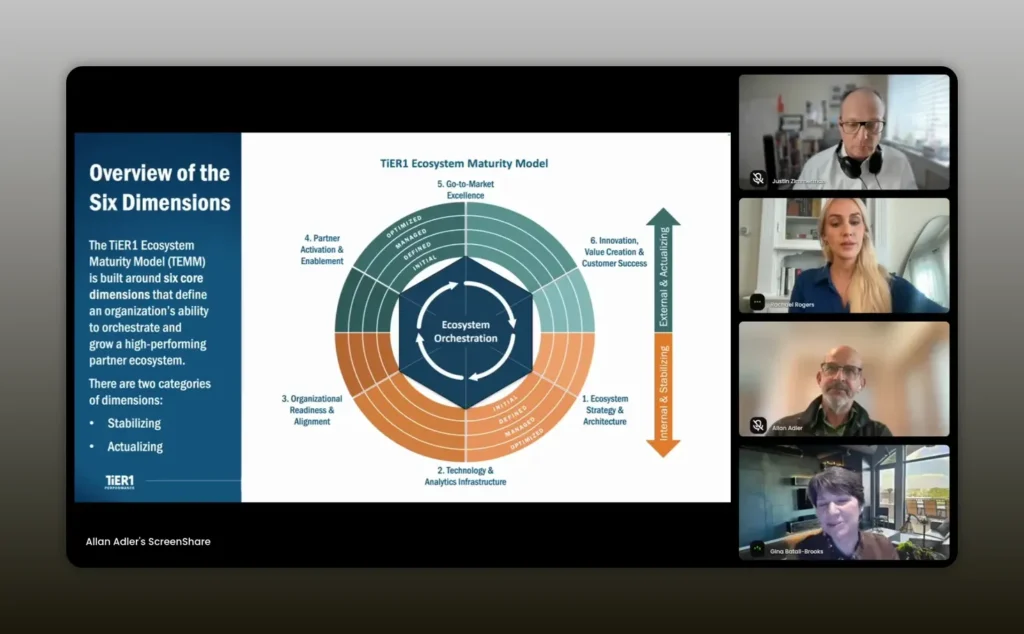
The way that it’s structured is that the bottom part is the foundational part. It’s the getting your house in order. -Allan Adler
Tier 1 ecosystem maturity model explained
The Tier 1 maturity model groups capabilities into six dimensions across two broad zones: stabilizing and actualizing. Stabilizing dimensions form your foundation. Actualizing dimensions are where partner impact becomes visible and measurable.
Think of the model as a pyramid. The base must be solid to support the upper levels. If your technology is cobbled together, your processes are siloed, or your strategy is fuzzy, then initiatives at the top will fail to scale or deliver predictable ROI.
The six dimensions at a glance
- Strategy and architecture – Clarity about who you serve, the outcomes you sell, and how partner roles map to those outcomes.
- Systems and infrastructure – A coherent tech stack and integration map that supports partner workflows and data sharing.
- Cross-functional collaboration – Organizational alignment and funding that embed ecosystems into the company’s operating model.
- Partner activation and enablement – Ideal partner profiles, scoring, personalized journeys, and incentive frameworks.
- Go-to-market excellence – Joint solutions, account planning, campaign alignment, and operationalized co-sell motions.
- Onboarding and joint customer success – Automated onboarding, shared KPIs, and joint responsibility for customer outcomes.
Three stabilizing dimensions you must get right
Start here. These are the capabilities that will determine whether your activation efforts succeed.
1. Strategy and architecture
Clear strategy beats busy work every time. Too many companies sign up partners and jump straight into enablement without defining who success looks like.
You must define:
- Your ideal partner types and motions
- Target outcomes for customers and partners
- How partner roles map to monetization and GTM motions
When strategy is explicit, everything else—resourcing, incentives, tooling—becomes much easier to justify and implement. Gina suggests pairing your business strategy with an infrastructure strategy so you only invest in systems that enable prioritized outcomes.
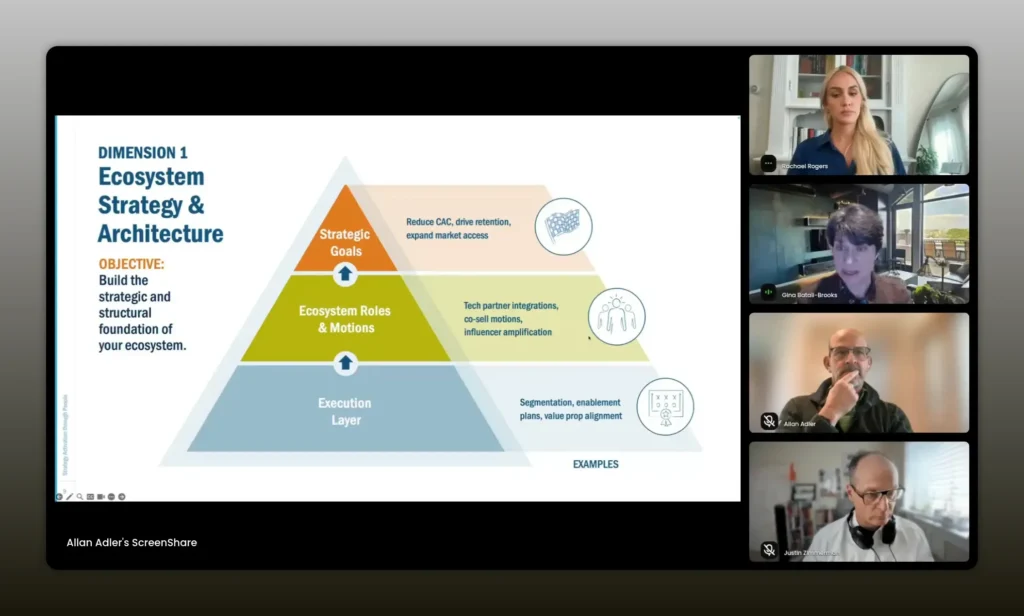
Start with strategy — get your house in order so partner motions aren’t scattered. -Allan Adler
2. Systems and infrastructure
Systems are not a magic wand. Overtooling without strategy creates fragmentation and a heavy operational burden. Instead, choose a coherent set of best-in-class systems that can integrate and share data across RevOps and partner workflows.
Prioritize:
- APIs and integration capabilities
- Single sign on and a unified partner experience
- A clear mapping of where partner data lives versus where internal data lives
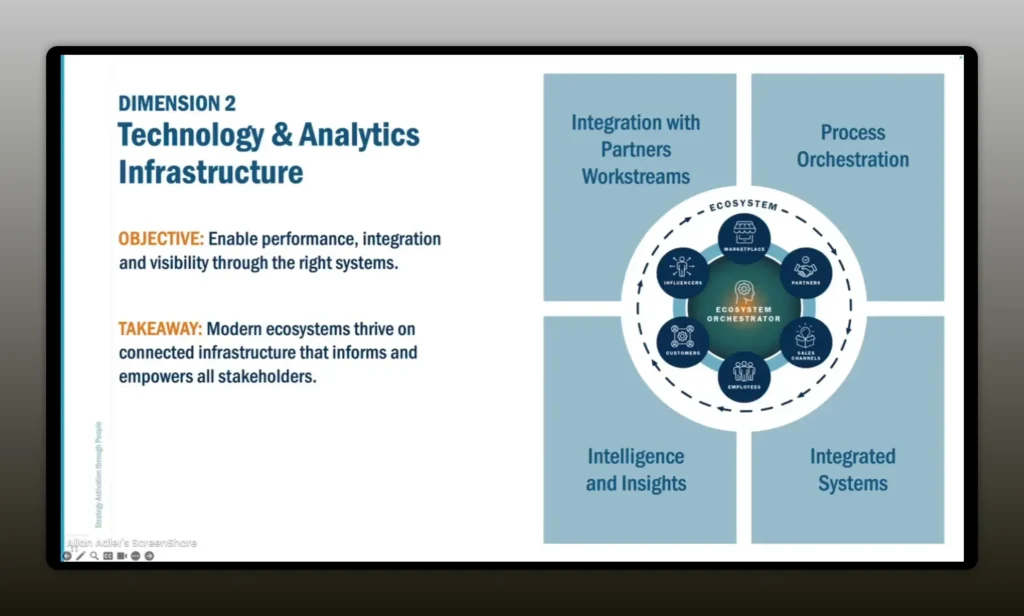
This dashboard connects activity metrics to real business outcomes—revenue, influence, customer retention. -Rachael Rogers
Allan uses an iceberg metaphor. Surface tooling for partners must sit on a solid, integrated tech foundation. If partners must jump between ten tabs to do account mapping, publish marketplace listings, and manage incentives, adoption and productivity will suffer.
3. Cross-functional collaboration
The best partner strategies fail at handoff if ownership is unclear. Embed partnership goals across sales, product, marketing, and customer success. Hire people who can span functions and hold the line on accountability.
To operationalize collaboration:
- Create clear roles and workflows for partner-sourced and partner-influenced opportunities
- Align compensation and incentives so sellers and CSMs see partner-led wins as wins for them
- Use storytelling to evangelize the partner motion to executives and doers alike
Without organizational alignment and funding, even great strategies will fall on deaf ears when you ask for budget. Rachael stresses that storytelling—framed in business outcomes—is essential for funding and momentum.
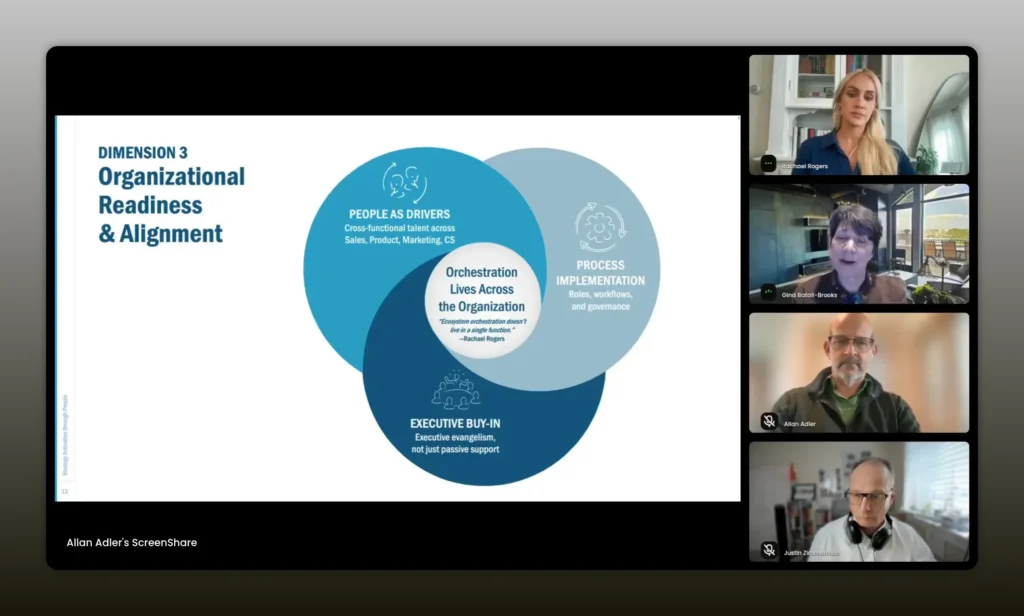
If your partner ecosystem is feeling scattered, this is the place that you should start. -Rachael Rogers
Three activation and actualization dimensions that drive outcomes
With the foundation in place, these three areas let you turn partners into measurable, repeatable revenue engines.
4. Partner activation and enablement
This is the moment of truth: can partners get set up, trained, and supported to deliver joint customer value? Start with Ideal Partner Profiles (IPPs) and bring them to life in your systems with proactive scoring and automation.
Key tactics:
- Automated IPP scoring to focus effort on likely revenue-generating partners
- Just-in-time personalized learning paths tied to transactions and deal stages
- Targeted incentive frameworks that vary by partner type and motion
Use A/B testing and analytics to determine which incentives actually move the needle, rather than relying on assumptions. Rachael emphasizes the importance of letting data drive incentive optimization.
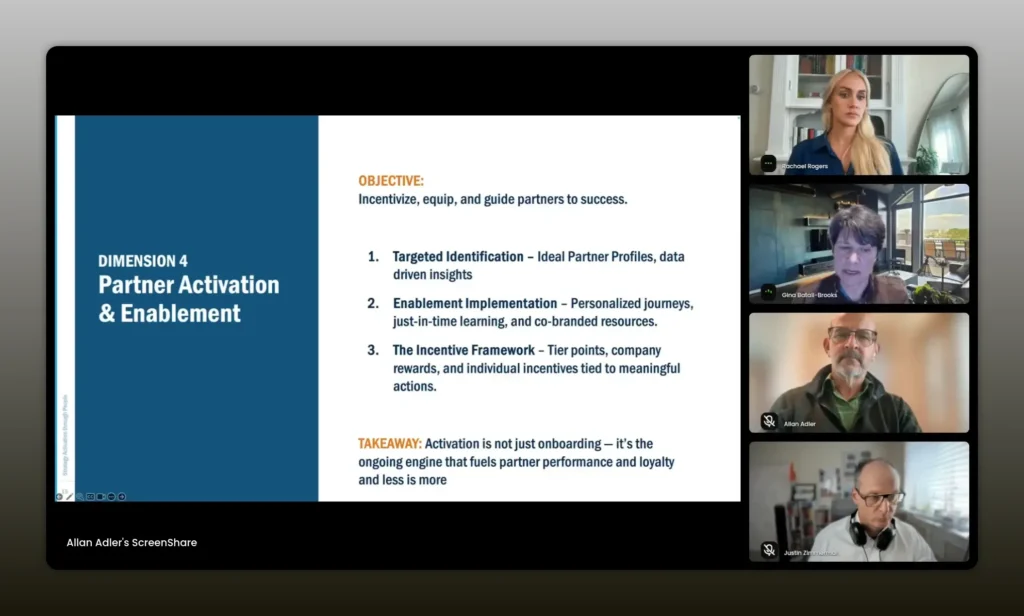
Activation is the moment of truth — get partners set up with just‑in‑time enablement and aligned incentives so they can actually close deals. -Gina Batali-Brooks
5. Go-to-market excellence
Great partner GTM is structured, repeatable, and integrated into the sales motion. It is not about occasional co-marketing announcements or slapping partner logos into a deck.
What to operationalize:
- Account planning with partner enablement baked into opportunity-level workflows
- Joint solution playbooks and measurable campaigns
- Sell-side tooling that auto-suggests partners based on customer needs and partner capabilities
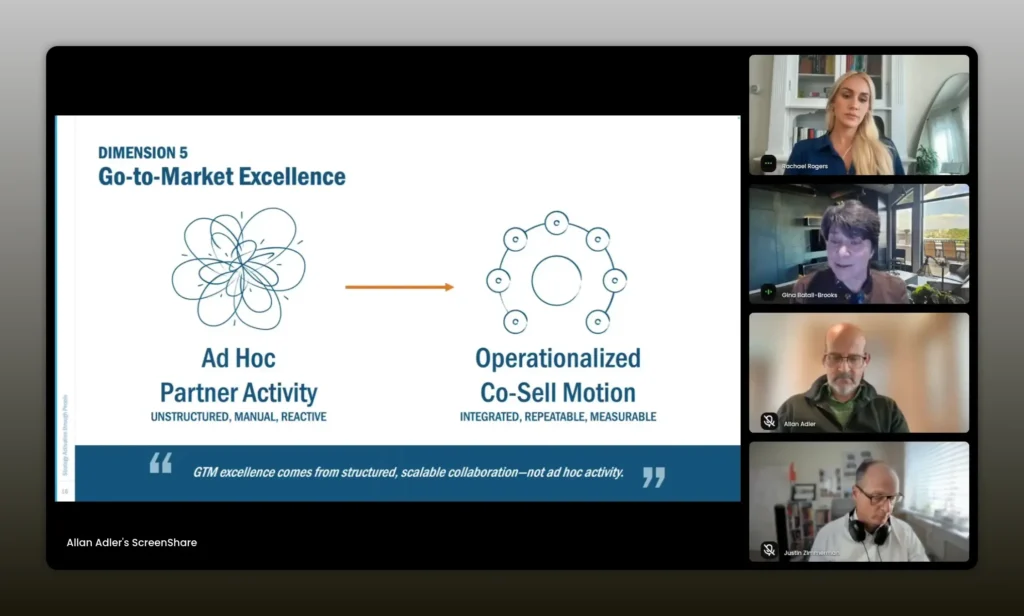
If partners have to jump between multiple tools to map accounts and manage marketplace listings, good luck enabling them. -Allan Adler
Gina stresses the importance of aligning compensation so everyone is compensated on the customer win, regardless of how the win is achieved. That behavioral alignment unlocks seller participation and partner collaboration.
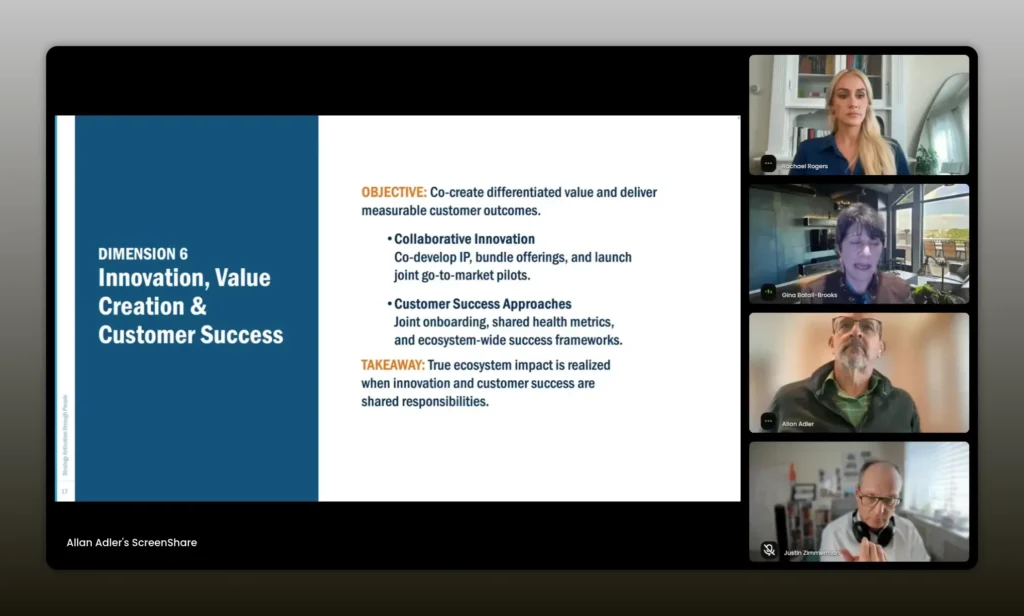
6. Onboarding and joint customer success
Onboarding is where promises become reality. Automate and optimize it into motion-based stages tailored to partner types—technical alliances need different steps than transactional resellers.
Effectiveness checklist for onboarding:
- Role-specific workflows and required artifacts for each partner motion
- Forms and automation to reduce manual steps and approvals
- Shared KPIs between product, partner, and customer success teams
We shortened the onboarding process by three months, which was incredible. -Gina Betali-Brooks
Allan makes a critical point: real ecosystem impact is realized when innovation and customer success are shared responsibilities. If the integration work, CS readiness, or product alignment is missing, partners and customers suffer.
Designing a partner-friendly tech stack
There will never be a single system that “does it all.” Your goal is to make multiple systems look and feel like a single partner experience. That means investing in APIs, single sign on, and smart orchestration layers so partners and sellers only see what they need, when they need it.
When evaluating vendor platforms ask:
- Does the vendor provide programmatic access via APIs?
- Can partner data be integrated into your CRM and RevOps stack?
- Does the platform enable partner workflows like deal registration, co-selling, marketplace listings, and enablement without excessive switching?
Allan iceberg metaphor is useful: surface-level convenience for partners must sit atop a deeply integrated tech foundation with both technical and commercial orchestration.
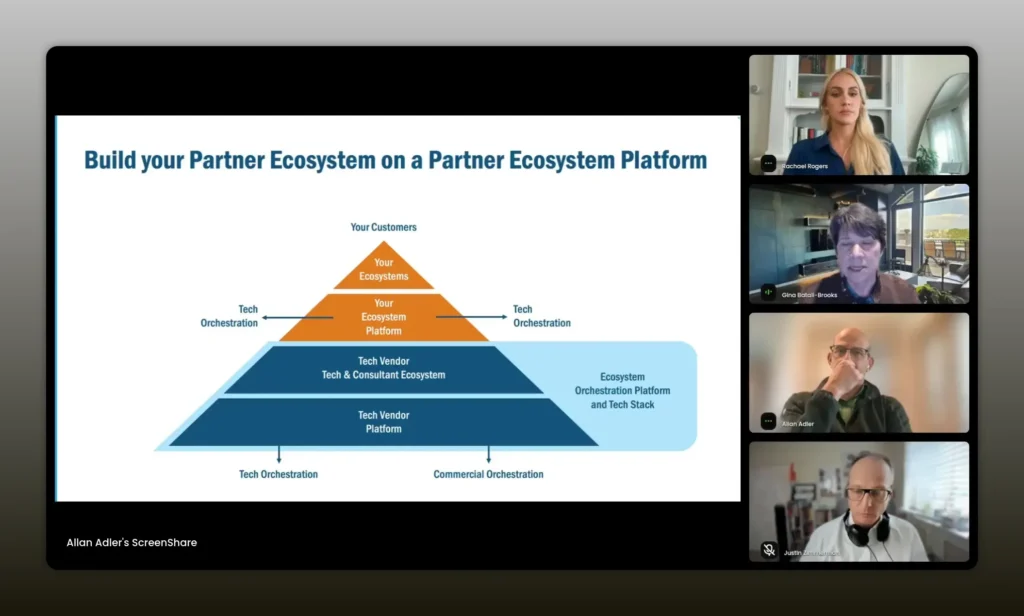
APIs, integrations, and a single sign on are table stakes for a partner platform. -Allan Adler
How to operationalize go-to-market excellence
Operationalizing GTM with partners is about removing friction and making collaboration the path of least resistance. Practical steps you can take right now:
- Standardize account planning templates that explicitly call out partner contributions.
- Build partner auto-suggestion logic in seller tools based on customer needs and partner capabilities.
- Run joint campaign pilots with clear success metrics and short feedback cycles.
- Align seller and partner incentives so both parties prioritize partner-led wins.
These small structural changes create predictable touchpoints and make it easier for sellers to bring partners into deals. Over time, the business sees partner deal velocity improve and partner influence revenue rise.
Key metrics and building an executive dashboard
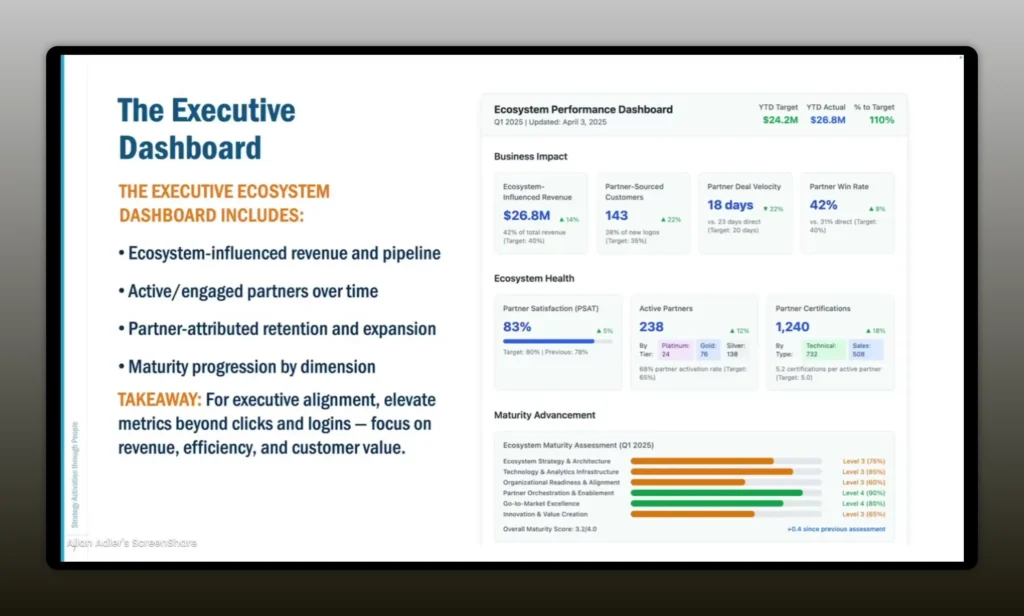
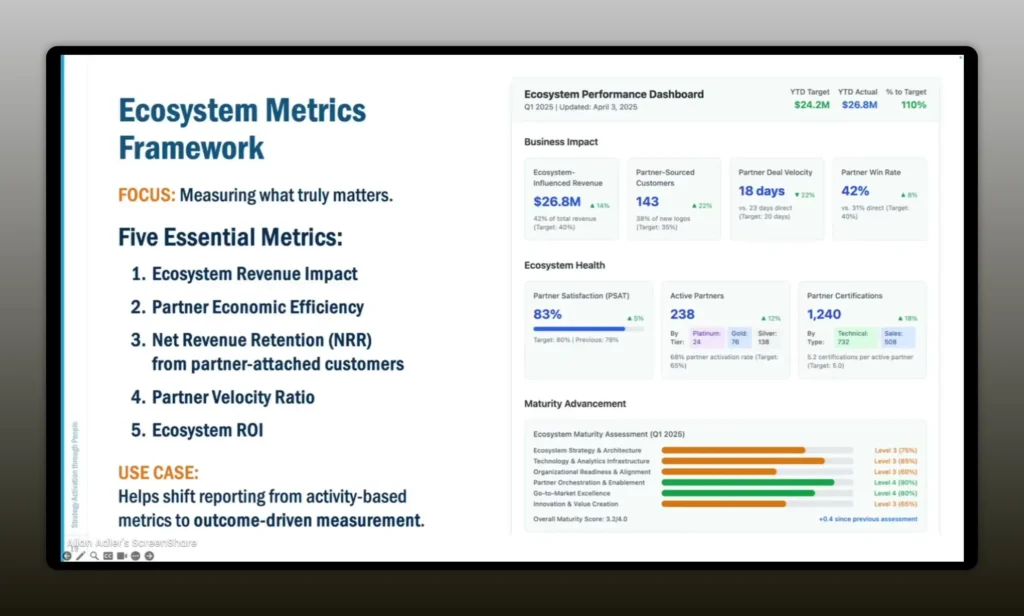
Executives don’t buy portal logins or certification counts. They buy revenue, margin, growth, and retention. Translate partner activity into business outcomes and present both activity and executive metrics in a single dashboard so stakeholders can see how investments drive outcomes.
Five executive metrics that matter
- Ecosystem revenue impact – What percentage of revenue is partner-influenced or partner-sourced?
- Partner efficiency – How does partner-sourced CAC compare to direct sales CAC?
- Ecosystem net revenue retention – Are partner-delivered solutions increasing retention and expansion?
- Partner deal velocity – Are partner-influenced deals closing faster than direct?
- Ecosystem ROI – Revenue generated versus program costs and investments.
As the bottom grows, the middle improves, and as the middle improves, the top happens. -Allan Adler
Gina recommends placing aspirational metrics on the dashboard with TBD markers where data is missing. That serves two purposes: it signals executive priorities and creates a clear funding ask tied to data gaps. Show what you want to report once you have the systems and integrations in place.
Engagement metrics and partner experience
Engagement metrics should measure quality and impact rather than vanity. Partners want to find what they need, get in and out quickly, and apply it to revenue-driving motions. Prioritize persona-driven experiences for partner managers, seller roles, and different partner types.
- User experience quality: time-to-complete tasks, successful search results, and task completion rates.
- Partner satisfaction: NPS or partner satisfaction scores tied to the platform experience.
- Personalized impact: adoption of just-in-time learning and whether micro-learning contributes to certification or deal performance.
- Publishing governance: content freshness and relevance; avoid content sprawl that forces partners to wade through noise.
- Relationship manager impact: how orchestration improves partner success and replicable practices from top-performing partners.
You want to think about how you align and sustain momentum across the entire business. -Rachael Rogers
AI-driven personalization and just-in-time content will change the partner learning model. Instead of large periodic training, partners will receive micro-lessons tied to the exact task or deal stage they are in. Track uptake and completion, and count meaningful micro-learning toward certification goals.
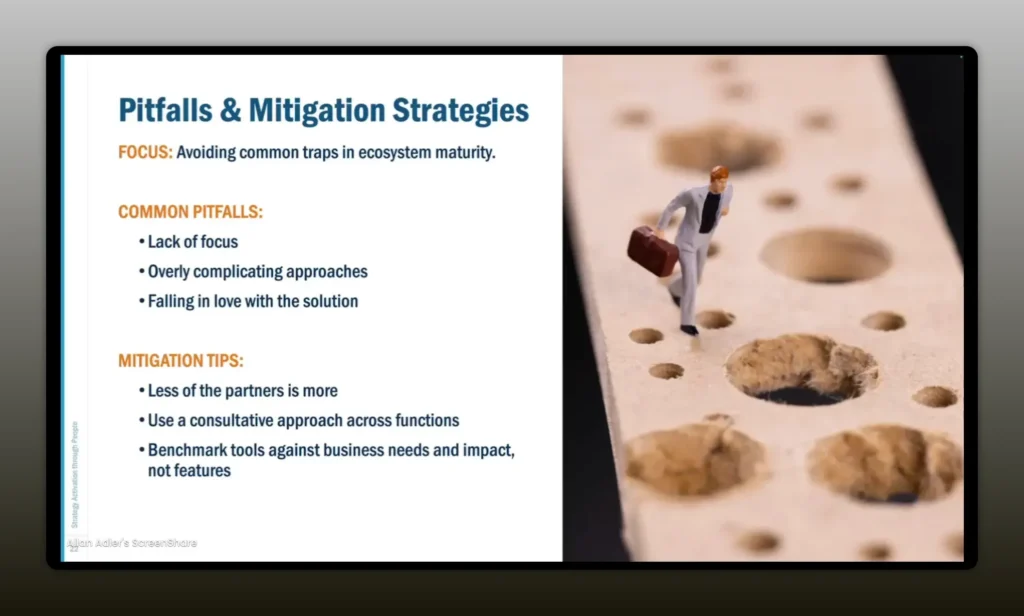
Common pitfalls and how to avoid them
Even seasoned teams stumble. These are the recurring traps teams fall into and practical ways to avoid them.
Lack of focus
Trying to serve every partner type and every motion dilutes impact. Define ideal partner profiles and bring those profiles to life in systems and scoring models so effort is focused where it matters.
Overcomplicating incentives
Just because you can create many incentive permutations does not mean you should. Keep incentives simple, transparent, and aligned to the behaviors that drive joint outcomes. If partners can’t easily understand how they earn, the incentive is ineffective.
Falling in love with solutions
Don’t implement a new tool or a new incentive because it seems elegant. Always test whether the change will actually fix a prioritized business problem. Run a small experiment, measure, and iterate.
Overtooling without an integration strategy
Buying many point solutions that do not integrate creates operational debt. Choose systems that enable connected workflows and provide shared data across sales, partner ops, and partner portals.
Ecosystem orchestration can’t happen if you don’t have a platform and tech stack that is coherent. -Allan Adler
Prioritization: marrying vision, execution, and expectations
Success requires three things aligned at once: an ambitious North Star, realistic next-mile deliverables, and clear expectation setting about what milestones look like. If you only have vision without execution, stakeholders will call it pie-in-the-sky. If you deliver execution without a North Star, you will have funding and influence issues.
Practical formula for prioritization:
- Set a North Star (example: 20% of ARR from partner-influenced revenue in three years).
- Define the next mile (example: three partners building joint solutions for one use case within three months).
- Agree on what success looks like at ~70% completion for the mile to avoid perfection paralysis.
Gina calls this the mile-marker approach. Break the mountain into tangible miles that stakeholders can see, measure, and validate.
Practical next steps and activation checklist
Start small but think big. Use the maturity model to pick a test case—a market, customer segment, or vertical—then activate a microcosm of the full model. Here’s a short checklist to begin:
- Document the North Star and one-mile milestones.
- Create or validate your Ideal Partner Profile and map it into a scoring model.
- Assess your tech stack for integration gaps and prioritize one or two integrations that unlock reporting and co-selling.
- Simplify incentives and align seller compensation to customer wins regardless of channel.
- Define the onboarding flow for your test-case partners and automate the most manual steps.
- Build a minimal executive dashboard showing one leading indicator and two lagging business outcomes.
- Run a 90-day pilot with clearly defined measurement and iteration cadence.
FAQs
How do I know which maturity dimension to prioritize first?
Use the maturity assessment to identify the weakest stabilizing capabilities that block your desired outcomes. If your systems are fragmented, prioritize infrastructure and integration. If your strategy is unclear, start with strategy and partner architecture. Always tie priorities to specific business objectives like reducing CAC or improving NRR.
What metrics will get executive attention?
Executives respond to revenue, efficiency, retention, and ROI. Present metrics like ecosystem revenue impact, partner-sourced CAC, ecosystem NRR, partner deal velocity, and ecosystem ROI. Supplement these with health metrics showing partner engagement and maturity gaps to justify investments.
How can I prevent overcomplicating my partner incentives?
Keep incentives aligned to simple, measurable behaviors. Start with one core incentive that rewards the desired outcome, such as joint customer wins, and measure its impact. Only add complexity when a clear business case emerges and when you can track results reliably.
When should I invest in specialized partner tooling?
Invest in specialized tooling once you have clarity on partner strategy and clear priorities. Ensure chosen tools integrate with your CRM and RevOps stack. Avoid buying tools as a way to solve organizational ambiguity; the best time to invest is after you define the use cases and can measure ROI.
How do I improve partner onboarding time?
Standardize role-specific onboarding flows, automate approvals and forms, and deliver just-in-time content. Use measurable stages and require only the essential artifacts to move partners to the next stage. Measure time-to-first-deal or time-to-certification as KPIs.
What is the best way to demonstrate partner influence on revenue?
Combine pipeline tagging, deal registration, and influence modeling in your CRM. Use opportunity-level fields to capture partner involvement and attribute influence. Over time, supplement with experimental designs or AB testing to validate partner-driven lift versus direct motions.
Conclusion
Orchestration is the difference between an expensive partner program and a scalable partner engine. Focus on the foundations—strategy, systems, and cross-functional alignment—before you pour energy into enablement, GTM, and onboarding. Translate partner activity into executive language—revenue, efficiency, retention, and ROI—and use a maturity-based roadmap to sequence investments.
Start with a small, measurable pilot that ties to a business objective and a clear mile marker. Use data to iterate incentives, personalize enablement, and prove real business outcomes. When you align vision, execution, and expectation, your ecosystem becomes a repeatable, financed growth function, not a series of one-off initiatives.