Create Co-Selling Content That Closes – The Twilio x Aircall x HubSpot Way
Expert advice from Jesse Cunningham, Tim Koeth, and Pat Donley.
Introduction
Fact: integrations decide whether prospects convert and customers stick around. The stakes: High. The quality of your HubSpot integration can shorten sales cycles, increase close rates, and create long-lasting account value. If your product simply exists alongside HubSpot, you miss a massive opportunity to position your solution as the multiplier that amplifies customers’ existing investment.
This article is designed to help you understand how to overcome these challenges and turn your integration into a growth engine for sales, upsell, and retention. Keeping reading to learn how experts have overcome these challenges.
Top partners are seeing three times higher close rates, ~40% shorter sales cycles, and deals that can be twice the size. Master the integration sales story and you help sellers sell faster, win more HubSpot deals, and close bigger opportunities. -Jesse Cunningham
Table of Contents
- Introduction
- Why an integration sales story matters
- The Better Together framework
- How to identify HubSpot users and high-intent buyers
- Discovery questions that reveal integration opportunity
- Demo inside HubSpot: how and why to do it
- Turning objections into reasons to integrate
- Measuring and sharing ROI and case studies
- Partner stories: Twilio Segment tactics
- Partner stories: Aircall tactics
- Using HubSpot Marketplace analytics and intent signals
- Co-selling with HubSpot sales and agencies
- Documenting and sharing win stories
- Account expansion and retention through integration depth
- Practical checklist for enablement teams
- FAQs
- Conclusion
Why an integration sales story matters
Your integration isn’t just a technical connector. It is a strategic differentiator that can change how fast you sell, how often you win, and how much revenue you capture. Top-performing partners see dramatic benefits: close rates three times higher, sales cycles reduced by around 40 percent, marketplace lead conversion as high as 71 percent, and deals that can be twice the size of average transactions.
When you lead with integration value, you shift the conversation from a single-point solution to an enhancement of the customer’s HubSpot ecosystem. That elevates the deal from a purchase decision into a platform optimization decision, which is a fundamentally easier argument to win.
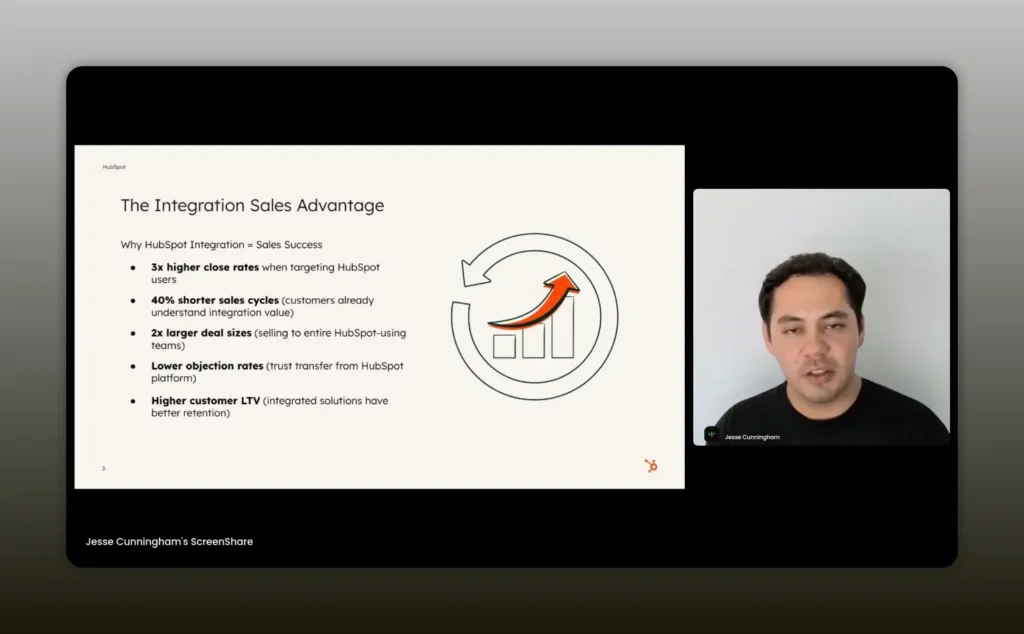
Top partners are closing faster and larger deals because they lead with the joint HubSpot impact. -Jesse Cunningham
The Better Together framework
The Better Together framework reframes how you talk about your product. Instead of describing what your tool does in isolation, you describe how your integration makes a customer’s HubSpot investment more valuable. This approach is persuasive for three reasons:
- Leverages existing investments — Customers have already bought HubSpot. You’re offering increased return on their existing spend.
- Ties into existing workflows — You remove friction by showing how data flows, how lists and workflows are enriched, and how teams save time.
- Creates switching costs — Deep integration embeds your solution into daily processes, making it harder to replace.
Language matters. Replace general claims like “we help X” with “our HubSpot integration helps your marketing, sales, and success teams turn HubSpot into a single source of truth for X outcome.”
How to identify HubSpot users and high-intent buyers
Finding HubSpot users is half the battle. When you know which prospects already run HubSpot, your messaging instantly becomes more relevant. Use a mix of technographic tools and direct discovery to prioritize your outreach.
- Technographic enrichment — Tools like Clearbit, Apollo, ZoomInfo, and HubSpot’s Breeze AI reveal a prospect’s tech stack at scale. Filter for HubSpot users and prioritize based on fit.
- Social listening and content signals — LinkedIn shares or HubSpot-related content on a prospect’s feed often signal engagement with the platform.
- Website checks — Footer widgets, tracking scripts, or public job postings mentioning HubSpot can be clues.
- Marketplace intent data — Use the HubSpot Marketplace analytics to see which organizations viewed your listing or took action. This is a bottom-of-funnel signal worth prioritizing.
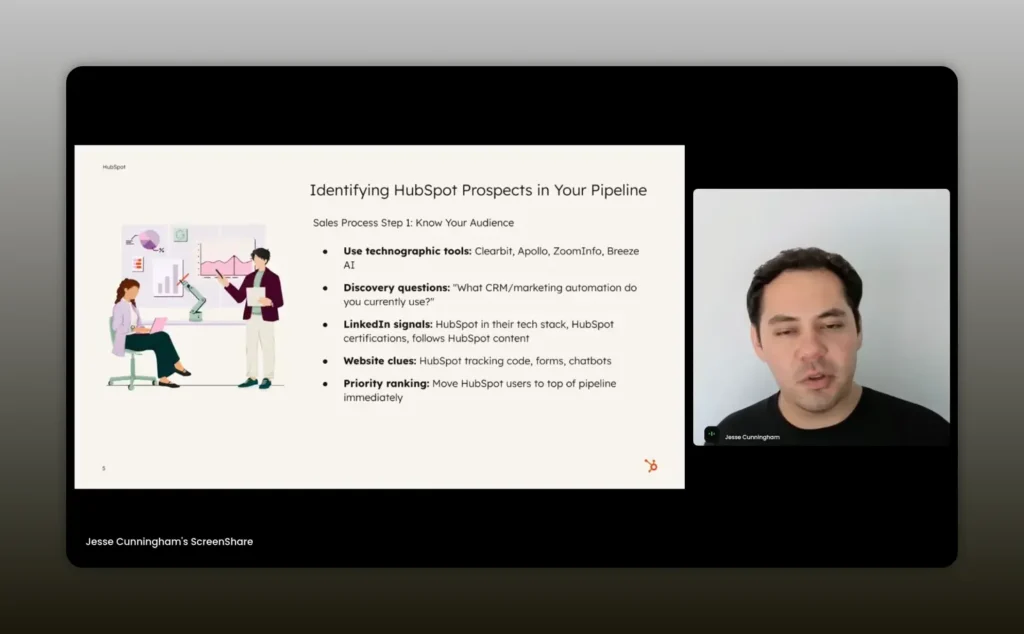
If they’re clicking your marketplace listing, treat it like a bottom of funnel buyer intent signal. -Tim Koeth
Discovery questions that reveal integration opportunity
Early discovery should include HubSpot-specific questions. These answers reveal where integration can deliver the most immediate value and what narrative you should use in the demo.
- Which CRM or marketing automation platform are you using right now?
- How are your teams currently using HubSpot across marketing, sales, and service?
- What data silos are causing manual work or duplicate efforts?
- What would a successful integration unlock for your team within 30 to 90 days?
These questions let you tailor your talk track. If a prospect is already searching for “HubSpot integrations” you should explicitly lead with the Better Together story rather than a generic product pitch.
Demo inside HubSpot: how and why to do it
One of the most effective sales tactics is to demo your integration inside a HubSpot environment. Every partner has access to developer test accounts — enterprise-level free HubSpot instances where you can install your app and build realistic flows for demo purposes.
Why demo inside HubSpot?
- Shows exactly where data lands — Demonstrate lists, contact properties, and how data maps into HubSpot records.
- Builds trust — Prospects see that the integration is native and quick to install.
- Makes objections disappear — Integration complexity, tool overload, and change management concerns fade when the buyer sees the real workflow in their HubSpot context.
Spend a third of your demo inside HubSpot when it’s relevant. Walk through property creation, workflow automation, and the downstream impact on reporting and CS handoffs. Train your AEs to run those HubSpot demos smoothly — the strongest reps are the ones who know HubSpot best.
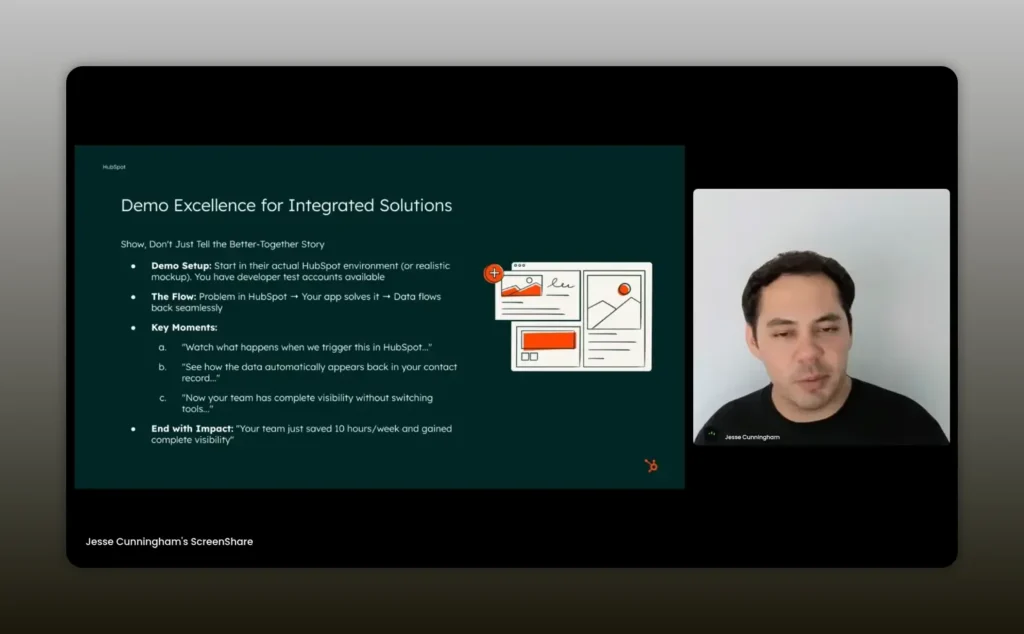
Demoing inside HubSpot turns theory into tangible value in minutes. -Pat Donley
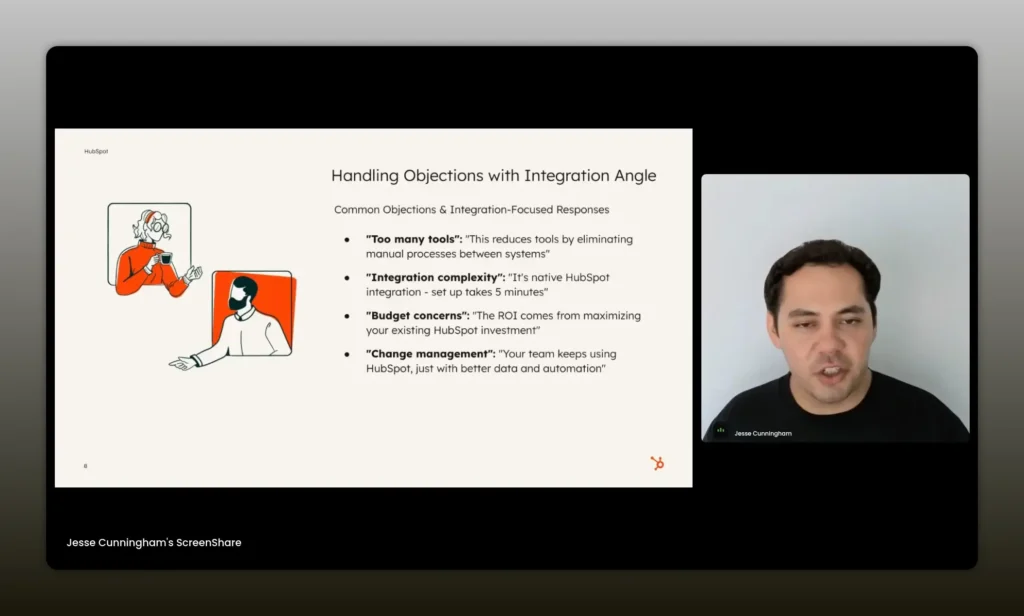
Turning objections into reasons to integrate
Common objections revolve around tool sprawl, integration complexity, budget, and change management. Reframe them.
- Too many tools — Explain how a deep integration reduces handoffs and automates tasks, effectively consolidating effort rather than adding steps.
- Integration complexity — Demonstrate the install and onboarding process in the HubSpot test instance. If installation is minutes or low-effort, say so and show it.
- Budget constraints — Remind customers they already invested in HubSpot; integration increases ROI on that existing spend.
- Change management — Emphasize how native syncs reduce training friction. Show specific examples of automated workflows that reduce manual steps for sales and support teams.
Measuring and sharing ROI and case studies
Numbers change decisions. Don’t rely on product features alone — quantify outcomes. Collect usage metrics, time saved, improved conversion rates, and revenue lift from customers using the integration. Use short, compelling case studies that sales reps can reference, and build vertical-specific one-pagers when possible.
Example metrics to capture:
- Time saved per rep from automated workflows
- Lift in lead-to-opportunity conversion after data enrichment
- Increase in campaign personalization or open rates
- Percentage increase in cross-sell revenue when integration is used
Share these internally with HubSpot account teams and externally with prospects. The more HubSpot sales and success teams understand the impact, the more likely they are to recommend your integration.
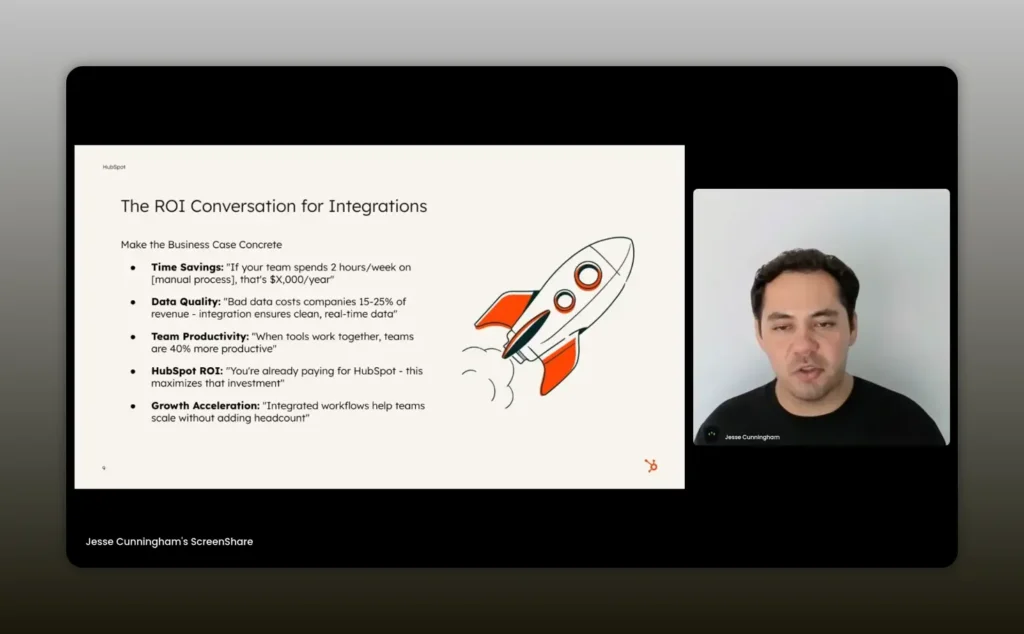
Case studies are the currency you need to trade on with HubSpot sales teams. -Jesse Cunningham
Partner stories: Twilio Segment tactics
Twilio Segment is a strong example of how to align product sales with HubSpot adoption. Tim describes four practical use cases they use to convert HubSpot-connected customers and grow mutual accounts.
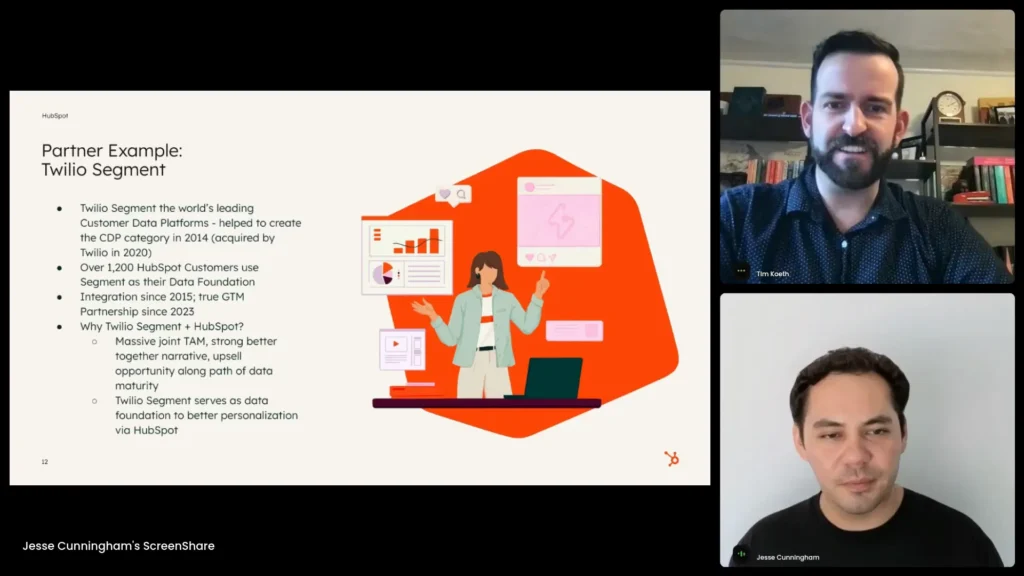
HubSpot helped us scale — we now support over 1,200 mutual customers and see a much stronger upsell motion. -Tim Koeth
1. Support existing mutual customers
Segment uses a tiered product structure where customers on basic connections-only plans get nudged to upgrade to Unify or Engage when they use HubSpot. That pitch focuses on returns to their HubSpot investment.
2. Build Better Together content and case studies
Talk to mutual customers to collect quotes and success metrics. Turn those into short case studies and recipe pages that are industry-specific. Tim mentions a credit union recipe that explains how Segment consolidates customer data while HubSpot delivers multi-channel personalization. That specific narrative makes it easier for sellers to recommend Segment when a HubSpot rep is selling into that vertical.
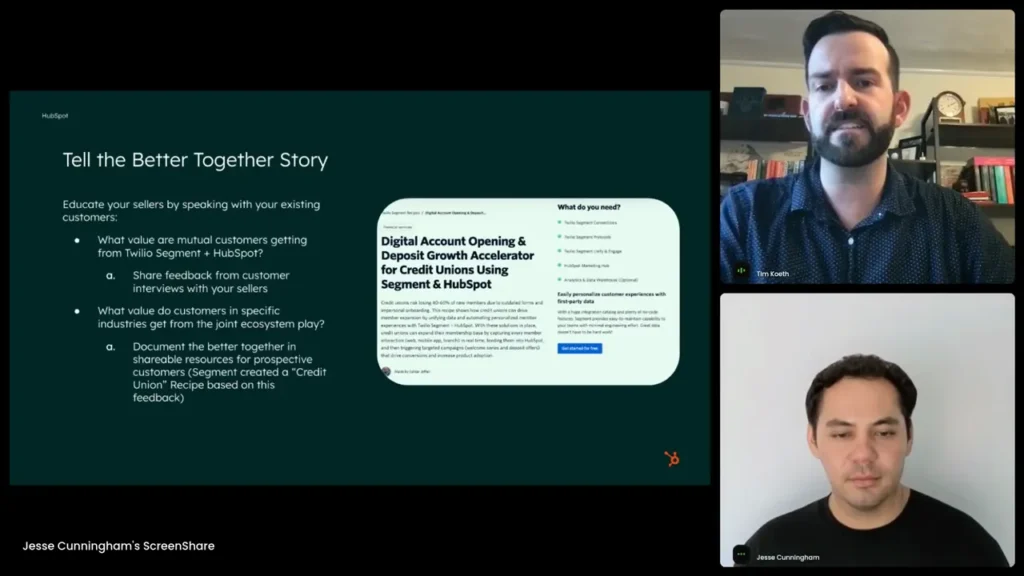
Tailored recipes for industries remove ambiguity and make co-selling with HubSpot straightforward. -Tim Koeth
3. Collaborate with agency partners
Segment co-creates collateral and “recipes” with agencies that implement both tools. Agencies validate the operational side of the integration and provide credibility to HubSpot sales teams because they can point to proven implementations and implementation partners.
4. Use Marketplace analytics and intent data
Segment monitors Marketplace listing views and compiles a monthly list of organizations checking the app. They share this list with the relevant HubSpot AEs, check on existing customers, and create tailored outreach when an organization looks like a new prospect. Treat marketplace viewers as high-intent signals and prioritize outreach.
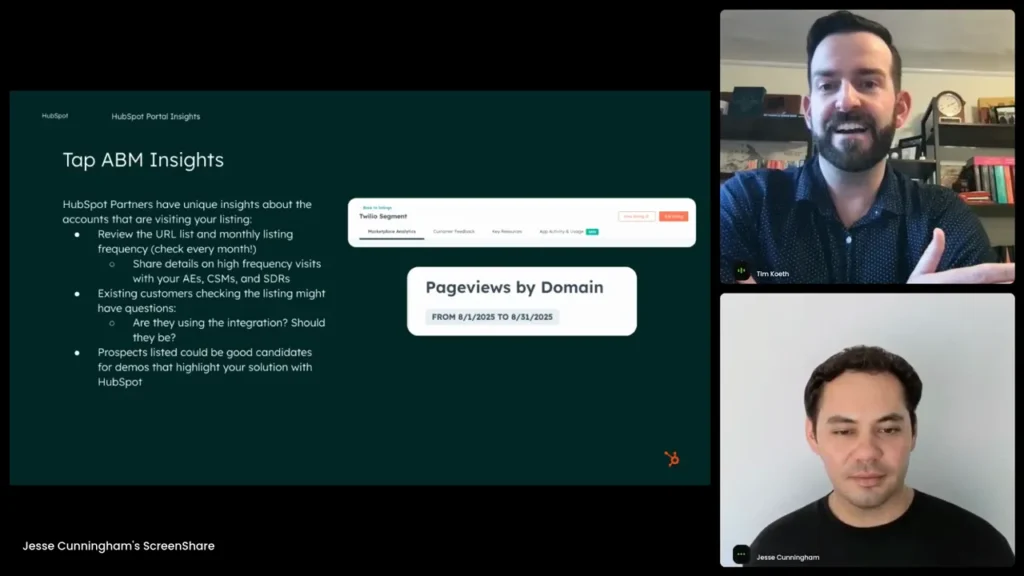
The marketplace viewer list is a goldmine of buyer intent if you’re willing to use it. -Tim Koeth
Partner stories: Aircall tactics
Aircall’s approach focuses on deep internal enablement, demonstration skills, and documenting wins. Pat shares tactical practices that accelerated Aircall’s growth within the HubSpot ecosystem.
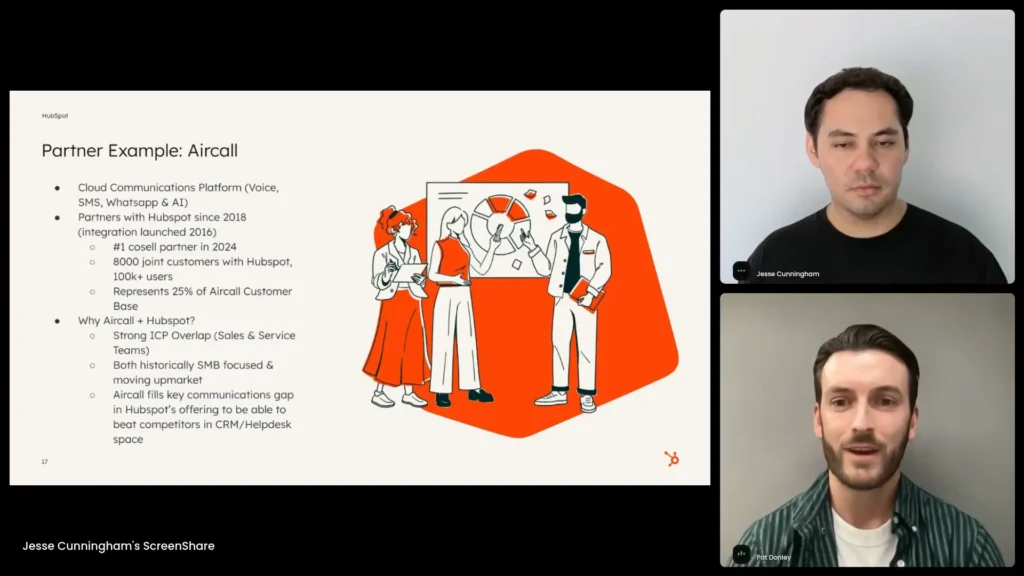
HubSpot is our number one partner — 8,000+ customers use our integration and roughly 38% of Aircall’s revenue is tied to the HubSpot ecosystem. -Pat Donley
1. Make your teams understand HubSpot
Aircall’s partnerships team builds internal certifications, playbooks, and documentation to ensure every AE and CSM understands HubSpot as a platform — not just how Aircall plugs into it. That depth allows reps to position Aircall as part of a larger HubSpot strategy rather than a point solution.
2. Demo inside HubSpot
Aircall spends roughly a third of its demo time inside a HubSpot environment. Because Aircall’s value is tied to HubSpot workflows and ROI, showing the integration in-action is non-negotiable. Their strongest sellers are those who can demo HubSpot the best.
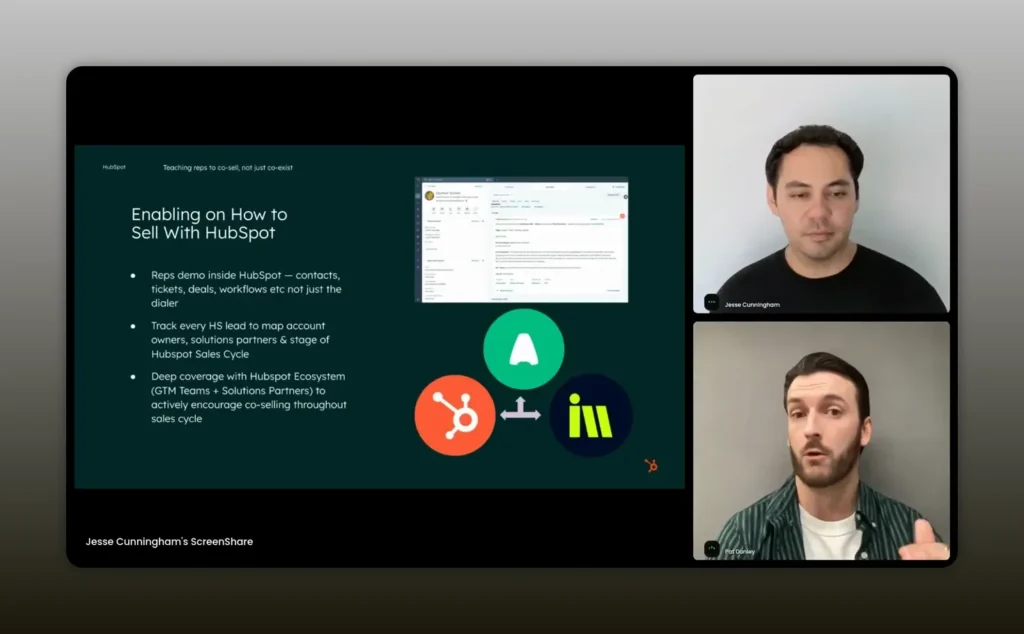
Our top reps spend a third of their demo showing HubSpot and how Aircall fits. -Pat Donley
3. Track HubSpot lead ownership and tailor messaging
Aircall traces every HubSpot lead back to the HubSpot owner — AE, CSM, or solutions partner — to understand where the prospect sits in their HubSpot journey. This allows tailored messaging aligned to whether the prospect is in implementation, considering a net-new HubSpot purchase, or already live.
4. Document and share win stories
A simple example: an inbound HubSpot lead became a shared win because Aircall found the HubSpot AE who was also selling service hub. They sold together, then that relationship led to follow-on opportunities that became the company’s largest service hub deal. Share wins internally and with HubSpot — repeated success draws further co-sell opportunities.
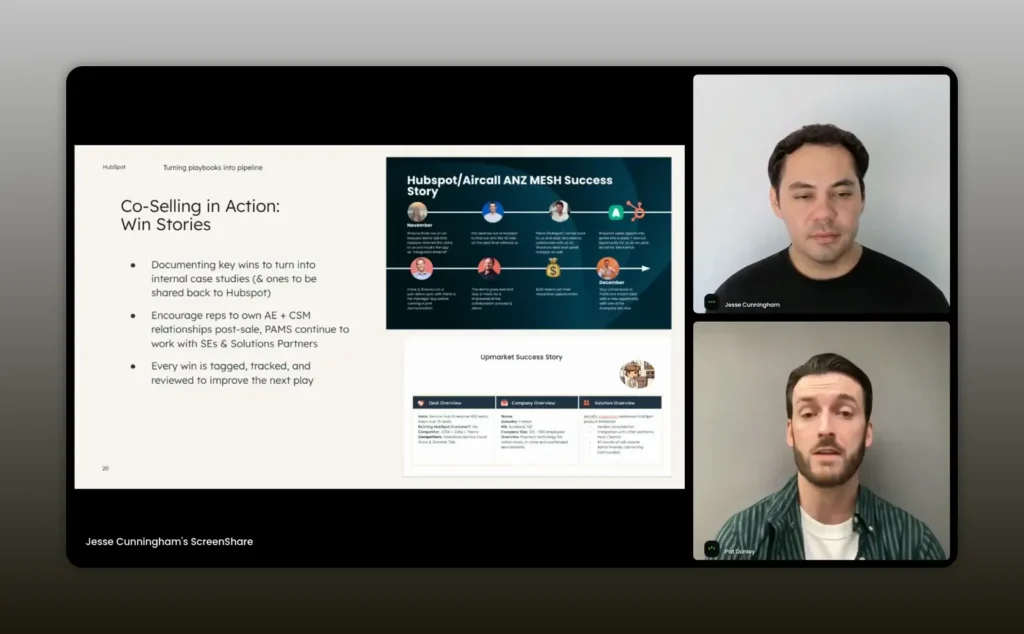
Documenting wins multiplies co-selling opportunities because HubSpot people start thinking of you first. -Pat Donley
Using HubSpot Marketplace analytics and intent signals
Marketplace analytics are underused. Every month the Marketplace provides an updated list of visitors to your listing. Segment and Aircall both use that data to trigger targeted outreach. Use cases:
- Existing customers — They might be curious about advanced integration features or need help activating the integration.
- Current customers not using the integration — Offer activation help, implementation partner referrals, or guided onboarding to shorten time-to-value.
- Prospects — Treat listing clicks as high intent. Outreach with a demo tailored to their business and HubSpot setup.
That intent signal often sits near the bottom of funnel, making it one of the most efficient prospecting inputs you can use.
Marketplace clicks are near-bottom-of-funnel signals—prioritize them. -Jesse Cunningham
Co-selling with HubSpot sales and agencies
HubSpot is a horizontal platform that relies on partners to bring vertical expertise. Positioning your product as the vertical specialist or recommended integration increases the likelihood HubSpot reps refer you to their prospects.
Steps to build co-sell motion:
- Create vertical-specific materials that HubSpot AEs can use when selling in that industry.
- Identify and align with agency partners who implement both your product and HubSpot. Co-author recipes and success stories.
- Enable HubSpot sales with short, actionable playbooks and demo scripts that show joint value quickly.
- Share documented wins and ROI metrics frequently so HubSpot teams internalize your impact.
Documenting and sharing win stories
Win stories create momentum. When a HubSpot rep sees that your product accelerates HubSpot deals, they’ll start to proactively suggest you to other customers. Capture these wins and record them both internally and in HubSpot’s systems so they become part of the organizational memory.
Best practices for win documentation:
- Capture the customer’s problem, the HubSpot workflow you impacted, and the measurable outcome.
- Create a one-page win narrative and a short slide for HubSpot AE enablement channels.
- Publicize the win inside both organizations where appropriate to foster broader co-selling awareness.
Account expansion and retention through integration depth
Once an integration is in use, it becomes a lever for upsell and expansion. As users see value, they are more receptive to additional modules, services, or higher-tier plans.
Ways to drive expansion:
- Monitor usage and trigger outreach when certain features are adopted.
- Create in-product prompts or email campaigns that highlight next-level functionality tied to HubSpot workflows.
- Offer packaged upsells that clearly show how an upgrade increases ROI within HubSpot.
Practical checklist for enablement teams
Use the following checklist to operationalize your Integration Sales Story across product, marketing, and sales.
- Create a Better Together one-pager that ties integration features to HubSpot outcomes.
- Build HubSpot demo accounts and a library of demo scripts for common verticals.
- Train AEs and CSMs on HubSpot basics and your integrated workflows.
- Develop vertical-specific case studies and recipes with agencies where possible.
- Monitor Marketplace analytics and technographic signals to prioritize outreach.
- Collect ROI metrics from customers and make them accessible to sales teams.
- Document and share win stories through internal channels and with HubSpot contacts.
- Define an ongoing co-sell process with HubSpot AEs and solutions partners.
FAQs
How do I find out if a prospect uses HubSpot?
Combine technographic tools such as Clearbit, Apollo, ZoomInfo, or Breeze AI with manual checks like LinkedIn activity and website signals. Also use HubSpot Marketplace analytics to see which companies viewed your app listing. Those views are high-intent signals you should prioritize.
What should I ask during discovery to uncover integration opportunities?
Ask what CRM or automation platform they use, how HubSpot is being used across teams, what data silos exist, and what success looks like in 30 to 90 days. Those answers directly inform which integration benefits to highlight.
Why demo inside HubSpot rather than showing my product alone?
Demoing inside HubSpot shows real mapping of data, automated workflows, and the downstream impact on reporting and customer handoffs. It reduces objections about complexity, speeds trust, and places your product within the buyer’s existing operational context.
How can I measure the ROI of my integration?
Collect quantitative metrics like time saved, conversion lift, revenue increase, and usage growth. Pair metrics with qualitative feedback in case studies. Package these as short one-pagers for sales and AE enablement.
How do I start co-selling with HubSpot sales teams?
Start small: provide HubSpot AEs with vertical-specific talk tracks and short demo scripts. Share mutual customer success stories and marketplace intent lists. Build relationships by aligning with HubSpot reps around shared opportunities rather than requesting co-sell before you demonstrate impact.
What internal enablement is most effective for ramping reps?
Create focused internal certifications, playbooks, and demo training that teach reps how HubSpot works and how your integration enhances it. Have a few deeply trained reps who can then coach the rest of the team with tailored sessions rather than sending everyone through generic courses.
Conclusion
Integration-first selling is a repeatable, high-impact strategy. When you position your product as the multiplier of a customer’s HubSpot investment, you win faster, sell larger deals, and create durable account value. Use technographic signals and Marketplace intent data to find the right prospects, demo natively inside HubSpot to remove friction, document measurable outcomes to make the case, and build enablement that trains sellers to tell a Better Together story. Follow the playbook above, collaborate with agencies and HubSpot teams, and document wins so co-selling becomes a natural outcome rather than a request.
Your integration can be a growth engine. Start treating it that way, and you will see your close rates, deal size, and retention improve.