Build Your Super Agent To Match & Recommend Partners
Expert advice from Ty Lingley (Ecosystem Leader, Workday).
Snapshot
Partner teams are expected to drive more revenue, support more internal stakeholders, answer more partner questions, and somehow do it all with fewer resources and tighter controls around AI. That tension is not going away. If anything, it is getting worse as ecosystems grow more complex across services partners, technology partners, sales partners, and hyperscalers.
When your field teams can instantly find the right partner, the right qualification, the right offer, or the right contact, co-sell execution gets sharper. Strategy gets better. Time that used to disappear into Slack messages, email threads, and ad hoc requests comes back. And in larger companies where security and governance slow everything down, a grounded AI system can become the practical bridge between compliance and speed.
If you want to solve slow co-sell execution, scattered partner knowledge, and nonstop internal requests, keep reading to see how Ty Lingley and Justin Zimmerman can help you do it.
“The real win is not just answering questions faster. It is freeing yourself to focus on strategy.” – Ty Lingley
Table of Contents
- Snapshot
- Why partner teams hit a wall
- The three core problems
- Why grounded AI matters
- How Ty built the system
- What data should go in
- The kind of questions it can answer
- What changed after rollout
- From operations to strategy
- How to keep data fresh
- Governance and enterprise reality
- Recommended tools
- FAQs
- Conclusion
Why partner teams hit a wall
You may know exactly what your ecosystem should do. You may understand your best services partners, your strongest technology integrations, your highest-potential co-sell motions, and your biggest whitespace. But if the rest of the business cannot access that knowledge when they need it, your ecosystem stays trapped inside one person or one small team.
That is where Ty started. After years building partnership programs in startups and then moving into large enterprise environments at Microsoft and Workday, he found himself facing the same pattern many partnership leaders know too well. Everyone touches partners. Sales does. Marketing does. Professional services does. Solution consulting does. But when those teams need answers, they usually go to the partner lead directly.
At small companies, that can be painful. At large companies, it becomes a full-time drag on execution.
Ty estimated he was spending roughly five hours every week handling high-priority internal partner questions in real time. These were not casual questions. They were tied to live deals, co-sell activity, and field execution. The questions had to be answered quickly, often over direct message, email, or calls.
That situation becomes even more expensive when your ecosystem keeps expanding. More partners mean more offers, more programs, more updates, more authorizations, more stakeholders, and more exceptions. The complexity does not scale linearly. It compounds.
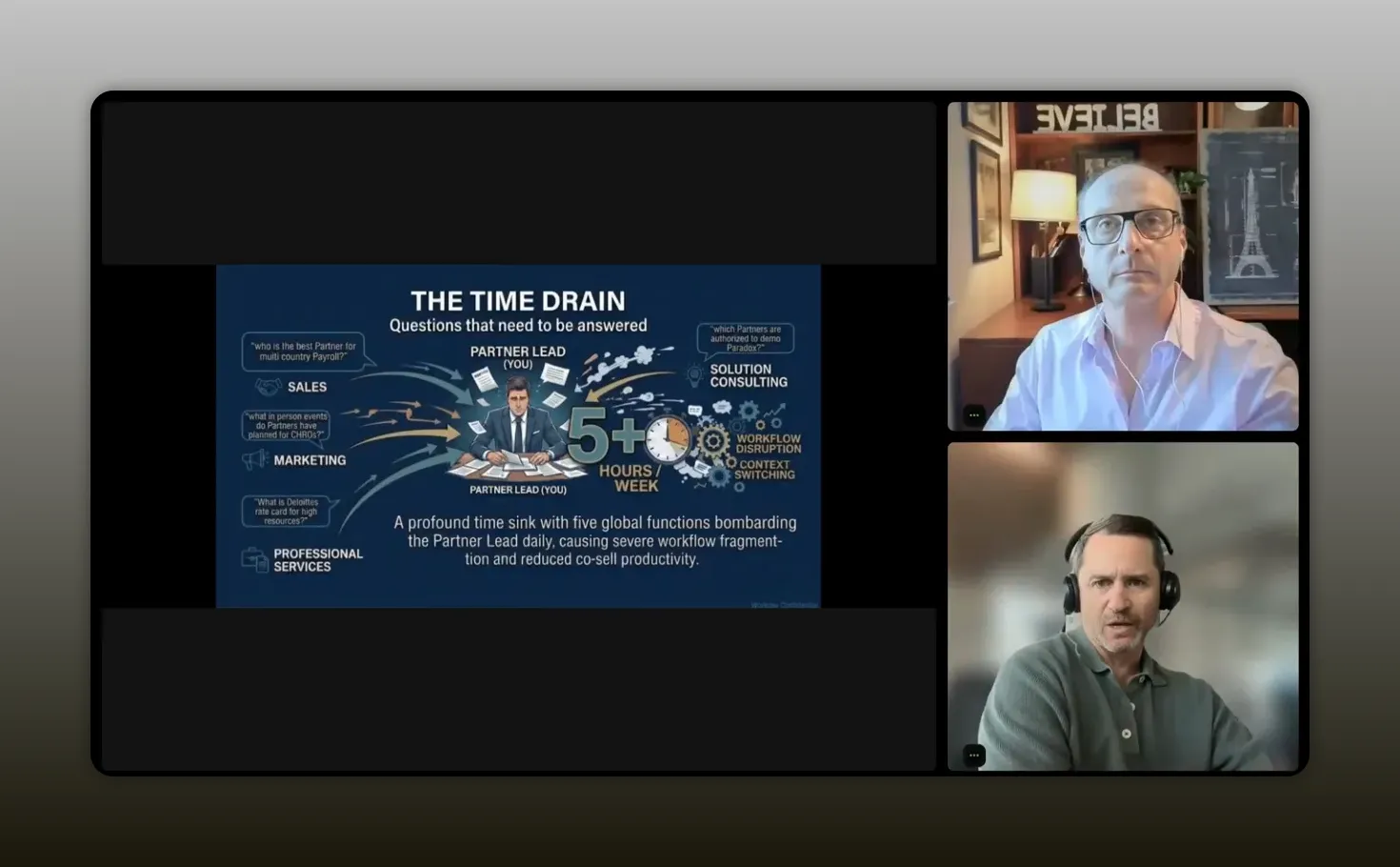
“Everybody touches partners, but not everybody has the right information at the right time.” —Ty Lingley
This is why ecosystem orchestration matters. It is not only about managing partners well. It is about making partner intelligence usable across the business.
If that idea sounds familiar, it lines up with the broader discipline of ecosystem orchestration, where the real breakthrough comes from connecting strategy, systems, and execution across functions instead of leaving partnerships as an isolated team sport.
The three core problems
Ty broke the challenge into three practical issues.
- Field teams do not have the right information at the right time. If an account executive needs the best payroll partner in Canada for a 500-person tech company, that answer has to be fast and accurate.
- The partner function does not scale on its own. If one person becomes the routing layer for every ecosystem decision, growth creates bottlenecks instead of leverage.
- Enterprise AI adoption is slow. In a large company, you usually cannot spin up a custom agent, plug in sensitive partner data, and launch it across the organization overnight.
The third point matters more than people often admit. A lot of AI advice assumes you are free to test anything. In enterprise settings, that is rarely true. Security, governance, and compliance are real constraints. You have to work within approved systems, approved data pathways, and approved sharing models.
So the question becomes: how do you get meaningful AI value now, without waiting for the perfect enterprise agent rollout later?
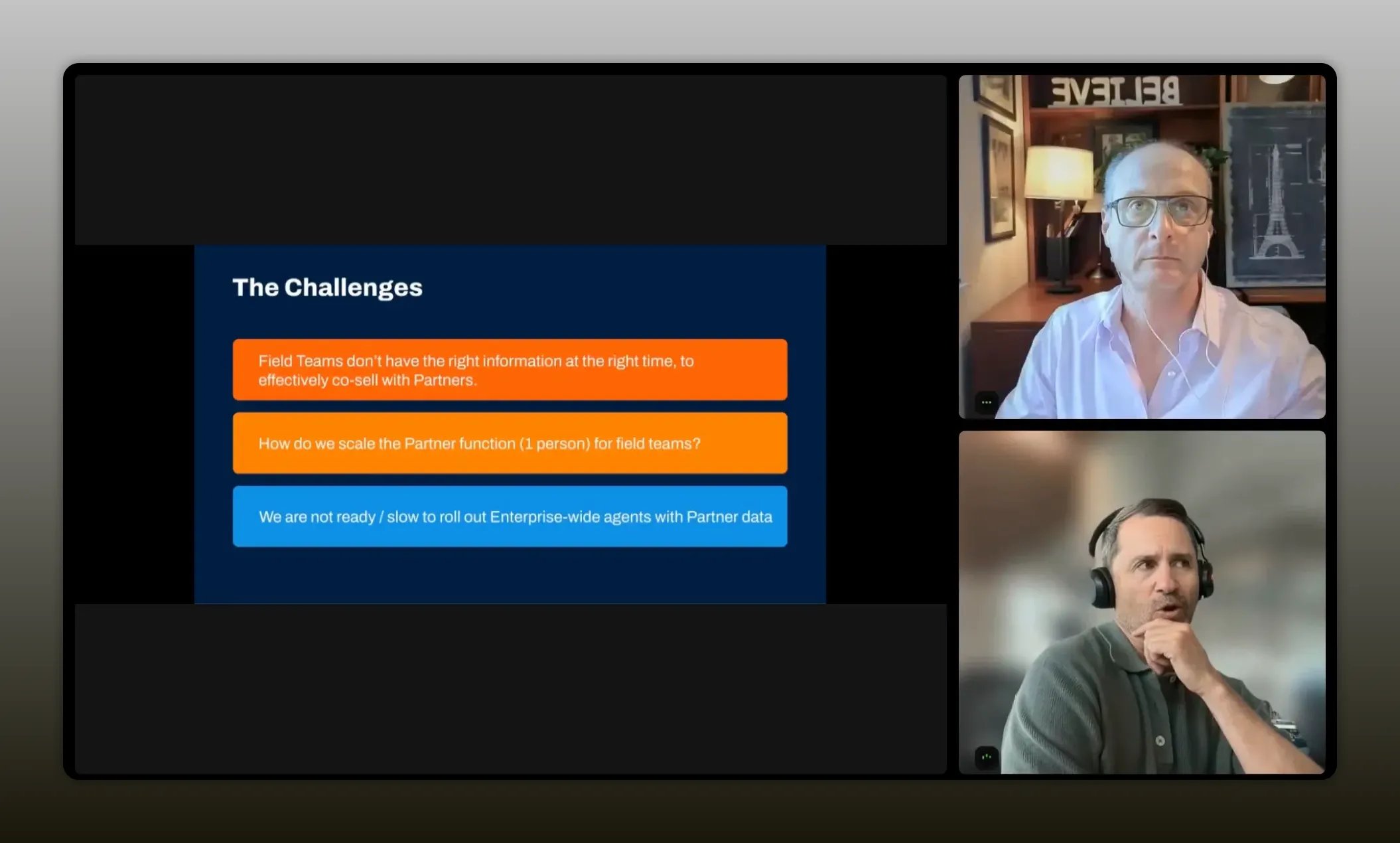
“Those three challenges were simple to name but hard to solve: getting the right partner information to the field at the right time, scaling partner decisions beyond one overextended router, and doing it all in an enterprise where you can’t just roll out an AI agent overnight.” —Ty Lingley
Why grounded AI matters
Instead of relying on a general-purpose model to somehow understand his partner ecosystem, Ty used a grounded, source-constrained AI workspace. In his case, that meant NotebookLM inside the Google stack already approved by the company.
That distinction is critical.
Open models like Gemini, Claude, or ChatGPT are incredibly useful for ideation and creation. But when your internal teams need exact answers about partner eligibility, qualifications, account overlap, revenue contribution, delivery performance, or stakeholder contacts, you need precision more than creativity.
A grounded AI environment narrows the system to the data you provide. It does not just guess based on broad internet knowledge. It searches and reasons from the materials you upload or connect.
That gives you three advantages:
- Higher trust because responses are anchored to approved sources
- Better predictability because the search space is constrained
- Lower risk because you are not depending on loosely inferred answers for critical partner decisions
This is also a practical model for revenue teams thinking through AI more broadly. If you are exploring how data and AI fit into partner operations, this more disciplined approach mirrors the kind of staged rollout described in this practical playbook for revenue teams.
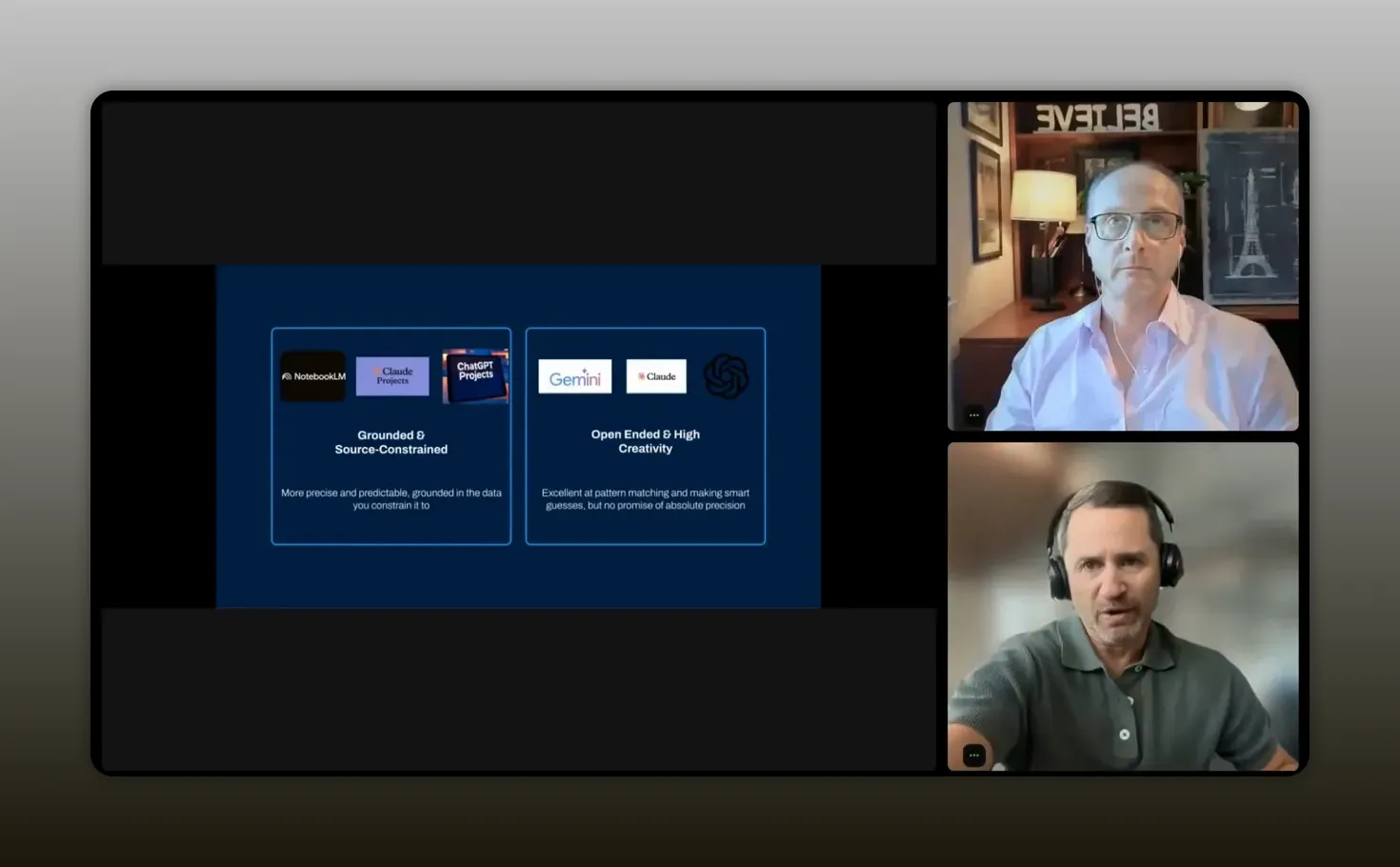
“General AI knows a lot about the world. It knows almost nothing about your actual partners until you teach it.” —Ty Lingley
How Ty built the system
The build itself was not flashy. That is part of the point.
Ty did not present this as a sophisticated engineering program or a custom-coded recommendation engine. He framed it as a homegrown solution built by someone who wanted the problem solved badly enough and had enough curiosity to assemble the pieces.
The system centered on a shared NotebookLM workspace loaded with partner ecosystem information. Rather than waiting for a formal enterprise agent program, he used the AI product already available through the company’s Google suite.
NotebookLM allowed him to ingest information in several ways:
- Uploaded documents
- Linked websites
- Connected YouTube or presentation content
- Files synced directly from Google Drive
- Structured data piped in through sheets or other formatted sources
That made the project achievable because the hardest part was not the interface. It was the content architecture.
Ty spent hours loading the right information, organizing it, and making sure the data being fed into the system was relevant and accurate. His notebook grew to hundreds of documents and sources, becoming a concentrated corpus of partner intelligence.
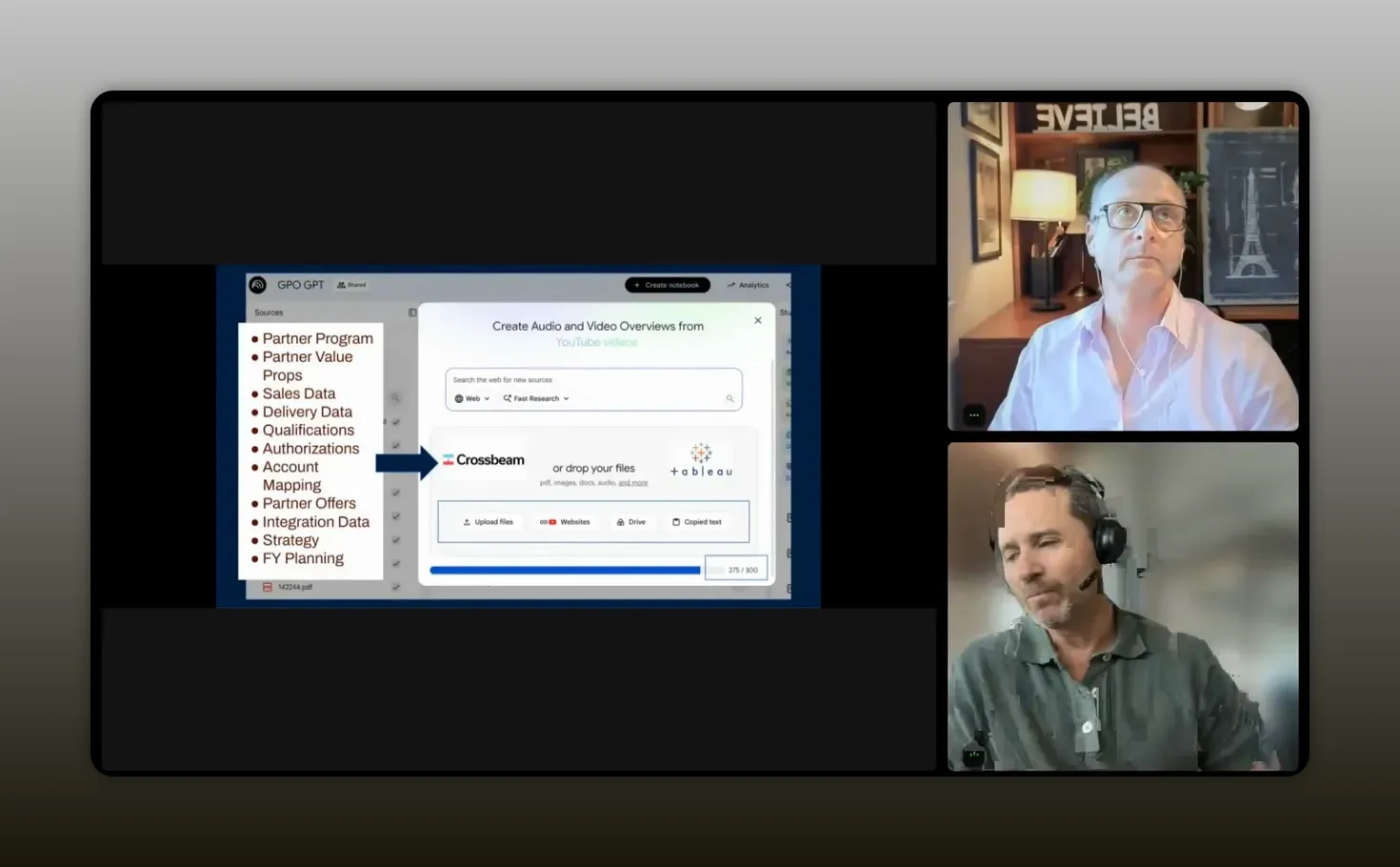
“You do not need to be the most technical person in the room to build something useful.” —Ty Lingley
This matters because too many AI projects stall out at the concept stage. People assume they need a larger budget, a bigger technical team, or executive sponsorship before they can move. Sometimes you do. But sometimes the real requirement is a practical use case, a compliant toolset, and enough discipline to structure the data.
What data should go in
The quality of a system like this depends on the quality and scope of the inputs. Ty’s example shows just how broad partner intelligence really is.
He loaded the notebook with data across categories such as:
- Partner program details and rules
- Joint value propositions
- Partner sales data
- Partner delivery performance
- Industry and segment qualifications
- Authorization by product or SKU
- Account mapping and overlap data
- Active partner offers
- Integration information
- Fiscal plans and business reviews
- Strategic partnership materials
That list is a useful template for your own ecosystem. You are not merely building a search box for partner names. You are building a reasoning layer for partner decisions.
It helps to think in terms of decision support. What does someone inside your company need to know in order to choose, activate, or collaborate with the right partner? Every source that helps answer that question belongs on your list.
Ty also expanded the notebook beyond internal data. He loaded external best practices, industry playbooks, and partnership thought leadership into the same environment. That gave the system a second job. It could not only answer factual internal questions, it could also cross-reference proven ecosystem approaches and suggest improvements.
That blend of proprietary data plus expert content is powerful. It is one thing for AI to tell you which partner has the best healthcare delivery track record. It is another thing for it to combine that answer with broader guidance on co-sell design, partner enablement, and ecosystem strategy.
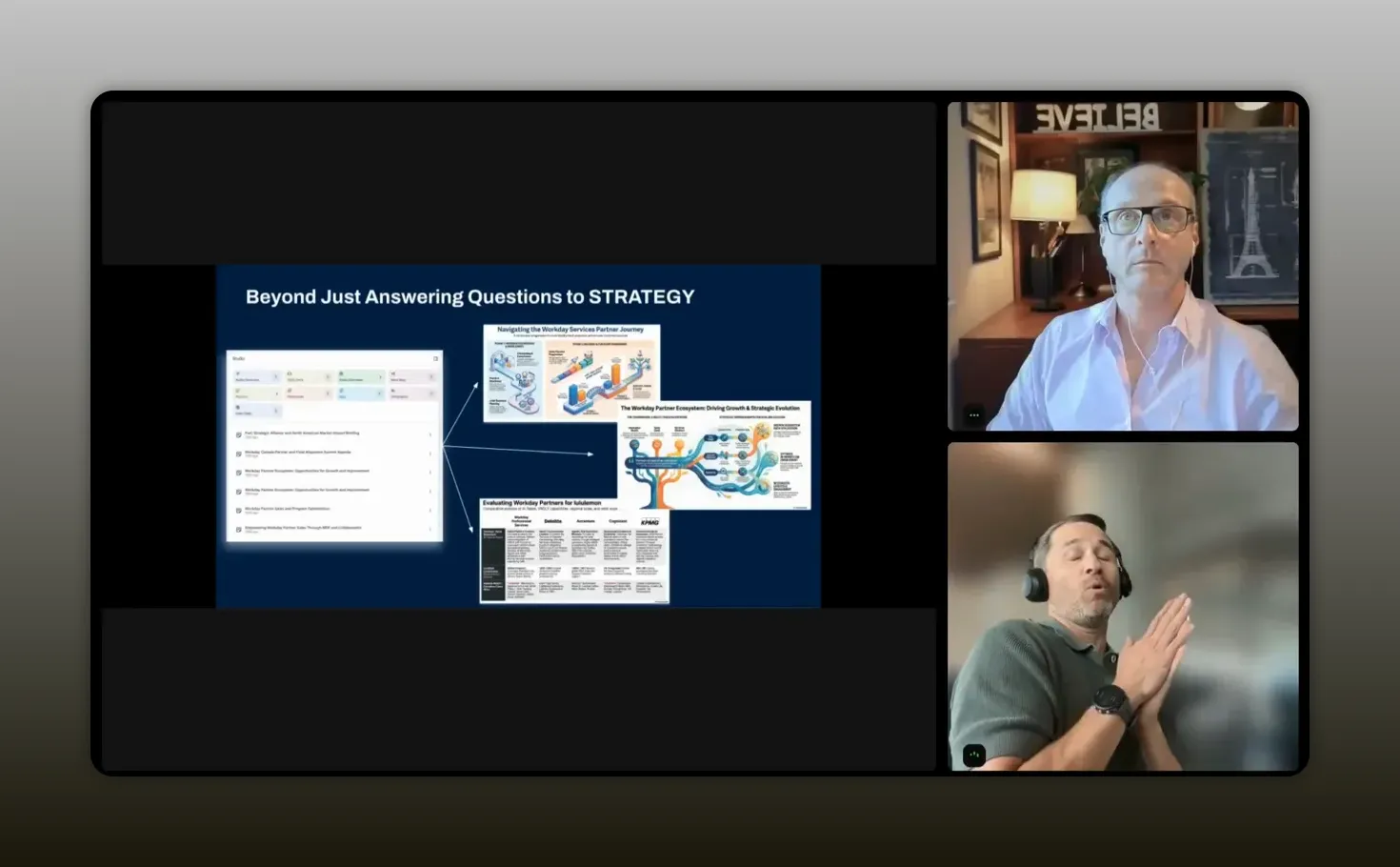
“The magic starts when your own ecosystem data meets the best ideas already out there.” —Ty Lingley
If you are building toward more advanced ecosystem data design, you may also want to look at this guide to orchestrating ecosystem data, dashboards, and AI agents, especially if your current challenge is less about prompts and more about architecture.
The kind of questions it can answer
The easiest way to judge whether this kind of system is worth building is to look at the questions it can answer quickly.
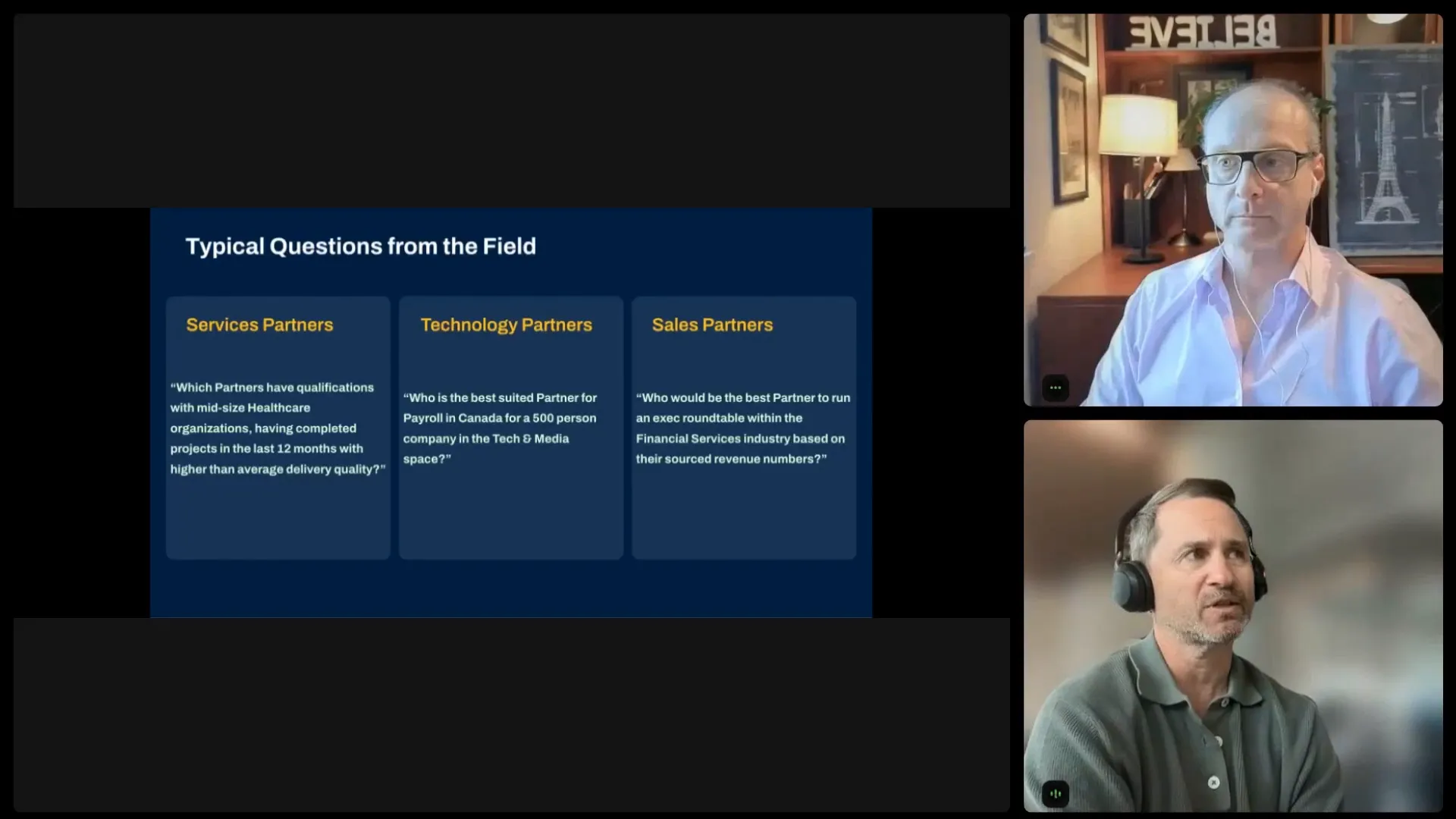
Ty shared examples across three partner categories.
Services partner questions
Imagine someone needs to identify service partners qualified for mid-sized healthcare organizations, with recent project experience and above-average delivery quality. That is not a simple lookup. It requires combining vertical expertise, time window, project history, and performance data.
Technology partner questions
Another request might be to find the best payroll partner in Canada for a 500-person company in the tech and media sector. That requires geography, use case, company size, partner category, and probably integration fit.
Sales partner questions
Marketing or sales might ask which partner is the strongest fit for an executive roundtable in financial services based on sourced revenue. That mixes campaign planning with partner influence and contribution metrics.
Those are exactly the kinds of requests that usually create a mess of back-and-forth messages. Somebody asks. Somebody else vaguely remembers a spreadsheet. Another person has a QBR deck. A fourth person knows a contact. Then the answer arrives too late or not at all.
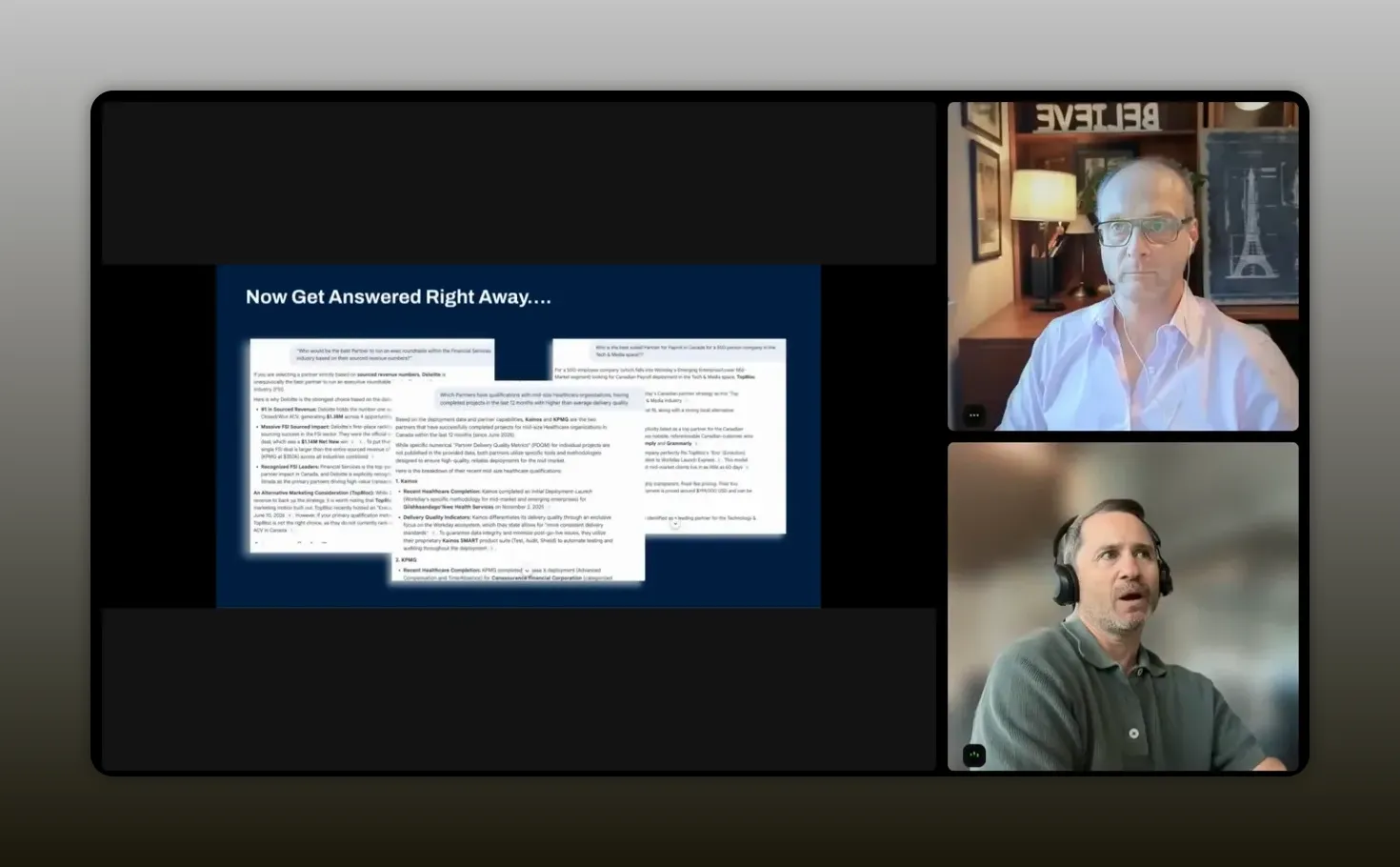
With the grounded notebook in place, those answers came back in seconds, with detail and recommended contacts for follow-up.
“When someone in the field asks a partner question, they don’t need a guess—they need the right answer anchored to your actual partner data, at the exact moment they’re deciding what to do next.” —Ty Lingley
This is where AI becomes less of a novelty and more of an operating layer. It does not replace partner judgment. It reduces the time needed to retrieve and assemble the inputs for partner judgment.
What changed after rollout
The result was dramatic but refreshingly simple.
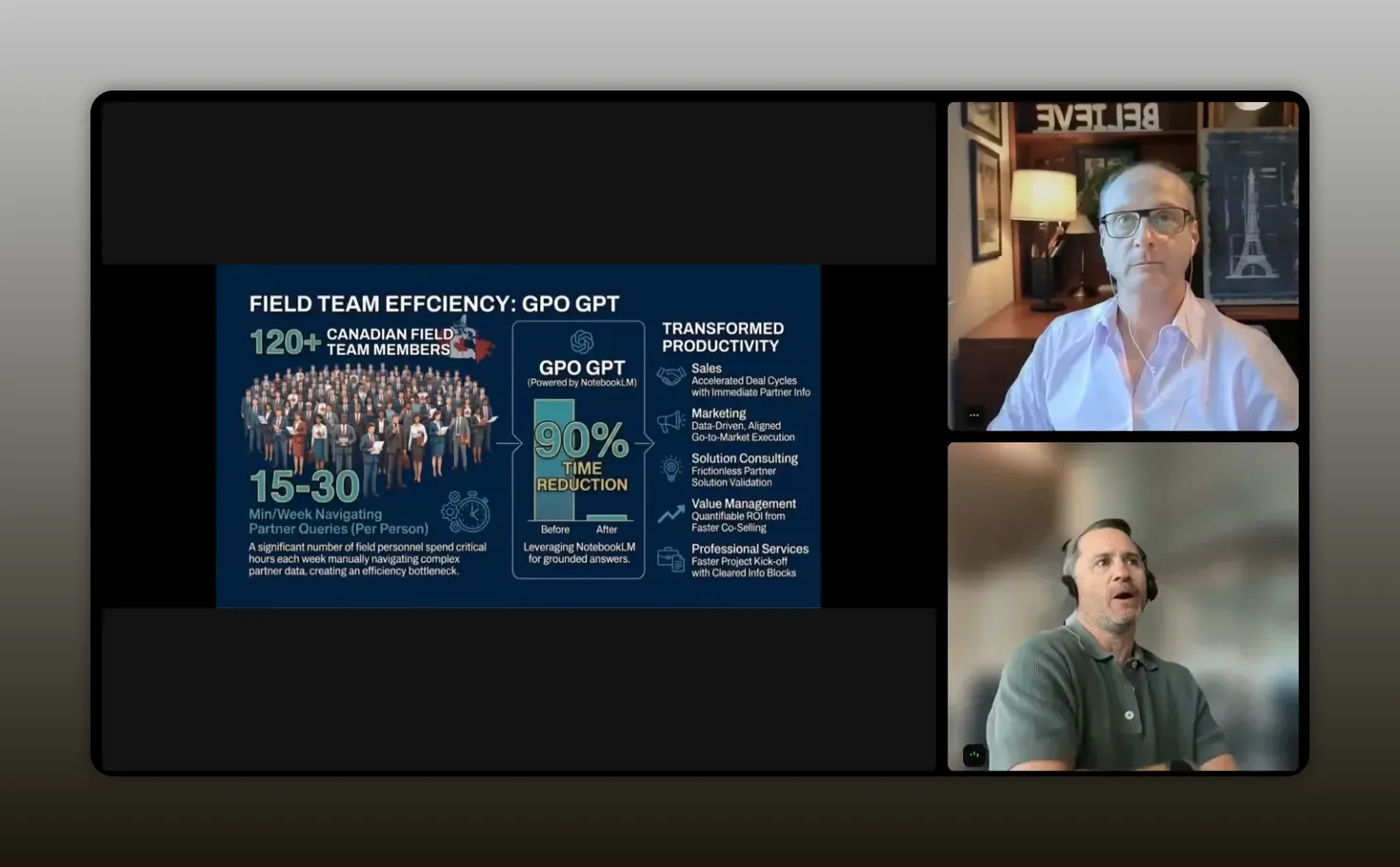
Instead of 125 field people going to Ty across Canada, they could go to the notebook first. If the answer was clear, they moved forward. If something still needed interpretation, then they escalated.
That changed the flow of work in a few important ways.
- Question volume dropped sharply. Ty estimated a 90 to 95 percent reduction in direct requests to him.
- Adoption was strong. More than 100 of 125 field users opted in and used the system.
- Time savings spread across the organization. Instead of only saving Ty’s hours, the notebook reduced the search and coordination burden across the field.
- Co-sell support became more scalable. Teams no longer had to wait for a single human gatekeeper to route them.
He estimated the broader organization was saving around 50 to 60 hours, which is an enormous return for a tool built from existing resources and a disciplined data foundation.
This is also a reminder that AI ROI should not be measured only by headcount reduction or flashy automation claims. In partner organizations, one of the most meaningful forms of ROI is execution speed. If deals move faster, internal alignment improves, and partner selection gets better, that value shows up everywhere.
“The right answer at the right time beats a heroic scramble every single time.” —Ty Lingley
From operations to strategy
One of the most interesting parts of Ty’s experience was the unintended upside.
He originally built the notebook to reduce lower-value repetitive work. That alone would have justified the effort. But once the notebook became comprehensive and reliable, it started helping with higher-order strategic questions.
For example, it contributed to partner strategy work for a specific company searching for ideal partners. It helped reveal friction points in the services partner journey. It also generated fresh thinking around co-sell improvements.
This is where many teams underestimate grounded AI. If you build it narrowly, it acts like a help desk. If you build it deeply, it can start acting like an ecosystem analyst.
That does not mean it becomes the strategist. It means it becomes a force multiplier for strategy. It can spot patterns faster, compare internal realities against outside best practices, and surface ideas you may not have connected manually.
“Once the system got strong enough on the basics, it started helping with strategy too.” —Ty Lingley
That transition from operational support to strategic insight is worth planning for. The first phase of your build might focus on question deflection and partner lookup. The second phase can expand toward partner planning, co-sell optimization, territory alignment, and program design.
How to keep data fresh
A stale partner intelligence system becomes a liability fast. If people lose trust in the answers, adoption disappears.
Ty handled freshness by working with the systems already in place. Because NotebookLM connected into Google Drive, updates to source files flowed in as those files changed. For data living elsewhere, such as reporting platforms, he used a simple bridge: pull data into Google Sheets, then let the notebook read from those sheets.
That is a practical pattern you can use even if your ecosystem data lives across multiple tools.
- Identify the source of truth for each partner data category.
- Create a reliable export or sync into an approved intermediary format.
- Point your grounded AI tool at that approved source.
- Establish owners for update cadence and quality checks.
The architecture does not need to be glamorous. It needs to be dependable.
Ty described using reporting data visualized in Sigma and then pulled into Google Sheets so it could update in near real time for the notebook. The exact stack may differ in your environment, but the principle stays the same. You are creating a controlled data path that balances usability with governance.
Governance and enterprise reality
The enterprise angle of this story matters because it is where many AI conversations become unrealistic.
In large organizations, the challenge is not only whether something is technically possible. It is whether it is allowed, supportable, and secure.
Ty did not bypass that reality. He worked inside it.
That meant:
- Using AI products already approved and rolled out internally
- Building from source-constrained data rather than uncontrolled inputs
- Controlling access through opt-in permissions
- Connecting to governed data sources instead of improvising shadow systems
This is one reason the project gained traction. It was useful, but it was also legible to the organization. It fit the environment instead of fighting it.
There is also a political lesson here. If you need access to more partner data, momentum helps. Ty noted that once the notebook had demonstrated value, it became easier to request access to additional information. Success created leverage.
If your own blocker is budget, security review, or internal approval, it may help to frame your plan around a narrow but high-value use case first. That is often the cleanest way to prove trustworthiness before expanding. For organizations wrestling with that step, this guide on winning budget and security approval for AI offers a useful lens.
Recommended tools
You do not need an oversized stack to get started. You do need clarity on what each tool is doing.
Core tools from Ty’s approach
- NotebookLM for grounded question answering and reasoning from approved sources
- Google Drive for storing docs, slides, sheets, and shared source material
- Google Sheets as a practical bridge for structured partner data updates
- Sigma or Tableau as reporting layers when partner performance and revenue data already live there
Useful source categories
- Partner program documentation
- QBRs and fiscal plans
- Account mapping data
- Delivery and qualification data
- Joint value propositions
- Partner offers and authorizations
- External best practice content
What to evaluate before you build
- Whether your AI tool can be constrained to trusted sources
- Whether your data owners will support a regular sync path
- Whether access controls can be managed cleanly
- Whether your field teams have a clear reason to adopt it
If the answer to those questions is yes, you likely have enough to begin.
FAQs
What problem does a partner AI notebook solve first?
It solves the retrieval problem. Instead of forcing sales, marketing, services, and partner teams to hunt across documents or wait for one expert to answer them, it provides fast responses grounded in your actual ecosystem data.
Why use a grounded tool like NotebookLM instead of a general chatbot?
A grounded tool limits responses to the sources you provide. That makes it more reliable for partner programs, qualifications, offers, revenue context, and internal decision support. General chatbots are useful, but they are not automatically informed about your partner ecosystem.
Do you need a technical team to build this?
Not necessarily. Ty’s example shows that a capable partnership leader can build a useful version with approved tools and strong data organization. The more complex your integrations become, the more technical help may be useful, but you can start without a major engineering effort.
What data should you prioritize first?
Start with the data behind your most common internal requests. That usually includes partner program rules, value propositions, qualifications, authorizations, partner performance metrics, account overlap, and partner contacts.
How do you keep the answers up to date?
Connect your grounded AI system to living sources whenever possible. Ty used Google Drive for dynamic documents and Google Sheets as a bridge for reporting data coming from other systems. The key is establishing a repeatable sync process, not relying on manual refreshes forever.
Can this help with strategy, or is it just for support requests?
It can absolutely help with strategy once the data foundation is strong. In Ty’s case, the system evolved from handling tactical partner questions to contributing to partner selection, co-sell improvements, and services journey analysis.
What adoption signals should you look for?
Look for repeated use by field teams, a drop in direct inbound partner questions, faster response times for partner decisions, and growing demand for additional data sources. Those signals show the system is becoming part of how the business actually works.
Conclusion
You do not need to wait for a perfect enterprise AI future to make partnerships more scalable right now. Ty’s approach shows that if you can access the right data, make it available in a grounded environment, and work within approved tools, you can turn scattered partner knowledge into a usable operating system for your field teams.
The headline benefit may sound like efficiency, and that part is real. But the deeper value is sharper execution. Better partner matching. Faster co-sell support. Less dependency on one overextended human router. More time for the work that actually moves the ecosystem forward.
If your partner team is buried in requests, this is your opening. Start with the questions you answer over and over. Build the source base. Ground the AI. Prove the value. Then expand from there.