How to Find and Build High-Impact Partnerships with AI
Expert advice from Delya Jansen at PartnerUtopia.
Snapshot
You are measured on results, not effort. That simple truth reshapes how the top partnership leaders approach partnerships—and it raises the bar for speed, accountability, and repeatability.
The stakes are high: the majority of partnerships fail, and each failure can waste months of time, drain scarce resources, erode executive confidence, and even jeopardize careers. At the same time, powerful new AI capabilities let you compress discovery, strategy, and execution into far shorter cycles—turning weeks or months of manual research and coordination into hours or days of evidence-backed decisioning.
The big opportunity is to move from endless manual processes—fragmented spreadsheets, ad-hoc playbooks, and a dozen open tabs—into a repeatable, measurable, evidence-based engine that reliably sources, evaluates, and discovers new partnerships with predictable results.
Keep reading to see what you can do to automate intake and scoring, instrument outcomes from day one, and ultimately shorten time-to-value and failure rates!
70% of partnerships fail—and you don’t have to accept that as inevitable – Delya Jansen
Table of Contents
- Why partnerships fail and what’s at stake
- Where traditional tools fall short
- Why combine your partnership playbook with AI
- Partner sourcing: from company goals to a prioritized landscape
- Partner workspaces: execution without chaos
- Reporting and measuring partner impact
- Pricing, adoption, and how small teams scale
- How to get started: practical steps you can take today
- Practical checklist for launching your first AI-aided partnership
- Common pitfalls and how to avoid them
- FAQs
- Conclusion
Why partnerships fail and what’s at stake
You know partnerships are supposed to accelerate growth, extend reach, and unlock new capabilities. But when you ask for evidence of impact across your organization, the answer is often fuzzy or absent. That’s because partnership work is rarely designed as a measurable, end-to-end process.
Instead, it’s a collection of disconnected activities: research in spreadsheets, PRM or CRM entries that are added late, Jira tickets at product level, and monthly slide decks assembled from stale exports.
Delya highlights the scale of the problem: you can expect roughly seven to 12 months—often longer—before a partnership even starts to show traction. Coupled with an industry failure rate she references, the math becomes stark: long cycles plus frequent failure equals a huge drain on budget and leadership patience.
What’s at stake is not just missed revenue.
You also lose time-to-market for product launches, waste headcount on manual integration coordination, and risk losing influence inside your company because your contributions aren’t clearly tied to company outcomes. If you are the partner manager, you are held accountable like a salesperson. That makes speed and clarity critical.
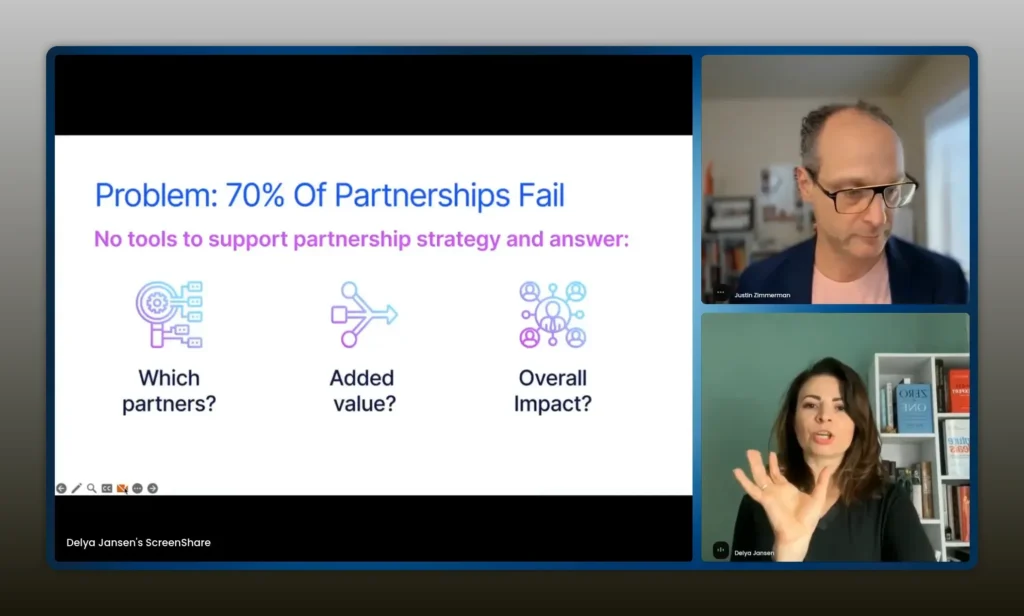
70% of partnerships fail — but failure isn’t inevitable. Build for outcomes, not activity. — Delya Jansen
Where traditional tools fall short
It’s tempting to blame tools. But the problem is not that tools don’t exist. It’s that they were built to do one thing very well. CRMs are for sales transactions. PRMs handle partner-facing workflows after a program exists. Project management tools track tasks. Analytics tools visualize data. None of them are designed to answer three essential early-stage questions:
- Should I partner at all to reach this company goal?
- If yes, who are the best-fit partners to pursue now?
- Once engaged, how do I operationalize and measure partnership health across teams?
Delya observed teams juggling 17 different tools and manually aggregating Excel sheets into Power BI or Tableau to produce the illusion of real-time reporting. That process is brittle and not repeatable. It also means partner managers spend more time hunting for data than driving partnerships that move the needle.
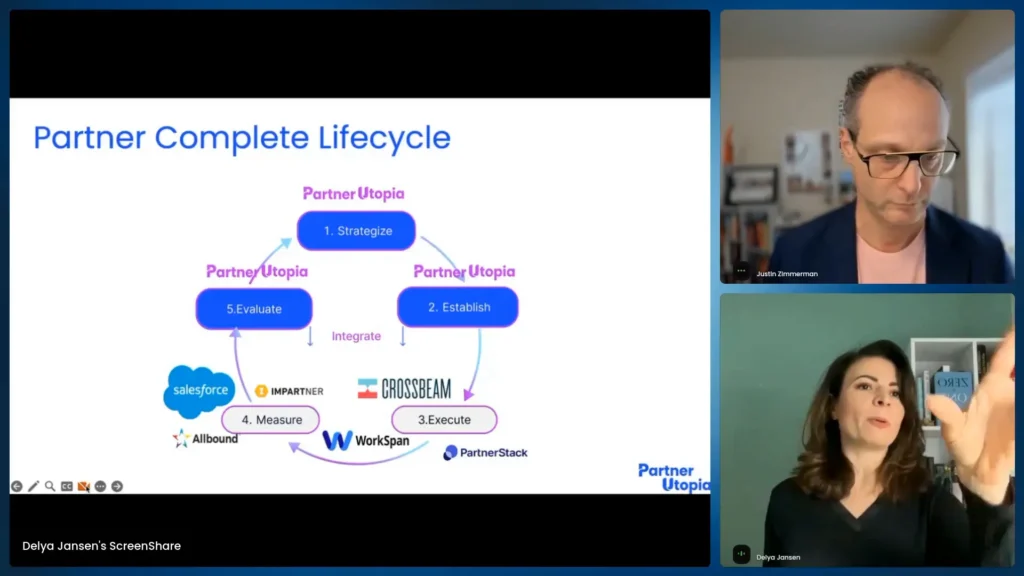
CRMs, PRMs, and project tools each do one job well — but none tell you if you should partner, who to prioritize, or how to measure partner impact. — Delya Jansen
Why combine your partnership playbook with AI
You’ve probably built repeatable processes by trial and error. You know which partner archetypes are quick wins, which are strategic bets, and which relationships are just fulfillment channels.
Delya took those proven formulas and asked: how do I make this a click-of-a-button process?
AI lets you convert logic and tribal knowledge into a cognitive engine that does the heavy lifting: recommends partners, writes initial outreach, and scaffolds execution plans.
AI is not a magic wand. It’s a tool that compresses the time it takes to arrive at the same high-quality answers you would otherwise reach manually. When you encode proven formulas into an AI-native workflow you: reduce discovery time, decrease failure rates, and free up your time to focus on higher-value relationship-building and negotiation.
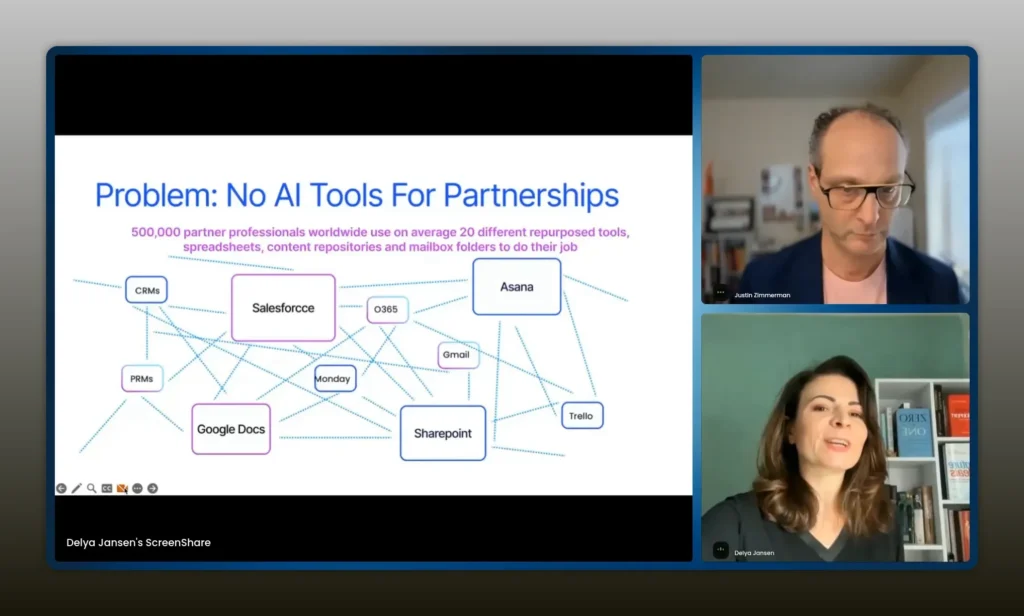
We we want a native AI tool that removes the 17-tab insanity – Delya Jansen
Partner sourcing: from company goals to a prioritized landscape
You start with outcomes, not partner profiles. Traditional partner discovery asks you to define an ideal partner profile and then fetch candidates from a database. That rarely produces strategic results. Instead, you should start by articulating the company goals you need to achieve: new markets, product integration, revenue acceleration, distribution, or customer support scale. From there you can ask the right question: who can get you closer to that goal fastest?
Delya describes a chat-based intake that asks the right questions up front: what are the company goals, which geographies matter, and what timing constraints exist. The output is not a flat list but a partnership landscape: an annotated, prioritized matrix that separates quick wins, strategic bets, and operational partners. That matrix becomes your strategy slide—ready to present to leadership and align stakeholders.
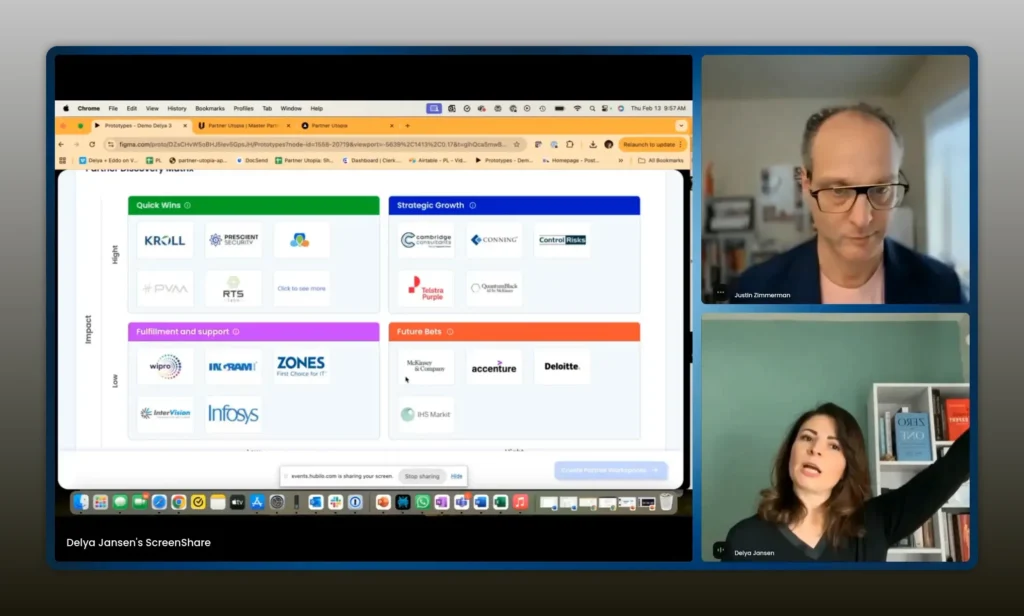
A partnership landscape should be a strategy, not a raw list of names – Delya Jansen
How to evaluate potential partners quickly
- Map partner fit to objective. For each candidate, identify the exact role they will play relative to your goal: customer acquisition, product integration, go-to-market amplification, or fulfillment.
- Assess speed to value. How quickly can the partner start producing measurable outcomes? Prioritize partners with short runway to meaningful metrics.
- Consider complexity. Integration-heavy partnerships may have high upside but require product resources and time. Balance those with simpler transactional or co-marketing relationships early on.
- Gather intelligence. Pull LinkedIn stakeholders, recent press, product maturity signals, and any partner-program details into a single brief so you can make a decision with evidence.
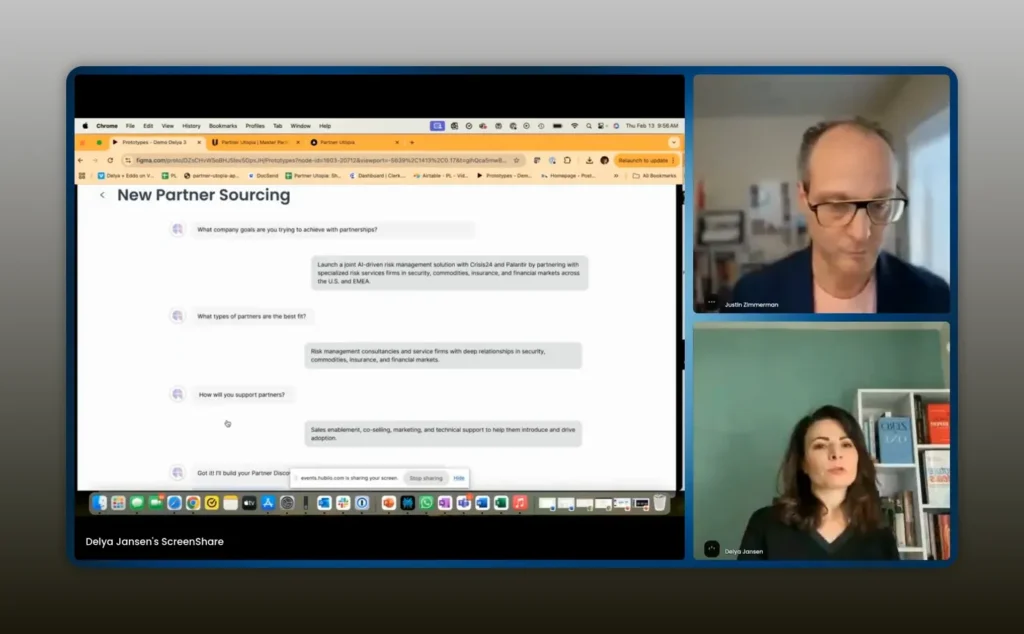
Partner discovery must be conversational and goal-driven, not a static database search – Delya Jansen
Partner workspaces: execution without chaos
When you decide to pursue a partner, execution is the next challenge. That’s where partner workspaces come in. Imagine each partner as a pre-populated project that contains:
- A partnership profile, filled automatically with company info and the joint value proposition
- Suggested stakeholder contacts and outreach messaging pulled from social and public sources
- Pre-built tasks and milestones aligned to your goals (integration, co-selling enablement, landing page creation)
- Built-in tracking of status, incentives, and success criteria
Delya emphasizes the pain of starting with a blank workspace. Instead, everything should be scaffolded based on your initial intake. That reduces busy work and prevents the partner manager from spending half the week filling out profiles and hunting approvals.
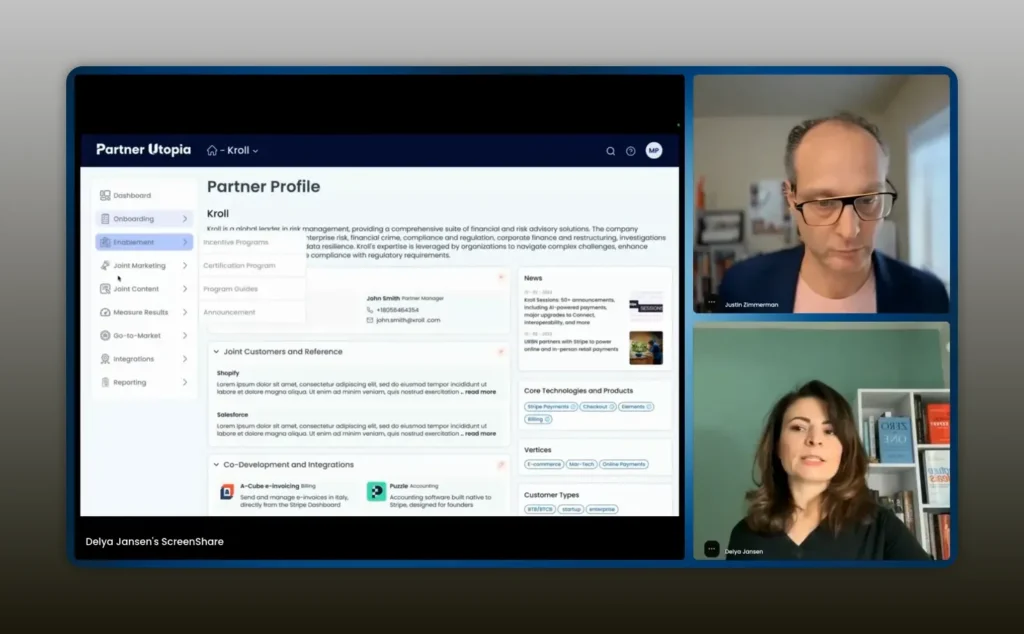
When you land on a partner workspace, you should find the work already started for you – Delya Jansen
What a good workspace does for you
- Standardizes onboarding steps so nothing is missed
- Provides repeatable playbooks per partner archetype
- Creates a single source of truth for cross-functional work
- Ties tasks to measurable outcomes and reporting
Reporting and measuring partner impact
The worst part of partnership reporting is that you often only show activity, not impact. You need to connect partner activity to company-level outcomes. Delya describes how teams used to aggregate Excel exports from a dozen tools into a BI dashboard. That may create pretty graphs, but it wasn’t real-time and it was effort-heavy.
The better approach is to instrument partnership outcomes from day one. Define success metrics for each partner at intake, then ensure your workspace and downstream integrations capture the signals that feed those metrics. Examples:
- For distribution partners: leads generated, conversions, ARR influenced
- For product partners: number of joint integrations, usage of the integration, support tickets reduced
- For channel partners: pipeline created, partner-influenced closed deals
Automated, dynamic reports should reflect live progress against these metrics. That keeps leadership informed and elevates your role by showing measurable contribution to company goals.
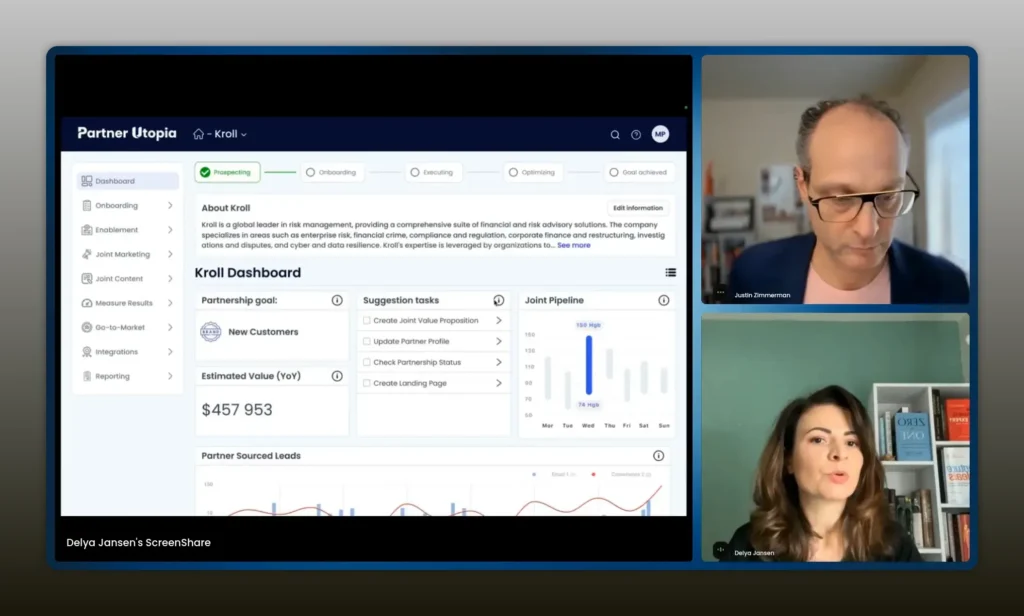
Dynamic reporting replaces static Excel slides and proves the partnership’s real contribution – Delya Jansen
Pricing, adoption, and how small teams scale
Delya built the product with the solo or small partner team in mind. If you are a team of one, two, or three, affordability and ease of adoption matter. Her approach is product-led growth: offer a low barrier to entry so individual partner managers can adopt the tool without enterprise procurement cycles.
Key pricing and adoption points to consider:
- Offer a low-cost entry tier so an individual contributor can purchase with minimal approvals
- Provide modular functionality (sourcing vs workspaces) so you only pay for what you need
- Ensure the product requires minimal IT overhead; the setup should be simple and fast
- Offer a beta or pilot program if you have complex needs; early access can accelerate feature parity for enterprise use
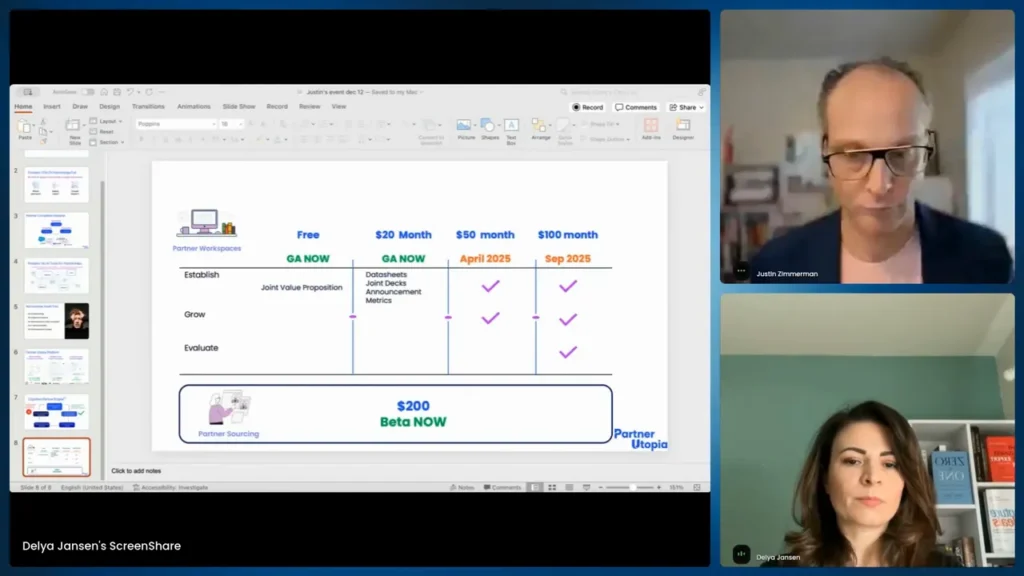
Enable partner managers to use the tool out of pocket if needed—so they can start delivering results fast – Delya Jansen
How to get started: practical steps you can take today
If you want to move from manual chaos to a repeatable partner engine, follow this sequence:
- Define the company outcome you want partnerships to advance. Be specific with metrics and timelines.
- Run a short intake chat with yourself or a small team to capture priorities, regions, and resource constraints.
- Generate a prioritized partner landscape that separates quick wins from strategic bets.
- Pick one quick-win partner and open a workspace pre-populated with tasks and a joint value proposition.
- Set success metrics and instrument reporting into a dashboard you can share weekly.
- Iterate based on results and expand to the next partner using the same template.
Practical checklist for launching your first AI-aided partnership
- Goal clarity: Document the single company outcome the partnership must move.
- Stakeholder map: Identify internal and external decision makers.
- Scorecard: Define acceptance criteria for partnership health (speed, revenue, integrations).
- Outreach kit: Prepare a joint value proposition and three outreach templates (LinkedIn, email, and phone script).
- Workspace template: Create or adopt a template that includes milestones, deliverables, and reporting fields.
- Measurement pipeline: Ensure the workspace captures metrics that feed your BI or dashboard tool.
- Review cadence: Schedule weekly partner health checks and monthly executive summaries.
Common pitfalls and how to avoid them
Even with AI and good workspaces, mistakes happen. Here are the most common pitfalls and how to avoid them:
- Rushing to sign partnerships without alignment on outcomes. Avoid by requiring a shared success metric before formalizing the relationship.
- Underestimating integration complexity. Avoid by scoring technical integration risk during sourcing and gating product-level engagement behind a technical feasibility milestone.
- Overloading partners with tasks without offering value. Avoid by always starting outreach with a clear joint value proposition and immediate reciprocal actions.
- Relying on activity metrics. Avoid by tying every activity to an outcome and tracking outcome signals, not just task completion.
FAQs
What is the first question I should answer before pursuing any partnership?
Define the company-level outcome the partnership must move and how you will measure it. If the partnership cannot be tied to a measurable outcome, deprioritize it.
How quickly can a partnership show meaningful results?
It depends on the type of partner. Quick-win co-marketing or distribution partners can show early signals in weeks to a few months. Product integrations and strategic channel plays typically take 6 to 12 months. Use the partner landscape to pick a mix of short- and long-term bets.
Can a solo partner manager afford to adopt an AI-powered tool?
Yes. Look for product-led platforms with low-cost tiers that let you start without enterprise procurement. The key is to ensure the tool reduces time-to-value and fits into your current workflow with minimal IT involvement.
What metrics should I track to prove partnership impact?
Choose metrics tied to your stated outcome. Common ones include partner-influenced pipeline, ARR influenced, number of active joint integrations, lead conversion rates from partner channels, and reduction in customer support incidents due to partner solutions.
How does AI actually help with partner discovery?
AI compresses the research and pattern recognition you would normally do manually. It can synthesize company signals, produce a prioritized partner landscape, create evidence-backed explanations, pull stakeholder contacts, and generate initial outreach messages that you can personalize.
Conclusion
Partnerships can be transformative, but only when you treat them as measurable, repeatable engines rather than one-off efforts. You can reduce failure rates by encoding your best practices into a coherent workflow: start with company outcomes, use a prioritized partnership landscape, scaffold execution with pre-populated workspaces, and instrument impact from day one. AI accelerates every step of that process by turning your heuristics into consistent, scalable actions. If you are a partner manager operating with limited resources, focus on quick-win partners first, adopt tools that minimize administrative overhead, and use the playbooks you refine to scale toward strategic bets. The result: faster results, clearer impact, and a partnership function that earns the recognition and resources it deserves.