Unlocking Cloud Marketplaces: Practical Steps to Build a Real Revenue Channel
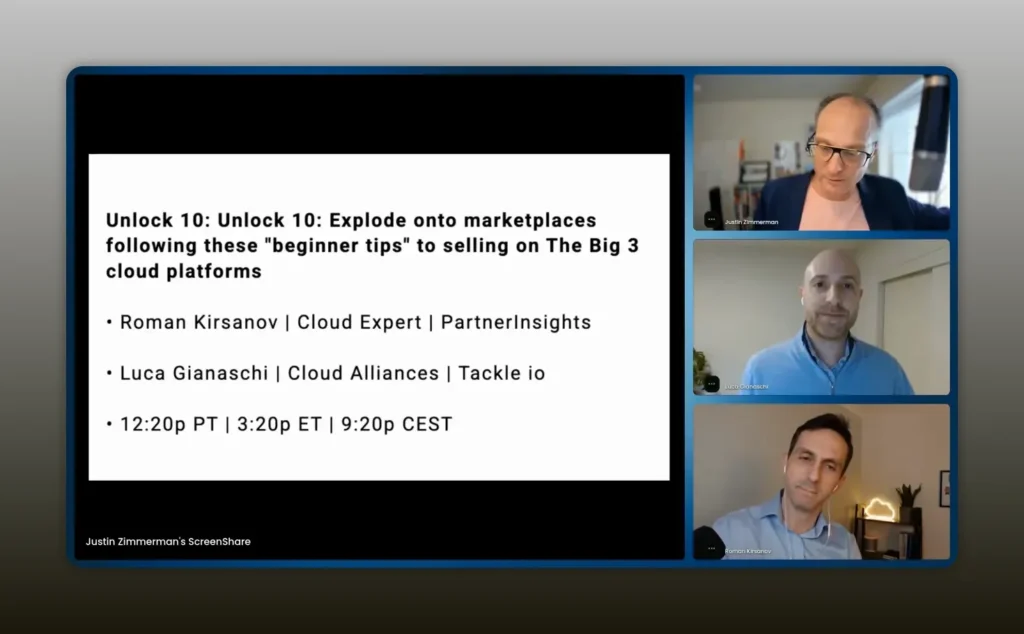
Expert advice from Roman Kirsanov at PartnerInsight and Luca Gianaschi at Tackle.io.
Snapshot
You face a major inflection point: customers, budgets, and buying habits have shifted toward cloud marketplaces and co-sell channels. Buyers are increasingly comfortable with self-service procurement, procurement teams expect catalog‑based purchasing paths, and cloud field sellers are being incented to recommend solutions that fit into their customers’ cloud contracts.
That means the question for most teams is no longer whether to participate, but how to engage effectively — how to avoid the common traps of treating a marketplace listing as a one‑off project, under‑resourcing the motion, or assuming cloud sellers will organically discover and champion your product without targeted enablement.
The opportunity is enormous and time‑sensitive. The hyperscalers have committed hundreds of billions in customer and platform spend (public estimates cluster in the low‑hundreds of billions—roughly $400B+ in documented commitments), enterprise buying is moving toward self‑service and marketplace models, and cloud sellers are becoming a powerful, incentivized distribution engine.
Those forces together create a rare window: with the right mix of investment you can capture incremental net‑new revenue, shorten sales cycles, and scale recurring revenue in ways that traditional channels often cannot match.
Keep reading to see what you can do to move fast and skillfully, so you can take advantage of this opportunity.
The cloud is a huge, time‑sensitive revenue opportunity—treat marketplaces as a real revenue channel and invest the people and time to capture it. — Luca Gianaschi
Table of Contents
- Why cloud marketplaces matter right now
- Four pillars to build a cloud go-to-market engine
- How much investment and time to expect
- Validating product and customer fit for marketplaces
- Operational realities: roles and day-to-day activities
- Common misconceptions that slow teams down
- A practical checklist to get started
- How to think about co-selling and cloud incentives
- Scaling: when and how to double down
- Resources and next steps
- FAQs
- Conclusion
Why cloud marketplaces matter right now
Market dynamics are changing. Enterprises have committed hundreds of billions in cloud spend, hyperscalers are accelerating investments, and buying patterns are shifting toward digital procurement. Those two facts together make cloud marketplaces a strategic distribution channel.
When you recognize the size of the pool—cloud commitments on the order of hundreds of billions—you also see why the hyperscalers are motivated to route customer spend through their marketplaces, and why your product being available and discoverable there can translate into meaningful revenue.
Imagine this $419 billion in cloud commitments. They have committed 30 percent on average that is underspent—customers will pull your products. — Roman Kirsanov
Beyond raw spending, adoption patterns matter. Analyst research suggests a significant share of large B2B deals will flow through self-service and marketplace channels in the near future. That means marketplaces are not an experiment; they are increasingly how procurement happens.
Four pillars to build a cloud go-to-market engine
Turn marketplace listing into a revenue channel by focusing on four core pillars: People, Processes, Technology, and the Cloud Partnership itself. Each pillar needs attention, and the interplay between them determines velocity and scale.
People
Someone needs to own the motion full time. That means a cloud alliances or partnerships leader to start and at least one dedicated role focused on the hyperscaler field. You cannot run a meaningful co-sell and marketplace motion purely part time.
Expect daily engagement with the cloud provider field. That engagement is how you earn mindshare and become a product sellers recommend or include in deals.
You have to have resources that engage on a daily basis with the field to promote your product. — Luca Gianaschi
Processes
Define how opportunities are logged, qualified, and routed. Operational cadence matters: how you track co-sell leads, how you respond to cloud field requests, and how you internally prioritize marketplace SKUs will determine whether sellers can actually transact with your product.
Standardize the playbooks for co-sell handoffs, proof-of-concept approvals, discounting logic, and fulfilment. Create simple templates for the cloud seller so they can quickly recommend your product to customers without operational friction.
Technology
Use tools to automate the mundane and scale the repeatable. Marketplaces often require integrations with billing, entitlement, and usage reporting. Early investment in automation reduces the manual burden on your team and speeds deal execution.
Platforms exist to manage listing lifecycles, co-sell pipelines, and deal registration. Leverage them to centralize the intelligence you need to analyze performance and prioritize effort.
Tackle helps ISVs sell and generate revenue through the cloud providers. — Luca Gianaschi
Cloud partnership and alignment
Be explicit about value to the cloud provider. Ask: what do you bring to the table and why should the cloud seller prioritize you? Clouds care about customer success, predictable revenue, and product fit. Align incentives and participate in the partner programs the cloud offers.
Successful ISVs build a two-way relationship: they help cloud sellers win by making the offering easy to understand, and they leverage provider programs to co-market, co-sell, and co-invest.
People, processes, technology, and the cloud partners and cloud alliances relationship. — Luca Gianaschi
How much investment and time to expect
There is no single number that fits all companies, but you should plan with realistic ranges so internal stakeholders understand the commitment and the expected runway to traction.
Headcount
Start with one dedicated full-time person owning alliances or cloud go-to-market. That role coordinates with product, marketing, sales, and finance. As you see results, you will scale the team—adding seller-facing roles, technical enablement, and program management.
Part-time ownership rarely works. If you are not willing to put a real FTE on the motion, the cloud marketplace will become a checkbox rather than a channel.
Time horizon
You need to think in terms of quarters and years, not weeks. Expect a minimum six months to get a sense of whether the approach is gaining traction, and plan a one to two year runway to build a meaningful program. That covers listing configuration, field enablement, initial co-sell wins, and refining your go-to-market playbook.
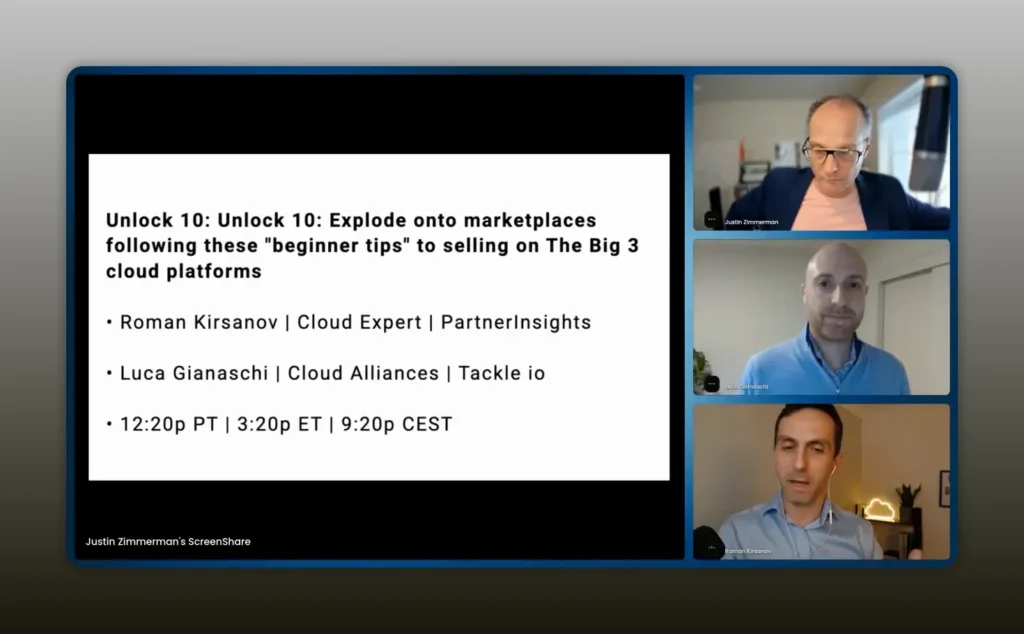
You need to start to think like it’s at least a six months exercise just to get whatever sense where it’s going. — Roman Kirsanov
Budget and other investments
Investment is not only cash but time and organizational attention. Budget items include:
- Headcount for alliance and seller enablement roles
- Platform and tooling to manage marketplace listings and co-sell pipelines
- Marketing and enablement materials targeted at cloud sellers
- Potential incentives, discounts, or funding to offset friction with buyers
Frame the line item as channel development rather than a marketing experiment. That helps secure longer term budget and alignment.
Validating product and customer fit for marketplaces
Not every product belongs on every marketplace. Before you commit, validate two things: product suitability and customer overlap with the cloud provider’s install base.
Product suitability
Ask if your product can be transacted and delivered in a cloud-native way, whether as SaaS, marketplace meter billing, or as an image/container that runs in customer accounts. Marketplace buyers expect a smooth procurement and procurement-to-production path.
Focus on your best product first. Put the offering that is easiest to package, price, and support into the marketplace to learn the channel dynamics.
Customer overlap
Even if your product is a good fit, your customers must live in the cloud provider’s ecosystem. If your buyer base does not overlap with that provider’s customers, you’ll see limited traction.
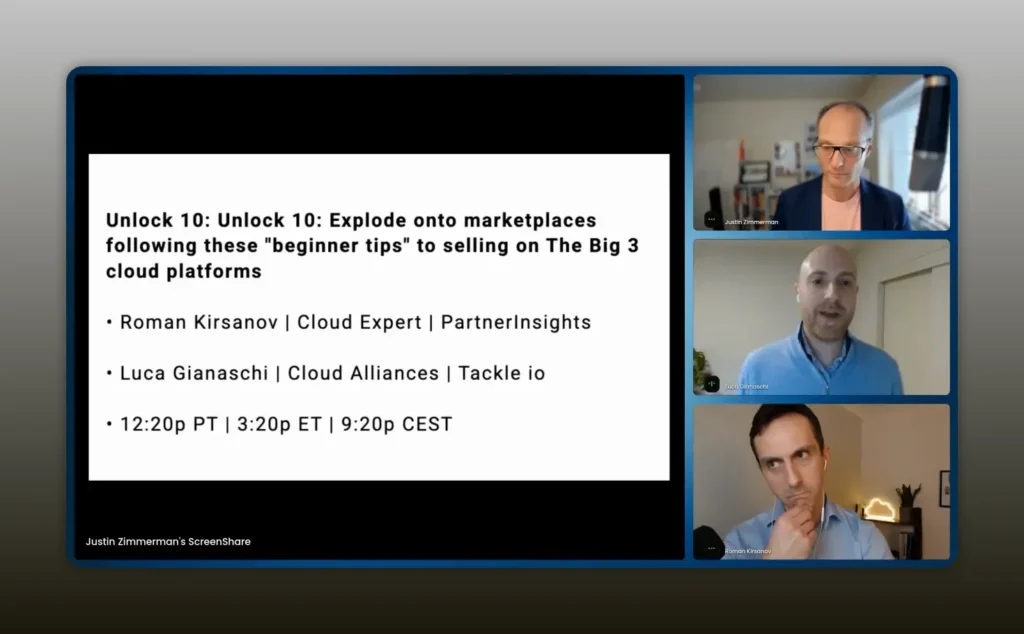
The product has to be interesting for the cloud and you have to have your customers there. — Luca Gianaschi
Use data to validate overlap. Marketplace platforms and third-party tools can reveal where your prospective accounts host, which helps prioritize which cloud marketplaces to pursue first.
Operational realities: roles and day-to-day activities
Once you commit, the daily work matters. Success is built on repetitive, consistent activities.
Daily and weekly cadence
- Daily: respond to cloud field inquiries, update active opportunities, and address any technical or procurement blockers.
- Weekly: sync with cloud partner managers, review pipeline health, and push enablement content to sellers.
- Monthly: analyze deal metrics, usage trends, and customer feedback to refine the offering and enablement approach.
Enablement and sales alignment
Make it effortless for the cloud seller to recommend you. That requires clear one-pagers, standardized demo environments, and a consistent set of answers for typical procurement questions like integration, pricing, SLA, and support.
Train your own sales team to complement the cloud seller’s effort rather than compete with it. Alignment creates an amplifying effect where both sides help close deals faster.
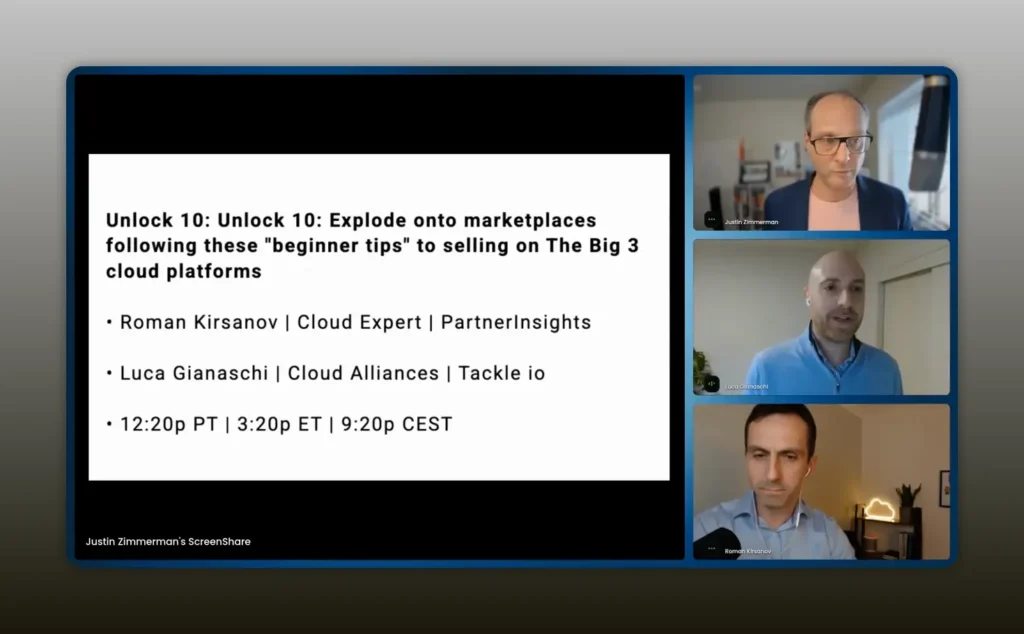
Start getting on those marketplaces and start activating their co-sale motion with the cloud providers. — Luca Gianaschi
Common misconceptions that slow teams down
Certain myths and unrealistic expectations cause teams to stall. Address these early so you can plan realistically.
Myth: listing is enough
Listing a product does not magically generate revenue. There is no substitute for intentional go-to-market motion, seller enablement, and operational follow-through.
Myth: cloud sellers will discover and champion your product without support
Cloud sellers are busy and oriented to customer outcomes. They will prioritize your product when you make it easy for them to recommend and when there is demonstrable value for the customer. That requires active engagement, not passive waiting.
Myth: minimal investment will yield maximal results
Marketplace channels scale when you commit people, time, and processes. Minimal investment may produce a trickle of inbound interest, but those results are not repeatable without deliberate support.
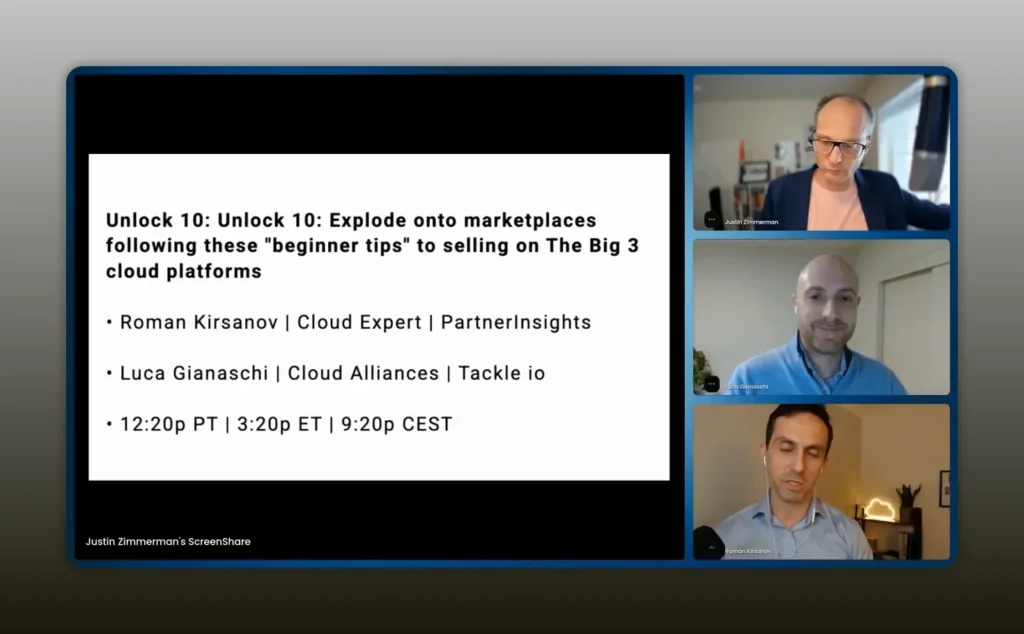
We are not partnering with them, we are sort of partnering with them—how do I get into this train which is taken off. — Roman Kirsanov
A practical checklist to get started
Use this short checklist as a launch sequence to convert initial interest into a predictable program.
- Validate product suitability: Can your product be packaged and transacted through a marketplace?
- Validate customer overlap: Are your target customers on the cloud provider you plan to partner with?
- Assign ownership: Hire or designate a full-time cloud alliances lead.
- Choose the pilot SKU: Start with the product that is easiest to package and support.
- Define operational playbooks: Co-sell handoff, pricing approval, proof-of-concept rules, and deployment support.
- Select tooling: Marketplace management, deal pipeline tracking, and billing integrations.
- Enable the cloud field: One-pager, 15-minute demo, standard POC, and an FAQ for sellers.
- Set KPIs and timeline: Define six-month milestones and a 1–2 year runway for scale decisions.
- Measure and iterate: Use usage and pipeline data to refine the offer and enablement cadence.
How to think about co-selling and cloud incentives
Co-selling is one of the most misunderstood elements of cloud go-to-market. It is not simply putting a product in front of a cloud seller. Co-sell requires reciprocity: cloud sellers need to see how recommending your product helps their customers and moves deals forward.
Practical tactics include:
- Joint customer stories that highlight measurable outcomes
- Co-funded pilots or credits to lower initial procurement friction
- Fast-response engineering support during sales cycles
- Clear pricing and contract templates that match cloud procurement expectations
Scaling: when and how to double down
Scale when you have repeatable evidence that the channel drives net-new revenue or materially shortens sales cycles. Indicators include:
- Consistent inbound demand from cloud sellers or marketplace discovery
- An increasing conversion rate for marketplace leads
- Operational capacity to handle onboarding and support without major manual work
At scale, invest in specialized roles: marketplace program manager, cloud seller enablement, and dedicated technical account management. Use data to decide where to allocate additional headcount and marketing spend.
Go to market strategy specific to this channel and validate your best products first. — Roman Kirsanov
Resources and next steps
If you want to accelerate, focus first on learning the provider-specific partner programs and the marketplace technical requirements. Each cloud has nuances in listing formats, billing models, and co-sell frameworks.
Use external data and tools to validate customer overlap and prioritize which cloud marketplace to pilot. Pilot aggressively with one SKU and one cloud provider, learn quickly, and then replicate success.
FAQs
How much headcount should I allocate to start a cloud marketplace program?
Begin with one full-time cloud alliances owner. This role initiates the program, coordinates internal teams, and engages daily with cloud field sellers. As traction grows, add seller-facing roles, technical enablement, and program management.
How long before I see meaningful results from a marketplace strategy?
Expect at least six months to gather initial signals and one to two years to build a meaningful channel. Use the first six months to validate product fit, customer overlap, and operational flow.
Is every product suitable for every cloud marketplace?
No. Validate both product suitability and customer overlap. Some products are ideal for a marketplace purchase model, while others require bespoke procurement. Use data to determine which marketplaces host your buyers.
What are the most important processes to define first?
Start with co-sell handoffs, opportunity tracking, proof-of-concept governance, pricing and discount rules, and fulfilment workflows. Those processes let cloud sellers recommend your product without operational blockers.
How do I get cloud sellers to recommend my product?
Make it easy: provide one-pagers, repeatable demos, clear outcomes and pricing, and short POC templates. Demonstrate customer impact and participate in co-marketing or incentive programs where appropriate.
What tools are essential for marketplace success?
Tools that manage listing lifecycles, co-sell pipelines, billing integrations, and deal registration are essential. These reduce manual work and provide the data you need to optimize the channel.
How do I prioritize which cloud provider to work with first?
Prioritize by customer overlap and ease of integration. Use data to see where your target accounts host workloads, and start where you have the most overlap and the clearest path to purchase.
Conclusion
The shift toward cloud marketplaces is not an optional experiment—it is a structural change in how enterprises buy software. If you want to capture this opportunity, treat marketplace participation as a channel with a plan, resources, and multi-quarter commitment.
Start by validating product and customer fit, assign a full-time owner, operationalize the co-sell process, and invest in the right tooling. Expect a learning curve and a runway of months to years, but also know that when you get the four pillars right—people, processes, technology, and trusted cloud partnership—you unlock a sustainable revenue channel that scales.
Make the choice to invest with intention, measure early signals, and double down when you see repeatable outcomes. The train is moving; prepare your team to get on board and build velocity.