Simplify hyperscaler marketplace listings: The Sugar.io partner ops playbook
Expert advice from Barbara Treviño (Alliances, Sugar.io).
Snapshot
Hyperscaler marketplaces open doors to enormous buyer commitments and new procurement routes, but they also create operational complexity that ripples across sales, finance, product, and customer success.
If you treat marketplace as a checkbox rather than a full GTM channel, you risk missed revenue, poor product fit signals, invoicing headaches, and bottlenecks that slow deals to a crawl.
Barbara explains how centralization, automation, and data are the levers that prevent those risks and turn marketplace into a scalable route to market. Keep reading to learn how Barbara can help you centralized marketplace listings, get faster private offers, and automated entitlement management.
I love making the marketplace experience coherent across teams — it changes how a business transacts in the cloud. -Barbara Treviño
Table of Contents
- Snapshot
- Table of contents
- Why hyperscaler marketplace matters now
- What partner ops actually does
- The five essential marketplace tools
- How to structure teams and processes
- Implementing automation and workflows
- Reporting, analytics, and KPIs
- Common pitfalls and how to avoid them
- Recommended tools
- Quick checklist for getting listed
- FAQs
- Conclusion
- Social post
Why hyperscaler marketplace matters now
Hyperscaler marketplaces — AWS Marketplace, Microsoft Azure Marketplace, Google Cloud Marketplace — are no longer experimental channels. Large enterprise customers increasingly prefer to use cloud consumption or committed spend to procure third-party software. That shift changes everything about how you price, package, sell, and recognize revenue.
When you treat marketplaces as an integrated route to market, you unlock:
- Access to buyers who prefer procurement through cloud contracts
- Simplified procurement and faster purchasing cycles for customers with cloud commitments
- Improved co-sell motion with hyperscaler sales teams when you track and share pipeline properly
- New distribution and usage signals that product and marketing teams can leverage
But marketplaces are also technically complex. Each provider has its own partner portals, private offer flows, billing primitives, and reporting models. That complexity often lands on the partnership team without the right ops support or tooling. The result is fractured processes, manual work, missed entitlements, and revenues that are difficult to forecast.
What partner ops actually does
Partner ops is the operational backbone that integrates partnerships into the broader business. It usually sits in revenue operations and connects partner strategy to tools, processes, data, and people. Partner ops translates alliance goals into programmatic solutions, automations, and measurable outcomes.
Key responsibilities of partner ops include:
- Mapping marketplace and co-sell flows into your CRM and systems
- Managing listings, private offers, entitlements, and disbursements
- Implementing automations that remove manual tasks from partner managers
- Providing analytics and attribution to sales, finance, and product teams
- Creating templates and workflows so the broader business understands partner-driven GTM
Barbara points out that partner ops is the bridge between sales, finance, product, and alliances. Without that bridge, partnerships become the redheaded stepchild of GTM — under-resourced, misunderstood, and underperforming.
The five essential marketplace tools
There are five functional tool areas you should prioritize when you operate in hyperscaler marketplaces. Each area addresses a core operational challenge and, together, they enable a repeatable marketplace motion.
1. Listing manager (centralized listing console)
What it does: consolidates all your marketplace listings across clouds into a single pane of glass. You can create, update, and manage PLG (product-led growth) and paid listings for AWS, Azure, and Google Cloud from one interface.
Why it matters: Each hyperscaler portal uses different fields, requirements, and content formats. Managing listings across portals manually is error-prone and slow. A centralized console removes those friction points and ensures buyers always see accurate product information.
Best practices:
- Standardize descriptions, screenshots, and offer language across clouds while adapting to platform-specific rules
- Use PLG listings to capture demand and follow up with contextual offers
- Gather a single source of truth for product metadata that feeds marketing and sales collateral
When Barbara manages listings, she focuses on making sure product messaging is consistent across clouds while letting each listing be tailored for cloud-specific buyer behaviors.
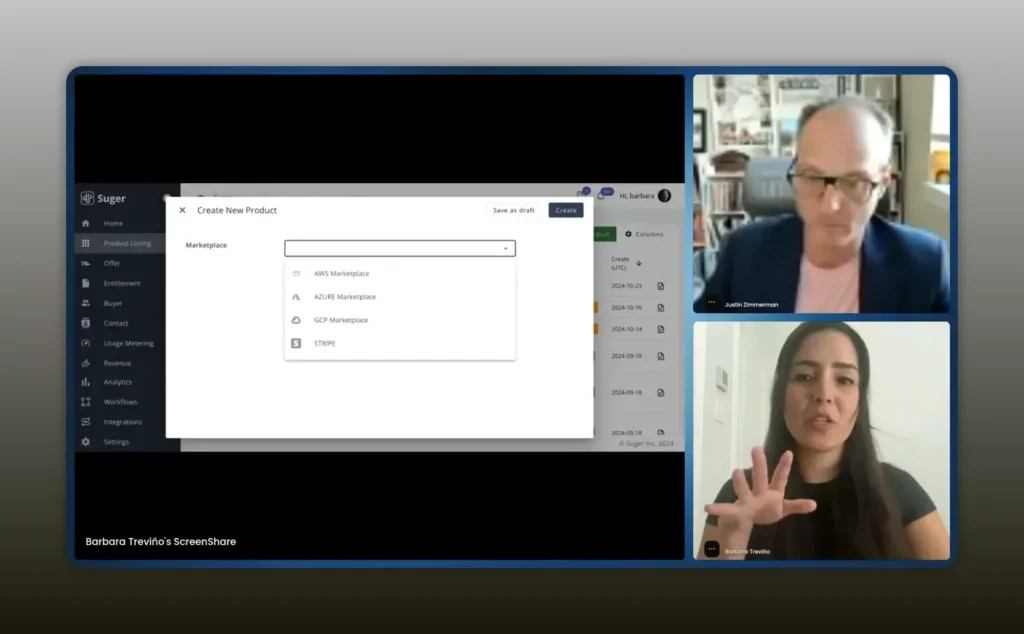
We centralize all dynamic parts of the hyperscalers into one pane of glass. -Barbara Treviño
2. Offers manager (private offers and pipeline visibility)
What it does: handles creation, distribution, and lifecycle of private offers. Tracks offer status (pending, accepted, expired) and ties offers to CRM opportunities so deal desk, partner teams, and sales have clear visibility.
Why it matters: Marketplace private offers are often how deals convert. Buyers use committed cloud spend to purchase your software. Without centralized offer management, your teams duplicate effort across different cloud portals and lose track of where deals stand.
Best practices:
- Map private offers to CRM opportunities and maintain a single opportunity record per buyer
- Set permission controls so deal desk can create, review, and approve offers without manual handoffs
- Create templates for commonly used discounts and contracting terms to speed approvals
Visibility into offer status reduces surprises and shortens time-to-close by enabling coordinated follow-ups.
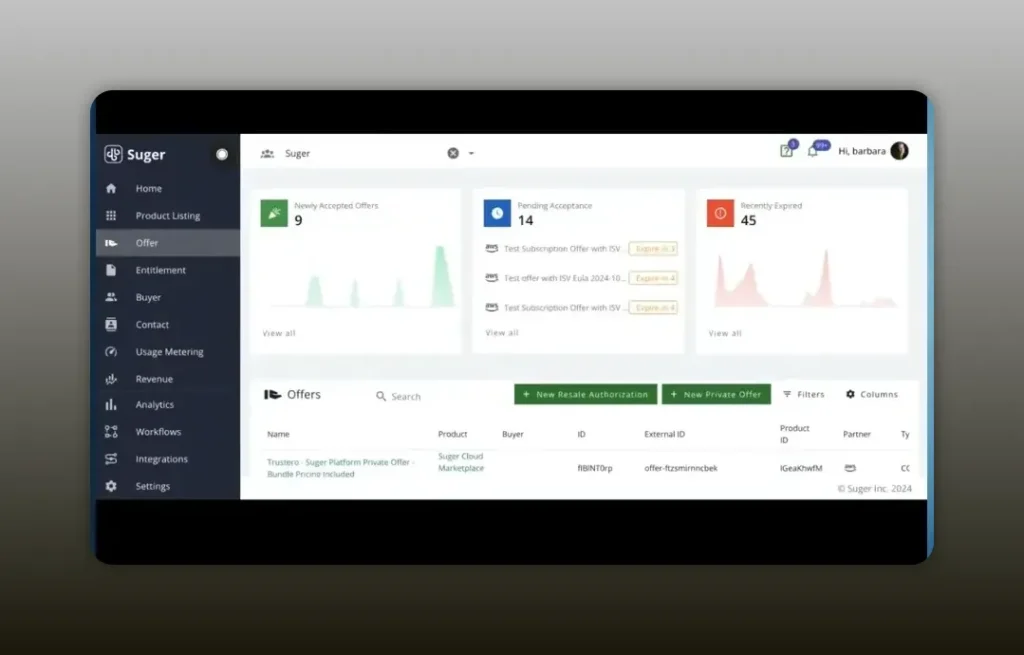
When an offer is accepted, it becomes an entitlement — and that needs to be managed. -Barbara Treviño
3. Entitlement and disbursement manager
What it does: tracks accepted private offers as entitlements and coordinates how revenue gets recognized and payments are disbursed back to you. Manages lifecycle events like renewal, cancellation, and consumption-based invoicing where applicable.
Why it matters: Finance teams must understand when a marketplace transaction turns into a recognized entitlement. Without accurate entitlement tracking, rev rec and cash forecasting break down. You also risk late or incorrect disbursements from cloud providers.
Best practices:
- Surface entitlement events into finance workflows automatically
- Generate alerts for expirations, renewals, and upcoming disbursement windows
- Document mapping of marketplace billing terms to your internal revenue recognition policy
Barbara emphasizes that entitlements are where the marketplace motion becomes real revenue — don’t let the handoff to finance be a manual mess.
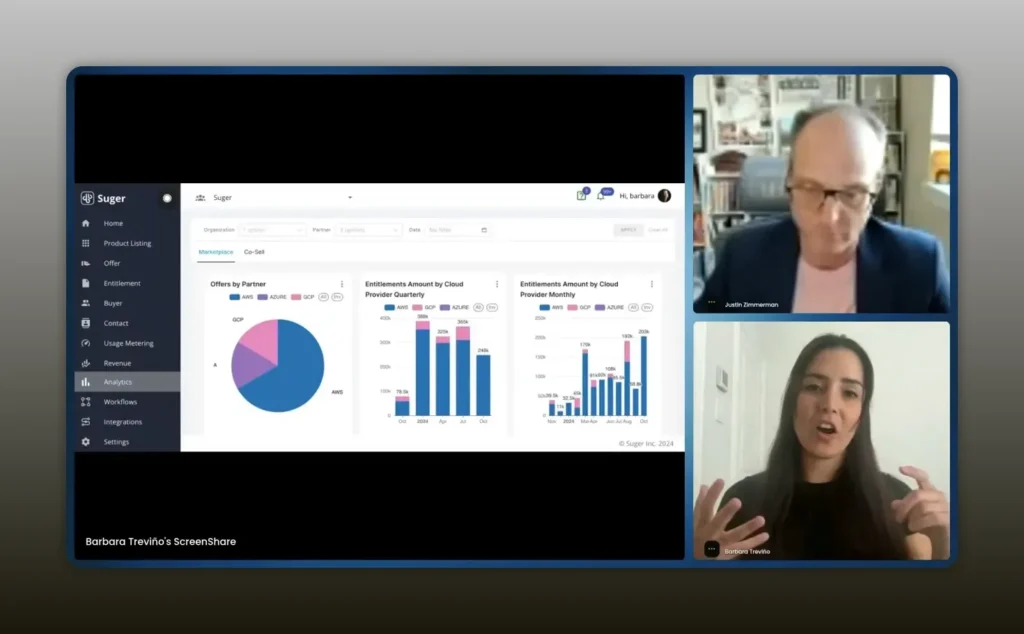
Automating entitlement creation stops revenue leakage and keeps finance in sync. -Barbara Treviño
4. Analytics and reporting
What it does: collects distribution, offer, entitlement, and usage data across hyperscalers and presents actionable dashboards for partner leaders, sales, and executives.
Why it matters: Attribution, partner contribution, and marketplace volume are conversation starters with executives. Data helps you answer which cloud performs best for which product and where to invest GTM resources.
Key dashboards to build:
- Distribution by cloud provider (volume, bookings, ACV)
- Offer funnel (sent, accepted, entitlement created)
- Product performance per marketplace
- Revenue recognition timings and disbursement forecasting
Use analytics to translate marketplace activity into decisions: where to optimize listings, what products to prioritize for specific clouds, and where additional enablement is required for sales teams.
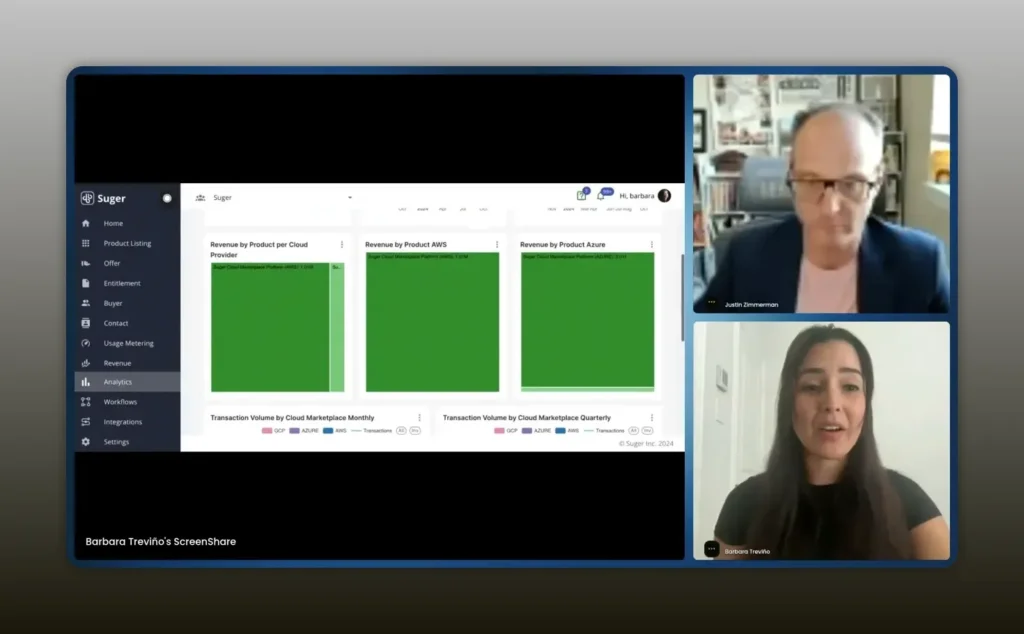
We use data to show partner contribution and the health of marketplace as a route to market. -Barbara Treviño
5. Workflow automation & integrations
What it does: automates approvals, notifications, and CRM syncs between marketplace portals and your systems. Integrates with Salesforce, HubSpot, Slack, and finance systems so actions in one place trigger downstream processes.
Why it matters: Manual emails, spreadsheets, and portal hopping kill speed. Automation reduces human error, ensures consistent processes, and frees partner managers to focus on strategic work like co-selling and partner enablement.
Common automations:
- When a private offer is accepted, create an entitlement record and notify finance
- When a CRM opportunity reaches a stage, auto-generate a private offer draft for deal desk review
- When a marketplace listing changes, notify product marketing and update website collateral
Barbara mentions workflows as one of Sugar’s major differentiators because they enable cross-team orchestration for marketplace events.
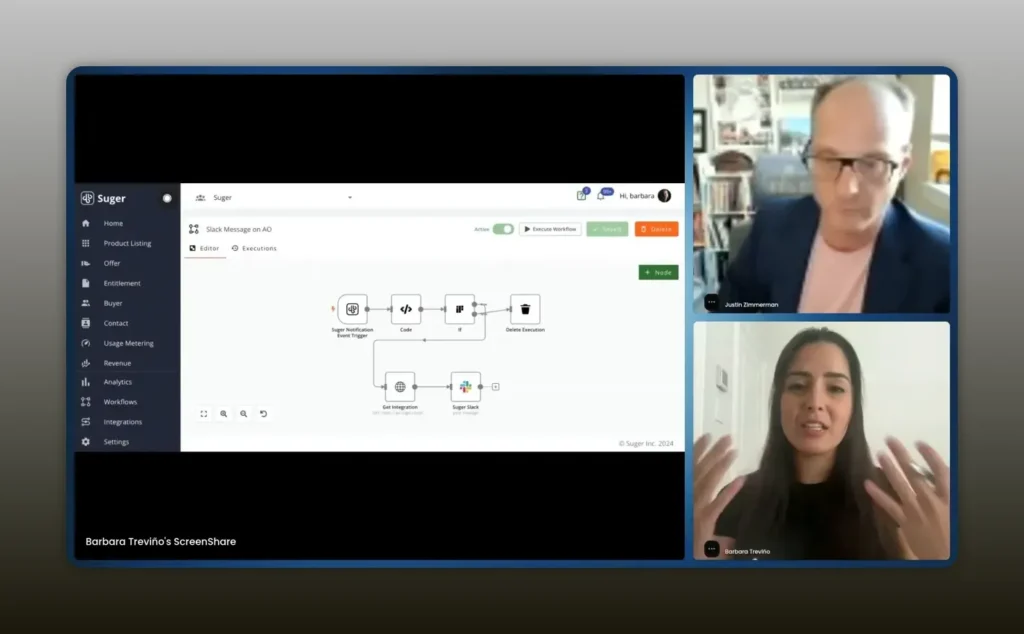
Workflows centralize the marketplace experience and remove repetitive tasks across teams. -Barbara Treviño
How to structure teams and processes
Operational success is rarely about tools alone. You need the right team structure and processes to make those tools effective.
Recommended roles and responsibilities:
- Partner ops lead: owner of marketplace programs, integrations, and CRM mapping
- Partnership managers: own relationships with hyperscalers and joint GTM
- Deal desk: approves private offers and pricing terms
- Finance ops: manages entitlement recognition and disbursements
- Product marketing: manages listing content and messaging
Bi-weekly syncs between partner ops, deal desk, and finance keep everyone aligned. Create compact SLAs so offers are reviewed within defined time windows and entitlements are processed promptly.
Implementing automation and workflows
Automation is the lever that turns manual complexity into repeatable scale. Focus on automating the highest-friction, highest-frequency tasks first.
Implementation roadmap:
- Map the end-to-end marketplace journey: listing -> private offer -> entitlement -> disbursement -> renewal
- Identify manual handoffs and bottlenecks in that journey
- Prioritize automations that remove the most manual effort: CRM-to-marketplace mappings, entitlement creation triggers, finance notifications
- Build templates for offers and approvals to shorten deal desk turnaround
- Deploy monitoring and alerts for exceptions
Start with simple automations that replace routine emails. Then layer on more sophisticated flows: conditional approvals, role-based permissions, and consumption-based billing triggers where applicable.
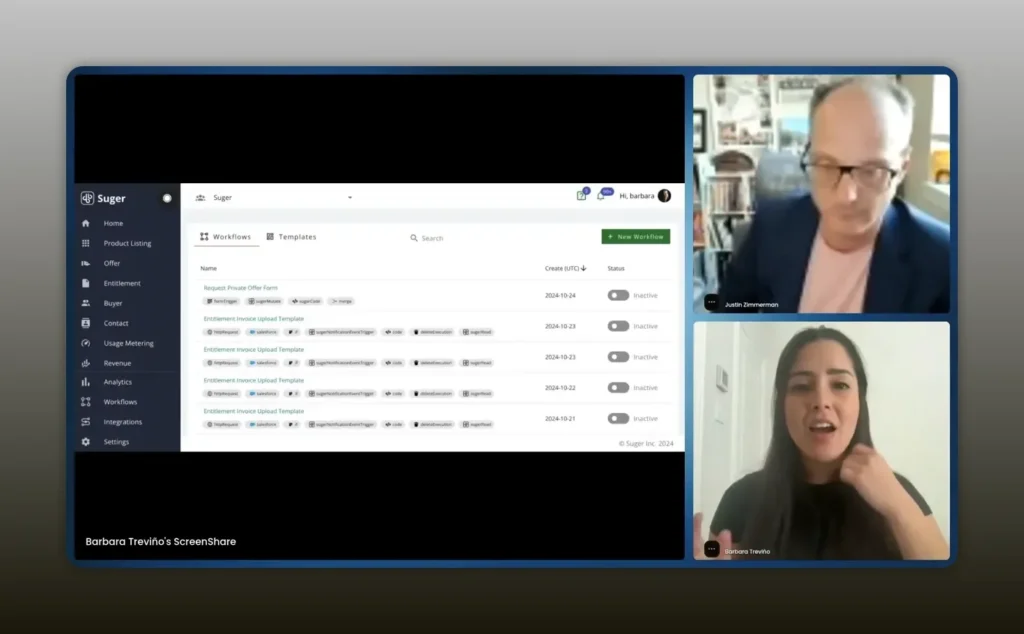
Map fields once and automate the rest — your sales team already updates the pipeline, let automation handle the rest. -Barbara Treviño
Reporting, analytics, and KPIs
Good reporting turns marketplace activity into measurable business outcomes. Decide on a few critical KPIs and make them visible to stakeholders.
High-value KPIs:
- Marketplace bookings and ACV by cloud provider
- Private offer acceptance rate
- Time from private offer creation to acceptance
- Entitlement to recognized revenue lag
- Number of active listings and conversion rate per listing
Use these KPIs to inform product and GTM decisions. Low acceptance rates on private offers could be a pricing issue or an enablement gap. Low listing conversions might indicate listing copy or PLG friction.
Common pitfalls and how to avoid them
These are recurring mistakes teams make when tackling hyperscaler marketplaces:
- Treating marketplace as a once-and-done project instead of an ongoing channel to optimize
- Keeping marketplace responsibilities siloed inside alliances with no cross-functional ownership
- Failing to automate entitlement notifications to finance — creates revenue recognition delays
- Not tracking offer lifecycle in CRM — leads to missed renewals and customer confusion
- Ignoring product-market-cloud fit signals from analytics
Fixes are straightforward: centralize ownership with partner ops, automate handoffs, create shared KPIs, and iterate on listing and offer strategies based on data.
Recommended tools
Choosing tools that fit your scale and maturity is critical. Tools fall into categories rather than single vendors — listing management, offer orchestration, entitlement tracking, analytics, and workflow automation.
- Sugar (listing and offers console, entitlements, workflows) — useful if you want an integrated cloud marketplace ops platform
- Partner Fleet (private or partner marketplace management) — good for managing integrations and internal marketplaces
- Superglue (co-sell automation) — automates partner pipeline and handoffs
- Salesforce or HubSpot (CRM integration) — central place for pipeline and co-sell data
- Internal finance systems (ERP) — must be integrated for entitlement and revenue recognition
Barbara’s guidance is to pick an API-first provider that can integrate with existing CRM and finance systems so you avoid custom point-to-point integrations later.
Quick checklist for getting listed
- Audit existing cloud marketplaces where you should be present
- Define product packaging per cloud and identify PLG vs paid listings
- Create standardized listing metadata and assets
- Map CRM opportunity stages to marketplace workflows
- Build private offer templates and approval workflows
- Integrate entitlement creation with finance and RevRec processes
- Put dashboards in place to monitor offers, entitlements, and revenue
FAQs
How does partner ops differ from alliances or partner management?
Partner ops is focused on the systems, processes, data, and integrations that make partnerships operational. Alliances or partner management is relationship-driven: building strategic ties, co-selling, and GTM initiatives. Partner ops translates alliance strategy into automated processes, CRM mappings, and measurable outcomes.
Do I need a third-party marketplace provider?
If your organization has multiple listings across AWS, Azure, and Google, and you want cross-team visibility with automations, a third-party provider dramatically reduces manual complexity. A central console consolidates listings, private offers, entitlements, and analytics so you scale instead of managing disparate portals.
How should we integrate marketplace events into Salesforce?
Map key marketplace events to Salesforce objects: listing updates can be content records, private offers map to opportunity-linked objects, entitlements become a revenue object, and acceptance triggers notifications and RevRec workflows. Use API-first integrations to keep fields synchronized and avoid manual exports.
What’s the difference between a private offer and an entitlement?
A private offer is a customized marketplace quote you send to a buyer. When the buyer accepts that offer on the cloud marketplace, the accepted offer becomes an entitlement — a recorded right to use the software that triggers billing and disbursement flows.
How do we handle renewal and retention through marketplace?
Treat marketplace entitlements like subscription contracts. Track expiration dates, consumption patterns, and renewal windows. Automate renewal notifications to sales or customer success and provide finance with renewal schedules for RevRec forecasting.
What KPIs should executive leadership care about?
Leadership wants clarity on pipeline contribution and revenue predictability. Lead with bookings by cloud, private offer acceptance rate, entitlement recognition timing, and the percent of deals converted through marketplace versus direct procurement.
Conclusion
Marketplaces are a strategic channel, not an optional add-on. To make the most of them, centralize your listings, automate private offer and entitlement flows, and connect marketplace data to your CRM and finance systems. Create a partner ops function that can bridge alliances, sales, product, and finance. With the right processes, workflows, and analytics in place, marketplaces become a predictable route to revenue rather than a source of friction.
Barbara’s core advice is straightforward: align the business, automate repetitive tasks, and use data to drive decisions. Do that and you will see marketplace turn from a technical headache into a scalable growth engine.
Social post
Announcing a new playbook for partner ops leads, deal desk managers, and revenue operations professionals…
Introducing Simplify hyperscaler marketplace listings: a partner ops playbook!
Inside it you will find actionable guidance to turn marketplace complexity into predictable revenue. You will learn how to centralize listings, streamline private offers, automate entitlement handoffs, build analytics that matter, and design workflows that remove friction from cross-functional teams. The playbook focuses on why marketplace is urgent now, what to automate first, and how to make finance, product, and sales partners in the marketplace journey.
- Fragmented listing management across clouds
- Manual private offer creation and tracking
- Entitlement and disbursement confusion with finance
- Missing attribution for partner-driven pipeline
- Slow deal desk turnaround and approval bottlenecks
- Lack of standard listing and offer templates
- Poor cross-team visibility into marketplace transactions
Grab this playbook if you are a partner ops lead and want to learn what Barbara does, so you can achieve centralized listings, faster private offers, and reliable entitlement automation. The playbook is free, no form-fill required, no optin required.
Marketplace is not a checkbox — it is a channel that needs ops, data, and automation. -Barbara Treviño