Why Partner Ops Matters: Build Scalable, Strategic Partnerships
Expert advice from Rachel Rogers, Will Taylor, and Antonio Caridad.
Snapshot
You are competing in a world where ecosystems and alliances increasingly determine who wins — market leadership is no longer decided solely by product or sales force but by the network of relationships you build and operationalize. That means partnerships are no longer a nice-to-have channel; they are a strategic lever that can multiply growth, open new customer segments, accelerate time-to-market, and create defensible differentiation that is hard for competitors to replicate.
The risk is real: without operational rigor, partnerships drift into an ad-hoc mix of opinions and one-off deals, inconsistent onboarding, slow time-to-first-deal, high cost-to-serve, and partner churn.
The opportunity is equally: with partner operations — clear processes, standardized onboarding, the right tech integrations, enablement pathways, and shared metrics — you can turn strategy into repeatable playbooks, demonstrate partner-sourced and partner-influenced revenue, improve deal velocity and win rates, and scale thoughtfully.
In short, investing in partner ops preserves your team’s capacity to focus on high-value relationships while converting ambition into predictable, trackable outcomes that compound over time. Now keep reading to learn how!
If you don’t have data, you only have an opinion. – Antonio Caridad
Table of Contents
- Why partner ops matters right now
- What partner ops actually is
- Map the partner lifecycle
- The four pillars model and partner experience
- Immediate tactical first steps
- Choosing and integrating tech
- How partner ops drives measurable impact
- Partner experience versus RevOps debate
- Scaling ops from zero to one to many
- Hot takes and common misconceptions
- Events, marketing, and partner orchestration: a practical example
- Practical templates and the first 90 days
- Real examples and short case notes
- FAQs
- Conclusion
Why partner ops matters right now
Ecosystem-led growth is moving from theory to board-level strategy. When leadership asks for predictable partner-driven revenue, they expect numbers, not anecdotes. That is where partner operations becomes mission critical — it takes strategy and makes it repeatable.
Rapid expansion magnifies hidden costs. You can sign many partners quickly, but without processes, onboarding, and tooling, partner success collapses under administrative weight. The downstream effects hit sales velocity, retention, customer experience, and ultimately the company’s top-line and net revenue retention.
What partner ops actually is
Partner operations is the operating function that builds the foundation for consistent, rigorous partner relationship execution. It covers contracting, onboarding, policies, processes, tech stack management, enablement, metrics, and partner-facing systems. Most importantly, partner ops should act as a strategic advisor to partnership leadership — not just a report-building, button-pushing team.
Partner ops translates strategy into pragmatic, measurable actions that scale. Rather than being a purely tactical engine, it should inform strategy by highlighting operational constraints and uncovering revenue opportunities.
Map the partner lifecycle
Start with a simple exercise: map the life cycle of a partner from prospect to advocate. Spend 30 minutes writing it down. The clearer that map is, the easier it will be to identify bottlenecks and automate repetitive tasks.
- Recruiting: How partners discover you and qualify to engage.
- Contracting and onboarding: What legal, technical, and enablement steps are required.
- Activation: How partners are trained, accredited, and set up to sell or deliver.
- Co-selling and marketing: Joint GTM motions and lead flow.
- Performance and measurement: Metrics, reporting cadence, and continuous improvement.
- Retention and growth: Nurture, incentives, renewals, and expansion.
Mapping helps you decide where to invest first: is the biggest friction in onboarding or in lead routing? Document it and prioritize.

Map the life cycle of a partner from prospect to advocate — spend 30 minutes writing it down. – Will Taylor
The four pillars model and partner experience
Antonio uses a model of four pillars that feed into a fifth: partner experience. The four pillars are:
- Program (strategies, tiers, partner segments)
- Systems (tools and integrations)
- Enablement (training, certifications, collateral)
- Metrics (shared KPIs, data flows, dashboards)
The fifth pillar, partner experience, is the sum of how well those four are executed. If any pillar is weak, partner experience suffers and the whole house risks collapse.
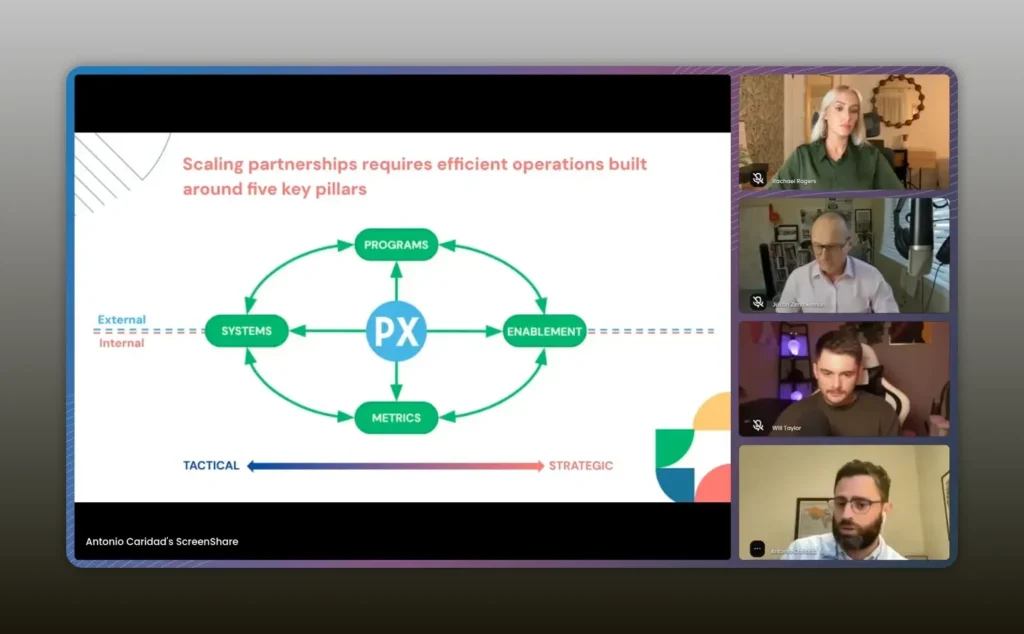
All of these pieces are critical. If enablement falls down, the whole house can come down because partner experience will suffer. – Antonio Caridad
Immediate tactical first steps
You do not need a large dedicated ops team to start. Begin by aligning ops with your strategic priorities and co-opting existing resources like sales ops or rev ops. Focus on a few high-impact actions.
- Define one or two measurable outcomes you want partnerships to move (for example, partner-sourced revenue, deal velocity, or retention).
- Audit where time is being spent today: how much of partner managers’ time is truly partner-facing?
- Map the partner lifecycle and highlight the top 3 bottlenecks.
- Standardize onboarding and documentation for new partners.
- Create a simple metrics dashboard to track progress and make ops decisions data-driven.
Small investments in standardization pay huge dividends. A clear onboarding playbook will reduce admin time and improve time-to-first-deal for partners.
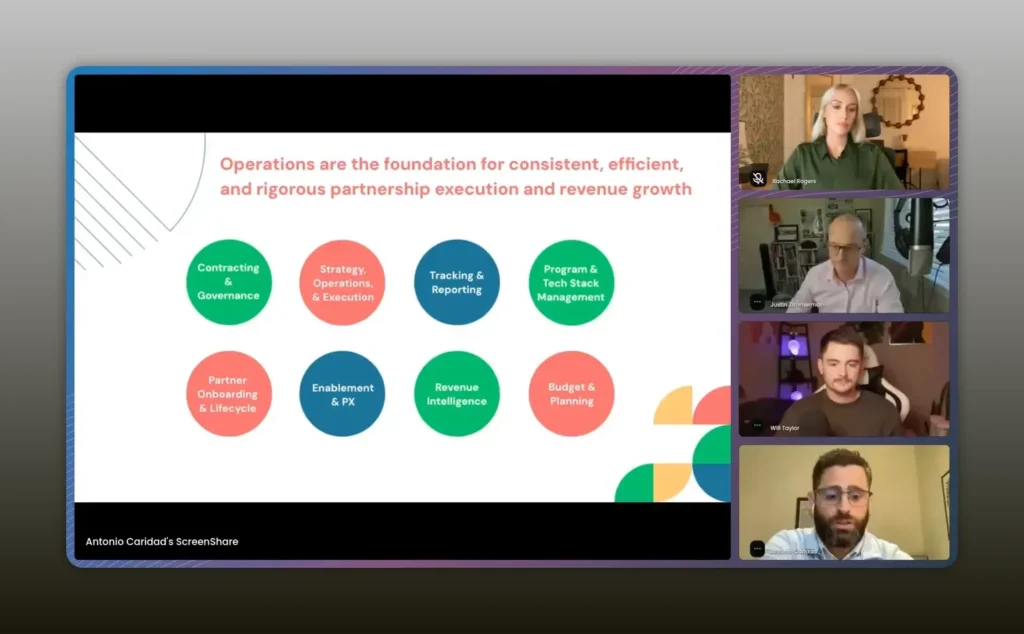
Make partner ops present early — even if it is a portion of someone’s time. Invest in the function over time. – Rachel Rogers
Choosing and integrating tech
Technology makes automation possible, but you do not need every point solution. Start with what you already have in your go-to-market stack. Identify where manual handoffs cause the most delays and automate those first.
Typical tech touchpoints:
- CRM for partner-sourced and influenced deals
- PRM (Partner Relationship Management) or partner portals for onboarding and enablement
- Lead routing and attribution tools
- Marketing automation and event registration systems
- BI/dashboarding tools for partner metrics
If you are a startup, leverage sales ops and marketing ops skills to build workflows in existing tools. If you are scaling, plan for a dedicated partner ops platform, but only after you have mapped and validated the processes.

If partner managers are spending 80 to 90 percent of their time with partners, a lot of operational work isn’t happening. You must seek ops help. – Antonio Caridad
How partner ops drives measurable impact
Partners need to be measured like any GTM channel. The impact of partner ops is visible when you can connect operational improvements to core revenue metrics.
Key metrics to track:
- Partner-sourced revenue and partner-influenced revenue
- Deal velocity for partner-involved opportunities
- Win rates on partner deals
- Time-to-first-deal for new partners
- Retention and NRR for customers acquired via partners
- Partner engagement (logins, certifications completed, joint activities)
The combination of these metrics paints a quantitative picture of how operations changes affect the business. There is no single metric that proves ops works; it is the trend across several metrics that tells the story.

When you can quantify deal velocity, win rates, booked revenue, and retention tied to partners, you’ll see how ops is helping. – Antonio Caridad
Partner experience versus RevOps debate
There is an important tension between focusing on partner experience and focusing on revenue metrics. Both matter. Your first priority should be to demonstrate measurable business impact. Use revenue and performance data to justify investment. Once you have that, craft a partner experience that scales and incentivizes growth.
Partner experience is not about making every partner feel good. It is about creating the right experience for the right partners — the ones that align to your strategy and deliver impact.
Good partner ops finds the balance: it builds systems that make it easy for high-value partners to work with you while keeping the cost-to-serve sustainable for lower-tier partners.

Partner experience drives customer experience; they are interconnected. But start by showing the revenue impact, then optimize experience. – Rachel Rogers
Scaling ops from zero to one to many
Startups and scale-ups need different implementations of partner ops. In zero to one:
- Someone owns partner ops part time (maybe you).
- Processes are lightweight and manual where necessary.
- Focus on validating partner motion and early metrics.
In one to many:
- Formalize onboarding, enablement, and co-selling workflows.
- Introduce partner-facing systems like a PRM or dedicated portals.
- Hire or build a dedicated partner ops function to become a strategic advisor to leadership.
The key inflection is when operational complexity starts to erode frontline partner-facing time. At that point, you need to invest to preserve both scale and partner experience.
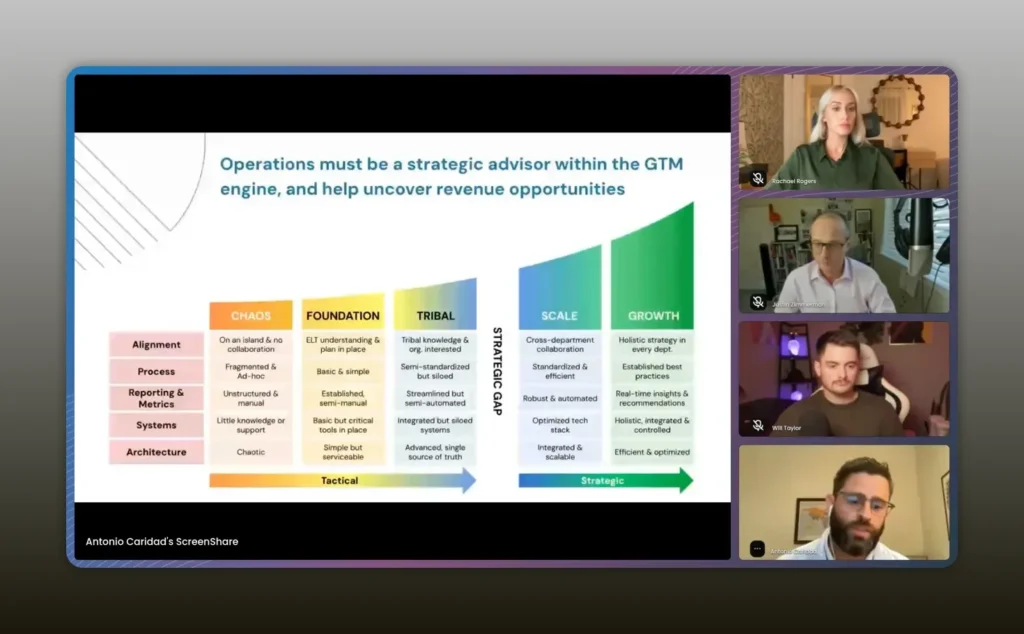
In startup world, invest in the function as a piece of someone’s time. In scale, hire for dedicated partner ops. – Rachel Rogers
Hot takes and common misconceptions
Several myths persist about partner ops. Here are a few hot takes to reframe the discussion:
- Myth: Partner ops is merely tactical. Reality: Partner ops should be in the strategy room and is key to defensibility.
- Myth: Partners only need leads. Reality: partner experience matters because partners influence many customers and partners talk to each other.
- Myth: You need a giant budget to start. Reality: Leverage existing ops teams and automations to bootstrap partner ops.
Antonio points out that if sales has sales ops and rev ops, partners deserve the same support. Treating partner ops as optional risks turning partnerships into “hugs and chugs” — lots of handshakes but little repeatable impact.
Partner ops is more than execution. It brings insights to the innovation table. – Rachel Rogers
Events, marketing, and partner orchestration: a practical example
Events are a microcosm of partner orchestration. Select partners with two lenses: marketing value for the audience and partnership value for strategic alignment. Build systems that match attendees’ needs with partners’ offerings, but avoid sharing raw contact lists without context.
Use registration flows and role-based questions to create quality matches. This is where MarTech meets partner tech — a two-sided marketplace that benefits both attendees and sponsoring partners.

MarTech meets PartnerTech: match attendee needs to sponsor solutions so people don’t get spammed. – Justin Zimmerman
Practical templates and the first 90 days
You can make immediate progress in the first 90 days with a concise plan and a few templates. Here is a simple playbook to follow.
First 30 days
- Map the partner lifecycle and current handoffs.
- Identify the top three operational pain points and quantify time spent.
- Create a one-page metrics dashboard with 3 KPIs: partner-sourced revenue, time-to-first-deal, and partner engagement.
Days 31–60
- Standardize onboarding with a checklist and a template welcome kit.
- Automate one manual handoff using existing tools (CRM automation, marketing automation, or Zapier workflows).
- Build a simple enablement path: 1-pager, 30-minute training, and a certification checklist.
Days 61–90
- Run a pilot with 3 to 5 partners using the new onboarding and enablement processes.
- Measure the pilot against the dashboard and iterate.
- Create a one-page ops brief for leadership with findings and resource ask (if needed).
Templates to create quickly: onboarding checklist, partner intake form, lead routing rules, and a partner health dashboard. Use automation platforms like Zapier for lightweight integrations if you lack a full partner tech stack.

Many systems can be simple automations or even a Google sheet to start — then scale to dedicated tools later. – Justin Zimmerman
Real examples and short case notes
Consider two short examples that illustrate the transformation partner ops enables:
Example 1: Rapid partner onboarding gone wrong
A fast-growing company onboarded dozens of partners during a growth spurt. Onboarding was inconsistent, internal workflows were manual, and partner managers ended up buried in tickets. As a result, deal velocity dropped and partner churn rose. By building standardized onboarding, a knowledge base, and a lightweight PRM, the company cut time-to-first-deal in half and reduced admin overhead for partner managers by 30 percent.
Example 2: Event matchmaking that improved lead quality
An events team used registration questions to qualify attendee needs, then routed only qualified leads to sponsors. The sponsor experience improved, spam decreased, and conversion rates from event introductions increased. That orchestration required a mix of MarTech and partner ops discipline.
FAQs
What exactly does partner operations do day to day?
Partner operations builds and maintains the systems that make partnerships repeatable. Day-to-day tasks include managing onboarding workflows, maintaining partner data and contracts, building dashboards, coordinating enablement programs, creating lead routing and attribution rules, troubleshooting partner issues, and aligning internal teams for joint go-to-market activities.
When should we hire a dedicated partner ops person?
Hire dedicated partner ops when operational complexity starts to reduce partner-facing time for your partner managers or when you cannot scale without automation and standardized processes. If you are routinely losing deals to slow handoffs, seeing inconsistent onboarding, or lacking reliable partner metrics, it is time to invest.
Which metrics should we prioritize first?
Start with partner-sourced revenue, time-to-first-deal for new partners, and partner engagement metrics like certifications completed or active co-selling activities. These three provide a balanced view of revenue impact, speed, and partner health.
Can small startups implement partner ops without a big budget?
Yes. Start by assigning a portion of someone’s time to partner ops responsibilities, leverage existing sales and marketing ops resources, and use simple automations like Zapier and shared documents. Focus on process clarity and a couple of automations that remove the most manual work.
How do we ensure partner experience without over-investing in low-value partners?
Segment partners by value and design different service tiers. High-value partners get tailored, high-touch onboarding and co-selling support. Lower-tier partners receive scalable, self-service enablement. Invest in automation and self-serve resources to keep cost-to-serve low while preserving experience for strategic partners.
How does partner ops interact with sales ops and rev ops?
Partner ops should align closely with sales ops and rev ops. Where sales ops manages territories and quotas, partner ops focuses on partner channel processes and partner-influenced pipeline. Regular coordination ensures consistent attribution, joint forecasting, and unified go-to-market execution.
Conclusion
Partner ops is the bridge between ambition and repeatable results. Without it, partnerships risk remaining a collection of one-off relationships and stale anecdotes. With it, partnerships become a measurable, scalable channel that powers growth and strengthens defensibility.
Begin by mapping your partner lifecycle, choosing a couple of priority metrics, and automating the highest-friction handoffs. Use the four pillars as a checklist and remember that partner experience is the compound result of program, systems, enablement, and metrics. Start small, prove impact, then scale operations intentionally.
If you invest in partner operations as a strategic function today, you will convert ideas into measurable outcomes and preserve the capacity of your team to focus on what matters most: building high-value, productive partnerships.