Zapier & ServiceNow: 7 Fatal Flaws in Partner Marketing & How to Fix Them
Expert advice from Miranda Sambrook and Maisa Fernandez.
Table of Contents
- Introduction
- Treat partners differently based on value and potential
- Don’t overvalue brand size; incubate hungry partners
- Stop single-launch thinking; embed partnerships in lifecycle
- Make data the engine of joint planning
- Keep a steady cadence across teams and partners
- Define shared success and build course correction plans
- Measure both awareness and direct revenue
- Practical checklist: 14 quick wins you can implement now
- Case examples and tool recommendations
- FAQs
- Conclusion
Snapshot
Partnership teams are sitting at the center of an expanding universe where integrations, co-markets, and AI features can either propel your growth or waste your budget. The stakes are high: partnerships can unlock new audiences, amplify awareness, multiply pipeline, accelerate product‑market fit, and materially lower acquisition cost—but only when the partnership motion is strategic, data‑informed, and consistently executed.
A strategic motion means more than a single launch; it requires shared objectives and KPIs, clear ownership across product, sales, and marketing, repeatable playbooks, automated operational plumbing (tiering, attribution, enablement), and a regular cadence for measurement and course correction.
Ignore those fundamentals and you don’t just miss opportunity—you end up with one‑off launches that fizzle, tiers that reward the wrong behaviors, misallocated spend and frustrated partners, and relationships that never convert into predictable revenue.
This article walks through the common fatal flaws we see and gives practical, repeatable fixes you can apply to make partnerships a reliable growth engine instead of a budget sink.
Without awareness, where does the revenue come from? – Maisa Fernandez
Treat partners differently based on value and potential
One of the most common mistakes is assuming every partner should be treated the same. Uniformity feels fair, but fair does not always mean effective. You need a foundation that scales with automation, and you also need room for exceptions. Design a partner model that is programmatic but flexible.
Start by building a reliable, automated tiering system. Use clear metrics that align to what your business cares about. For many integration-driven ecosystems the obvious metrics are:
- Active integration usage
- Health score of the integration, such as feature parity and bug rate
- Upgrade or monetization lift driven by the integration
- Lead quality and enterprise opportunities generated
When partners hit those thresholds, reward them with standardized benefits that are easy to administer. Let automation handle baseline rewards and ensure you can scale without manual work. That frees your team to focus on exceptional, high-impact cases.
At the same time, build an off-menu mechanism for opportunistic collaboration. The off-menu approach means you can say yes to a smaller partner that has strategic timing, an emergent use case, or an AI story that suddenly matches your upcoming campaign. That partner might not qualify for platinum tier, but the moment is right and the content will land with your audience.
Quick implementation steps
- List the quantitative metrics that mean success for your product and GTM motion.
- Automate the measurement and tier assignment where possible.
- Create an off-menu workflow for exceptions and fast approvals.
- Reassess tiers annually to reward not just volume but quality.
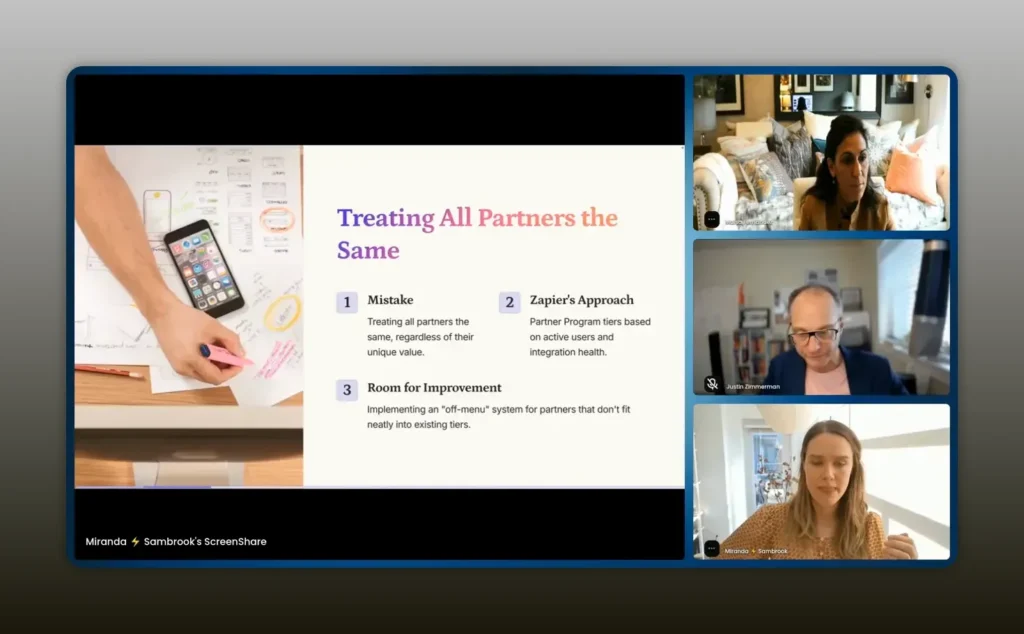
We built an off-menu system so we can surface timely partners even when they are not yet platinum. – Miranda Sambrook
Don’t overvalue brand size; incubate hungry partners
Big brands are tempting. They promise reach and credibility. But a partnership with a household name is often slower, more bureaucratic, and filled with gating processes. That does not mean you should avoid enterprise partners. It means you should be deliberate about the role each partner plays.
Classify partners by the role they should play in your go-to-market. Some useful categories are:
- Awareness partners: name recognition, events, thought leadership
- Incubation partners: small but fast, willing to experiment
- Growth partners: medium players that can expand usage in tight verticals
- Co-sell partners: hyperscalers and big GSIs who drive enterprise pipeline
Smaller, niche partners are often more motivated to co-create and promote. They will pour energy into co-markets, drive creative launches, and accelerate mutual growth. Give them repeatable playbooks and the tools to activate.
Quick implementation steps
- Audit recent partner campaigns and tag them by partner size, role, and outcome.
- Create incubation tracks that include co-created templates, sponsored seats in webinars, and prioritized support.
- Keep a rolling pipeline of experiments with small partners and place winning plays into larger partner programs.

Smaller partners are often hungrier and more creative. They will help you build business fast. – Miranda Sambrook
Stop single-launch thinking; embed partnerships in lifecycle
Launching a shiny co-marketing campaign and walking away is a trap. One-off campaigns can boost metrics for a moment but they do not create systemic lift. Instead, weave partner activities into lifecycle and platform signals so the partnership consistently nudges the right users at the right times.
Move from static campaigns to action-triggered touch points. For example, when a partner releases a new integration or reaches a milestone inside your platform, trigger tailored messages:
- In-app recommendations and tiles
- Triggered emails based on partner actions
- Contextual Intercom messages or tooltips
- Automated nurture sequences that flow into sales handoffs
The data speaks: triggered communications tied to partner actions often produce two times more engagement than generic broadcasts. Use the surfaces that your users already interact with to make partner activation feel native rather than noisy.
Quick implementation steps
- Identify in-platform events that indicate a partner milestone such as integration installation, usage spike, or feature adoption.
- Map a set of triggered comms that includes email, in-app banners, and Intercom messages.
- Design creative that mentions the partner by name and highlights the immediate benefit to the user.
- Instrument measurement to prove lift in usage and upgrades after a trigger fires.
When someone logs into Zapier home, we show a contextually relevant partner recommendation and see significantly higher engagement. – Miranda Sambrook
Make data the engine of joint planning
Data should not be a rear-view mirror. It should proactively inform where you build, who you incubate, and when you push for co-sell motions. Align on what winning looks like for both parties and let data drive tactical plays.
Use a Venn diagram approach to define the intersection where both partners win. Get specific about the ideal customer profile, the industries you will target, and the behaviors you want to change. Run a short workshop when you are forming a strategic partnership. The workshop should produce:
- Shared objectives and measurable KPIs
- Target segments, ICPs, and buyer personas
- A prioritized list of co-marketing plays
- Roles and responsibilities for follow up on leads
Make those workshop outputs operational. Use data feeds to deliver the right content and advice to sellers during moments that matter such as renewals, co-sell opportunities, and downsell risks. The more you can automate seller enablement with data-informed content, the more consistent your execution will be.
Quick implementation steps
- Run a one-day go-to-market workshop for each strategic partner and capture a playbook.
- Prioritize 3 hero plays that both sides will commit to for the next six months.
- Connect CRM, product usage, and partner signals to create moments of action for sellers.
- Agree on dashboards and a monthly review cadence to assess progress.
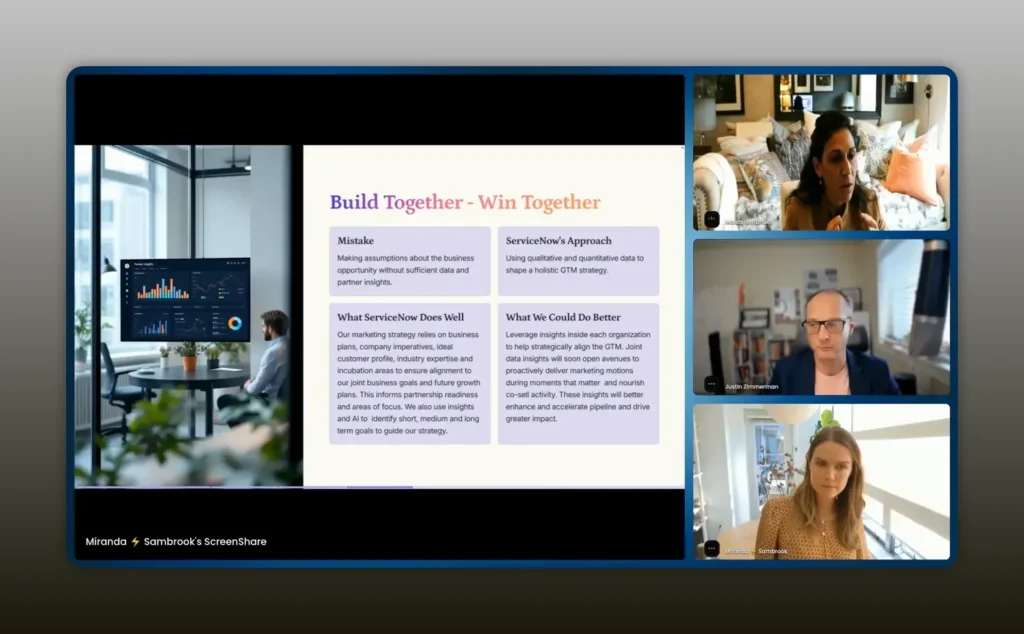
Let data be the map that tells you where the two partners win together. – Maisa Fernandez
Keep a steady cadence across teams and partners
Cadence matters. Marketing, sales, product, and support all need to move in step with partner plans. Too often partner marketing operates in a silo with sporadic outreach. Regular, structured touch points fix that.
Set up a minimal cadence that you can keep forever. Monthly check-ins with partners will generate more insight and opportunity than quarterly scramble sessions. Make the meetings short and outcome oriented. Add a cross-functional internal cadence so that sellers and product managers are not surprised by partner activity.
Examples of useful cadences
- Weekly tactical sync for active joint campaigns
- Monthly business reviews to assess pipeline and content needs
- Quarterly strategic planning for hero plays and resource allocation
When you add cadences, you will discover small product or UX opportunities that can drive partner success. A single in-app tile or recommendation can become a top performing channel when it is surfaced at the right moment in the customer journey.
Quick implementation steps
- Start a monthly partner call for every partner in your top 50 list.
- Share a concise agenda and data snapshot in advance so meetings are focused.
- Assign owners for action items and track completion in a shared space.

That little tile recommending a LinkedIn integration was the third most effective channel for driving usage inside Zapier. – Miranda Sambrook
Define shared success and build course correction plans
Ambiguous goals lead to wasted spend and frustration. Every partnership must have agreed success metrics for the short term and the long term. You also need a fail fast plan that tells both parties how to change course.
Break success down into four practical categories
- Awareness metrics such as impressions, event reach, and PR pickup
- Engagement metrics such as clicks, installs, and usage sessions
- Conversion metrics such as trial to paid conversion and revenue uplift
- Pipeline and lead quality metrics that sales can act on
Be explicit about the pivot play. If you are not hitting milestones, who escalates the conversation, who reallocates budget, and who stops the activity? Embed that cadence into your quarterly reviews so course corrections do not become surprises.
Quick implementation steps
- Include success metrics and an explicit pivot plan in every partner playbook.
- Map decision owners so it is clear who will take action when targets are missed.
- Run a midpoint health check and decide on either scale, adjust, or sunset.
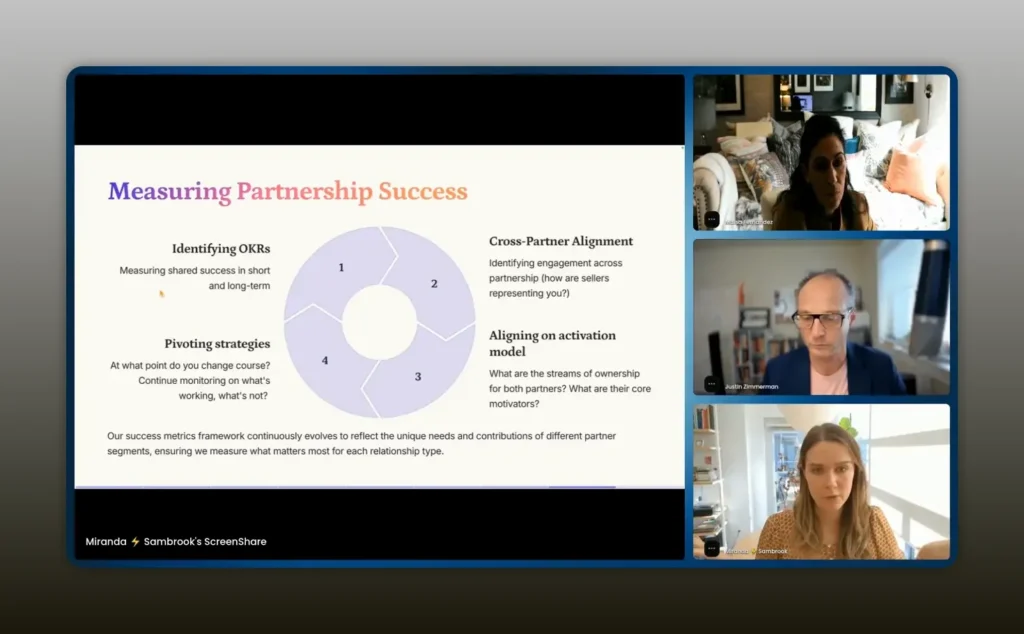
If you are not on the trajectory to meet your goals, call it early and realign. – Miranda Sambrook
Measure both awareness and direct revenue
Partners can be asked to move different levers. Sometimes you want awareness, sometimes you want direct revenue, sometimes you want enterprise pipeline. Do not evaluate a partner by only one metric. Measure what you intended to move.
Ask the right question before you launch an activity
- Is this play meant to drive awareness or direct conversion?
- What is the expected lead quality and follow up plan?
- Which side owns the sales nurture and follow up?
If you cannot map an outcome to the action, you will waste both time and money. For awareness plays set KPIs like share of voice, event leads, or industry mindshare. For revenue plays set clear conversion rates and lead routing logic.
Quick implementation steps
- Tag every partnership play with its primary objective: Awareness, Engagement, Conversion, or Pipeline.
- Create measurement templates for each objective so results are comparable.
- Hold post-mortems for every hero play and document lessons learned.

Without awareness, where does the revenue come from? – Maisa Fernandez
Practical checklist: 14 quick wins you can implement now
The list below combines fatal flaws and quick wins into a runnable checklist. Use this as the starting point to level up your partner marketing motion.
- Automate partner tiering using usage and health scores.
- Create an off-menu fast-track for time sensitive partnerships.
- Run incubation tracks for small but hungry partners.
- Map partner roles: Awareness, Incubation, Growth, Co-sell.
- Trigger comms from partner in-platform events.
- Show contextual partner recommendations inside your product.
- Run a one-day go-to-market workshop for strategic partners.
- Provide sellers with data-driven content at moments that matter.
- Set a minimal meeting cadence and keep it consistent.
- Include explicit success metrics and pivot plans in every playbook.
- Measure awareness separately from direct revenue outcomes.
- Aggregate partner resources into a single, discoverable portal.
- Use AI to dynamically build co-marketing assets and demand plays.
- Celebrate partners publicly and share credit for wins.
Case examples and tool recommendations
These approaches are practical and supported by common platforms and tooling decisions. Here are a few patterns that worked in the real world.
Pattern 1 Autopilot tiering and off-menu exceptions
How it works: Use product usage data to automatically move partners into tiers and grant program benefits. Use a manual ticket for off-menu placements that senior partner marketing reviews weekly.
Tools to use: Product analytics, partner portal, automation engine such as Zapier, and a simple approval workflow in your CRM.
Pattern 2 Triggered in-product promotions
How it works: Show contextual partner tiles when a user signs into the platform and meets criteria such as prior integration usage. Route clicks into a partner-specific landing page and capture attribution.
Tools to use: In-app messaging systems, Intercom, product experimentation platform, and tracking through analytics.
Pattern 3 Data-driven GTM playbooks
How it works: Run a workshop to define hero plays, instrument success metrics, and connect to seller enablement so follow up is immediate and personal.
Tools to use: CRM, dashboards for partner performance, content hub, and a demand center to activate campaigns.
FAQs
How should I decide which partners get programmatic benefits and which get special treatment?
Start with objective, measurable criteria such as integration usage, health score, upgrade rates, and lead quality. Automate baseline tier assignments and build a fast-track approval process for special cases where timing or strategic fit matters more than volume.
What is the right cadence to maintain with partners and internal teams?
Adopt a layered cadence. Weekly syncs for active campaigns, monthly business reviews for ongoing partnerships, and quarterly strategy sessions for hero plays. Include sellers, product, and support when appropriate and keep agendas short and data-focused.
How do I measure whether a partner is delivering awareness or direct revenue?
Tag each joint activity with its primary objective. For awareness track impressions, event reach, and brand lift. For direct revenue track trial installs, conversion rate, and ARR from partner-originated leads. Use consistent measurement templates to compare outcomes.
Can small partners really move the needle?
Yes. Small and niche partners are often more committed and creative. They are willing to co-invest in campaigns and iterate quickly. Build incubation tracks that give them templates and prioritized support so you can scale the plays that perform.
What role does product need to play in partner marketing?
Product should be a core stakeholder. Product inputs guide integration prioritization and in-product surfaces for partner promotion. Regular product-marketing-partner syncs can uncover lightweight UX changes that unlock large behavioral lifts.
How do you coach leadership to invest in partner marketing?
Show the pipeline and lift driven by partners, not just vanity metrics. Present clear case studies that tie partner activity to revenue or key customer outcomes. Emphasize that partnerships are a scale motion and that the partner model is integral to your go-to-market strategy.
Conclusion
Partner marketing is a high-leverage channel when you design it to be data driven, operationally repeatable, and flexible enough to seize timely opportunities. Treat partners according to the value they deliver and the role they play. Build automated tiers but allow off-menu exceptions. Move beyond single-launch thinking and embed partners into lifecycle touch points. Use data to plan, to enable sellers, and to course correct. Maintain a steady cadence with partners and internal stakeholders. Finally, measure both awareness and revenue so you know what each partnership truly delivers.
Start with small, concrete steps and iterate. Set up automated tiering, run a one-day GTM workshop for your top partners, trigger contextual in-product recommendations, and create a short monthly partner review. That combination of systems and relationships will turn partner potential into measurable business impact.