Content Distribution & Co-Marketing In The Age of AI
Expert advice from Ed Chater (Co-Founder & COO, Evertune) and Tyler Calder (CMO, PartnerStack).
Snapshot
You are not just optimizing for Google anymore. You are now competing for visibility inside large language models that recommend software, shape buying behavior, and increasingly influence which brands even make it into the consideration set. AI traffic may be smaller than traditional search traffic today, but it often converts better. Why? Because the model is doing some of the pre-selling before a buyer ever reaches your site.
The risk is simple: if the open web teaches AI the wrong thing about your company, the model will confidently repeat it. The opportunity is just as clear: if you can influence the right sources across the internet, you can improve how AI describes your category, your brand, and your fit for the buyer.
If you want to solve weak AI visibility, limited third-party validation, and slow content activation, keep reading to see how Ed Chater and Tyler Calder can help you do it.
“Third-party content is what is helping build your authority, your credibility.” -Tyler Calder
Table of Contents
- Snapshot
- Why AI visibility matters now
- Why AI traffic converts differently
- How LLMs actually learn
- Why probabilistic search changes measurement
- The real shift from SEO to AEO
- Why third-party content carries so much weight
- A three-step framework for AI visibility
- Step 1: Measure visibility with rigor
- Step 2: Identify the sources that shape the model
- Step 3: Activate content through partners
- A real example of repositioning a brand
- Recommended tools
- FAQs
- Conclusion
Why AI visibility matters now
AI is already operating at massive scale, and we are still early. The adoption curve is not flattening out. It is still climbing.
That means your team is not preparing for some distant future use case. You are dealing with a buying behavior shift that is already showing up in prospect conversations, internal planning, and executive questions. Tyler puts it plainly: companies are hearing about this from partnerships, marketing, and the C-suite.
That lines up with what the market is showing. OpenAI, Google, Anthropic, and Perplexity have all trained users to ask conversational questions instead of typing short search keywords. Buyers are using AI to compare vendors, evaluate software, summarize categories, and pressure-test decisions. For B2B teams, that is especially important because AI is beginning to influence high-intent moments such as shortlist creation, integration research, and even RFP support.
As models get better and agentic workflows improve, AI will not just assist the journey. It will compress more of it. In some cases, it already does.
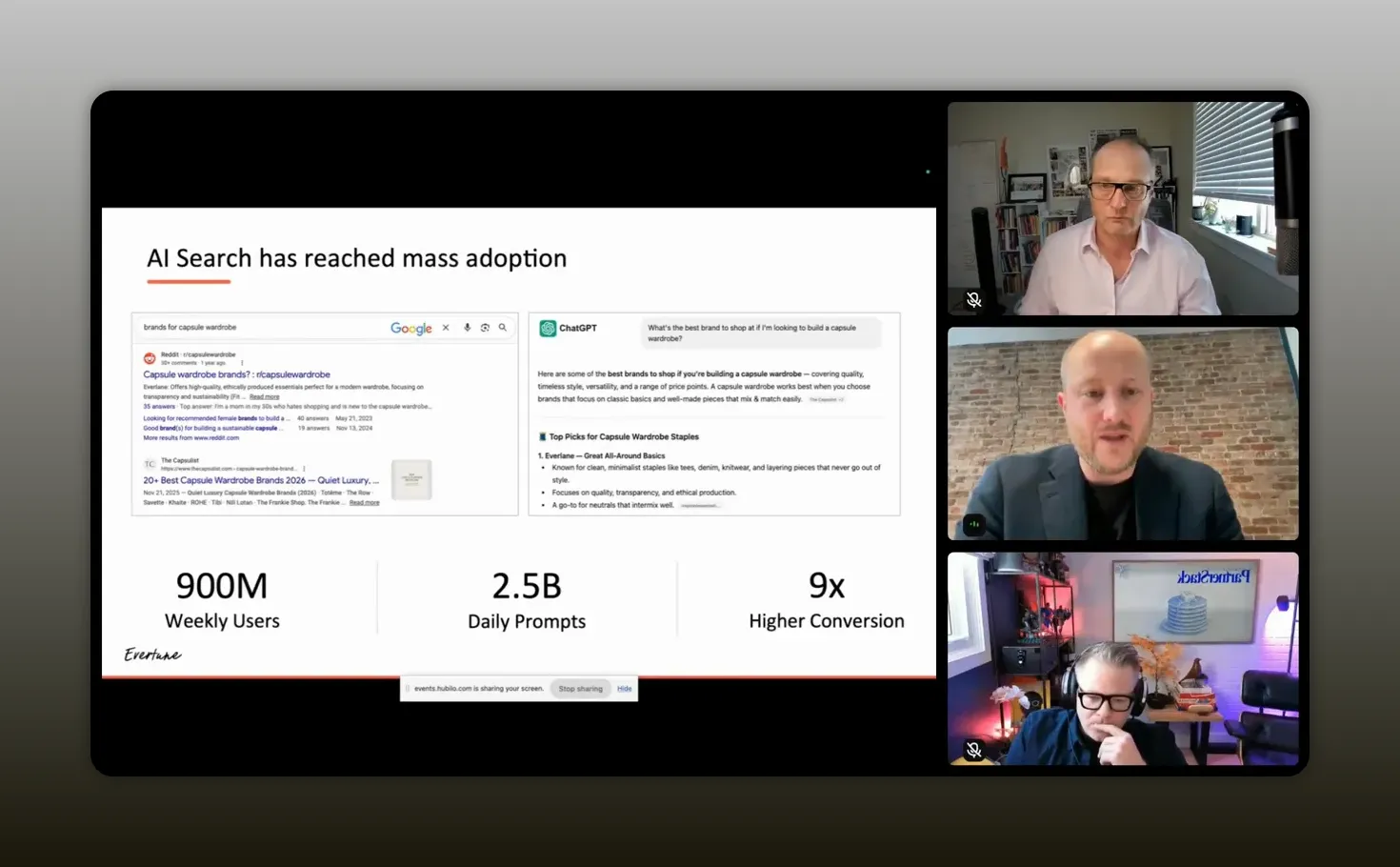
“We’re at the beginning of a parabolic curve as opposed to reaching the maturity level.” -Ed Chater
If that sounds dramatic, it should. In traditional search, a buyer still clicked around, compared pages, and interpreted results on their own. In AI search, the model often assembles an answer that feels like a recommendation. If your brand is absent, miscategorized, or weakly supported, you may never even make it into the answer.
This is one reason partnership teams suddenly have a bigger role to play. AI does not learn your story only from your site. It learns from the whole web. That opens the door for partner ecosystems, co-marketing, and third-party content to become part of your AI discovery strategy.
If you are building a broader partner-led growth engine, this is very much in line with the kind of ecosystem thinking described in this guide to ecosystem orchestration. AI visibility is becoming another output of a well-run ecosystem, not a side project.
Why AI traffic converts differently
One of the most useful observations Ed shares is that AI referral traffic often converts at a higher rate than traditional search traffic, even when the volume is lower.
The reason is intuitive once you think about it. AI often performs some of the evaluation work upfront. By the time someone lands on your site, they may already have received:
- a category explanation
- a shortlist of options
- a recommendation based on fit
- a summary of strengths or tradeoffs
In other words, the model has already done part of the persuasion. That does not make your site less important. It makes the pre-click environment more important.
If a language model has learned that your product is best for a particular use case, your site receives warmer traffic. If it has learned something outdated or incorrect, your site gets less traffic or the wrong traffic.
That distinction matters because many teams still evaluate AI visibility like an SEO side metric. It is not. It is closer to category positioning, market education, and conversion prep rolled into one.
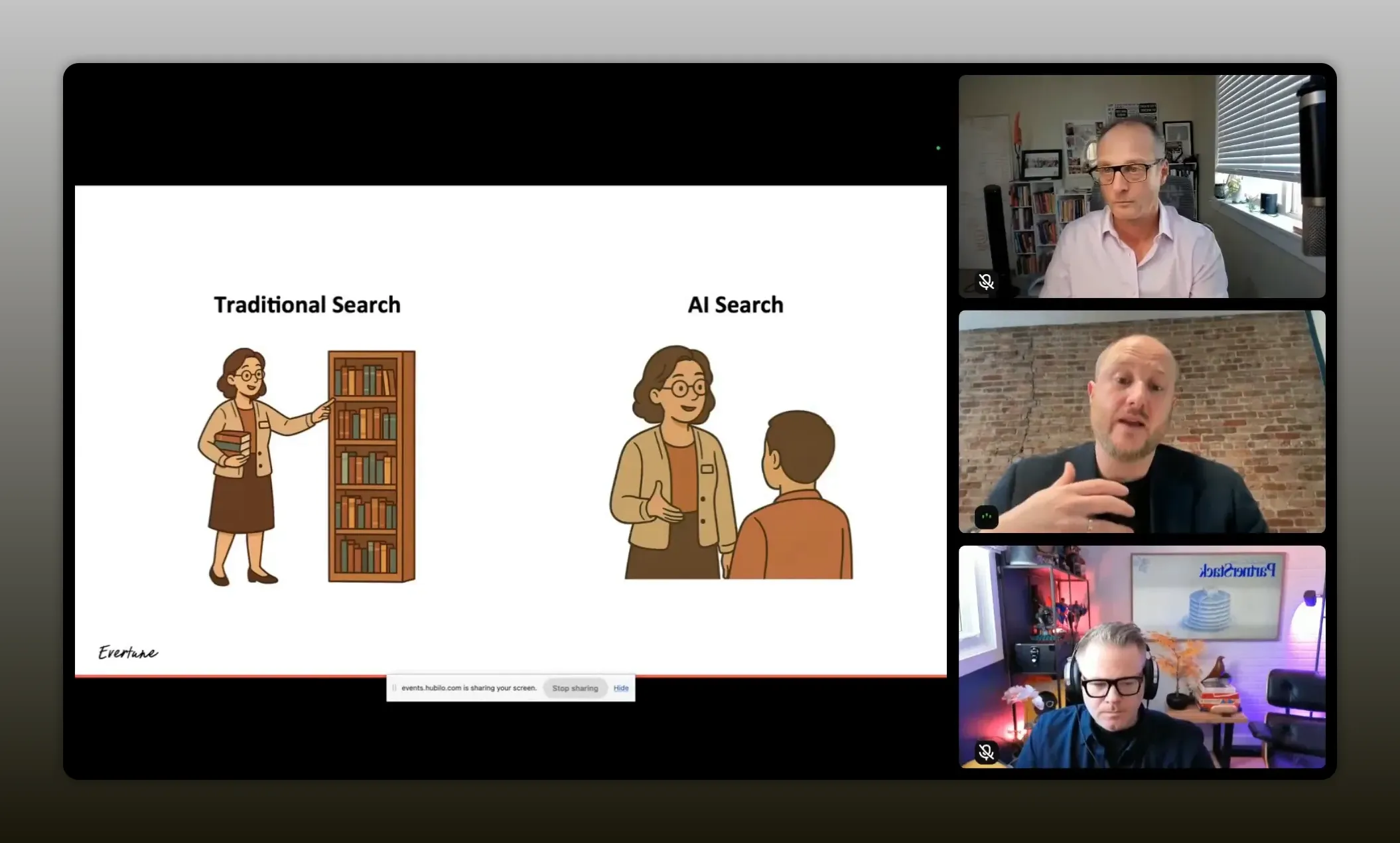
“Traditional search retrieves pages; AI search is inferring the answer from patterns it’s learned and the sources it can cite—so you can be absent, mis-categorized, and never make it into the recommendation.” -Ed Chater
How LLMs actually learn
Ed spends time on foundations for a reason. If you do not understand how large language models learn, you will fall back on old habits and optimize for the wrong things.
The cleanest analogy he uses is this:
- Traditional search works more like a library index. It catalogs pages with metadata and retrieves them.
- Generative AI works more like a system that has read the books, learned patterns from them, and can talk about what it has absorbed.
That does not mean SEO is dead. It means the mechanics are different enough that your strategy has to evolve.
At a high level, Ed describes three phases of how an LLM learns:
1. Pre-training
This is the model’s broad education phase. It reads enormous amounts of text and repeatedly predicts the next token, or the next likely piece of language, based on what came before.
The simple example is the sentence: “The capital of France is ___.” Most people fill in “Paris” immediately. That is essentially what the model is doing, except at huge scale across trillions of tokens.
2. Post-training
This is the refinement phase. The model gets additional steering about what kinds of answers are better, safer, more useful, or more aligned. It learns not just patterns of language, but patterns of preferred response behavior.
3. Retrieval and live search
Modern models increasingly reach into the live web. Using retrieval-augmented generation, or RAG, they search indexed content, pull relevant sources, synthesize what they find, and produce an answer.
This final phase is especially important for marketers because it means AI is not trapped in static training data. It is still learning from what exists on the internet now.

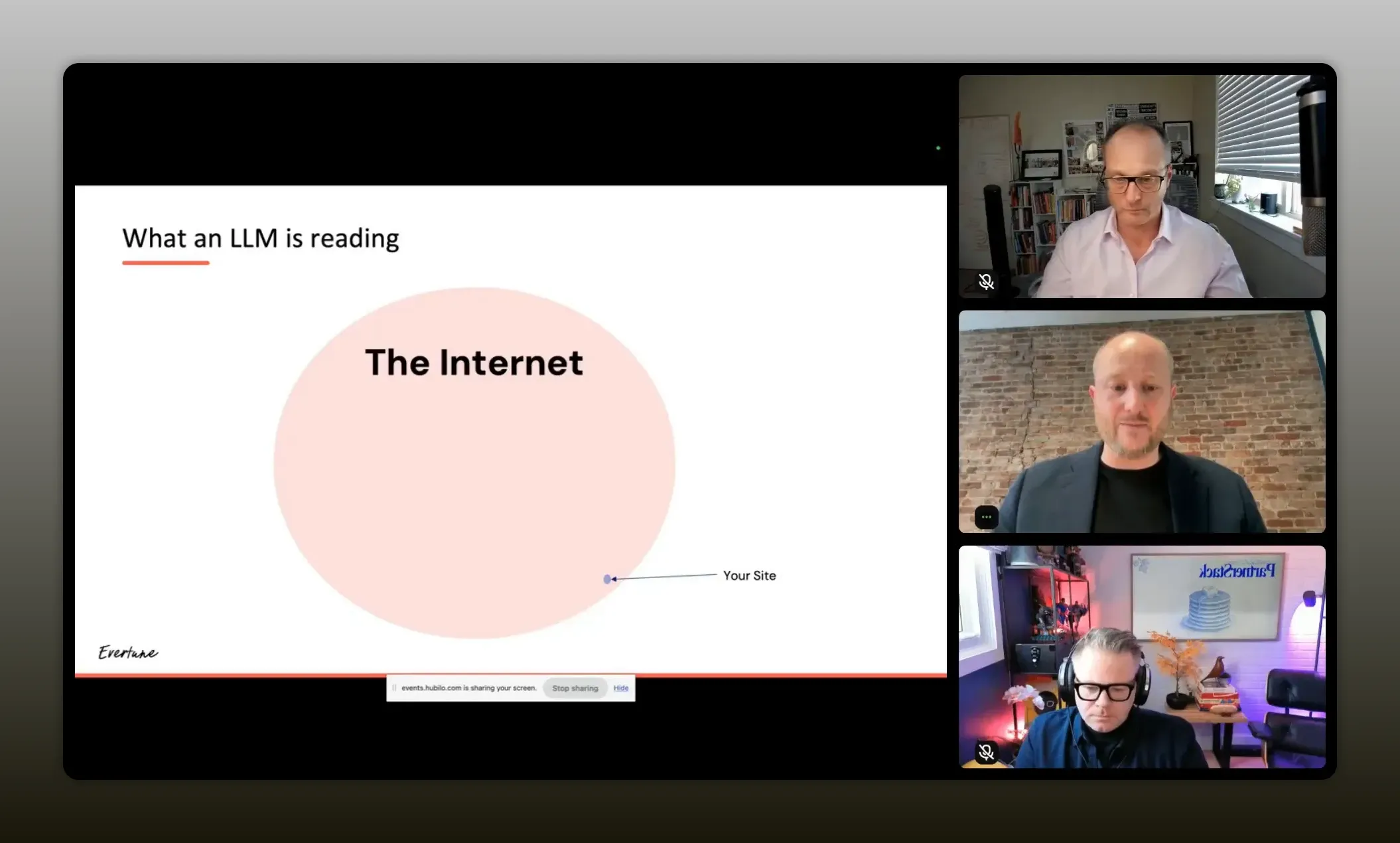
“The LLM is reading the entirety of the internet.” -Ed Chater
That is the strategic unlock. If AI learns from the open web, then your brand narrative can be influenced by content that lives beyond your own domain.
It also means you should stop thinking of AI only as a channel to monitor and start thinking of it as an audience to educate.
Why probabilistic search changes measurement
One of Ed’s most important points is that these models are probabilistic by design. That is not a flaw. It is the operating principle.
Ask an AI model a question once and you get one answer. Ask it the exact same question many times and you get a spread of answers. The distribution may be narrow or wide, but it is rarely identical every time.
That has huge consequences for how you measure brand visibility.
Ed uses the example of asking for the best portable speakers. In one answer, you might see Bose, JBL, Sony, or Anker. Across many repeated prompts, more brands appear. If you only sample once, your measurement may suggest a brand has zero presence when in reality it appears in 30 to 40 percent of outputs over a larger sample.
This is why single-prompt screenshots are not strategy. They are anecdotes.
If you want credible AI visibility data, you need:
- Repeated prompting at sufficient sample size
- Careful prompt design to reduce built-in bias
- Consistent measurement over time
- Interpretation that reflects probability, not certainty
That level of rigor matters because otherwise you end up chasing noise. A one-off result can make you think your program is working or failing when the underlying distribution says something very different.
This is similar to broader AI measurement discipline in partner and revenue programs. If that topic is on your radar, this practical playbook on partnerships, data, and AI is worth your time.
“AI search is probabilistic by design—so if you only test a single prompt, you’re basically measuring the noise, not the likelihood.” -Ed Chater
The real shift from SEO to AEO
A lot of teams are trying to map AI optimization directly onto classic SEO. Some overlap exists, but Ed is careful here. The overlap is real. The systems are not the same.
With search engines, you historically optimized around crawlability, metadata, backlinks, site structure, and keyword relevance. With LLMs, semantic understanding and pattern recognition carry much more weight. The model is inferring what your company is, what problems it solves, and what claims about it are reinforced across multiple sources.
That is why AEO, answer engine optimization, is not just SEO with new branding.
The model is not simply matching keywords from a database. It is estimating what answer is most likely appropriate based on the patterns it has learned and the sources it retrieves.
So what does that mean for you in practice?
- You need clear, consistent positioning language.
- You need repeated reinforcement of that language across the web.
- You need third-party credibility signals.
- You need fresh content that supports the claims you want AI to make.
- You need to monitor whether the model is learning the right story.
Google has also been moving toward rewarding helpful, people-first content for years. In that sense, the direction of travel is familiar. Google’s own guidance on helpful content still aligns with what Ed recommends: create content that serves humans first, because that is what robust systems are built to value over time.
Why third-party content carries so much weight
This is where Tyler really hammers the point home: third-party content builds authority and credibility. The model does not just believe what you say about yourself. It looks for outside validation.
That should sound familiar if you have spent years in SEO. External mentions, references, and signals have always mattered. But in AI search, they may matter in a more narrative way.
Your website can say you are enterprise-ready, category-leading, secure, or best for a particular use case. The question is whether the broader web supports those claims.
Ed shares a key finding from EverTune’s analysis of hundreds of millions of prompts: the sources AI relies on are usually spread across a long tail of domains. A few top domains may show up frequently, but the influence is not concentrated only in the obvious places. Wikipedia is a notable exception in some cases, yet many answers draw from a broad mix of sites.
That has two big implications:
- You should not obsess only over a handful of flagship domains.
- You need scalable ways to create and distribute accurate third-party content across a wider ecosystem.
That is exactly why partner content becomes so strategically useful. Partners already operate on relevant domains, serve adjacent audiences, and can publish credible context around your brand, category, integrations, and use cases.
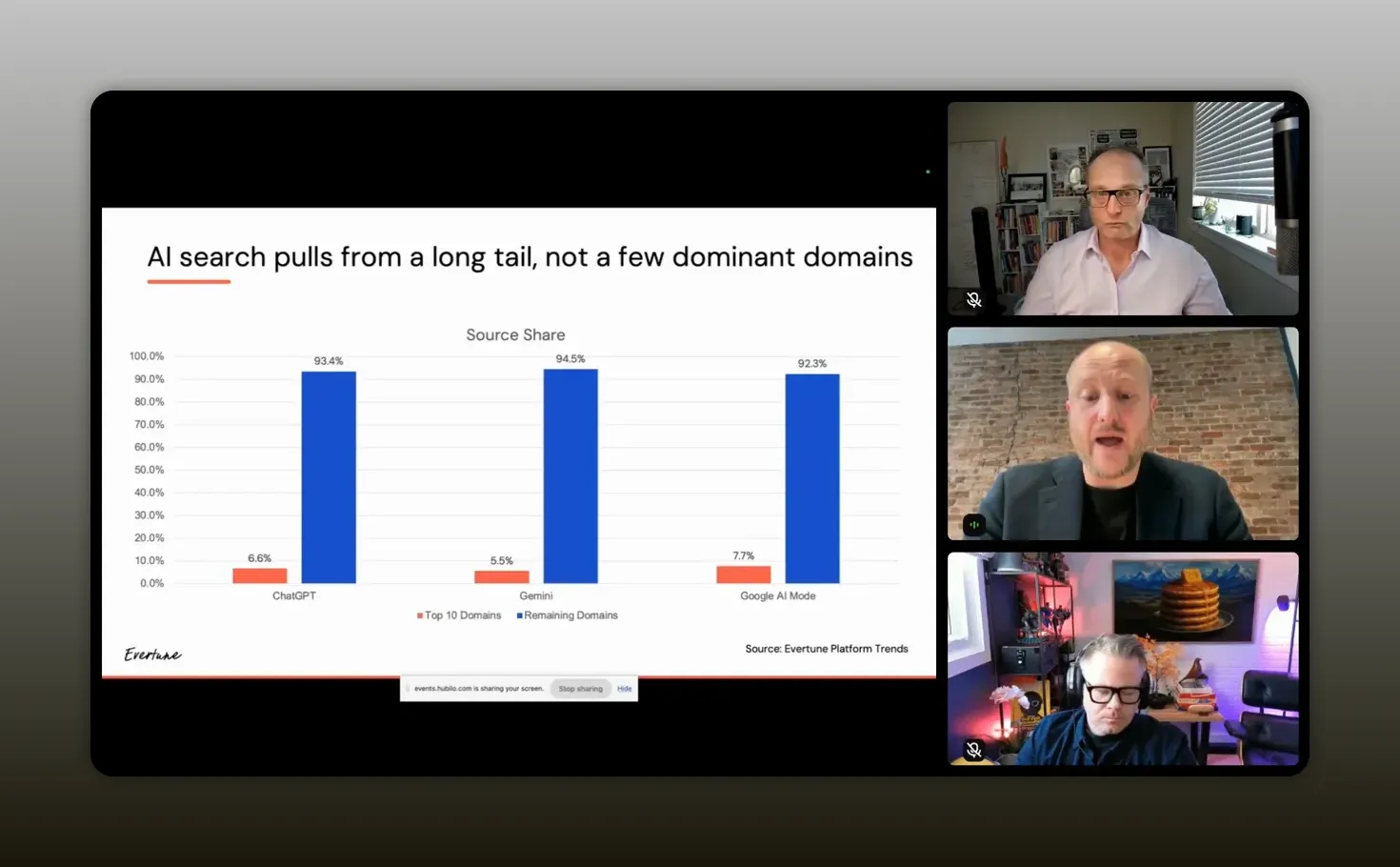
“There’s always a massive long tail, and very rarely do you see any singular domain being completely outsized.” -Ed Chater
If you already invest in co-marketing, this is not a completely new muscle. It is an expanded reason to build it well. The same operational thinking behind strong ecosystem programs applies here too, especially the need for repeatable activation. That is a theme echoed in this piece on flywheels versus funnels in partnerships.
A three-step framework for AI visibility
Ed outlines a practical cycle that gives you a much better way to operationalize AI discoverability. It comes down to three linked steps:
- Measure visibility
- Identify influential sources
- Activate content campaigns
That sounds simple, but each step has a very specific role. Skip one and the whole thing gets weaker.
You cannot activate intelligently if you have not measured correctly. You cannot prioritize the right content if you do not know which sources matter. And you cannot improve model understanding if you only publish on your own site and hope for the best.
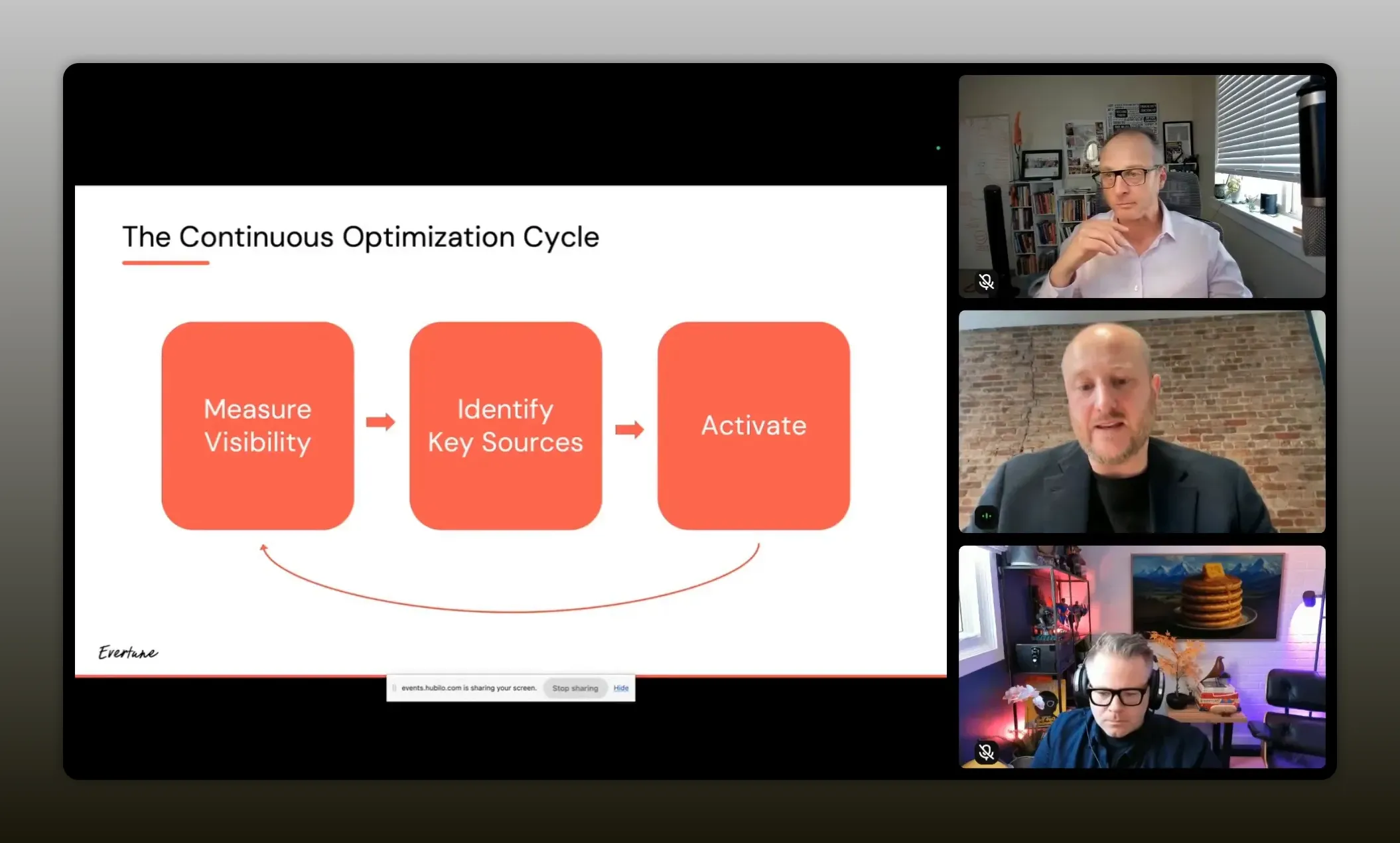
“Once you understand that AI is probabilistic, the only way to improve visibility is to run a continuous optimization cycle“ -Ed Chater
Step 1: Measure visibility with rigor
The first discipline is measurement. Not vanity checks. Not isolated prompts. Real measurement.
Ed calls out a few core metrics and cautions:
Mention frequency
This is the foundational metric. How often does your brand appear in responses to relevant prompts? If buyers ask category or use-case questions, how frequently are you included?
Sentiment
This can be useful, but only if you avoid prompting bias. If you ask “What are the best CRM platforms?” you have already nudged the model toward positive framing. If you ask for a review or an open assessment, you get a more realistic sentiment signal.
Prompt design
The structure of your prompt bank matters. If the wording leads the model, your data will flatter you. If the wording is broad, commercial, and realistic, your data becomes much more actionable.
Statistical consistency
Run enough samples to understand the distribution. Otherwise, you are measuring coincidence.
This is one of the most underappreciated parts of AI visibility work. Teams want answers quickly, but the faster route often gives the least reliable truth. A disciplined approach takes more effort upfront and saves a lot of wasted effort later.
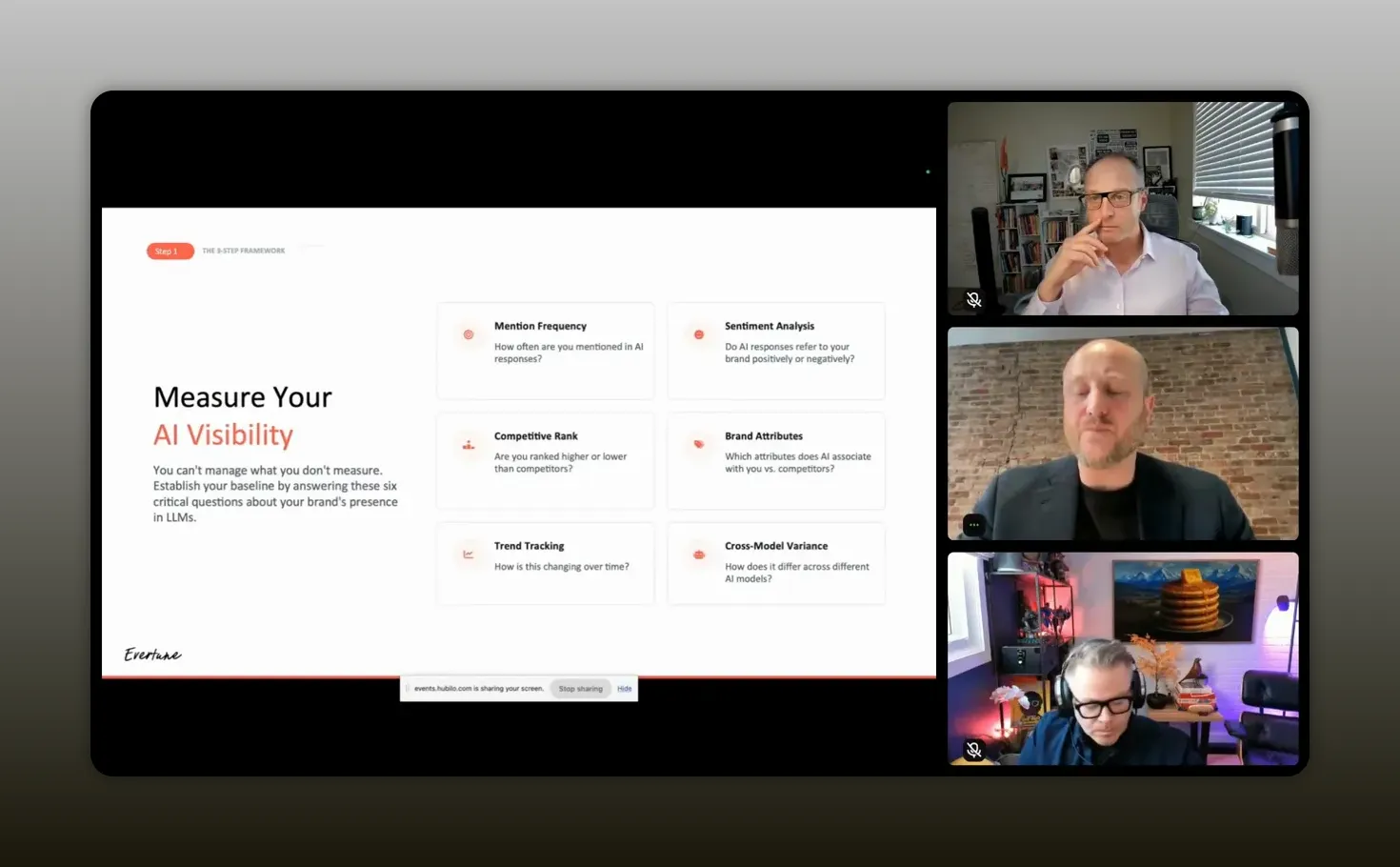
“You want to spend a lot of time thinking about your prompting strategy.” -Ed Chater
If you are building a measurement system internally, a helpful rule is to separate three prompt groups:
- Category prompts such as “best platforms for…”
- Use-case prompts such as “what software helps with…”
- Brand-specific prompts such as “write a review of…” or “compare X to Y”
Together, they show whether the model knows you, recommends you, and describes you correctly.
Step 2: Identify the sources that shape the model
Once you know how visible you are, the next question is why. What sources is the model reading? Which domains are reinforcing your story, ignoring you, or teaching the wrong lesson?
Ed breaks the source landscape into a few useful buckets:
- Owned sources: your site and the content you control most directly
- Supportive third-party sources: domains already mentioning you in the right way
- Relevant but missing sources: domains covering your category where you are absent
This framework is practical because each bucket suggests a different action.
Owned sources are your low-hanging fruit
You control these. They are easier to update, easier to align, and easier to optimize. If your site still tells an outdated story, fix that first.
Supportive third-party sources should be reinforced
When you find sites already describing your brand accurately, study them. What angle are they taking? What language do they use? Can you replicate that pattern with similar partners, publishers, or communities?
Missing sources are often your best growth opportunity
If AI keeps citing a category page, comparison article, or partner domain where you are absent, that is a strategic gap. You may not need to outpublish the whole internet. You may just need to close the right gaps in the right places.
This source-level analysis is where AI strategy starts to become operational. You move from broad anxiety about “how do we rank in ChatGPT?” to a concrete plan about what content should exist, where it should live, and who can help create it.
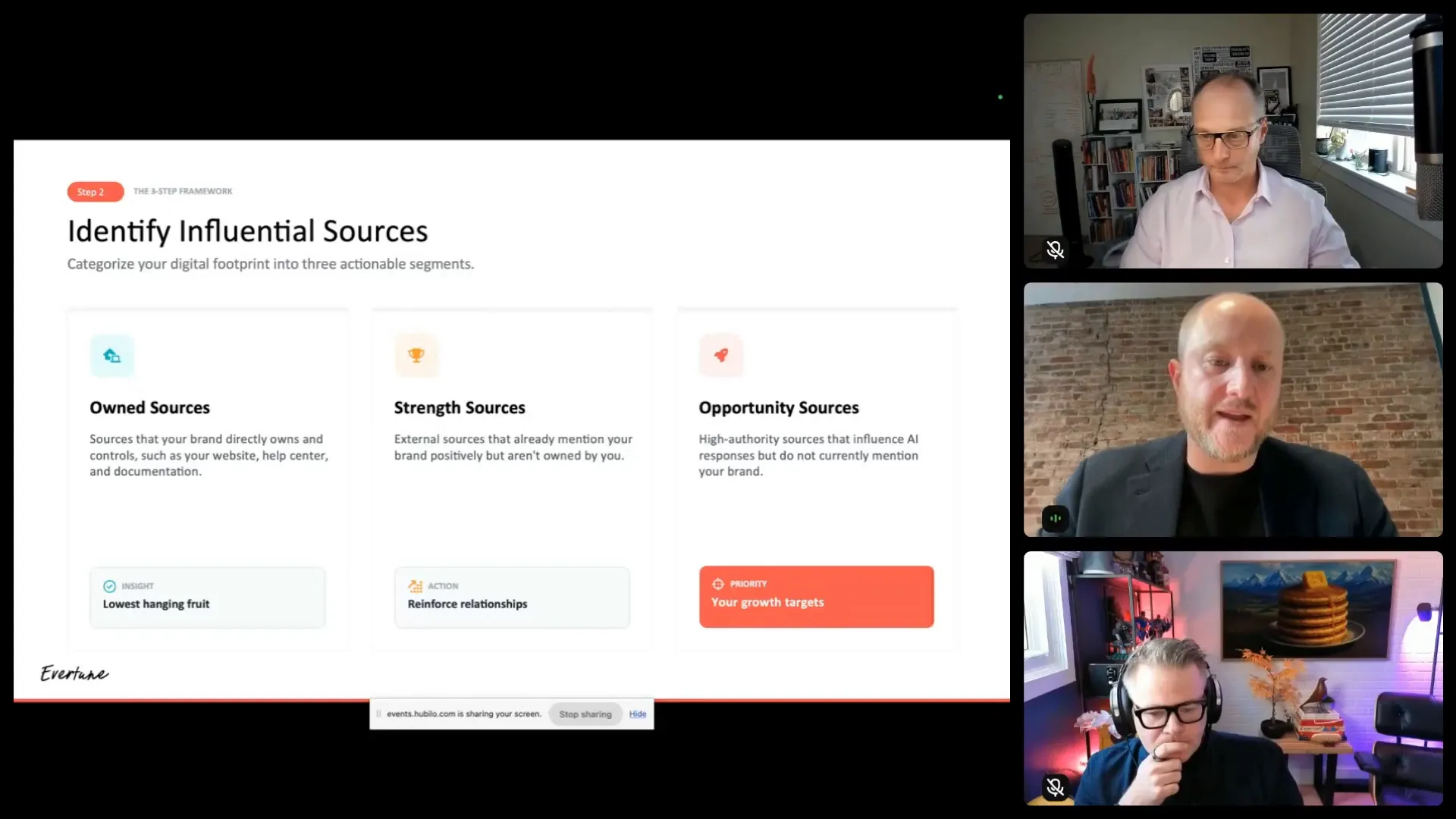
“Identify the influential sources shaping the answer, then reinforce the right narrative where the model is actually learning from.” -Ed Chater
Step 3: Activate content through partners
This is the part where the whole strategy gets practical at scale.
Ed’s argument is straightforward: if the model learns from the internet, and influential sources are spread across a long tail of domains, then one of the fastest ways to improve AI visibility is to publish high-quality third-party content through partners.
Tyler strongly agrees. He has been advocating for co-marketing with partners because it creates the kind of third-party validation LLMs appear to reward.
The key is not to create robotic content designed only to please machines. Ed specifically warns against overfocusing on content that is just for LLMs. The better target is the overlap between:
- content that is genuinely useful for humans
- content that search engines can understand
- content that language models can learn from and cite
That sweet spot is where sustainable advantage lives.
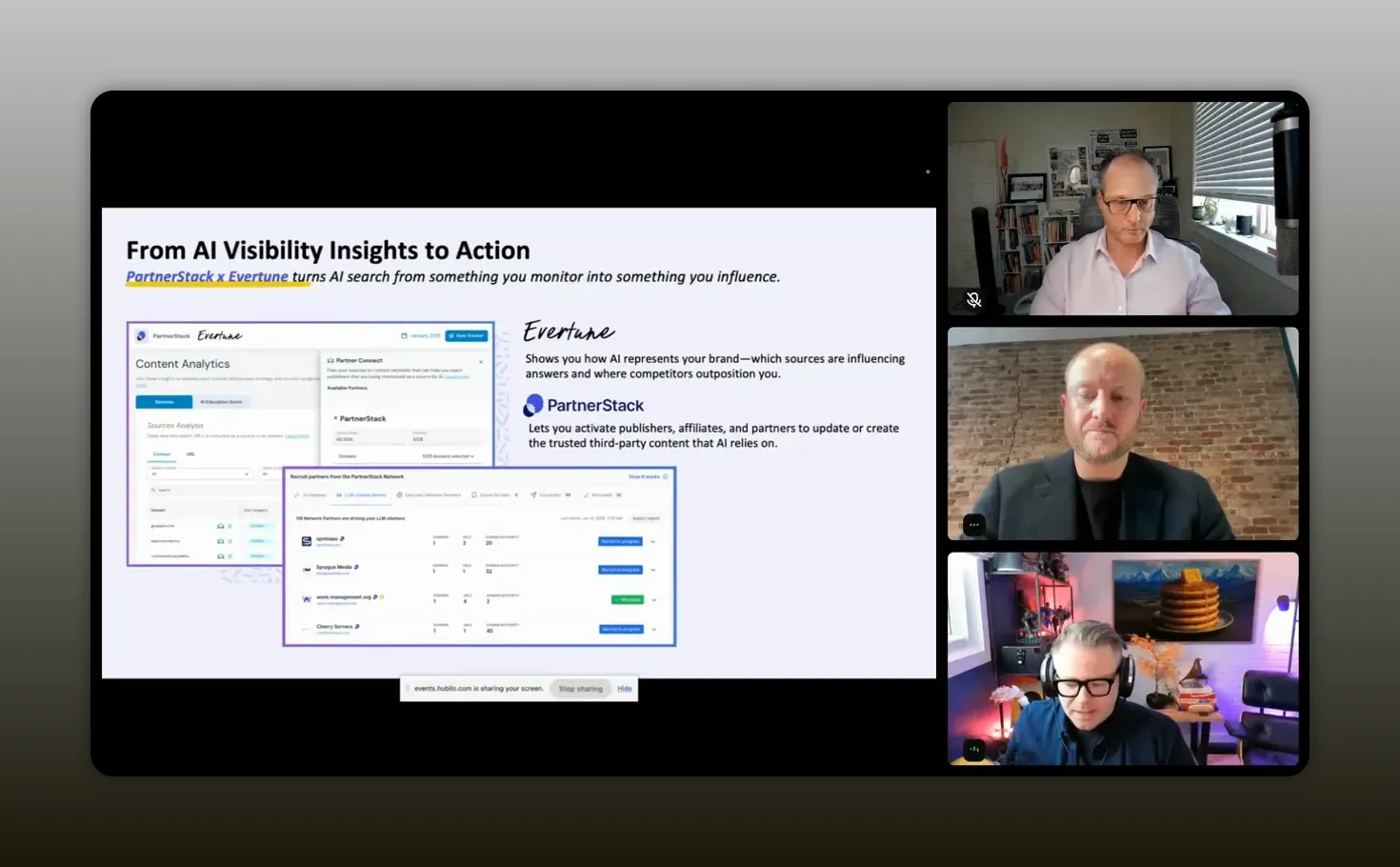
To make this easier to execute, Ed announces an integration between EverTune and PartnerStack. The idea is to connect source analysis directly to partner activation. If you can identify which domains matter, and then identify which of those are available within a partner ecosystem, you can move much faster from insight to action.
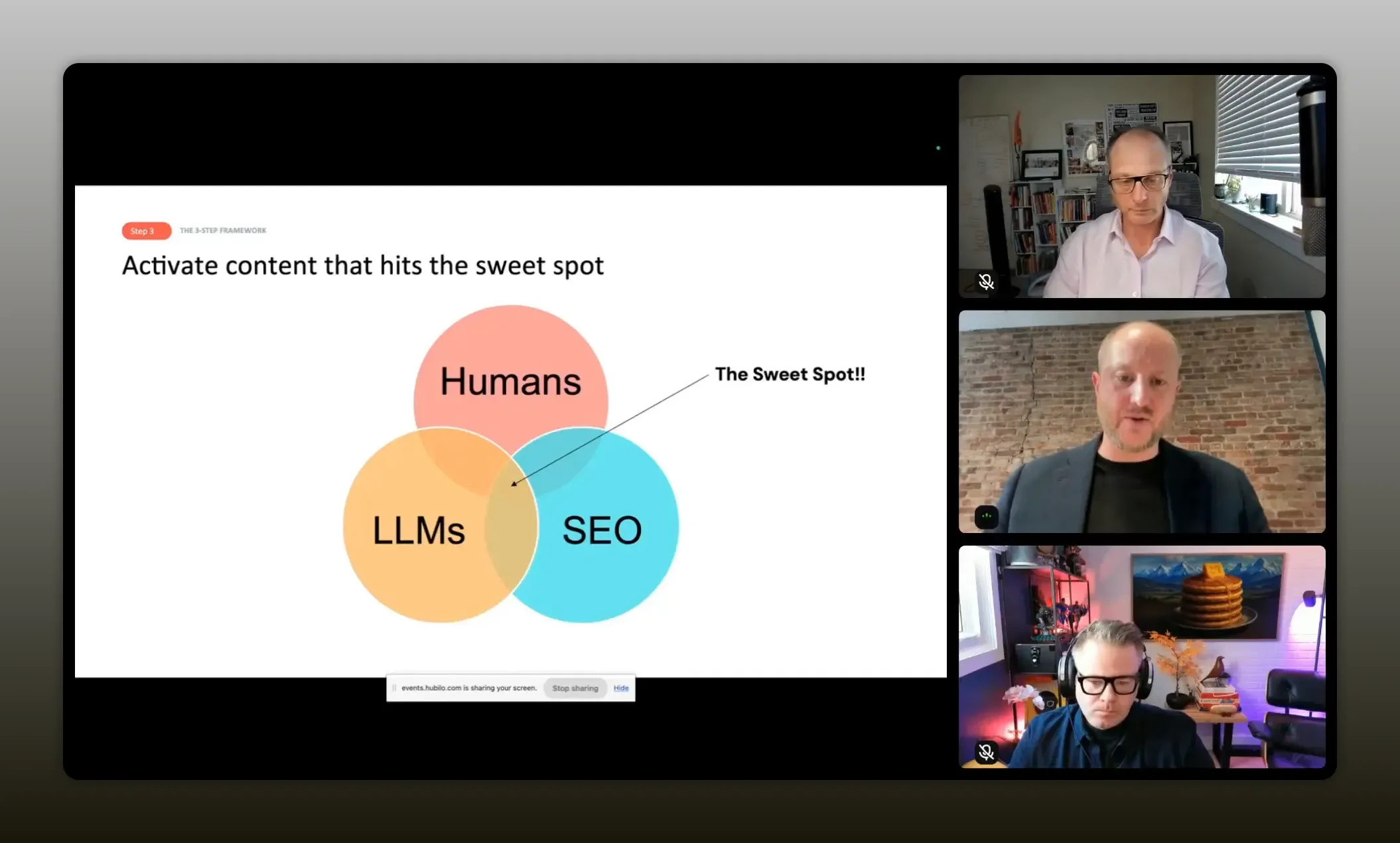
“You have to activate third-party reinforcement through partners, because that’s where the model learns and the credibility signals actually compound.” -Ed Chater
That matters because scale is where most internal teams stall out. In theory, anyone can manually identify sources, recruit content partners, negotiate content, coordinate publishing, and monitor outcomes. In practice, the labor cost is huge, and the process quickly becomes bottlenecked.
The integration is meant to reduce that friction. Source data from EverTune helps identify where to focus. PartnerStack helps surface and activate relevant partners across those domains. The outcome is a more repeatable path to content distribution that supports AI visibility goals.
A real example of repositioning a brand
Tyler shares an example that captures both the risk and the speed of this shift.
A company had started in SMB and later moved upmarket into enterprise. The problem was that a lot of historical content on the internet still positioned the brand as SMB-focused. As a result, language models were effectively redirecting buyers away from the company for enterprise use cases and toward competitors the models believed were better fits.
That is not a small messaging issue. That is a revenue issue.
The company’s executive team was understandably frustrated. From their perspective, the business had changed. Why did AI not know that?
The answer is brutally simple: because the web had not taught it well enough.
Tyler says they worked with three partners to create new content focused on the company’s enterprise role, enterprise-grade integrations, security, and compliance. Within three days, the way the brand was being described inside LLMs had shifted.
No magic. Just targeted third-party reinforcement applied to the right narrative gap.
“Within three days, the way the brand was being talked about within the LLMs had shifted.” -Tyler Calder
That example carries an important lesson. AI visibility is not only about being included. It is also about being classified correctly.
For many SaaS companies, the risks include:
- being associated with the wrong market segment
- being described with outdated capabilities
- being omitted from key category conversations
- being framed as weaker than your current positioning
Partner content can help fix those issues quickly because it adds fresh, external evidence to the web. And that is exactly the kind of evidence these systems appear to use when forming commercial answers.
Recommended tools
If you want to operationalize this strategy, you need a combination of insight and activation. Based on the discussion, these are the two tools at the center of the workflow.
Evertune
Ed’s platform is built around understanding how your brand shows up in LLMs. Its value is not just checking whether you appear. It is helping you measure visibility with statistical rigor, analyze source patterns, and identify where the model is learning from.
That makes it useful for teams trying to answer questions like:
- How often are we mentioned for core category prompts?
- What sentiment or framing shows up around our brand?
- Which domains are influencing the model’s answers?
- Where are the biggest source gaps?
You can explore more at Evertune.
PartnerStack
Tyler’s focus is activation. If the challenge is getting quality third-party content live across relevant domains, PartnerStack helps connect brands with partners who can create and distribute that content at scale.
That matters because the bottleneck is often not insight. It is execution. Many teams know they need third-party validation. Far fewer have a clean way to activate it systematically.
You can learn more at PartnerStack.
A simple operating model
If you are trying to turn this into a repeatable motion, a basic workflow looks like this:
- Measure your current AI visibility across realistic prompt sets.
- Audit the domains and sources influencing those answers.
- Fix owned content gaps first.
- Identify partner or third-party sites where your narrative is absent or weak.
- Publish useful content that reinforces the positioning you want AI to learn.
- Re-measure and iterate.
That loop is the important part. AI visibility is not a one-time project. It is a continuous optimization cycle.
FAQs
What is AI visibility in practical terms?
It is how often and how accurately your brand appears in AI-generated answers for relevant prompts. That includes whether language models mention you, how they describe you, what use cases they associate with you, and whether they recommend you in commercial or category-based questions.
Why is partner content so important for LLM discoverability?
Because language models learn from the broader internet, not just from your own website. Third-party content acts as outside validation. It reinforces your authority, credibility, and positioning, especially when multiple relevant domains describe your brand consistently.
How is this different from traditional SEO?
There is overlap, but the mechanics differ. Traditional SEO relies heavily on retrieval systems, metadata, and ranking signals. LLMs infer meaning and generate answers based on learned patterns plus retrieved sources. That means semantic consistency, narrative reinforcement, and third-party validation become even more important.
Why can’t I just test one prompt in ChatGPT and use that as my benchmark?
Because LLMs are probabilistic. The same prompt can produce different outputs across repeated attempts. A single answer is anecdotal. Reliable benchmarking requires repeated sampling, careful prompt design, and measurement over time.
What metrics should I care about first?
Start with mention frequency. How often are you included in relevant answers? Then look at source analysis to understand where the model is drawing information from. Sentiment can be useful too, but only if your prompts are structured carefully enough to avoid bias.
Can partner content really change AI outputs that quickly?
It can, especially when the issue is a clear narrative gap and the new content is relevant, credible, and published on meaningful third-party domains. Tyler shared an example where targeted partner content shifted LLM positioning within days.
Should I create content specifically for AI models?
Not in a narrow or artificial way. Ed’s advice is to aim for content that works for humans, search engines, and LLMs at the same time. Short-term gimmicks may work briefly, but durable visibility comes from useful, authentic, well-distributed content.
What should I fix first if AI is describing my company incorrectly?
Start by checking your owned content for outdated positioning. Then identify which third-party sources are reinforcing the wrong message or omitting the right one. From there, work with partners to publish updated, use-case-specific content that teaches the correct narrative.
Conclusion
You are entering a world where AI systems do not just help people find information. They help shape what people believe before they ever talk to your team. That changes the job.
Ed’s framework gives you a practical way to respond: measure visibility with rigor, identify the sources shaping the model, and activate content through partners at scale. Tyler’s perspective adds the missing operational truth: third-party content is not a nice-to-have in this environment. It is one of the clearest ways to build authority, correct positioning, and influence how LLMs talk about your brand.
The big shift is this. Your website is still important, but it is no longer the whole story. The open web is the classroom, and AI is learning from all of it. If you want better answers, recommendations, and discoverability, you need to teach the model through a broader ecosystem.
That is the opportunity in front of you right now.