Flywheels Not Funnels: Gong’s Approach To Multi-Million Dollar Partnerships
Expert advice from Greg Portnoy and Rob Moyer.
Introduction
You are being asked to do more with fewer resources, to create predictable partner revenue from relationships that feels unpredictable. Sure partnerships can unlock massive growth, but only when you move beyond logo-chasing and embrace an operating model built on repeatable systems, clear attribution, and relentless execution. The risk is that without structure you stay scrappy forever: inconsistent wins, skeptical leadership, and no scale. The opportunity is enormous—partner channels can out-perform direct in win rate and deal size when run like a proper sales engine. This mini-playbook will help you get close the promise of partnerships!
You get much more success when you’re maniacally focused on outcomes specific to the customers. -Rob Moyer
Table of Contents
- Build flywheels, not funnels
- Experimentation: what to test first
- Process vs tools: the 80/20 rule
- Data, attribution, and the credibility gap
- Key KPIs that win resources
- Use conversational intelligence to make influence credible
- How to choose a PRM and partner portal
- AI for partner scale: the partner account manager
- Crawl, walk, run: getting process right quickly
- Practical checklist to get to your first multi-million
- FAQs
- Conclusion
Build flywheels, not funnels
Funnels drain; flywheels compound. Instead of running one-off initiatives and starting over each quarter, design motions that feed back into each other and produce multiple outputs over time. The flywheel mindset changes how you staff, what you measure, and the experiments you run.
Until you have three wins with a partner, it’s not a partnership. Anybody can get one win. -Rob Moyer
How to think about flywheels:
- Define repeatable motions that produce the same outputs across multiple partners.
- Run multiple small experiments in parallel, then double down on the ones that work.
- Structure work so different team members own different motions; avoid everyone doing the same thing.
- Design for compounding outputs: enablement that creates referrals, integrations that increase attach rate, and co-selling that raises deal size.
Experimentation: what to test first
When you are zero to one or one to ten, you need to run experiments quickly and intentionally. The goal is to learn what scales, not to implement every possible program.
Start with three or four hypotheses. Each hypothesis should have:
- A clear target customer and partner profile
- Minimal resources required to run the test
- Success criteria and a defined measurement window

Static enablement is dead every 90 days. Go into the weeds and enable your partner managers to be more effective. -Rob Moyer
Examples to test early:
- Deal registration plus an executive introduction versus a referral model — which creates higher win rates?
- A co-sell motion with technical integration versus a simple referral for the same customer profile.
- Different enablement formats: short playbooks and one-pagers versus long LMS courses. Which drives faster activation?
Process vs tools: the 80/20 rule
You will hear people obsess about the right tool. The truth is that process matters far more. Rob will tell you it is 80 percent process and 20 percent tools. Build your operating model first. Then select tools that support that model.
Get your system right, then build your tool stack to support your system. -Rob Moyer
How to choose tools after process:
- Map the partner lifecycle and identify the manual bottlenecks.
- Prioritize tools that reduce partner manager overhead and accelerate partner actions.
- Look for vendors that move quickly and align their roadmap to your top three problems.
- Avoid buying tools to cover every hypothetical future need. Solve today’s blockers first.
Data, attribution, and the credibility gap
Partnerships live or die by credibility. To get headcount and budget you need data that proves your channel performs better than direct in key ways. That requires a clear attribution model and the discipline to measure it.
Partner source is gold. Co-sell is silver. Influence is bronze. Define these clearly and measure them. -Rob Moyer
Start by defining three attribution buckets:
- Partner source: The partner is the originator of the opportunity (deal registration, executive intro).
- Co-sell: The partner participates in two or more critical sales activities (integrations, technical support, executive alignment).
- Influence: The partner influences one activity or contributes signals that help the deal progress.
With these definitions you can:
- Attach partners to deals in your CRM and track the influence flow.
- Compare win rates for partner-involved deals versus purely direct deals (Rob saw 3x higher win rates for partner-backed opportunities).
- Calculate the expected pipeline and make a resource ask based on projected performance.
Key KPIs that win resources
Executives fund what they can measure. Make your KPI dashboard speak to resource owners in their language—pipeline, win rate, and deal size.
- Win rate uplift: The single best proof point. If partner deals win at 3x the rate of direct deals, that is the headline you want.
- Average deal size: Partners often open larger, multi-year, multi-seat opportunities.
- Pipeline coverage: Project the pipeline you will need to reach revenue targets given partner win rate uplift.
- Partner activation metrics: Time to first deal, number of partner-sourced opportunities per active partner, and attach rate for integrations and services.
- Attribution mix: Percentage of revenue that is partner source, co-sell, and influenced.

Measure win rates. Use the data to tell the story of why partnerships matter. -Rob Moyer
Use conversational intelligence to make influence credible
You know influence is valuable, but others often call it squishy. Using conversation intelligence and labeled trackers for partner mentions turns influence into measurable signals you can act on.
Practical steps:
- Set up partner-specific trackers in your conversation intelligence platform to detect mentions of partners, marketplaces, and integrations.
- Create alerts so partner managers can engage early when a partner is being discussed in a deal.
- Attach those signals to CRM deals so your forecasting reflects partner activity.
I had smart label trackers for every partner. When somebody even mentioned AWS marketplace, my team had an alert and engaged quickly. -Rob Moyer
This approach converts soft influence into early-warning signs that drive co-selling and integrations. It also gives you forensic data to answer the inevitable question: how did the partner actually move the needle?
How to choose a PRM and partner portal
When choosing a PRM, focus on the partner manager experience and fit to your top problems. You are not buying an enterprise inventory; you are buying a set of features that reduce friction and increase partner action.
I wanted a tool for the partner managers, not just the leaders—tools that create efficiencies for partner managers. -Rob Moyer
Checklist when evaluating PRMs:
- Does it let partner managers view and act on deals, referrals, and registrations quickly?
- Can you attach partners to deals and model attribution inside the system?
- Is the vendor roadmap aligned to your top three problems rather than a laundry list of features?
- Does the portal offer self-service enablement and an API to sync to your CRM and LMS?
- How fast does the vendor iterate and push improvements?
Greg stresses that partner programs benefit when you treat partner sales like direct sales: create the same operational efficiencies, tooling, and forecasting rigor.
AI for partner scale: the partner account manager
Partnership powered AI is not a silver bullet, but it is a force multiplier for stretched partner teams. Use AI to remove repetitive tasks, answer partner questions, and surface signals so human partner managers can focus on high-value work.
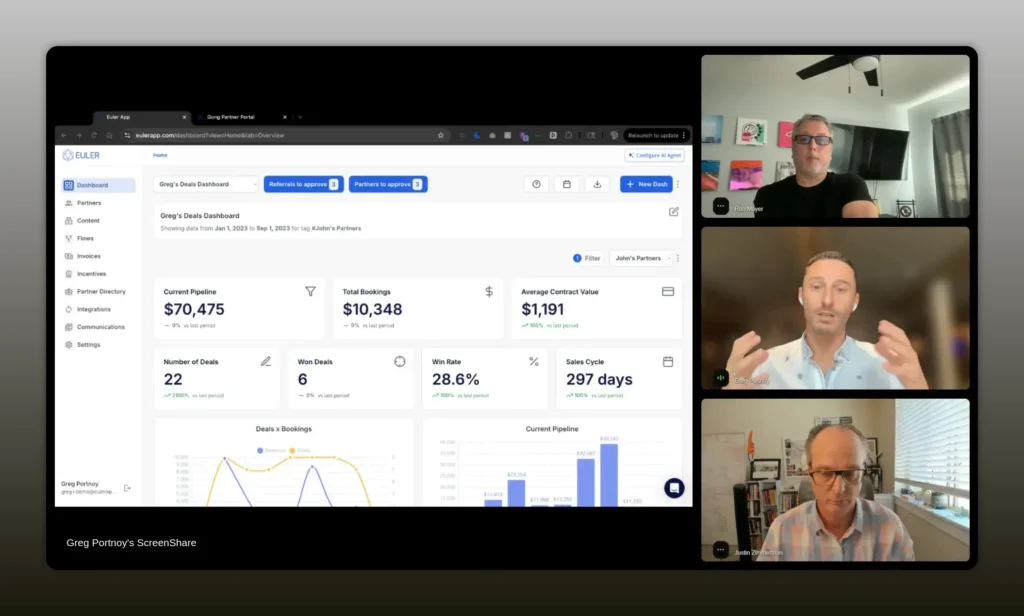
An all-knowing partner account manager in the portal can answer 90% of partner questions and free your team to do the hard work. -Greg Portnoy
What an AI partner account manager can do:
- Answer enablement questions and reference training materials uploaded to your LMS
- Return affiliate links, deal statuses, commissions, and pipeline summaries to partners
- Surface deals for co-sell outreach based on conversational signals
- Provide personalized next steps for partners to activate and close deals
Design considerations:
- Feed quality data into AI—garbage in, garbage out. Structure your CRM, PRM, and LMS so the AI has reliable inputs.
- Be pragmatic: pick the three AI features that solve immediate burden, then expand as you get value.
- Monitor outputs and create guardrails so the AI does not overpromise or misattribute.
Crawl, walk, run: getting process right quickly
Leaders often overthink strategy and under-execute. In early stages you must be scrappy, but you must also document and make repeatable what works. That is how you convince skeptical leadership to invest in growth.

Go get those wins, but show how you got that win and how it’s repeatable. -Rob Moyer
Practical crawl, walk, run plan:
- Crawl — Pick 1 to 3 motions. Run quick experiments, collect basic data in CRM, and document the sales play for each win.
- Walk — Formalize successful motions into templated processes: partner onboarding, deal registration, co-sell playbooks, and a simple attribution model.
- Run — Add tooling to automate the repeatable parts: PRM for partner actions, conversational trackers for influence, and AI assistants for partner queries. Scale headcount only once you can forecast outcomes.
Rob and Greg both emphasize being both book smart and street smart. You need strategy and hustle: learn fast, document, and then automate.
Practical checklist to get to your first multi-million
Use this checklist as a playbook to push you from scrappy to scalable.
- Define 3 quick hypotheses that could generate revenue and map owners to each.
- Set up attribution buckets: source, co-sell, influence; attach partners to deals in CRM.
- Measure win rate uplift for partner-involved deals versus direct.
- Run 5 experiments, double down on the top 2 that produce repeatable wins.
- Document the playbook for each successful motion and create a basic enablement pack.
- Pick a PRM that solves your top three partner manager problems, not the entire wishlist.
- Start small with AI features that reduce partner manager load (FAQ assistant, pipeline summaries).
- Use conversation intelligence to detect partner mentions and trigger co-sell engagement.
- Report pipeline, win rate, and average deal size to sales leadership monthly.
FAQs
How should I define partner attribution so it is defensible?
Start with three clear categories: partner source (originator of opportunity, executive intro, or deal registration), co-sell (partner participates in two or more critical sales activities), and influence (partner impacts a single sales activity). Document the definitions and attach partners to deals in your CRM so you can report consistently. Use conversation intelligence for signal validation when available.
What metrics should I prioritize in my first 6 months?
Focus on win rate uplift for partner-involved deals, pipeline generated or influenced by partners, time to first partner-sourced deal, and average deal size for partner-backed opportunities. These metrics speak directly to resource owners and make the case for investment.
When should I invest in a PRM or partner portal?
Invest when you have repeatable motions and more than a handful of partners to manage. If you can define the partner lifecycle and know the data you want to capture, a PRM that reduces partner manager friction and scales enablement is worth the investment. Prioritize vendors that solve your top three problems and iterate after deployment.
How does conversational intelligence prove partner influence?
Use labeled trackers to detect partner mentions, integrations, and marketplace activity in sales calls and emails. Those signals create an auditable trail you can tie back to deals. Alerts let partner managers engage early, and you can attach the recorded mentions to the CRM opportunity to show influence in forecasting conversations.
What are realistic expectations for AI in partnerships today?
AI should be used to remove manual work first: FAQ answering, partner onboarding tasks, deal status lookups, and basic pipeline summaries. Expect major efficiencies in partner support and faster activation. Do not expect AI to replace strategy decision-making; instead, use it to multiply the impact of human partner managers.
How many wins do you need to call a partner a real partner?
Rob recommends three wins. One-off logos are proof of concept; three wins show repeatability and alignment. Use these wins to document the playbook and prove that the model can scale.
Conclusion
Partnerships can become your most efficient and defensible growth channel if you treat them like a business: instrument the motions, measure the impact, and iterate quickly. Start by running focused experiments, documenting what works, and then automating the repeatable parts with tooling that prioritizes the partner manager experience. Use data—especially win rates and pipeline—to win resources. Leverage conversation intelligence to make influence auditable and consider practical AI features to take routine work off your team’s plate. With disciplined execution and a flywheel mindset, you can build partner programs that scale to multi-million dollar engines.