PartnerStack MCP: How to Run a Smarter Partner Program With AI
Expert advice from Mike Roper (PRM Expert at PartnerStack).
Snapshot
You are not just choosing a PRM anymore. You are deciding where your partner data lives, how quickly your team can act on it, and whether AI becomes a real operator in your workflow or just another tab with nice promises.
That is the bigger shift Justin and Mike put on the table. Partner teams are moving from manual follow-up, scattered spreadsheets, and disconnected systems into a model where your AI assistant can help benchmark a program, define partner profiles, recruit the right people, score partner health, draft QBRs, and even push data back into your PRM.
If you want to solve fragmented partner data, inconsistent recruiting, and reactive partner management, keep reading to see how Justin Zimmerman and Mike Roper can help you do it.
“We want to give you the data from PartnerStack in a place that’s convenient for you.” – Mike Roper
Table of Contents
- Why PRM choice matters more now
- What PartnerStack is trying to solve
- How the Skills Marketplace changes partner work
- Building a partner program from scratch with AI
- Discovering and recruiting better-fit partners
- Finding top performers and learning from them
- Using AI to prepare QBRs and partner reviews
- Creating a more useful partner health model
- Pushing data back into the PRM and CRM
- Automating commissions and payouts
- The weekly action digest every partner manager wants
- What AI native PRM really means
- Recommended tools
- FAQs
- Conclusion
Why PRM choice matters more now
Justin framed the conversation the right way. If you are in the market for a PRM, you do not just have a lot of options. You have a lot of very different options.
Not every PRM is built for the same type of partner motion. Some are stronger for affiliates. Some are stronger for co-sell. Some handle recruiting well. Others are better at operations, payouts, or ecosystem reporting. And now there is a new layer to evaluate: how well the platform works with AI assistants and connected systems.
That matters because partner teams no longer want to bounce between tools to answer simple questions like:
- Who are my best partners this quarter?
- Which partners are at risk?
- Who should I recruit next?
- Which commissions need review?
- What should I do this week?
Those are not hard strategic questions. They are hard operational questions when the data is buried across systems.
This is why conversations about MCP, AI assistants, and operator workflows are suddenly central to PRM evaluation. If you want a broader look at how AI is reshaping partnership operations, this overview of the state of AI in partnerships gives useful context.
What PartnerStack is trying to solve
Mike described PartnerStack as a full service, end to end partnership relationship management platform. The important part is not the label. It is the scope.
The platform is built to support multiple partner models, including:
- Affiliates
- Referral partners
- Co-sell partners
- Resellers
- Integration partners
- System integrators
That alone is valuable, especially for B2B SaaS companies running more than one partner motion at the same time.
But Mike kept coming back to four specific capabilities that define the current direction:
- Partner recruitment with a vetted ecosystem audience.
- AI visibility strategy tied to how LLMs surface brands and solutions.
- Automated commissions and payouts with tax and compliance support.
- MCP powered workflows that let your AI assistant work with partner data directly.
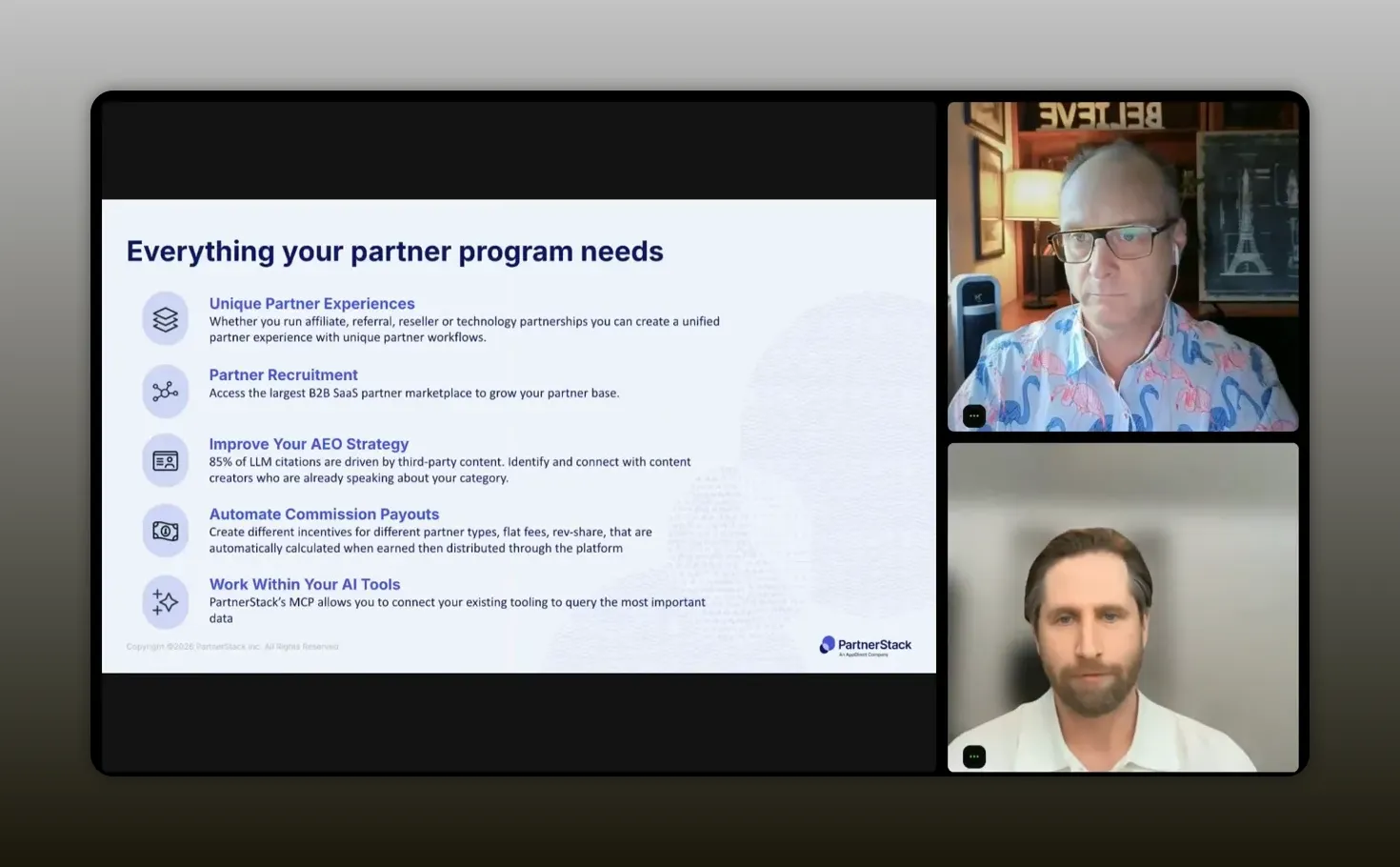
“This is what we think of when we think about being AI native.” -Mike Roper
That last point is where the demonstration became most interesting. The idea is simple: instead of forcing partner managers to live inside yet another dashboard all day, bring the PRM data into the AI tools they already use.
That is the shift from a static system of record to a more active system of work.
How the Skills Marketplace changes partner work
One of the sharpest ideas in the session was the Skills Marketplace.
Mike described a skill as a reusable set of instructions you can upload to your AI assistant. That sounds simple, but it has big implications.
Most partner teams already have hidden skills. They live in old docs, saved prompts, Slack messages, one-off SOPs, and the heads of experienced partner managers. The problem is that these workflows are rarely packaged in a way that can be reused consistently.
The marketplace turns that knowledge into portable operating logic.
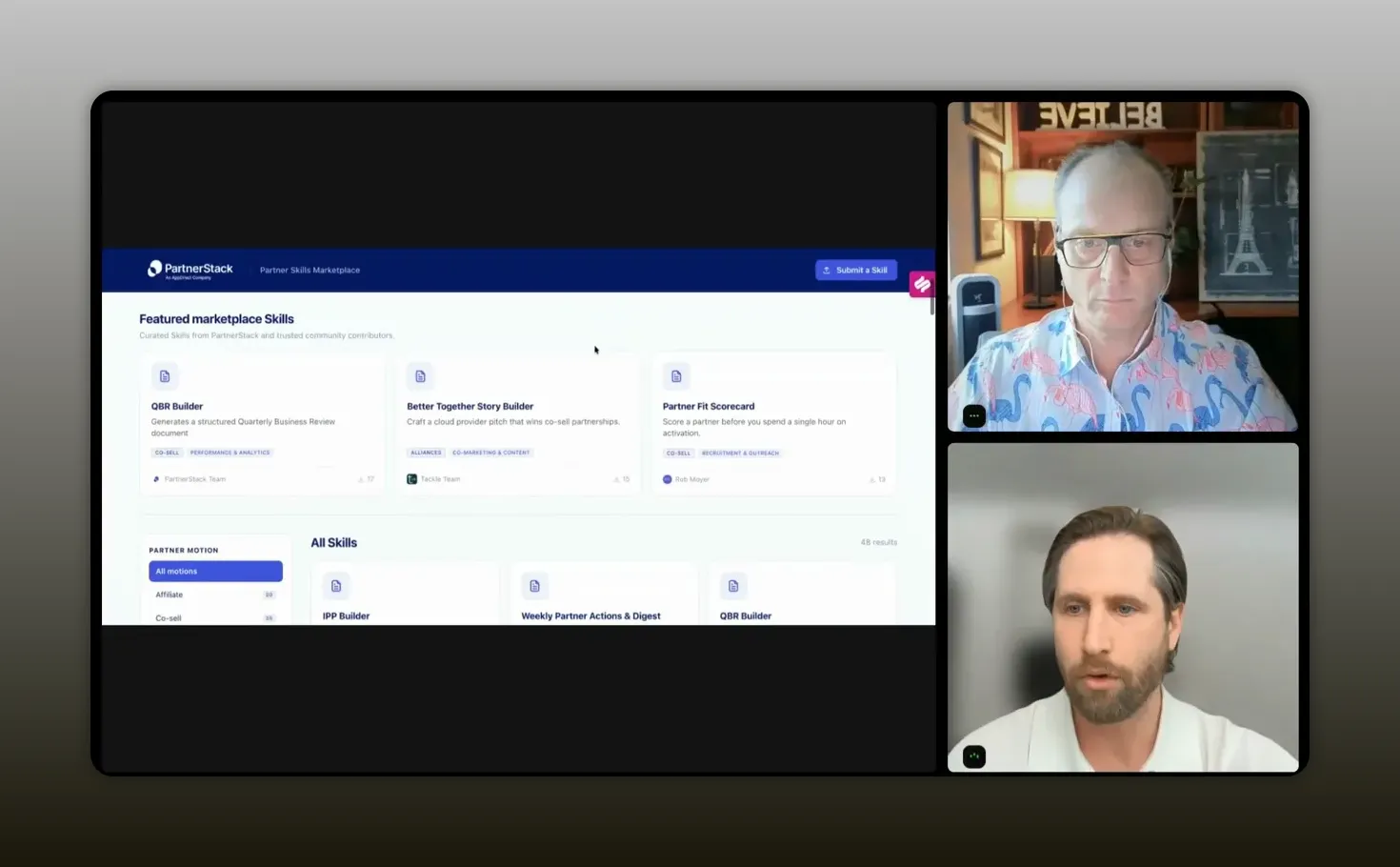
“Skills are the new playbooks for partner management in the AI era.” – Justin Zimmerman
In practice, that means you can use prebuilt skills for things like:
- Recruiting partners
- Identifying top performers
- Creating a weekly action digest
- Benchmarking a new program
- Building an ideal partner profile
- Preparing QBRs
- Scoring partner health
And because the library is open, outside contributors can submit their own skills for review. That creates a model where partnership best practices become easier to share, test, and improve over time.
If you are already experimenting with Claude as a workflow engine, this Claude guide for partnerships pairs nicely with that concept.
Building a partner program from scratch with AI
Mike walked through a strong early use case: you are building a partner program from scratch.
That moment is usually messy. You may have previous experience, but every new company changes the constraints. Different category. Different customer profile. Different sales motion. Different expectations from leadership.
Instead of starting from a blank page, the workflow begins with a benchmarking skill. The AI asks a few structured questions:
- What does your company do?
- Who do you target?
- What partner types are you trying to work with?
- What is the goal of the benchmarking exercise?
Then it pulls publicly available information and returns a concise one pager showing how comparable companies structure their programs.
That kind of output matters for two reasons.
First, it helps you get oriented fast. Second, it gives you something leadership can actually react to. Instead of abstract opinions, you bring in a structured view of what the market appears to be doing.
Mike used the example of a sales engagement tool competing with companies like Apollo, ZoomInfo, and other established players. The AI uses public signals to assemble a practical benchmark, not private competitor data.
That distinction is important. The value is not in pretending you have secret access. The value is in compressing research time and converting messy public inputs into a usable planning document.
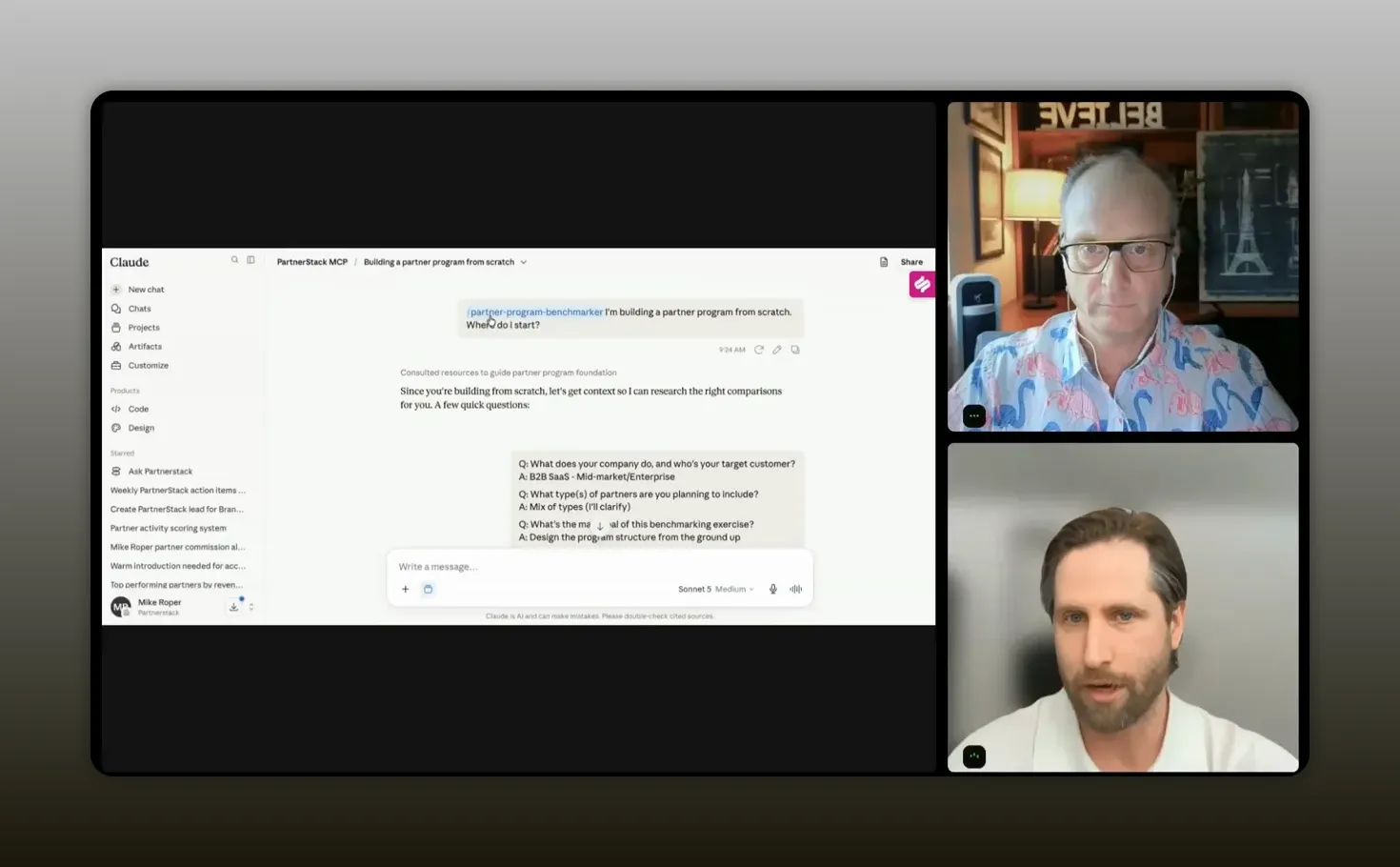
“Where do I start? How do I start? It’s going to ask you the right questions.” – Mike Roper
Discover and recruit better-fit partners
Once the program structure is clearer, the next challenge is recruiting the right partners.
Mike showed how the process can move from benchmark to IPP, or ideal partner profile. This is one of those areas where partner teams often stay too vague. They know they want affiliates, agencies, or referral partners, but they do not define the attributes clearly enough to recruit consistently.
The IPP workflow tightens that up by asking what your target customer profile looks like and what kinds of partners overlap with that ecosystem.
From there, the output becomes more useful than a generic partner wish list. It can separate partner types and identify:
- What to look for
- What to avoid
- Why each type is relevant
- How each partner group fits your recruitment strategy
Then Mike moved into PartnerStack’s discovery and recruitment interface.
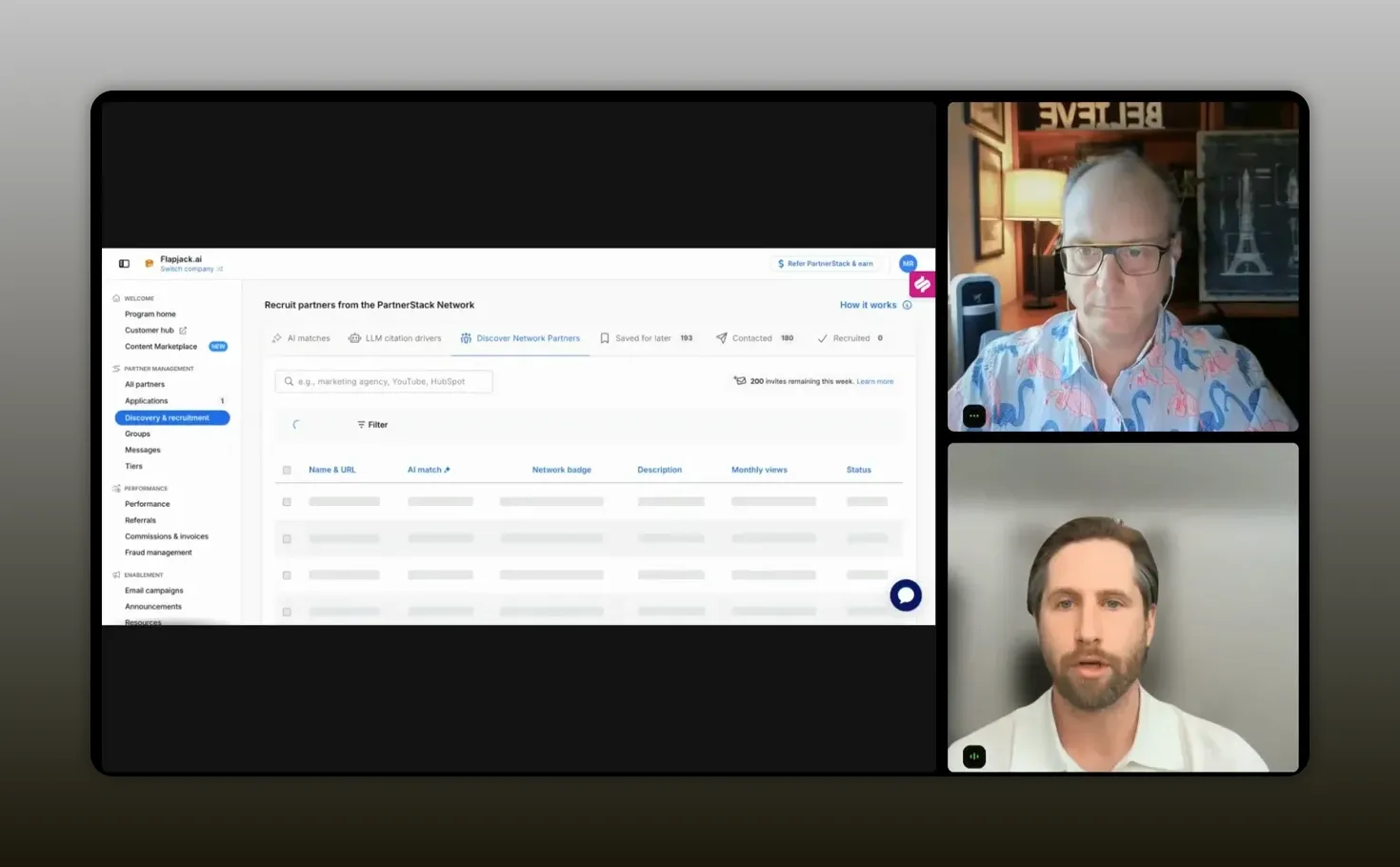
“PartnerStack’s already done all of the filtering for me.” – Mike Roper
The recruiting flow includes vetted partners with B2B SaaS audiences and filters for criteria such as:
- Audience segment like SMB, mid market, or enterprise
- Partner type such as affiliate or influencer
- Fit against the profile you defined
Once you click into a partner, you can review profile details, website, audience size, and other fit indicators. From there you can recruit directly.
There are really three layers here:
- Manual selection with filters and profile review.
- AI assisted ranking where best fit partners are surfaced for you.
- Agent based outreach where an AI workflow can personalize and send recruiting messages.
That third layer is where the workflow becomes more than convenience. You can choose templated outreach or AI generated outreach that personalizes the value proposition to a specific partner.
Used well, that saves time without flattening every message into the same generic pitch. Used poorly, it becomes spam at scale. The difference is whether your IPP and message logic are actually strong.
Mike’s sequence was smart because it built strategy first, then automation second.
Finding top performers and learning from them
After recruiting and activating partners, the next problem is resource allocation.
Most partner teams eventually hit the same wall. They know the program is producing value, but they are not always sure where to invest time next. Should they recruit more? Support current partners? Rebuild onboarding? Expand top accounts?
This is where the AI query layer becomes powerful.
Mike showed how partner data from PartnerStack can be pulled into Claude to answer questions like who the top referral partners are and which affiliates are driving the most revenue and commissions.
The output was not just a ranking table. It also added context.
For example:
- If performance is flat at the top, you may be too dependent on a small number of partners.
- If one affiliate is dramatically outperforming the rest, that person becomes a model to learn from.
- If a revenue leader has high commissions but low strategic engagement, that may suggest untapped growth potential.
Mike used Nico as the example of a standout affiliate. The right next step was not simply to celebrate the number. It was to ask what Nico is doing that others are not, then use that learning to upgrade partner support and future recruiting.
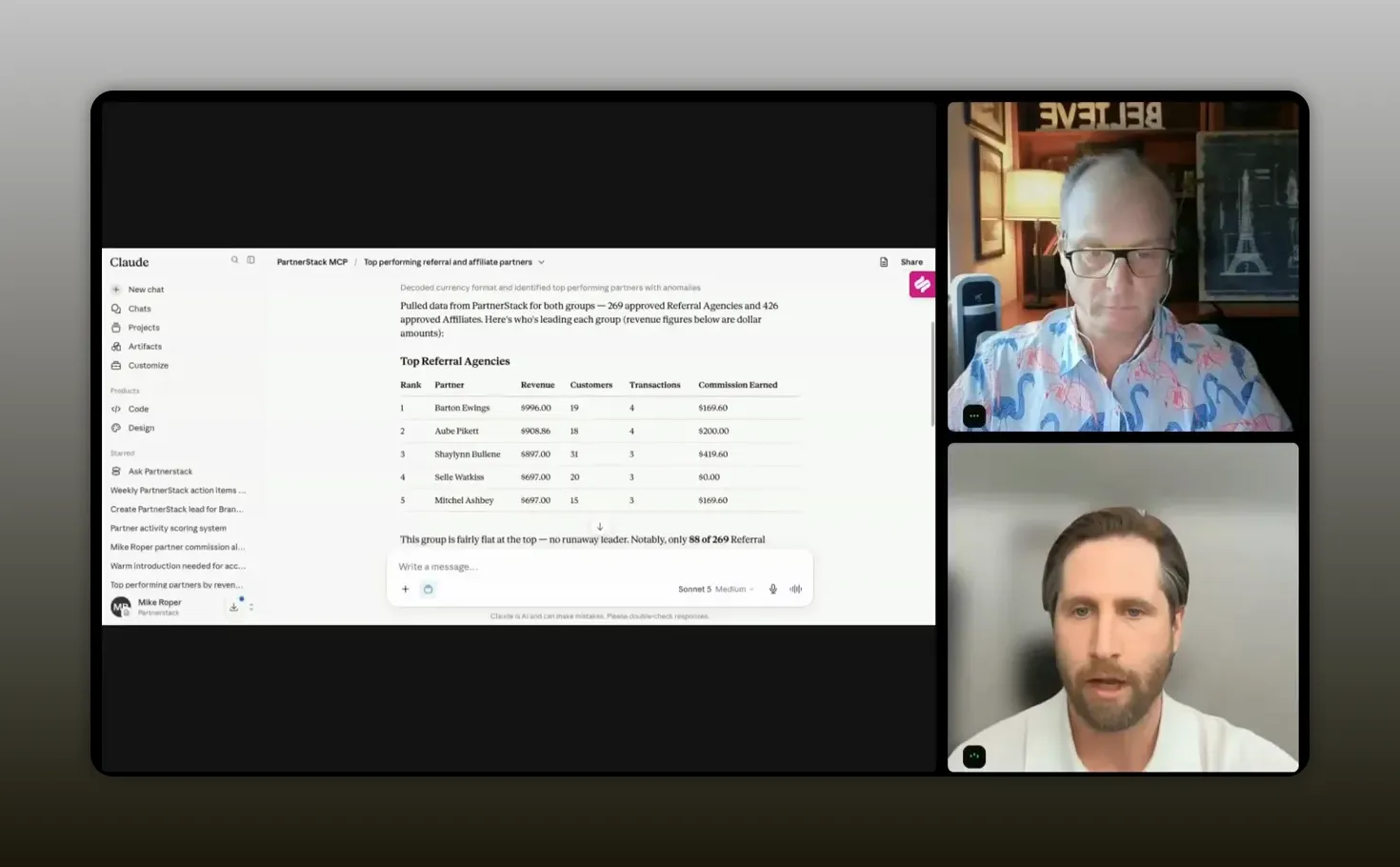
“We want to understand what Nico is doing.” – Mike Roper
That is a better operating model than simple leaderboard management. It turns analytics into action.
Using AI to prepare QBRs and partner reviews
One of the most practical workflows Mike showed was QBR preparation.
Anyone who has built partner reviews manually knows the pain. You pull data from multiple systems, build a deck or one pager, summarize wins, highlight gaps, and try to make the conversation constructive instead of transactional.
The QBR skill simplifies that process by asking a handful of framing questions:
- What timeframe should the review cover?
- Who is the audience?
- Do you want to use an existing structure or a default framework?
From there, it generates an executive summary, key highlights, performance history, and recommended next steps.
What I liked most in Mike’s example was the way he used a drop in performance as the real conversation starter. When a partner had strong results in 2024 and a drop afterward, the point was not to produce a prettier report. The point was to identify a specific business question: what changed, and what can we do to win that business back?
That is the kind of AI use case partner teams should prioritize. Not novelty. Not synthetic fluff. Actual preparation that leads to better conversations.
It also reinforces one of Mike’s bigger points: partners are not in it just for the commission. Good partner management means understanding mutual goals and maintaining a healthy two way relationship.
If you are interested in more reusable AI workflow patterns for partner teams, this live build on Claude co-work for partnerships goes deeper on operationalizing best practices.
Creating a more useful partner health model
Partner health scoring is easy to oversimplify.
A lot of programs make the same mistake. They treat referral volume or lead count as the primary indicator of partner quality. That can be useful, but it is incomplete.
Mike showed a broader health check approach that can combine:
- Deals registered
- Leads submitted
- Deal velocity
- Stage progression
- Email engagement
- Communication frequency
- CRM data
- PRM activity signals
This matters because a partner who sends a lot of low quality leads may look active on the surface but create little real value. Meanwhile, a partner sending fewer but better qualified opportunities may deserve more attention.
The health model Mike described also supports segmentation into categories such as:
- Top performers
- High potential partners
- At risk partners
- Dormant partners
Once you have that, better decisions follow:
- Assign dedicated management to strategic accounts.
- Invest more activation support in high potential accounts.
- Rework onboarding if too many new partners stall early.
- Clean up dormant accounts if the program needs refocusing.
This is much closer to how modern customer success teams think about account health, and that is a good thing. A strong partner ecosystem usually needs that same discipline.
Pushing data back into the PRM and CRM
The demo was not just about pulling information out. It also showed how an AI assistant can push structured information back into your system.
Mike used a simple referral example. A partner shares a lead. The operator enters the details through Claude. The assistant checks for the partner, identifies the record, and creates the lead in PartnerStack.
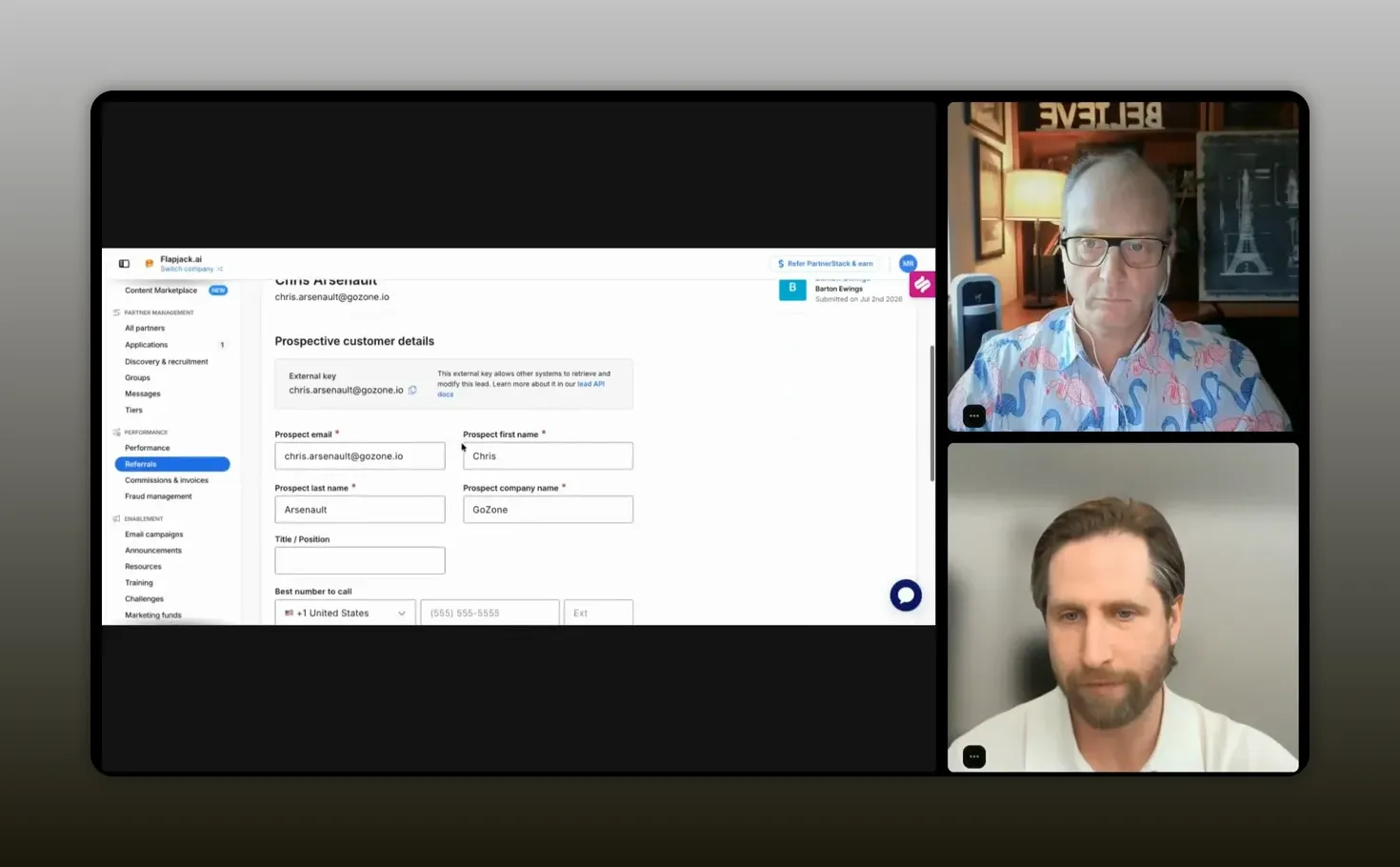
“All of the attribution is going to be tracked in PartnerStack.” – Mike Roper
Then the workflow continues:
- The lead is visible inside the PRM.
- The system can check the CRM for duplicates.
- The lead can sync into Salesforce.
- Internal stakeholders can be notified in Slack or email.
- Sales ownership can be assigned.
- Partner attribution stays intact as the opportunity progresses.
This kind of bidirectional sync is critical. A partner program breaks trust quickly when leads disappear into the sales process with no visibility or payout follow-through.
PartnerStack’s position here is not just that data moves. It is that data moves without disrupting your existing workflows. That is the part that matters to operators who have already lived through brittle integrations.
For general background on the Model Context Protocol itself, the official MCP site is worth bookmarking.
Automating commissions and payouts
This is one of those parts of partner operations that becomes more important the moment your program works.
If you cannot calculate, review, approve, and pay commissions smoothly, the rest of the partner experience suffers.
Mike highlighted a core part of PartnerStack’s long standing value proposition: automated commission handling and payouts. That includes support for different structures such as:
- Flat fees
- Revenue share
- Hybrid models
It also includes the annoying but essential back office work that partner teams often do not want to own manually, including tax and compliance tasks like collecting W-9 information.
The operational flow Mike described was straightforward:
- Commissions earned in a given month are added to an invoice.
- Finance or approved users can review the invoice details.
- If needed, they can remove a commission or edit the invoice flow.
- The company pays PartnerStack.
- PartnerStack pays out the partners via their preferred method.
Those payout methods can include Stripe, PayPal, and direct deposit, which reduces friction for partners working with multiple programs.
That last part matters more than many teams realize. A great partner experience often comes down to removing tiny points of operational friction. If getting paid is annoying, partner goodwill drops fast.
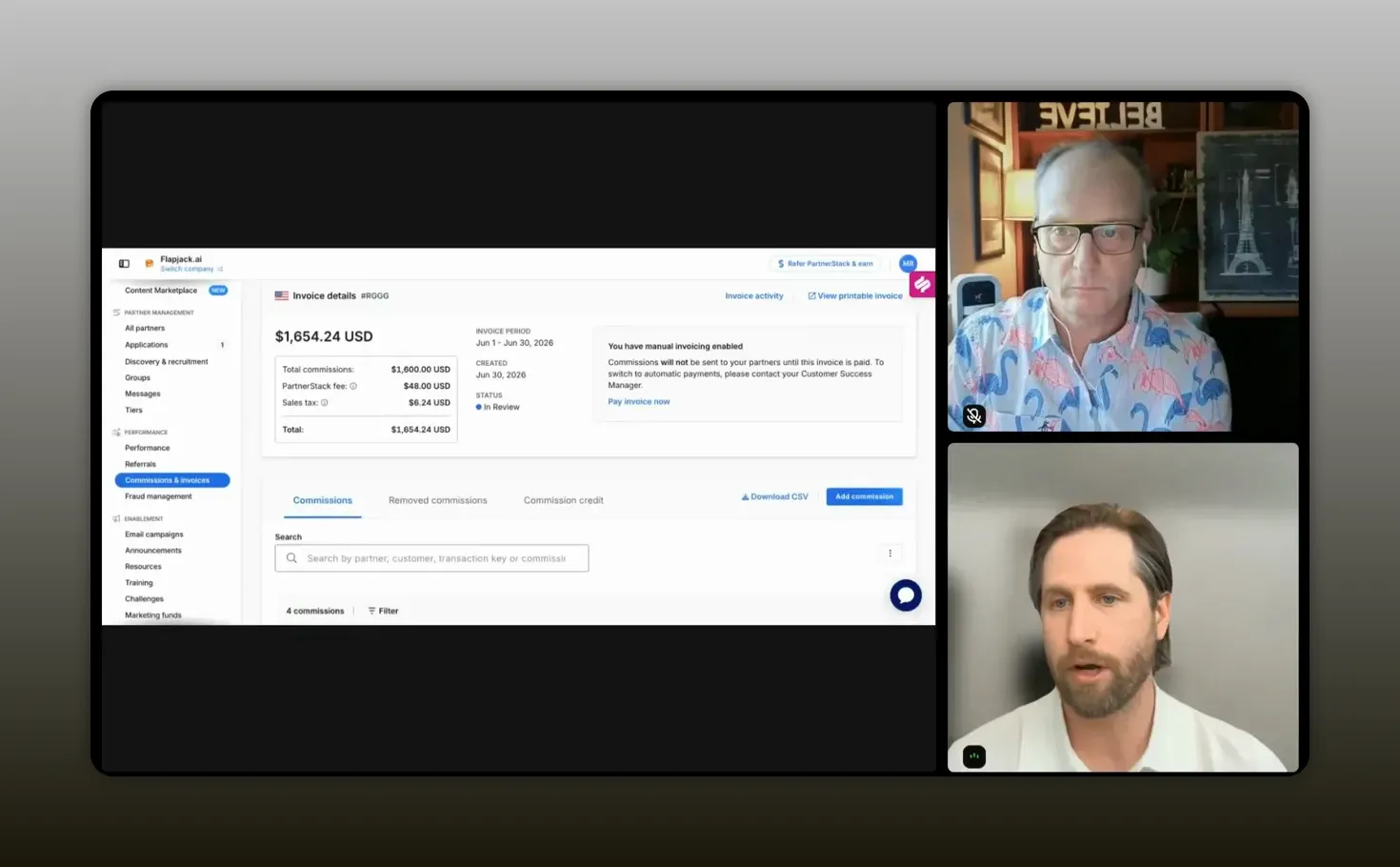
“Partner experience starts with the partner experience.” – Mike Roper
The weekly action digest every partner manager wants
The workflow Mike said he wished he had as a partner manager was the weekly action digest.
That felt right because it solves a deeply familiar problem. Partner managers are often forced into detective work every week. You open Salesforce. You check partner accounts. You review referrals. You scan pending applications. You look for stalled deals. You try to figure out what actually needs attention.
The digest turns that scattered process into a prioritized report.
In Mike’s example, the digest could highlight:
- Pending partner applications that should be approved or reviewed
- Commissions that need attention
- Top commission earners
- Deals that are stalled
- Action items that need partner follow-up
It can also be pushed into Slack so the right people stay informed.
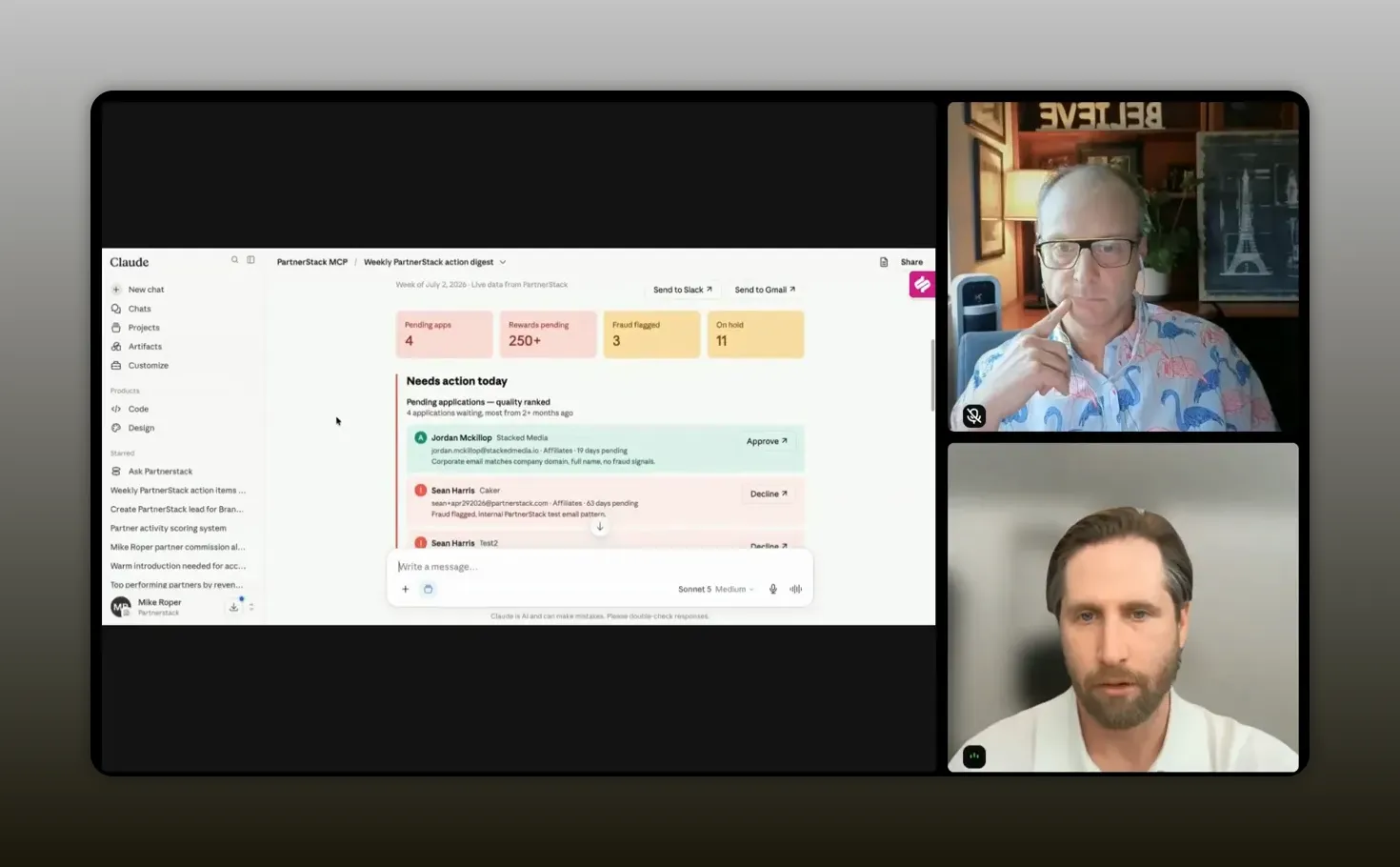
“It’s exactly that weekly reminder, that follow-up to engage with your partners.” – Mike Roper
This is a small feature with outsized impact because it improves focus. Instead of treating partner management as an endless sweep across systems, you start from a clear list of what deserves action now.
What AI native PRM really means
There is a lot of loose talk right now about AI native software. Mike gave it a clearer meaning.
In this case, AI native does not mean slapping a chatbot on top of a dashboard.
It means:
- Your AI assistant can access relevant partner data.
- That data can be combined with CRM, email, and other systems.
- You can ask useful operational questions in one place.
- You can take action, not just read summaries.
- You can package expertise into reusable skills and workflows.
That is a meaningful distinction.
For partner leaders, the real question is whether this approach improves control or reduces it. Justin made the case that it actually gives you more control over workflows because you can define what the system does, what logic it uses, and what outcome you want.
Done right, that gives you:
- Faster program design
- More targeted recruiting
- Cleaner partner reporting
- Better account prioritization
- More consistent team execution
It also nudges partner teams closer to a more mature operating model. Less hero work. More repeatable systems.
If your organization is also exploring AI agents, MCP connections, and cross-system workflows beyond PRM alone, this deeper article on AI, MCP, and operator workflows that scale is highly relevant.
Recommended tools
If you want to put this style of workflow into practice, these are the core tools and layers Mike and Justin centered on:
- PartnerStack for PRM operations, recruiting, attribution, commissions, and partner management.
- Claude as the AI assistant layer for querying, summarizing, planning, and taking action.
- Salesforce or HubSpot as the CRM source for pipeline and account context.
- Slack for notifications, routing, and weekly digests.
- Email systems for partner outreach and engagement data.
- Additional connected systems such as Gong when conversation data adds partner insight.
The key lesson is not that you need the biggest stack possible. It is that you need a stack where data can move cleanly between systems and where your AI layer can operate with enough context to be useful.
FAQs
What is PartnerStack MCP meant to do?
It connects PartnerStack data to AI assistants like Claude so you can query partner information, generate reports, run workflows, and in some cases push structured updates back into your systems.
How is a skill different from a normal prompt?
A skill is a reusable instruction set. Instead of rewriting the same process every time, you can package the workflow once and use it repeatedly for tasks like recruiting, benchmarking, QBR preparation, or health scoring.
Can this help if you are building a partner program from scratch?
Yes. One of the clearest use cases shown was benchmarking a new program, identifying comparable companies, and defining an ideal partner profile before starting recruitment.
Does PartnerStack support different partnership models?
Yes. Mike specifically referenced affiliates, referrals, co-sell, resellers, integration partners, and system integrators as supported motions.
What makes the weekly action digest useful?
It brings together the actions a partner manager should take now, such as reviewing partner applications, checking commissions, and following up on stalled deals, instead of forcing you to hunt through multiple systems manually.
Why does commission automation matter so much in a PRM?
Because a partner experience falls apart quickly if attribution is unclear or payouts are slow. Automating calculations, invoice review, compliance steps, and payout methods helps maintain trust and operational consistency.
Conclusion
The biggest takeaway from Justin and Mike is that the future of partner operations is not about replacing partner managers. It is about giving you a better operating layer. When skills, AI assistants, PRM data, CRM context, and payout workflows all connect cleanly, you stop spending so much time gathering information and start spending more time making decisions. That is the opportunity here. If you are evaluating PRM software now, do not just ask whether it tracks partners. Ask whether it helps you build, recruit, analyze, activate, and scale in the place where your team already works.