The Webflow AEO Guide To Partner-Sourced Inbound
Expert advice from Guy Yalif (Chief Evangelist, Webflow) and Tyler Calder (CMO, PartnerStack).
Snapshot
Search traffic is softening. AI assistants are intercepting questions earlier. And when your brand does appear, it is often reduced to a few facts, an incomplete summary, or a confident misunderstanding.
That creates real risk for partner teams. If your company, your partner program, and your ecosystem story are not showing up accurately in AI answers, you lose visibility before a conversation even starts. But there is a big upside too. The traffic that does come from large language models is often more qualified, further down the funnel, and more likely to convert.
The opportunity now is to adapt your content, technical setup, authority strategy, and measurement model so AI systems can find you, understand you, and recommend you.
If you want to solve declining organic visibility, weak partner discovery, and inaccurate brand representation, keep reading to see how Guy Yalif and Tyler Calder can help you do it.
“LLMs are both threat and opportunity to your ability to go build a brand with your target partners.” -Guy Yalif
Table of Contents
- Snapshot
- Why AEO matters now
- SEO is not dead, but the job has changed
- The four-part AEO framework
- Content: from keywords to questions
- Technical setup: help AI understand your pages
- Authority: earn mentions, not just links
- Measurement: what success looks like now
- What this means for partner teams
- A practical starting plan
- Recommended tools
- FAQs
- Conclusion
Why AEO matters now
The world of search and discovery has changed, and you can feel it whether you run demand generation, content marketing, SEO, or partner marketing.
People still search, but they increasingly start in ChatGPT, Gemini, Claude, Perplexity, and other AI interfaces. Instead of typing a keyword and opening ten tabs, they ask a question and get an answer. That one behavior change alters everything upstream.
Guy makes the point clearly: many brands are seeing less organic traffic. Not the dramatic doomsday numbers that make headlines, but meaningful declines in the 10 to 25 percent range. That is enough to force a strategic reset.
At the same time, the traffic coming from LLMs appears to be much more valuable. At Webflow, Guy shared that 8 percent of self-serve signups came from LLM source traffic, and that traffic converted 6x better than unbranded organic search. Tyler noted similar patterns at PartnerStack, where LLM-referred traffic was converting two to three times higher than their next best channel.
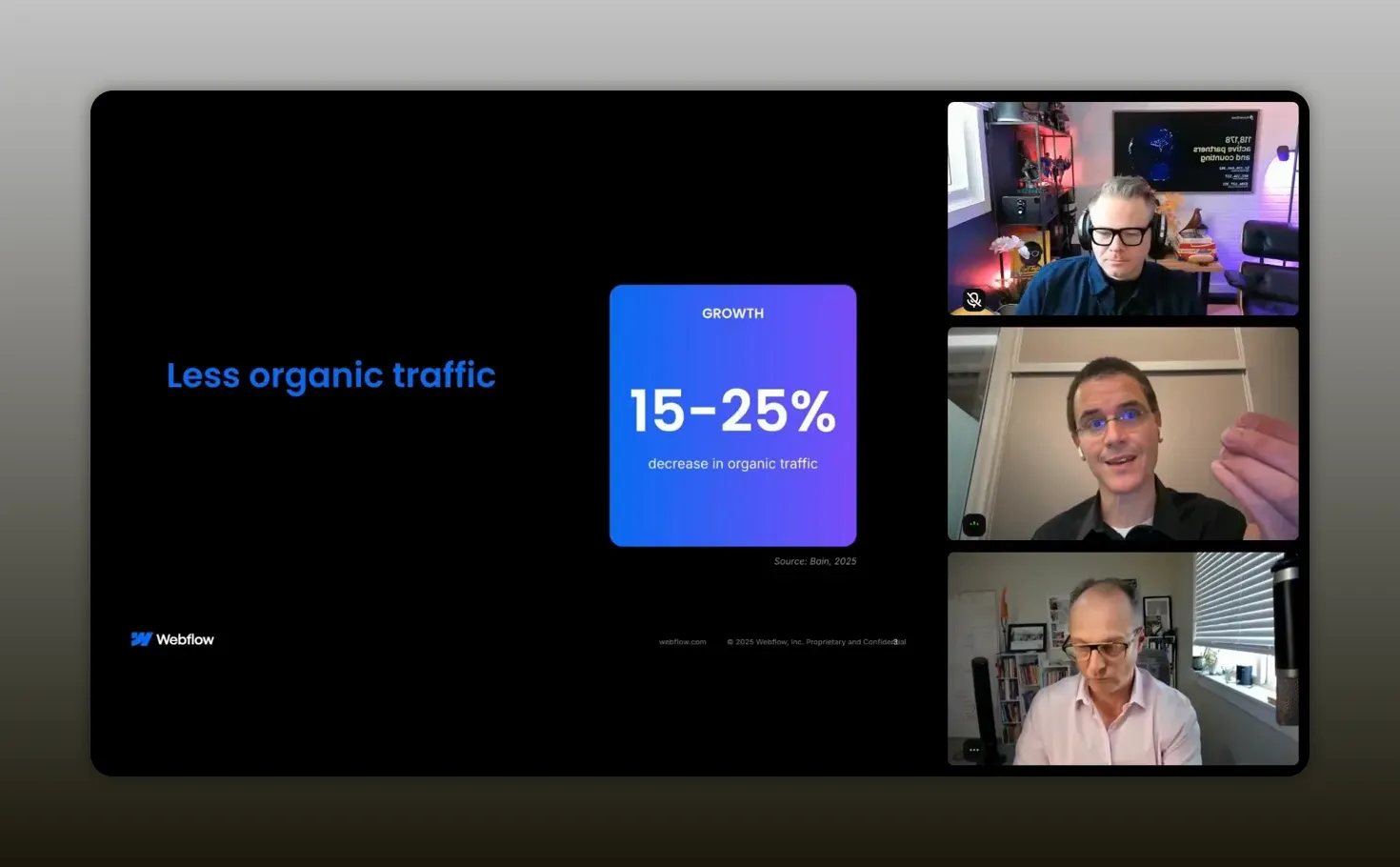
“That traffic converted six times better, not six percent, six X better.” -Guy Yalif
That is the tradeoff you need to understand. You may get less traffic overall, but the traffic you do get can be more qualified, more informed, and closer to action.
There is another issue that matters just as much, especially if you care about partnerships. LLMs often describe your company or partner program as a set of facts. They may skip the story. They may miss what makes you different. They may not mention you at all. Worse, they can be confidently wrong.
If your growth depends on attracting partners, affiliates, agencies, or ecosystem players, then AI visibility is not just a content problem. It is a positioning problem, a pipeline problem, and a brand problem.
SEO is not dead, but the job has changed
A lot of people want to declare SEO dead whenever the internet changes shape. That is not what is happening here.
Guy’s framing is more useful: good AEO is close to what good SEO always should have been. If you create genuinely useful content for the people you want to reach, that work still matters. In fact, the overlap between strong SEO and strong AEO is substantial.
That matters because it keeps you from making two common mistakes:
- Throwing out your existing SEO discipline because AI feels like a brand new game
- Assuming your current SEO program is enough without adapting to question-based discovery and AI citation behavior
If you already have an SEO team or agency, you probably have the right foundation. You just need to evolve the playbook.
For partner organizations, this should sound familiar. The best ecosystems are rarely built by chasing one tactic. They are built by orchestrating multiple systems around shared value, shared visibility, and measurable outcomes. That same mindset applies here. If you want a broader ecosystem view of how these pieces fit together, this guide on partner-first growth through ecosystem orchestration is worth your time.
The four-part AEO framework
Guy organizes the work into four practical categories:
- Content
- Technical setup
- Authority
- Measurement
That framework is useful because it keeps you from overfocusing on one lever. Many teams jump straight to content production. Others obsess over tools. Others only care about ranking reports.
AEO requires all four. You need content that answers the right questions, pages that AI systems can parse easily, outside signals that establish trust, and a measurement model that reflects how AI discovery actually works.
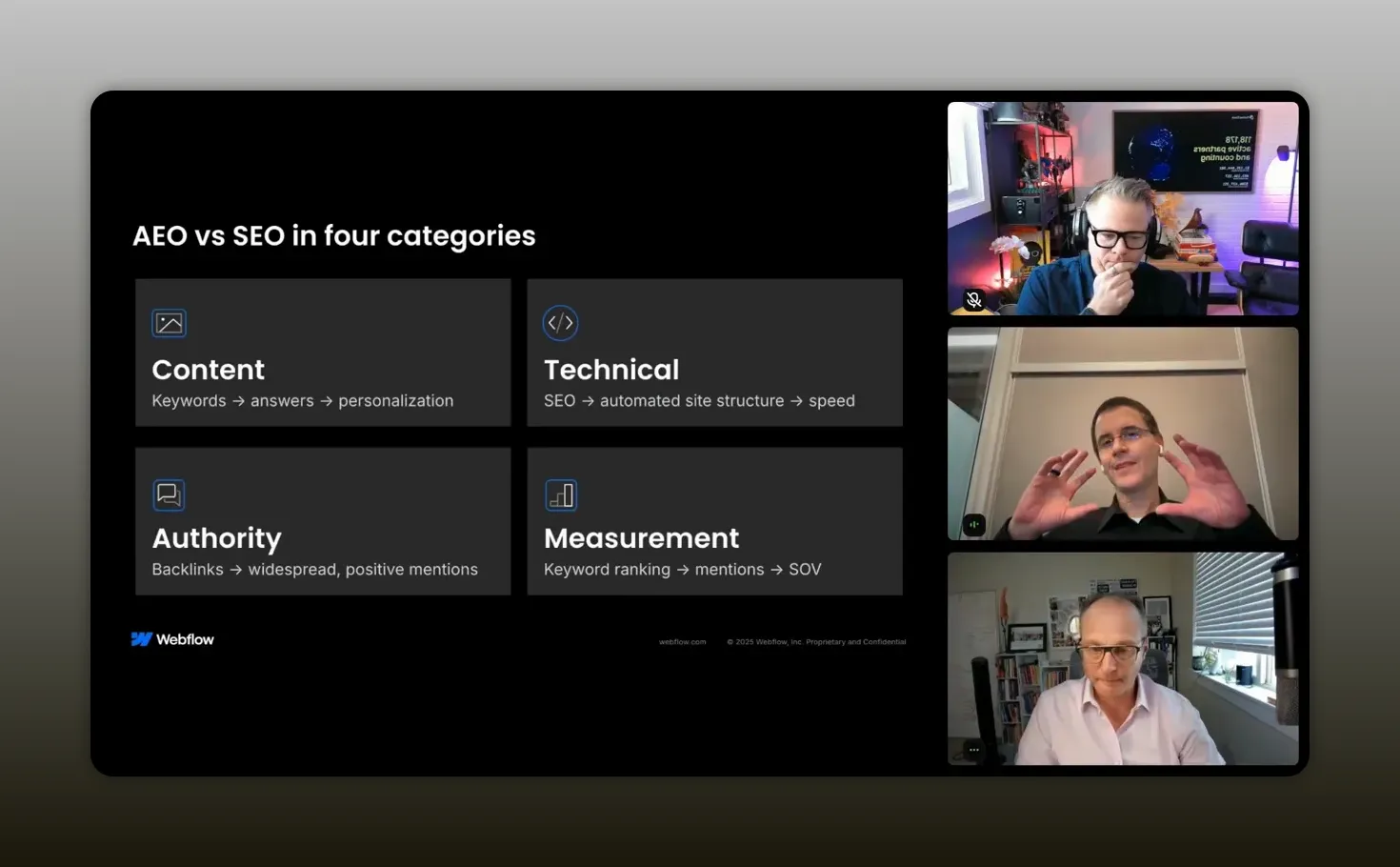
“Think about it in four categories. The content you create, how you tactically set yourself up, how you establish authority, and how you measure.” -Guy Yalif
Content: from keywords to questions
The biggest mental shift in AEO is simple: your topic strategy can no longer live only as a basket of keywords. It needs to become a basket of questions.
That sounds small, but it changes how you plan, write, and organize content.
Start with the questions your partners actually ask
If you work in partnerships, you already have a goldmine of these questions. They show up in sales calls, partner calls, onboarding emails, enablement sessions, and objection-handling conversations.
Guy suggests several ways to source them:
- Review partner and prospect call recordings
- Analyze email conversations
- Check Google’s “People also ask” results
- Ask an LLM what a prospective partner would want to know
The point is not to generate generic prompts. The point is to map the real decision journey.
For example, a prospective partner might ask:
- What is it like to partner with this company?
- How does the economic relationship work?
- What resources would I need on my side?
- How long does onboarding take?
- What are the risks?
- How will my brand or logo be used?
Those are not vanity content ideas. Those are conversion questions.
Answer questions throughout the full journey
One of the more useful insights Guy shared is that LLMs are sending traffic to a wider set of domains than traditional search did. That means deeper, more specific, more long-tail questions now have a better chance of getting surfaced.
So yes, create top-of-funnel content. But do not stop there.
Create content for:
- Early awareness questions
- Evaluation questions
- Operational questions
- Risk and trust questions
- Late-stage decision questions
If your content stops at “why partnerships matter,” you are missing the questions that actually move someone toward action.
Use question-based headlines where it makes sense
Webflow tested a simple change: reframing blog headlines as questions. It was not a massive academic study, but the result was still compelling. They saw 13 percent more LLM source traffic just by changing the header format.
That does not mean every headline should be a question. It means the format aligns well with how people now query AI systems.
If your content directly answers a real question, let the page signal that clearly.
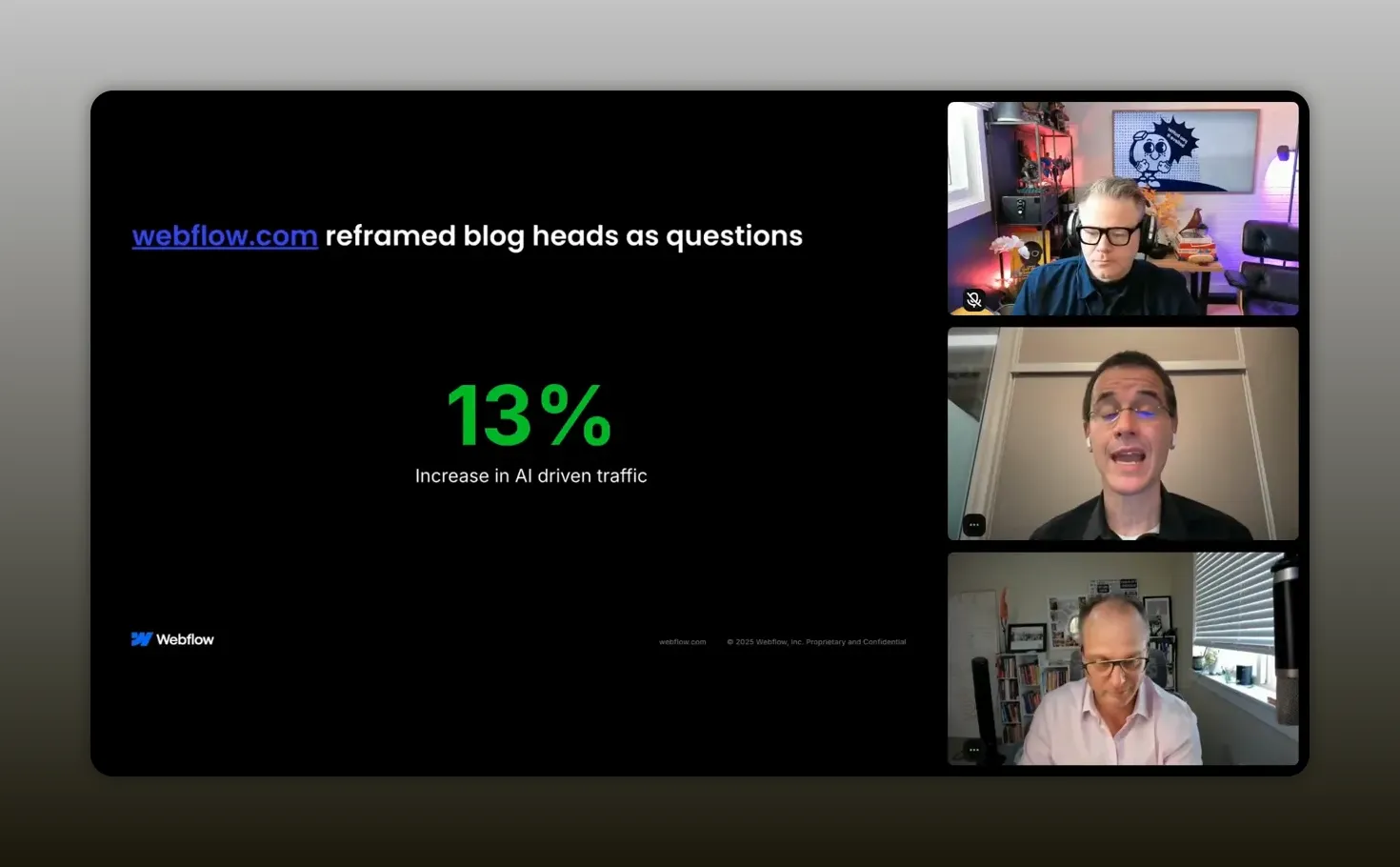
“The topics you want to be known for now become a basket of questions.” -Guy Yalif
Keep your content fresh
Freshness matters more than many teams realize. Guy cited third-party data showing that 95 percent of ChatGPT citations came from content updated within the last 10 months.
That should change how you think about your editorial calendar. You do not just need net new content. You need a refresh engine.
At Webflow, updating existing content at greater speed led to:
- 42 percent more traffic in two weeks
- 14 percent better conversion on that traffic
That combination is especially powerful because more traffic often lowers conversion rates. Here, both moved in the right direction.
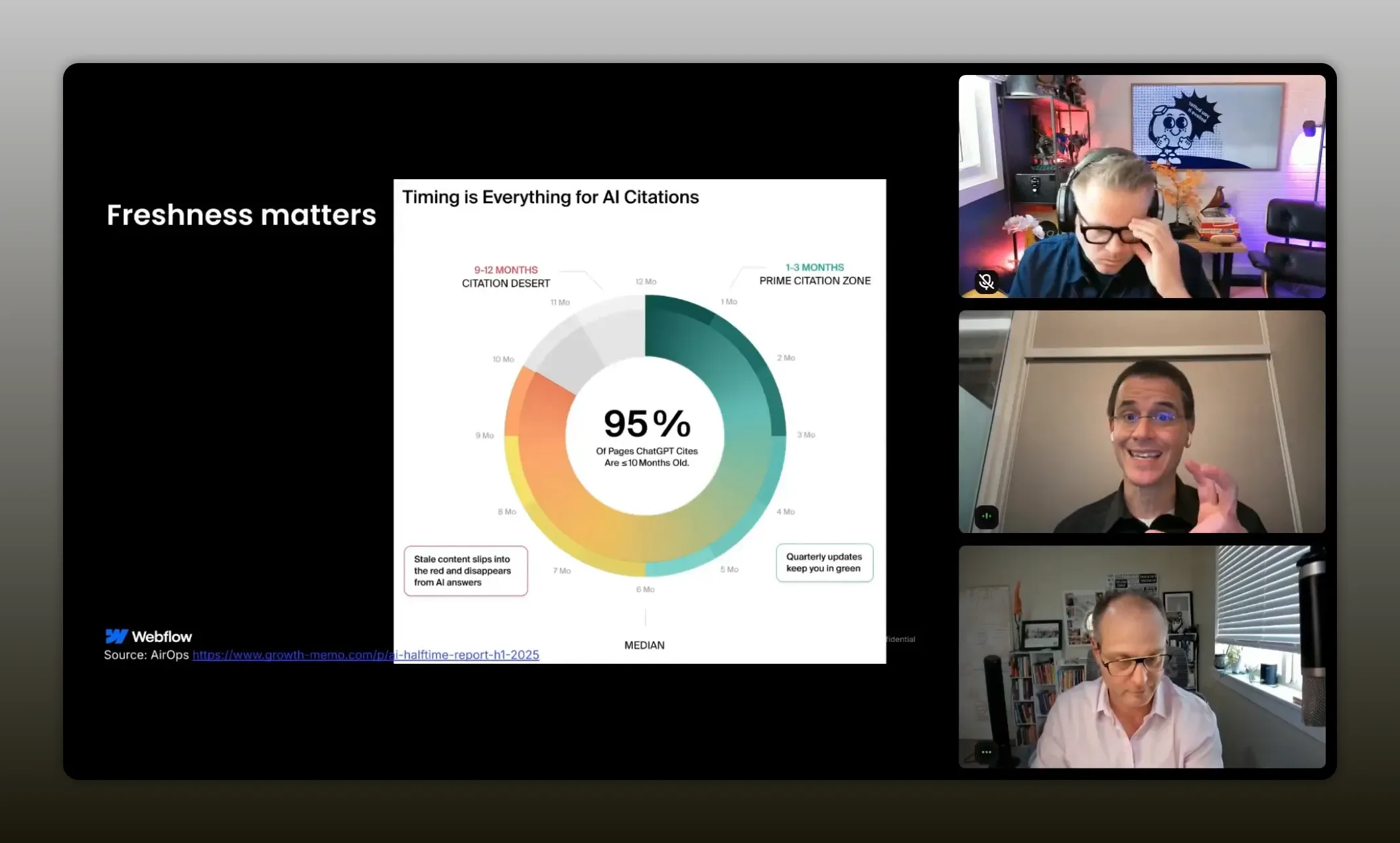
“You don’t just need net new content—you need a refresh engine, because freshness is what keeps your pages showing up in citations.” -Guy Yalif
Do not spam AI-generated content
AI makes it easy to create volume. That does not mean volume is the answer.
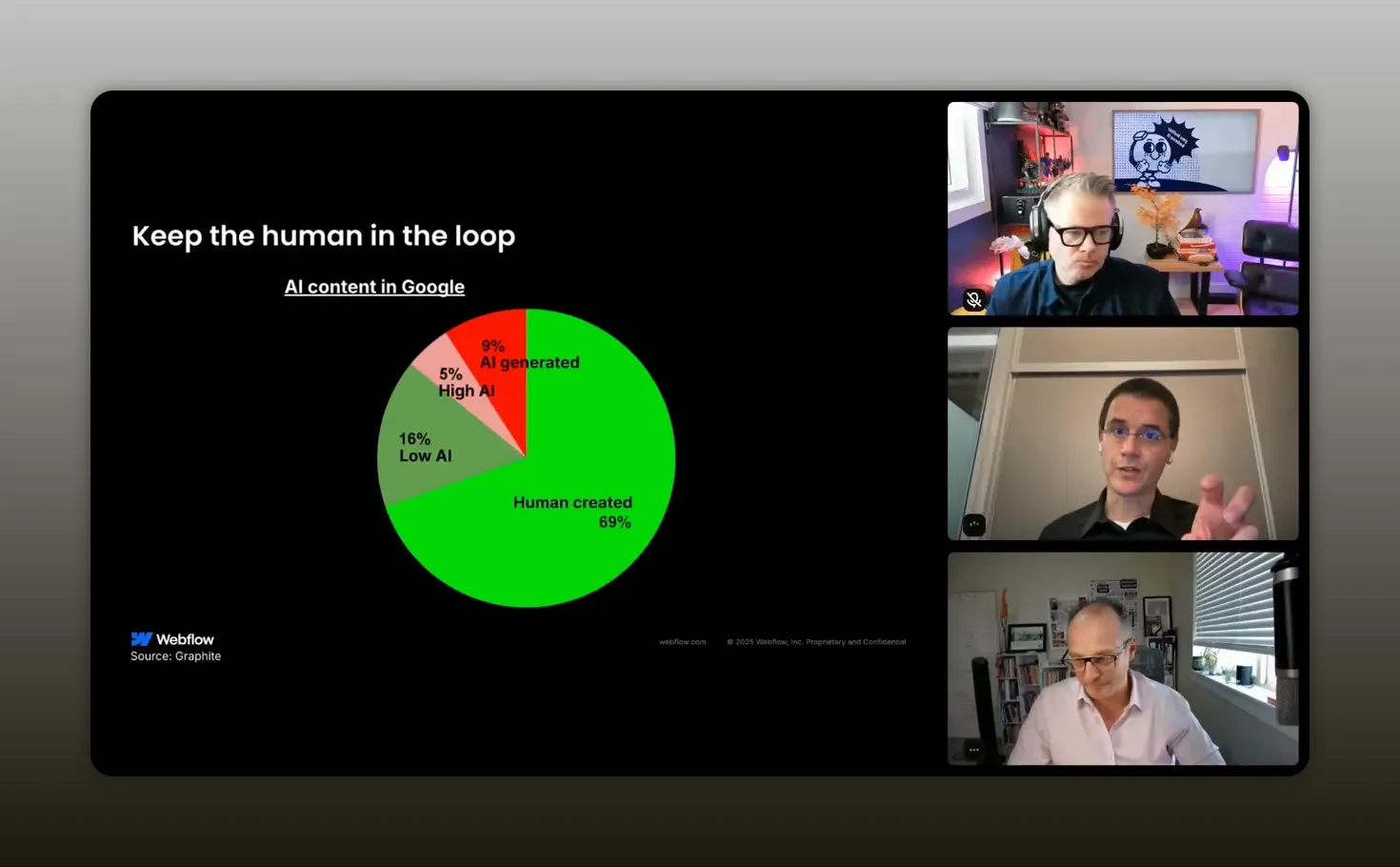
Guy pointed to analysis showing that most content cited by Google in AI Overviews is still either entirely human-created or primarily human-created with light AI assistance. The lesson is straightforward: use AI to speed up good work, not to mass-produce forgettable pages.
Your best content should still be:
- Useful
- Specific
- Updated
- Written with real expertise
- Aligned to actual questions in the funnel
If you need a reminder that disciplined experimentation beats content spam, this piece on building partner flywheels instead of one-off funnels reinforces the same principle from another angle.
Technical setup: help AI understand your pages
Strong content is necessary. It is not sufficient.
You also need to make your site easier for AI systems to crawl, interpret, and cite. Guy’s point here is refreshingly practical: if you have not handled the basics of SEO yet, do that first. Make sure your metadata exists. Make sure your links work. Make sure your pages are indexable.
Then move into the technical layer that matters more in AEO.
Schema is one of the highest-leverage changes you can make
Schema is structured metadata that tells machines what a page is and what its content means. It can identify a page as an article, FAQ, event, product, company page, bio page, and much more.
Why does that matter? Because structured data lowers the cost of understanding your content.
LLMs and search engines are constantly making tradeoffs between:
- How expensive a page is to crawl and parse
- How valuable and trustworthy the content appears to be
If you make your pages easier to process, you increase the likelihood that they will be crawled, understood, and cited.
Guy shared several useful stats here:
- 73 percent of Google first-page results have schema
- 88 percent of websites still have not added schema
- Adding structured metadata can lead to 42 percent more citations
That is a rare combination of high impact and relatively low adoption.
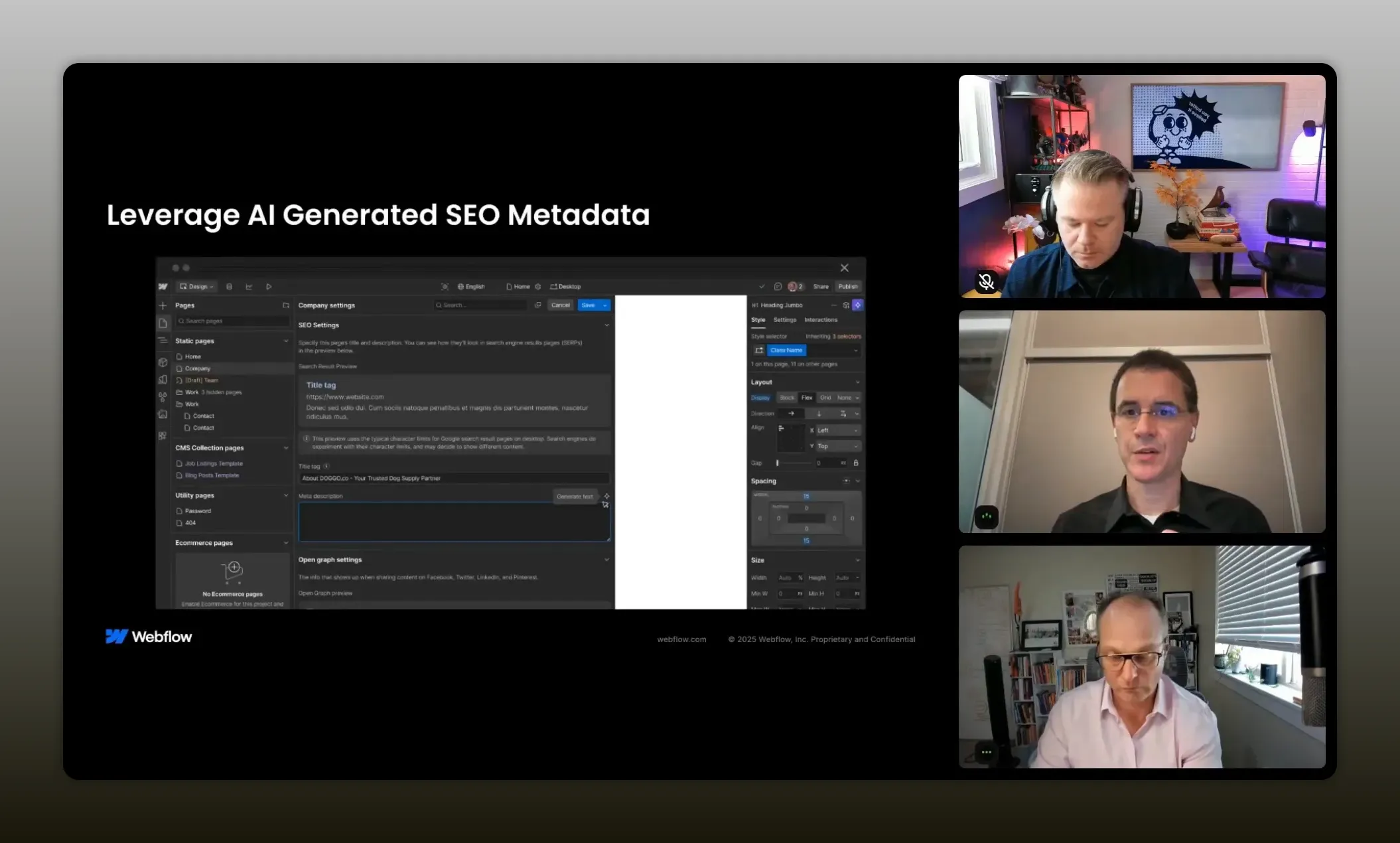
“Make sure your SEO metadata is there—not just links and keywords, but the structured signals like titles, descriptions, and schema—so machines can understand what your pages are and cite you accurately.” -Guy Yalif
Use on-page structure to make content easier to extract
Not every signal has to live in code. Some of the strongest improvements come from simple structural changes on the page itself.
Guy highlighted several:
- Bulleted lists
- Clear headings
- TL;DR summaries near the top
- Tables of contents
- FAQ sections
These are helpful for humans and helpful for machines. That is the sweet spot.
At Webflow, adding a table of contents to blog templates drove 59 percent more LLM source traffic in a month and 23 percent more SEO traffic. That is not a subtle lift.
They also added FAQ sections with schema to six high-value product pages. In just two weeks, more than half of the incremental citations to webflow.com came from those six pages, and traffic to them increased by 24 percent.
Do not optimize for machines at the expense of humans
This is one of the most important cautions in the whole discussion.
As AI search grows, some teams are tempted to over-engineer content for machine extraction. That can lead to awkward formatting, unnatural copy, and pages that read like they were assembled by a committee of bots.
Guy pushes back on that. You still need to write for people first.
Use structure to clarify. Use schema to annotate. Use FAQs to answer real questions. But do not reduce your content into lifeless chunks just because you think a model might parse it more easily.
Accessibility metadata helps too
Another practical point: accessibility information is not just good practice. It also helps AI systems interpret the meaning and structure of your content. Alt text, labels, and semantic organization all contribute to better machine understanding.
If your site is already doing strong technical SEO and accessibility work, you are likely in better shape than you think. If not, this is catch-up work worth doing fast.
“Schema is hard to overvalue. Most haven’t done it yet, but it’s proven to be valuable.” -Guy Yalif
Authority: earn mentions, not just links
Backlinks still matter. Guy is clear on that.
LLMs often run searches behind the scenes, and Google’s AI-generated results still lean heavily on content that already performs well in search. In one data point he shared, 52 percent of Google AI citations came from pages already ranking in the top 10 search results.
So yes, keep building backlinks.
But AEO introduces another authority signal that deserves more attention: plain text mentions.
Why plain text mentions matter
LLMs are trying to detect consensus. They read across the web and synthesize patterns. If multiple credible sources mention your company, your partner program, your expertise, or your integration strengths, that creates a trust signal.
You can think of this as the AEO cousin of traditional link building.
That changes how you should approach authority-building:
- Get included in list articles
- Contribute guest posts
- Do podcasts and webinars
- Invest in digital PR
- Encourage partner co-marketing and ecosystem content
“The AEO version of backlinks is plain text mentions.” -Guy Yalif
For partner teams, this is a major opportunity
This is where Tyler adds a smart ecosystem lens. Partner leaders have an advantage many demand gen teams do not. You already have a network of companies creating content around adjacent problems, integrations, use cases, and customer workflows.
That means you can work with partners to co-create content that improves authority on both sides.
Think about the kinds of pages and assets that naturally generate mentions:
- Integration guides
- Co-branded customer stories
- Joint webinars
- Partner program explainers
- Ecosystem comparison pages
- Best-tools lists and solution roundups
When those assets exist across multiple trusted sites, they help LLMs form a more accurate picture of who you are and where you fit.
For small teams, that also makes the work more scalable. Instead of trying to create all authority signals yourself, you activate your ecosystem. If that challenge sounds familiar, this practical session on partner marketing for tiny teams offers a useful complement to the same idea.
Stay signals matter
Guy also points out that some AI systems now have browser-level visibility. That means they can observe whether someone lands on your site and bounces right back, or whether they stay and engage.
That makes site experience part of authority.
If your pages are visually weak, slow, confusing, or disconnected from the promise made in the AI answer, you are not just hurting conversion. You may be weakening future visibility too.
Show real expertise on the page
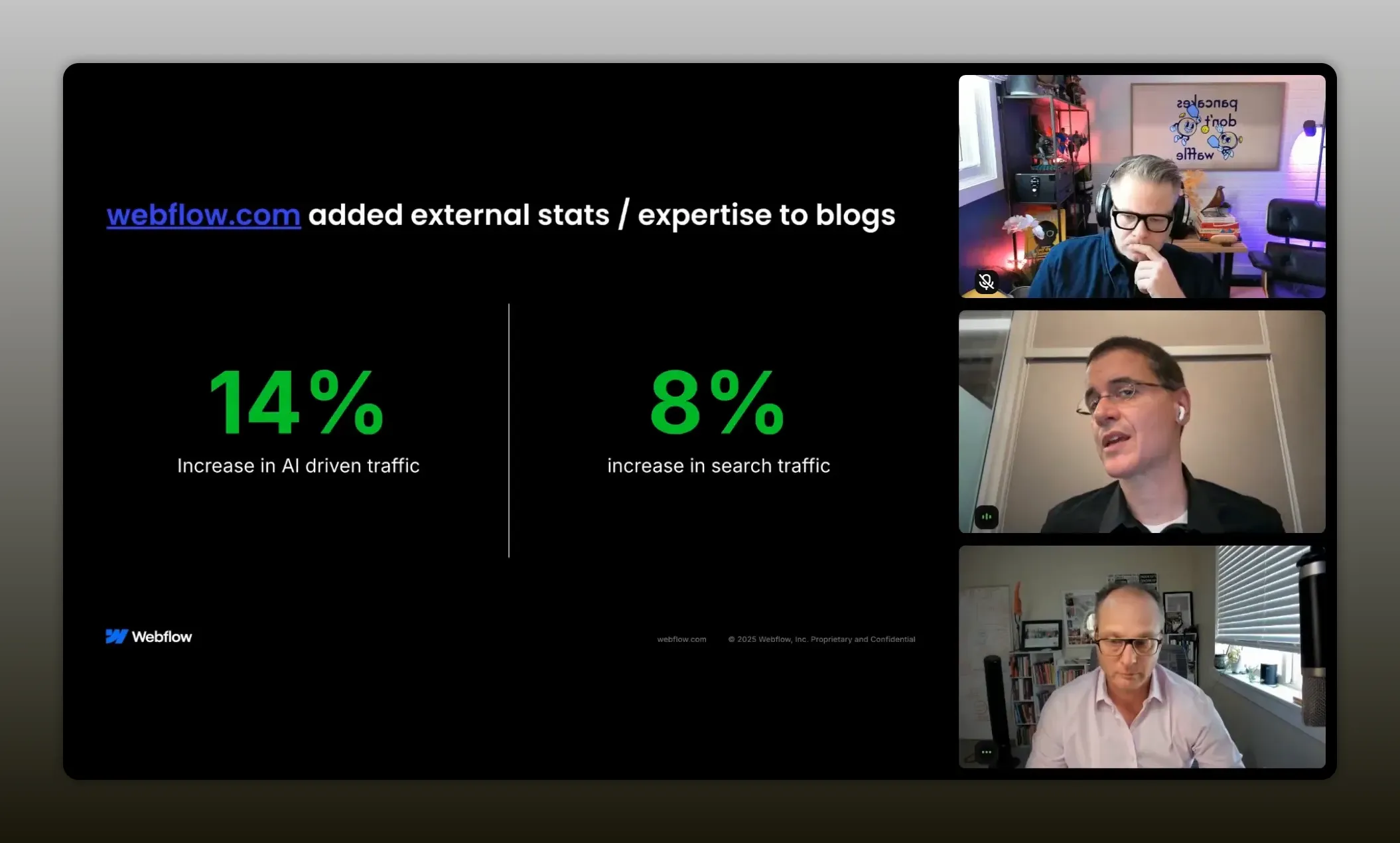
One experiment at Webflow involved adding external stats and author expertise signals to blog posts, including visible bios. The result was a modest but encouraging lift in AI-driven traffic and search traffic.
It was not a giant breakthrough, but it aligns with common sense. Expertise should not be hidden. If you have domain knowledge, operating experience, or practitioner insight, make that visible.
Measurement: what success looks like now
If your old search playbook revolved around keyword rankings, AEO will force you to mature your reporting.
There is no equivalent of “we moved from position five to position three” in a world where AI systems generate paragraph responses, cite multiple sources selectively, and personalize outputs.
Guy recommends a more useful progression.
Start with the basics in your analytics stack
Before you buy anything new, look at two things:
- How much traffic is coming from LLMs?
- How well does that traffic convert?
That gives you the first signal that this channel matters. For most teams, the share is still relatively small, but growing quickly.
One caveat from the discussion is important: you cannot always rely on referral traffic alone. If someone gets interested in your brand inside ChatGPT, opens a new tab, and navigates to you directly later, standard analytics may not attribute that visit to the LLM.
That is why some teams are adding self-reported attribution questions to forms and conversion flows.
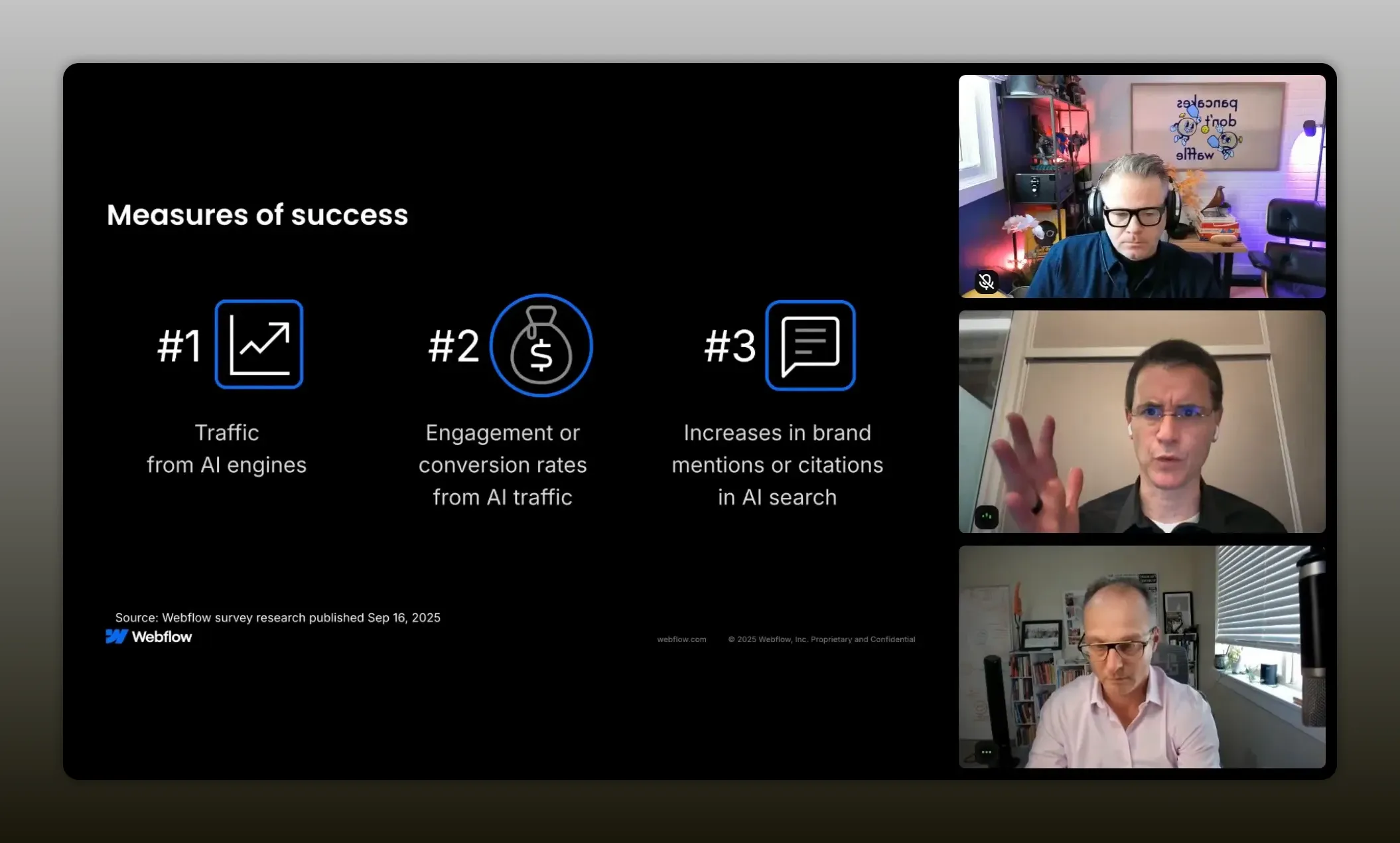
“First, start with your existing analytics tool. How much traffic am I getting from LLMs, and how are they converting?” -Guy Yalif
Then track visibility for the questions you care about
The next level is using tools such as Semrush, Ahrefs, Profound, Scrunch, and other emerging platforms to monitor AI visibility.
The workflow is straightforward:
- Define the questions you want to be associated with
- Run those prompts repeatedly across AI systems
- Measure whether your brand is mentioned
That gives you a simple visibility score.
Advance to share of voice
Once you know whether you appear at all, the next layer is competitive context.
You can ask:
- How often do we appear versus competitors?
- For which question clusters are we strongest?
- Where are rivals getting cited that we are absent?
This becomes your AI-era share-of-voice model.
The highest maturity level is about quality, not just presence
Guy argues that the most advanced AEO measurement is not just mention tracking. It is evaluating the quality of the mention itself.
The three high-maturity questions are:
- Was the mention accurate?
- Was the sentiment positive?
- Did your intended message come through?
That is the real test for partner teams. If an AI system mentions your partner program but gets the economics wrong, misstates your integration depth, or leaves out the reasons someone should work with you, the visibility is incomplete at best and harmful at worst.
What this means for partner teams
A lot of the AEO conversation starts in SEO circles, but partner teams should be paying very close attention because this shift changes how ecosystems get discovered.
When a prospective agency, integration partner, services firm, or affiliate asks an AI assistant who they should work with, your partner page alone is not enough. The model is pulling from across the web. It is piecing together a reputation.
That means your partner growth strategy now depends on more than a portal and a program description. You need:
- A clear narrative about why your ecosystem matters
- Question-based content that addresses partner concerns
- Technical structure that exposes meaning clearly
- Third-party mentions that reinforce your position
- Measurement that tells you whether AI is representing you correctly
This is also why partner content should not live in a silo. Partner leaders should collaborate with SEO, content, demand gen, product marketing, and web teams. Guy’s whole framework works best when those functions stop treating AI visibility as someone else’s problem.
A practical starting plan
If you are wondering where to begin, keep it simple and stack the work in the right order.
1. Audit your current discovery story
Ask leading LLMs the questions you want prospective partners asking. See what appears. Check whether your brand is mentioned, how it is described, and who else is cited.
2. Build a question map
Turn your current SEO topics and partner FAQs into a prioritized question library. Group by awareness, evaluation, onboarding, economics, trust, and objections.
3. Upgrade your highest-value pages first
Do not try to fix the entire site at once. Start with pages tied closely to partner discovery and conversion:
- Partner program pages
- Integration pages
- High-intent blog posts
- Category pages
- Solution comparison pages
4. Add structure
Improve headings, tables of contents, FAQs, schema, metadata, alt text, and internal organization. Make the page easier for both people and machines to navigate.
5. Refresh, do not just publish
Update your strongest existing content. Freshness appears to matter a lot for AI citation behavior.
6. Activate your ecosystem
Coordinate with partners on co-marketing, integration content, webinars, guest posts, and ecosystem pages. These create the mentions and consensus signals LLMs rely on.
7. Measure the right things
Track LLM traffic, conversion, visibility on key prompts, share of voice, and message accuracy. This is how you keep the work grounded in business outcomes instead of novelty.
Recommended tools
You do not need a giant stack to get started, but a few categories matter.
Core categories to consider
- Web analytics: Use your existing analytics platform to track LLM referral traffic and conversion behavior.
- AI visibility monitoring: Tools like Semrush and Ahrefs now include AI visibility capabilities, and newer vendors such as Profound and Scrunch are focused specifically on this space.
- Structured data support: Use schema markup and validate it with tools like Google’s Rich Results Test.
- Content research: Pull questions from customer calls, email threads, Google “People also ask,” and direct LLM prompting.
- Website platform: A modern website platform that supports metadata, schema, accessibility, testing, and fast page updates can make execution much easier.
Guy also referenced a Webflow AEO maturity resource and site evaluator built around this framework. Even if you do not use Webflow, the underlying idea is useful: assess your site against a structured rubric instead of guessing.
FAQs
What is AEO?
AEO stands for answer engine optimization. It is the practice of improving how your brand and content appear in AI-generated answers, AI search experiences, and large language model results. It overlaps heavily with SEO but puts more emphasis on question-based content, structured data, authority signals, and answer quality.
Is SEO still worth investing in if AI search is growing?
Yes. Guy’s core point is that good AEO is close to what good SEO should have been all along. Search performance still influences AI visibility, backlinks still matter, and many AI systems rely on traditional search results as part of their retrieval layer.
Why does LLM traffic often convert better?
Because people often arrive after already getting context and narrowing options in an AI tool. They are further along in their evaluation and more likely to be qualified. Webflow saw LLM source traffic convert six times better than unbranded organic search, and PartnerStack reported similarly strong conversion lift.
What should partner marketers optimize first?
Start with the highest-intent partner discovery pages and the questions partners ask most often. Then improve page structure, add schema, refresh stale content, and build authority through partner co-marketing and third-party mentions.
Are backlinks still important in AEO?
Yes. Backlinks still support search visibility, and search visibility still helps AI visibility. But plain text mentions on credible sites are becoming more important because LLMs look for consensus across sources, not just linked references.
How do I find long-tail questions worth creating content for?
Look at emails, call recordings, late-stage sales questions, onboarding issues, objections, and partner enablement conversations. You can also use Google “People also ask” results and prompt an LLM to surface related questions by persona or funnel stage.
Can I track all AI-influenced visits in analytics?
No. If someone clicks directly from an LLM to your site, referral data may be available. But if they read about you in an LLM, open a new tab, and navigate later, that influence may not appear in standard referral reports. Self-reported attribution can help close some of that gap.
Should I create lots of AI-generated pages to increase coverage?
That is not the recommendation here. The stronger pattern is to publish and refresh genuinely useful human-led content, using AI to support research, workflow speed, and optimization rather than replacing expertise.
Conclusion
The shift from search engines to answer engines is not a niche SEO update. It is a change in how trust gets formed online.
If you want partners to find you, understand you, and choose you, you need more than rankings. You need question-driven content, technically legible pages, authority built across your ecosystem, and a measurement model that cares about accuracy as much as visibility.
That is the big opportunity Guy and Tyler put on the table. AI discovery may reduce some top-of-funnel traffic, but it can also deliver better-fit visitors, stronger conversion, and a sharper competitive edge for teams willing to adapt early.
The brands that win will not be the ones that panic about AI. They will be the ones that make themselves easy to understand, easy to trust, and impossible to ignore.