10 New Principles for AI in Partnerships
Expert advice from Nelson Wang (Founder, Partner Principles).
Snapshot
The gap between people who use AI well and people who do not is widening fast. In partnerships, that gap shows up in everything: how quickly you recruit partners, how well you prepare for meetings, how consistently you document partner knowledge, how sharply you prioritize, and how much time you still have left for the part of the job that actually matters most, which is trust, influence, and relationship building.
If you keep treating AI like a novelty, you risk falling behind people who are already using it to compress work, improve quality, and create repeatable systems. If you learn how to use it with context, discipline, and experimentation, you can become the kind of partner leader who gets more done, drives more impact, and creates more career upside.
If you want to solve weak prioritization, repetitive partner workflows, and slow execution, keep reading to see how Nelson Wang and Justin Zimmerman can help you do it.
“AI is designed to unleash for you more time and energy to focus on your superpower.” -Nelson Wang
Table of Contents
- Snapshot
- Why AI matters now for partner teams
- 1. Know where to focus
- 2. Context is everything
- 3. Co-pilot before autopilot
- 4. AI fluency is a muscle
- 5. Build once, run forever
- 6. Protect your superpower
- 7. Run experiments, not projects
- 8. Start with drafts, not blank pages
- 9. Write the playbook yourself
- 10. Adopt the CEO mindset
- Recommended tools
- FAQs
- Conclusion
Table of Contents
- Why AI matters now for partner teams
- 1. Know where to focus
- 2. Context is everything
- 3. Co-pilot before autopilot
- 4. AI fluency is a muscle
- 5. Build once, run forever
- 6. Protect your superpower
- 7. Run experiments, not projects
- 8. Start with drafts, not blank pages
- 9. Write the playbook yourself
- 10. Adopt the CEO mindset
- Recommended tools
- FAQs
- Conclusion
- Social Post
Why AI matters now for partner teams
Nelson has spent years in partnerships and has now completed more than 60 consulting engagements with technology companies. The pattern he keeps seeing is hard to ignore: the highest-value partner professionals are learning how to use AI to better serve customers, partners, and internal teams while also becoming dramatically more efficient.
That matters because partnerships has always been a leverage game. You are constantly balancing internal alignment, external influence, partner strategy, pipeline creation, enablement, reporting, follow-up, and executive communication. There is never a shortage of work. The real issue is whether you are spending your time on what actually drives business outcomes.
Nelson frames this through three broad buckets:
- Less than 10% of your work with AI: you are probably skeptical or too busy to seriously adopt it.
- 10% to 50%: you are likely pragmatic and using it in certain workflows, but not yet across the board.
- More than 50%: you are actively pushing innovation and rethinking how the work gets done.
The important thing is not judging where you are. It is recognizing that your next career step may depend on whether you stay there.
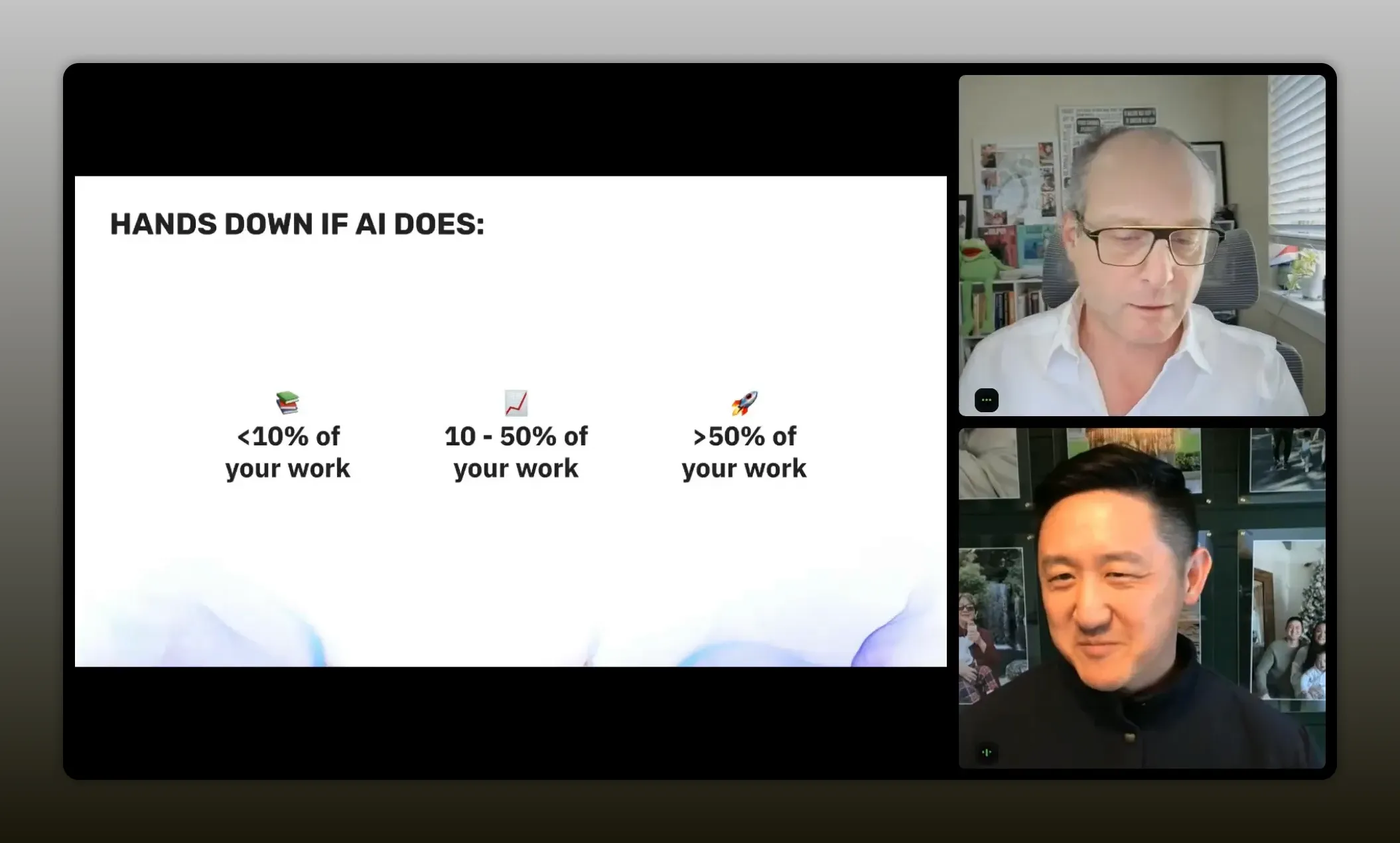
“If you’re in the 10% to 50% bucket, you’re being pragmatic—but you’re not yet using AI across the board. Your next step is broadening it into the way you operate day-to-day.” —Nelson Wang
Justin’s framing around playbooks is useful here too. Partner teams are hungry for practical guidance, not just AI hype. If you want a broader perspective on where this is heading, this related piece on how AI will reshape partnerships complements Nelson’s principles well.
Now, let’s take a look at Nelson’s 10 AI principles for partner managers.
1. Know where to focus
One of the biggest mistakes in AI adoption has nothing to do with prompts. It starts earlier than that. People use AI for whatever is easiest rather than whatever matters most.
Nelson describes the skeptic as someone who stays busy but is not always clear on what really drives impact. That person gets pulled into loud tasks, urgent complaints, one-off asks, and scattered workflows. AI gets used occasionally, but mostly for random conveniences.
The innovator takes a different approach. You use a framework to identify the highest-value use cases first. Nelson suggests evaluating potential AI workflows through three lenses:
- Frequency
How often does the work happen? Every hour, every day, every week, every quarter? - Manual effort
How much time, clicking, formatting, summarizing, reviewing, or data entry does it require? - Business outcome
Does it drive partner revenue, reduce costs, improve speed, or unlock more time for high-impact work?
That is a simple but powerful way to prioritize. If a workflow happens often, takes a lot of manual effort, and connects to real business outcomes, that is where AI can make a meaningful difference.
A weekly partner executive summary is a good example. If you spend two hours every week collecting updates, rewriting notes, and formatting a digest for leadership, AI can help. So can repetitive partner directory approvals, recurring enablement prep, partner account research, or standard recruiting outreach.
Start by mapping your work. Ask yourself:
- What do I repeat constantly?
- What is annoyingly manual?
- What actually ties back to revenue or strategic outcomes?
That is where your first serious AI wins live.
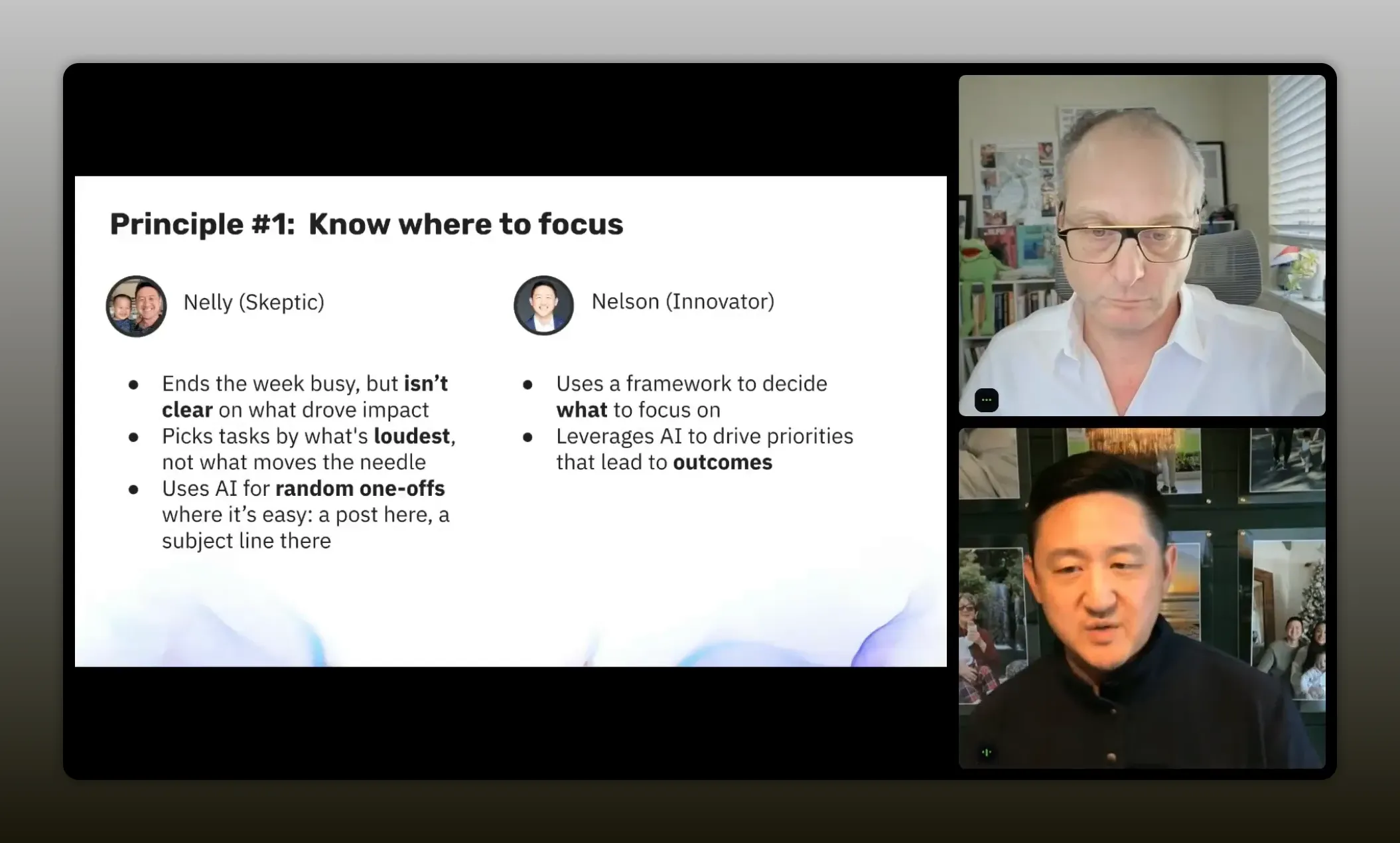
“AI is designed to unleash more time and energy so you can focus on your superpower—your relationships and judgment.” —Nelson Wang
2. Context is everything
A lot of bad AI output is self-inflicted. You type a one-line request like “build this” or “write me a deck” and hope for magic. Then the result is generic, weak, or just wrong. Nelson calls that what it is: slop.
High-quality output usually comes from high-quality context.
The better model is to treat prompting less like issuing a command and more like briefing a capable teammate. That means giving AI:
- An identity: Who is it acting as?
- Context: What company, partner type, or market are you working in?
- Objective: What exactly needs to be produced?
- Requirements: What format, timeline, KPIs, phases, or constraints matter?
- Additional instructions: Tone, exclusions, references, guardrails, and quality bar.
Nelson gives a practical example around building a title slide for a presentation. With minimal context, the draft looked acceptable at first glance, but it was clearly generic. Once context and guardrails were added, the branding improved, the message sharpened, and the slide became tailored to the actual audience and purpose.
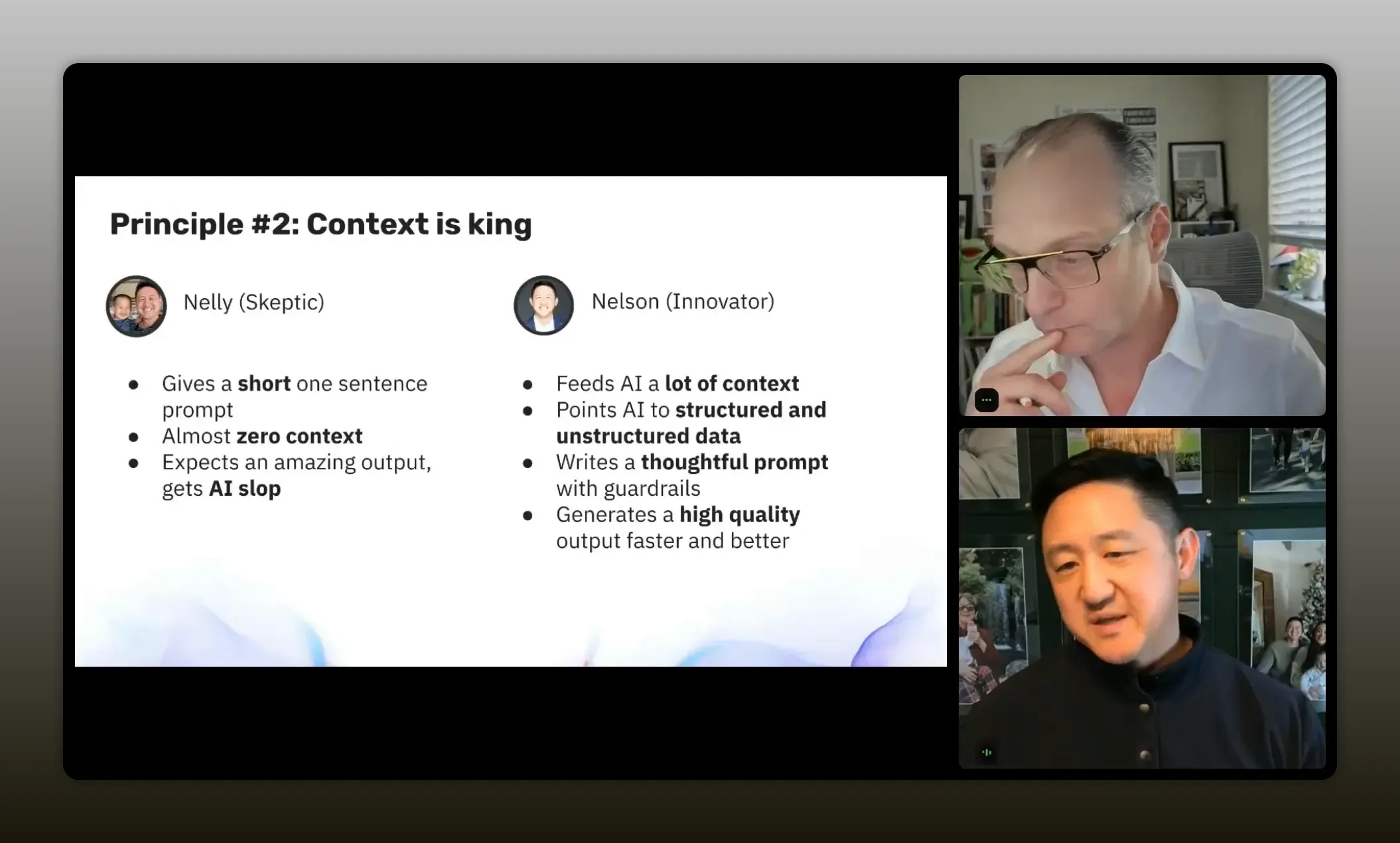
“Context and guardrails are incredibly important to getting the type of high quality outcome you want with AI.” -Nelson Wang
This is one of the most transferable skills you can build. If you give AI better source material, it will usually give you better drafts. And one of the smartest moves Nelson recommends is asking AI to help you write better prompts in the first place. You are not just using the tool for output. You are using it to improve your own method.
The real magic, as he puts it, happens when you combine AI with human taste and human-in-the-loop feedback. That is the difference between automation and judgment.
3. Co-pilot before autopilot
This principle should probably be posted on every AI roadmap in every company.
Do not hand over critical systems, sensitive workflows, or high-stakes outputs to AI before you understand how it performs with supervision.
Nelson’s analogy is useful: if you hired a new partnership development rep tomorrow, you would not give that person full access to everything and let them start firing off CEO-level communications on day one. You would train them, provide context, review their work, coach them, and gradually increase trust.
AI should work the same way.
Start with co-pilot mode:
- Use AI as a teammate, not an unsupervised operator
- Limit access to only what is necessary
- Review output before anything gets sent or published
- Iterate with feedback
- Build guardrails as you go
Only after repeated success should you even consider more autonomous workflows.
This matters in partnerships because so much of the work touches brand, trust, and revenue. A bad outbound message, a mistaken slide, missing context in a partner handoff, or a workflow that alters records incorrectly can create unnecessary damage.
AI can absolutely increase your leverage. But leverage without oversight is not strategy. It is risk.
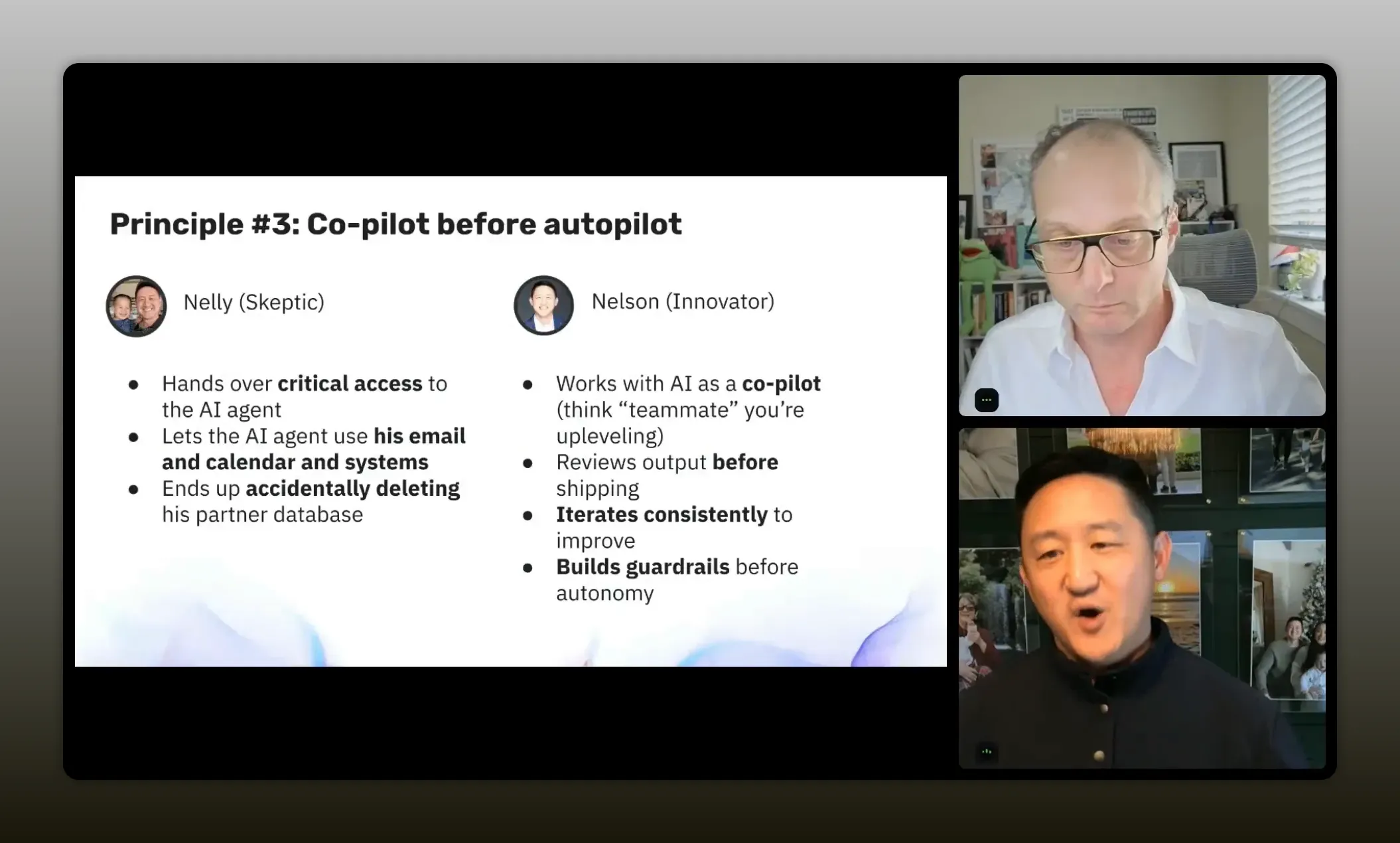
“Start with co-pilot—don’t jump straight to autopilot where you lose oversight.” —Nelson Wang
4. AI fluency is a muscle
You do not become good at AI by reading one post, attending one session, or collecting a list of tools. You become good by using it over and over until it becomes part of how you think.
Nelson is explicit about this. On some busy days, he spends seven to eight hours working with AI. That amount of repetition changes how you approach problems. You stop asking, “Should I use AI here?” and start asking, “How should I structure this so AI can help me do it better?”
He describes a progression from atrophy to training to fluency.
- Atrophy: little usage, skepticism, weak prompting, low trust
- Training: experimenting regularly, learning where it works, building repetitions
- Fluency: AI feels native in your daily workflow and changes how you operate
That is a useful way to think about adoption because it lowers the pressure. You do not need to be perfect. You need reps.
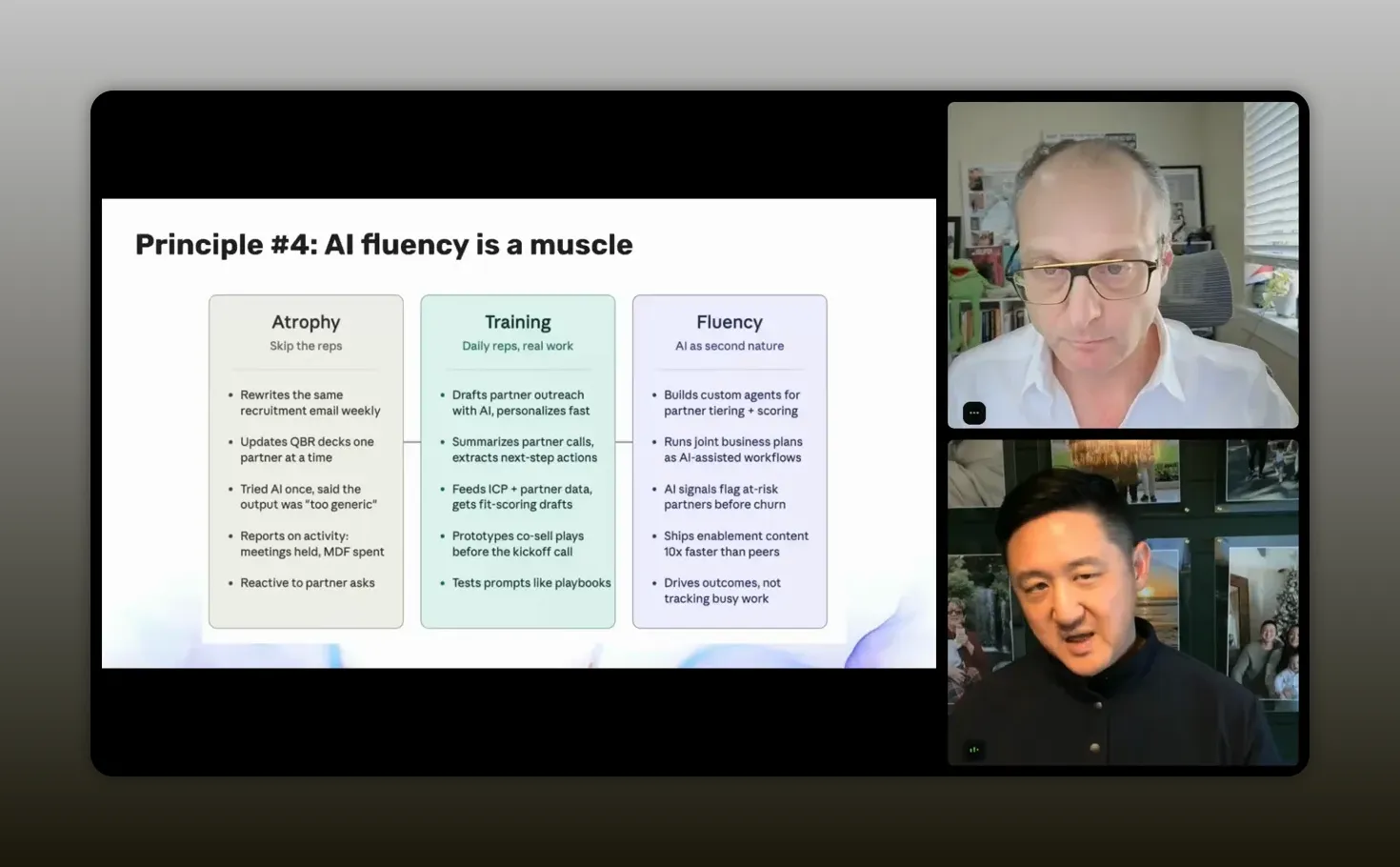
“The more you use it, the better you become over time.” -Nelson Wang
If you want to improve faster, pick just two or three recurring use cases and commit to using AI for them every day for a few weeks. That might be:
- Meeting prep
- Follow-up summaries
- Partner research
- Recruiting outreach drafts
- Internal update writing
Consistency matters more than complexity.
5. Build once, run forever
Partner teams lose a shocking amount of value by solving the same problem again and again from scratch.
The skeptic sees a repeated task every week and still treats it as a one-off. The innovator builds the workflow once and then runs it as a repeatable operating system.
Nelson gives several examples of what repetitive partnership work looks like:
- Approval workflows for partner assets or testimonials
- Starting from a blank page for recurring content
- Treating every partner action as a fresh exception
- Letting institutional knowledge live only in one person’s head
That last point is a big one. In many organizations, the real state of a partnership is stored in scattered docs, old messages, and someone’s memory. Then that person leaves, and the handoff is a thin Google Doc with half the context missing.
AI can help fix that if you use it to:
- Create reusable prompt libraries
- Standardize partner reviews and summaries
- Capture historical context in accessible formats
- Support onboarding and handoffs with richer documentation
This is where partnerships starts to look more like a system and less like improvisation.
If this is a priority for your team, you may also find useful ideas in Zero to Partner ROI In 90 Days Via AI, which explores how AI can speed up partner execution and operational clarity.
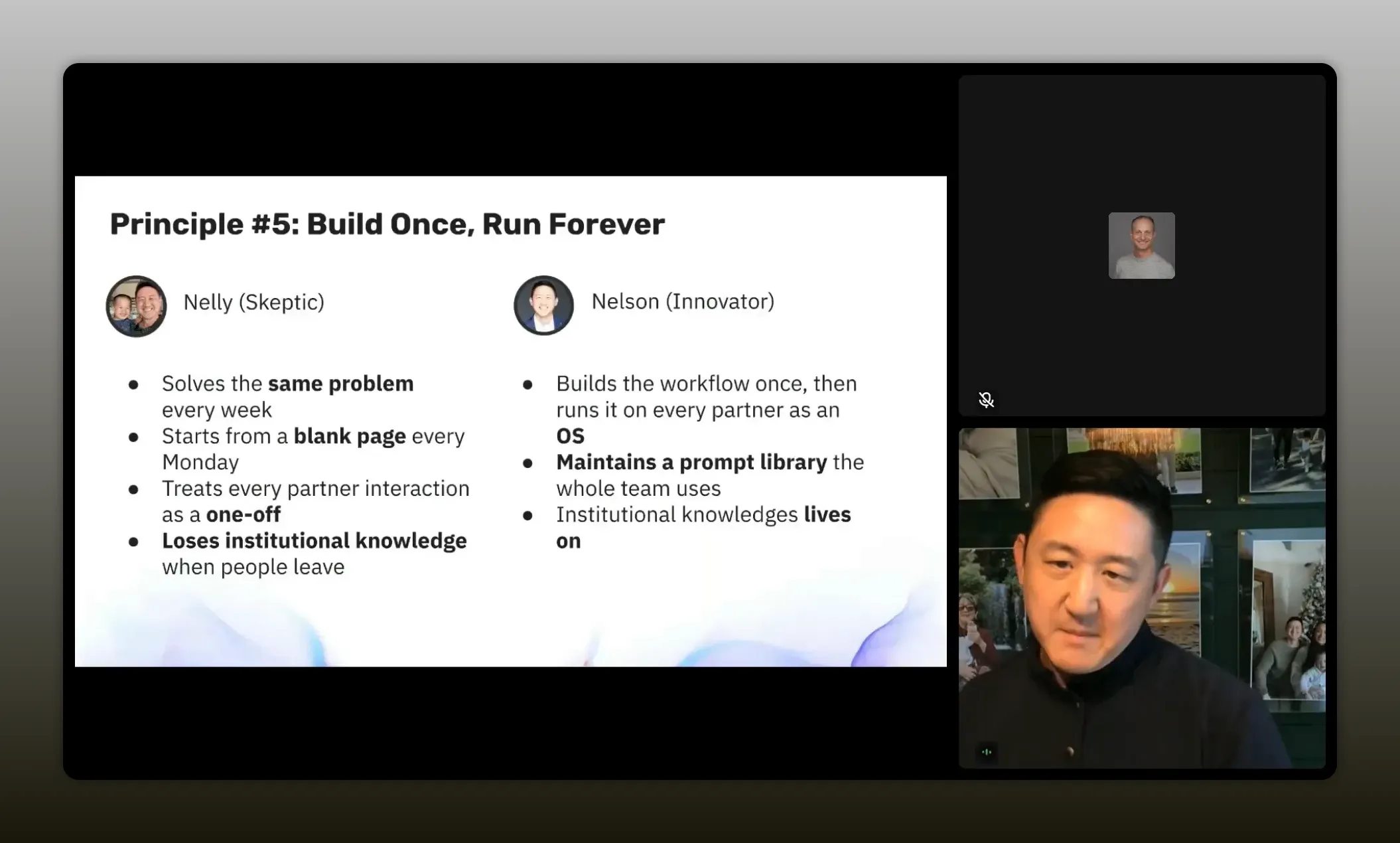
“Build it once, put the right system around it, and run it forever.” —Nelson Wang
6. Protect your superpower
This may be the most important mindset shift in the whole framework.
When Justin asked what a partner manager’s superpower is, the answers were immediate: relationships, influence, motivating without authority. In other words, the very human parts of the role.
And Nelson’s response was clear. That is exactly the point.
AI is not great at sitting across from Deloitte, Accenture, McKinsey, or any strategic partner and building trust. It does not create authentic energy in the room. It does not establish confidence through your judgment and credibility. It does not navigate the subtle interpersonal work that unlocks a million-dollar deal.
You do.
AI’s best use is to free up more of your time for the things only you can do.
That means using AI to reduce time spent on:
- Formatting
- Summarizing
- Research gathering
- First-draft creation
- Repetitive admin work
- Workflow coordination
So you can spend more time on:
- Building trust
- Co-selling
- Cross-functional influence
- Strategic judgment
- Executive alignment
- Partner motivation and momentum
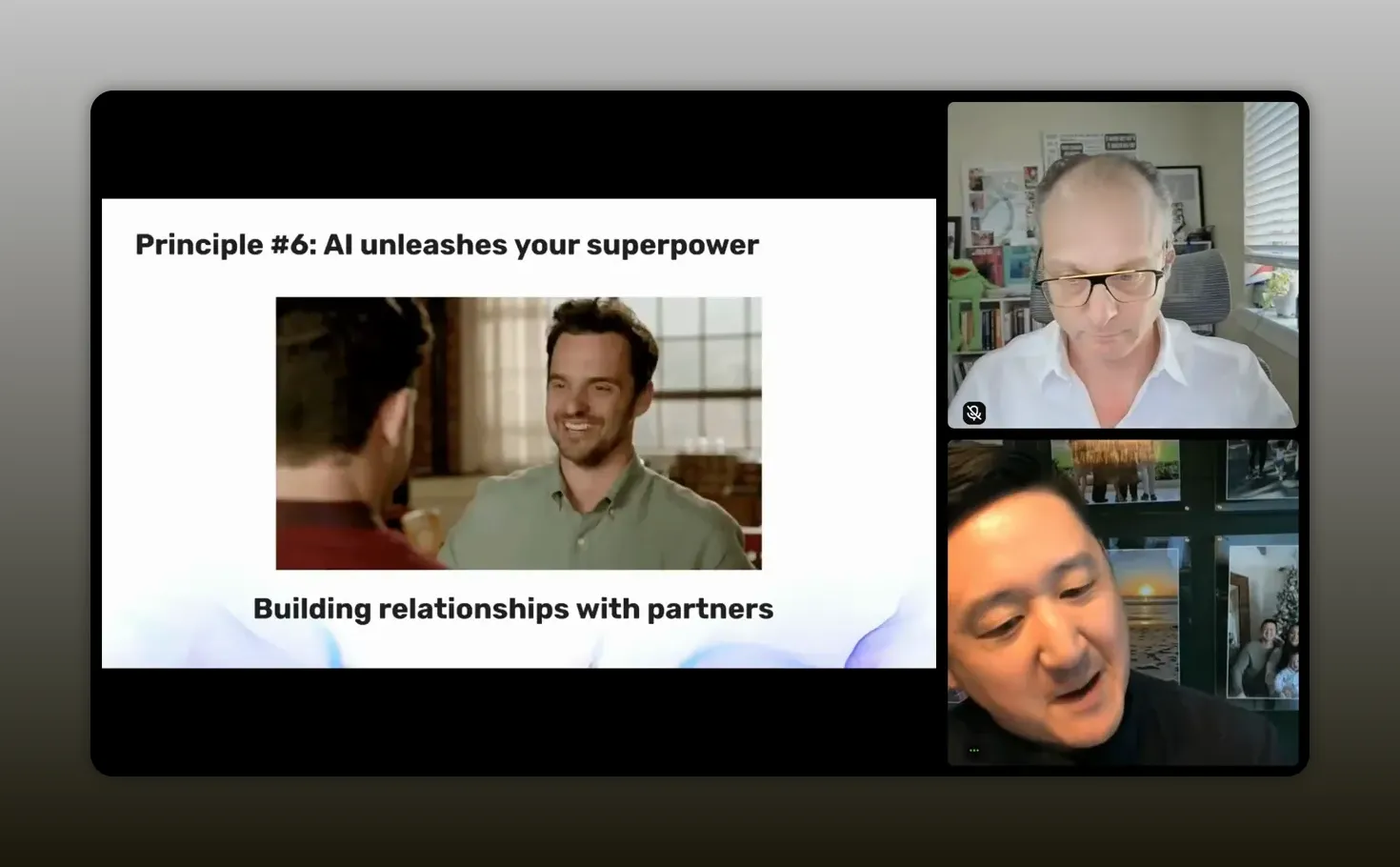
“The human element of the trust, of the energy, of the relationship… that is your superpower.” -Nelson Wang
If you ever feel uneasy about AI, this is the grounding idea to come back to. The goal is not to become less human in your work. It is to become more effective at the most human parts.
7. Run experiments, not projects
A lot of teams sabotage progress by over-formalizing AI adoption before they have learned anything useful.
Nelson warns against three common traps:
- Waiting for the perfect AI tool
- Trying to create a giant plan before testing real use cases
- Giving up after one bad attempt
Instead, he recommends a portfolio of experiments. Small bets. Fast iteration. Weekly measurement. Sometimes even immediate measurement if the quality bar is obvious from the output itself.
For example, if you use AI to create a partner recruiting deck on Monday, you may know by Friday whether the outreach converted into meetings. That feedback loop is short enough to teach you quickly.
The point is not to avoid failure. The point is to use failure as data.
A useful pattern here is:
- Pick one narrow workflow
- Create a repeatable prompt or process
- Ship it
- Measure quality and speed
- Refine based on what happened
- Repeat weekly
That is how you actually build m/omentum.
If partner ROI is top of mind, another relevant resource is Accelerate Partner ROI 80% with AI, which focuses on how organizations are using AI to sharpen partner decision-making and execution.
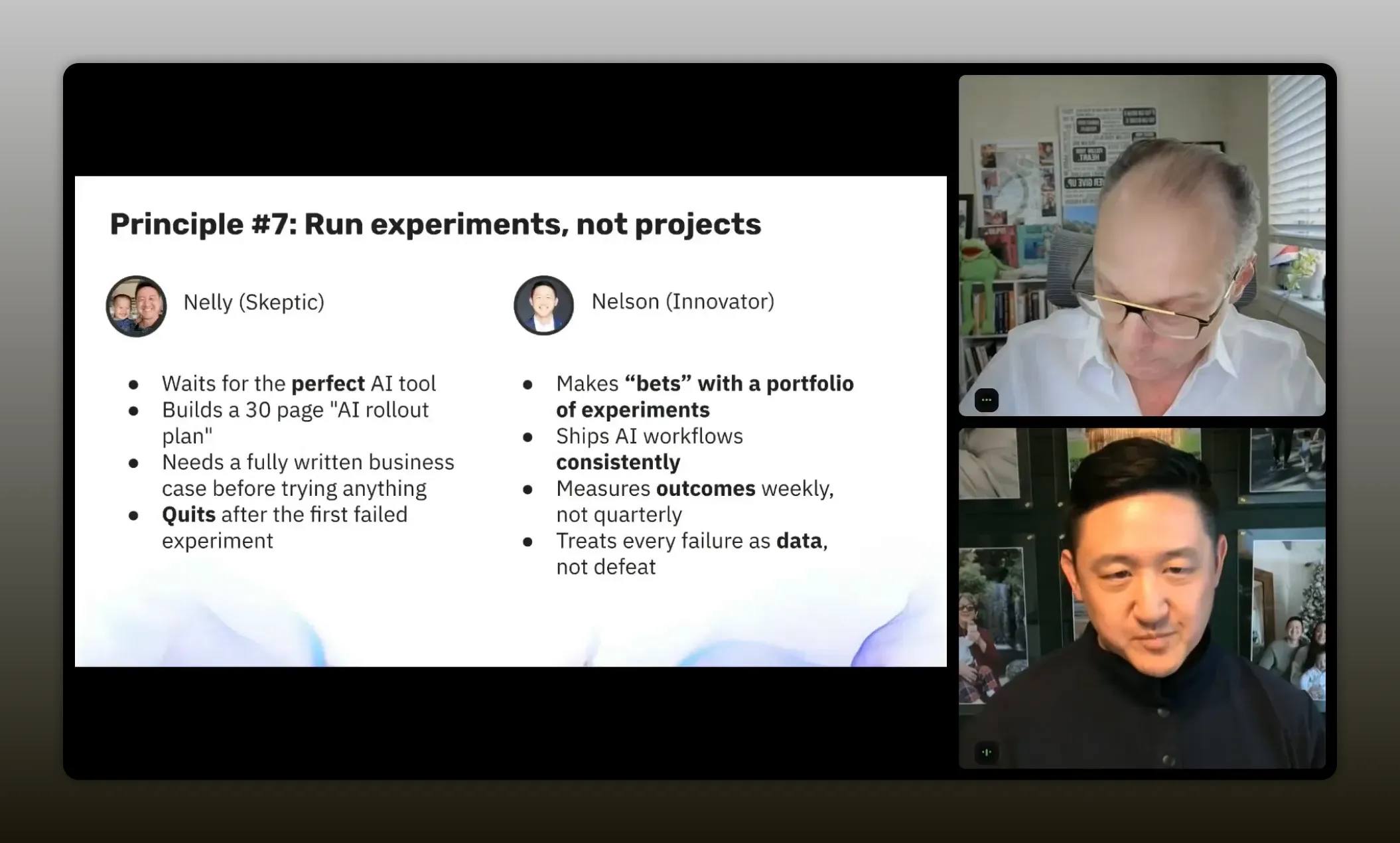
“Make small bets with a portfolio of experiments—ship, measure weekly, and use what you learn to refine.” —Nelson Wang
8. Start with drafts, not blank pages
Nelson is a prolific writer. He publishes frequently, has written books, and clearly cares about quality. His advice here is practical and refreshing: starting from zero is hard, so stop doing it when you do not have to.
If you need to create almost any form of content, let AI help generate the first draft. That does not mean publishing whatever it spits out. It means using it to get off the blank page faster so you can shift your energy to refining, improving, and tailoring.
This can help with:
- Partner outreach emails
- Business case drafts
- QBR structures
- Internal memos
- Partner enablement outlines
- Strategy presentations
- Meeting agendas
If you are already strong at writing, this speeds you up. If writing is not your natural strength, it gives you a stronger starting point. Either way, you win time.
This principle also reinforces why context matters. A generic draft is better than a blank page, but a context-rich draft is where real leverage shows up.
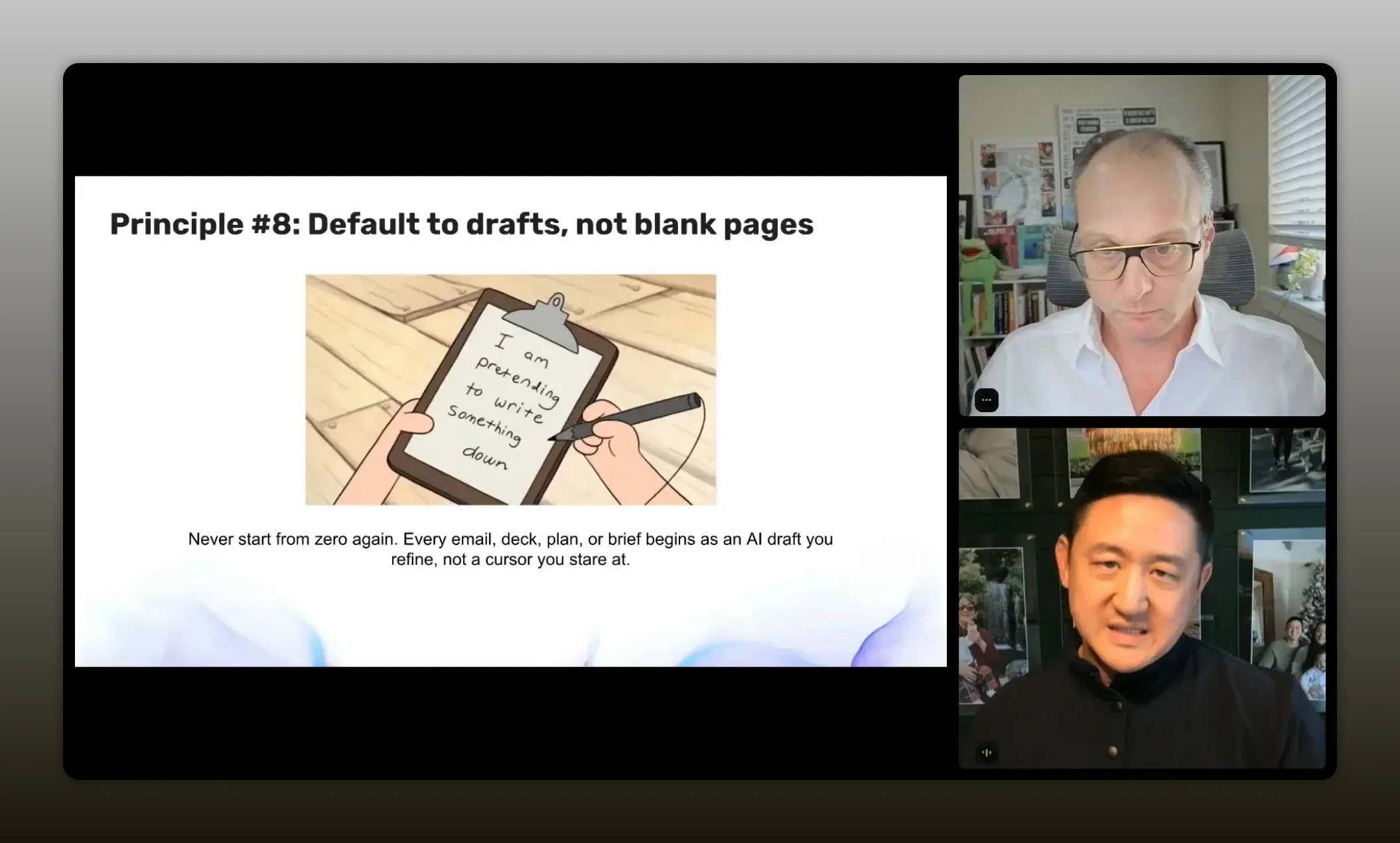
“It’s hard to start from zero—default to drafts, not blank pages.” —Nelson Wang
9. Write the playbook yourself
This was one of Nelson’s strongest calls to action.
Do not wait for the perfect internal playbook. Do not wait for someone else to explain exactly how your team should use AI. Do not assume the market will slow down while you sit on the sidelines.
Be urgent. Experiment. Build. Learn. Share.
Nelson mentions that during AI training work with teams like HubSpot, one of the biggest lessons was that the most capable people are not waiting for a final answer. They are discovering what works through action and feeding those learnings back into the system.
This is especially important in partnerships because no two ecosystems are identical. Your partner mix, routes to market, co-sell structure, channel strategy, and internal dynamics are specific to your company. Which means your best AI playbook will likely come from your own experiments.
A few ways to accelerate this:
- Connect with peers who are already using AI deeply
- Swap prompt patterns and workflow ideas
- Document what works for your team
- Revisit and update those patterns often
- Stay curious instead of defensive
The market is rewarding people who are willing to learn in public and improve quickly.
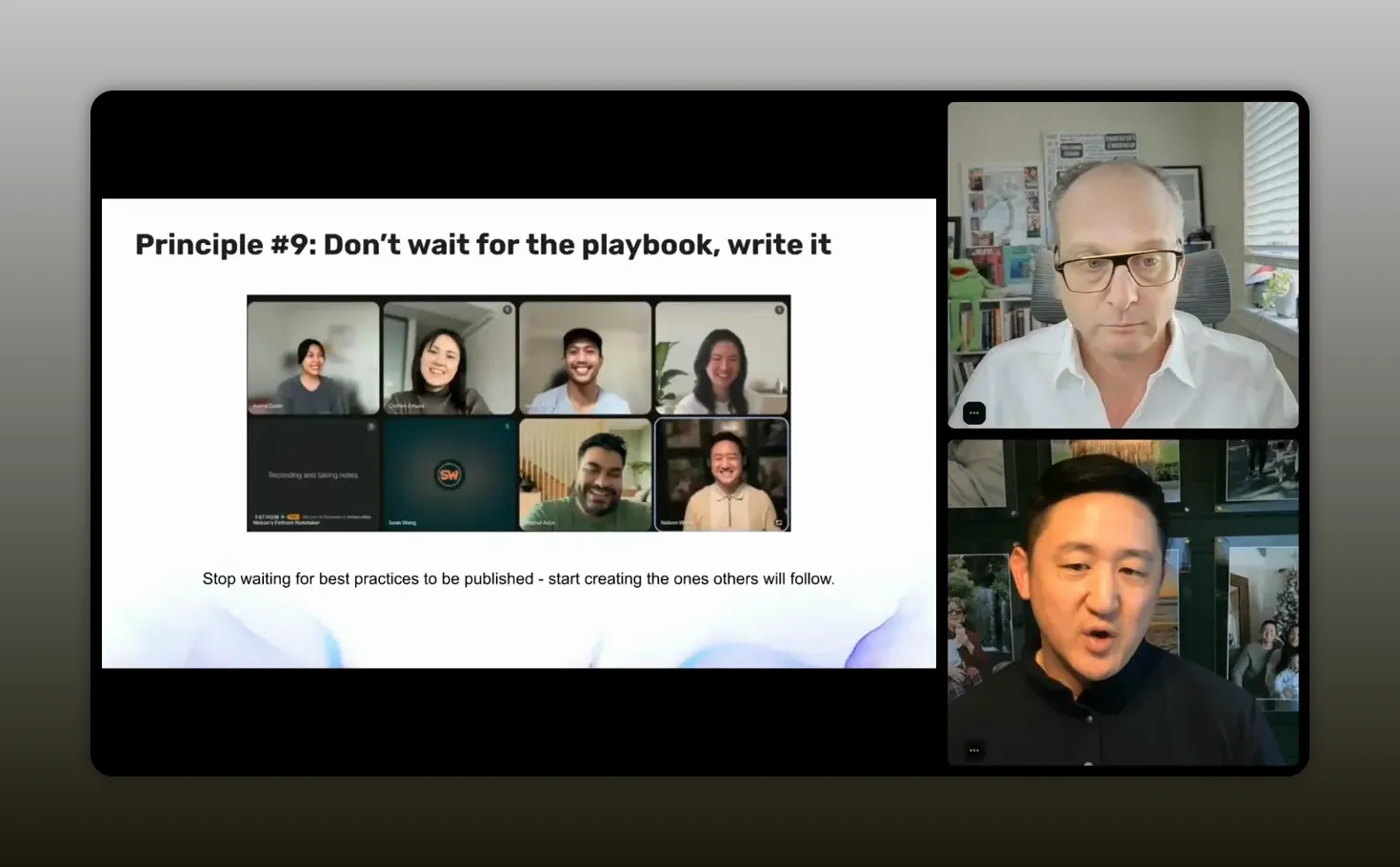
“There is no waiting. You need to go write the playbook.” -Nelson Wang
10. Adopt the CEO mindset
Nelson saves one of the strongest ideas for last: approach your role with the mindset of a CEO.
In practice, that means stopping the habit of treating AI as someone else’s problem. It means looking at your partner business, your motions, your workflows, your P&L impact, and asking how to operate with more leverage.
The skeptic protects the status quo:
- This is how we did it last year
- Someone else will figure out the AI side
- I am too busy to rethink the model
- I will keep throwing time at the work
The operator with a CEO mindset asks harder questions:
- How do I drive better outcomes with the resources I already have?
- Before I add headcount, can AI handle part of this work?
- Where is the real leverage in this partner motion?
- What do I need to self-disrupt in order to improve?
That last question matters. Self-disruption is uncomfortable. If your old way of working helped you succeed, it is natural to defend it. But the people who create outsized gains in the AI era are the ones willing to revisit their assumptions.
AI is not a side topic. It is becoming part of how strong operators think.
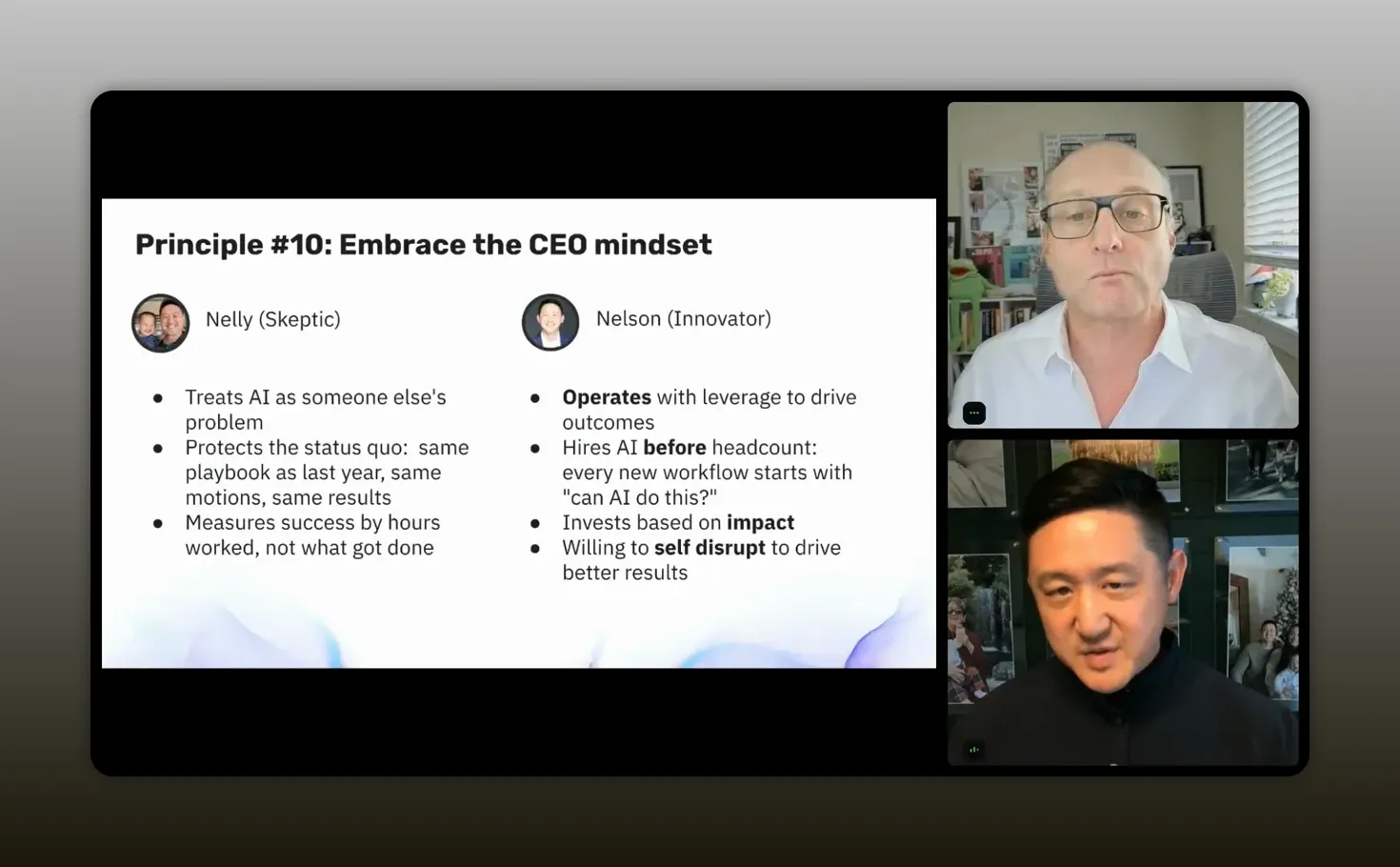
“The folks that will truly level up 10x are the ones that are willing to self-disrupt.” -Nelson Wang
Recommended tools
Nelson is careful not to turn this into a giant tools list. The principles matter more than the stack. Still, he does share several tools he has used directly and finds useful across different workflows.
Here is the stack he highlighted:
- App building: Replit, Lovable, Airtable
- Presentations: Gamma, Claude
- No-code agents: Dust
- Video AI: Synthesia, HeyGen
- Workflow automation: n8n, Zapier
- Voice AI orchestration: Vapi
- Productivity and knowledge: Notion AI, NotebookLM
You do not need to adopt all of these. Pick the category that matches your current bottleneck. If your issue is drafting, start with presentation and writing tools. If your issue is repetitive ops, start with automation. If your issue is knowledge capture, start with a tool built for organizing context.
FAQs
How much of your work should AI be doing right now?
There is no universal target, but Nelson breaks it into three useful stages: under 10%, 10% to 50%, and over 50%. If you are under 10%, the opportunity is probably to start using AI in a few recurring workflows. If you are already at 10% to 50%, the next step is broadening adoption into more of your day-to-day operating system. The real goal is not a percentage. It is using AI where it meaningfully improves speed, quality, and leverage.
What is the best first AI use case for a partner manager?
Start with a workflow that is frequent, manual, and tied to a real outcome. That could be meeting prep, executive summaries, partner research, recurring outreach drafts, or documentation handoffs. If a task happens often, consumes too much time, and affects partner revenue or internal execution, it is a strong candidate.
Why does AI output often feel generic or low quality?
Usually because the prompt lacks context. Short one-line asks often produce generic results. Better outputs come when you provide identity, business context, objective, requirements, and guardrails. AI performs much better when it is briefed like a capable teammate instead of being treated like a mind reader.
Should partner teams automate everything as fast as possible?
No. Nelson strongly recommends co-pilot before autopilot. Start with AI assisting you in supervised workflows. Review outputs, refine prompts, and build trust gradually. Only move toward more automation after you understand where the tool performs reliably and where guardrails are required.
Will AI replace the human side of partnerships?
Not the part that matters most. Relationships, influence, trust, motivation, and judgment remain human strengths. AI is most valuable when it removes low-leverage work so you can spend more energy on those higher-value interactions.
How do you get better at using AI in a practical way?
Treat AI fluency like a muscle. Build repetitions. Use it every day in a small number of workflows. Review the output. Improve your prompts. Track which uses actually save time or improve quality. Skill comes from regular practice, not occasional curiosity.
What mindset shift matters most for long-term success?
The CEO mindset. Think in terms of leverage, outcomes, and resource allocation. Ask where AI can help you drive more impact before you assume you need more time, more people, or more process. The people who advance fastest will be the ones willing to self-disrupt and rethink how the job gets done.
Conclusion
The best way to read Nelson’s 10 principles is not as an AI manifesto, but as an operating model for better partner work. Know where to focus. Give better context. Review before you automate. Practice until the workflow becomes natural. Systematize what repeats. Protect the human parts of your role. Run experiments. Start from drafts. Stop waiting. Think like a CEO.
If you do that, AI stops being an abstract trend and starts becoming a practical advantage. Not because it replaces you, but because it gives you more leverage, more capacity, and more room to do the work that actually compounds. In partnerships, that is where the upside lives.