The $2,000,000 Partner Playbook (for PLGs in SMBs)
Expert advice from Marta El Bay (Head of Partnerships, Surfe).
Snapshot
You can spend months trying to cold-email your way into a major ecosystem, only to realize the big opportunity isn’t just getting listed in a marketplace. It is becoming the partner an ecosystem actively recommends, embeds in-product, and eventually builds with. That kind of motion can change your distribution, product roadmap, and category position.
Marta El Bay’s work at Surfe shows what this looks like when a small team gets it right. Instead of chasing a flashy but generic partner strategy, she aligned around a tight use case, a clear customer problem, and a partner ecosystem that actually fit. Then she combined bottom-up demand creation with top-down executive outreach to turn an integration into a multi-layer partnership with Pipedrive.
If you want to solve partner access, internal buy-in, and ecosystem credibility, keep reading to see how Marta and Justin can help you do it.
“We said, I start from the bottom, you start from the top, and we will meet in the middle.” -Marta El Bay
Table of Contents
- Snapshot
- Why this story matters
- What Surfe does and why ecosystem fit mattered
- Why Pipedrive was the right bet
- What the deal became over time
- Why Surfe got selected
- Why leadership buy-in changed everything
- The bottom-up playbook Marta used
- The top-down motion that opened doors
- Why partnerships is basically sales
- How to build a better-together story with proof
- How Marta is using AI now
- Recommended tools
- FAQs
- Conclusion
Why this story matters
If you run partnerships at an ISV on a small team, you probably know the fantasy outcome. You integrate with a major platform. That platform starts promoting you. Then your product gets surfaced inside their app. Eventually, your technology powers part of their product experience or becomes part of a deeper OEM-style relationship.
That is the maturity path nearly every software partnership leader wants.
What makes Marta’s story so useful is that it is not built on a giant team, a giant budget, or some vague “build relationships” advice. It is built on focus, partner fit, persistence, and a very practical understanding of how ecosystems really move.
You are not looking at a one-off co-marketing campaign here. You are looking at a step-by-step progression from simple integration to strategic distribution to embedded product value.
That is why this is worth studying.
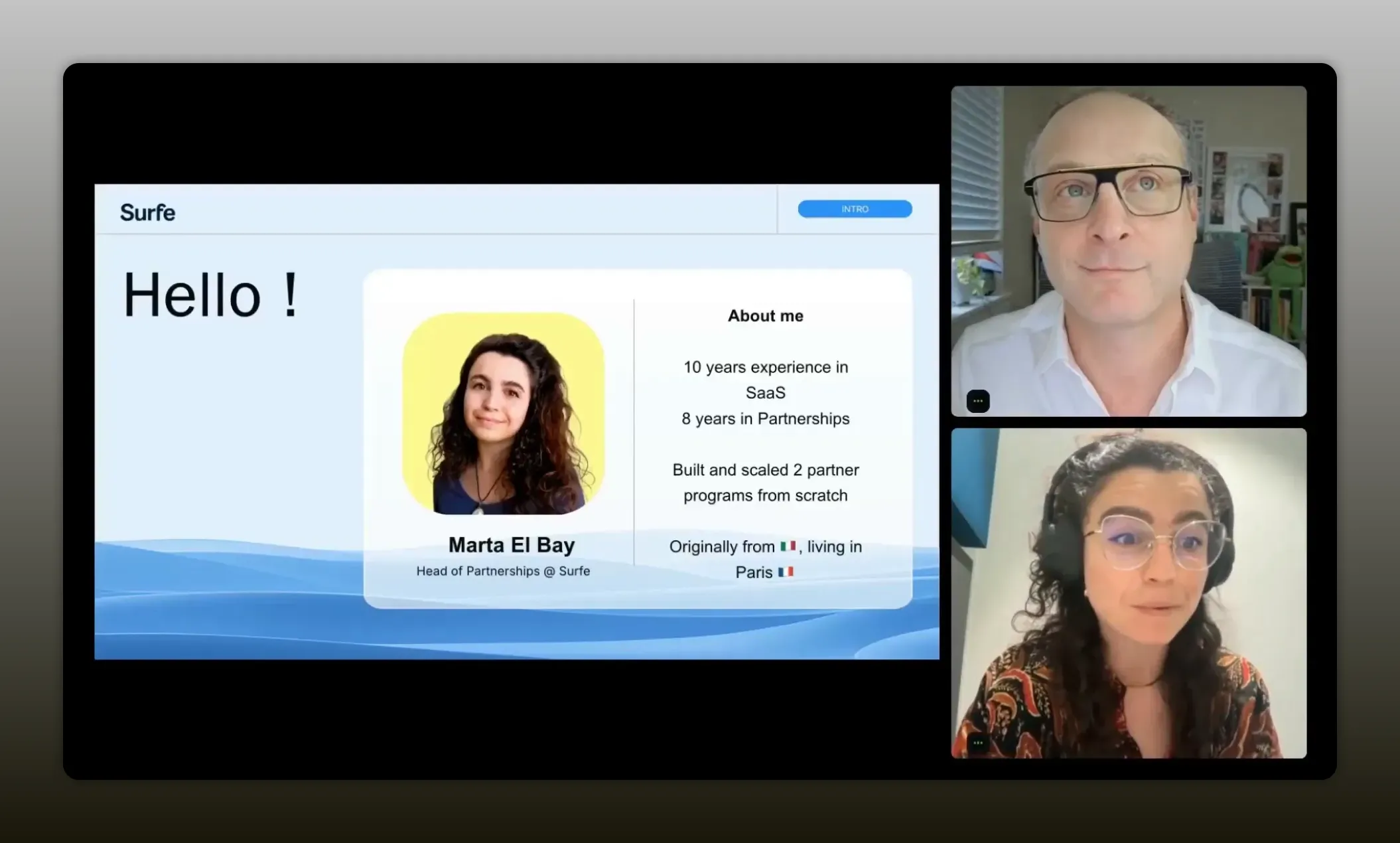
“When you’re on a small team, you can’t do everything—you have to get laser-focused, and you have to make sure every step creates momentum with the ecosystem.” -Marta El Bay
What Surfe does and why ecosystem fit mattered
Surfe started as a Chrome extension that connects LinkedIn with CRM systems. HubSpot was the first integration, followed by Pipedrive and Salesforce. The product then expanded beyond basic connection and workflow support.
Today, the product helps users:
- Connect LinkedIn activity to their CRM
- Enrich contact records
- Build lead lists using filters
- Get recommendations based on ideal customer profile
- Keep CRM data clean and complete
One especially interesting part of the product is what Marta described as waterfall enrichment. Rather than relying on one proprietary database, Surfe combines multiple enrichment tools to improve the odds of finding accurate, useful contact data.
That matters because the core customer problem was not abstract. It was painfully specific and very common: sales teams lose time because CRM data gets stale, incomplete, and messy.
If you have ever looked at a CRM full of outdated roles, missing phone numbers, old company names, or duplicate records, you already understand why this product resonated.
“We make sure that all the data that goes into the CRM is clean and filled with the relevant information.”Marta El Bay
That use case also shaped the partner strategy. Marta did not just ask, “Which ecosystem is biggest?” She asked, “Which ecosystem serves the same customer at the same stage, with the same pain?”
That distinction is everything.
Why Pipedrive was the right bet
Surfe also integrated with HubSpot and Salesforce, but Pipedrive was especially attractive for a few reasons.
1. Shared customer profile
Pipedrive focuses heavily on sales teams, especially smaller and earlier-stage teams. That matched Surfe’s core audience well. Both companies were trying to help teams improve prospecting, sales productivity, and pipeline creation.
2. Shared mission
Marta emphasized that Pipedrive’s ecosystem, content, and product strategy all spoke directly to sales teams. That gave Surfe a natural narrative. It was easier to explain why the two products belonged together because the overlap was obvious.
3. Similar ecosystem maturity
There was also a practical advantage here. Surfe and Pipedrive were operating in a more compatible ecosystem context than, say, Surfe and Salesforce. Bigger ecosystems can be powerful, but they can also be harder to influence, slower to navigate, and less aligned with an earlier-stage product story.
In other words, Marta did not chase the biggest logo for the sake of it. She chose the ecosystem where the better-together story was strongest.
If you are figuring out where to invest your partner energy, this is a useful reminder: fit often beats prestige.
What the deal became over time
One of the best parts of this story is that the partnership did not arrive all at once. It evolved in levels.
Level 1: Distribution partnership
Pipedrive started pushing Surfe to its customer and prospect base through multiple channels, including:
- In-product popups
- Surveys
- Newsletters
- Webinars
The commercial model included revenue share, and Pipedrive users received an extended trial on one of Surfe paid plans. They also got onboarding support and dedicated resources.
Level 2: In-product placement
The relationship moved further into the product experience. In Pipedrive’s lead section, Surfe became directly accessible within the interface, complete with branding.
Level 3: Product infrastructure partnership
Then came a much deeper step. Surfe began powering enrichment inside Pipedrive. Instead of merely being a partner app, Surfe became the data layer behind part of the product experience.
Level 4: Joint product development
Marta also hinted at a still-developing next phase: a newly built product created by both teams to serve both customer bases.
That progression is remarkable because it shows how partnerships can mature when trust, customer value, and execution all compound over time.
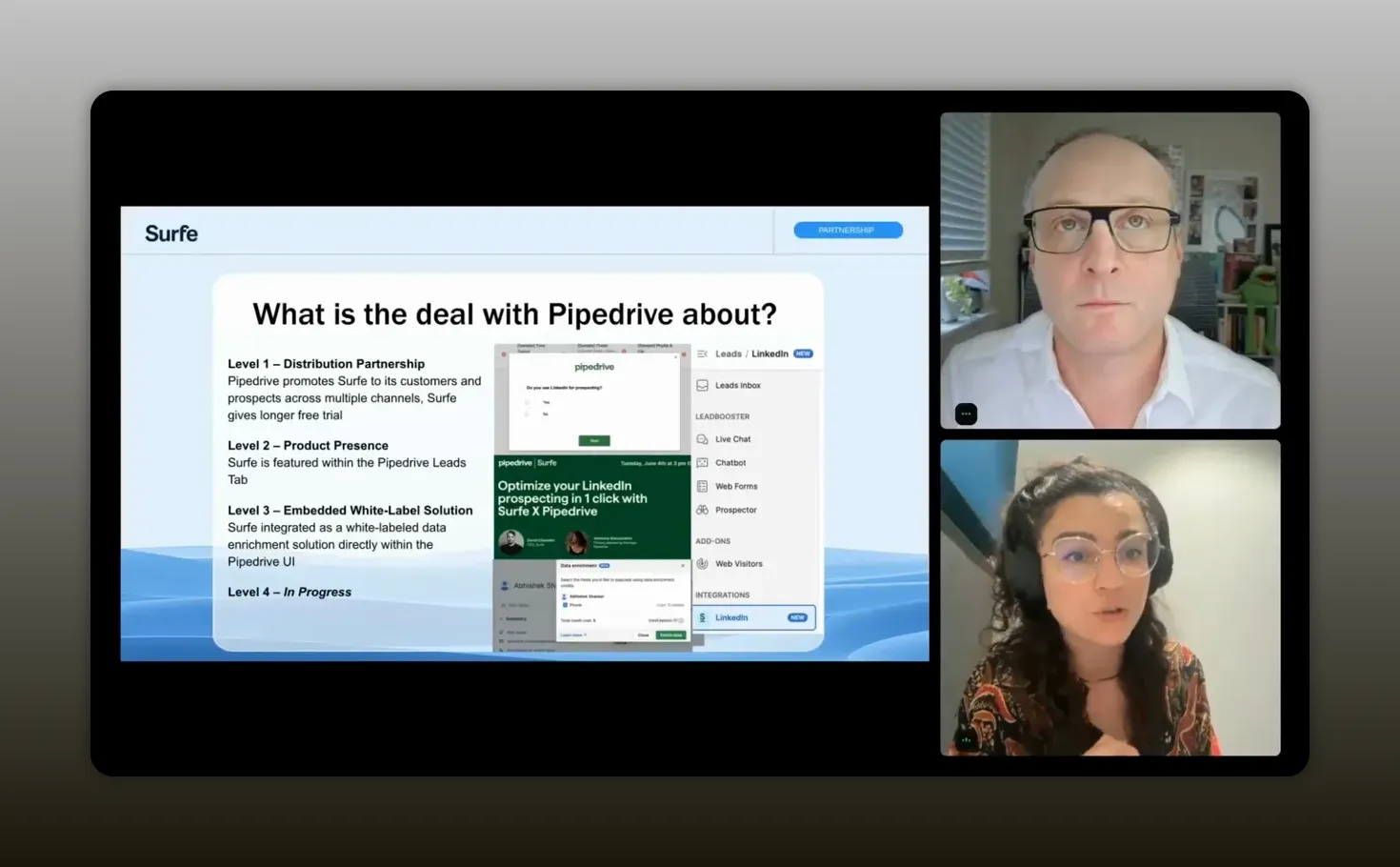
“We started as a distribution partnership… but then as every partnership, it evolved.”Marta El Bay
This is the dream path for many ISVs:
- Integrate
- Get distributed
- Get embedded
- Power value inside the platform
- Co-build new product experiences
The key question, of course, is: why did Surfe get there?
Why Surfe got selected
Justin asked the obvious question: why Surfe?
Marta’s answer was refreshingly grounded. It was not just strategy. It was strategy plus timing plus flexibility.
Her point was important. Sometimes, if you try the same motion a year earlier, it fails. Ecosystems need to be ready. Internal priorities need to line up. The market needs to create the right urgency.
But “being in the right place at the right time” only works if you are also prepared.
Marta highlighted three things that made the difference:
- Clear strategic fit
- Willingness to adapt tactics
- Leadership involvement
That middle point deserves more attention than it usually gets. A lot of partner teams want a clean, repeatable process. That is fair. But when you are trying to open a strategic relationship, rigid process can become a liability.
Marta’s mindset was simple: if a gatekeeper blocks one path, find another route. Stay structured, but stay flexible.
That is one reason ecosystem work often looks messy from the outside. The best partnership leaders are not just process operators. They are strategic problem-solvers.
Why leadership buy-in changed everything
Marta was very direct about this: the deal would not have happened without executive support.
Her CEO, David, was deeply involved. That did not mean occasional approval on a slide deck. It meant real participation, late-night strategizing, discussing next moves, preparing materials, and helping push the deal forward.
This is a pattern you see again and again in major partner wins. If you want a durable, meaningful strategic partnership, you usually need executive engagement.
Why?
- Executives can reach people individual contributors often cannot
- They add credibility to the strategic vision
- They can help align product, commercial, and company priorities
- They signal internal commitment to the potential partner
Justin made the point clearly: big deals with longevity are not built from a checklist or a generic tiered program. They need leadership support because strategic partnerships are company bets, not just team activities.
If your leadership team does not yet understand the value of partnerships, one of your first jobs is not prospecting. It is internal education.
You need buy-in before you need budget.
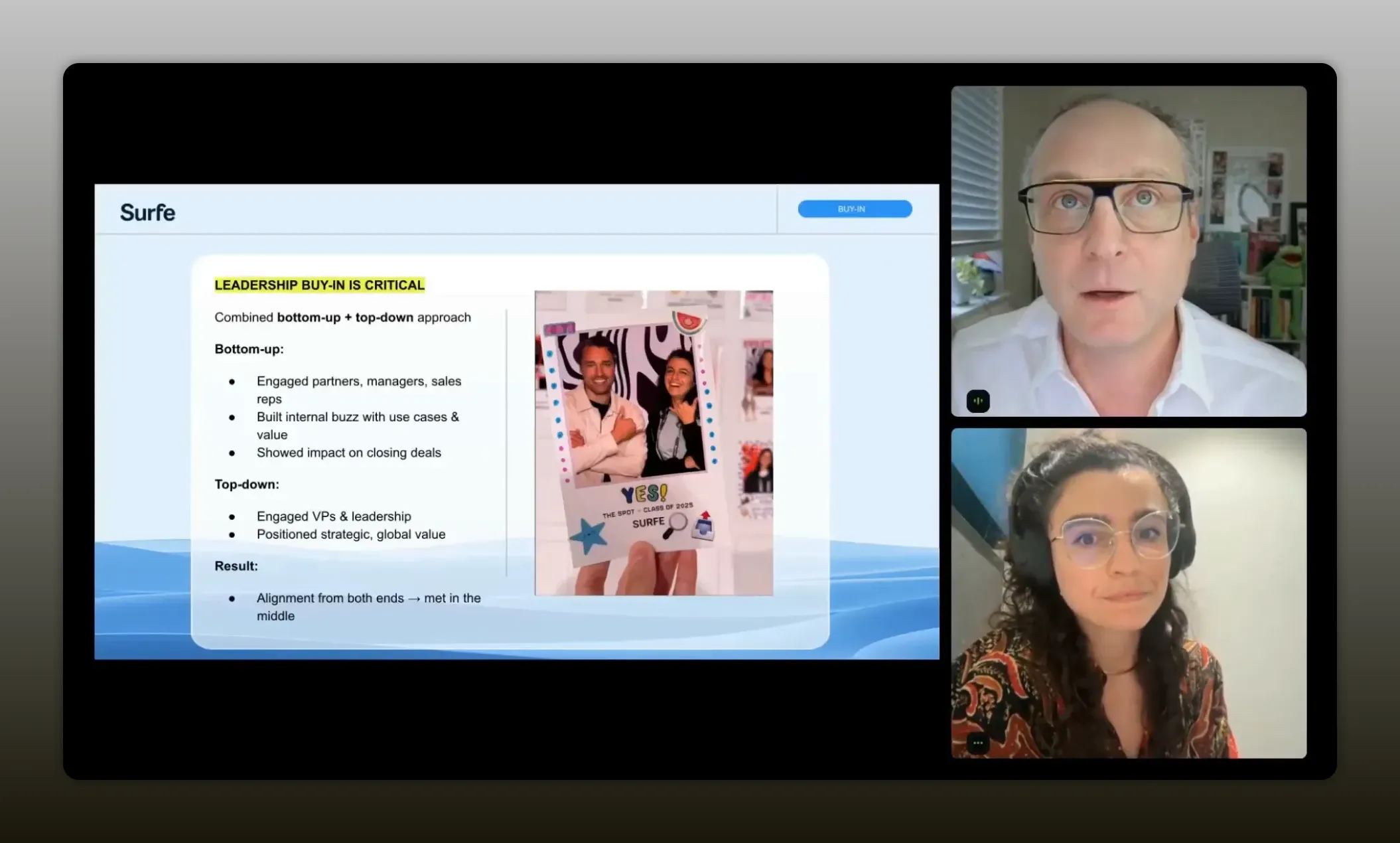
“Leadership buy-in wasn’t a formality for us—it meant my CEO was actively involved, strategizing late into the night and using his access to open doors that I simply couldn’t reach.” -Marta El Bay
The bottom-up playbook Marta used
This is where Marta’s approach gets especially smart.
Instead of starting with Pipedrive’s C-level executives, she started at the bottom of the ecosystem. Specifically, she started with solution partners and resellers.
Why them?
Because those partners deal directly with customers. They know the real friction. They feel the pain of stale CRM data. They are motivated to improve retention and customer outcomes. And if they find a tool that solves an active customer problem, they have incentive to talk about it internally.
Marta selected a set of high-fit partners and gave them free access to Surfe. Not as a gimmick. As a serious test.
Her message was roughly this:
- I know this problem exists
- If it exists for you, here is a solution
- Use it however you want
- If it works, tell your partner manager at Pipedrive
- If it does not work, give me feedback and ignore me forever
That is an excellent outreach frame because it is specific, low-friction, and centered on customer value.
It was not a generic sequence. It was not fake personalization. It was a targeted offer built around a known problem.
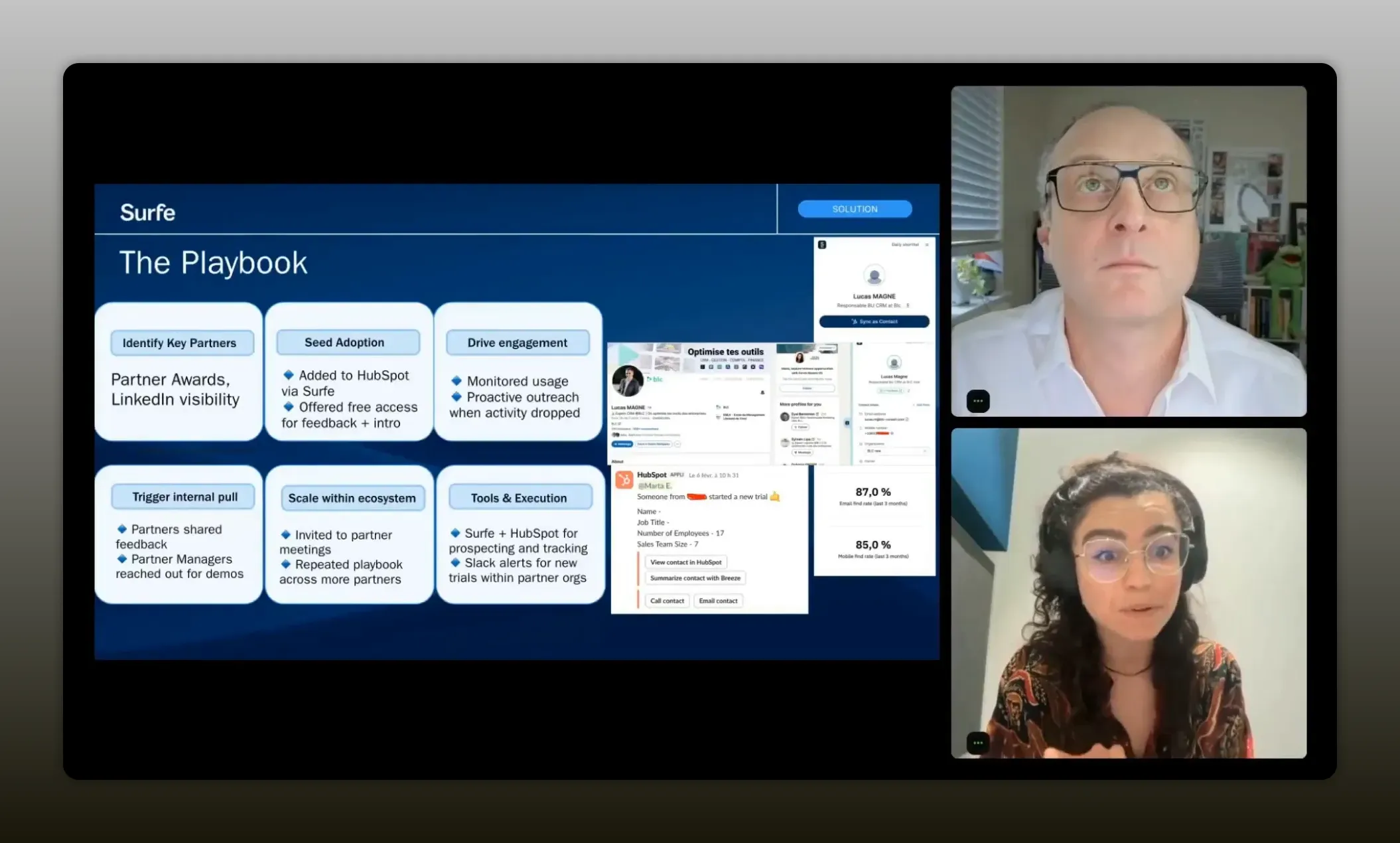
“I gave them the tool… just please, if you like it, ping your partner manager at Pipedrive.”Marta El Bay
The result was internal demand creation.
Those solution partners began telling their partner managers that Surfe was useful. Some introduced Marta to other partner managers. Others started setting up customers with Surfe licenses. Then sales teams inside Pipedrive heard about the tool from partners working active deals.
Soon Marta started receiving direct messages from Pipedrive sales reps saying they had customers who needed LinkedIn integration and asking for demos.
That is the genius of the move.
She did not try to force attention with cold outbound alone. She created ecosystem-native proof that spread through the channels Pipedrive already trusted.
If you want a partner ecosystem to notice you, one of the best methods is to become useful to the people already creating value inside it.
The top-down motion that opened doors
At the same time, Marta was feeding signals upward.
As partner and sales interest inside Pipedrive grew, she shared screenshots and examples with David. That gave him evidence that the timing was right and the traction was real.
Armed with that validation, David went after executive conversations.
And yes, he cold-called.
Marta made a funny but important point here: CEOs do not usually like cold calling. But strategic partnership building sometimes requires unusual effort. David was picking up the phone, sending messages, and emailing leaders directly to sell the long-term strategic vision.
So while Marta was driving use-case adoption and grassroots demand, David was carrying the higher-level strategic story into the executive layer.
That is what she meant by meeting in the middle.
The pattern looks like this:
- Bottom up: prove customer value through ecosystem partners
- Internal signal: show traction and demand inside the ecosystem
- Top down: bring executive vision and commercial potential to leadership
- Converge: turn proven demand into strategic partnership structure
This is a highly effective model for smaller teams because it does not depend entirely on one type of access.
If you only go top-down, you may get ignored.
If you only go bottom-up, you may create noise without strategic commitment.
Together, the two motions reinforce each other.
“This is actually a good time for us to talk… right now it’s just us, but it could be a strategic move for you.”Marta El Bay
Why partnerships is basically sales
Justin paused the conversation at one point to make a broader point that is worth underlining: partnerships is sales, just without the same immediate buyer transaction.
Marta’s process looked a lot like a sales motion:
- Identify target accounts
- Research the organization
- Map stakeholders
- Run targeted outreach
- Offer value early
- Track engagement
- Respond to signals
- Expand relationships
That is why partnership teams can learn so much from revenue teams, and why modern AI prospecting tools can be useful in partnerships too.
If your partnership function still treats relationship-building as something magical and unstructured, you will probably move slower than teams that apply disciplined go-to-market thinking.
This is also where broader ecosystem orchestration comes into play. If you want a structured model for aligning strategy, systems, and partner execution, this guide to ecosystem orchestration offers a useful framework.
How to build a better-together story with proof
One thing Marta made very clear is that bottom-up and top-down tactics are not enough if the partnership does not genuinely make sense.
You still need:
- A strong partner fit
- A clear better-together narrative
- Evidence that the combined value solves a real problem
With Pipedrive, the story worked because both companies served similar users and similar use cases. Even better, the pain points were backed by data from Pipedrive’s own customer research.
According to Marta, those customers were struggling in the pre-sales phase with things like:
- Finding leads
- Qualifying leads
- Keeping CRM data current
- Preparing well for first meetings
That research validated the joint story. Surfe was not inventing a problem to justify a partnership. It was helping solve one the ecosystem had already identified.
This is one of the strongest positions you can have in partner strategy: when your narrative is supported by the partner’s own data.
If you are building your own AI- and data-informed partnership motion, this practical playbook on partnerships, data, and AI is a good companion read.
How Marta is using AI now
One funny part of the conversation was Marta pointing out that this whole Pipedrive playbook was built just a couple of years ago, but it already feels like another era.
At that time, AI was not woven into every workflow. There were no mature AI-heavy prospecting motions for partnership teams. So her process was much more manual:
- Researching partner award winners
- Watching ecosystem signals on LinkedIn
- Using Surfe to collect contact data
- Managing outreach in HubSpot
- Monitoring product usage closely
- Mapping organizations in detail
She specifically looked at partner awards, regional recognition, and social signals from Pipedrive to identify which partners mattered most. If Pipedrive featured a partner publicly, she treated that as a sign of importance.
Then she manually tracked activity. She checked user dashboards. She looked for product usage patterns and friction points. If a partner tried a feature and did not get the expected result, she proactively reached out before they even reported the issue.
That built trust.
Now, though, she is experimenting with a more AI-assisted motion inside HubSpot using the prospecting agent.
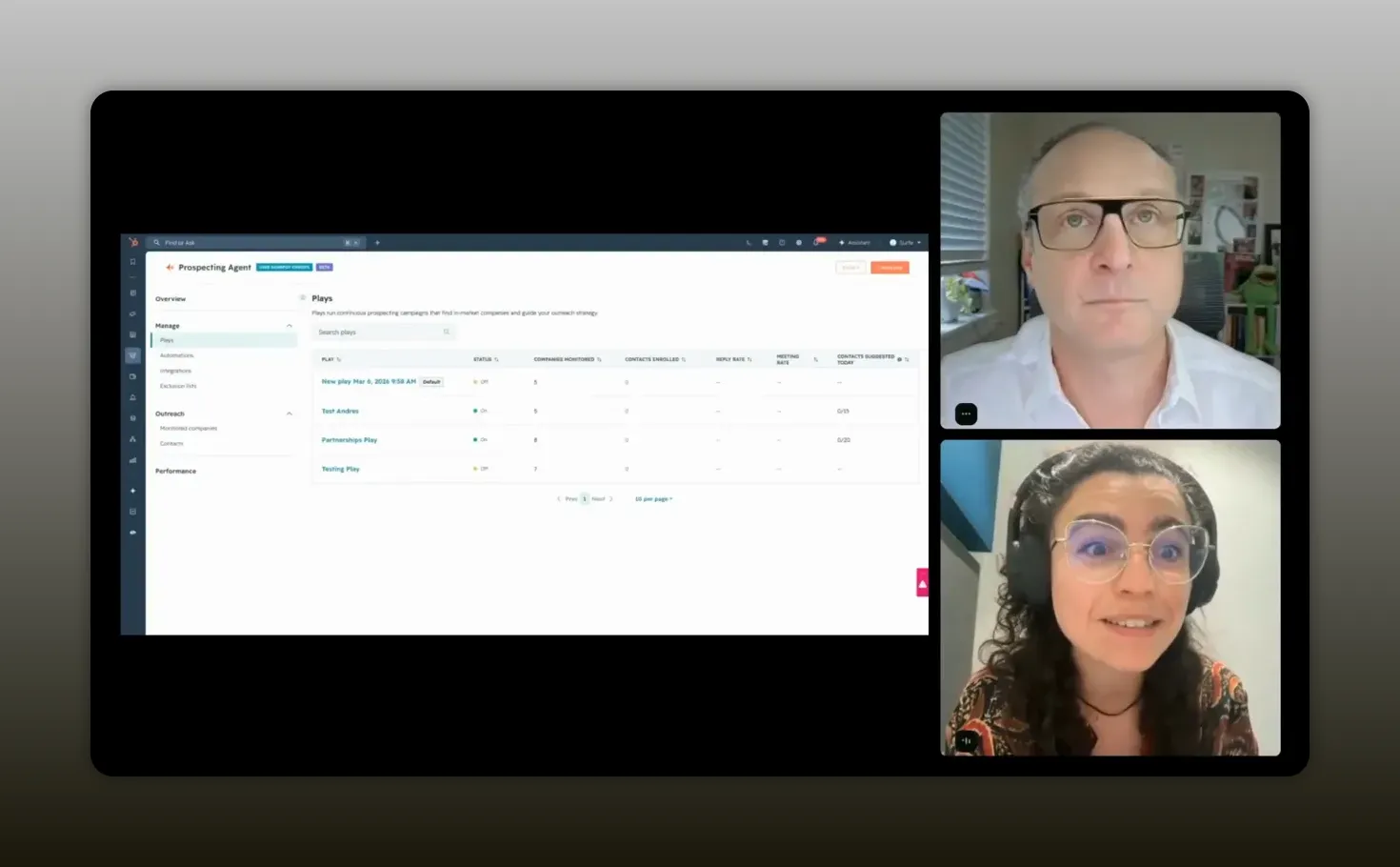
“Why don’t partner people use this kind of prospecting tools? For me, partnerships is sales.”Marta El Bay
Her current focus is different as well. She is looking at ways to send Surfe’s APIs and data into other tools that could benefit from embedded enrichment, similar to the white-label direction the Pipedrive partnership took.
For that, she is using HubSpot’s prospecting agent to:
- Define a target persona, especially product and data leaders
- Set selling context carefully
- Identify companies to monitor
- Source contacts using Surfe data
- Generate email drafts
Her warning was useful: AI tools are only as good as the context you feed them. If you spend time setting up the selling context properly, the resulting outreach can be surprisingly strong.
This is an important shift for partner teams. AI is not replacing strategic thinking. It is compressing the manual parts of account research, contact sourcing, and personalized outbound.
If you are still doing all partner discovery manually, you may want to compare your current process against newer AI-supported methods like the ones described in this guide to faster partner discovery with AI.
Recommended tools
Marta’s story was not about stacking dozens of tools. It was about using a few tools well and pairing them with strong judgment.
Core tools mentioned
- Surfe for contact sourcing, LinkedIn-to-CRM workflows, and enrichment
- HubSpot as the CRM and, more recently, for the prospecting agent
- Slack for internal coordination
- Org chart tooling for mapping organizations and relationships
How to think about your stack
If you are building a partnership motion like this, your tools should help you do four things well:
- Identify the right partner accounts
- Map the right people inside those accounts
- Track outreach and engagement consistently
- Respond quickly to usage and relationship signals
The deeper lesson is that technology supports the motion. It does not create the motion. Marta’s success came from choosing the right ecosystem, knowing the customer pain, and combining demand creation with executive access.
FAQs
How do you get a big ecosystem partner to notice a smaller ISV?
Start by becoming useful to the ecosystem’s existing partners and customer-facing teams. Marta’s approach worked because she created demand inside the ecosystem first, especially through solution partners who already felt the pain her product solved. That internal validation traveled farther than cold outreach alone.
Why was Pipedrive a better fit than a bigger platform like Salesforce?
Because fit mattered more than size. Pipedrive served a similar customer profile, had a clearer overlap in use case, and operated in an ecosystem context where Surfe could tell a more natural better-together story. Bigger logos are attractive, but they are not always the best strategic starting point.
What made the partnership successful beyond the product integration?
Three things stood out: a genuine customer problem, bottom-up demand creation, and top-down executive involvement. The integration opened the door, but trust, traction, and aligned strategic vision moved the relationship forward.
What does “partnerships is sales” actually mean?
It means the work often follows similar motions: account selection, stakeholder mapping, outbound messaging, follow-up, and relationship expansion. The difference is that the outcome is usually indirect revenue, distribution, product leverage, or strategic access rather than a simple transaction.
Do you need executive buy-in for a partnership like this?
Yes, especially if you want the relationship to become strategic. Executives can access higher-level decision makers, frame the long-term opportunity, and signal commitment. Marta’s CEO played a major role in translating grassroots traction into executive conversation.
How can AI help partner teams today?
AI can speed up research, contact sourcing, company monitoring, and outreach drafting. Marta is now experimenting with HubSpot’s prospecting agent to support partner prospecting, particularly for product and data leaders who may benefit from Surfe’s APIs and enrichment capabilities.
What is the biggest takeaway for a small partnerships team?
Do not try to brute-force your way into a major ecosystem. Pick the right ecosystem, build a narrative around a real pain point, prove value through the people closest to customers, and align your leadership team early.
Conclusion
If you strip away the logos and the tooling, Marta’s playbook comes down to a few durable principles.
Pick the ecosystem where your value is most obvious.
Build around a painful, specific customer problem.
Create internal demand from the bottom up.
Arm your leadership team with proof so they can work the top down.
Stay flexible enough to find new paths when the obvious route is blocked.
And remember that the best partnerships do not appear fully formed. They evolve. A distribution agreement can become in-product placement. In-product placement can become embedded functionality. Embedded functionality can become joint product creation.
That progression is available to more teams than people think, but only if you approach partnership building as a strategic growth motion rather than a passive channel exercise.
Marta’s story is a strong reminder that small teams can win very big outcomes when they combine focus, customer insight, and disciplined execution.