Getting Hired in Today’s Market
Expert advice from Nelson “Coach Nelson” Wang (Founder, Partner Principles and PartnerOS).
Snapshot
You are competing in a world where a single partnerships role can generate 500 or more inbound applicants, plus additional outbound candidates reaching the same shortlist. If you rely only on a resume and a generic cover letter, you are playing a low-signal game against a high-signal audience. The real risk is not “not getting hired fast enough.” The real risk is that you blend into the background and never give the hiring team a concrete reason to prioritize you.
Here is the big opportunity: you can create a company-specific pitch deck that maps the job description to your track record, aligns to their mission, and outlines your first 30, 60, 90 days. Use AI to get 70 to 80 percent of the way there quickly, then add the human layer that makes it feel thoughtfully built. This shifts your application from “documents” to “a persuasive asset,” and it works earlier than you think.
Keep reading to learn how Coach Nelson can help you stand out, book interviews, and move closer to your offer.
“Coach Nelson” advice: make it company-specific, proof-based, and aligned to what they actually expect in the role.
Table of Contents
- Snapshot
- Why “apply and hope” fails in fast-growth AI hiring
- The sales lens: treat yourself like the product
- The “art of the possible” strategy for partnerships hiring
- How to build a customized pitch deck with AI (without looking generic)
- What to include in your slides: title slide to 30-60-90 days
- When to use the deck: pre-read, follow-up, and multipliers
- Multi-threading and breaking through the clutter
- Recommended Tools
- FAQs
- Conclusion
Why “apply and hope” fails in fast-growth AI hiring
If you have ever felt like your applications disappear into a black hole, you are not imagining it. In the partnerships and go-to-market talent space, hiring can be brutally competitive. Coach Nelson shared that recruiters can see hundreds of inbound applicants for a single role. Recruiting Partner Specialist added that, for a given position, you might also run into outbound outreach that brings you into the same funnel from the other direction.
Now zoom out. The job market has not just become more competitive. It has become more process-driven. Many companies screen with ATS filters, hiring managers triage quickly, and functional leaders delegate decisions. In that environment, the “usual” application approach is not wrong. It’s simply too low differentiation.
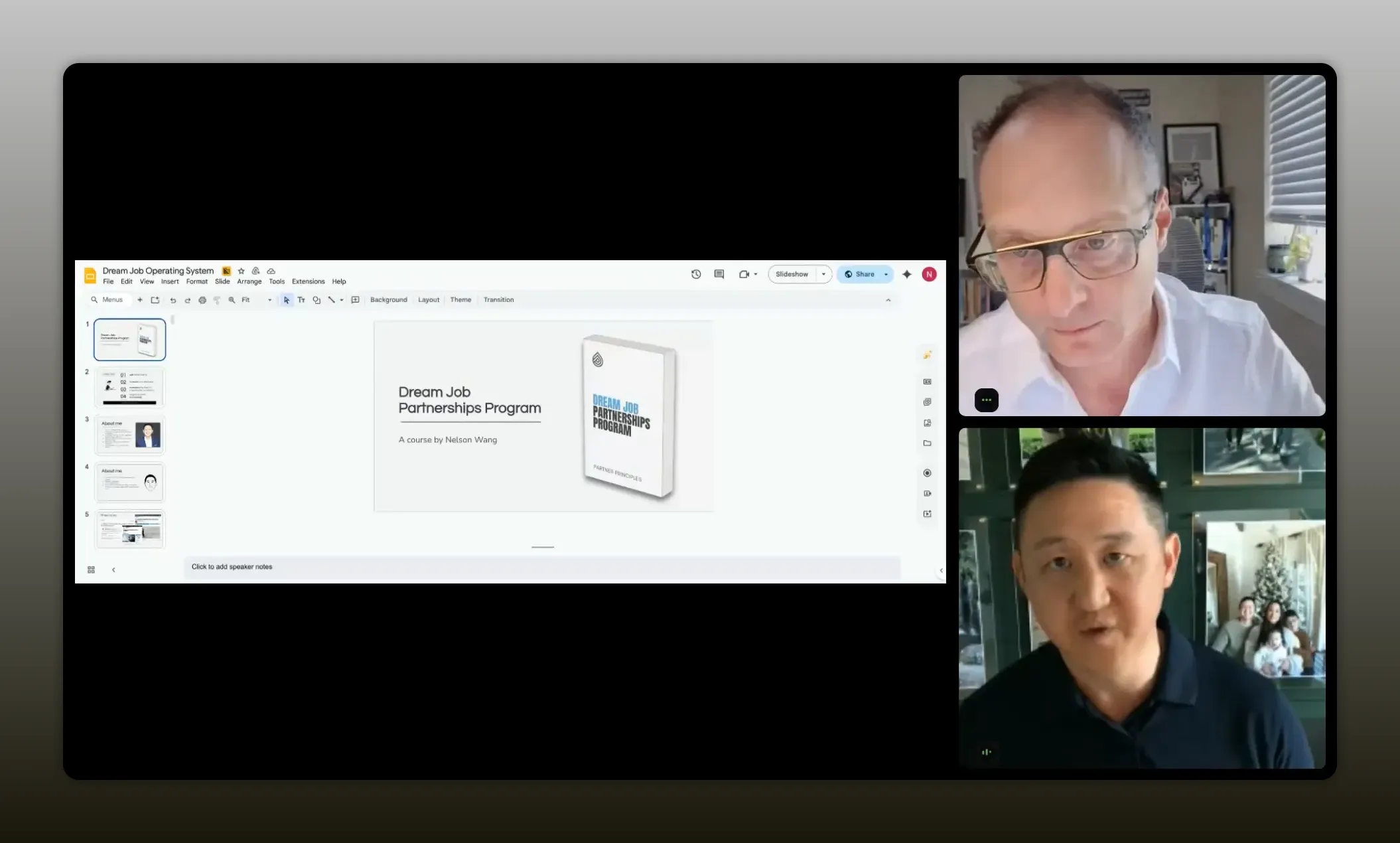
“Everyone’s using the same tools, the resumes look the same, the outreach sounds the same, and you blend into the pile unless you create company-specific, proof-based signal.” – Coach Nelson
The sales lens: treat yourself like the product
Coach Nelson described a perspective many professionals avoid because it feels uncomfortable: use a sales lens. Yes, the product is you. Yes, it feels heavier because you are not selling an object. You are selling your capability, your fit, and your future impact. But the mechanics are similar.
In sales, you do not assume one pitch converts. You build a system: you create a compelling asset, you reach the right buyers, and you measure results by iteration, not by a single outcome.
In hiring, the same idea applies:
- You need an asset (your pitch deck) instead of only a file (your resume).
- You need distribution (reach executives and hiring stakeholders, not only the portal).
- You need persistence (multi-threading, follow-ups, and repeat cycles).
- You need proof (track record and references or credible signals).
This is how you reduce the “all or nothing” pressure that makes job searching feel emotionally unstable.
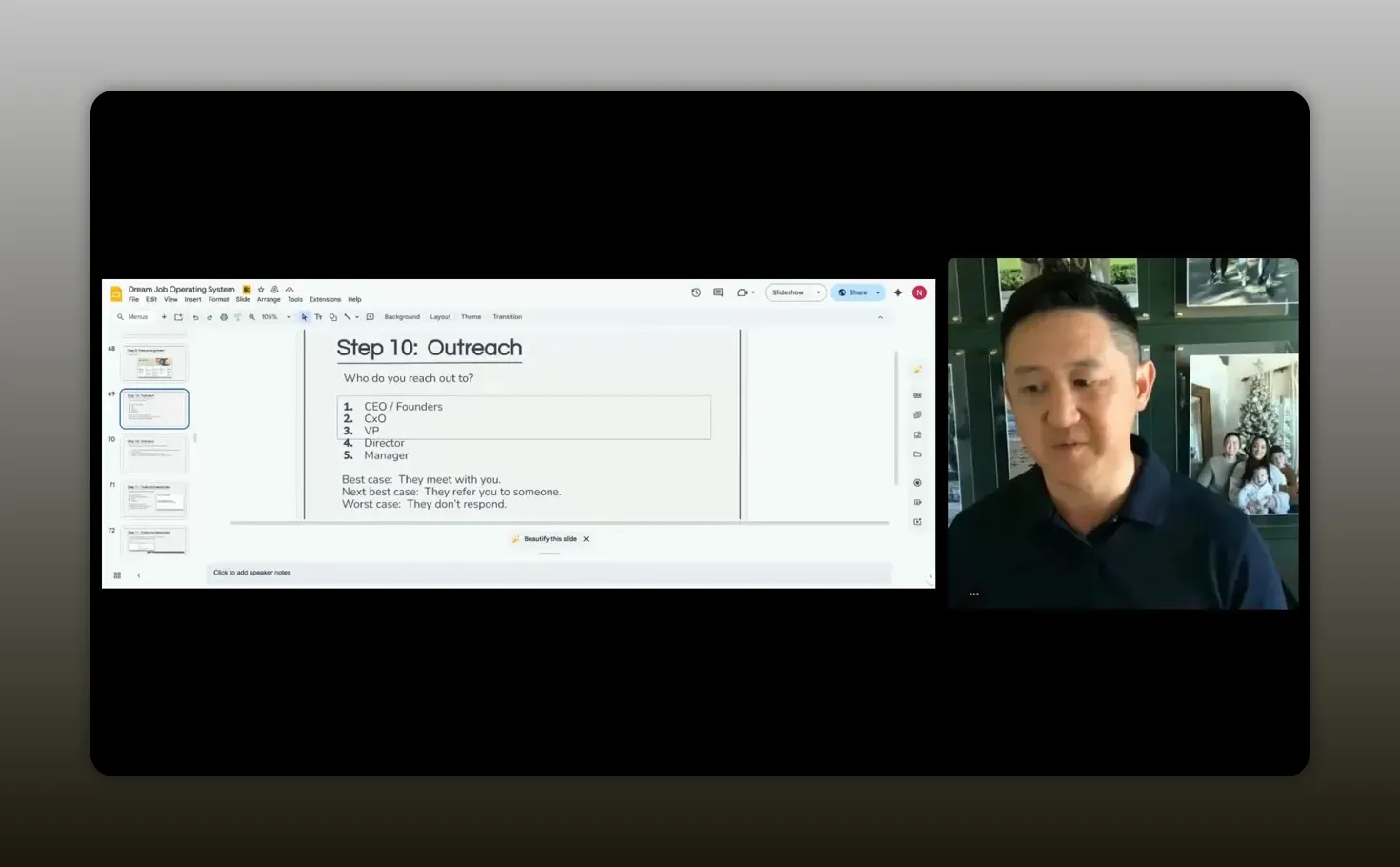
“Don’t just market your resume—market *your ability to deliver*. Build a company-specific asset that makes it obvious why you’ll be the next best hire.” – Coach Nelson
The “art of the possible” strategy for partnerships hiring
Coach Nelson’s core tactic is the “art of the possible.” The key move is to create your customized pitch deck before anyone asks.
Most candidates wait until interviews to explain how they will succeed. That means you start late. In contrast, Coach Nelson recommends doing this early in the process if you are comfortable with the sweat equity involved.
Your deck becomes a preemptive answer to the questions hiring teams already have:
- How will you add value in this partnerships function?
- Why do you care about our mission and approach?
- How will you execute in the first 30, 60, 90 days?
- Do you have proof you can deliver?
Once you provide those answers in a clean, persuasive format, you stop being part of the pile. You become a candidate with signal.
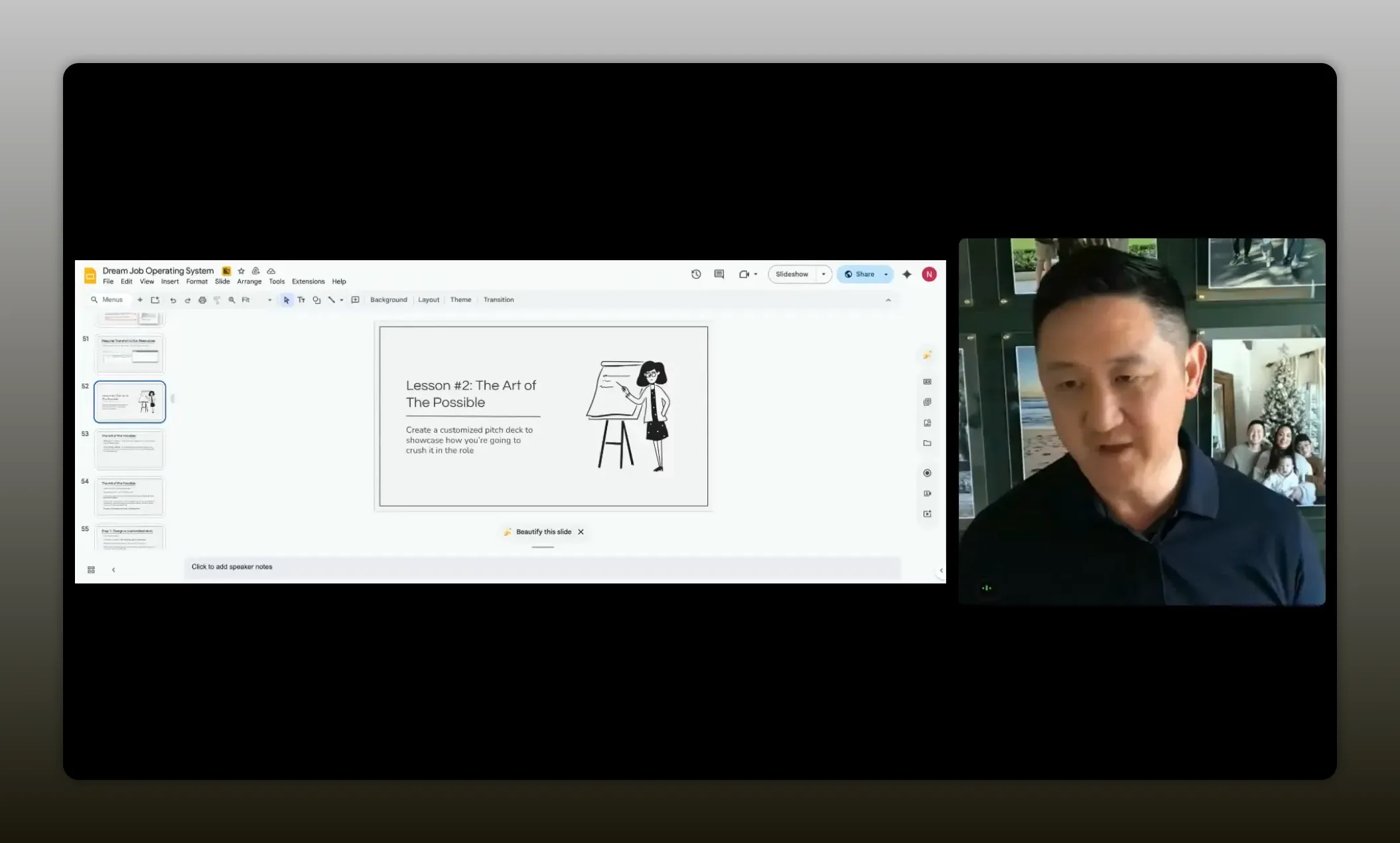
“The art of the possible is simple: don’t wait to explain your plan—show it first, tailored to their brand, their job, and the proof that you can deliver.” — Coach Nelson
How to build a customized pitch deck with AI (without looking generic)
Here is the biggest misconception: “AI will generate a deck, so I can send it.” Coach Nelson is very clear on the quality bar. The goal is not to generate something fast and hope it lands. The goal is to design a beautifully customized deck for that specific company.
AI should handle speed. You should handle judgment.
Your deck should be customized in three layers
- Brand layer: matching the company’s logo, color palette, typography, and visual style. Coach Nelson suggested you can even generate a brand kit style by looking up the company website and identifying design elements. Then you apply that styling to your slides.
- Content layer: mapping the job requisition to your story. Do not write “generic how.” Read their responsibilities and requirements, then map your past actions and outcomes to what they need.
- Human high-touch: fixing what AI often gets wrong, especially logos and images. Coach Nelson pointed out that AI sometimes cannot pull the exact logo or precise images. Add those manually from the company website so the final artifact looks intentional.
What “70 to 80 percent done” looks like
Coach Nelson’s workflow is practical: AI gets you off zero and produces the framework, slide structure, and most of the layout logic. That is the advantage. But the final quality pass is where you add your credibility. That final polish is what signals “this person actually took time.”
In the example Coach Nelson coached, the candidate used a Salesforce-focused pitch with strong design and company-specific branding. The result was not just a better-looking application. It created a different narrative: “they speak our problem set.” Within about two weeks, the candidate sent it cold and received an interview.
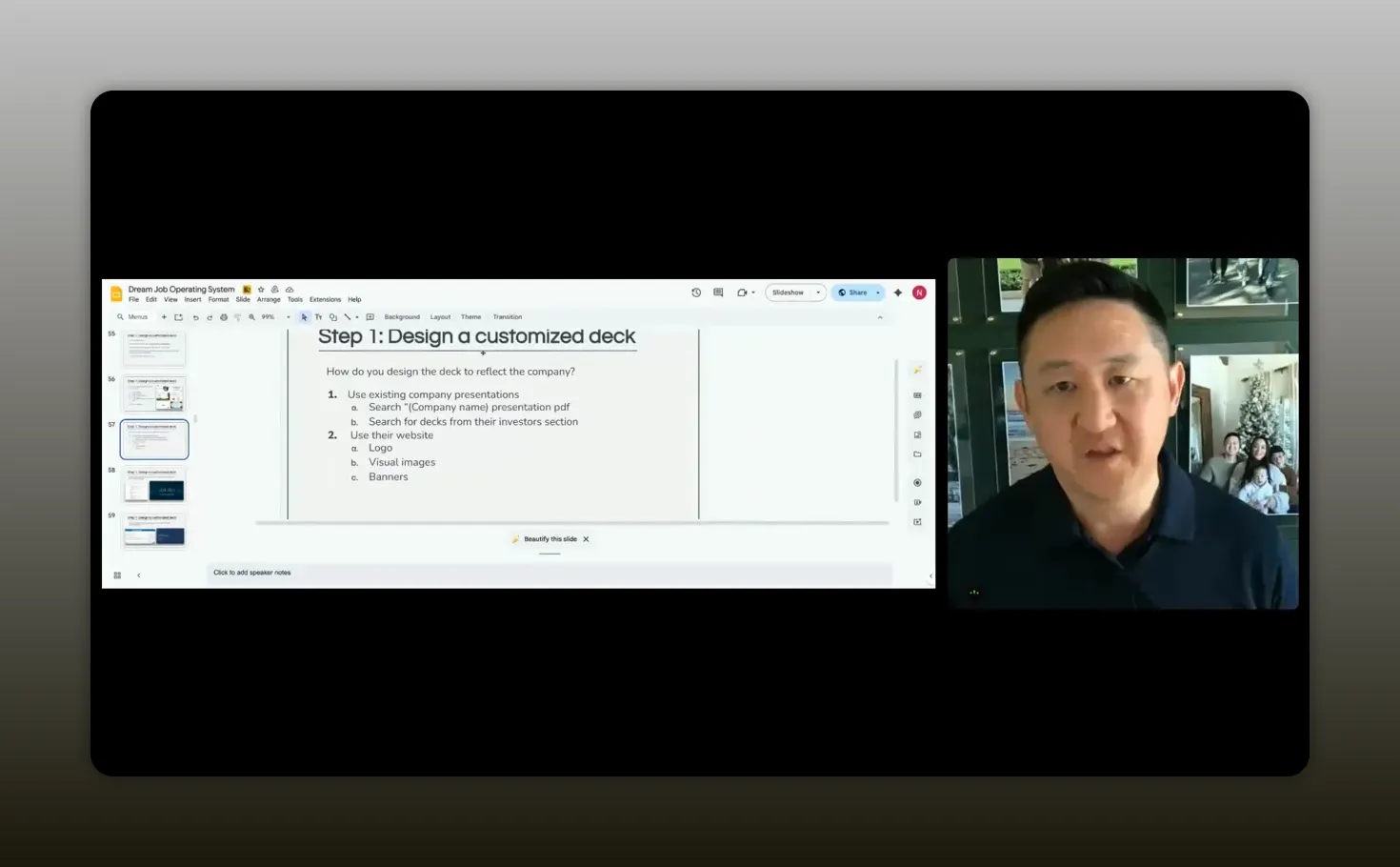
“Build a company-specific pitch deck that matches their brand, maps directly to their job description, and proves you can deliver. That’s what makes it feel thoughtfully custom, not generic.” — Coach Nelson
Design customization can feel intimidating until you realize how much material is publicly available. Coach Nelson recommends building your deck using reference points.
Fast reference sources
- Company website: brand colors, typography, imagery, and logo usage.
- Investor relations decks: investor presentations often contain downloadable PDFs with consistent themes and slide layouts.
- Public PDF search: search for “Company name presentation PDFs” or “Company name investor relations deck.”
- AI-assisted restructuring: use presentation tools like Gamma-style workflows to redesign existing content quickly in matching templates.
Coach Nelson also shared a simple example: if you want to apply to Cisco, you can search for Cisco presentation PDFs, download reference decks, and reuse the visual design elements to create a company-specific job pitch deck. It turns “blank slide anxiety” into a starting point.
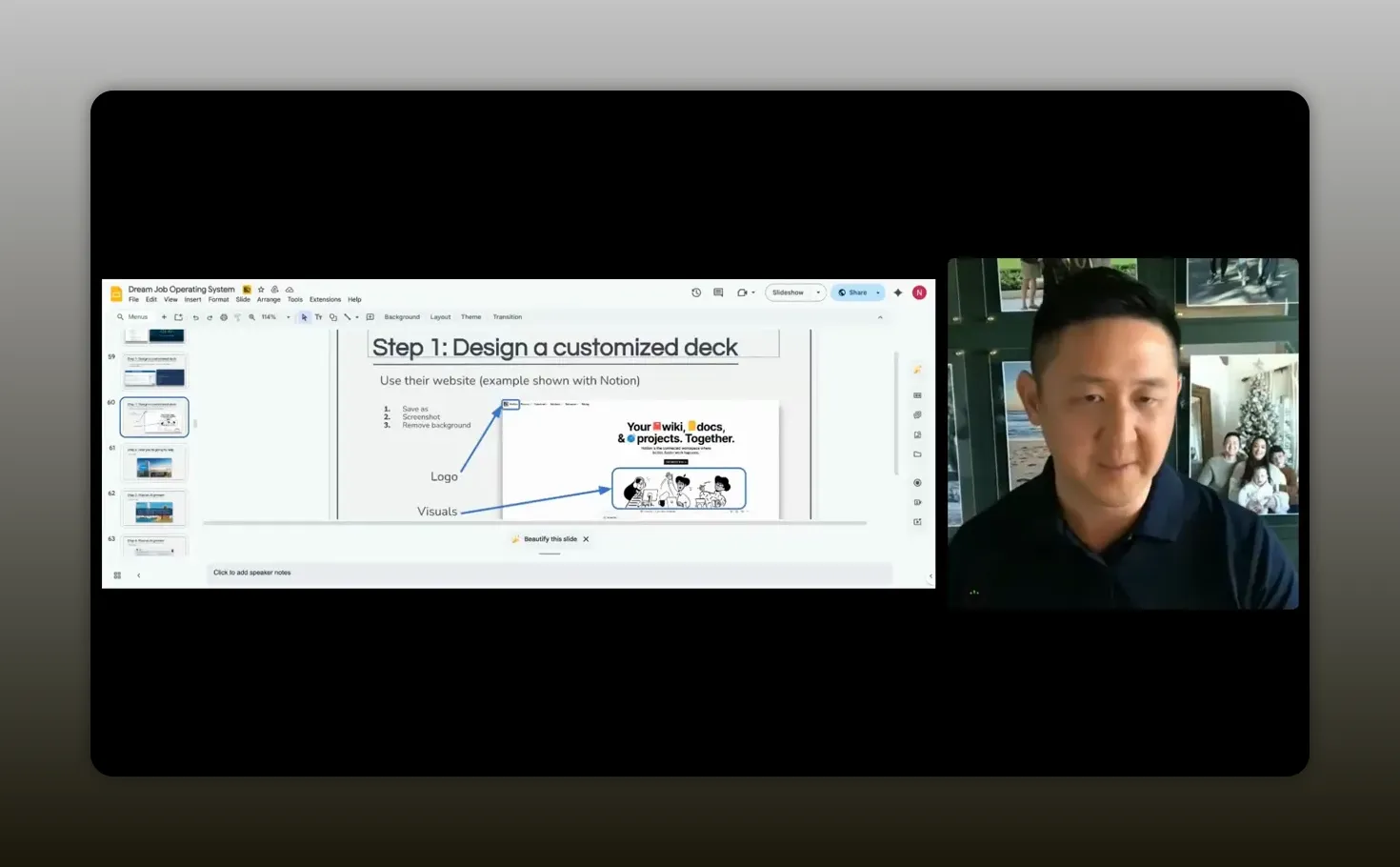
“Pull their brand kit, map the job description to your real contributions, and then add the human high-touch fixes (logos/images) so it feels truly built for *their* problem set.” — Coach Nelson
What to include in your slides: title slide to 30-60-90 days
Your pitch deck should not merely be pretty. It should be structured like a persuasive plan.
Coach Nelson highlighted a set of slide “anchors” you can adapt to your role and company. Think of these as modules you reorder depending on the job function.
1) Title slide: how you would help
On the title slide, show your immediate value in one clear statement. Coach Nelson referenced a friend’s deck where the candidate described goals like driving world-class guest experiences. The point is not the topic. The point is the framing: you lead with what you’ll do.
2) Mission alignment: why you care
Most interviews ask some version of “Why do you want to work here?” Coach Nelson suggested making this explicit in the deck by explaining:
- What the company is trying to achieve
- Why that mission matters to you
- How your values and approach align
When you do this in writing, your answers become more grounded. You also look like someone who researched the company deeply.
3) “How I’ll execute” mapped to the job description
Then comes the most important part: explain how you will execute using pillars or a framework. Coach Nelson strongly recommended mapping directly from the job listing. The job requisition is not only a filter. It is content you can reuse.
With AI, you can accelerate the first draft by feeding in:
- Your resume or past responsibilities
- The job listing
- A prompt asking for pillars that show execution
After that, you do the human review so it stays accurate and high quality.
4) Your personal why (make it specific)
Coach Nelson noted that a deck that includes a strong personal why resonates because it shows you understand the culture and mission, and you have a reason to join beyond “the role sounds cool.”
5) Track record and proof points
Coach Nelson recommended including a “track record” slide. This supports two outcomes:
- Hiring signal: proof is persuasive.
- Interview preparedness: you prewrite answers to “walk me through your track record.”
Even if the company never references your deck, you still benefit because you will sound more confident and structured in interviews.
6) First 30, 60, 90 days (prescriptive and practical)
One of Coach Nelson’s strongest suggestions is to envision yourself in the role and outline your first 90 days in detail. Not vague intentions. Concrete phases like assessment, design, and execution.
When you include this, you show you have already thought through the real work and the sequencing required to succeed.
7) Cite references (and expect back-channel)
If you have references, surface them in the deck. Coach Nelson emphasized that companies often back channel, so references can matter. The deck becomes a place to anchor those credibility signals up front.
8) Anticipate obstacles and measures for success
Coach Nelson’s example also included obstacles and measures for success. This is a high-signal move because it shows you do not only plan the happy path. You understand implementation risk.
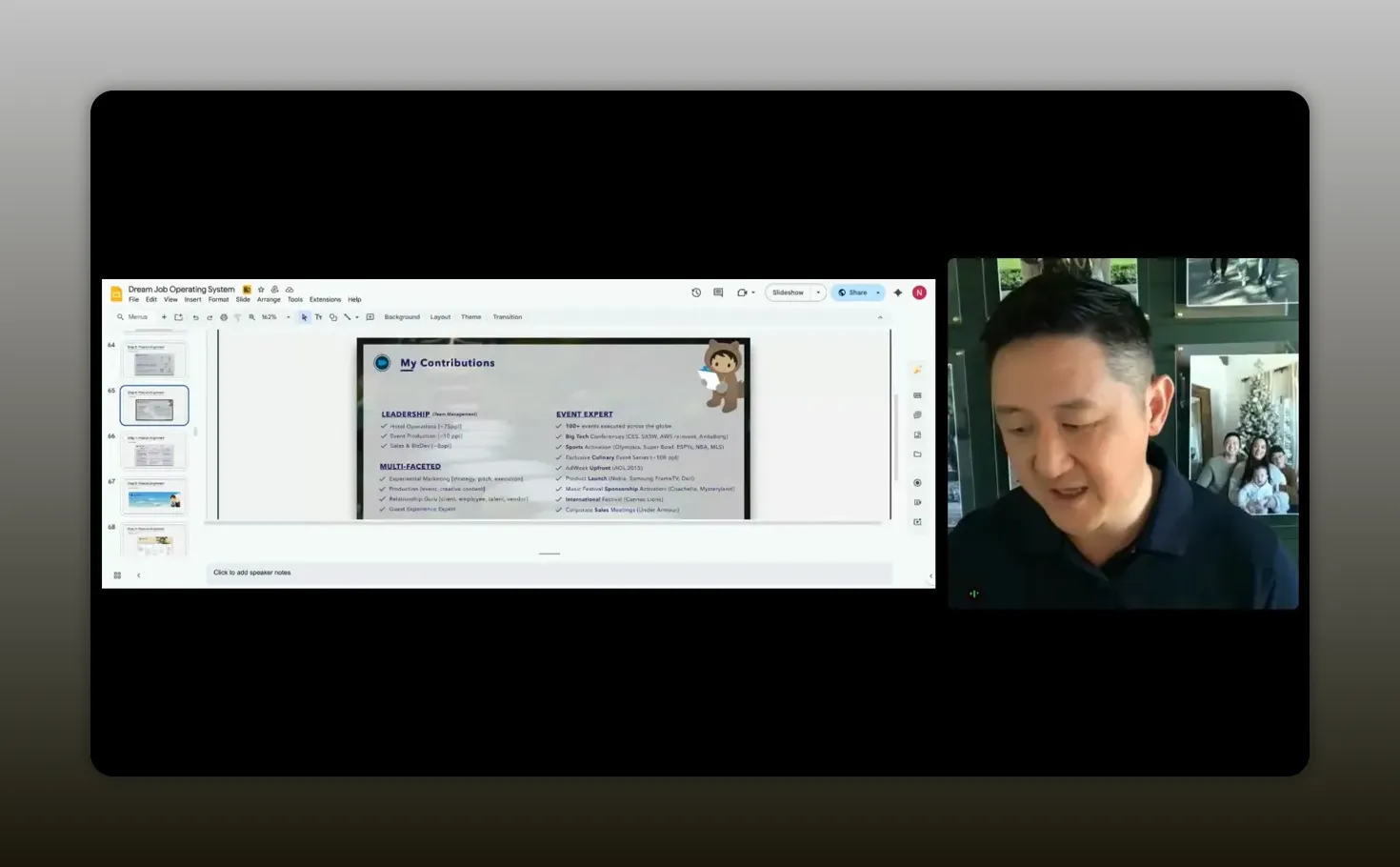
“Frame your deck around *their* job description and brand—then prove it with your real contributions. Don’t just show what you’ve done; show how you’ll deliver in the first 30, 60, 90 days.” — Coach Nelson
When to use the deck: pre-read, follow-up, and multipliers
Creating the deck is only half the equation. You also need to know where it fits in the candidate journey.
Best timing opportunities
- Pre-interview: attach or share the deck in a message to secure an interview. Coach Nelson suggested using it as a pre-read when you are reaching out on platforms like LinkedIn.
- Scheduled interview follow-up: send it after the interview as a reinforcement asset. Coach Nelson contrasted generic follow-ups like “thanks for your time” with a deck that proves serious intent.
- Executive outreach: leverage it to make it easy for a busy stakeholder to forward or delegate. When an executive cannot personally interview you, it helps if someone else can quickly see your fit,
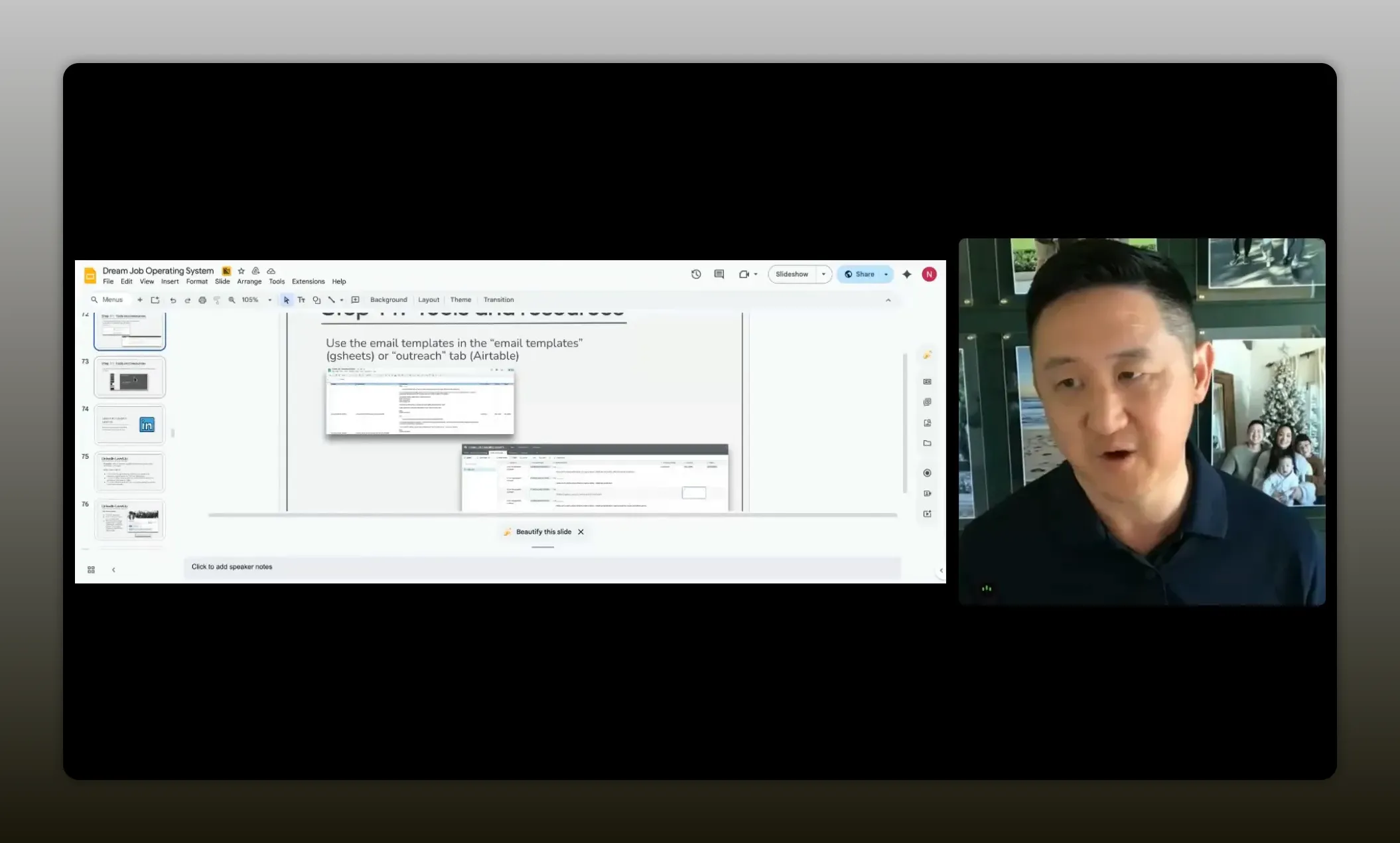
“[Outreach] is about creating a company-specific asset that makes it easy for the right stakeholder to say ‘yes’ and forward you to the decision maker.” — Coach Nelson
Multi-threading and breaking through the clutter
Coach Nelson addressed a common question: “I spent two hours making a deck, but I did not get interviews. Why?” His response was practical: you only need one “yes,” but you may have to send many assets to reach the right person at the right time.
He also introduced the concept of multi-threading. Do not send one message to one person and wait.
How to multi-thread effectively
- Target executives and hiring stakeholders, not only the application portal.
- Use multi-channel outreach: LinkedIn, email, and even X-style outreach if it aligns with the company culture.
- Get shared connections: use a warm connection to ask for referrals.
Should you upload it with your resume?
Coach Nelson explained that uploading attachments can be risky because ATS systems might not surface them the same way. Most people focus on the resume. So the safer route is to send the deck directly in outreach to relevant stakeholders, rather than relying on an attachment to be noticed.
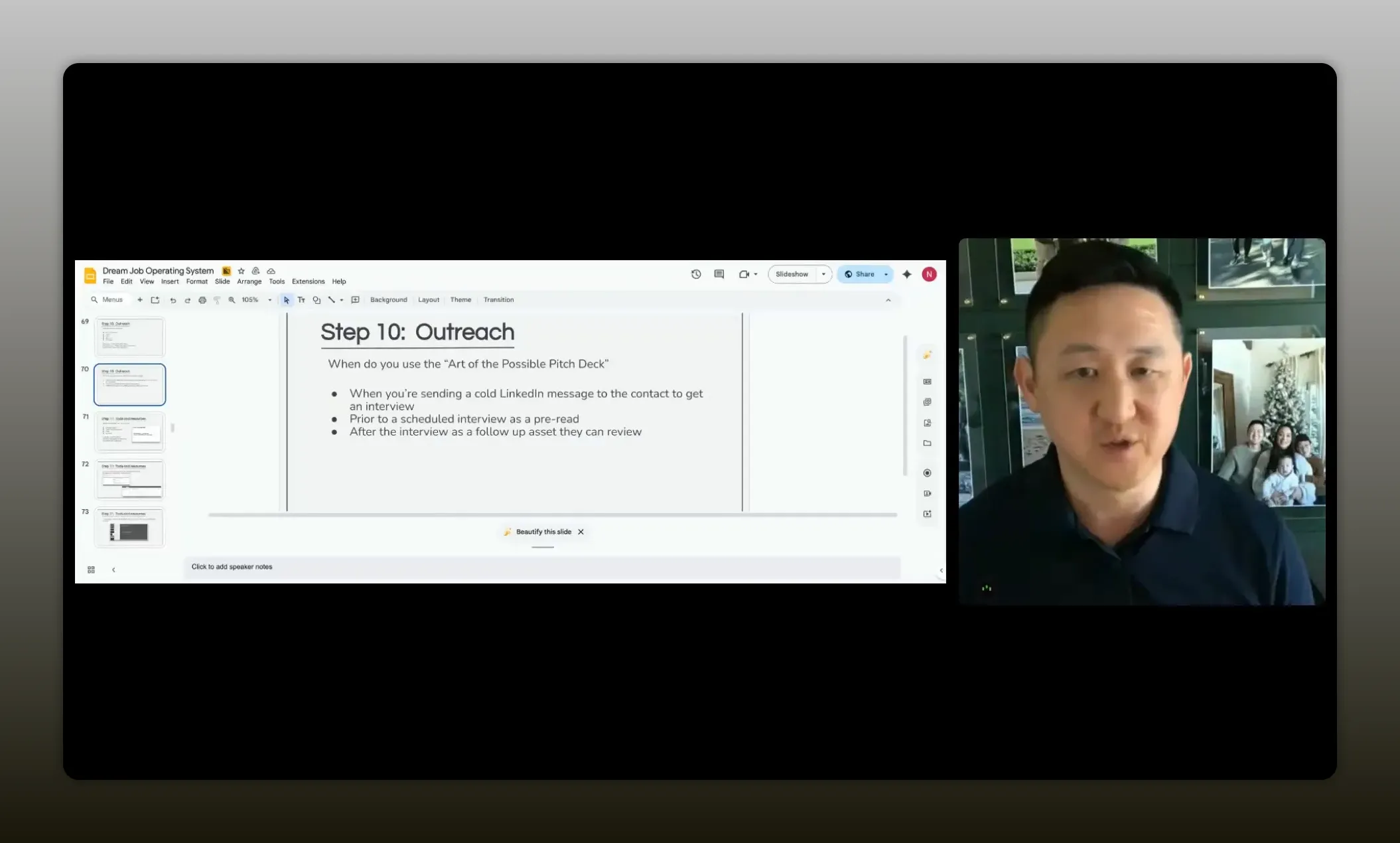
“Start with the stakeholder who can delegate. Reach out to the right exec or hiring leader with a company-specific deck so it’s easy for them to say yes—and forward you to the decision maker.” — Coach Nelson
Recommended Tools
AI can accelerate this whole process, but you still control the final quality. Coach Nelson mentioned several tools in practice:
- Gamma for generating and redesigning presentation structures quickly
- Claude for drafting, structuring, and building presentation content quickly
- Google Slides or PowerPoint for manual refinement when you want pixel-level control
- Miro for collaborative frameworks if you prefer working visually
- Email enrichment and outreach tools (like Apollo and Clay) to support multi-threading
The key theme is hybrid workflow: AI does speed and structure, you do the human high-touch for logos, images, and correctness.
FAQs
Do you upload this kind of presentation with your resume?
It depends, but Coach Nelson warned that ATS systems can miss attachments because most screeners focus on the resume file. A stronger approach is to send the pitch deck directly to executives or hiring stakeholders using outreach channels, so it is seen intentionally.
When is the best time to send the pitch deck?
Send it early, as long as you are comfortable with the sweat equity. Coach Nelson recommended using it before questions come up in outbound motion, during early stages like a hiring screen, or as a pre-read if you secure an interview. It also works as a follow-up after the interview.
What if AI generates something generic or looks “sloppy”?
That is exactly what you want to avoid. Coach Nelson set a high-quality bar: do not just generate and send. Customize the brand styling, manually fix logos and images that AI cannot pull correctly, and ensure the content is mapped to the specific job requirements.
How long does it take to make a customized deck now?
Coach Nelson described a shift from weeks of effort to hours when you combine AI with good templates. In one example, the coached candidate sent a cold deck within about two weeks and got an interview. Your time depends on how comfortable you are with editing and ensuring accuracy, but the starting point can be much faster.
What should the deck include for partnerships roles specifically?
Use pillars tied to the job listing and include: a value-forward title slide, mission alignment and your personal why, an execution plan mapped to responsibilities, proof via track record and metrics, a detailed first 30, 60, 90 days plan, and optional references.
How do you break through the clutter to get the interview?
Use distribution like a sales process. Multi-thread across LinkedIn and email, target executives and hiring stakeholders, and use shared connections to make referrals easier. Include your pitch deck in outreach so the recipient has a concrete reason to act.
How many decks should you send before you give up?
Coach Nelson’s practical reminder was: it only takes one yes. If you send three and get nothing, you might still need to send more. The real lever is consistency and durable effort over time.
Conclusion
If you want interviews in today’s market, you need more than “apply harder.” You need a persuasive differentiator that reduces uncertainty for the hiring team. Coach Nelson’s approach centers on an “art of the possible” pitch deck: company-specific branding, job-description mapped execution, proof through track record, and a prescriptive first 90 days plan. Use AI to accelerate the creation, then add human high-touch so it does not look generic.
Finally, treat job searching like a sales process. Build a system. Multi-thread distribution. Follow up. You are not trying to win a single lottery ticket. You are trying to earn enough signal, at enough touchpoints, that the right decision maker prioritizes you.