AI matchmaking for partnerships: how to find, prioritize, and scale the right partners
Expert advice from Rachael Rogers (Partner Strategy, GitLab) and Delya Jansen (Founder, PartnerUtopia).
Snapshot
You face balancing ambitious partner growth goals with finite time and budget while the market keeps changing. The biggest risk is choosing the wrong partners or missing the moments when partnership leverage matters most. When you move up-market, change your ICP, or commit to a strategic go-to-market motion, every partner selection becomes a high-stakes bet.
Choosing poorly wastes months of effort, drains budget, and creates partnerships that never produce pipeline or reduce churn. Choosing well creates new channels, accelerates product adoption, and embeds partners into the full customer lifecycle. Keep reading to learn how Rachael and Delya can help you achieve faster partner sourcing, smarter prioritization, and measurable partner-driven growth.
I need confidence that the partners we’re prioritizing really are the right ones. – Rachael Rogers
Table of Contents
- Snapshot
- Table of contents
- Why partner selection is the new growth lever
- Common mistakes partner teams make
- How AI changes the partner discovery equation
- Partner Utopia: an AI-first sourcing and workspace flow
- Step-by-step partner sourcing workflow
- From discovery to workspaces: operationalizing partnerships
- What metrics to track and why
- Tech stack and recommended tools
- Implementation checklist
- Frequently asked questions
- Conclusion
- Social post
Why partner selection is the new growth lever
Your partners are extensions of your go-to-market engine. They introduce you to new customers, complement your product with services or integrations, and influence retention through joint customer outcomes. When partners are aligned with a clear timeline, resourcing plan, and customer profile, they more consistently generate pipeline and help reduce churn.
Rachael emphasizes this strategic view: partner work should be embedded across the customer lifecycle, not tacked on as an afterthought. You should be able to point to partner activation, partner-sourced revenue, and partner-driven impact on churn as core KPIs.
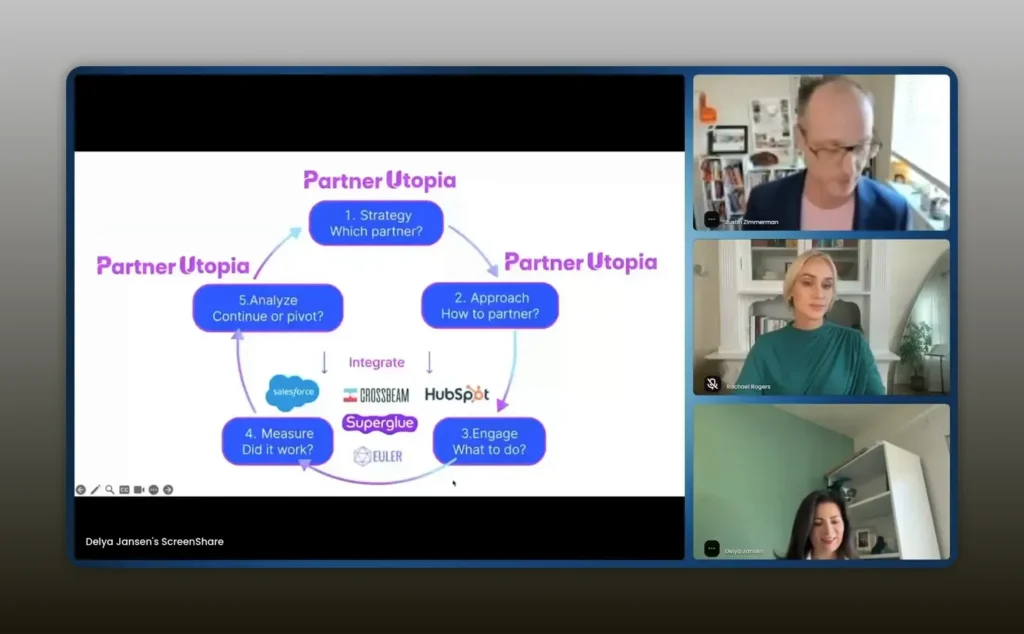
I currently drive ecosystem strategy at GitLab and focus on integrating partnerships into core business functions. – Rachael Rogers
Common mistakes partner teams make
Most partner teams fall into predictable traps. You have likely seen some of these:
- Manual sourcing that takes months and becomes stale by the time you decide.
- Optimizing for quantity over quality—adding logos without alignment to business goals.
- Not defining a timeline for partner investments, leaving teams unsure where to focus first.
- Siloed data and tools that make reporting painful and reactive instead of proactive.
- Relying on playbooks and templates that require too much manual execution.
Delya frames the problem bluntly: early lifecycle partner strategy often relies entirely on people and guesswork. That costs time and leads to a high failure rate.
Partner acquisition has felt clunkier and more manual than it should be. – Rachael Rogers
How AI changes the partner discovery equation
AI lets you reframe the question. Instead of starting with “what is our ideal partner profile,” you start with “what business outcome do I need to accelerate?” Feed the outcome and the constraints—ICP, geography, resourcing—and AI can ingest real-time market signals and partner behavior to suggest candidate partners and optimal timelines.
That shift matters because it:
- Removes guesswork by grounding decisions in publicly available signals, platform data, reviews, and news.
- Enables rapid re-evaluation when your business goals or the market shift.
- Provides transparent reasoning so you can defend recommendations to the C-suite.
Rachel and Delya both stress that objective, reproducible partner recommendations are essential when stakes are high and budgets are tight.
Partner Utopia: an AI-first sourcing and workspace flow
Partner Utopia (the platform Delya demoed in the discussion) approaches partnerships with two linked capabilities: a sourcing engine that uses AI to recommend partners and a partner workspace that automates execution tasks once you commit to a partner.
Key differentiators:
- Start with one business goal rather than a long questionnaire. The tool prioritizes speed and precision.
- Use real-time aggregation: news, review pages, social channels, documented partner behaviors, and market trends to build partner profiles.
- Expose the logic behind every recommendation so you can understand and contest a match.
- Offer low-cost, immediate access so partner managers can trial value without heavy procurement cycles.
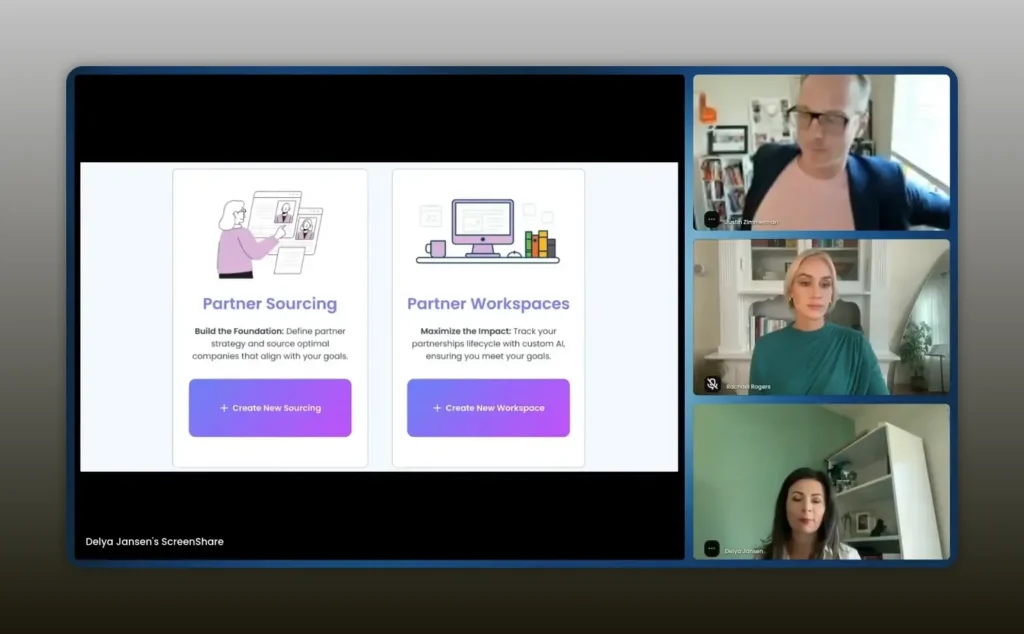
We built a lifecycle management platform that starts at the very beginning—right when you’re thinking about partnerships. – Delya Jansen
Step-by-step partner sourcing workflow
This is a practical workflow you can apply to any partner program, inspired by the sourcing prototype and Rachael’s experience:
1. Define a single, measurable outcome
Pick one concrete business goal: expand into e-commerce enterprise buyers, reduce churn among mid-market customers, or accelerate time to value for a specific vertical. Narrowing to one outcome sharpens matching logic and prevents diluted efforts.
2. Capture constraints and resources
Record what you will commit to the partnership: sales enablement, joint customers for referrals, technical assistance, marketing budget, or co-selling headcount. The resource profile influences which partners will realistically convert a relationship into results.
3. Run an AI-powered sweep
Let the AI consume millions of data points: signals of partner market traction, product fit, company stability, partnership behaviors, customer reviews, and public materials. The goal is to produce a prioritized timeline for outreach: start now; revisit in 6 months; consider in 12 months.
4. Review explainability output
Examine the rationale: recent product announcements, customer reviews, partner program documentation, and macro trends that influence suitability. This transparency helps build the case internally.
5. Convert to a workspace
When you pick a partner, spin up a workspace that generates the required artifacts: partner profile, joint value proposition, landing pages, data sheets, outreach templates, and launch checklists. Automate recurring reporting into your CRM and PRM.
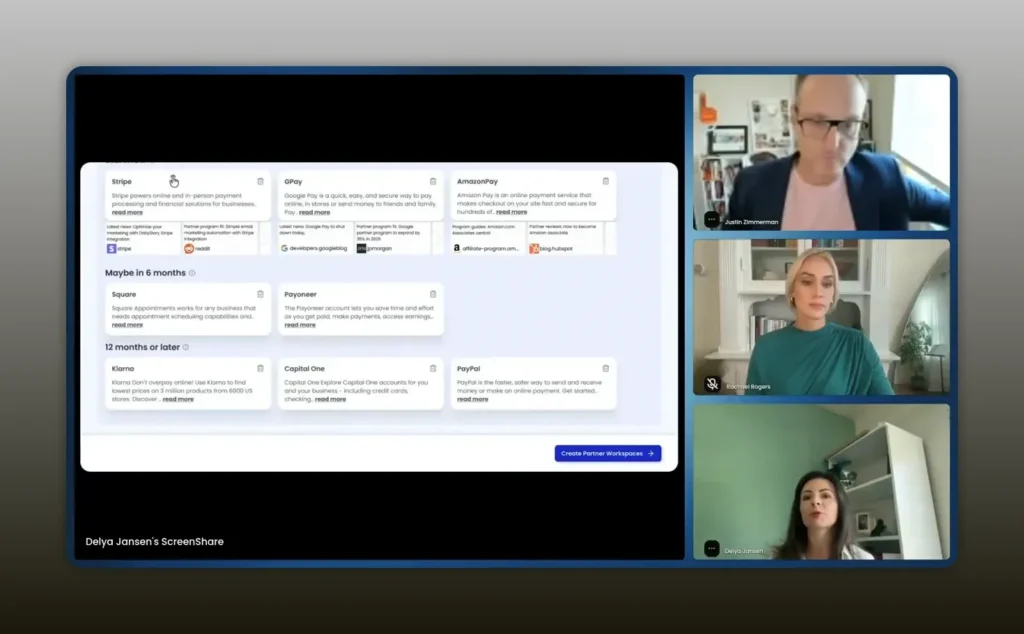
We expose the logic behind each match so you can see why we recommended that partner now versus later. – Delya Jansen
From discovery to workspaces: operationalizing partnerships
Discovery matters, but execution is where partnership value is realized. The platform approach collapses the gap between “we should partner with X” and “we have a measurable joint program with X producing pipeline.”
Workspaces should automate repetitive tasks and arm you with one-click deliverables:
- Partner profile pre-populated with relevant data and talking points.
- Joint value proposition drafted from your inputs and partner signals.
- Pre-built marketing assets and announcement templates tied to the value prop.
- Automated reporting that pulls from Salesforce, Crossbeam, HubSpot, and other sources so you can deliver scheduled insights to stakeholders.
Delya product shows that removing manual artifacts shortens the time from initial discovery to go-to-market and lowers the probability of partnership failure.
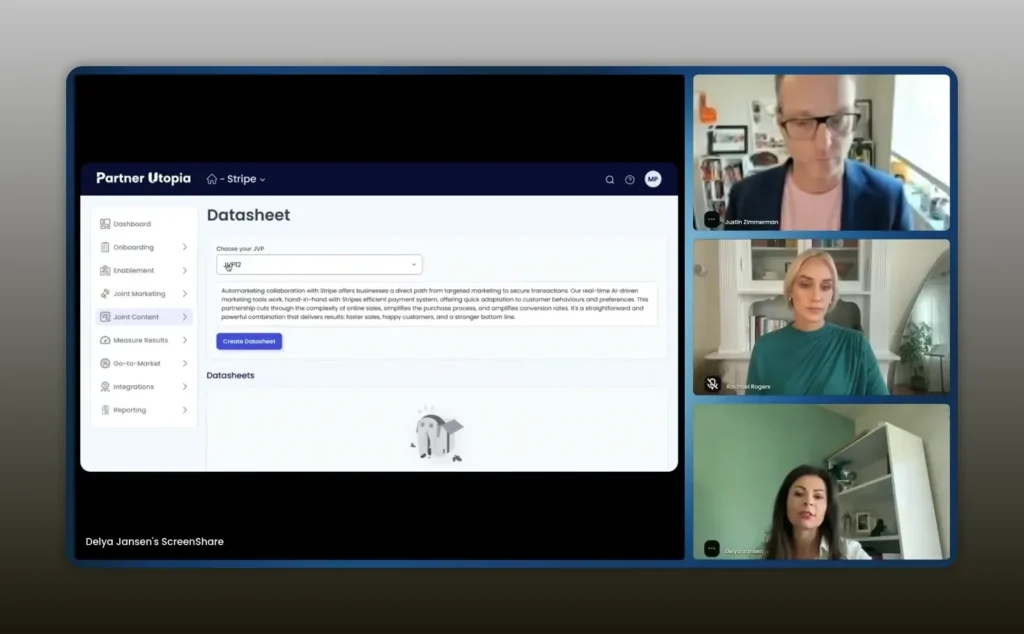
Instead of playbooks, we built buttons that actually do the job for you. – Delya Jansen
What metrics to track and why
Make partners accountable to outcomes. These metrics move beyond vanity indicators and focus on business impact:
- Partner activation rate: how quickly a partner reaches baseline engagement (trained sales, published joint collateral, or first joint campaign).
- Partner-sourced revenue: deals attributed to partner referrals or co-sells.
- Partner-influenced retention: churn delta among customers acquired or managed via partners.
- Pipeline velocity: time from introduction to close for partner-sourced deals compared to direct-sourced.
- Program ROI: cost of partner enablement and joint marketing divided by incremental revenue.
Use dashboards that update automatically. If a CMO or CFO asks for a report on Monday, you should not spend your weekend collecting assets. Automated reporting preserves your time and ensures your metrics are defensible.
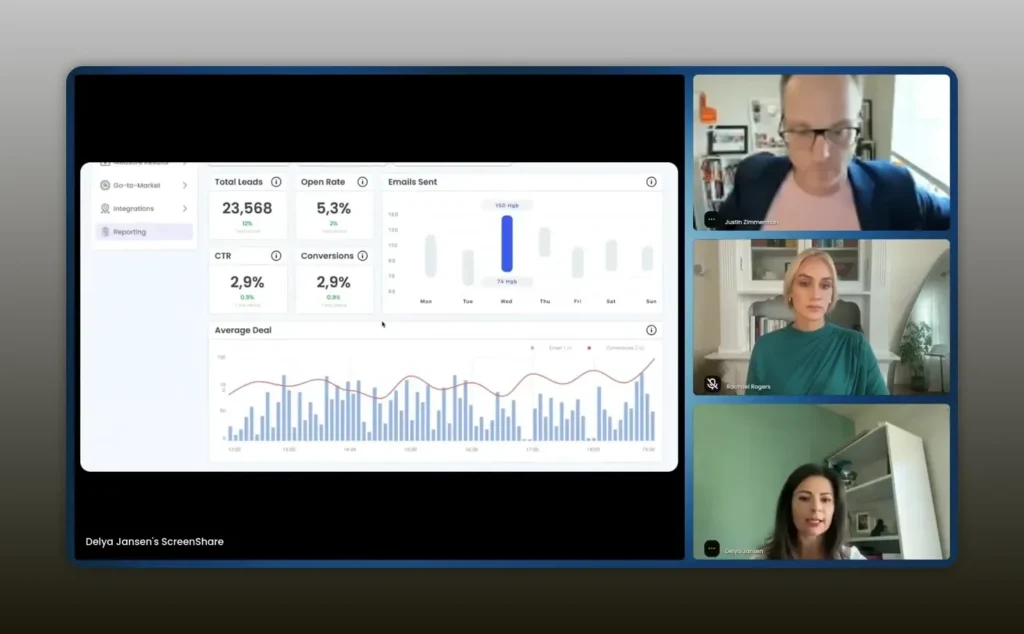
Your reporting should be one-click: marketing, sales, or executive summaries scheduled to stakeholders. – Delya Jansen
Tech stack and recommended tools
There is no single right stack, but here are the categories and example tools that, when combined with an AI sourcing layer, deliver scale:
- AI sourcing and partner intelligence: Partner Utopia (sourcing prototype), Perplexity for research augmentation.
- Partner relationship management: PRM platforms for later-stage partner enablement and incentives.
- Partner data and overlap analysis: Crossbeam for account overlap and joint customer discovery.
- CRM and revenue systems: Salesforce, HubSpot for pipeline and attribution.
- Marketing automation: Marketo, HubSpot to execute joint campaigns and nurture partner leads.
- Reporting and analytics: Business intelligence tools or native dashboards that consolidate data from the stack.
Delya highlights price sensitivity: make sure at least one tool in the stack is accessible without enterprise procurement so partner managers can test value quickly.
Implementation checklist
- Pick one initial business outcome to target with partners.
- Document available resources you will invest (sales enablement, budget, customer referrals).
- Run an AI-enabled sourcing run and validate the top 5 recommendations with internal stakeholders.
- Choose 1-2 partners with the highest potential and spin up a workspace for each.
- Deploy a repeatable joint launch checklist and automate reporting into your CRM.
- Track partner activation and partner-sourced revenue monthly and refine the model every quarter.
Frequently asked questions
How fast can AI generate a list of recommended partners?
With an AI-first approach and a short intake questionnaire, you can get prioritized recommendations in under a minute of input time. The system runs deeper aggregation in the background to validate stability and partnership behavior; that additional analysis may take days to complete, but you will have an initial shortlist quickly to start stakeholder conversations.
What inputs are required for accurate partner matching?
Provide one clear business goal, the target ICP (industry, company size, region), and the resources you can commit to the partnership. Also include any constraints such as timelines or channels to prioritize matches that are realistic for your org.
Will the AI replace partner managers?
No. AI removes repetitive, time-consuming research and surfaces recommendations, but human judgment remains essential for relationship-building, negotiating terms, and executing joint go-to-market plans. AI increases your capacity and helps you focus on high-leverage activities.
How do you validate that a recommended partner won’t be a risk?
AI should aggregate signals about company stability, partnership behavior, news sentiment, and reviews. Look for explainability features that show the data points used in the match so you can verify risk factors before investment.
What happens if there are no recommended partners now?
An objective platform can tell you when partnerships are not the right lever right now. It will suggest revisit timelines and alternative actions. That itself is valuable because it prevents wasted effort and keeps your program focused on high-impact activities.
Conclusion
Partnerships are strategic bets. The difference between a bet that pays off and one that fails is the speed and quality of your partner selection process. Use AI to surface objective, explainable partner recommendations, feed those recommendations into automated workspaces, and measure impact across the full customer lifecycle. That combination shortens time-to-value and reduces the cost of experimentation.
Rachael and Delya both make the same core point: when you pair clear business outcomes with technology that automates research and execution, you stop relying on hope and start investing with confidence.
Social post
Announcing a new playbook for Partner Managers, Ecosystem Leaders, and Alliance Directors…
Introducing AI matchmaking for partnerships: how to find, prioritize, and scale the right partners!
Inside it you will find a strategic framework to help you align partners to outcomes and avoid wasted effort. You will learn how to turn one clear business goal into a prioritized timeline of partner investments, how to automate the heavy lifting of partner onboarding and assets generation, and how to report partner impact without weekend work.
- Manual partner sourcing takes months and goes stale quickly
- Choosing partners without outcome alignment wastes budget
- Playbooks alone are not enough—they require heavy execution
- Siloed data prevents proactive reporting
- High failure rates come from poor timeline and resource planning
- Explainability is required to convince executives
- Affordable, low-friction tools let partner teams test ideas quickly
Grab this playbook if you are a Partner Manager, Ecosystem Leader, or Alliance Director and want to learn what Rachael and Delya do, so you can achieve faster partner sourcing, smarter prioritization, and measurable partner-driven growth. The playbook is free, no form-fill required, no opt-in required.
I want buttons—not playbooks—so my team can move faster. – Delya Jansen