Partner Marketing for Tiny Teams: Practical Playbook for 2025
Expert advice from Tyler Briggs at Box.com and Lauren Jeter at Pong.
Snapshot
Partner marketing is not a “nice to have.” When done correctly, it amplifies reach, accelerates product adoption, and builds brand equity faster than many direct channels. You can share logos, co-host events, and tap into a partner’s audience—often at lower CAC than equivalent paid channels. For tiny teams that need leverage, partnerships are leverage in its purest form.
Think of the partnership relationship as a two-way street. If you are willing to invest effort and resources, your partner must be too. You must vet partners not only on product fit but on capacity and strategic intent. A partner that is supportive on the paperwork but lacks resources for execution will produce poor results—even if the integration is perfect.
This article cover practical approaches to achieve better outcomes through partner marketing.
If it doesn’t make dollars, it doesn’t make sense.
– Lauren Jeter
Table of Contents
- How to choose partners when you have limited bandwidth
- The five-step partner marketing framework
- Building the perfect joint one-pager
- Essential assets and “campaign in a box”
- How to measure impact: metrics that matter
- Scaling without headcount: agencies, templates, and playbooks
- Common mistakes tiny teams make and how to avoid them
- 2025 planning: aligning partner marketing to company KPIs
- Practical checklist to get started this quarter
- FAQs
- Conclusion
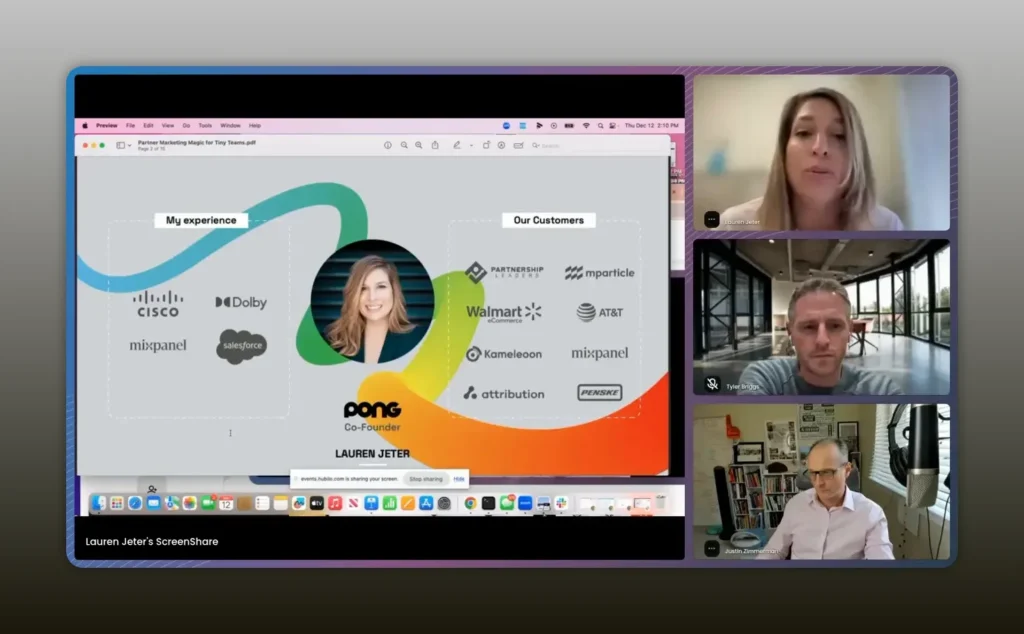
Partner marketing for tiny teams—you can create partner marketing magic without a large team.
– Lauren Jeter
How to choose partners when you have limited bandwidth
When your team is small, trying to “be everywhere” means you will be nowhere. The first rule is ruthless prioritization. Use a data-driven approach to find the 20% of partners likely to generate 80% of the value.
Start by mapping opportunity using three lenses:
- Revenue impact — Which partners have historically contributed to deals or top accounts?
- Strategic integrations — Which partners enable critical product scenarios or unlock new markets?
- Co-marketing reach — Which partners have a high-quality audience that matches your ICP and a history of promoting joint content?
Create a simple scorecard or matrix to weight these axes. Ask: how many partners can I realistically handhold? That number becomes your working set. Everything else moves into a scaled or self-serve tier.
If your partner doesn’t have capacity to execute, it won’t work. Treat partnership as a two-way street.
– Lauren Jeter
The five-step partner marketing framework
Convert scattered activity into repeatable impact by following a five-step rhythm. This is the backbone of a tiny-team playbook because it forces focus and repeatability.
1. Map the market
Use account maps, TAM analysis, and pipeline data to validate whether a partner unlocks a real market. Look for overlap between your ICP and their customer base. If there is no addressable market, skip the partnership for now.
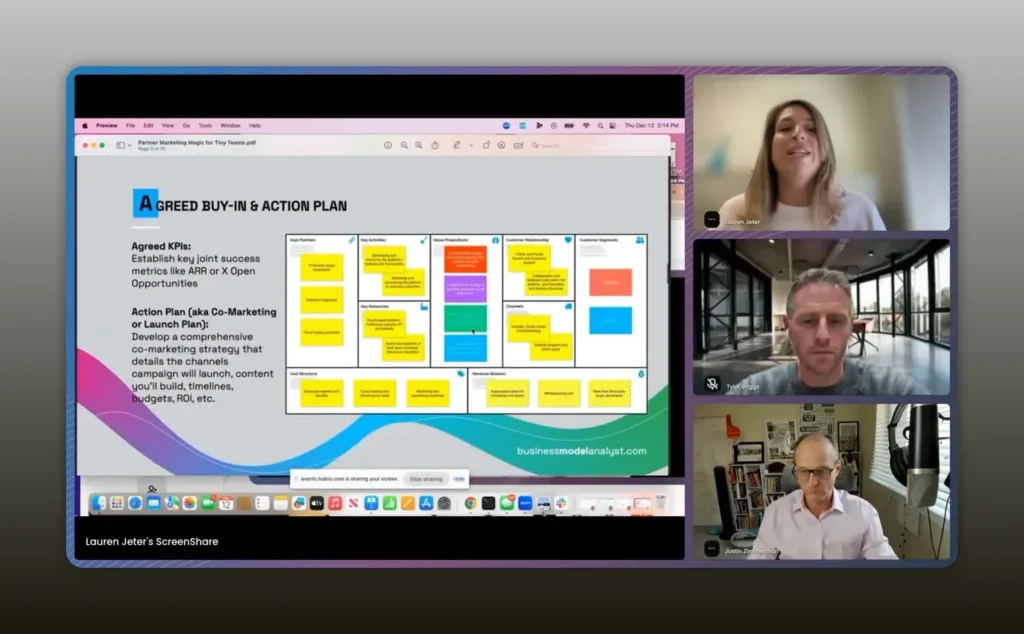
2. Agree buy-in and action plan
Get a compact, signed agreement on objectives, roles, and resourcing. Define a handful of high-impact activities rather than a laundry list. Confirm who is accountable for what, and set simple milestones like “webinar scheduled,” “landing page live,” and “joint case study drafted.”
3. Generate the joint value proposition
Build a crisp better-together message that describes the pain you solve, the gains you deliver, and the segment this joint offer targets. A Venn diagram mentality works: intersect your product capabilities, the partner’s strengths, and the customer’s job-to-be-done. Use that distilled message everywhere.
4. Implement impactful content
Create a campaign-in-a-box that partners can deploy quickly. This reduces friction and increases the likelihood they will promote the work. Typical components:
- Joint one-pager
- Joint landing page template
- Webinar template and speaker brief
- Sales enablement kit (pitch deck snippets, battle cards)
- Short customer quote snippets and logos
5. Continuous improvement
Run retros after every campaign. Evaluate revenue outcomes, pipeline influence, and efficiency metrics like time-to-launch. Ask the classic start/stop/continue questions across marketing, partnerships, and sales teams so you can refine the playbook before you scale it to other partners.

Map the market, agreed buy-in and action plan, generate value proposition, implement impactful content, and continuous improvement. – Lauren Jeter
Building the perfect joint one-pager
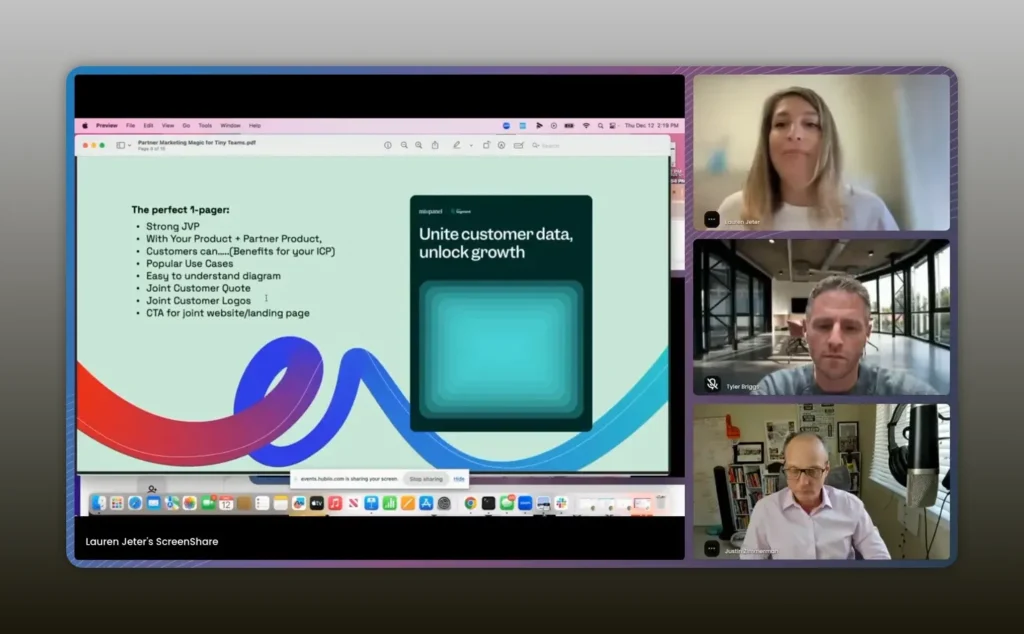
The joint one-pager is a tiny-team superweapon. It is the single asset that both sales and partners can rally around. It must be concise, scannable, and action-oriented.
Structure it like this:
- Top-line headline that describes the combined outcome (not the features). Example: “Unite customer data, unlock growth.”
- One-line value proposition summarizing the joint offer and whom it serves.
- Three use cases—short bullets focused on real customer jobs-to-be-done.
- Integration diagram that shows how data or workflow flows between products.
- Customer proof — one quote and a few logos that validate the claim.
- Single CTA to a joint landing page or demo request.
Make the one-pager a living asset. If you assemble a library of these and version them by vertical or ICP, you can enable multiple partners to repurpose the same core content with minimal edits.

A simple diagram explaining the integration reduces friction for buyers and sellers. – Lauren Jeter
Essential assets and “campaign in a box”
For tiny teams, the goal is to make it effortless for a partner to promote the joint offer. Create a campaign package that contains everything they need:
- Landing page copy and template with modular sections that match the one-pager.
- Webinar deck and speaker notes so the partner can run it without bespoke prep.
- Email copy and social tiles sized and labeled for each channel.
- Paid ads creative variations and suggested targeting.
- Sales enablement — one-sheeters, battle cards, and an objection-handling script.
When everything is pre-made, your partner can launch quickly and your small team won’t be the bottleneck. This is also how you scale support without immediate headcount growth.
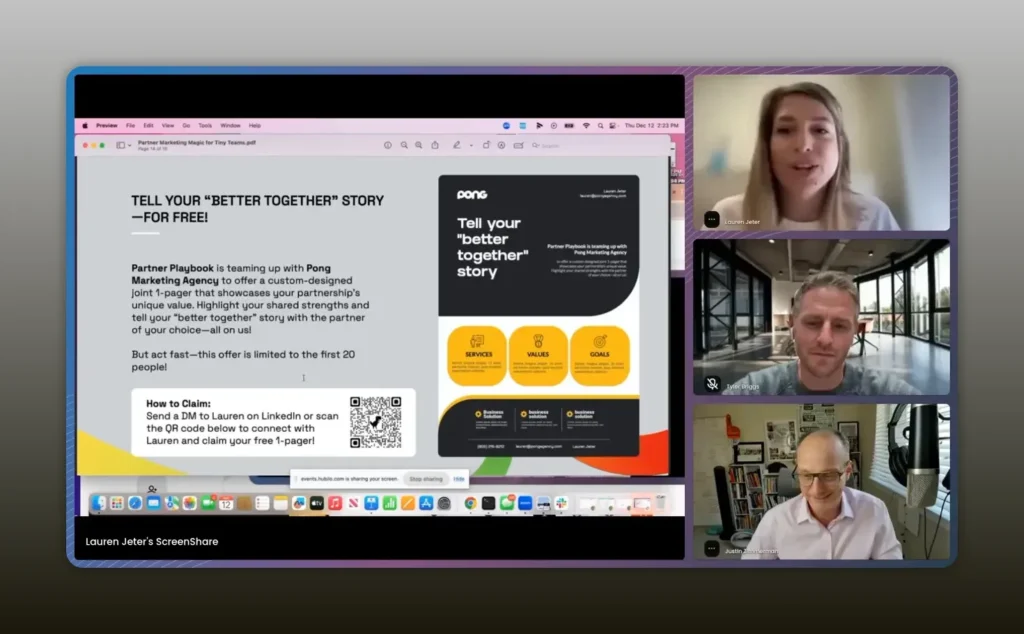
We can come in and implement partner marketing content pretty flawlessly for less than half the cost of a dedicated headcount. – Lauren Jeter
How to measure impact: metrics that matter
For a tiny-team partnership program, focus on a few metrics that show business impact. Top candidates:
- MRR / ARR influenced — revenue directly attributable to joint campaigns or partner-sourced deals.
- Pipeline sourced — value of leads that entered your funnel through partner channels.
- Conversion rate from partner-sourced MQL to SQL to closed-won.
- Time-to-value — how long between campaign launch and deal activity.
- Partner engagement — number of co-marketing actions completed versus agreed.
Whenever you pitch a partner program internally, tell the story with data. Track a small set of KPIs and use them to ask for budget or headcount. As Tyler Briggs put it: if you can tell a clear story and bring the data, you’ll find funding.
Scaling without headcount: agencies, templates, and playbooks
If you cannot add a partner marketer right away, find ways to scale through partners and trusted external providers. Two practical routes:
- Agency-as-an-extension — Use a firm that specializes in partner marketing to produce the assets and run the program. It’s cheaper than hiring a senior full-time headcount and faster to launch.
- Self-serve playbooks — Build templates and a partner portal where partners can download assets, fill in a few fields, and spin up campaigns themselves.
At Box, Tyler Briggs created a prioritization matrix and then used an agency model to elevate emerging partners without slowing down the core program. That hybrid approach lets you treat top-tier partners with a high-touch program while still supporting a broader ecosystem through scalable assets.
“You have to ruthlessly prioritize. Saying no hurts, but it creates space for the partnerships that matter.”
– Tyler Briggs
Common mistakes tiny teams make and how to avoid them
Here are recurring pitfalls along with practical fixes:
- Reactive yes-syndrome — saying yes to every partner request dilutes results. Fix it with a tiered model and a strict limit on handholding slots.
- Lack of buy-in — if you launch without partner accountability, nothing sticks. Fix it by securing a compact action plan and named owners at the partner organization.
- No measurable hypothesis — campaigns without defined KPIs are impossible to learn from. Fix it by setting one primary metric and two supporting metrics up front.
- Asset paralysis — over-polishing content delays launches. Fix it with modular templates built to ship and iterate.
- One-off execution — failing to create repeatable processes. Fix it by standardizing the onboarding and a post-campaign retro ritual.
Yearly planning: aligning partner marketing to company KPIs
As you plan for the year ahead, partner marketing must align with company priorities. Ask these questions:
- What metrics does leadership care most about next year: new ARR, expansion, retention?
- Which partners can materially move those metrics?
- What is your budget-to-impact ratio for partner-led initiatives versus direct channels?
Gather the data now. Review the wins and misses from the last year and identify what to cut and what to double down on. Tyler Briggs recommends making a clear, data-backed pitch for the few things that will move needle—then get funding. If your boss knows what they care about, you can make them care about your plan too.
Practical checklist to get started this quarter
Use this checklist to convert intention into action fast:
- Run a partner scorecard and select your top N partners to handhold.
- For each top partner, create a simple one-page action plan with roles and dates.
- Build a campaign-in-a-box template and test it with one partner.
- Launch one joint webinar or landing page and track MQL to revenue conversion.
- Run a retro within two weeks of campaign completion and document learnings.
- Iterate the asset set and standardize for future partners.
You can find creative ways to make deals that don’t require upfront money—exposure and mutual value can be the currency. – Tyler Briggs
FAQs
How do I start partner marketing if I have no dedicated headcount?
Focus on a handful of high-potential partners and build a campaign-in-a-box. Use an agency or a specialist to produce the assets and run the first launches. Prioritize ruthlessly and document a repeatable process so you can scale without immediate headcount increases.
What should be on a joint one-pager?
A strong headline expressing the outcome, a one-line value proposition, three use cases, a simple integration diagram, a customer quote and logos, and a single CTA to a joint landing page. Keep it scannable and focused on the buyer’s job-to-be-done.
How do I pick the right partners when I have limited time?
Use a scorecard that weights revenue influence, strategic product fit, and promotional reach. Decide how many partners you can realistically support with high touch and place everyone else into a scalable, low-touch tier.
Which metrics should partner marketing report on?
Report on ARR/MRR influenced, pipeline sourced, conversion rates for partner-sourced leads, time-to-value for partner campaigns, and partner engagement against agreed activities. Keep the dashboard tight; three to five metrics are enough to tell a story.
How do I ensure partners actually promote the work?
Remove friction. Provide each partner with a pre-built campaign-in-a-box, agree on a promotion schedule, and include promotional commitments in the action plan. Offer co-funded promotions or shared creative to increase their incentive.
Are there tools that make co-marketing easier?
Yes. Use shared landing page builders, webinar platforms with easy co-hosting, and partner portals for asset distribution. There are also AI generators that help craft joint value propositions and messaging faster; use them to speed alignment.
Conclusion
Partnerships done well multiply your impact. Operating with a tiny team means you must be deliberate: choose partners with the greatest strategic and revenue potential, make every campaign repeatable, and measure the outcomes in dollars and pipeline. Build a compact playbook, use a campaign-in-a-box to remove friction for partners, and be disciplined about retros and continuous improvement. If you follow this approach, you can create partner marketing magic without a large team and turn partnerships into one of your most efficient growth levers in 2025.