How to 8x Partner Source Revenue with a Partner Directory
Expert advice from Cody Sunkel at PartnerFleet.io.
Snapshot
You might be sitting on an underutilized growth channel: the partners who build on your platform, extend your product, and connect you to new customers. These partners — ISVs, integrators, agencies, implementation partners, and marketplace apps — can drive new pipelines, improve retention through deeper integrations, and lower customer acquisition costs by leveraging trusted relationships.
What’s at stake is more than a handful of extra leads. If you get this right, you can turn partners into an evergreen, scalable source of revenue and referrals that compounds over time, creates network effects around your product, and makes your platform stickier in ways that paid channels rarely do.
Justin and Cody make a clear case: the old reflex—paying commissions and asking for referrals—is necessary but not sufficient. Commissions move the needle for a subset of partners, but the majority are chasing predictable customer access and pipeline, not just payout schedules.
But to unlock the other 80 percent of partner potential, you need to give partners what they actually value the most: consistent, visible access to your customer base and automated ways to capture inbound interest. This article give you everything you need to know to get this right!
If you start sending your partners leads and driving value and showing them that you care about their success, they’re going to be more likely to reciprocate. – Cody Sunkel
Table of Contents
- Why partner source revenue matters
- The problem with commissions and incentives
- The 80 percent love language: leads and exposure
- Partner directory as a scalable solution
- Designing listings that convert
- Prioritizing placement and exposure
- KPIs that align incentives and measure success
- Case study: Smokeball
- Activation: time to first lead
- Scaling the give-to-get flywheel
- Technical checklist and common pitfalls
- How to audit an existing directory
- Partner Fleet and practical next steps
- FAQs
- Conclusion
Why partner source revenue matters
Partner source revenue is the gold standard for partnership programs because it moves the needle on ARR and shows direct return on ecosystem investments. Reports show a majority of partnership teams already track partner-sourced revenue and partner-sourced leads as core KPIs. That is the right focus, but many teams are missing the lever that unlocks far more upside.
Cody points to the massive ecosystems that have already internalized this: Salesforce, Shopify, Microsoft, HubSpot. They generate more value for their partner ecosystems than they keep for themselves, and that mutual value drives adoption and stickiness. You should view partner-sourced revenue not as a nice to have but as a strategic channel that can scale alongside product and sales.
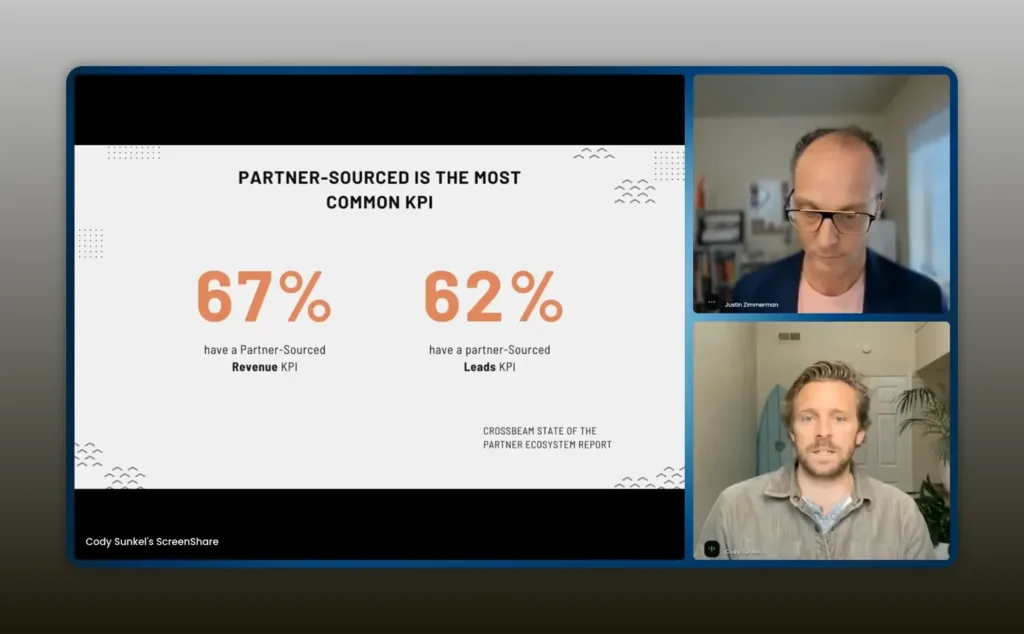
Partner source revenue is the KPI that separates the winners from the hobbyists. – Justin Zimmerman
The problem with commissions and incentives
Most programs default to revenue share as the primary lever. That makes sense. Compensation motivates some partners. But it misses a crucial human truth: for many partners, commissions are not the primary driver of their business decisions.
Data shows that while 72 percent of programs believe revenue shares are the most important financial incentive, only 21 percent of partners treat commissions as essential. The remaining 79 percent call commissions a nice-to-have or decline them altogether. That means relying solely on payouts produces diminishing returns.
When you think in Pareto terms, a small fraction of partners will respond to commission-focused programs. The other 80 percent want something different: visibility and leads that plug directly into their pipeline.
The 80 percent love language: leads and exposure
You need to speak your partners’ love language. For most agencies and service providers, the thing that matters most is being in front of your customers. Partners want predictable ways to win work through your audience. That’s why referrals and customer introductions are the top non-financial incentives partners value.
When you give visibility and customer access, you trigger reciprocity. Justin and Cody describe this like neighbors sharing baked goods. Small, consistent gestures of value create goodwill, and goodwill drives reciprocation. In partner terms, that reciprocation often comes back as co-sells, referrals, and deeper integrations.

Your partner’s love language is leads. Give them leads, and they will give you deals. – Cody Sunkel
Partner directory as a scalable solution
A well-built partner directory converts the intimacy of co-marketing into something that scales. Think of it as the infrastructure that lets your product and your partners share attention at scale. A directory can do a lot of heavy lifting:
- Co-market infinitely without needing two teams to execute every campaign.
- Expose partners to your customers right where buyers are researching solutions.
- Enable self-service discovery so buyers can find a partner when they need one.
- Drive passive leads that don’t rely on your AEs or CSMs to shepherd every referral.
Despite that potential, only about one third of companies use a partner directory as an incentive and only 15 percent use it to actively generate partner leads. That is a huge opportunity gap.
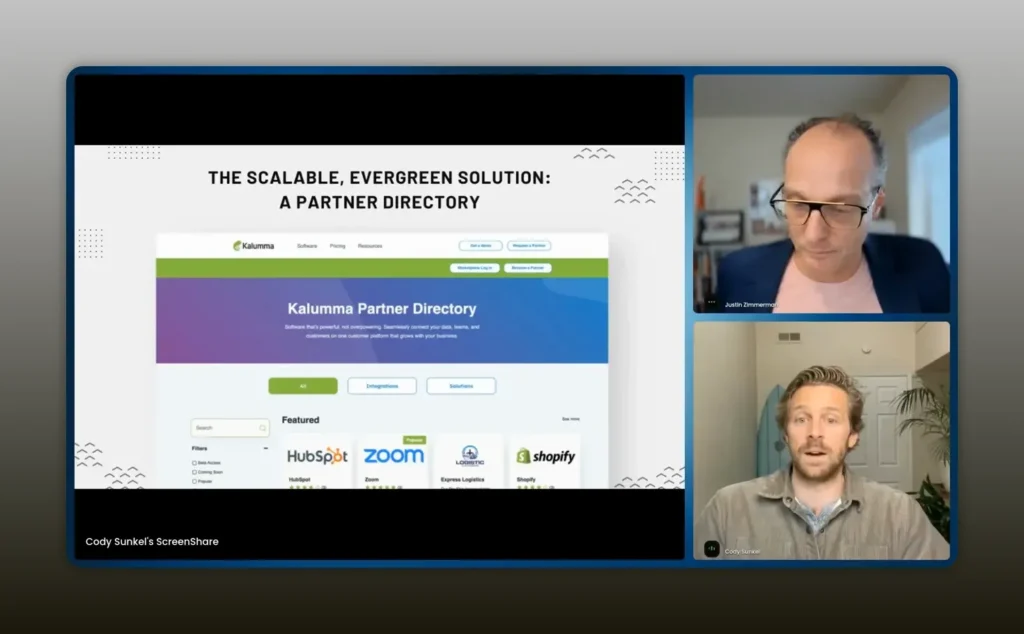
A partner directory is a fully scalable and evergreen way to give partners exposure and capture leads. – Cody Sunkel
Designing listings that convert
A directory is not a checkbox. It becomes a revenue engine only when listings are designed to convert. Think like a product manager for partner pages. The metrics you want to optimize are visitors, listing engagement, and lead conversions.
Key elements that increase conversion rates:
- Clear value proposition right at the top. Visitors should immediately understand the partner’s expertise and what problem they solve together with you.
- Use cases and outcomes rather than generic descriptions. Specificity builds trust and helps SEO.
- Trust signals such as logos, case studies, certifications, and co-branded client results.
- Direct call to action that matches the buyer intent: request demo, schedule consult, view case study, start a trial.
- Structured data and metadata so your directory pages are findable by search engines and properly indexed.
Justin emphasizes that the listing itself delivers SEO value and a marketable page for partners. Treat partner pages like mini-landing pages and apply conversion optimization techniques you already use for product pages.
Prioritizing placement and exposure
Not all partners should be treated the same. Use differentiated placement and features to reward partners who engage and to set expectations for performance. Placement tiers can be a non-financial incentive that still drives real value.
Ways to prioritize:
- Featured placements in category pages or the home of your marketplace.
- Search boosts within your directory based on certifications, case studies, and customer ratings.
- Sponsored highlights reserved for partners who co-invest in demand efforts.
- Automated rotation so new partners get discovery windows and don’t languish at the bottom of lists.
Placement strategy should align with transparency. If you give exposure, make sure partners understand what actions they need to take to earn more visibility.
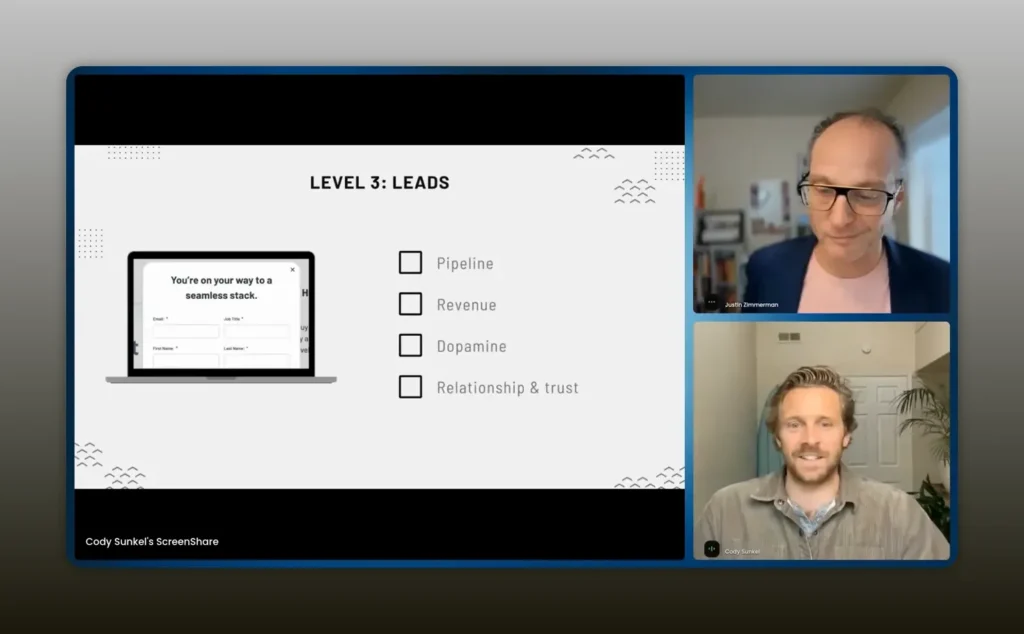
Brand association, higher traffic, elevated credibility—those are real things you give partners when you prioritize their placement. – Justin Zimmerman
KPIs that align incentives and measure success
If you want your directory to produce partner-sourced revenue, measure what matters. Set KPIs that make the give-to-get flywheel explicit and actionable.
Suggested metrics to track and report on:
- Leads to partners per month — raw volume of inbound partner leads your directory sends.
- Percent of partners receiving at least one lead — measures distribution and fairness.
- Directory conversion rate — leads divided by visitors. This tells you how well listings convert.
- Time to first lead for new partners — an activation metric that shortens onboarding and proves value quickly.
- Lead-to-deal conversion rate for partner-sourced leads — how well these leads turn into revenue.
- Revenue generated for partners — make this visible. Big ecosystems show partners the value they receive and then reap reciprocal benefits.
Justin and Cody recommend adding or restructuring KPIs to prioritize partner enablement and to measure the passive, ongoing value provided by the directory.
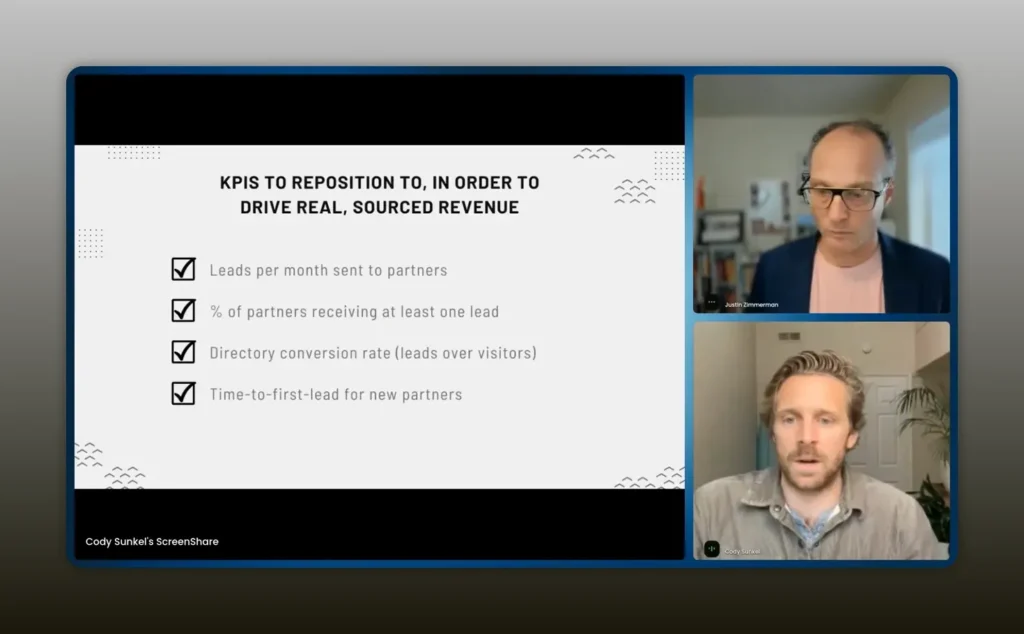
Track leads per month, directory conversion rate, and time to first lead — those are the levers that tell you whether the flywheel is spinning. – Cody Sunkel
Case study: Smokeball
Smokeball is an example of a company that oriented its partner program around delivering value to partners through a directory. Their approach shows how a focus on partner success pays off for both sides.
Highlights from Smokeball’s experience:
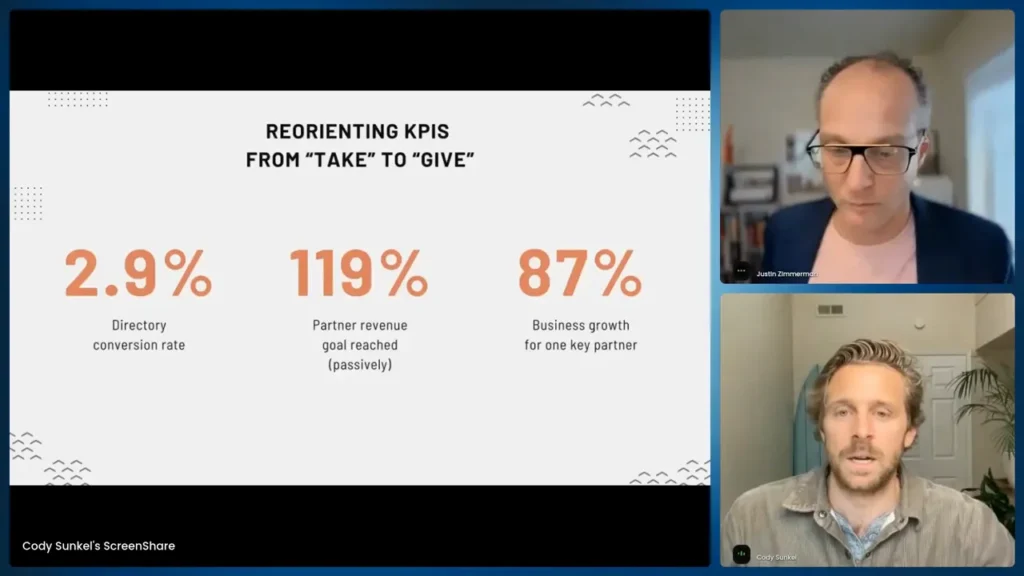
- The directory converts at nearly 3 percent from visitor to lead. That is a strong benchmark for niche marketplaces.
- They set a goal for revenue generated for partners and exceeded it by 19 percent without constant manual intervention.
- One partner grew their business by 87 percent from Smokeball-sourced work. That shows the real impact on partner businesses.
- The person overseeing that metric was on holiday for seven weeks while the results continued to roll in, underscoring the passive nature of a correctly optimized directory.
Smokeball’s success illustrates the two central themes above: align incentives toward partner value, and make the marketplace an evergreen engine that requires minimal ongoing human intervention.
We were surprised to see that all the revenue metrics were about what we drove for partners, not ourselves. – Cody Sunkel
Activation: time to first lead
Getting a partner to the first lead quickly is crucial for activation and momentum. If partners see early success, they will invest more into optimizing their listing, providing better case studies, and reciprocating by sending referrals back to you.
Practical ways to accelerate time to first lead:
- Ensure their listing is complete and optimized for search and conversions before launch.
- Give new partners a temporary boost in placement for the first 30 days.
- Provide a co-branded email or announcement template partners can use to announce their listing.
- Run a short, targeted ad or social push that highlights new partners and routes traffic to their pages.
- Offer a simple onboarding task list that includes uploading a case study and setting up a clear CTA.
These tactics reduce friction and create the dopamine hit partners need to stay engaged. That dopamine hit is not trivial: excitement from early wins drives retention and collaboration.
Scaling the give-to-get flywheel
The flywheel concept is simple: you give partners access and leads; partners reciprocate with referrals and revenue; that activity drives more customers and more listings, which increases the directory’s value; the cycle continues. But scaling it requires operational rigor.
Steps to scale:
- Automate lead tracking and attribution so partners can see the leads you send and confirm outcomes.
- Surface partner impact in dashboards and monthly reports so partners know what value you provided.
- Use placement and conversion data to iterate on listing templates and discovery UX.
- Invest in passive demand through SEO and content that targets buyer intent around partner solutions.
- Create simple reciprocity programs that are easy to opt into, such as fast near-term co-sells, prioritized support, or shared discovery calls.
Scaling isn’t about trying to hustle every partner manually. It’s about building systems where giving value becomes habitual and visible, and where partners are naturally incented to reciprocate.

If you send more leads to partners and make the outcomes visible, you can increase reciprocal partner-sourced revenue dramatically. – Justin Zimmerman
Technical checklist and common pitfalls
To ensure your partner directory becomes a lead engine rather than a brochure, focus on these must-haves and avoid common breakdowns.
Essential technical items:
- Lead capture and routing — every listing must capture intent and route leads via email, CRM integration, or webhook.
- Attribution tracking — tag leads with directory origin so you can measure conversion and revenue accurately.
- SEO-friendly pages — structured markup, meta tags, and fast loading times.
- Analytics and dashboards — measure visitors, engagement, conversion, and partner distribution.
- API or integration layer — connect listings to partner CRMs or PRM systems for closed-loop reporting.
Common pitfalls to avoid:
- Treating the directory as a static brochure rather than a conversion funnel.
- Poor listing hygiene: missing case studies, broken CTAs, or inconsistent metadata.
- No follow-up processes for partner leads, which leads to poor conversion and disappointed partners.
- Not tracking partner-sourced outcomes, which makes ROI invisible and undermines trust.
How to audit an existing directory
If you already have a partner directory and it is underperforming, a systematic audit will reveal where it is leaking value. Cody offered to perform audits for attendees, and you can replicate that approach yourself.
Audit checklist:
- Confirm lead capture works end-to-end. Submit test leads and verify they arrive at partner inboxes or CRMs.
- Measure the directory conversion rate (leads divided by visitors). Compare to your internal benchmarks.
- Check SEO health: indexed pages, organic traffic, and keyword coverage.
- Review listing quality: completeness, CTAs, case studies, and trust signals.
- Assess distribution: what percent of partners receive at least one lead over 30, 60, 90 days?
- Validate attribution and reporting: can you show partners how many leads you sent and how those leads performed?
Fix the weakest links first. Often the biggest gains come from ensuring leads actually reach partners and that listings have a clear CTA.

There are often broken links in the chain — find them and repair them, and your directory will suddenly start generating real value. – Cody Sunkel
Partner Fleet and practical next steps
You don’t have to build this entire stack from scratch. Companies like Partner Fleet offer purpose-built platforms to power partner directories and marketplaces. But whether you use Partner Fleet or another solution, the strategic moves are the same:
- Align KPIs to measure partner value and partner-sourced revenue.
- Design listings as conversion pages and track directory conversion rate.
- Automate lead routing and attribution so partners can see outcomes.
- Use placement and exposure as a non-financial incentive to reward partner engagement.
- Continuously optimize via SEO, analytics, and partner feedback.
Cody and Justin recommend starting with a small pilot of your best partners. Optimize the listing templates and the routing logic, then expand. If you have gaps in infrastructure, it is worth evaluating third-party platforms to speed up time to value.
FAQs
How is a partner directory different from a marketplace?
A partner directory is typically a discoverability layer where partners list services, integrations, and expertise. A marketplace usually includes transactional capabilities, checkout, and deeper commerce flows. Directories focus on exposure and lead generation, while marketplaces can enable transactions and fulfillment. Both can drive partner-sourced revenue but serve different buyer journeys.
What is a good conversion rate for a partner directory?
A strong benchmark is around 2 to 3 percent conversion from visitor to lead for niche directories, as demonstrated by Smokeball. Aim for continuous improvement by optimizing listing copy, CTAs, trust elements, and SEO. Your specific rate will vary by industry, buyer intent, and traffic sources.
How do I attribute leads to my directory so partners trust the reporting?
Use UTM parameters, hidden form fields, and CRM tagging to mark leads originating from directory pages. Implement webhook or API-based forwarding to partner CRMs. Maintain a shared dashboard showing leads sent and, when possible, lead outcomes. Closed-loop attribution increases partner trust and helps you measure ROI.
What non-financial incentives work best alongside a directory?
Top non-financial incentives include featured placement, prioritized support, co-marketing opportunities, access to product roadmaps, and co-branded content. Partners value exposure and credibility, so anything that increases their visibility to your customers is high-impact.
How quickly should a new partner get their first lead?
Time to first lead should be treated as an activation metric. With an optimized onboarding and a placement boost, many partners can receive their first lead within 30 days. Faster times increase satisfaction and engagement.
Can the directory replace co-marketing and AE incentives?
Not entirely. A directory complements co-marketing and sales incentives by creating a passive, scalable channel for discovery. Co-marketing and AE involvement remain powerful for high-value, strategic deals. Use the directory to broaden reach and co-marketing to deepen strategic partnerships.
Conclusion
Turning your partner ecosystem into a predictable revenue channel requires intentional change. Stop treating partners like commission wires and start treating them like customers you serve. Build or optimize a partner directory that gives visible, measurable value to partners, align KPIs that reward mutual success, and automate the plumbing so the system can scale without manual firefighting.
Justin and Cody show that when you give partners what they truly want—leads and exposure—you create a powerful reciprocity loop that can multiply partner-sourced revenue many times over. Start small, measure rigorously, and iterate relentlessly. The upside is real: stronger partner relationships, healthier partner businesses, and a sustainable source of growth for your own company.