Unlock Super Productivity: Build Your 2nd Brain With AI
Expert advice from Allan Adler (Managing Director, Partner Ecosystem Market).
Snapshot
We are in a phase of work where speed alone is not enough, and expertise alone is not enough either. Partnership teams are stuck between overflowing systems of record and nonstop systems of action, while the real missing layer is intelligence. That gap is where work gets messy, slow, and fragile. It is also where the biggest opportunity lives.
Allan argues that the future does not belong to the people who produce more decks, docs, and updates by hand. It belongs to the people who build architectures that produce those outputs for them. If you are still treating every QBR, pitch deck, partner plan, and campaign brief as a one-off artifact, you are creating more manual work, more inconsistency, and more hidden debt.
A second brain changes that. It gives you a living system that stores context, improves decisions, scales execution, and keeps knowledge alive long after a project or person moves on.
If you want to solve inconsistent execution, slow partner workflows, and lost institutional knowledge, keep reading to see how Allan Adler and Justin Zimmerman can help you do it.
Stop producing artifacts. Start producing architecture. -Allan Adler
Table of Contents
- Snapshot
- Why a second brain matters now
- What a second brain actually is
- From artifacts to architecture
- How multiple brains work together
- The human role in an AI-first workflow
- Why you should build brains early
- Applying this directly to partnerships
- A new operating model for partner teams
- Practical first steps
- Recommended tools
- FAQs
- Conclusion
Why a second brain matters now
Most partnerships teams have no shortage of systems. You probably have a CRM, a PRM, spreadsheets, shared folders, call notes, partner plans, campaign docs, Slack threads, email chains, and maybe a few dashboards that almost tell the story.
However, ou still need to decide what matters, who needs what, what changed, what the next move is, and how to turn all of that into execution. That is the missing intelligence layer Allan is talking about.
Most partner professionals live between systems of record and systems of action. Systems of record store data. Systems of action help you send emails, launch campaigns, run outreach, and trigger workflows. But neither one really thinks with you.
That is why so much partnership work depends on your memory, your judgment, and your ability to manually stitch together context from scattered places. It works, until it does not. The moment your world gets more complex, or your team grows, or your portfolio expands, your personal memory stops being enough.
That is where a second brain becomes useful. It is not about replacing your judgment. It is about giving your judgment a structure that can scale.
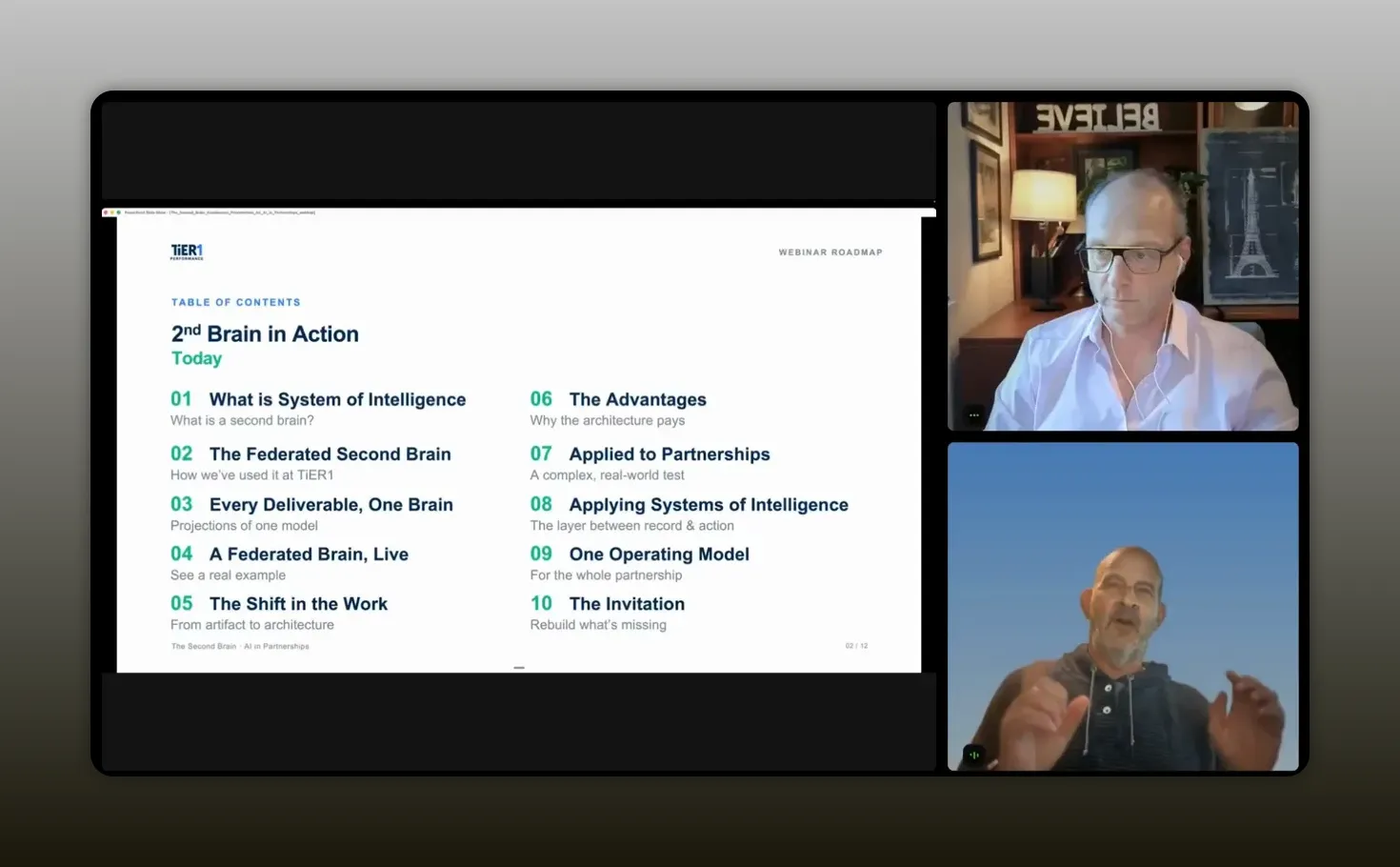
You need a second brain because the world is too complex to rely on your first one alone. -Allan Adler
What a second brain actually is
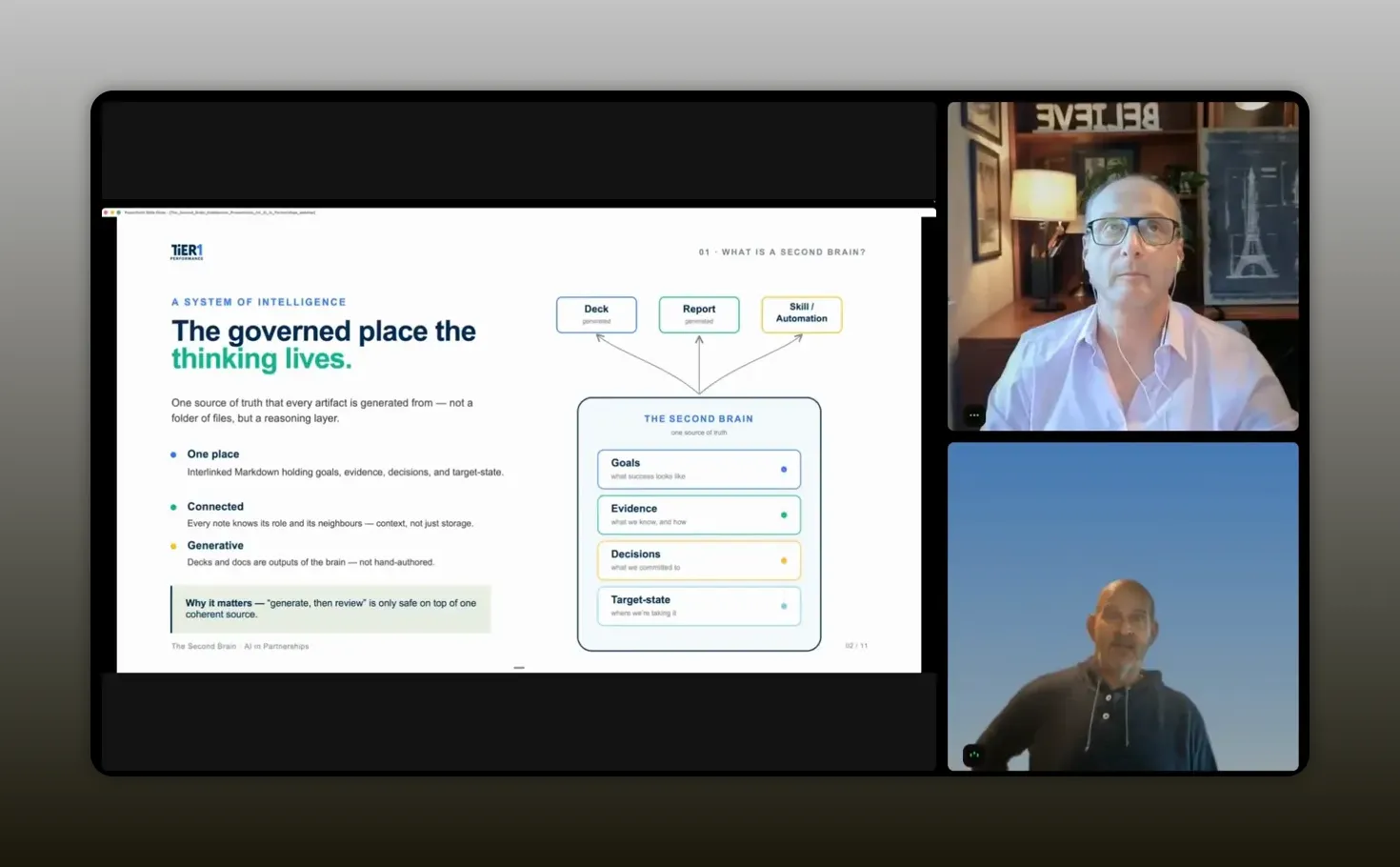
Allan describes a second brain as a system of intelligence. It sits between your system of record and your system of action. This is not just a folder full of prompts. It is not a random collection of AI chats. It is not a note-taking app with a fancy name.
A real second brain is an organized architecture that contains:
- Goals
- Target states
- Evidence of success
- Decisions
- Relevant source material
- Instructions for how related parts connect
When that architecture is built well, it starts producing useful outputs. Those outputs might be an ideal customer profile, a QBR summary, a partner pitch deck, a better together narrative, a campaign brief, or a change management plan.
The important shift is this: you stop treating each output as a separate act of creation. Instead, you build a system that can generate those outputs with the right context attached.
Allan talks about interlinked markdown files as the structural layer underneath this. You do not need to get hung up on the file format. The point is that the content is stored in a way that is modular, connected, and readable by AI. One note can reference another. A methodology can connect to a stakeholder map. A target account definition can connect to the better together story. A sales motion can connect to evidence of success.
That is what turns storage into context, and context is the thing most partnership teams are missing.
From artifacts to architecture
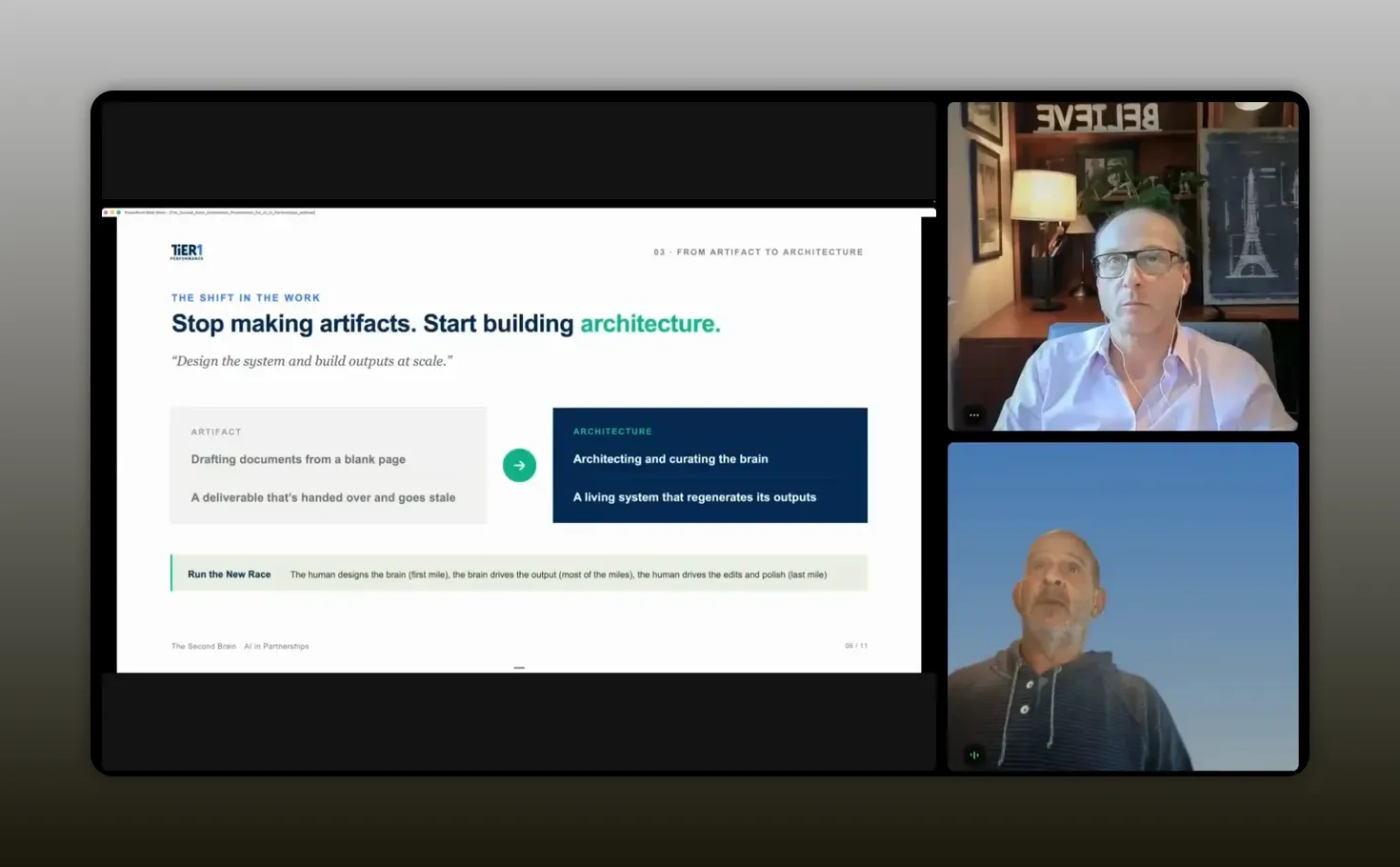
The sharpest idea Allan brings forward is also the simplest to remember: stop focusing on the artifact and start focusing on the architecture that creates the artifact.
That sounds abstract until you apply it to your own work. Think about how much of your week goes into building documents:
- Partner business reviews
- Joint account plans
- Executive updates
- Partner launch plans
- Co-marketing briefs
- Enablement materials
- Internal alignment decks
In the old model, you create each one manually. Maybe you reuse a prior version. Maybe you copy and paste from five sources. Maybe you remember a key detail from a call three weeks ago and insert it at the last minute. That is not leverage. That is survival.
In the new model, you architect the brain once, refine it over time, and let the system generate the first draft of the artifact. Your role then becomes editor, curator, and architect.
Allan frames this as a three-part workflow:
- The human designs the brain.
- The brain drives most of the output.
- The human handles the final edits and polish.
That is a much better use of your expertise.
If this shift interests you, you may also like this practical set of AI principles for partnerships, especially around building systems that strengthen human judgment instead of bypassing it.
Your job is to tell the brain exactly what it is here to do. -Allan Adler
How multiple brains work together
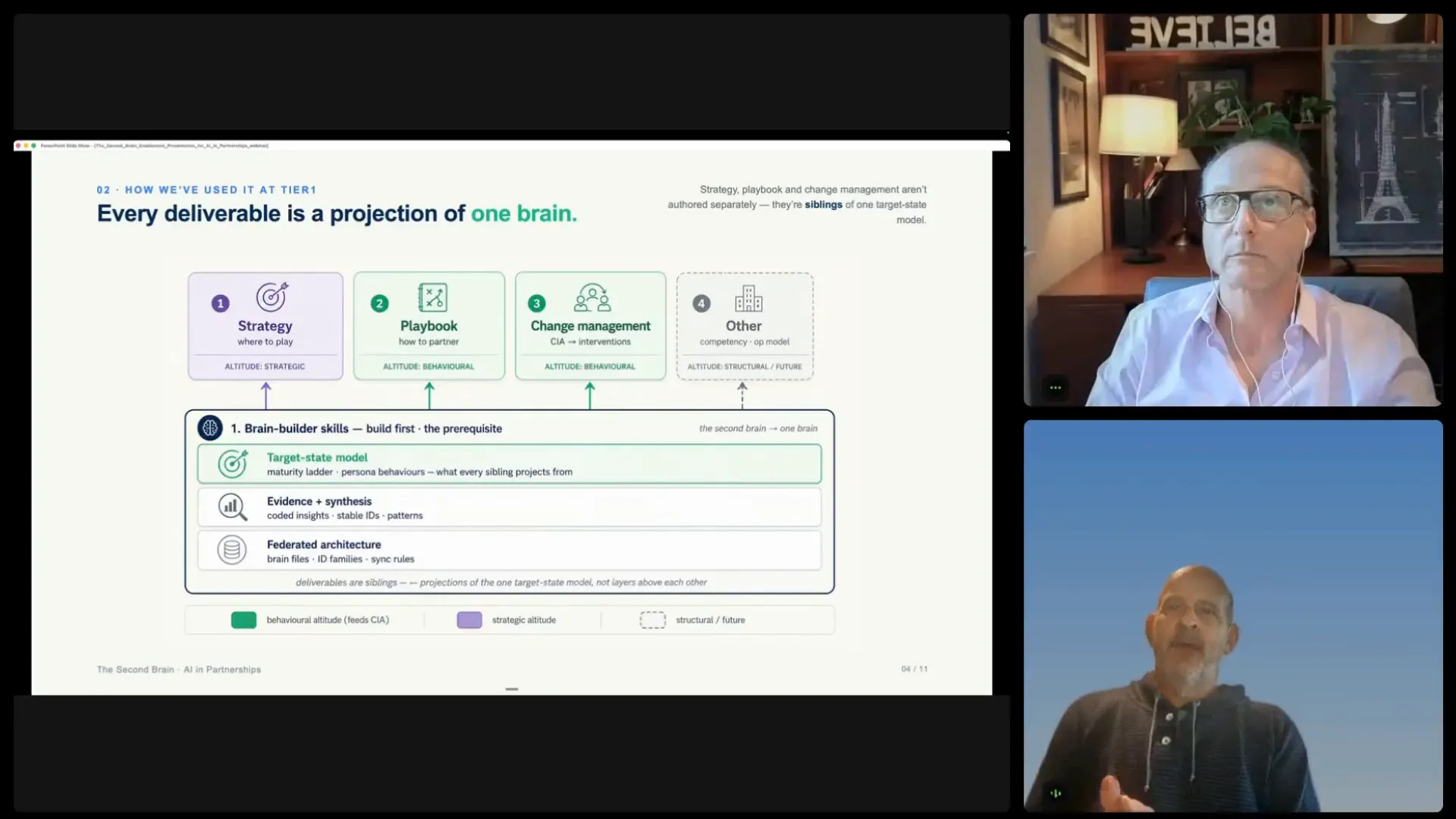
One of the most useful parts of Allan’s framework is that he does not treat a second brain as one giant blob. He treats it as a set of connected brains, each with a clear role.
That matters because most real work is too complex for a single structure.
In his consulting example, Allan describes a project broken into several connected brains:
- Corpus brain for raw materials such as interviews, reference docs, links, and source files
- Methodology brain for rules, process, dimensions, probes, and ways of working
- Constituency brain for stakeholders, roles, interests, and relationship context
- Synthesis brain for patterns, insights, and what the inputs are collectively saying
- Program brain for the overall initiative, risks, decisions, open questions, and commitments
- Deliverable brains for the specific outputs such as a playbook or change plan
This is where the concept starts to get powerful.
Instead of stuffing everything into one prompt thread and hoping the AI remembers what matters, you create a network of specialized intelligence. Each brain has a job. Each brain knows how it relates to the others. And together they form an operating system for the work.
You can apply the same pattern to partnerships.
For one strategic alliance, you might have:
- A partner profile brain
- A joint value proposition brain
- A stakeholder map brain
- A pipeline motion brain
- A co-marketing brain
- An enablement brain
- An executive briefing brain
The value comes from federation. These are not isolated bots. They are connected operating units.
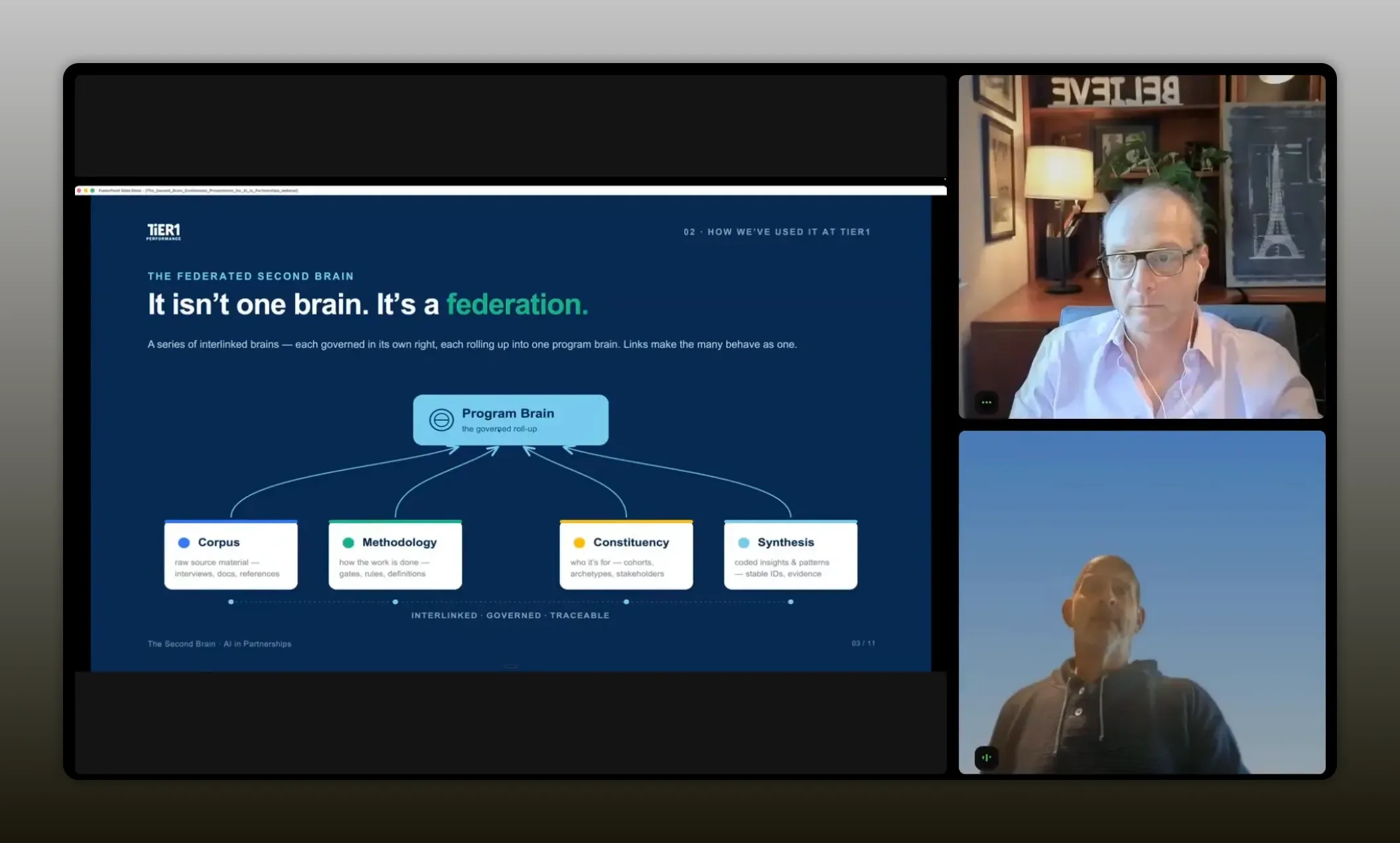
When the brains are stitched together, you get context instead of just storage. -Allan Adler
The human role in an AI-first workflow
There is an important warning inside all this enthusiasm. AI is not automatically right. Allan makes that very clear.
His description is memorable: AI is a kind of dumb genius. Extremely capable, yet still prone to errors, invented logic, and confident nonsense if you let it run unchecked.
That means your role is not disappearing. It is becoming more strategic.
When you build a second brain, your job is to challenge the architecture:
- Does this brain belong here?
- Is this the right target state?
- Are these the right sibling structures?
- What information is missing?
- What assumptions should be tested?
Allan describes this as a sparring process. You debate with the AI. You push back. You ask why. You correct weak structure before it becomes scaled confusion.
That is why this is not just prompt engineering.
He points to a progression that many AI users are already feeling:
- First came prompt engineering
- Then context engineering
- Now the work is moving toward harness engineering and loop engineering
In plain language, that means you are no longer just asking better questions. You are building better systems and feedback loops.
That should sound familiar if you work in partnerships. Good partner managers already think in systems. You build motions, handoffs, signals, rhythms, and accountability structures. A second brain lets you do the same thing for intelligence.
If you want another practical angle on this shift, this hands-on Claude workflow for partnerships pairs nicely with Allan’s approach.
The architecture is what tells the brain what good looks like—goals, evidence of success, and the connections between parts—so your outputs are generated with context, not assembled from memory. -Allan Adler
Why you should build brains early
Allan makes a strong argument for starting early, not after your work becomes chaotic.
When you retrofit a second brain onto scattered documents and disconnected workflows, you can still get value. But you are also inheriting the mess. He calls that brain debt.
If you build the brain at the beginning, several things happen:
1. You get coherence under speed
This may be the biggest win. Most teams assume speed and coherence compete with each other. Move fast and things get sloppy. Slow down and maybe the work gets better.
Allan argues that AI changes that tradeoff. If you build the architecture while the work is happening, you can move fast and stay aligned. Your brain becomes the structure that keeps decisions, context, and outputs connected.
2. You preserve memory
This is huge for project work and equally huge for partner management. When the only output is a slide deck, the real thinking disappears the moment the work ends. What remains is a dead artifact with no living logic behind it.
A second brain preserves the reasoning, context, sources, and pathways that created the output.
3. Onboarding becomes dramatically easier
Imagine a new person taking over a key alliance. Instead of inheriting a folder graveyard and a rushed handoff call, they inherit a living system they can query. They can ask what matters, what changed, who the stakeholders are, what risks exist, and what the current priorities are.
That is not just convenient. It protects revenue and relationship continuity.
4. The system itself becomes a teacher
Allan points out that a well-built brain can teach a new consultant the structure of a project in about half an hour. The same idea applies to new partner managers, channel marketers, alliance leaders, or sales collaborators.
When knowledge is structured, it becomes teachable.
Onboarding shrinks when the knowledge lives in the brain instead of in scattered handoffs. -Allan Adler
Applying this directly to partnerships
This is where the concept moves from interesting to actionable.
Allan suggests that partnership work can be broken into three broad motions:
- Business and solution alignment, or why the partnership exists
- Go-to-market value promise, or how the partnership creates demand and shared positioning
- Value delivery, or how the partnership actually delivers outcomes
Each motion can be supported by its own brains.
For example, a selling brain might pull intelligence from your CRM and PRM. A marketing brain might pull from marketing automation systems and messaging docs. An enablement brain might manage training assets, common objections, and positioning logic.
What makes this different from ordinary tooling is the layer in the middle. The brain does not just pass data through. It reasons over the data using the architecture you have designed.
That means you can ask better questions, such as:
- What partner stakeholder group needs a different narrative right now?
- What triggers suggest a joint account is likely to convert?
- What better together message fits this segment?
- What risks are emerging across this partnership portfolio?
- How should this quarter’s QBR be framed based on progress and gaps?
Those are not just automation tasks. They are intelligence tasks.
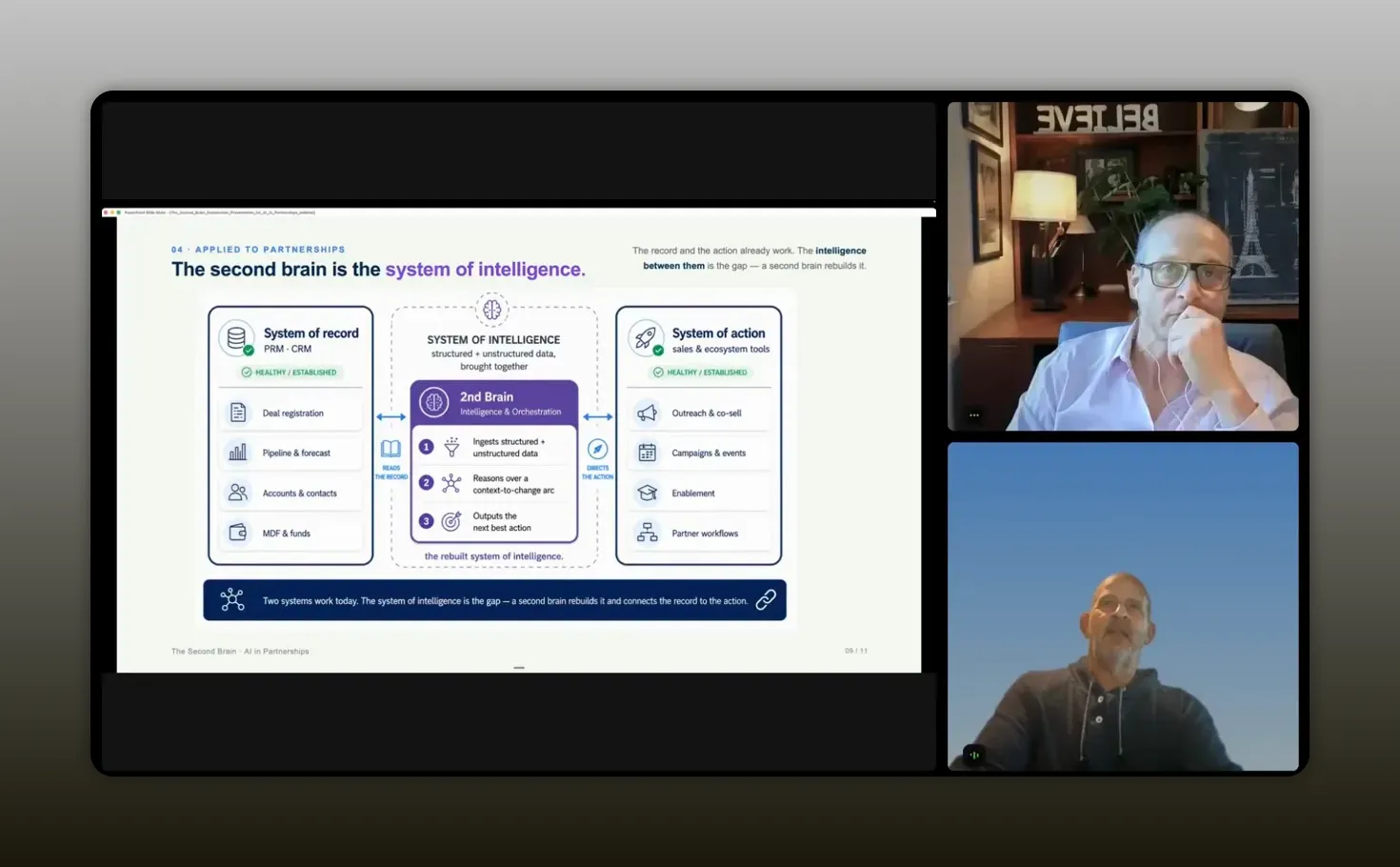
Partnerships need an intelligence layer between the systems that store data and the systems that execute work. -Allan Adler
A new operating model for partner teams
Allan stretches the idea even further. He proposes that a second-brain system could become the operating model for managing partnerships at scale.
That is a big claim, but it makes sense when you break it down.
Most partnership teams are trying to operate across two dimensions at once:
- Vertical, which means the full relationship with a specific partner like AWS, SAP, or a major reseller
- Horizontal, which means the functional motions across many partners, such as marketing, selling, enablement, and governance
A second-brain model can support both.
You could have a marketing brain for AWS, plus a broader marketing brain that learns across AWS, Azure, CDW, and others. The same can apply to selling, enablement, governance, and executive engagement.
This creates two forms of leverage:
- You manage one partnership with greater depth.
- You learn across partnerships with greater scale.
That is especially relevant if you are trying to move toward ecosystem-led growth. The more partners you have, the more dangerous it becomes to run the function on heroic memory and handmade documents.
For broader context on how AI is changing this kind of operating model, this playbook on how AI will reshape partnerships adds a useful strategic lens.
Practical first steps
If you want to test this idea without turning your whole team upside down, start smaller than your ambition.
Here is a sensible path based on Allan’s framework.
Pick one recurring output
Choose something you create often and care about, such as:
- QBRs
- Partner briefs
- Joint value propositions
- Campaign planning docs
- Executive account reviews
Define the target state clearly
Allan emphasizes one sentence above all others: your job is to…
That sentence becomes the core instruction for the brain. Be specific. If the brain exists to generate a quarterly partnership review that aligns sales, marketing, and leadership around progress, risks, and next actions, say exactly that.
List the inputs the brain needs
Do not start with prompts. Start with source reality:
- Notes
- Past decks
- Meeting summaries
- Partner plans
- Pipeline reports
- Stakeholder maps
- Messaging docs
Then ask the AI what is missing. That is one of Allan’s most practical moves. Instead of assuming you know the full structure, let the system expose the gaps.
Separate raw material from method
Do not dump everything into one place. Distinguish source content from process logic. That alone will improve the quality of what the system can generate later.
Treat the first version as architecture, not final truth
You are not building a museum. You are building a machine that learns. Push on the weak spots. Rename pieces. Rework the logic. Improve the sibling relationships between brains.
Measure whether it improves leverage
The key question is not whether the AI made something pretty. The key question is whether the architecture makes future work faster, more coherent, and easier to hand off.
You should sharpen the axe while chopping the wood. -Allan Adler
Recommended tools
Allan centers this workflow around Claude and Claude Co-Work, using them as the environment for building and running these brains. The exact tool matters less than the behavior, but his stack is straightforward.
- Claude for structured reasoning, drafting, synthesis, and iterative dialogue
- Claude Co-Work for project-based collaboration with reusable brain structures
- Markdown documents for storing modular, connected, AI-readable context
- Your existing CRM and PRM as systems of record
- Your outreach, marketing, and workflow tools as systems of action
If you are evaluating the platform behind this kind of workflow, the official Claude product page is the best place to start.
If you are just getting comfortable with Claude in a partnerships context, this beginner-friendly guide is a solid companion resource.
FAQs
What is a second brain in partnerships?
It is a structured intelligence system that sits between your record systems and your action systems. It stores context, connects related knowledge, and helps generate better outputs such as partner plans, reviews, messaging, and decision support.
How is a second brain different from a prompt library?
A prompt library helps you ask repeatable questions. A second brain provides the underlying architecture, context, linked knowledge, goals, rules, and source material that make those questions useful at scale.
Do you need technical skills to build one?
Not necessarily. The core skill is clear thinking. You need to define outcomes, organize source material, challenge weak logic, and iterate. Technical fluency helps, but the deeper requirement is architectural thinking.
What partnership workflows benefit most from this approach?
Recurring, context-heavy workflows benefit the most. QBRs, executive updates, joint account planning, co-marketing strategy, enablement content, and stakeholder onboarding are all strong candidates.
Why not just use CRM and PRM data directly?
Because those systems store records, not reasoning. They are essential inputs, but they do not usually provide the intelligence layer needed to connect goals, evidence, stakeholders, strategy, and next-best actions.
What is the biggest mistake teams make with AI here?
They jump straight to output generation without building the context architecture first. That creates shallow results, inconsistencies, and a lot of avoidable rework.
Conclusion
The big shift Allan is pointing to is not just about using AI more often. It is about changing what you produce. If you keep producing isolated artifacts, you will stay trapped in manual effort no matter how good the tools get. If you start producing architecture, you create a system that gets smarter, faster, and more reusable over time. For partnership teams, that is more than a productivity upgrade. It is a new way to preserve context, scale execution, and make intelligence operational.