How to Build High-Impact Partner Marketing in 2025: A Practical Playbook
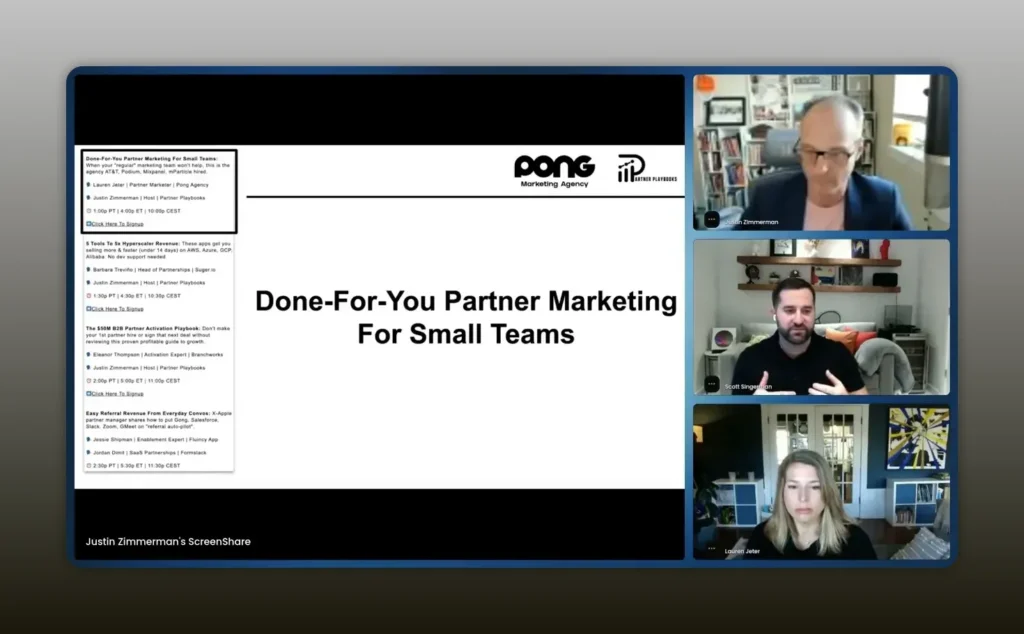
Expert advice from Scott Singerman (VP Partnerships, Mixpanel) and Lauren Jeter (Founder, Pong Agency).
Snapshot
Done well, a partner marketing program amplifies your reach into new audiences, lowers cost per acquisition by pooling budgets and credibility, and effectively turns other companies into distributed sales and marketing teams that scale your GTM motion.
But it isn’t magic — it requires clear joint value propositions, repeatable campaign kits, sales enablement that reduces friction for partner reps, and instrumentation (UTMs, partner codes, CRM fields) so you can attribute and optimize. The wrong approach — vague outcomes, heavyweight enablement, or co-marketing without product fit — wastes time, creates misaligned expectations, and leaves revenue on the table.
This article will help you start small with defined pilots, one‑page narratives, and bite‑sized enablement (60–90 second videos, one‑pagers, demo playbooks), that treat partners as extensions of your demand team rather than passive logos. You’ll discover when you combine clarity, resourcing, and measurement, partnerships stop being an experiment and become a repeatable, high-impact growth channel.
Co-marketing and co-selling together are really the important emphasis here to drive growth. – Lauren Jeter
Table of Contents
- Why partner marketing matters now
- The three types of partner marketing: to, through, and with
- Partner enablement: turning partners into revenue generators
- How to evaluate and pick an agency or external partner
- Sample first project scope to test an agency
- Designing a joint campaign playbook (example: technology integration)
- Localization and channel/reseller marketing
- KPI framework and how to measure partner-sourced revenue
- Common pitfalls and how to avoid them
- Outbound and recruitment templates for partners
- Budget and resourcing tips for 2025 planning
- FAQs
- Conclusion
Why partner marketing matters now
Market noise is higher, paid channels are more expensive, and your ICP is fragmented across platforms and services. When you partner, you multiply brand familiarity, combine budgets and lists, and present a better together value that removes friction for buyers. Partnerships are not just about resellers or integrations. They can be a primary demand-generation channel when you execute them with a marketing-first mindset.
Scott often saw partnerships evolve from purely technical relationships into full demand levers. If you expect partners to help with retention, onboarding, and pipeline, you must invest in go-to-market materials and enablement that make it easy for partners to promote and sell your solution.
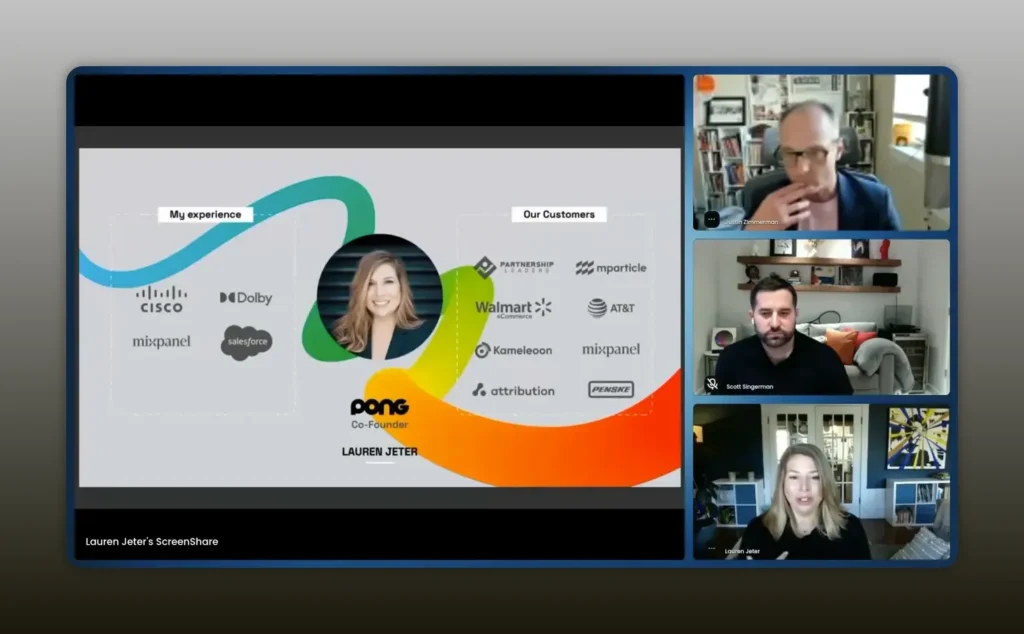
We specialize in content creation, web design, web development, video, e-learning content, SEO and paid ad management. – Lauren Jeter
The three types of partner marketing: to, through, and with
Think of partner marketing in three buckets. Each requires different assets, different timelines, and different KPIs.
Partner to (marketing to partners)
This is recruitment and enablement. You run campaigns to attract the right partners and convert them into productive members of your ecosystem. Use one-pagers, clear benefit stacks, and an easy certification path.
If you are early, you might have inbound interest. But when you need specific partners—say a systems integrator in Japan or a consultancy in Brazil—you must proactively market to those partners and give them a clear onboarding road map.
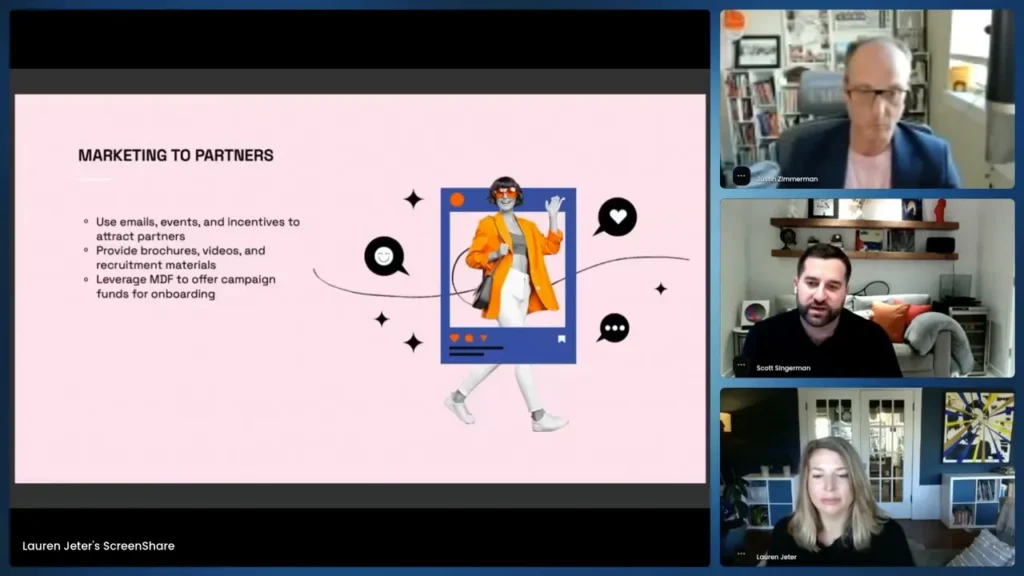
Marketing to partners is recruiting the right fit and equipping them with bite-sized enablement—one‑pagers, short videos, and a clear onboarding path—to turn interest into revenue. – Lauren Jeter
Partner through (marketing through partners)
This is the “campaign in a box” approach. You create a co-branded kit partners can launch into their channels: emails, paid ad assets, landing pages, and sales briefs. The idea is consistency at scale. Your partners localize, personalize, and run those assets to their audience.
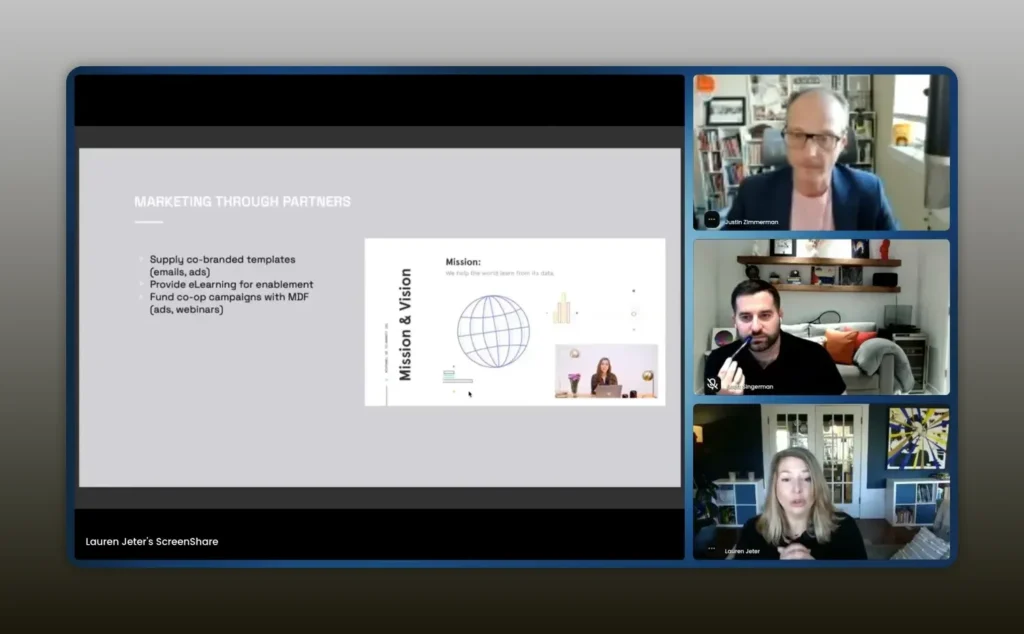
We created interactive demos and short marketing videos to make technical content accessible to partners and customers. – Scott Singerman
Partner with (co-marketing)
This is the classic co-marketing move: joint webinars, joint ebooks, shared events, or joint landing pages. Co-marketing works best when there is a real technical or strategic integration underpinning the value proposition. If you only share an ICP but have no product-level fit, the campaign risks becoming fluffy and underperforming.
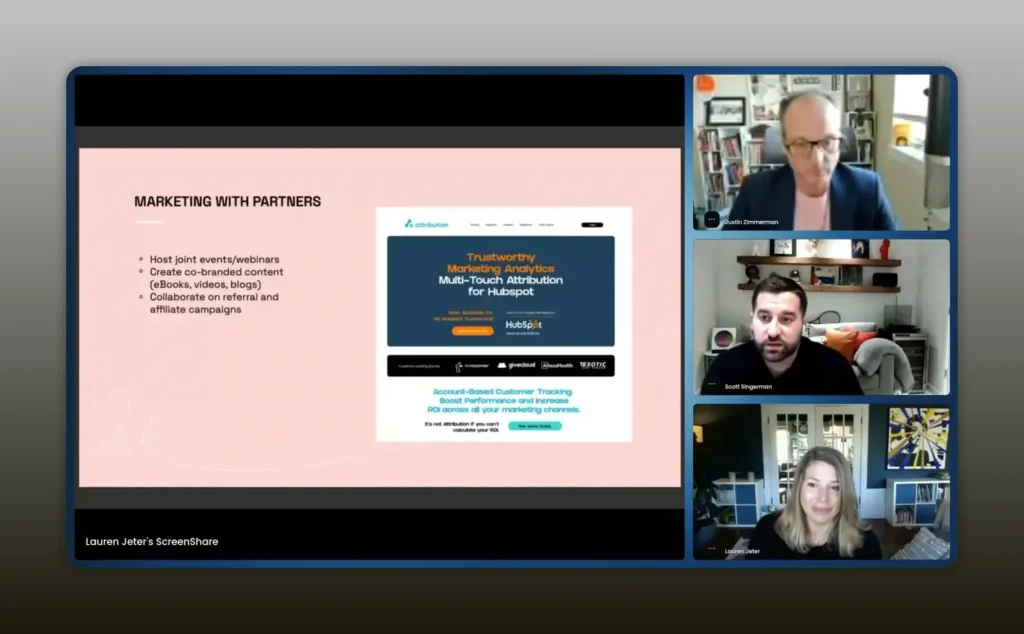
We’re all out in the market basically telling the same story, which generates revenue for both parties. – Scott Singerman
Partner enablement: turning partners into revenue generators
Enablement is the bridge from “partner signed” to “partner selling.” Early enablement tends to be technical, but to scale partner-driven demand you need GTM enablement: short videos, infographics, interactive demos, certification badges, and sales playbooks.
Practical guidelines:
- Create bite-sized learning modules. Short videos, 60 to 90 seconds, work well for busy partner reps.
- Turn dense documentation into visuals. Use one-pagers and infographics for quick reference in sales calls.
- Build a certification path with measurable milestones and rewards—featured placement, deal registration benefits, or co-op funds.
- Make enablement accessible asynchronously. Host it in a partner portal with tracking to measure engagement.
Our V1 certification was dense and text heavy. Breaking it into bite-size videos and infographics made it consumable. – Scott Singerman
How to evaluate and pick an agency or external partner
When you need extra capacity or creative lift, you will consider agencies. Scott suggests three practical rules to lower risk.
- Start with your network. Referrals from other partnership pros are the highest signal. Ask for examples that match your motion: enablement, co-marketing, or localization.
- Run a small pilot with a defined scope. A single deliverable with clear acceptance criteria lets you test responsiveness and quality.
- Be prescriptive about outcomes. Provide the content or subject matter expertise and ask the agency to focus on design, conversion, and speed to market.
Warning signs to watch for:
- An agency that refuses small pilots or insists on big retainer buys up front.
- Vague case studies without clear results or sample deliverables.
- Poor onboarding processes or slow response times in early communication.
Sample first project scope to test an agency
Use the following exact template for a first scoped engagement. It is concrete, quick to execute, and will expose execution quality.
- Objective: Convert existing partner enablement documents into a 6-module certification course.
- Deliverables:
- 6 interactive micro-videos, 60 to 90 seconds each
- 6 one-page visual summaries (infographics)
- Sample quiz per module and badge artwork
- Landing page template for partner portal
- Timeline: 4 to 6 weeks
- Acceptance criteria:
- Scripts and storyboards approved within 5 business days of kickoff
- Draft videos delivered week 3, final versions by week 5
- All assets delivered in agreed formats with source files
- Success metrics:
- Partner engagement rate (portal views) > 40% in first 30 days
- Certification completion by at least 20 partners in 90 days
- Increase in partner-sourced leads month over month
Designing a joint campaign playbook (example: technology integration)
If you have a technical integration and a partner with market reach, use a repeatable playbook. Scott used this approach when he ran a joint campaign with Segment and Mixpanel. The playbook below distills the core steps.
- Agree the value narrative. Define the buyer pain, the combined solution, and the primary CTA. Document this in a 1-pager.
- Define roles and timelines. Who creates which assets, who owns the landing page, who localizes creative, and who runs paid channels?
- Create a joint asset kit. Include co-branded landing page, demo, 2 short videos, email templates, and a webinar deck with speaker notes.
- Enable partners with sales briefs and micro-training. Share key objection handling, technical prerequisites, and joint packaging/pricing guidance.
- Launch and measure. Track joint campaign UTM parameters, partner codes, and pipeline created. Run weekly standups during push week.
- Optimize and scale. Localize assets, create paid amplification plans, and test creative variations based on partner performance.
When we needed help resourcing and executing a joint Segment campaign, external creative and execution capacity was essential. – Scott Singerman
Localization and channel/reseller marketing
When you go to market through resellers or channel partners in other geographies, consistency matters more than ever. Provide a primary campaign framework and let resellers adapt it. Keep brand guardrails but allow local messaging that connects with regional buying patterns.
- Hand partners a localized content pack: translations, localized imagery, and suggested subject lines or ad copy.
- Offer co-funding or co-op budgets for high-priority markets to encourage promotion.
- Provide playbooks that map to the regional sales motions: inside sales, field sales, or reseller-driven deals.
In complex international markets, partners localize campaign assets and deliver the in-market execution that we could not do directly. – Scott Singerman
KPI framework and how to measure partner-sourced revenue
You need a measurement approach that differentiates partner-sourced leads, partner-influenced pipeline, and partner-sold revenue. Track these metrics to justify investment and refine programs.
- Partner-sourced leads: New leads that originate through partner channels or UTMs and are logged in your CRM.
- Partner-influenced pipeline: Opportunities where a partner was a touchpoint in the buying process.
- Partner-sold revenue: Closed-won deals sourced and owned by the partner (reseller motion).
- Enablement engagement: Portal views, certification completions, and training attendance.
- Campaign performance: CTRs for partner emails/ads, conversion rates on landing pages, webinar attendance to SQL conversion.
- ROI calculation: Partner-sold revenue divided by co-marketing spends and enablement costs, compared to direct channels.
Common pitfalls and how to avoid them
Partnerships fail for predictable reasons. Here are the pitfalls and practical fixes.
- Pitfall: Launching co-marketing without a real product integration.
Fix: Make technical integration and tangible customer outcomes the threshold for co-marketing. - Pitfall: Overloading partners with long, text-heavy enablement.
Fix: Use microlearning and visuals. 60 to 90 second videos and one-pagers win. - Pitfall: No clear ownership for deliverables and timelines.
Fix: Use a RACI for every campaign and set acceptance criteria before production. - Pitfall: Too big a bet on an untested agency.
Fix: Start small with a pilot project and scale after proven delivery. - Pitfall: Not measuring partner influence properly.
Fix: Instrument UTM parameters, partner codes, and a field in CRM for partner influence.
There’s a big part of the partnership job that is borrowing and stealing resources from other functions. – Scott Singerman
Outbound and recruitment templates for partners
Use short, prescriptive outreach. Below are two templates you can adapt.
- LinkedIn outreach (initial) Hi [Name], I notice your team works with [technology/service]. We’ve partnered with [Partner] to help customers get [specific outcome]. Would you be open to a 15-minute call to explore whether a partnership could accelerate revenue for both of us?
- Email outreach (recruitment) Subject: Partnership opportunity: joint offering for [ICP] Hi [Name], We built a product that integrates with [Partner tech], and combined we can deliver [measurable outcome]. We’re recruiting solution partners in [region/industry] and wondered if you’d be open to a short conversation. We provide enablement, co-branded assets, and deal registration to partners who qualify. Best, [Your name]
Budget and resourcing tips for 2025 planning
When you prepare budgets, account for three buckets: enablement, co-marketing campaigns, and partner program operations. Split funds between pilot initiatives and scaled programs. If you want to be conservative:
- Allocate 30 percent for enablement (content, platform, certification)
- Allocate 50 percent for co-marketing campaigns (shared ads, events, landing pages)
- Allocate 20 percent for program ops (partner portal, tracking, admin)
Use small pilots to prove ROI before scaling. Scott found that an agency or external creative partner can accelerate delivery when internal teams are overcommitted. Start with short, high-impact assets that demonstrate immediate partner value.
Start with something small. If they deliver, then give them more. It’s like any relationship when you’re trying to build trust. – Scott Singerman
FAQs
What makes a partner marketing campaign successful?
Success hinges on three things: a clear joint value proposition, measurable campaign KPIs (UTMs, codes, and CRM fields), and partner enablement that reduces friction for the partner sales motion. Prefer campaigns built on real technical integration over vague audience overlap.
How do I choose the right agency for partner marketing?
Look for relevant case studies, network referrals, and willingness to run a small pilot project with clear deliverables. Be prescriptive about outcomes and scope to avoid scope creep and to measure delivery quickly.
What assets should I prioritize for partner enablement?
Prioritize short videos (60 to 90 seconds), one-pagers, sales briefs, and an interactive demo or checklist. These assets make technical concepts consumable and are easy for partner reps to use in real sales conversations.
When should I invest in co-marketing versus partner recruitment?
If you lack qualified partners in a geography or vertical, prioritize recruitment. If you already have productive partners and a technical integration, prioritize co-marketing to amplify reach and generate demand together.
How should I measure partner ROI?
Track partner-sourced leads, partner-influenced pipeline, and partner-sold revenue. Compare partner-sourced revenue against co-marketing spends and enablement costs. Include conversion metrics for enablement content to justify ongoing investment.
What are realistic first-year expectations for a partner program?
In year one, focus on building program infrastructure, recruitment, and enablement. Expect slower revenue as partners ramp; aim for measurable engagement (portal visits, certifications) and a small set of partner-sourced deals that prove the model.
Conclusion
Partner marketing is a strategic lever that rewards clarity and execution. Treat partners like distributed demand-generation teams: give them clear one-page narratives, bite-sized enablement, and repeatable campaign kits. Use small pilots to test external agencies, insist on measurable KPIs, and prioritize campaigns built on real integration. When you align co-marketing with co-selling and measure influence properly, partnerships stop being a buzzword and become a scalable engine for growth.