Inside The World’s Top Revenue Platforms For Affiliate, Co-Sell, and Tech Partner Programs
Expert advice from Tyler Calder (CMO, PartnerStack).
Snapshot
You are operating in a moment when partnerships have moved from a nice-to-have growth lever to a business-critical route to market. Customer acquisition costs have climbed dramatically, growth rates have become harder to sustain, and trust in direct company messaging has weakened. That creates a huge opening for partner ecosystems, agencies, affiliates, creators, technology partners, and trusted peer networks.
But here is the catch: recognition is not the same as operational readiness. Plenty of companies agree partnerships matter, yet their programs still run through disconnected spreadsheets, manual follow-ups, static dashboards, and a handful of overworked people. That gap is where revenue leaks out.
The opportunity is to build a program that combines clean data, meaningful attribution, smart automation, and genuinely human partner relationships. You do not need to automate everything. You need to automate the right things, so your team can spend more time doing the work that creates trust, momentum, and revenue.
Keep reading to learn how Justin Zimmerman and Tyler Calder can help you improve partner attribution, activate more partners, and scale revenue without losing the human element.
“The challenge is not convincing people that partnerships are critical. The challenge is showing that you can operationalize and scale them.” -Tyler Calder
Table of Contents
- Why partnerships matter more now
- The operating model gap is where programs stall
- Attribution is more than reporting
- What a modern PRM platform needs
- Move from dashboards to partner signals
- How to activate the long tail of partners
- Earn a seat in the sales motion
- Using AI without wrecking partner relationships
- Tools
Why partnerships matter more now
Partnerships are not a side project anymore. They are increasingly one of the most efficient ways to reach customers, build trust, create pipeline, and protect growth when direct acquisition becomes more expensive.
Tyler pointed to a clear market reality: customer acquisition costs have risen sharply over the last five years while many B2B companies have seen their growth rates slow. You can keep trying to outspend everyone in paid channels, but that is a rough game. Or you can build distribution through people and organizations that already have credibility with the customers you want to serve.
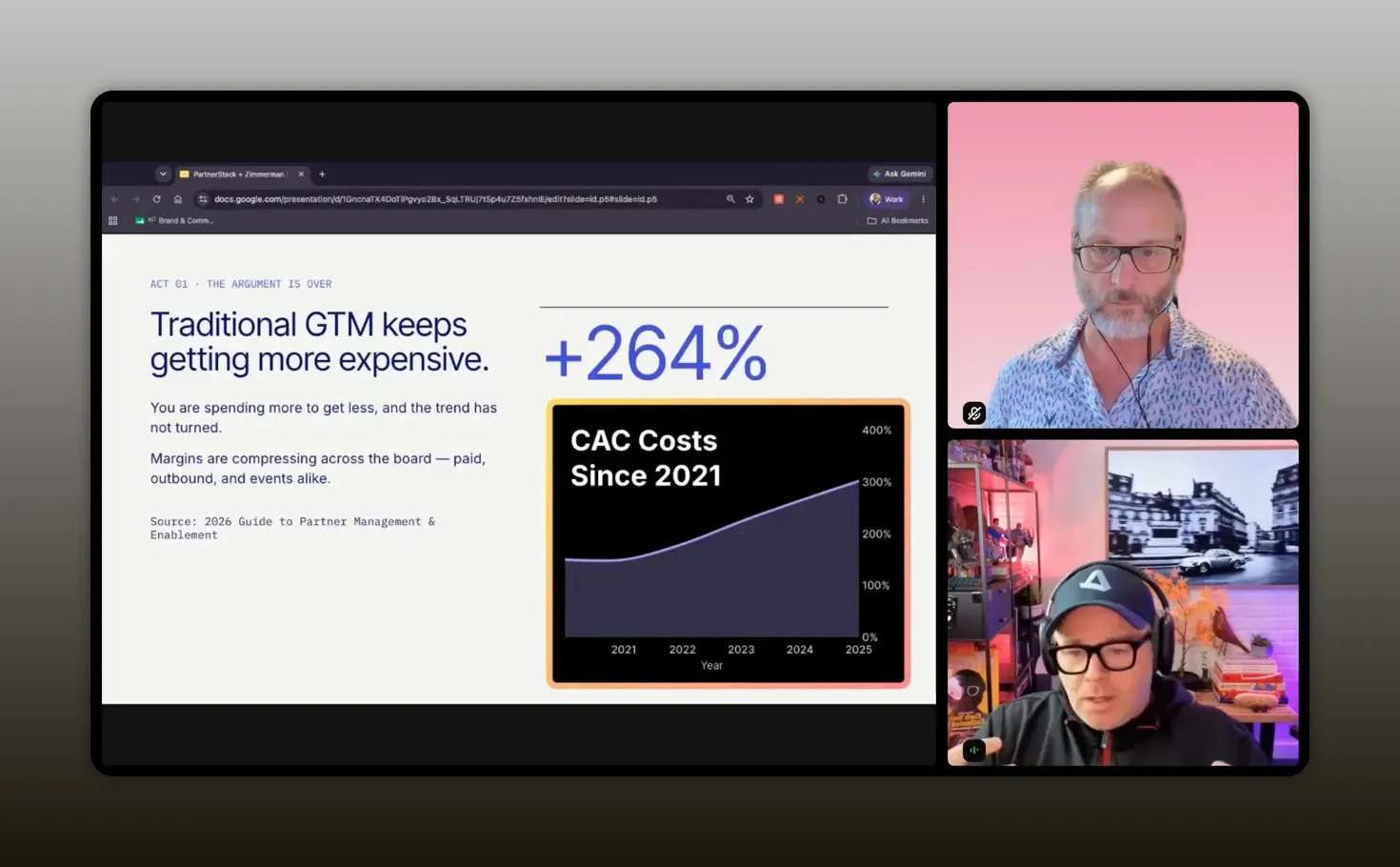
“We need new routes to market. We need to be a little bit more efficient, and that is where partnerships step in.” -Tyler Calder
That is why the ecosystem conversation has matured. The old debate about whether partner programs deserve a seat at the table is largely over. The bigger question is whether your broader organization has caught up operationally.
When partners are genuinely attached to your go-to-market motion, the upside can extend across the business:
- Marketing gains trusted channels for reach, credibility, and demand generation.
- Sales gains warmer introductions, partner context, and support on complex opportunities.
- Customer success gains implementation and service partners that can improve customer outcomes.
- Leadership gains a more durable revenue engine than a single direct acquisition channel.
Trust is the other major reason this matters. Executives may believe their customers trust them, but customers often do not feel the same way. Trust has not disappeared. It has moved into communities, peers, specialists, creators, agencies, and third parties. Those are the people and organizations in your partner ecosystem.
This makes partnerships uniquely powerful. A credible partner does not just add another touchpoint. They can reduce skepticism before your sales team ever enters the conversation. For additional context on why trusted partner relationships matter in agency motions, see this practical guide to partnering with agencies.
The operating model gap is where programs stall
Here is the uncomfortable part. Many teams understand the value of partnerships, but their systems do not reflect that importance.
Tyler highlighted two numbers that should make every partner leader pause:
- About 65% of partner organizations still manage all or a meaningful part of their programs through spreadsheets and shared documents.
- About three in four partner leaders manage much of their work in tools such as Slack, Teams, and Notion.
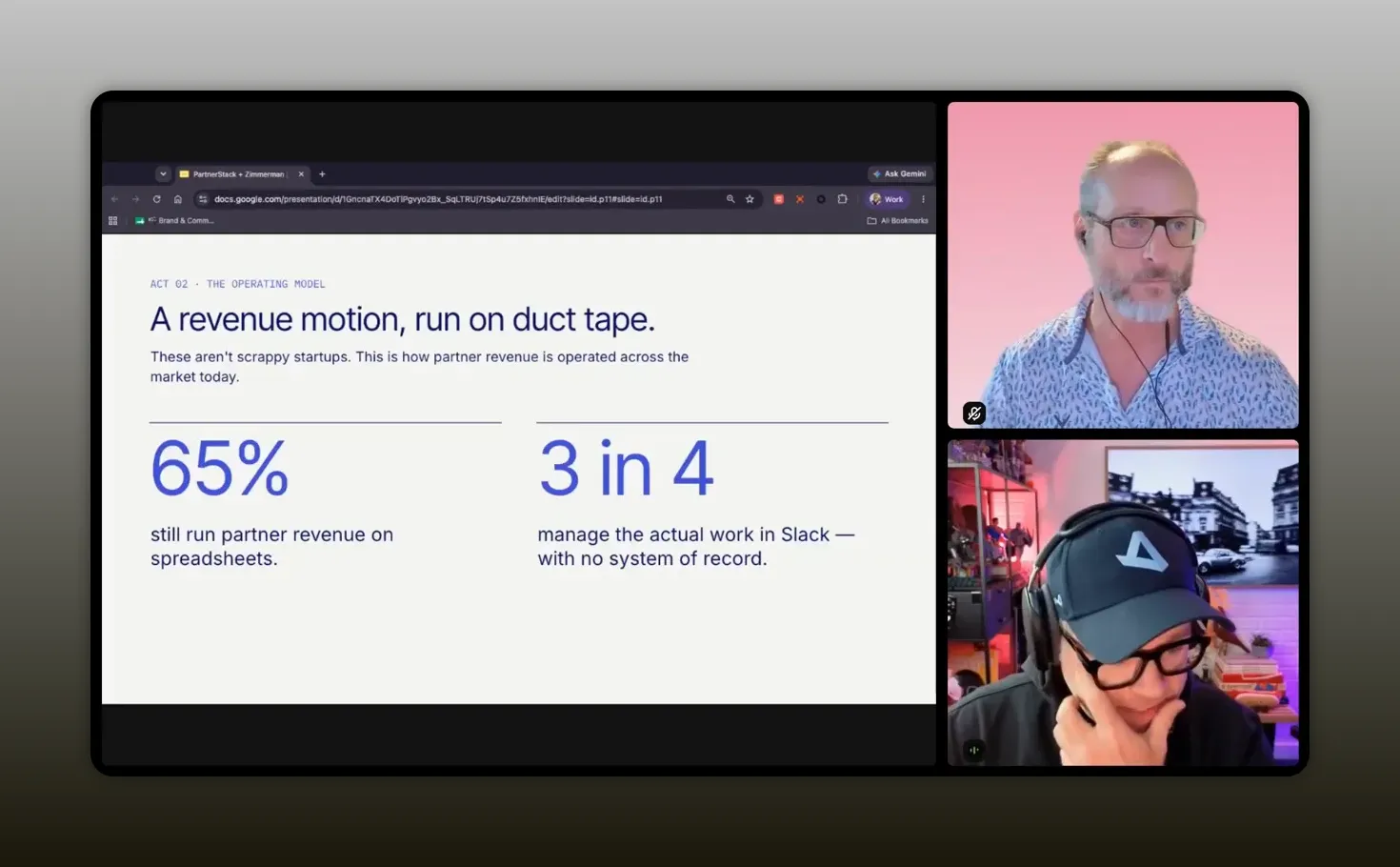
“There is a revenue motion in place, there is executive alignment that it is important, but there is a little bit of duct taping.” -Tyler Calder
There is nothing wrong with starting in a spreadsheet. In fact, you probably should. If your program is early, spreadsheets, a CRM, Slack, and discipline can take you a long way. Buying a dedicated platform on day one is not automatically good judgment.
The warning signs come later. You know you have reached the limit when:
- Your team is stretched too thin and important follow-ups are falling through.
- Partners receive inconsistent experiences depending on who owns the relationship.
- Finance is doing manual reconciliation work that does not belong on its plate.
- Sales is doing partner coordination behind the scenes because it cannot see the right data.
- Teams have created shadow processes outside the program to get things done.
That is when disconnected tools stop being scrappy and start becoming expensive. The issue is not that spreadsheets are bad. The issue is that you need a reliable source of truth once the complexity of your program outruns the process holding it together.
Attribution is more than reporting
Attribution gets a bad reputation because nobody believes it is perfect. Fair enough. There are dark funnels, multiple influences, self-reported sources, informal referrals, and interactions that never appear neatly in a CRM field.
But the answer is not to give up on attribution. The answer is to understand what it is for.
First, attribution gives you the evidence to tell a business story. You need to show your CFO, CEO, sales leader, and board how partnerships contribute to pipeline, revenue, win rates, ACV, retention, and expansion. If you cannot explain where the impact is coming from, it becomes much harder to make the case for budget, headcount, tools, or co-marketing investment.
Second, attribution is the context layer for AI. This is the part that matters right now.
If your data says Partner A sourced a deal but your call recordings, email threads, CRM activity, and internal messages show that Partner B created the trusted introduction, then a simplistic model will give you a simplistic recommendation. An AI workflow operating on incomplete attribution will simply automate bad judgment faster.
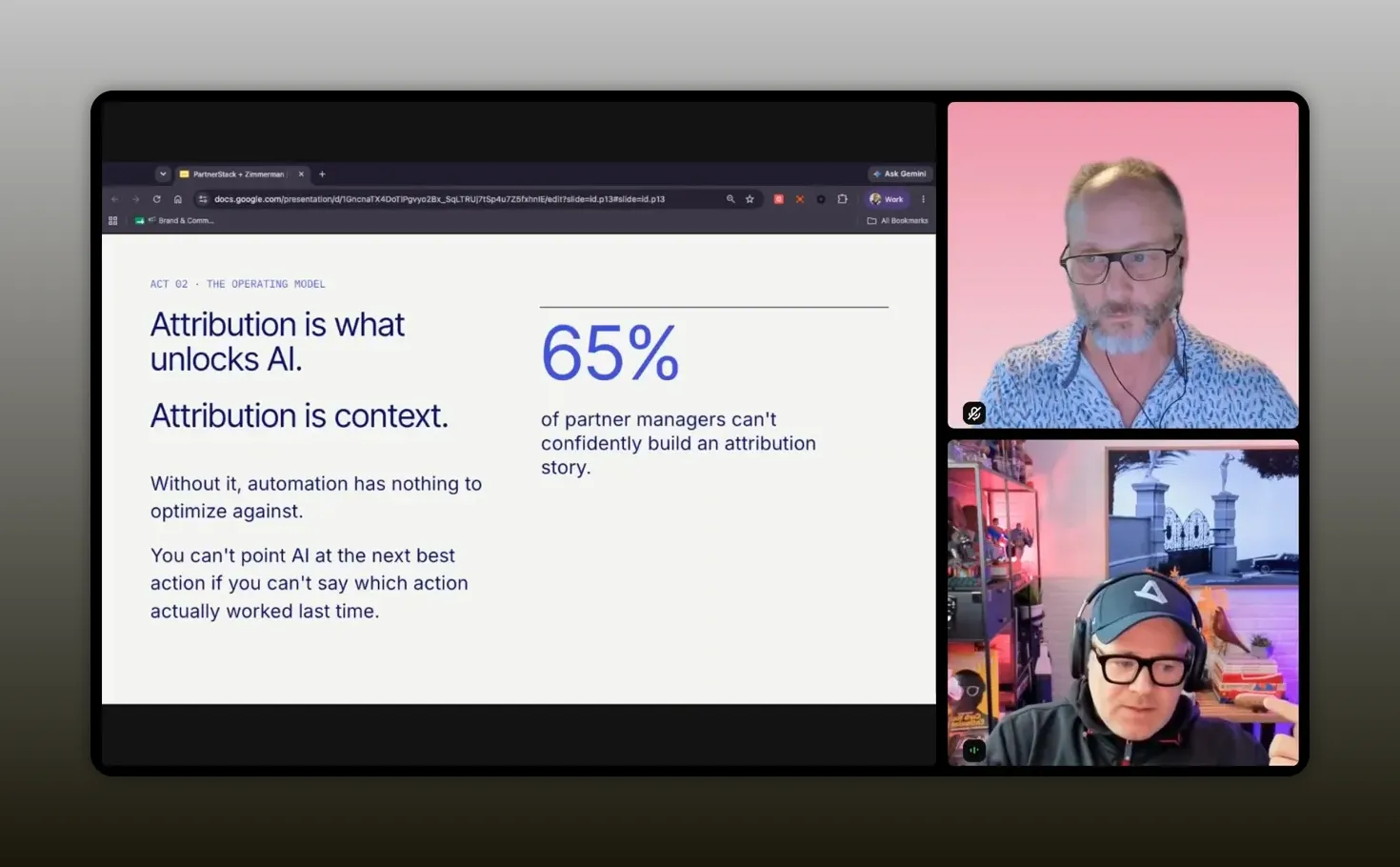
“If your attribution is broken and it is not accurate, then you are going to get recommendations that are just wrong.” -Tyler Calder
Build an attribution story, not just a single-touch report
A stronger model connects the data you already have across your tech stack. That could include your PRM, CRM, marketing automation platform, call intelligence tool, email, Slack, deal registration system, and customer data.
For example, a more complete partner-influenced deal story might include:
- A partner introduces an account to your team.
- The prospect engages with your website, content, or event.
- Sales qualifies the opportunity in the CRM.
- A second partner provides technical validation or implementation expertise.
- Call notes confirm who created trust, who helped close the deal, and who supported the buyer.
You may still need to choose a reporting model, such as first touch, last touch, weighted, or time-decay. Every model has limitations. The goal is not false precision. The goal is a credible, useful narrative that informs investment decisions and fair compensation.
Start with a practical question for your finance leader: What would a trustworthy partner performance story look like to you? Once you know the answer, work backward into the inputs, definitions, and systems required to support it.
What a modern PRM platform needs
A modern partnership platform should help you manage indirect revenue across the full customer lifecycle. That includes demand creation, deal progression, retention, and expansion. It should not simply count partners, referrals, and registered leads in a static dashboard.
Tyler’s framework for the foundational capabilities of a modern PRM or ecosystem platform has five parts.
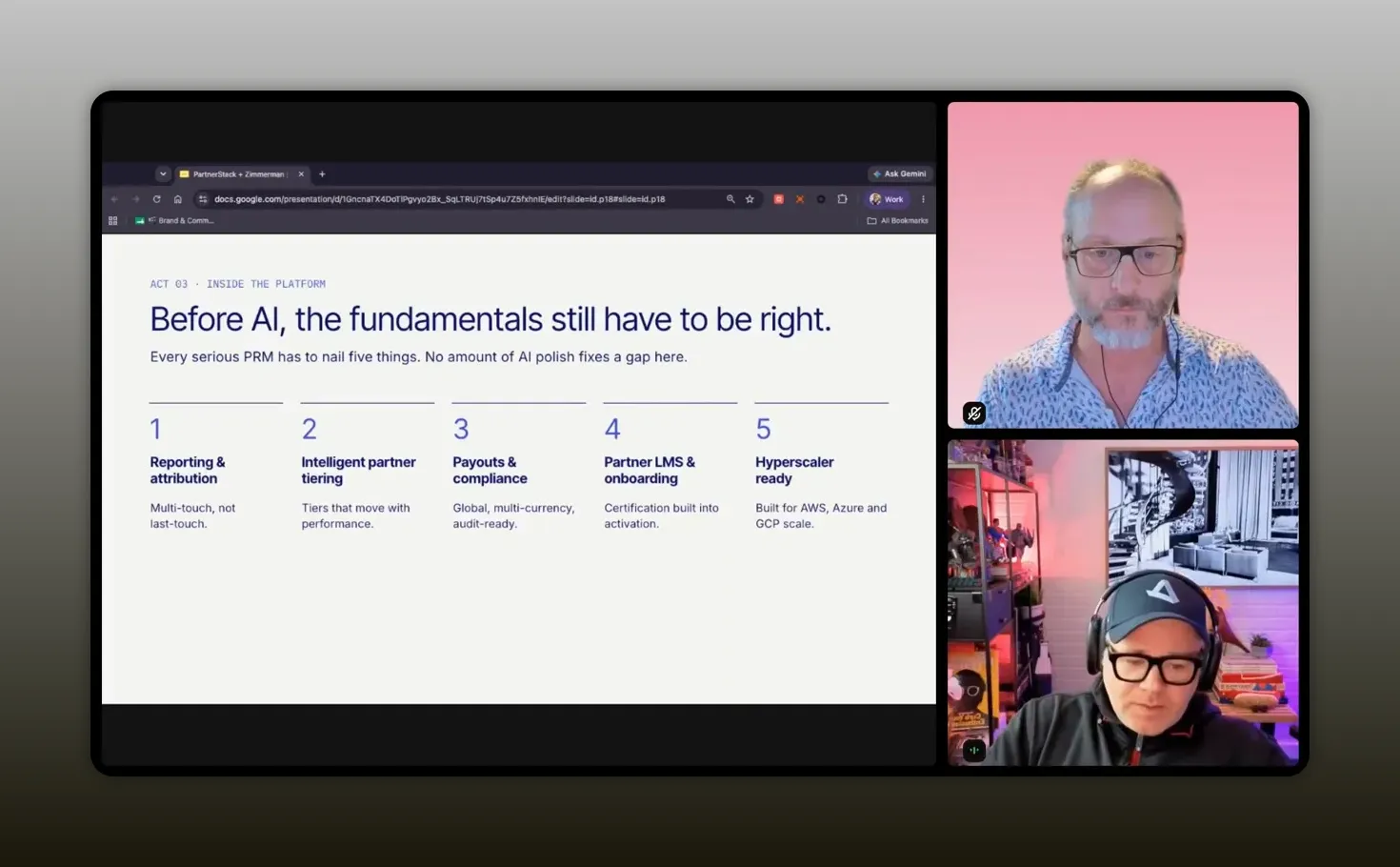
“AI is important, but the fundamentals need to be right. The fundamentals of the platform and the fundamentals of your own program.” -Tyler Calder
1. Reporting and attribution
Your platform should be a dependable place to measure the business outcomes that matter. Pipeline and sourced revenue are important, but they are not the whole story. You also want to understand partner impact on win rate, deal velocity, ACV, net revenue retention, and expansion.
2. Intelligent partner management
Once you have dozens or hundreds of partners, tiering cannot depend entirely on someone remembering to update a spreadsheet before a QBR. A better program recognizes signals continuously. You can choose whether to move partners dynamically or on a quarterly schedule, but you should know when a partner has met the criteria to advance.
That creates a better partner experience. A tier change can become a timely moment to celebrate performance, unlock benefits, share a new opportunity, or trigger a personal conversation.
3. Payouts and compliance
This may not be the part of the job that gets partner leaders excited, but your finance team absolutely cares. Accurate, on-time, auditable, globally compliant payouts matter. They are a fundamental promise of any revenue-sharing program.
As you scale across currencies, regions, partner types, and compensation plans, a weak payout process can create an enormous amount of manual work and damage partner trust fast.
4. Just-in-time onboarding and enablement
Static courses and generic nurture sequences are not enough. A partner that has just registered a deal, slowed down after strong engagement, or never completed onboarding needs a different next step. Good enablement responds to what that partner is actually doing.
5. Marketplace readiness
If hyperscaler marketplaces are important to your go-to-market strategy, the ability to work with them efficiently becomes part of the platform decision. Without appropriate technology support, marketplace activity can pull in product, engineering, operations, and finance resources at exactly the time you are trying to create a smoother motion.
Move from dashboards to partner signals
The old operating model looks familiar. Data comes out of your partner program, lands in a dashboard, gets interpreted by a partner manager, and creates more manual tasks. You send Slack messages, draft emails, ask for reports, schedule meetings, and try to decide what deserves attention first.
The better model is built around real-time signals and recommended next actions.
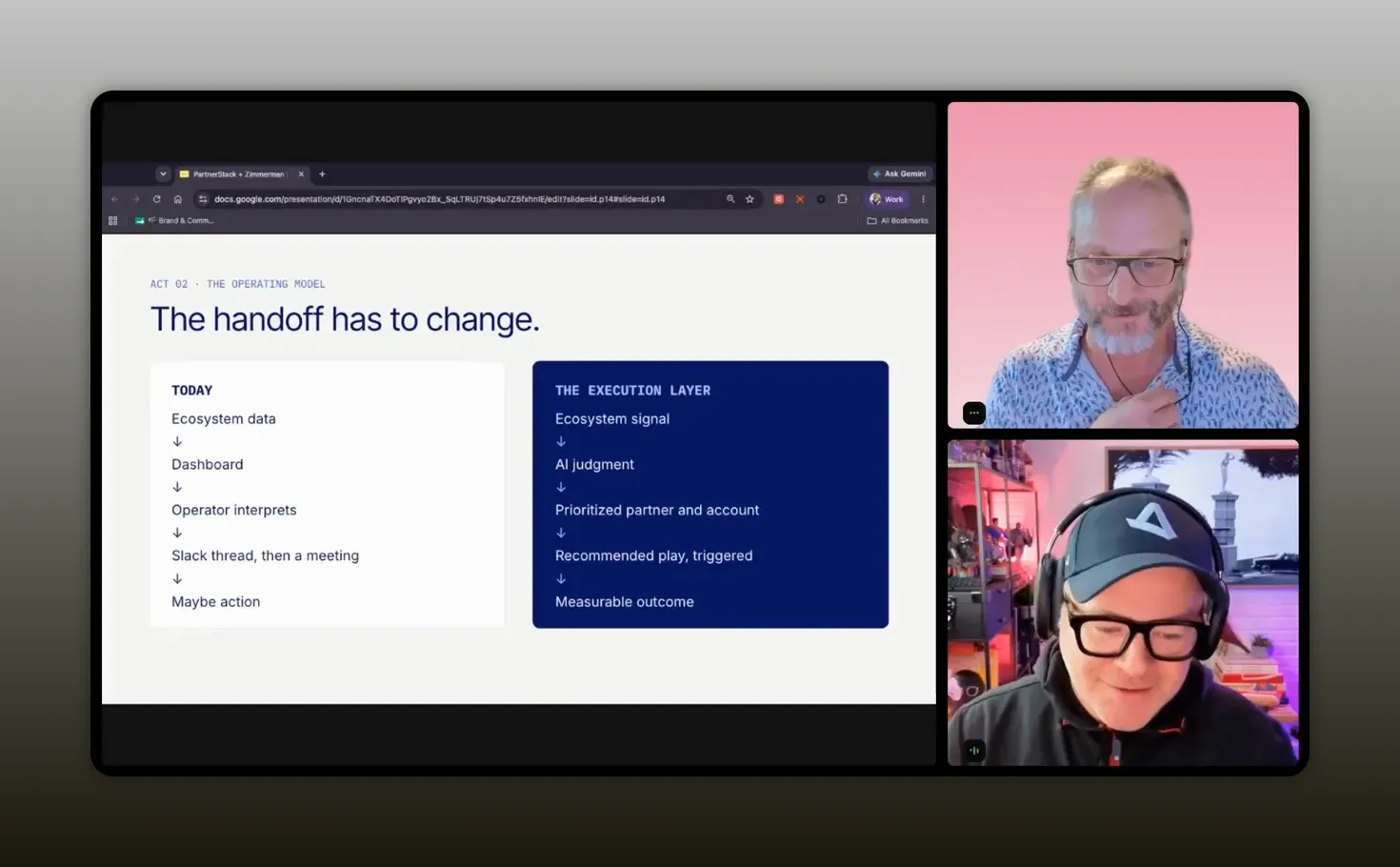
“On the left, the human is in the loop the whole way. On the right, the human jumps in once they are fed something meaningful.” -Tyler Calder
That workflow looks like this:
- Collect signals: Deal registration, pipeline movement, engagement, certification progress, communication history, account overlap, and partner activity.
- Add context: Combine data from your PRM, CRM, marketing platform, call recordings, Slack, and other relevant systems.
- Apply judgment: Use rules or AI to identify what matters, such as a stalled deal, a partner ready for advancement, or an inactive partner worth re-engaging.
- Recommend an action: Draft the right outreach, identify who should contact whom, or suggest the best partner to bring into a deal.
- Keep a human in control: Approve, revise, personalize, or take the action manually when the situation calls for it.
That is not about removing partner managers. It is about moving their time away from hunting for fragmented information and toward better decisions. The difference is massive. You stop asking, “What should I do today?” and start receiving a prioritized, explainable set of recommendations.
If you are building signal-driven co-sell motions, this guide to automating partner engagement with scalable co-sell workflows offers additional examples, including account overlap triggers and stalled-deal rescue workflows.
How to activate the long tail of partners
The 80/20 rule is everywhere in partnerships. A small percentage of partners creates most of the revenue, while a far larger group is quiet, inactive, or producing very little. The average pattern Tyler shared is closer to 75/25, which means roughly three quarters of partners are not producing meaningful results.
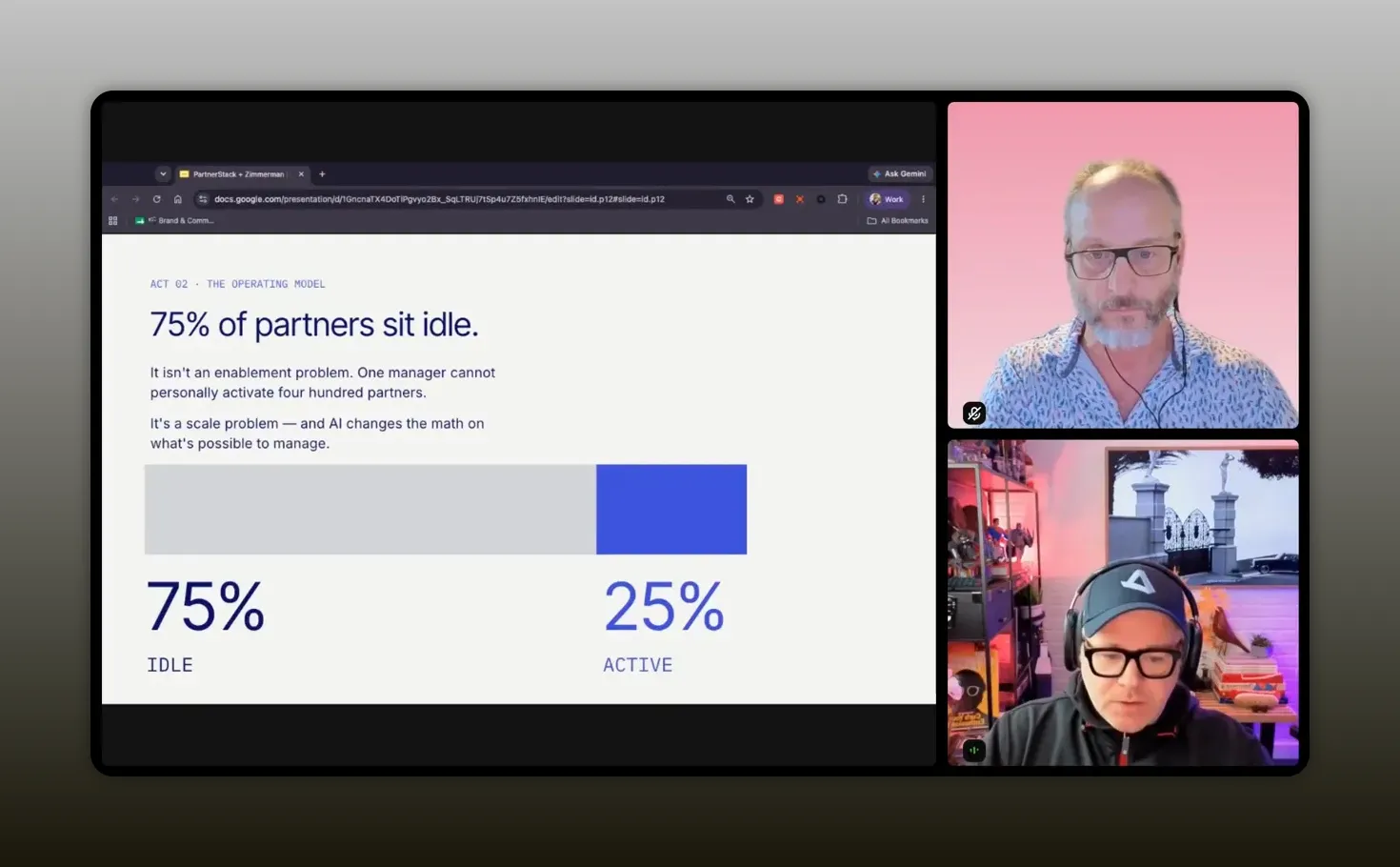
“Do not accept the 80/20 rule. There is a huge opportunity to unlock the mid and long tail of your partners.” -Tyler Calder
It is tempting to call this an enablement problem. Send more emails. Add another certification. Build a fancier PDF. Make another resource hub. Most of us have tried some version of that, and it rarely solves the actual issue.
The core challenge is scale. Small partner teams have only so many hours. They cannot provide custom, high-touch activation to every partner manually. So the practical answer is not generic enablement at greater volume. It is targeted support based on signals.
Use just-in-time activation
Instead of giving every partner the same journey, shape your outreach around what you know:
- A newly accepted partner may need one clear first action rather than a library of content.
- A highly engaged partner who has not sourced a deal may need a joint account-mapping prompt.
- A partner who was previously active but has gone quiet may need a personal check-in and a relevant opportunity.
- A services partner with strong customer fit may need an offer, a referral path, or co-selling guidance.
Recruitment works the same way. It is easy to recruit a large pile of “good enough” partners. It is much harder, and far more valuable, to recruit partners that show evidence they will actually activate. Focus on fit, intent, business model, customer overlap, and the signals that suggest the relationship can become productive.
That is how you improve the quality of your partner base instead of simply expanding its size.
Earn a seat in the sales motion
Sales teams have had dedicated systems, dashboards, reporting standards, and operating cadences for decades. If partnerships are meant to be a revenue engine, your team needs to operate alongside sales with comparable clarity.
That means you should not be an occasional guest when someone wants a partner introduction. You should be part of the sales rhythm, especially pipeline reviews and revenue meetings.
Your goal is to make partner data useful in the exact places sales already works. Help sales answer questions such as:
- Which open deals have a relevant partner relationship?
- Which partner can help re-engage this stalled opportunity?
- Which accounts have meaningful overlap?
- Which partner has demonstrated expertise in this customer’s market or use case?
- Where can a partner improve confidence, technical validation, or implementation readiness?
Bring the evidence, not just enthusiasm. When you can show the impact partners have on pipeline quality, win rates, account value, and retention, you stop asking sales to “help partnerships” and start operating as one revenue team.
Using AI without wrecking partner relationships
AI can save time, improve prioritization, and surface valuable patterns. But it can also make your program feel cold, noisy, and careless if you use it as an excuse to automate every interaction.
The best programs sit in the middle. They automate tasks that are repetitive, data-heavy, and easy to standardize. They preserve human judgment for moments that require trust, nuance, negotiation, or genuine relationship building.
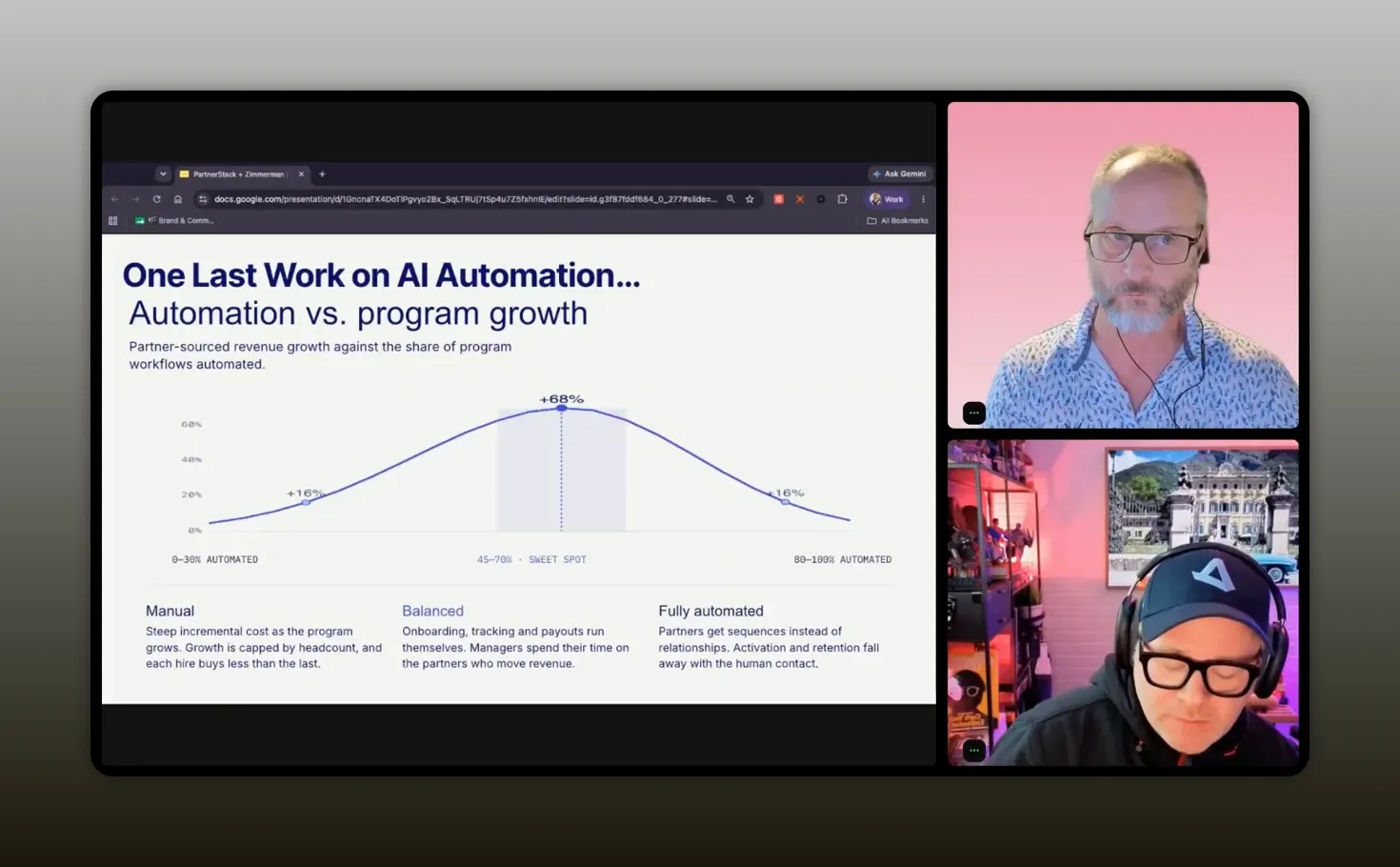
“The programs that are succeeding have figured out the things that should be automated and the things that should not be automated.” -Tyler Calder
Good AI use cases for partner teams
- Creating a morning brief that prioritizes partner actions based on current signals.
- Identifying deals that have stalled and suggesting the most relevant partner to involve.
- Drafting outreach that a partner manager reviews and personalizes.
- Finding partners that match a defined ideal partner profile.
- Flagging partners that may be ready for a tier change.
- Delivering just-in-time enablement prompts based on activity or inactivity.
- Making it easier to submit leads and deal registrations where teams already work, such as Slack, Teams, or email.
Where humans should stay in the loop
- Strategic partner planning and executive relationships.
- Compensation conversations and conflict resolution.
- Complex deal strategy involving multiple partners.
- High-stakes recovery conversations with a dissatisfied partner.
- Any communication where context, tone, and trust matter more than speed.
AI is not the strategy. It is an execution layer. The quality of what it gives you depends on the quality of the data, definitions, and context you provide. Spend more time building that foundation than you spend chasing flashy prompts.
Tools
Your exact tech stack will depend on your maturity, partner types, revenue model, and internal systems. The point is not to collect tools. The point is to connect the tools that hold meaningful partner context.
- PartnerStack PRM or ecosystem platform: Use it as the operating system for partner profiles, deal registration, program activity, reporting, tiers, and payouts.
- CRM: Connect partner data to the sales pipeline so partner influence is visible in the revenue motion.
- Marketing automation: Track demand activity and coordinate relevant partner campaigns.
- Call intelligence and transcription: Use call context to understand who really influenced an opportunity. Tyler specifically noted tools such as Gong, Granola, and Plaud as examples worth considering.
- Collaboration tools: Slack, Teams, and email remain essential because people prefer working where they already work.
- AI model and secure connector: Use an LLM and appropriate integration layer to query connected data and build partner workflows safely.
Do not make a tool decision purely because it promises AI. Start with reporting, attribution, partner operations, enablement, and financial accuracy. Once that foundation is in place, AI can become much more useful. For a deeper look at connecting partner data to AI-native workflows, explore how PartnerStack MCP supports AI-native partner program workflows.
FAQs
When should you move from spreadsheets to a PRM platform?
You should consider a dedicated platform when spreadsheets and shared documents are creating missed follow-ups, inconsistent partner experiences, heavy finance reconciliation, poor reporting, or shadow processes across sales and operations. Early programs can work well with simple tools, but complexity eventually requires a stronger source of truth.
What is the most important partner program metric?
There is no single metric for every program. Start with the business outcomes your leadership cares about, including sourced and influenced pipeline, revenue, win rate, ACV, retention, expansion, and deal velocity. The best metric is one that connects partner activity to a real business outcome.
Why is partner attribution important for AI workflows?
AI needs accurate context to make useful recommendations. If your attribution model does not reflect who influenced a deal, why a partner matters, or where activity happened, automated recommendations can be wrong. Better data produces better prioritization, next actions, investment decisions, and compensation outcomes.
How can you activate more inactive partners?
Do not rely only on generic emails, static courses, or resource libraries. Use activity signals to offer just-in-time support. Give new partners a clear first action, help engaged partners identify account opportunities, re-engage formerly active partners personally, and focus recruitment on partners that show signs they will activate.
Should partner teams automate outreach with AI?
Yes, with restraint. AI can help draft outreach, prioritize accounts, identify deal risks, and prepare relevant context. Keep humans involved for strategic relationships, sensitive conversations, partner conflict, complex deals, and communications where personal trust is central.
Conclusion
Your partner program does not scale because you add more partners, dashboards, or automation. It scales when you build an operating model that makes the right action easier at the right moment. Get the fundamentals right: a credible attribution story, connected partner data, clear program rules, timely enablement, accurate payouts, and visibility inside the sales motion. Then use AI to remove the busywork, not the relationship. That is how you turn partnerships from a promising channel into a disciplined, trusted revenue engine.