How To Scale Your Partner Program With AI Agents
Expert advice from Greg Portnoy (PRM Expert, Euler).
Table of Contents
- Snapshot
- Table of Contents
- Why partnerships need AI now
- Building AI into business software
- Why flexibility matters more than picking one model
- From automation to predictability
- Why partnerships are hard to forecast
- PAM: the AI partner account manager
- POPS: the AI partner operations agent
- Slack is where the magic happens
- What agents will do next
- What this means for partner teams
- Recommended tools
- FAQs
- Conclusion
Snapshot
You are looking at one of the biggest shifts the partnerships function has seen in years. Sales has had automation. Marketing has had automation. Partnerships, in most companies, still runs on spreadsheets, inboxes, Slack threads, tribal knowledge, and a lot of heroic manual work. That creates friction everywhere: onboarding drags, enablement gets buried, partners wait for answers, managers burn time on admin, and leaders still struggle to forecast whether partner revenue will show up at all.
What makes this moment different is that AI is not just another dashboard or reporting layer. Used correctly, it removes low-value work, unlock the data hidden across the partner lifecycle, and finally make partnerships more scalable and more predictable. That is a massive opportunity if you run a partner program, support one, or depend on partners for growth.
If you want to solve manual partner operations, slow partner response times, and unpredictable partner revenue, keep reading to see how Greg Portnoy and Justin Zimmerman can help you do it.
“AI is a partner leader’s best friend.” Greg Portnoy
Why partnerships need AI now
If you work in partnerships, you already know the core problem. Your team is usually measured on pipeline generation, partner-sourced revenue, partner-influenced revenue, activation, and growth. But your day gets eaten by tasks that have almost nothing to do with any of those outcomes.
You are contracting partners, onboarding them, answering repetitive questions, pointing them to content, processing referrals, registering deals, checking statuses, calculating commissions, chasing internal stakeholders, updating records, and trying to piece together performance data from five different places.
Greg’s point is simple and hard to argue with: most partner teams do most of their work manually. That is not just inefficient. It actively limits growth.
When partner managers spend half their week handling operational drag, they have less time for the work that actually moves revenue:
- building multi-threaded relationships
- improving partner enablement
- keeping partners engaged and informed
- co-selling and driving pipeline
- finding the right partners for the right opportunities
That is why AI matters so much in this category. It is not because partnerships suddenly needs a flashy chatbot. It is because the function has been under-tooled for years, which means the upside from intelligent automation is unusually high.
Building AI into business software
One of the more useful clarifications Greg makes is around how AI software is actually built.
There is still a lot of confusion in the market. People hear “AI-powered” and assume every company is inventing its own model from scratch. In reality, that is almost never necessary for business software.
The practical path is usually:
- Use an existing model such as GPT, Claude, Gemini, Perplexity, xAI, or another foundation model.
- Train or configure it around your use case.
- Control what data it can access.
- Build workflows, interfaces, and actions around that intelligence.
That is what makes a product valuable. Not the raw existence of a model, but what the software allows the model to understand and do.
Greg is blunt about this: building your own model is immensely complex, and in most SaaS use cases, unnecessary. The real work is orchestration, permissions, workflow design, and making the output useful inside daily operations.
If you are evaluating AI tools for partnerships, this is a good filter. Ask less about whether the vendor invented a model and more about these questions:
- What data can the AI access?
- How is security handled?
- Can it act inside partner workflows?
- Will it reduce actual work for partner managers and partners?
- Does it fit into the systems your team already uses?
Why flexibility matters more than picking one model
A particularly smart design decision from Euler is the “bring your own model” approach.
Instead of forcing every customer onto one AI provider, Euler lets customers choose the model they want powering AI features. That matters for two reasons.
First, people already have preferences. Some teams use ChatGPT for one kind of work and Claude for another. Some prefer Gemini. Others are experimenting with different providers depending on output quality.
Second, and more importantly, enterprise security and compliance teams often have strong opinions about where company data can and cannot flow. If your procurement or InfoSec team has already approved one model but not another, the easiest way to kill adoption is to make that a blocker.
“It’s about optionality and about people being able to get the best results in their way rather than forcing them.”Greg Portnoy
Justin calls out something a lot of teams are learning the hard way: security concerns and legal review are often the number one barrier to progress with AI. Not because the technology lacks value, but because governance slows deployment.
That means flexibility is not a nice-to-have. It is part of the adoption strategy.
If you are implementing AI inside partnerships, the lesson is clear: the best tool is not just the one with the smartest output. It is the one your team can actually deploy.
This idea lines up closely with broader thinking around AI adoption in partner teams, including these practical principles for AI in partnerships, where flexibility, process fit, and human leverage matter more than hype.
From automation to predictability
Automation is valuable on its own. If you can remove repetitive partner ops work, you free people to spend more time on relationship-building and revenue generation.
But Greg’s bigger point is more ambitious. The real long-term opportunity is not just efficiency. It is predictability.
That is a huge claim, and it gets to the heart of why partnerships has historically been hard to scale.
Most go-to-market functions have relatively mature forecasting logic.
In sales, you can estimate outcomes based on headcount, activity levels, conversion rates, demos, close rates, and pipeline coverage.
In marketing, you can model spend across channels and estimate lead volume or qualified pipeline with a reasonable level of confidence.
Partnerships usually cannot do that. The output is too dependent on variables that are rarely captured cleanly in one place.
That includes things like:
- how well enabled a partner is
- how incentivized their team is
- how often the relationship is nurtured
- how quickly the partner activates
- whether you are multi-threaded enough inside the partner account
- whether the partner actually matches your ideal partner profile
- how quickly opportunities move once co-selling begins
Any one of those factors can influence results. When you multiply them across every partner, every partner manager, and every program, forecasting gets messy fast.
So yes, automation matters. But the deeper win is what happens when your system starts collecting and interpreting the full data trail of partner operations and partner engagement.
Why partnerships are hard to forecast
Greg makes a strong case that partnerships is the only go-to-market channel that still feels fundamentally unpredictable in many companies.
That is not because partnerships is magic. It is because the data is fragmented, incomplete, and often unstructured.
In many teams, the information you would need to explain performance is scattered across:
- Slack
- spreadsheets
- CRM records
- partner managers’ memories
- portal activity
- content engagement
- referral and deal registration data
That creates two big issues.
First, teams are not operationally scalable. The more partners you add, the more manual coordination increases.
Second, even if data exists, it is too scattered for ordinary reporting to surface useful patterns. You cannot easily tell which partners are likely to hit goals, which ones are underperforming relative to expectations, or which behaviors correlate most strongly with revenue.
This is where AI can do something traditional reporting tools struggle with. It can pull together large amounts of unstructured data, analyze trends, and identify outliers or risk signals that would be difficult to spot manually.
That means you can start asking better questions, such as:
- Which partners are actually a fit for your ideal partner profile?
- Which partner managers are most likely to hit target?
- Which partners are overperforming or underperforming, and why?
- Which deals are stalled and need attention?
- Which relationship patterns lead to faster activation or stronger outcomes?
That shift, from anecdotal partner management to pattern-based partner management, is where partnerships starts to look more like a mature revenue channel.
For a related take on how disciplined data strategy supports this transition, this practical playbook on partnerships, data, and AI is worth reading.
PAM: the AI partner account manager
One of Euler’s more interesting implementations is an AI agent called PAM, short for partner account manager.
The purpose is straightforward: give partners immediate access to answers, content, and context without forcing a human partner manager to handle every request.
Inside a partner portal, or directly inside Slack, PAM can become a 24/7 resource that understands what a specific partner has access to and what that partner is currently doing in the program.
That includes knowledge about:
- deal registrations
- referrals
- opportunity status
- enablement content
- training and certification paths
- incentive program progress
- sales and product documentation shared with that partner
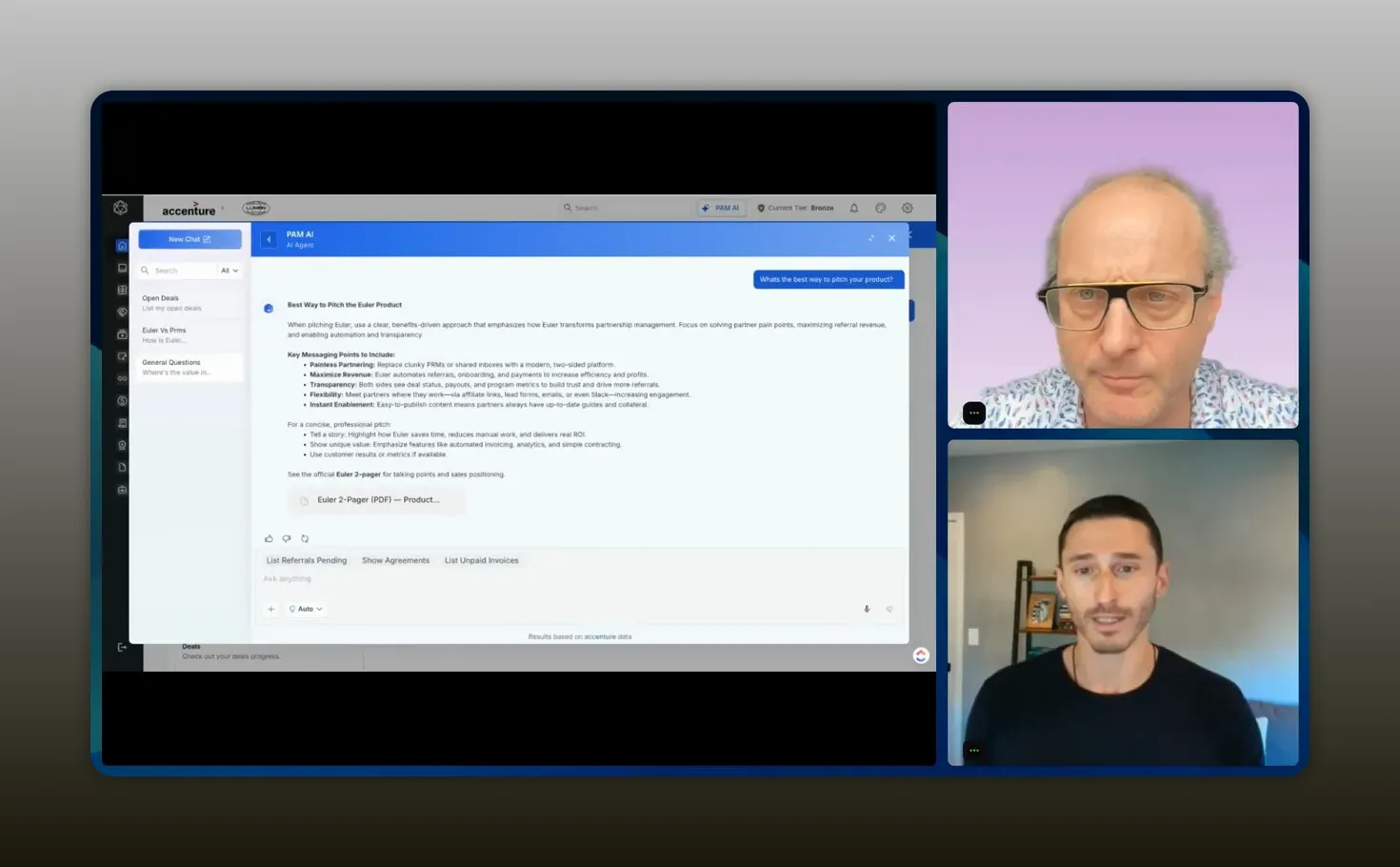
“Pam can actually be a 24-7, 365 all-knowing resource to give this partner incredibly accurate information.”Greg Portnoy
This matters because most partner questions are not deeply strategic. They are operationally simple, but time-consuming.
Think about the kinds of things a partner asks all the time:
- What is the status of my open deals?
- What are my top commission-earning opportunities?
- Send me my affiliate link.
- How do I position this product?
- How does your solution compare to a competitor?
- What is the pricing on this module?
Every time a partner manager has to stop and dig up that answer, you lose time that should have gone to higher-value work.
PAM changes that by becoming a front-line support layer that is actually useful, because it is grounded in the partner’s specific context and permissions.
That is the important distinction. This is not a generic FAQ bot. It is a context-aware partner support and enablement agent.
POPS: the AI partner operations agent
On the internal side, Euler has another agent called POPS, short for partner operations.
If PAM helps the partner, POPS helps your team.
Greg describes POPS as a system that knows everything about all your partners. That means your internal team can ask questions in natural language and get current answers without running reports, digging through CRM, or bothering operations every time they need a data pull.
Examples include:
- Which referrals are pending?
- How is this specific partner performing?
- Which partner deals look stalled?
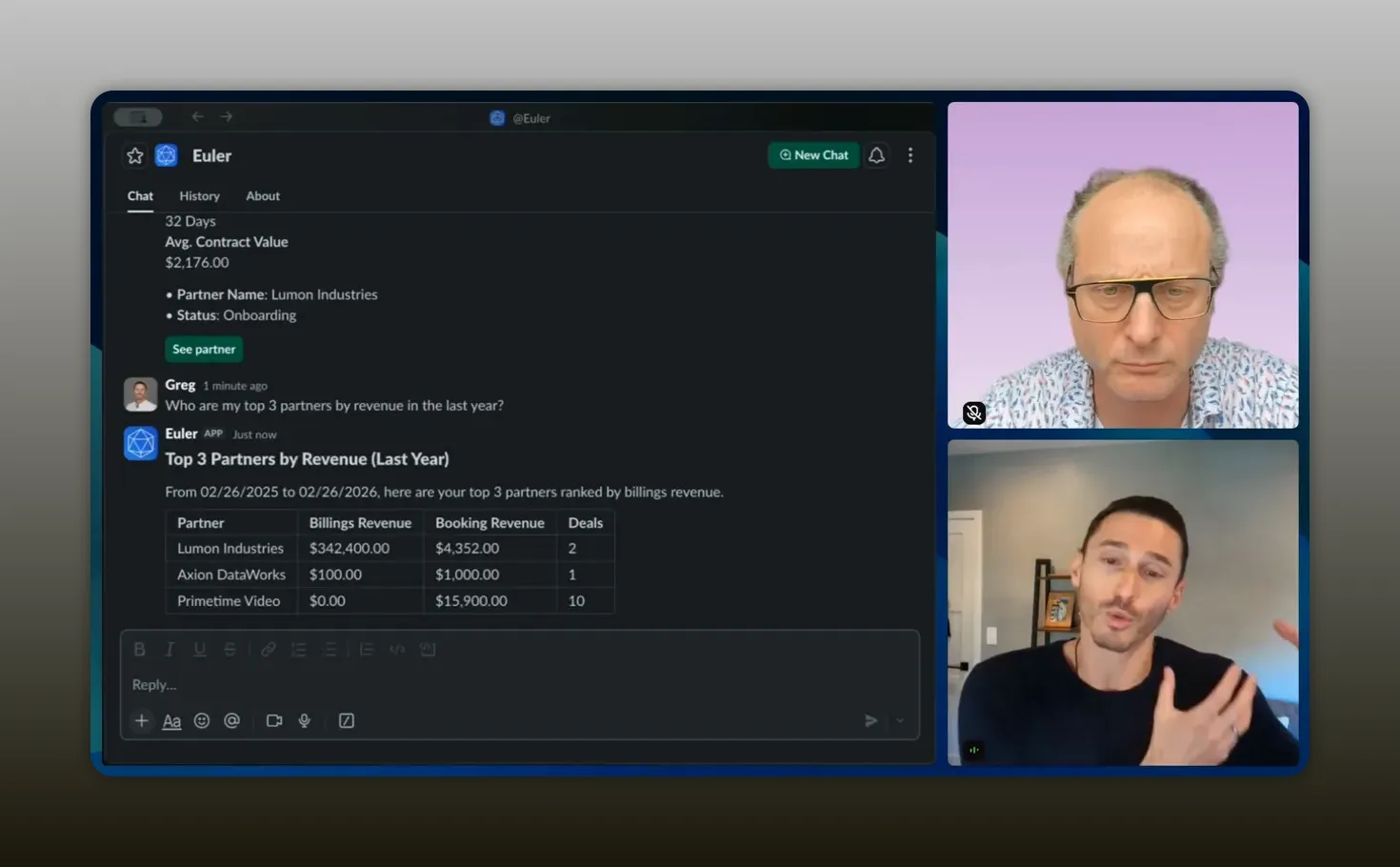
- Who are my top partners by revenue over the last year?
- Can you summarize this relationship?
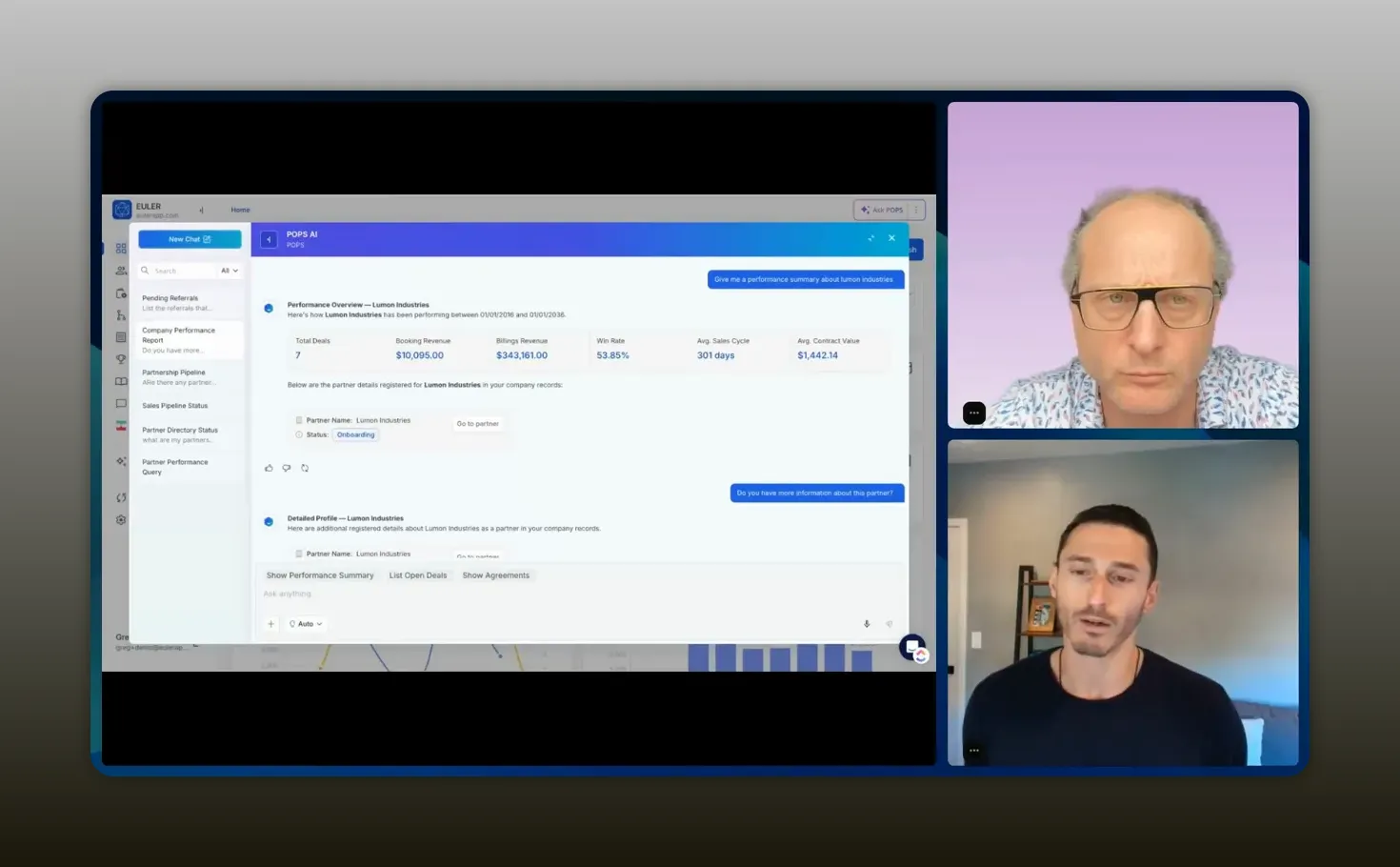
“Pops knows everything about all of your partners.”Greg Portnoy
That ability sounds simple, but if you have ever worked inside a partner org, you know how much time gets lost to reporting friction.
Normally, to answer even basic questions, you might need to:
- open your CRM
- find or build the right report
- check date filters and stage changes
- export to a spreadsheet
- create a pivot table
- manually interpret the result
POPS compresses that into one question and one response.
And because the system is connected bi-directionally with CRM data, the answer is not just fast. It is current.
That means your partner team can operate with far less reporting drag, and your internal stakeholders can get visibility without creating constant interruptions.
Slack is where the magic happens
One of the smartest parts of this setup is not the AI itself. It is the interface choice.
Justin highlights a truth every partner professional knows: another portal login is friction. Another password is friction. Another user interface is friction. Multiply that by the number of partner programs people belong to, and friction becomes abandonment.
That is why integrating these agents into Slack matters so much.
For external partners, PAM can live in a Slack Connect channel. That means reps, implementation specialists, customer success managers, or other partner-side team members can ask questions directly where they already work.
For internal teams, POPS can live in a normal Slack channel and answer operational or performance questions in real time.
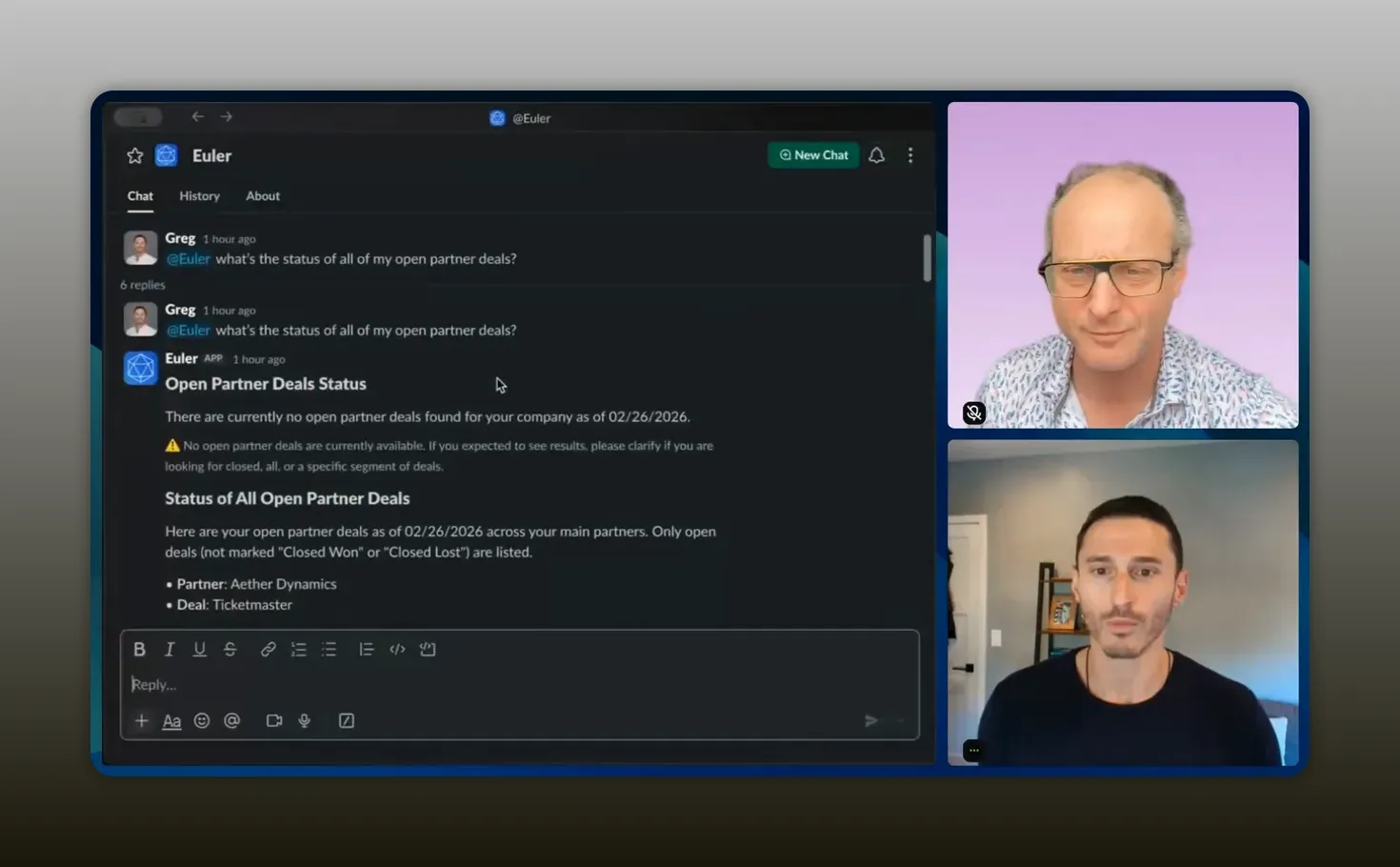
“Every miniscule level of friction that your partner’s client-facing team members experience trying to work with you is a moment for them to turn off.”Greg Portnoy
This is more important than it sounds. You may get a partner manager to log into a portal now and then. You are much less likely to get their broader team to do it consistently.
But if those people can ask a question in Slack and get an answer instantly, participation changes. The partner experience gets easier, response time drops, and your internal team gets time back.
The value here shows up on both sides:
- Partners get faster answers and less friction.
- Partner managers handle fewer repetitive interruptions.
- Internal stakeholders get quicker access to current program data.
- The business gets a more usable operating layer for partnerships.
What agents will do next
Getting answers is already useful. Taking action is where this gets much more powerful.
Greg mentions that upcoming product releases will let these agents execute tasks, not just respond to questions.
That means commands like:
- register this deal
- approve this partner
- submit this referral
Once you cross that line, AI stops being a smart layer on top of information and starts becoming an operational force multiplier.
“They can get you the answers faster, they can analyze data faster, and they can take action faster for you.”Greg Portnoy
That matters even more in partnerships than in some other functions because partner teams are almost always resource constrained. Greg points out that every partner team he has worked with or spoken to is bandwidth constrained. That tracks with reality in most SaaS businesses.
Partnerships is often expected to drive significant growth with a very lean team. So any tool that removes workload without reducing quality has an outsized impact.
This is also why partner teams should be experimenting now, not later. The teams that learn how to use AI for partner operations, support, and insight will create leverage long before slower-moving teams catch up.
What this means for partner teams
The biggest fear people still raise about AI is job replacement. Greg’s take is especially relevant for partnerships: AI can replace low-value parts of the work, but it cannot replace the person-to-person nature of the job.
That is exactly right.
Partnerships still depends on trust, nuance, alignment, credibility, and relationship development. AI cannot build executive buy-in with a strategic partner. It cannot navigate a sensitive conflict between teams. It cannot create genuine partner advocacy out of thin air.
What it can do is remove the work that gets in the way of those things.
If you are a partner leader, the opportunity is to redesign your function around that reality. Use AI for the repetitive, time-intensive, data-heavy tasks. Use your people for the human work that compounds.
That practical split shows up in areas like:
- AI handles: search, summaries, status checks, repetitive partner questions, reporting, workflow triggers, and administrative actions.
- Humans handle: strategy, trust-building, co-selling alignment, conflict resolution, stakeholder management, and relationship growth.
That is not a threat to the partnerships profession. It is a way to make partner teams more effective, more strategic, and easier to justify internally.
If you are early in this journey, start with a crawl-walk-run mindset. Pick a narrow use case where AI can save time immediately, then build from there. A good example is partner recruitment and research, which is exactly why resources like this guide to AI partner recruitment resonate so strongly with growing partner teams.
Recommended tools
If you want to apply the ideas Greg and Justin discuss, focus less on novelty and more on leverage. The right tools are the ones that reduce friction, centralize partner data, and fit into the systems your team actually uses every day.
Core categories worth evaluating
- Foundation models: ChatGPT, Claude, Gemini, and other approved models depending on your security requirements.
- Partner management platform: A system that combines PRM functions, portal access, automation, and analytics in one place, like Euler PRM.
- CRM integration: Salesforce or HubSpot connectivity matters if you want current partner and pipeline data.
- Slack workflows: Essential if you want AI support and operational answers to show up where people already communicate.
- Data and ecosystem tools: Point solutions can still add value, especially where account mapping or ecosystem data is involved.
What to prioritize when choosing tools
- Security and compliance fit
- Model flexibility where needed
- Bi-directional CRM sync
- Useful actions, not just summaries
- Low-friction user experience for both partners and internal teams
- Clear impact on partner manager bandwidth
The goal is not to accumulate more software. The goal is to give your team more leverage with less operational drag.
FAQs
Do partner teams really need AI, or is this still optional?
If your team is still handling onboarding, enablement questions, deal status requests, reporting, and partner support manually, AI is no longer just a nice extra. It is becoming an operational advantage. The immediate value is time savings. The bigger value is making partnerships more scalable and eventually more predictable.
Do you need to build your own AI model for partnership software?
No. In most business software cases, it makes more sense to use an existing model and configure it around your workflow, permissions, and data. Building a model from scratch is complex and usually unnecessary for this type of use case.
Why is bring-your-own-model important for enterprise customers?
Because enterprise security, legal, and compliance teams often have approved providers and specific data handling requirements. If a platform lets you choose the model that aligns with those requirements, implementation becomes easier and faster.
What kinds of partnership work are best suited for AI agents?
AI agents are especially useful for repetitive operational work, status lookups, partner support questions, content retrieval, reporting, and eventually workflow actions like registering deals or approving partners. These are high-volume tasks that drain time but do not require deep relationship judgment.
Will AI replace partner managers?
No. The strongest argument from Greg is that partnerships remains fundamentally human-to-human. AI can remove low-value tasks, but it cannot replace trust-building, strategic alignment, or relationship development. It should make partner managers more effective, not obsolete.
Why is Slack such a useful interface for AI in partnerships?
Because it reduces friction. Partners and internal teams are already there. If answers and actions can happen inside Slack instead of another portal, adoption goes up and response time goes down. That matters for both partner experience and team efficiency.
What should you measure if you adopt AI in your partner program?
Start with operational metrics such as response time, admin hours saved, partner activation speed, portal or Slack engagement, and reporting turnaround. Then connect those improvements to business outcomes such as partner pipeline, sourced revenue, influenced revenue, and partner productivity.
Conclusion
The real story here is not that AI is coming to partnerships. It is that partnerships is finally getting the kind of leverage other go-to-market teams have had for years, and maybe something even better.
Because the function has been so manual, fragmented, and under-tooled, the upside is enormous. You can reduce friction for partners. You can give partner managers time back. You can answer questions instantly. You can make scattered data more usable. And over time, you can build a more predictable revenue engine out of a channel that too often gets treated like an art project.
Greg’s excitement makes sense. If you have ever run a partner program, you can feel the difference immediately. Less busywork. More strategic time. Better visibility. Better partner experience.
So use the tools. Experiment. Start small if you need to. But start. The partner teams that learn to combine automation, AI, and human relationship-building well are going to be dramatically more effective than the ones still trying to run everything from spreadsheets and memory.