Live Build… Claude CoWork For Automated Co-Marketing Results
Expert advice from Scott Murtaugh (Founder, Growth Process Automation).
Snapshot
You have a bigger opportunity than simply using AI to write another partner email. The real opportunity is turning the scattered, resource-heavy work of co-marketing into a repeatable operating system. For partnership teams, especially teams of one, the bottleneck has shifted. Starting is no longer hard. Generating ideas, hooks, draft copy, and webinar concepts is relatively easy. The difficult part is getting from a promising idea to a campaign that is actually ready to run, complete with a shared value proposition, a brief, registration assets, email promotion, social posts, ownership, timelines, and measurement.
That matters because co-marketing is often the first practical activation with a new partner. If every campaign requires borrowing copywriters, designers, demand generation support, and operations help, you will place fewer bets and learn more slowly. A structured AI workflow can help you build the campaign foundation in under an hour while keeping your judgment firmly in the loop.
Keep reading to see how Scott and Justin Zimmerman can help you create partner campaigns, accelerate execution, and make more partnership bets.
“The harder problem now is getting to the execution piece.” -Scott
Table of Contents
- Why partner co-marketing stalls
- The plan, create, execute, measure loop
- Build context before you create copy
- Turn your process into reusable skills
- Create a joint value proposition
- Build a webinar brief and run of show
- Move assets into campaign execution
- Use AI with quality control
- Measure fit, not just activity
- Recommended tools
- Conclusion
Why partner co-marketing stalls
Co-marketing should be one of the easiest ways to activate a partnership. You have two companies with related audiences, complementary expertise, and a reason to put a useful story into the market together. A webinar, workshop, panel, guide, or event can create credibility, shared demand, and early partner-sourced opportunities.
Yet this motion routinely gets stuck. The challenge is rarely a lack of ideas. It is the operational pileup that begins after the idea is approved.
You need to agree on the audience. You need a point of view that is meaningful to both companies. You need a landing page, promotional emails, social copy, speaker coordination, a run of show, registration tracking, lead routing, and post-event follow-up. If you lead partnerships, you may need to request support from marketing at every stage, then wait for space in someone else’s queue.
Scott has seen this from the perspective of both small companies and larger organizations. After more than 15 years in B2B technology, data partnerships, and product partnerships, including management of a global partnership network at Yext, he understands the familiar pattern: partnership teams are asked to produce more revenue while constantly borrowing resources.
That is especially painful when you are a team of one. A campaign that should be a fast test turns into a quarterly project. You make fewer bets, activate fewer partners, and lose the chance to discover which joint messages and audiences create momentum.
Justin frames the stakes clearly: co-marketing is often a common road to revenue and a natural first activation with a partner. The issue is not whether the motion works. The issue is whether you can operate it at the speed your partner ecosystem requires.
The plan, create, execute, measure loop
A good AI-enabled co-marketing workflow does not begin and end with a prompt asking for a social post. It follows the same core campaign discipline you would use without AI:
- Plan: Define the partner, audience, objective, positioning, and campaign premise.
- Create: Produce the brief, event structure, promotional copy, and supporting assets.
- Execute: Turn approved assets into assigned, scheduled deliverables in the systems your team uses.
- Measure: Assess attendance, lead quality, ICP fit, and what the campaign tells you about the partnership.
AI can accelerate each stage, but it is particularly useful when the stages are connected. The output from planning should become the input to creation. The campaign brief should inform the email cadence and social posts. The resulting campaign data should inform the next test.
That is the difference between using AI as a blank-page assistant and using it as workflow infrastructure. The blank-page problem has become easier. The bigger problem is moving reliably from a generated idea to real execution.
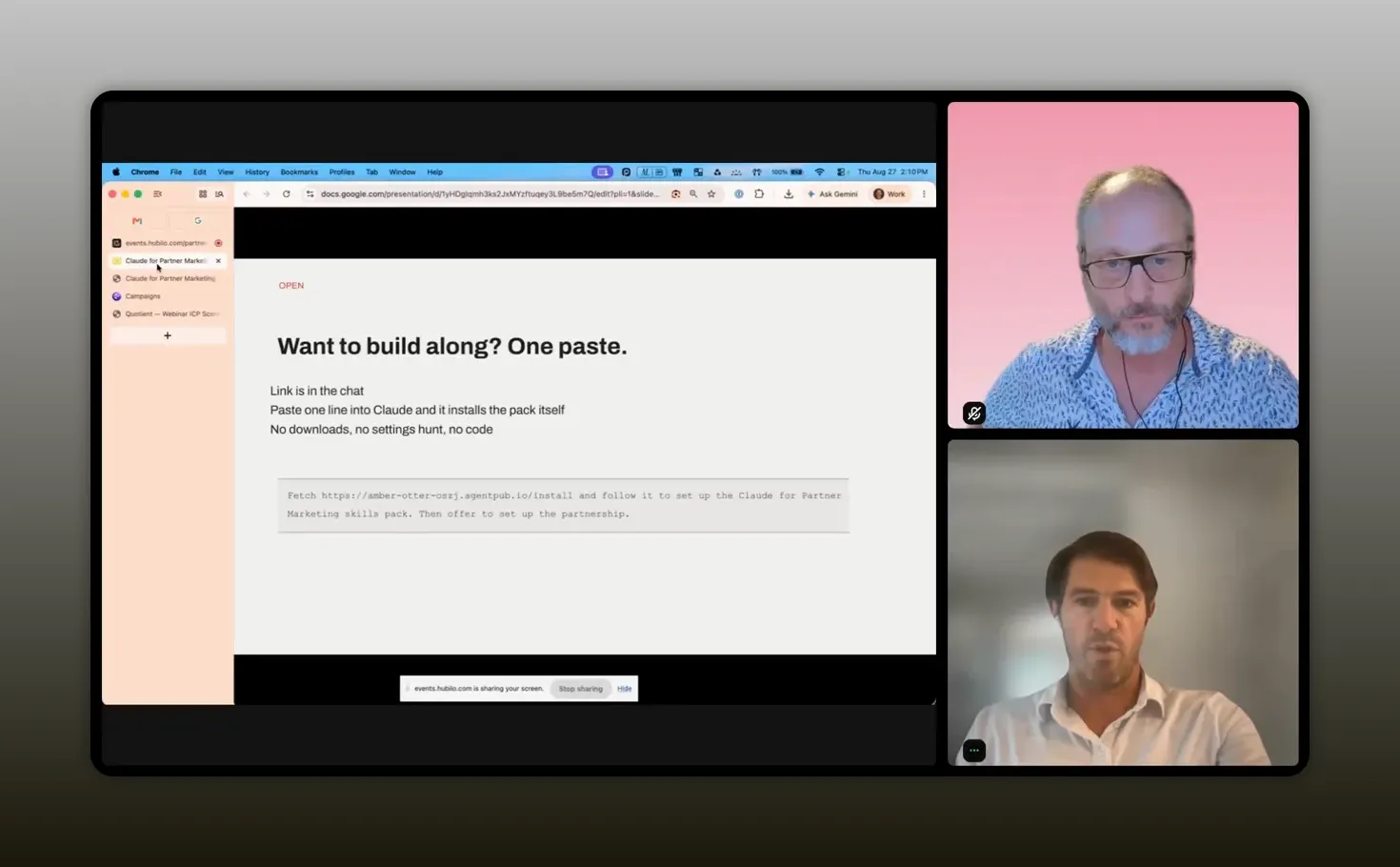
“We are going to plan, create, execute, and measure.” -Scott
Start with the loop, not the tool. If you only automate copy generation, you may create a larger backlog of material that still needs coordination, approvals, formatting, and scheduling. If you automate a documented process, you create a path from idea to action.
Build context before you create copy
The fastest way to get generic co-marketing is to provide generic input. A partner campaign needs more than a company name and a request for a webinar title. It needs the context that a good marketer or experienced partnerships leader would seek before writing anything.
Scott’s workflow begins by establishing the partner relationship and building the contextual documents that the subsequent tasks need. In a Claude project, that can mean working from a local folder that holds source material, campaign outputs, reusable instructions, and context documents.
Your context should answer questions like these:
- Who is your company, and what do you help customers do?
- Who is the partner, and what do they help customers do?
- Where do your capabilities complement each other?
- Which shared ICP is most likely to care?
- What pain, friction, or desired outcome brings that audience to the campaign?
- What claims can you credibly make together?
- Who is the campaign explicitly not for?
- What does your brand sound like when it is clear, useful, and specific?
Use the real materials you already have. Positioning documents, customer research, previous campaign briefs, product messaging, sales calls, and customer interviews all make the output better. Your strongest source of language is often the language customers already use to describe their problem.
That point is easy to overlook. Marketing teams can unintentionally invent new terms and then force the market to learn them. If you build messaging from the phrases customers use on calls, your co-marketing will usually feel more immediate and understandable.
When important context is missing, do not pretend it is there. Instruct the AI to identify what it needs to know and ask for it. This surfaces the unknowns that could otherwise weaken your positioning or produce a campaign based on assumptions.
For a deeper operational approach to turning context and best practices into reusable partnership workflows, see this Claude Co-Work partnership playbook.
Turn your process into reusable skills
A skill is best understood as a reusable standard operating procedure. Rather than re-explaining your preferred process in every chat, you document the process once and make it repeatable.
In Scott’s example, skills are stored as markdown files and used within a project. Each skill provides instructions for a particular job, such as setting up partner context, creating a joint value proposition, building a webinar brief, generating campaign assets, or reviewing quality. The workflow can then chain these skills together so the previous output becomes the next input.
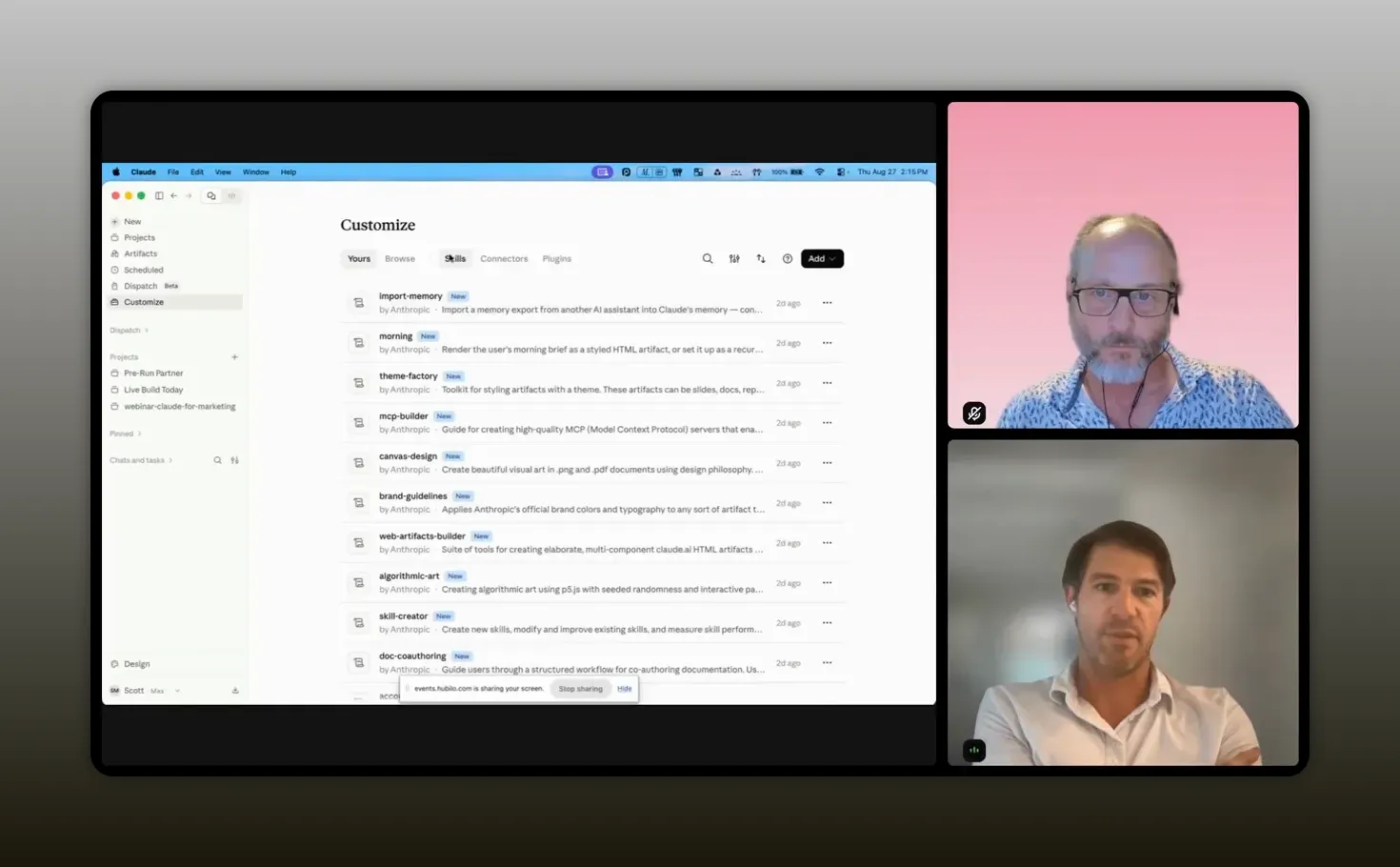
“Think about a skill as an SOP that lets you run the same process over and over.” -Scott
This approach produces compounding value. You do the hard thinking once about what a quality co-marketing campaign requires. Then you improve the system with every activation instead of rebuilding the campaign from scratch.
What a co-marketing skill should include
Your skill should be opinionated enough to create consistency, but flexible enough to handle the details of each partner. A useful structure includes:
- Purpose: The precise business outcome the skill should produce.
- Required inputs: Company context, partner context, audience, objective, date, offer, and relevant source materials.
- Process steps: The ordered decisions and deliverables to create.
- Output format: A consistent document format that makes review and handoff easy.
- Quality checks: Requirements for clarity, accuracy, voice, audience fit, and completeness.
- Escalation questions: Prompts the system should ask when it lacks essential information.
The task list capability inside a project is valuable because it gives the agent a structured sequence to follow. Instead of a purely turn-based conversation where you must constantly direct the next move, you have defined guardrails. The agent can work through the task list, retain the campaign context, and save outputs to the shared project location.
You should still inspect the work. Scott is direct about this: AI does not replace the judgment built through running partner tactics manually. That experience helps you notice a weak claim, a vague persona, an unrealistic goal, or messaging that sounds technically correct but commercially flat.
Create a joint value proposition
The joint value proposition is the center of your campaign. If you skip it, every downstream asset becomes a negotiation. The webinar title drifts. The emails become company-centric. The partner promotes one idea while you promote another. The audience cannot quickly understand why the two companies are together.
A strong joint value proposition answers one essential question: what becomes easier, faster, better, or possible for the shared customer because these two companies work together?
The output should define the overlap between both businesses without pretending they are the same. You are looking for the practical intersection of audience, problem, workflow, and outcome.
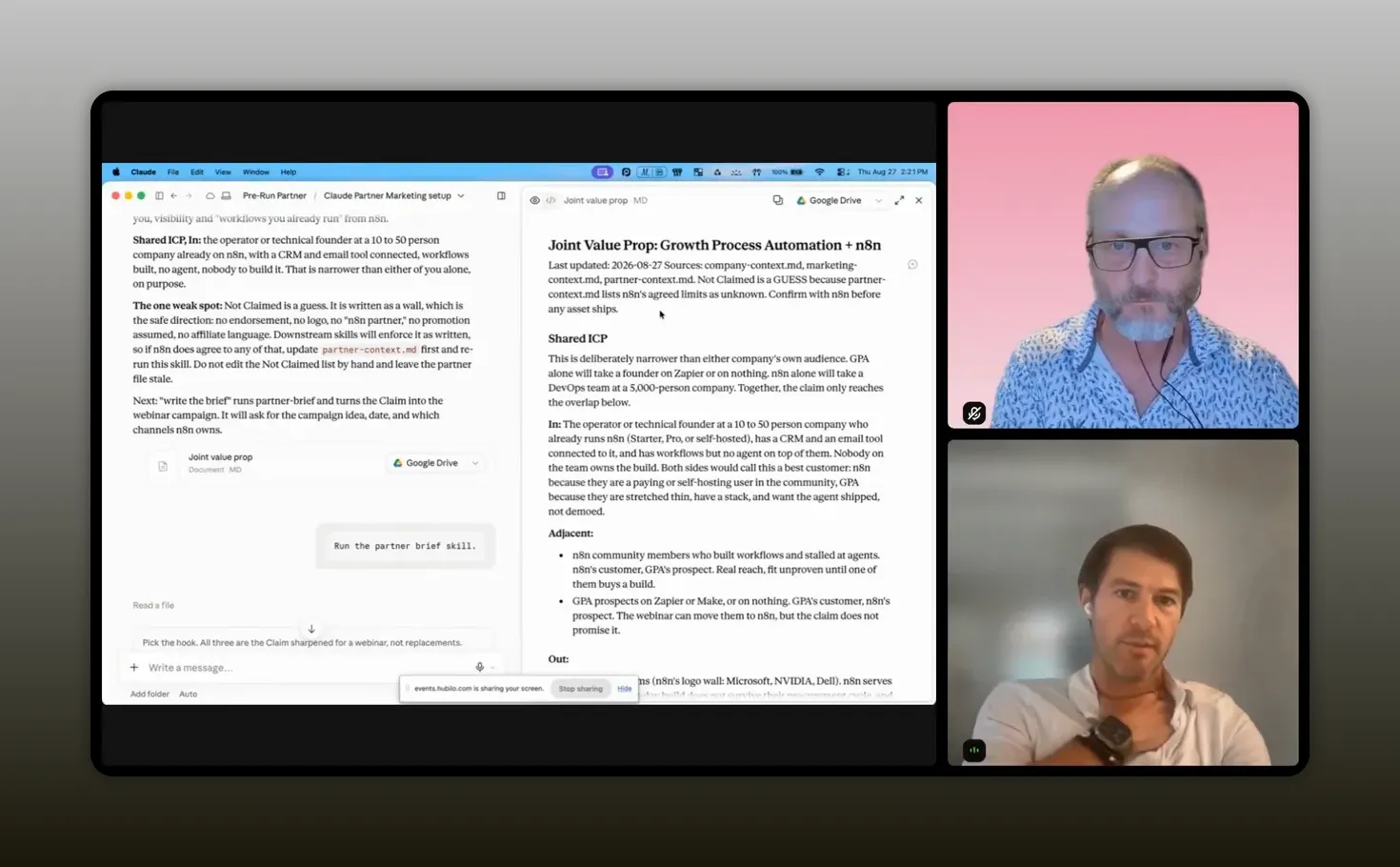
“Be clear about who this is for and who this is not for.” -Scott
Use the shared ICP to narrow the campaign
Start with the audience both companies can credibly serve. “B2B marketers” is not a shared ICP. It is a broad category. A sharper definition may include the role, company situation, workflow problem, and urgency that make the campaign timely.
Then identify the goodwill each company brings. One partner may have authority with a specific functional audience. The other may contribute a complementary technical capability or proven workflow. Together, you can make a useful claim that neither party could make as convincingly alone.
Be equally clear about exclusions. If the campaign serves early-stage teams without a marketing operations function, say so. If it applies to a particular use case but not broad enterprise transformation, make that distinction. Clarity protects campaign quality and helps the right people self-select.
Generate multiple hooks, then choose deliberately
A useful workflow can generate three potential hooks rather than force you to settle for the first idea. That gives you options to compare:
- A problem-first hook that names a frustrating status quo
- An outcome-first hook focused on what the audience can achieve
- A workflow-first hook that explains how to make the change
Your job is to choose the hook that has the best overlap of partner credibility, audience urgency, and campaign objective. Do not select a hook merely because it sounds clever. Select it because it creates a clear reason for the right people to register and participate.
Build a webinar brief and run of show
Once you have partner context and a joint value proposition, turn the strategy into a campaign brief. This is where the initiative becomes real. A brief gives your partner, marketing team, speakers, and operations team one shared source of truth.
Scott’s co-marketing workflow generates an overall brief that includes the hook, goal, audience, and campaign elements. It can also ask for practical variables, such as the date and the outcome you want the program to achieve.
A useful webinar brief should cover:
- Campaign objective: What the initiative is designed to accomplish.
- Primary audience: The shared ICP and the situation that makes them relevant.
- Core promise: The practical value attendees will leave with.
- Title and hook: The clear, compelling campaign frame.
- Partner roles: Who owns the expertise, promotion, logistics, and follow-up.
- Agenda: The order of ideas, examples, demonstrations, and takeaways.
- Call to action: The next appropriate step for a qualified participant.
- Promotional plan: Landing page, emails, social posts, partner kit, and schedule.
Use voice input if it helps you move more quickly. Scott demonstrates making a spoken adjustment to a target percentage in the brief. The important lesson is not the feature. It is the ability to review a generated document, make an informed correction, and have that refinement flow into the full campaign output.
For webinars specifically, the best format is usually practical rather than promotional. Your shared audience should leave with a checklist, framework, process, or clear next action. This partner webinar playbook offers additional guidance for choosing objectives, promotion, registration, and follow-up.
Make the run of show useful
A run of show should do more than list speaker names and timestamps. It should show what each segment is supposed to accomplish. If you are building a workshop, include the live exercise. If you are demonstrating a workflow, explain the before state, the process, and the result. If you are telling a partner story, connect it directly to the shared audience problem.
The goal is to remove ambiguity before the event. A well-built run of show helps speakers prepare, creates a more cohesive experience, and makes it easier to repurpose the material afterward.
Move assets into campaign execution
This is the crucial leap. A polished brief is not a campaign. A folder full of generated copy is not a campaign either. Execution begins when your assets become scheduled deliverables with visible ownership.
Scott uses Quotient as the marketing execution platform in this workflow. Through an MCP connection, the AI workflow can publish campaign content into the execution environment. The practical result is a campaign space that contains the brief, tasks, activation timeline, social posts, and email broadcasts.
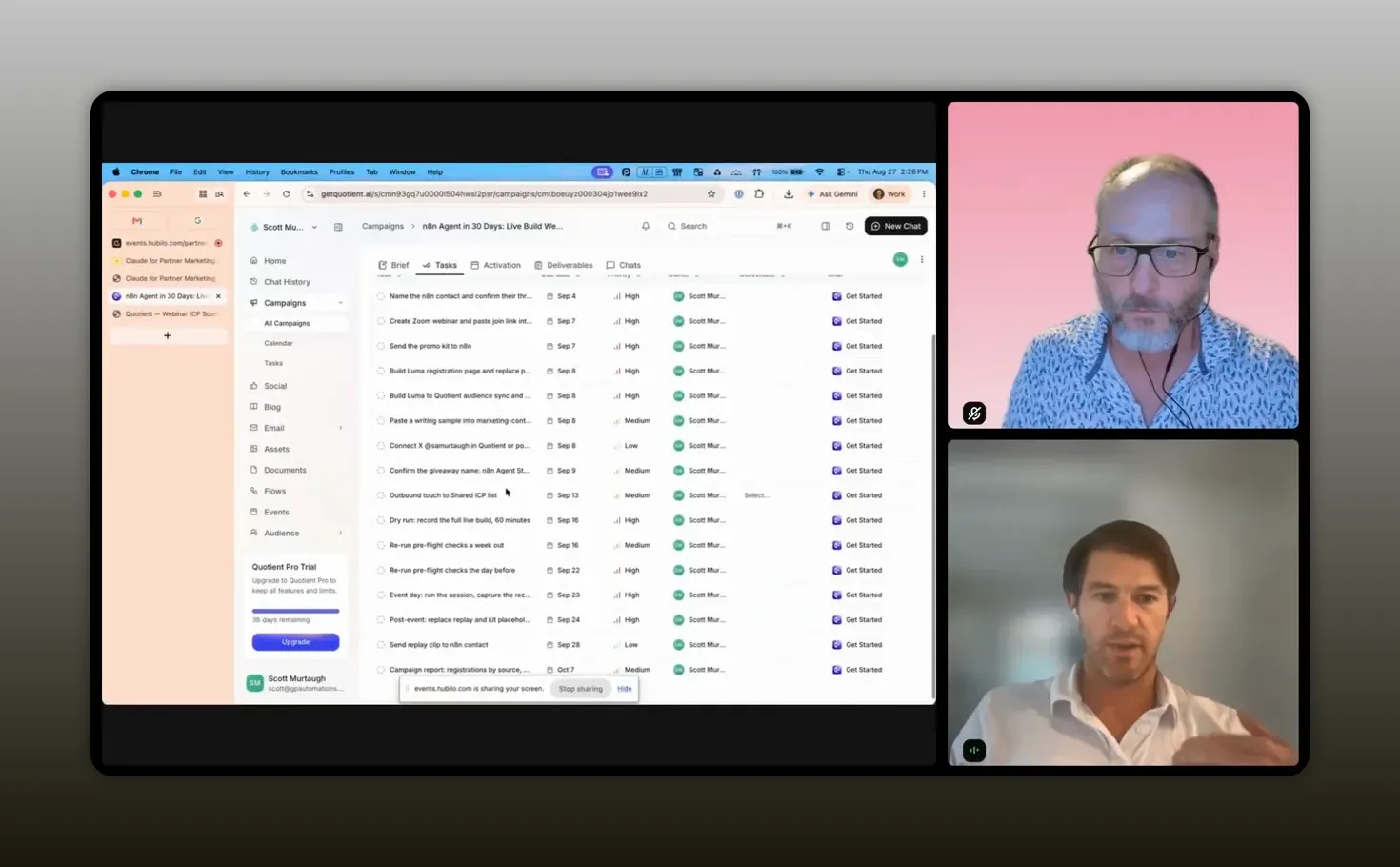
“The ability to turn an idea into deliverables has gotten a lot faster.” -Scott
That shift changes the way a lean partnership team operates. Instead of sending scattered documents to marketing and hoping the pieces come together, you can provide a structured campaign package. Marketing can see what needs review, what is scheduled, and where changes are needed.
Build a complete promotional kit
At minimum, a co-marketing promotion kit should include the materials both partners need to promote consistently:
- Registration page copy and primary call to action
- Email invitation and reminder cadence
- Organic social posts for each company
- Partner-ready copy that can be used with minimal editing
- Visual asset requirements or image-generation requests
- Publishing dates and owners
- Follow-up messaging for registrants and attendees
The campaign platform shown in the workflow includes editable social posts and an email editor, making it possible to inspect the content in context before scheduling. You can remove elements that do not fit your brand, such as unnecessary hashtags, revise calls to action, or request supporting images.
AI should reduce the time it takes to create the first complete version. It should not remove your responsibility to ensure the final version represents both brands accurately.
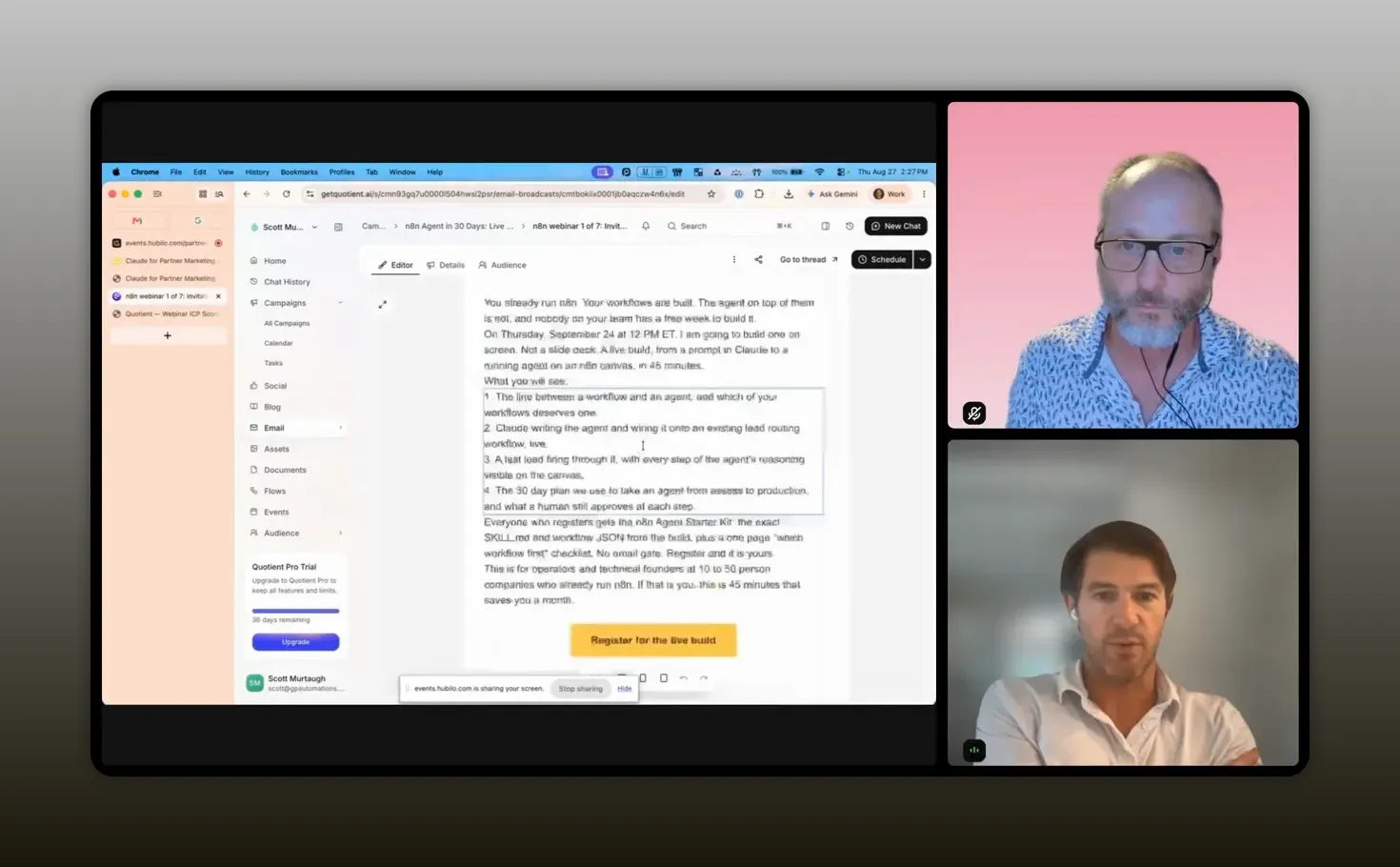
“Read the copy and make sure it matches your voice and tone.” -Scott
There will still be tasks outside the workflow, such as setting up event links, confirming speakers, handling approvals, and finalizing audience lists. The advantage is that those tasks no longer compete with the fundamental work of drafting every single asset. You arrive at the operational handoff with a coherent campaign rather than an unfinished idea.
Use AI with quality control
The risk of an AI workflow is not simply that it will make mistakes. The larger risk is that you will move too quickly to notice them. When outputs appear polished, it is easy to accept them without applying your judgment.
Scott’s process includes a QA skill that reviews what has been created and flags passes or warnings. That is a smart pattern. Quality assurance should be designed into the workflow, not treated as a vague hope at the end.
Before publishing, review the campaign against a simple checklist:
- Accuracy: Are company descriptions, product capabilities, partner claims, and event details correct?
- Audience fit: Does every asset speak to the same shared ICP?
- Joint value: Is the reason for the partnership obvious, or are two separate messages competing?
- Voice: Does the copy sound like your organization and respect the partner’s positioning?
- Action: Does each asset give the audience a clear next step?
- Operational completeness: Are dates, links, owners, assets, and follow-up actions accounted for?
The best safeguard is strong source material. If your project contains clear voice guidance, current positioning, and high-quality customer language, the first draft will be far more useful. If your source material is weak, your outputs will only become more confidently generic.
You can also use external documentation to understand the platform capabilities and setup options for Claude, but your internal process matters more than any single tool. The value comes from connecting reliable inputs, structured skills, human review, and execution systems.
Measure fit, not just activity
Measurement closes the loop. Too many partner campaigns stop at registration volume, attendance, or the number of posts published. Those are useful activity signals, but they do not tell you whether the campaign created the kind of opportunity your partnership strategy needs.
In the final step of Scott’s workflow, a skill can pull in attendee information and compare it against the ICP. That makes it possible to evaluate not only how many people came, but how well the audience matched the intended market.
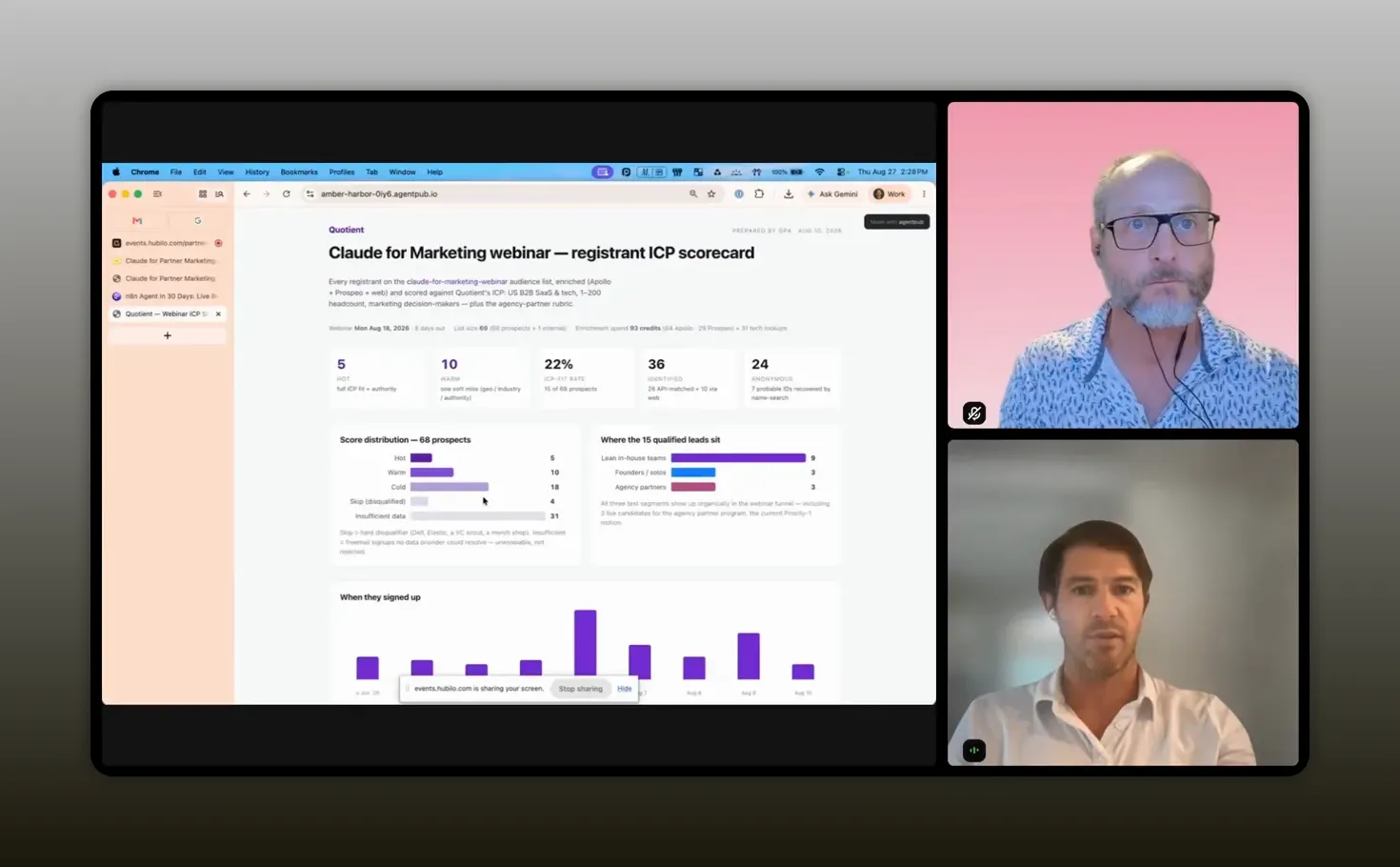
“You can test more, build more, and create partner-sourced leads quicker.” -Scott
Questions to ask after every campaign
- Did the right types of accounts register and attend?
- Which partner contributed the strongest audience fit?
- Did the hook attract the intended persona?
- Did participants engage with the intended offer or next step?
- What objections, questions, and language appeared during follow-up?
- Is this partner and message worth repeating, refining, or expanding?
This is where scale becomes meaningful. The point is not to run more webinars for the sake of a busier calendar. The point is to run more informed experiments. If a manual process means you can only activate one partner campaign per quarter, you learn slowly. If a structured workflow enables an activation every two weeks, you can test partner fit, messaging, audience segments, and offers with much more speed.
That creates a practical advantage for teams with limited headcount. You can make more focused bets while retaining enough discipline to see which ones deserve more investment. For more ideas on scaling this motion without expanding the team, explore how to create more co-marketing without the headcount.
Recommended tools
Your tech stack does not need to be complicated. It needs to support a connected process from context to execution to measurement.
- Claude Desktop and Projects: Use a paid Claude plan and the desktop environment to work with project folders, local context, instructions, outputs, and reusable skills.
- Growth Process Automation: build and manage AI-powered automations and go-to-market systems that help startups and SMBs reduce manual work and grow without adding headcount.
- Markdown skill files: Document repeatable SOPs for partner setup, joint value propositions, campaign briefs, QA, and measurement.
- Local project folders: Keep source documents, generated outputs, and campaign context together so the workflow has a durable working memory.
- Quotient: Use a marketing execution platform to bring campaign briefs, tasks, emails, social posts, and schedules into an operational system.
- MCP connectors: Connect AI workflows to the tools where work actually gets completed, rather than leaving content trapped in a chat.
- Event platform and CRM: Create registration links, capture attendance data, and support the measurement process for ICP fit and follow-up.
Choose tools based on your current process. You do not need every application on day one. Begin by documenting one co-marketing SOP, building the context package, generating one complete campaign brief, and creating a reliable QA step. Add execution connections once your core process is working.
Conclusion
Partner co-marketing does not need to be a quarterly scramble for borrowed marketing resources. When you build a workflow around planning, creation, execution, and measurement, you give yourself a repeatable way to activate partners with speed and consistency. Start with context. Define the shared audience and joint value proposition. Turn your best process into skills. Review the work with real judgment. Then connect the approved campaign to the systems where it can be scheduled, launched, and measured. That is how you move from more AI-generated material to more real partner momentum.
FAQs
How can AI help a partnership team run co-marketing campaigns?
AI can help you structure partner and marketing context, generate a joint value proposition, build a webinar brief, create promotional assets, run quality checks, and assess attendee fit against your ICP. Its strongest value comes from connecting those steps in one reusable workflow.
What is a joint value proposition in partner co-marketing?
A joint value proposition explains the distinct customer outcome made possible by two companies working together. It should identify the shared audience, the problem they face, the complementary roles of each partner, and the practical benefit of the combined approach.
Should you trust AI-generated partner campaign copy without editing it?
No. Use AI to accelerate the initial campaign build, then review every claim, audience assumption, call to action, and brand expression. Your experience and judgment are essential for making sure the campaign is accurate, relevant, and credible for both partners.
What should a co-marketing webinar brief include?
Your brief should include the objective, shared ICP, joint value proposition, campaign hook, event title, agenda, speaker roles, run of show, promotional assets, schedule, ownership, and intended follow-up action.
How should you measure a partner webinar?
Measure more than registrations and attendance. Review how closely registrants and attendees matched your ICP, which partner contributed qualified engagement, whether participants took the desired next step, and what the results reveal about the message, audience, and partnership opportunity.