How to Scale an AI-Powered Affiliate Program Without Losing Trust
Expert advice from Nancy Harnett (Head of Growth Partnerships, HubSpot).
Snapshot
You are probably feeling the same tension every partnership team is feeling right now. Growth is coming faster, partner expectations are getting higher, and manual workflows that once felt manageable are starting to crack. That is exactly where AI comes into play: leverage it can remove the friction that keeps great relationships from scaling. If you get that right, you can move faster on intake, deliver better insights to partners, improve activation, and spot growth opportunities before they stall out. If you get it wrong, you end up with generic outreach, weak enablement, slower response times, and a program that feels automated in all the wrong ways.
If you want to solve slow partner intake, generic enablement, and hard-to-scale optimization, keep reading to see how Nancy Harnett and Justin Zimmerman can help you do it.
“AI does not replace partner relationships, and nor should it. It should remove the friction that prevents any relationship from scaling.” -Nancy Harnett
Table of Contents
- Snapshot
- AI should scale relationships, not replace them
- The affiliate program lifecycle most teams hit
- Where AI fits in a partnership program
- How to automate partner intake and scoring
- How to deliver personalized insights at scale
- How to use AI for expansion and optimization
- Nancy’s practical AI workflows
- Why smaller partner teams have the most to gain
- Implementation principles that actually work
- Recommended tools
- FAQs
- Conclusion
AI should scale relationships, not replace them
Nancy runs Global Growth Partnerships at HubSpot, which covers affiliate marketing for growth, affiliate creators, forum growth, and AEO content partnerships. That scope matters because it means she is not talking about AI in the abstract. She is talking about applying it in a real, high-volume partner environment where speed, consistency, and partner experience all matter at once.
Her core point is simple and worth repeating: AI should not replace the relationship layer of partnerships. It should remove the operational drag that keeps your team from showing up well in those relationships.
That distinction is where a lot of teams go wrong. They hear “AI-powered program” and immediately imagine chatbots everywhere, auto-generated messages, and fewer humans in the loop. But partnerships are still a relationship business. If your program starts to feel like a vending machine, your best partners notice.
What AI can do brilliantly is handle the repetitive, high-volume, context-heavy work that eats your team alive:
- Sorting and scoring applications
- Analyzing performance trends
- Drafting enablement materials
- Pulling historical context before a partner call
- Surfacing optimization ideas from raw data
That frees your people to spend more time on what actually grows revenue:
- Strategic alignment
- Negotiation
- Creative problem solving
- Building long-term trust
If you want a useful framing for this, think of every partner manager as leading a tiny team of AI agents. The human still owns the relationship. The agents handle the prep, analysis, and pattern recognition.
That is a healthier model than trying to hand your program over to automation and hoping for the best.
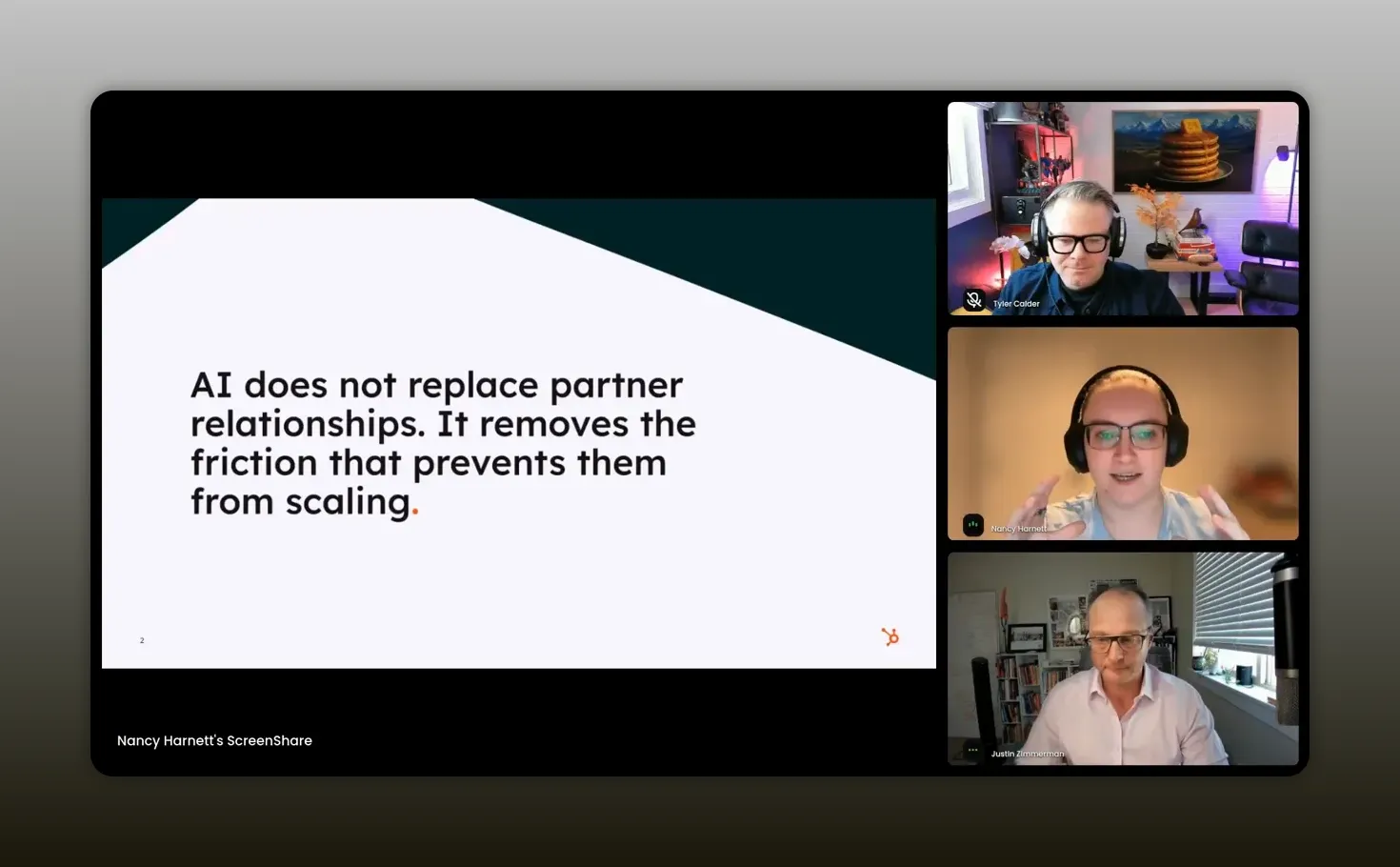
“AI needs to be another teammate responsible for impact and for efficiency and for effectiveness.” -Nancy Harnett
The affiliate program lifecycle most teams hit
One of the most useful parts of Nancy’s framework is the way she breaks down the lifecycle of a growing affiliate program. If you have ever felt that your program went from manageable to chaotic almost overnight, this will sound familiar.
The early growth phase
At the start, things feel exciting. You bring in new partners through your network or platform, applications roll in, and the volume is still low enough that you can personally welcome people, answer questions quickly, and build one-to-one relationships.
Manual processes are not fun, but they are still workable. Because they are workable, many teams delay building AI support into the program.
That is a mistake.
Nancy’s point is that this early phase is actually the best time to introduce AI elements. Not because you are already overwhelmed, but because you can design scalable systems before your program reaches stress.
The breaking point
Then comes the phase every program hits eventually: the breaking point.
This is where:
- Application volume grows faster than your team can review it
- Response times start to slow
- Partner communication becomes generic
- Enablement lags behind partner needs
- Growth becomes harder to interpret
At this stage, the program can still be growing on paper while the partner experience quietly gets worse.
That is what makes this moment so dangerous. You can look busy, even successful, while laying the groundwork for lower activation, weaker partner loyalty, and inconsistent quality.
The scaling point
If you use AI well, the breaking point becomes a making point. You start supporting partners faster, personalizing at scale, and seeing what is working before issues spread.
If you use AI poorly, you simply scale confusion faster.
That is why process design matters more than tool hype. Tools are helpful. Workflows are what save you.
A related framework on using AI in partnerships without damaging execution makes a similar point: AI works best when it strengthens disciplined systems rather than replacing them.
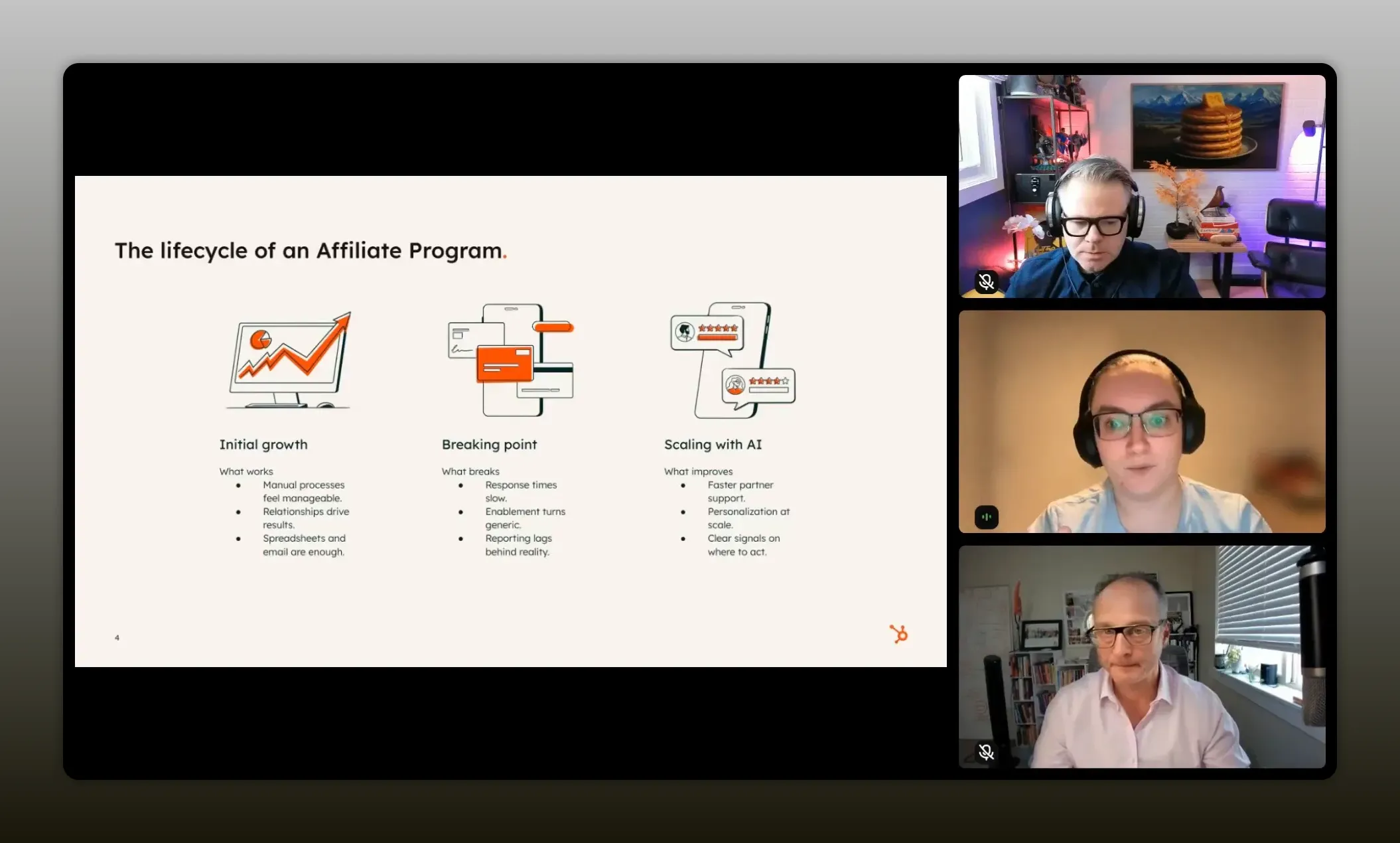
“AI can turn that breaking point into a making point, so you can support partners faster, personalize at scale, and get clear signals on what’s working.” -Nancy Harnett
Where AI fits in a partnership program
Nancy uses a pyramid model that is especially useful for deciding what should and should not be AI-assisted.
The foundation: optimized workflows
At the base of the pyramid are the fundamentals. For most affiliate and partner programs, those include five core workflows:
- Recruitment
- Onboarding
- Enablement materials
- Activation tactics
- Growth
If these workflows are weak, adding AI will not magically fix the program. You will just automate a weak system.
So the first job is making sure your core workflows exist, are repeatable, and reflect what a good partner experience should look like.
The middle layer: AI support
Once the workflows are in place, AI can optimize them. This is where AI belongs most naturally. It can assist with research, summarization, scoring, recommendations, content drafting, and data interpretation.
The goal is not to make the program feel robotic. The goal is to make the program feel surprisingly responsive and relevant.
The top layer: human relationship work
At the top of the pyramid sits the part you should not outsource: relationship building.
This includes:
- Strategic alignment
- Negotiation
- Trust-building
- Long-term planning
Nancy is blunt here, and rightly so. If you try to turn your entire partner program into a stack of bots, you are not building a partnership ecosystem. You are creating a click farm with better branding.
This is a performance issue. High-quality partners want relevance, context, and a sense that someone understands their business.
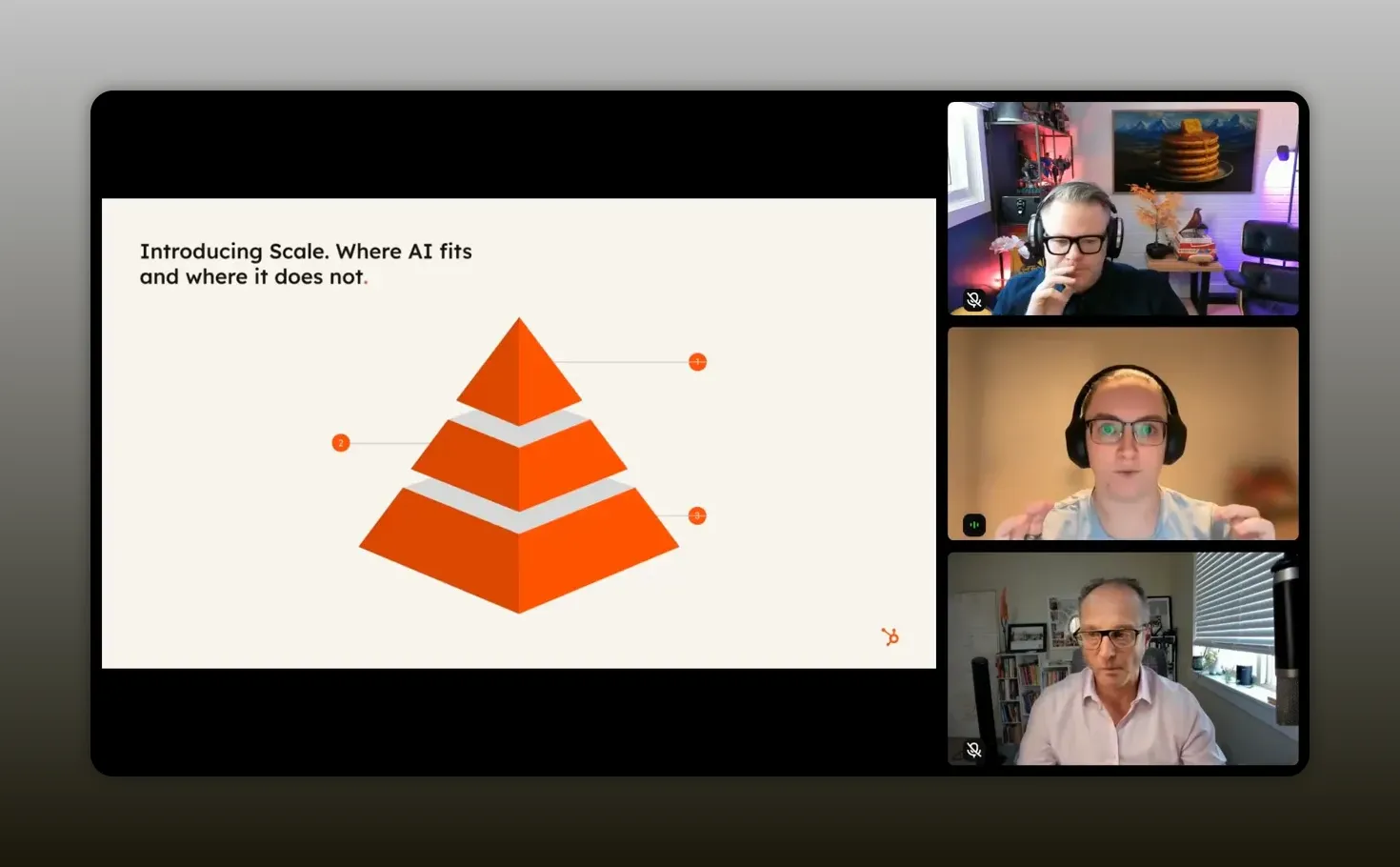
“We’re in a relationship business.” -Nancy Harnett
How to automate partner intake and scoring
One of the first places HubSpot saw real leverage was partner intake and scoring.
Nancy shared that her team was dealing with roughly 100 to 150 applications per week. Before introducing AI, one person manually reviewed every application each morning. If you have done that kind of review work, you know exactly how it goes. It is repetitive, time-consuming, and vulnerable to inconsistency.
Even with criteria in place, manual review can drift. You start making decisions based on recency, fatigue, personal preference, or whatever stood out in the last ten minutes.
To fix that, HubSpot built an intake and scoring model using agent.ai, the agent marketplace founded by HubSpot co-founder Dharmesh Shah. The idea was intentionally simple:
- Input a partner URL
- Evaluate it against defined criteria
- Output a score and fit recommendation
The scoring included factors like domain credibility and relevance. The tool then categorized the applicant along the lines of:
- Excellent fit
- Good fit
- Needs work to become a fit
- Not a fit
The important part is not just the label. It is the explanation.
The system also generated suggestions for improvement. Maybe the site needed more relevant topics for HubSpot’s audience. Maybe the content was outdated and needed freshness updates. Maybe there was a stronger category alignment available than the one the applicant was trying to force.
This matters because it turns intake from a simple gatekeeping process into a scalable learning loop.
And that is where AI starts earning its keep. You are not just filtering applications faster. You are creating a more structured and more repeatable decision system.
If your team is trying to solve this exact problem, this guide to AI partner recruitment workflows is a useful companion to Nancy’s approach.
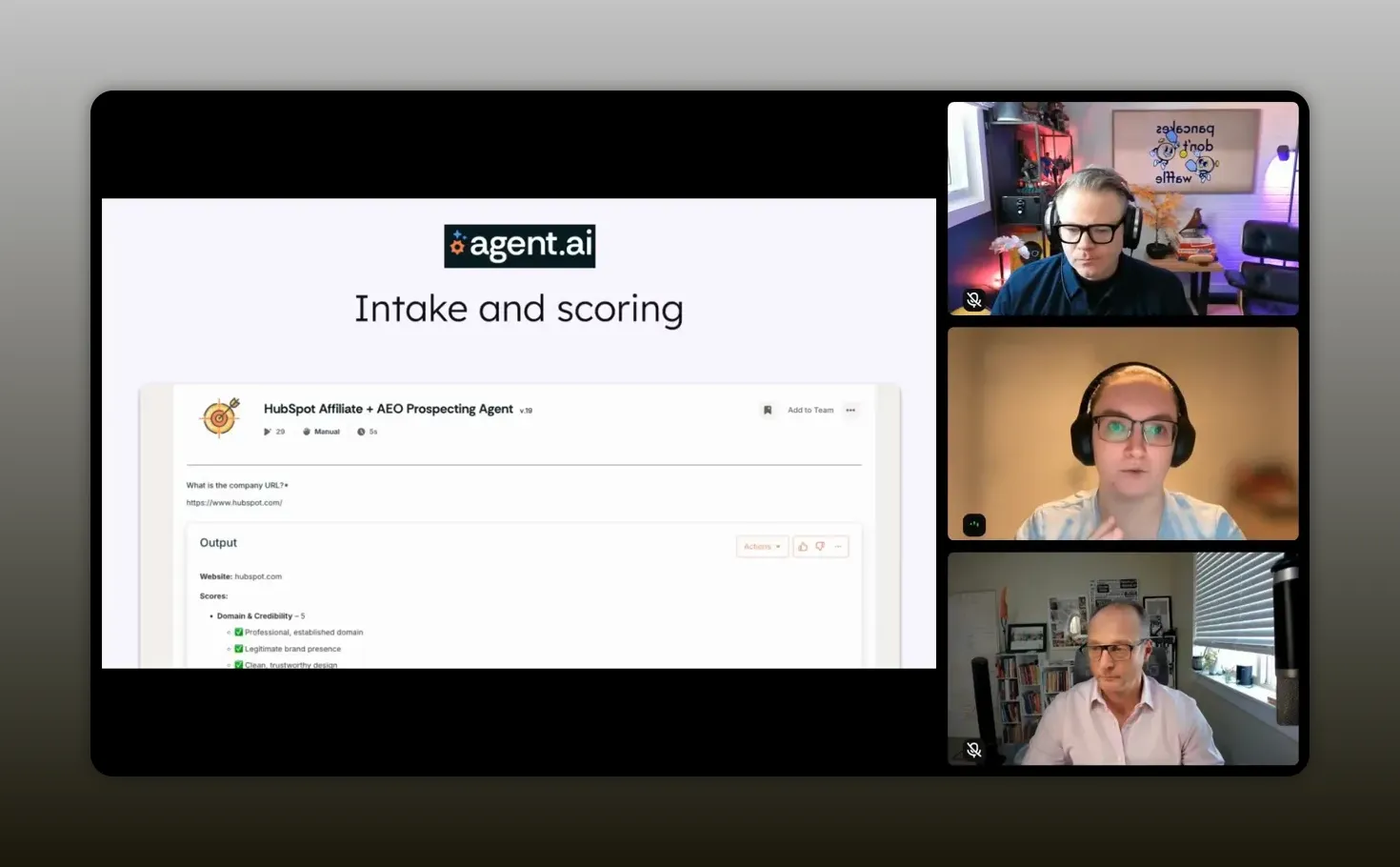
“We wanted to make the process very, very simple. Input a URL and get out the output.” -Nancy Harnett
How to deliver personalized insights at scale
If intake solves the front door problem, personalized insights solve the retention and growth problem.
Nancy described this as one of the biggest game changers at HubSpot. Historically, valuable partner insights often live in disconnected places:
- Spreadsheets
- Affiliate network dashboards
- CRM records
- Internal notes
That creates a frustrating dynamic. You technically have the data, but not in a form that helps your team act on it quickly or helps partners improve from it directly.
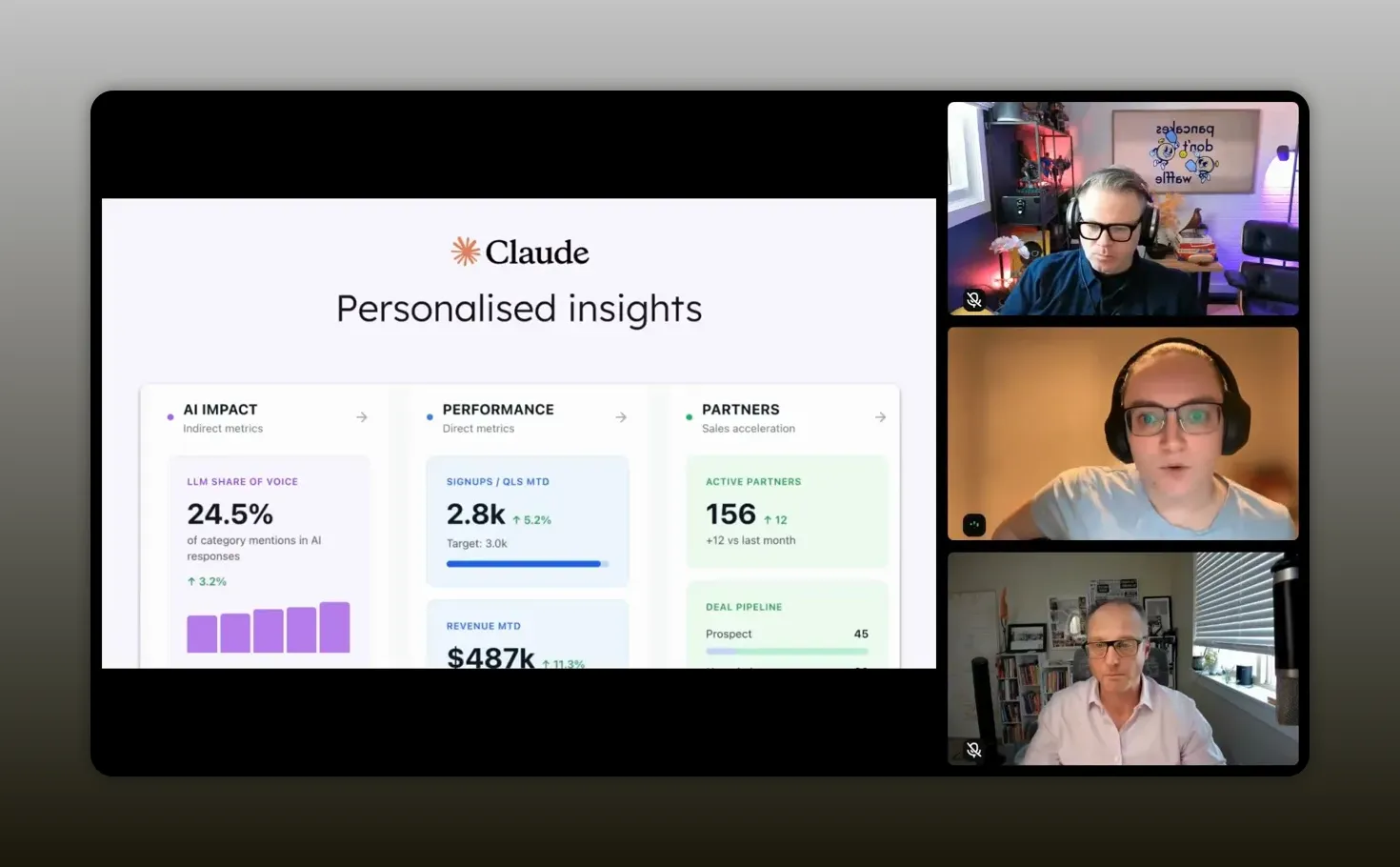
HubSpot addressed that by using Claude to create a more actionable insight layer. Instead of building “just another dashboard,” the team worked toward an insight platform that could pull together partner data and turn it into recommendations.
What that looked like
Nancy shared an example of a broader program dashboard built in Claude that included:
- AI impact metrics
- LLM share of voice
- Monthly signups against goal
- Revenue data
- Partnership pipeline status
- Active partner counts and deal stages
Because HubSpot can connect its CRM into Claude, the team can pull insights from multiple sources into one place. That creates a much more complete view of both current performance and near-term opportunity.
Why this matters for partner teams
Partners do not just want reporting. They want relevance.
A generic monthly report rarely changes behavior. A personalized dashboard or recommendation set that says, “Here is where your growth is coming from, here is where you fell off, and here is what to do next” is dramatically more useful.
That difference is subtle but powerful. Reporting tells you what happened. Insight helps you decide what to do.
For programs trying to become more data-driven, that shift is essential. It is also in line with broader revenue-team thinking around partnership data as a strategic asset, which is explored further in this practical playbook on partnerships, data, and AI.
“That is the power of AI. It’s creating that personalized experience and enhancing the partner relationship.”Nancy Harnett
How to use AI for expansion and optimization
The third use case Nancy highlighted is one that many lean teams struggle with the most: expanding and optimizing existing partners.
When you are running a program alone, or with a very small team, it is easy to spend all your time on new partner recruitment. Existing partners get managed only when there is a visible issue or a sudden spike in opportunity.
That reactive model leaves money on the table.
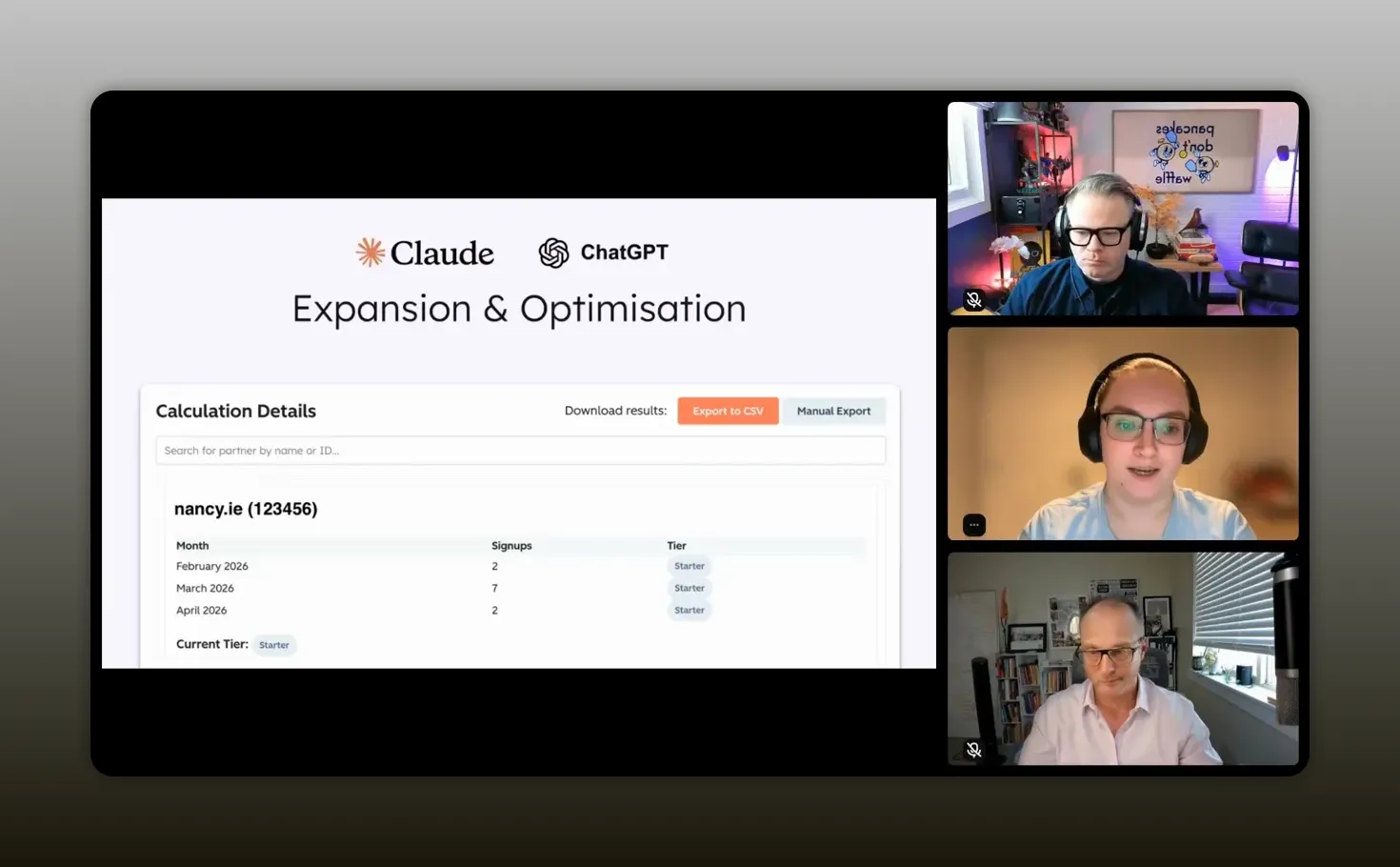
HubSpot built a workflow using a combination of Thoughtly and ChatGPT to analyze partner data over the previous three months. The setup included a CSV upload of raw data hosted on a landing page in HubSpot, which then generated a structured partner breakdown.
The output could quickly show:
- Current tier
- Recent signup trends
- Performance changes over time
- Individualized optimization suggestions
Nancy gave a simple example:
- February: 2 signups
- March: 7 signups
- April: 2 signups
That kind of snapshot immediately raises the right question: what happened in March?
Maybe a new content asset performed well. Maybe a placement changed. Maybe a promotional angle worked and then got removed. Instead of manually digging through notes and dashboards, the team can quickly identify the anomaly and take a more informed conversation back to the partner.
This is where AI becomes a force multiplier for partner managers. It helps you notice the things a good manager would want to notice anyway, but much faster and with more consistency.
In practical terms, that means you can spend more time coaching and less time hunting for context.
“You’re able to do an awful lot more with less time.”Nancy Harnett
Nancy’s practical AI workflows
Beyond the big strategic use cases, Nancy shared a set of day-to-day workflows that make AI useful in the real world. This is where a lot of teams get stuck. They understand the theory, but they do not know what practical usage should look like on a Tuesday morning.
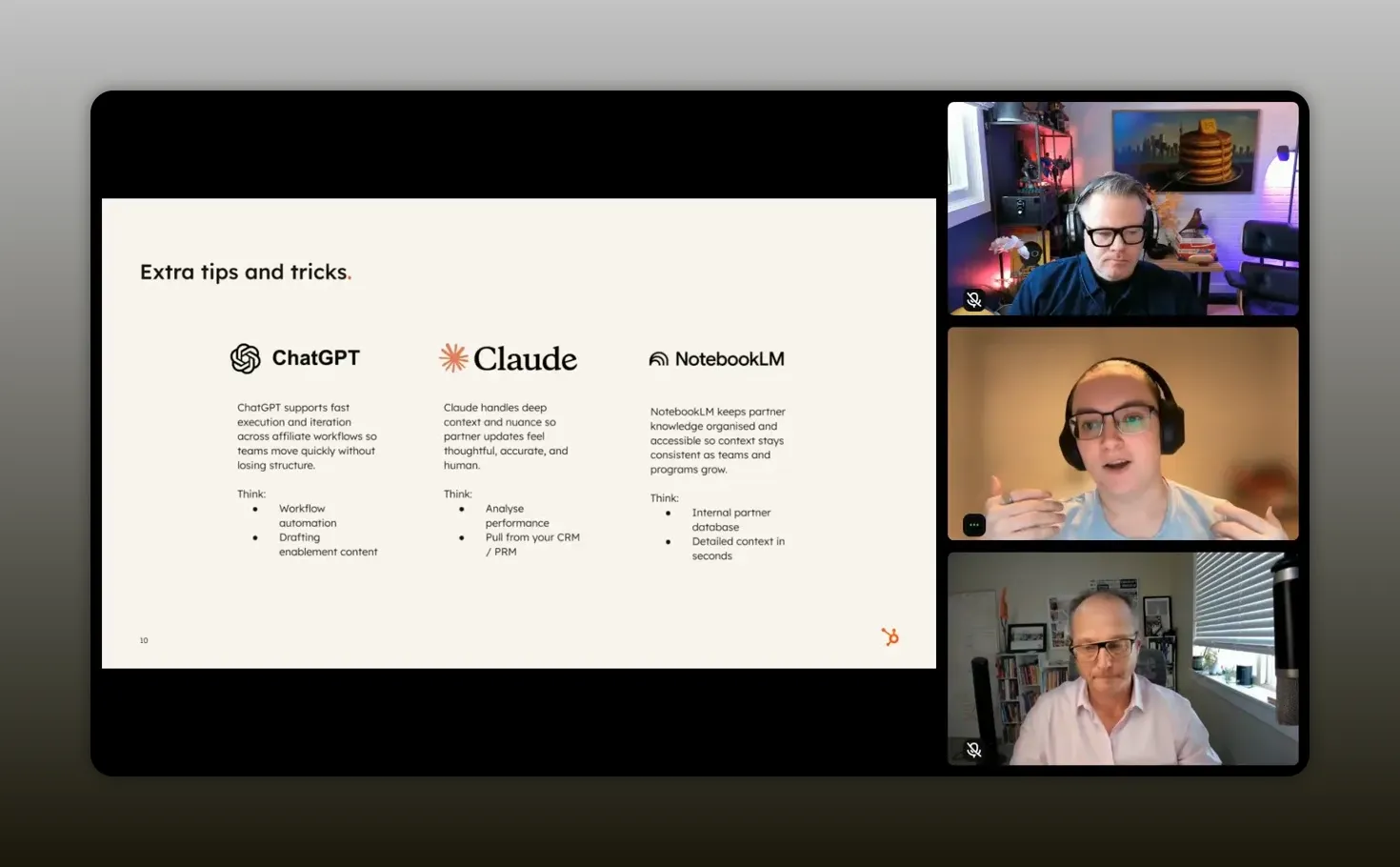
Her stack centers around three tools: ChatGPT, Claude, and NotebookLM.
ChatGPT as a thought partner
Nancy uses ChatGPT as a strategic sparring partner. That means she is not just asking it to write things. She is using it to pressure-test ideas.
Examples include:
- Improving executive presentations
- Refining how a message lands
- Creating custom GPTs for outreach
- Finding similar partner profiles
- Drafting enablement materials
That is a smart model for AI usage. Instead of treating the tool like an answer machine, she treats it like a collaborator that helps shape stronger output before it reaches another human.
It is also a strong reminder that “personal productivity” use cases are not trivial. Better presentations, faster briefs, cleaner messaging, and faster first drafts all compound over time.
Claude for multi-source analysis
Claude seems to be the standout tool in Nancy’s current workflow. The reason is not style. It is synthesis.
She uses Claude to analyze information from multiple sources and bring it together into a usable answer. That is valuable for program analytics, but it is also valuable for managing your own day.
Nancy has connected her calendar, Gmail, and Asana. Each morning, she can ask Claude to summarize:
- What meetings are on deck
- What tasks need attention
- Which emails need immediate response
For anyone managing a busy partner portfolio, that alone can reduce a lot of cognitive clutter.
NotebookLM for context and recall
NotebookLM got some extra love for good reason. Nancy uses it in two especially useful ways.
First, as a way to consume reading she might otherwise never get to. If you have a pile of bookmarked articles you swear you will read on Friday, NotebookLM can turn them into an audio conversation format. That makes it easier to absorb useful material while doing other work.
Second, and more relevant for partnerships, she uses it as a lightweight partner knowledge base.
You can create a notebook for each partner and feed it:
- Call notes
- Email threads
- Internal memos
- Partner documents
- Other relationship context
Then, before or during a call, you can ask the notebook questions like:
- Have we discussed this topic before?
- What was the last issue they raised?
- Did we ever promise this deliverable?
That is not flashy AI. It is useful AI. And useful wins.
“That is where AI is most powerful, getting the answers to your partnerships quicker.”Nancy Harnett
Why smaller partner teams have the most to gain
One of the strongest undercurrents in Nancy’s advice is that AI is especially valuable for small programs.
If you are a one-person or two-person partner team, you do not need AI because it is trendy. You need it because the alternative is letting high-value work drown in low-leverage tasks.
Small teams often get pulled in five directions at once:
- Recruiting new partners
- Approving applications
- Creating onboarding materials
- Answering partner questions
- Reviewing performance data
- Preparing internal updates
Without some level of automation and AI assistance, one area always gets neglected. Usually that area is optimization of existing partners, because it requires focused analysis rather than urgent reaction.
That is why Nancy’s examples matter. They are not moonshot experiments. They are practical systems that help a small team punch above its weight:
- Application scoring to reduce manual review time
- Insight dashboards to improve partner conversations
- Trend analysis to spot opportunities early
- Context notebooks to reduce scramble before calls
Justin reinforced this broader point well. Teams cannot really turn away from AI anymore. This is force learning. The question is no longer whether AI will affect partner operations. The question is which platforms you should use, which workflows deserve attention first, and how your team will build confidence through practice.
Implementation principles that actually work
If you are figuring out where to start, Nancy’s approach suggests a few practical principles worth following.
1. Start before the pain gets severe
Do not wait until response times are broken and backlog is piling up. Add AI support while your program is still manageable so your workflows scale cleanly.
2. Fix the workflow before you automate it
AI can improve a good workflow. It cannot rescue a vague or inconsistent one. Get clear on process, decision rules, and desired partner experience first.
3. Use AI where speed and consistency matter most
Partner intake, analytics synthesis, enablement drafting, and context retrieval are ideal starting points because they are repetitive and high-impact.
4. Keep humans at the relationship layer
Do not automate your way out of trust. AI should support partner managers, not erase them.
5. Optimize for actionable output
A dashboard is not the goal. A recommendation is. A summary is not the goal. A better next step is.
6. Build lightweight systems first
You do not need a giant transformation project to get value. A scoring model, a partner notebook, or a morning prioritization workflow can create meaningful gains quickly.
7. Treat this as a team capability, not a one-time experiment
Justin’s closing comments pointed to something important. This is going to be a community and team effort. Tools will keep changing. What matters is building the habit of learning, testing, and sharing what works.
Recommended tools
Here are the main tools Nancy referenced, along with how they fit into a partnership-led growth motion:
- ChatGPT: Strategy support, message refinement, custom GPT workflows, outreach drafting, enablement content creation.
- Claude: Multi-source analysis, dashboard creation, prioritization, CRM-connected insight synthesis.
- NotebookLM: Partner context management, article summarization, audio briefings, lightweight partner knowledge base.
- HubSpot: CRM data source and operational system connecting partner insights and landing-page workflows.
- Asana: Task management input for AI-assisted daily prioritization. Learn more at .
- PartnerStack: Partnership platform context for partner ecosystem operations and event sponsorship.
- agent.ai: Agent marketplace used for early partner scoring experimentation. Learn more at
If you are comparing models for different partnership workflows, this breakdown of Claude vs ChatGPT vs Lovable for partnerships can help you decide where each one is strongest.
FAQs
What is the best first AI use case for an affiliate program?
Start with partner intake and scoring if application volume is growing. It is repetitive, measurable, and easy to compare before-and-after performance. You can reduce review time, increase consistency, and create a cleaner approval process without changing the relationship layer of the program.
Will AI hurt partner relationships?
It can if you use it to replace human interaction rather than support it. Nancy’s point is that AI should remove friction, not remove people. Use it for prep, analysis, and recommendations, then let your team use that leverage to have better conversations.
How can a small team use AI without a big budget?
Use lightweight tools and narrow workflows. A custom scoring assistant, a NotebookLM knowledge base for key partners, or an AI-generated morning priority summary can all create time savings without requiring a large implementation project.
What does personalized insight at scale actually mean?
It means going beyond generic reporting. Instead of simply showing partner performance data, you surface patterns, explain changes, and suggest actions. For example, if a partner spikes in one month and drops the next, the system should help you identify what changed and what to test next.
Which AI tool is best for partnerships?
There is no single best tool for every task. Nancy uses ChatGPT for strategy and drafting, Claude for analysis and synthesis, and NotebookLM for context management and knowledge retrieval. The right choice depends on the workflow you are trying to improve.
How do you keep AI outputs accurate in partner programs?
Give the model structured inputs, keep workflows narrow, and review outputs before they affect partner-facing decisions. Accuracy improves when you connect reliable data sources and ask the system to perform focused tasks instead of broad, vague ones.
Conclusion
The big takeaway from Nancy and Justin is not that partnerships are about to become fully automated. It is that the teams who learn to combine AI-powered platforms with AI-powered people will move faster without becoming colder.
If you are running an affiliate or growth partnership program, the path is pretty clear. Get your foundational workflows right. Use AI to strengthen intake, insights, and optimization. Keep humans firmly in charge of trust, strategy, and relationship depth. Then keep iterating.
That is how you scale a modern partner program without flattening the very thing that makes partnerships work in the first place.