10 Things EMEA Partner Managers Should Stop Doing Immediately… and Let Claude Do
Expert advice from Teddy Ludmer (Strategic Partnerships Lead, Tipalti) and Thorunn Devoy (VP Partnerships, Talon.One).
Snapshot
A partner manager covering the UK, Nordics, France, DACH, Benelux, or beyond is constantly switching context, languages, sales motions, partner expectations, and internal stakeholders. That is difficult enough with a full team. As a team of one, it can quickly become overwhelming.
Claude and the AI features already inside your tech stack can reduce the manual work around that complexity. They can summarize deal channels, build QBR drafts, create partner-ready content, organize recommendation data, qualify opportunities, and flag contract issues. The goal is not to automate the relationship. The goal is to protect more of your time for the relationship, the judgment, and the market expertise that actually move partnerships forward.
Keep reading to see how Thorunn and Teddy can help you stay informed across markets, personalize partner activation, and scale partner operations with AI.
“People still want to speak to humans.” -Teddy
Table of Contents
- Why EMEA partner management needs a different operating model
- Start with the tools already in your stack
- Turn internal noise into useful partner signals
- Build better QBRs without rebuilding every slide
- Create personalized joint value stories
- Give partners the content they actually need
- Build an AI-powered partner directory
- Keep partner development and ICP fit dynamic
- Use AI with practical judgment and guardrails
- Recommended tools
- Conclusion
Why EMEA partner management needs a different operating model
EMEA is not a single market, even if your job title makes it sound like one. The partner motion that works in the UK may need a different message, local proof point, commercial approach, or relationship cadence in France, the Nordics, or elsewhere. You may support several sales teams at once, each moving at a different pace and each expecting partnerships to be responsive.
This is what makes the role so interesting, but also so operationally intense. Your day can involve a UK partner call, a France sales request, an in-market event decision, an RFP requiring a recommendation, a deal that has unexpectedly moved into contracting, and a strategic partner who needs an executive-ready QBR. The usual response is to work harder, sit in more calls, and read every message. That does not scale.
Thorunn and Teddy have both built partnership programs from the beginning in companies expanding internationally. Their shared takeaway is simple: you do not need to become fifteen different partner managers to succeed across fifteen different contexts. You need an operating model that helps you retain regional awareness while removing repetitive work.
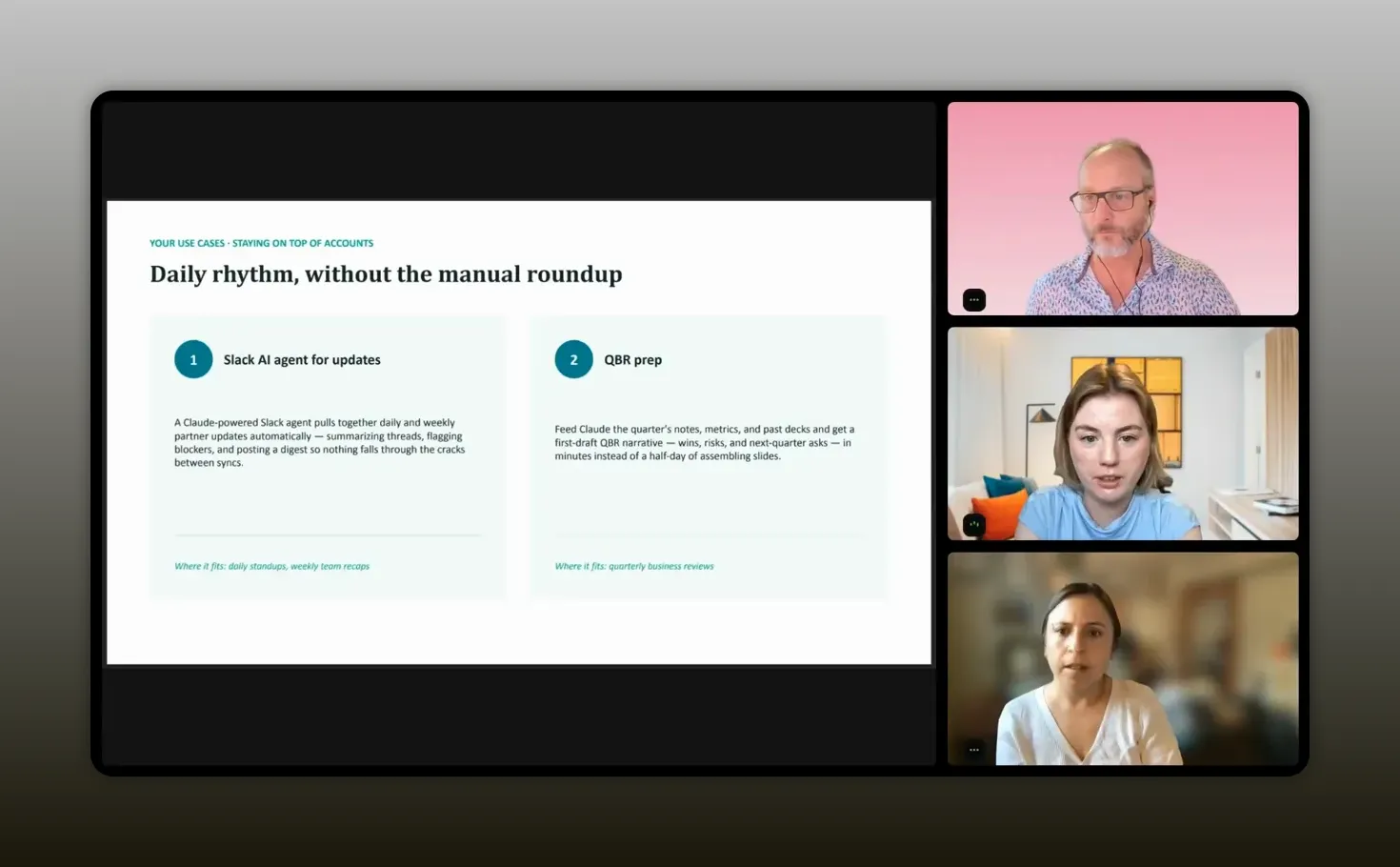
“You can be one partner manager that knows how to operate in different regions.” -Teddy
AI is useful here because it can bring scattered information together, summarize it, classify it, and make it easier to act on. It can help you see where your attention is needed without forcing you to be present in every internal conversation.
That distinction matters. The value of a strong partner manager is still human. You build trust, understand nuance, manage expectations, recognize political dynamics, and make thoughtful decisions when the information is incomplete. AI should help you show up more prepared and more consistently, not send generic work at a faster rate.
Start with the tools already in your stack
The most useful AI workflow may already be one small adjustment away. You do not need a giant transformation project, advanced technical skills, or a complicated prompt library before you begin. Start with the platforms your company has approved, the data you are permitted to use, and the recurring work that consumes time every week.
A practical partner management stack can include:
- Claude for drafting, summarization, research support, structured analysis, content creation, and workflows built around uploaded information.
- Slack AI for scanning conversations, summarizing channels, identifying action items, and surfacing internal updates.
- Gong or another call intelligence platform for tagging calls and bringing deal or partner conversation signals into your workflow.
- Notion AI for organizing a knowledge base, creating searchable directories, and querying structured partner information.
- Crossbeam for ecosystem data and account overlap.
- Partner platforms such as Magentrix or Impartner when those systems are already part of your partner program.
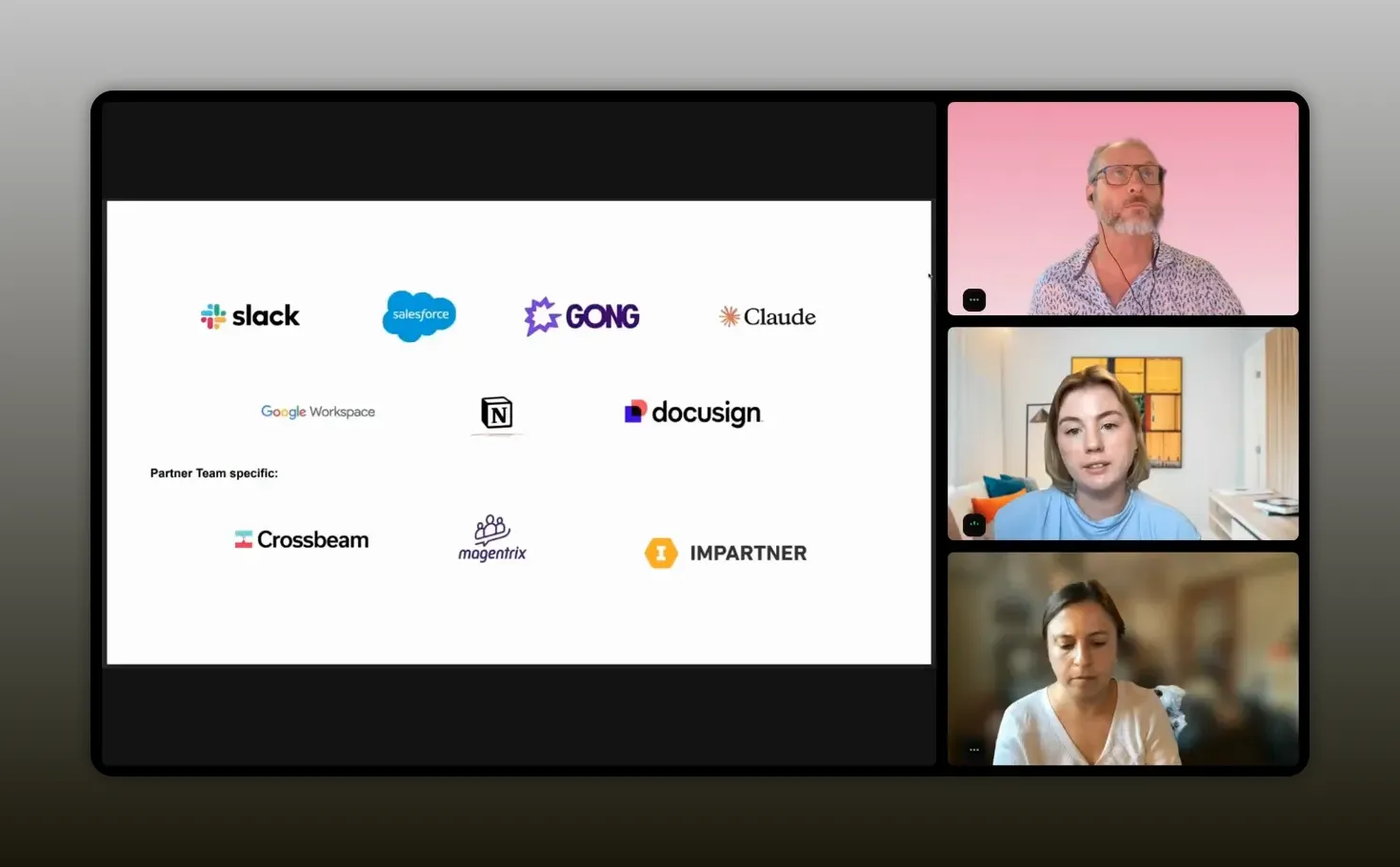
“The tools you are already using can embrace AI and optimize your workflow.” -Teddy
For an overview of Claude capabilities and workflows, the official Claude site is a useful starting point. But the key operational point is not which tool has the flashiest feature. It is whether a tool can reliably support a real job to be done.
Start by asking three questions:
- What repeatable task regularly takes too long?
- What information already exists but is difficult to find or connect?
- What decision would be easier if you had a clean summary every morning or every week?
Your answer might be an internal deal update, a partner content request, QBR preparation, partner matching, or ICP review. Begin there. If you are just getting comfortable with Claude, this Claude for partnerships guide offers additional practical workflows for partner research, enrichment, and outreach.
Turn internal noise into useful partner signals
One of the fastest wins is to stop treating every Slack channel as something you must manually monitor. Partner managers often sit at the intersection of sales, marketing, product, customer success, leadership, and external partners. You need visibility into all of those conversations, but you do not need to read every line.
Thorunn described a workflow where each opportunity had its own deal channel, alongside market-specific channels such as a UK territory channel. Slack AI and Claude were used to scan those updates and send a concise morning summary. The summary could flag deal movement, upcoming events, planned market visits, stalled activity, or actions needed from partnerships.
That gives you a daily operating rhythm:
- Scan an AI-generated brief for deal movement and market changes.
- Identify the few items where your partner intervention could help.
- Reach out to the right seller, customer success manager, or partner with relevant context.
- Use the same workflow to make partnerships visible internally through thoughtful updates.
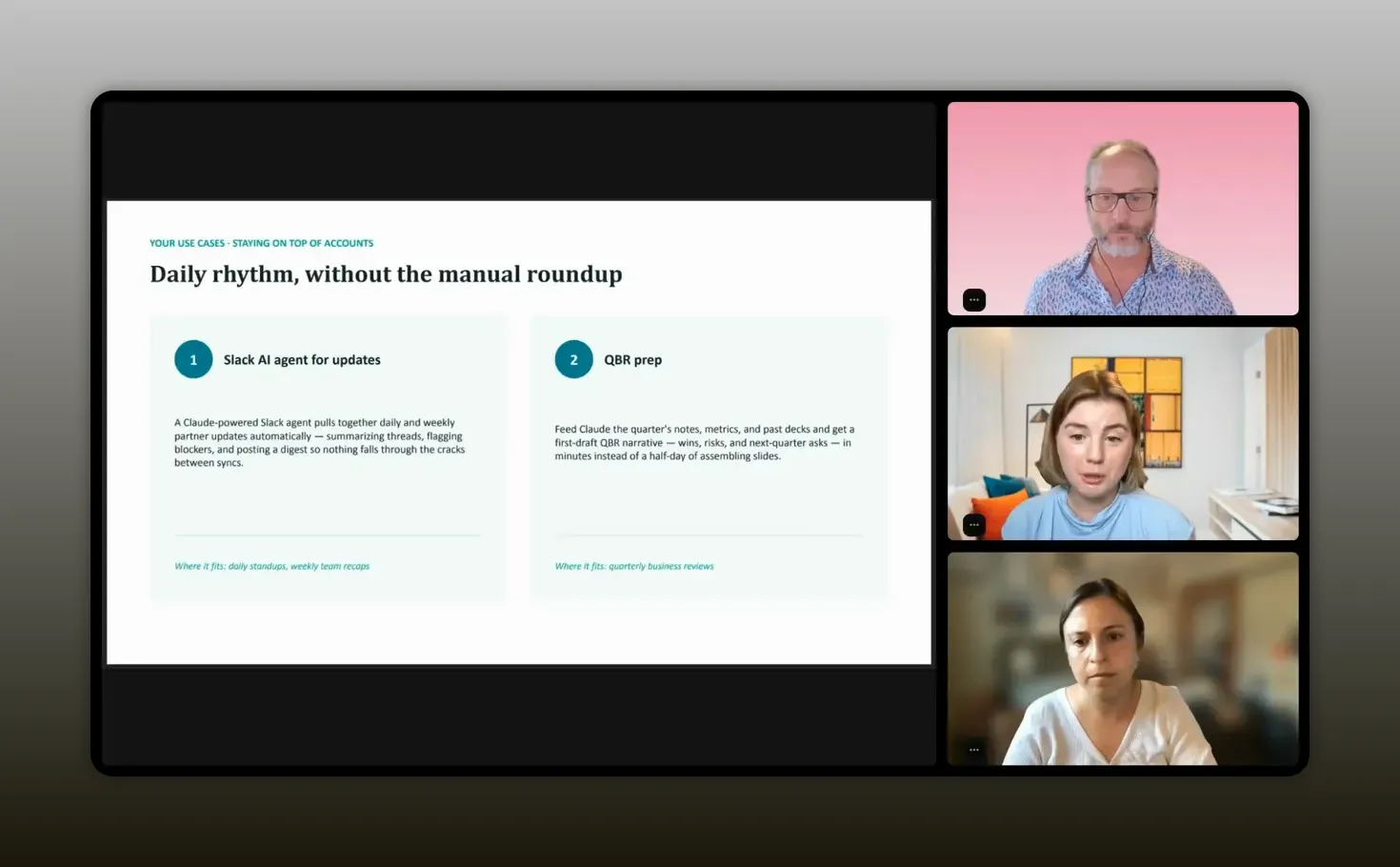
“AI can help you stay on top of things without being in every conversation.” -Thorunn
Teddy applied the same principle to internal collaboration. A daily summary can identify outstanding replies, next steps, and unfinished requests across functions. You can then set a reminder to follow up with specific people or prepare a concise internal update so sales, product, and customer success know what is happening with partners.
This is more important than it sounds. Partnership execution often breaks down not because the strategy is wrong, but because the right internal person did not have timely context. A clean AI summary makes it easier to keep partner priorities present in the workflows of other teams.
Use AI summaries to trigger human action
Do not stop at the summary. Make it an input to an action. If a deal has advanced into contracting, tell the partner. If an opportunity has stalled, ask whether there is a blocker you can jointly solve. If a product team is preparing for a partner meeting, give them the relevant account, opportunity, and partner context ahead of time.
The AI output is not the work. It is the signal that lets you do the work at the right moment.
Build better QBRs without rebuilding every slide
Quarterly business reviews can be valuable strategic moments. They can also become a time sink when you spend hours assembling pipeline data, marketing activity, progress updates, account notes, and old slides into a new deck.
Claude can create a strong first draft if you give it the right inputs. Upload or connect the relevant materials: pipeline reviews, partner activity, marketing performance, strategic priorities, previous QBR notes, and any new program updates. Ask it to create a structured QBR outline, draft the narrative, identify themes, and separate core discussion points from material that belongs in an appendix.
Thorunn used this approach before an executive QBR with a strategic partner. The AI-generated draft made internal review easier because the team could discuss the substance early: which issues belong in the executive conversation, which metrics need context, and what should be moved to supporting slides. The time was spent on judgment and polish instead of basic assembly.
A useful QBR prompt should set expectations about audience, time, and output. For example, instruct the tool to prepare an executive-level discussion framework with business outcomes, pipeline movement, joint marketing activity, risks, decisions required, and next-quarter priorities. Then provide the source material.
Do not hand over the final deck without a review. Check every number, confirm the account context, adjust any weak positioning, and ensure the final document reflects the real relationship. AI makes the blank-page problem disappear. It does not remove your responsibility for accuracy or strategic direction.
If executive reporting is a persistent drain on your time, you can also use a repeatable framework such as creating a quarterly state of partnerships report with Claude to connect partner activity to business impact.
Create personalized joint value stories
Generic enablement rarely creates action. You can give a partner’s sales or customer success team a polished joint value proposition, run a great enablement session, and still get little follow-through. The issue is usually not a lack of interest. It is that the partner-facing team does not know how to position your value for a particular customer.
Thorunn used Claude to create personalized points of view for tier-one target accounts. The inputs combined the joint value proposition, a target account list of existing partner customers, and research into what each company was doing. Claude then helped produce a concise one-pager explaining where the combined solution could add value.
The partner AE or customer success manager could use that one-pager in a QBR or make a warmer introduction. Instead of asking them to figure out how to position you, you have already done the groundwork.
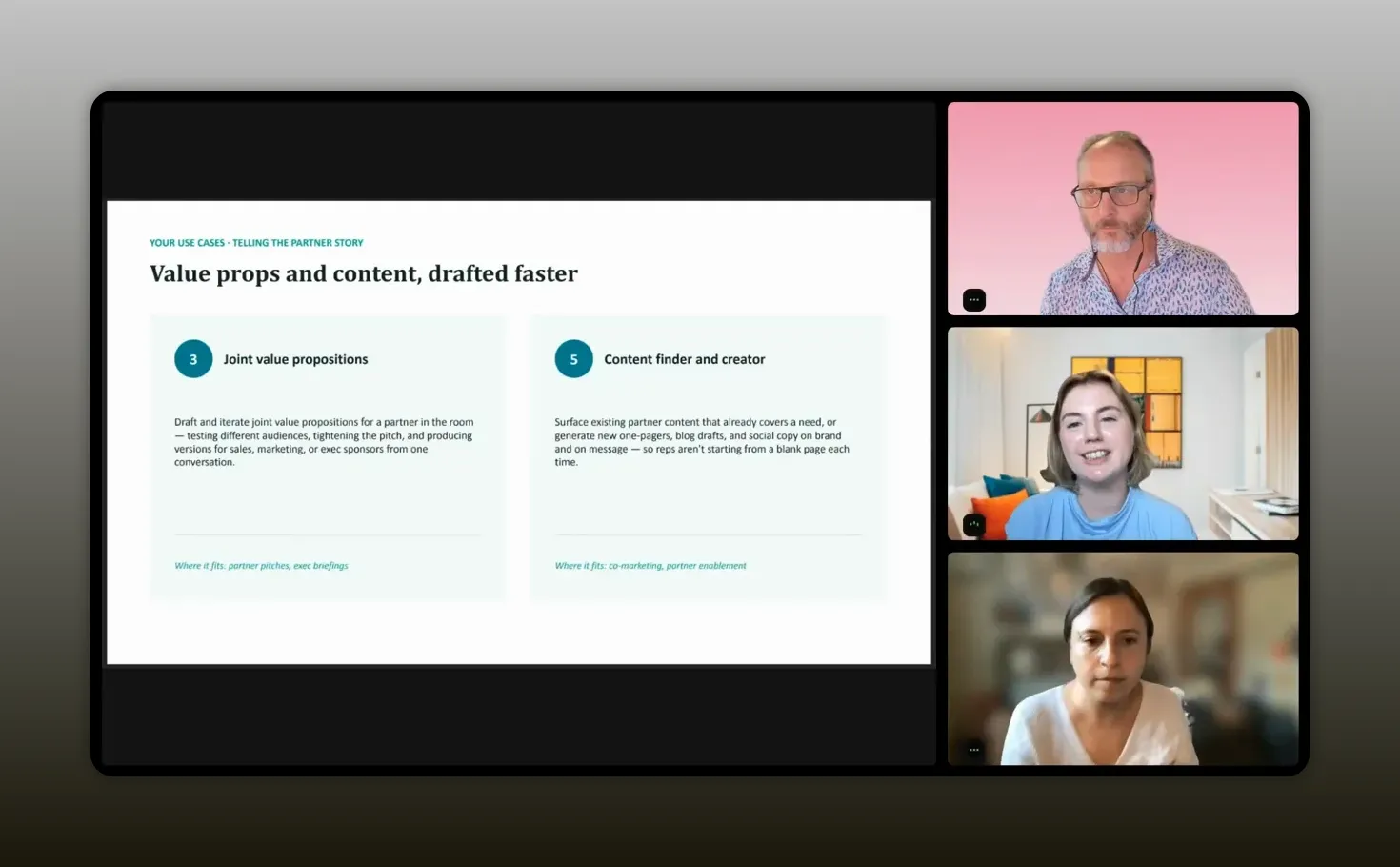
“When you come with something hyper-personalized, it is easier to make the introduction.” -Thorunn
This approach worked because it made the partner contact look thoughtful and advisory in front of their customer. That is a far stronger reason to collaborate than a generic request to share a slide or introduce an account.
Where to use account-specific partner content
- Strategic account plans
- Joint pipeline reviews
- Partner customer QBRs
- Sales plays for named accounts
- Executive alignment meetings
- Follow-up after an integration or technology enablement session
Keep the scope disciplined. Even with AI, each account requires validation. This works best for the accounts where a thoughtful point of view can genuinely change the odds of engagement.
Give partners the content they actually need
Partner managers receive content requests constantly: an ICP one-sheet, a guide for what to listen for, a customer story, a partner-specific overview, or a concise explanation of how to position the solution. In a large company, an asset management platform may solve part of this. In a startup, you often have to make do with what is available.
Claude can help turn a clear request into a first draft of a one-sheet or PDF-ready document. Teddy’s approach was straightforward: use the partner’s requested format and need as the brief, generate the material quickly, and ask the partner if it is the right direction. You can then adapt rather than starting every asset from scratch.
When your materials, approved brand context, and internal knowledge are connected to the workflow, AI can also become a content finder. An AE looking for information about a particular partner or case study can query a shared database rather than messaging you every time. This makes the partner program easier to activate across the business.
Build an AI-powered partner directory
One of the biggest hidden risks in partnerships is allowing all partner knowledge to live in your head. You may know which agency is strong in Denmark, who works with a particular technology, which partner has the right vertical experience, or which one should be excluded because of a competing product. But that insight is difficult for the rest of the company to access and difficult for you to maintain at scale.
A structured directory in Notion can change that. Create fields for the information people actually need when making a recommendation:
- Countries and regions served
- Partner type and service model
- Technology ecosystem and integrations
- Industry or customer specialization
- Known customer experience
- Program tier or partner fit score
- Capabilities and implementation expertise
- Whether the partner has a competing product
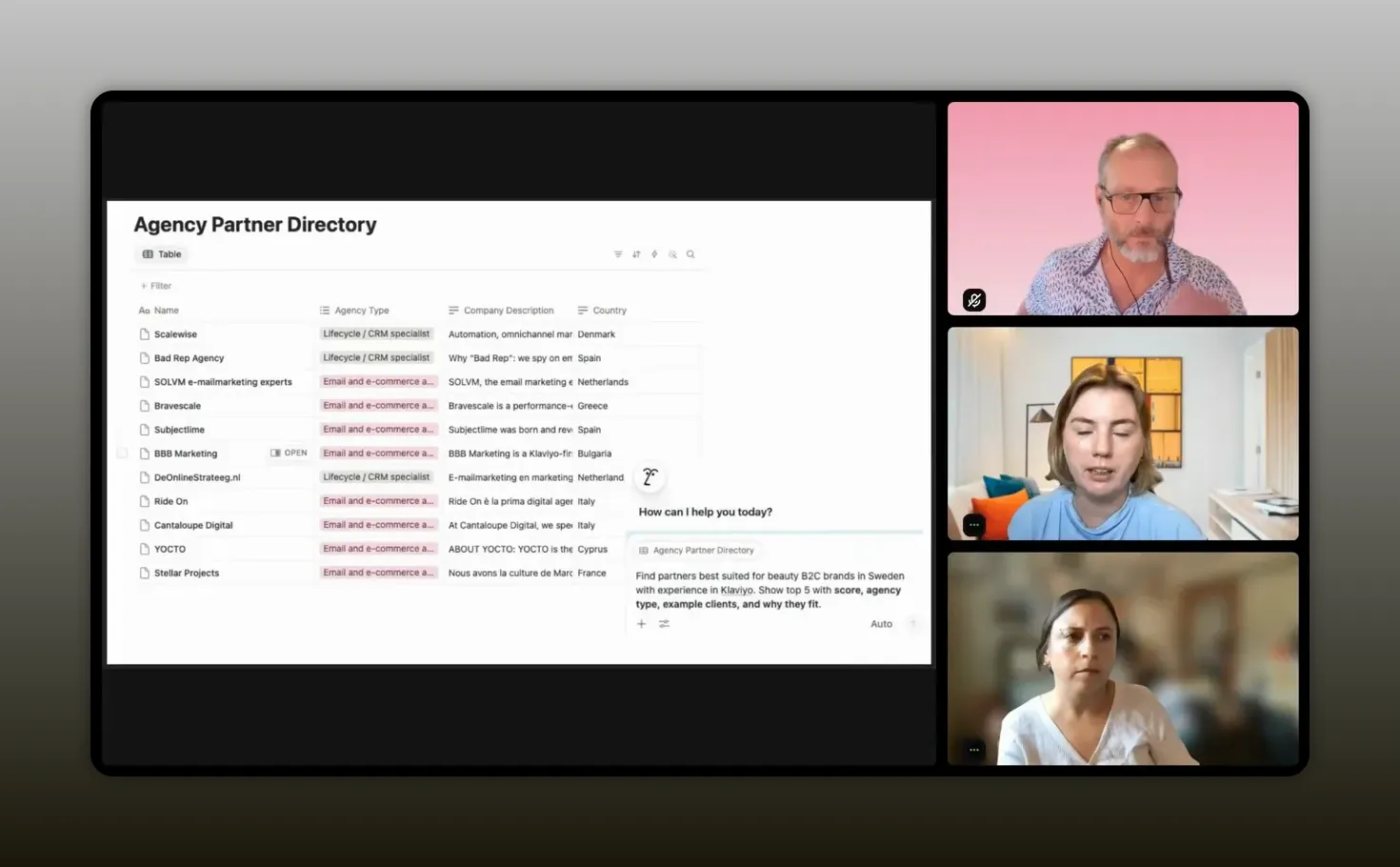
“If you have good data, you can really get good results.” -Thorunn
You can populate this database from an existing spreadsheet, integrations, or an onboarding form sent to new partners. Once the data is organized, Notion AI, Slack, or Claude can query it in natural language.
For example, a seller might ask for a recommended partner in Denmark that works with a given technology and has a fit score above eight. The AI can narrow the directory based on those conditions and return suitable options. You remain responsible for the final recommendation, but you no longer need to search through disconnected documents or rely on memory alone.
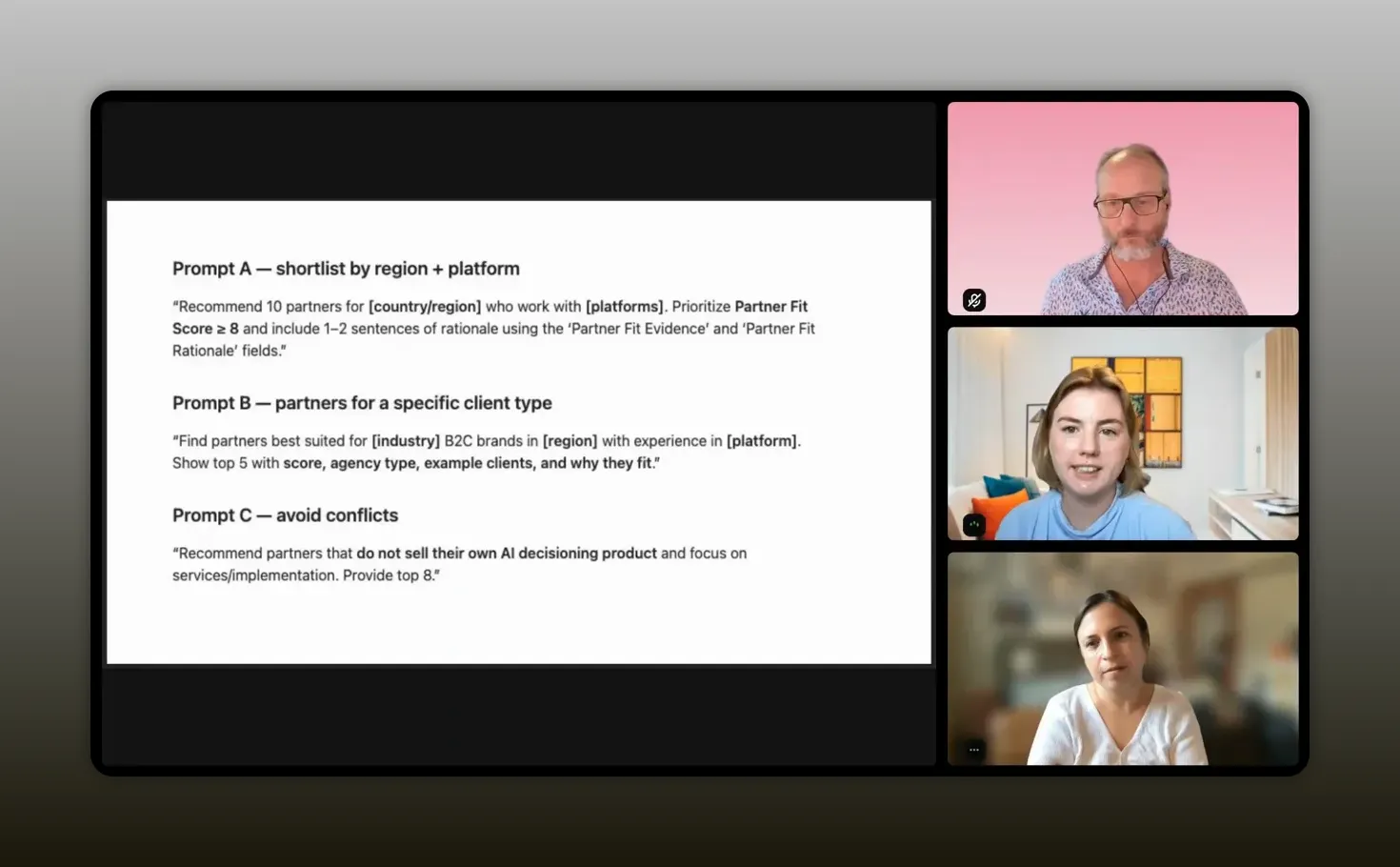
“Structure the information simply, then use AI to make it accessible.” -Thorunn
This is a particularly strong workflow for RFPs, RFIs, customer referral requests, and field teams that need a fast answer. It also creates resilience. Your partner program becomes less dependent on one person being available at every moment.
Keep partner development and ICP fit dynamic
Partner development often begins with a spreadsheet of target companies. The problem is that a static list ages quickly. New information changes priorities, companies evolve, markets shift, and what you learn from conversations should change where you spend your time.
Teddy used AI to support a dynamic partner development list and automate ICP fit review. Rather than maintaining a fixed group of fifty prospects, you can feed new information into the system as you gather it. That creates a living prioritization process rather than a spreadsheet that slowly becomes less useful.
You can also make part of the ICP fit process externally accessible. A partner can enter an opportunity and receive an indication of whether it is a fit, along with potential deal size or other relevant parameters. Done well, this makes it easier for partners to qualify opportunities and makes the partnership feel easier to work with.
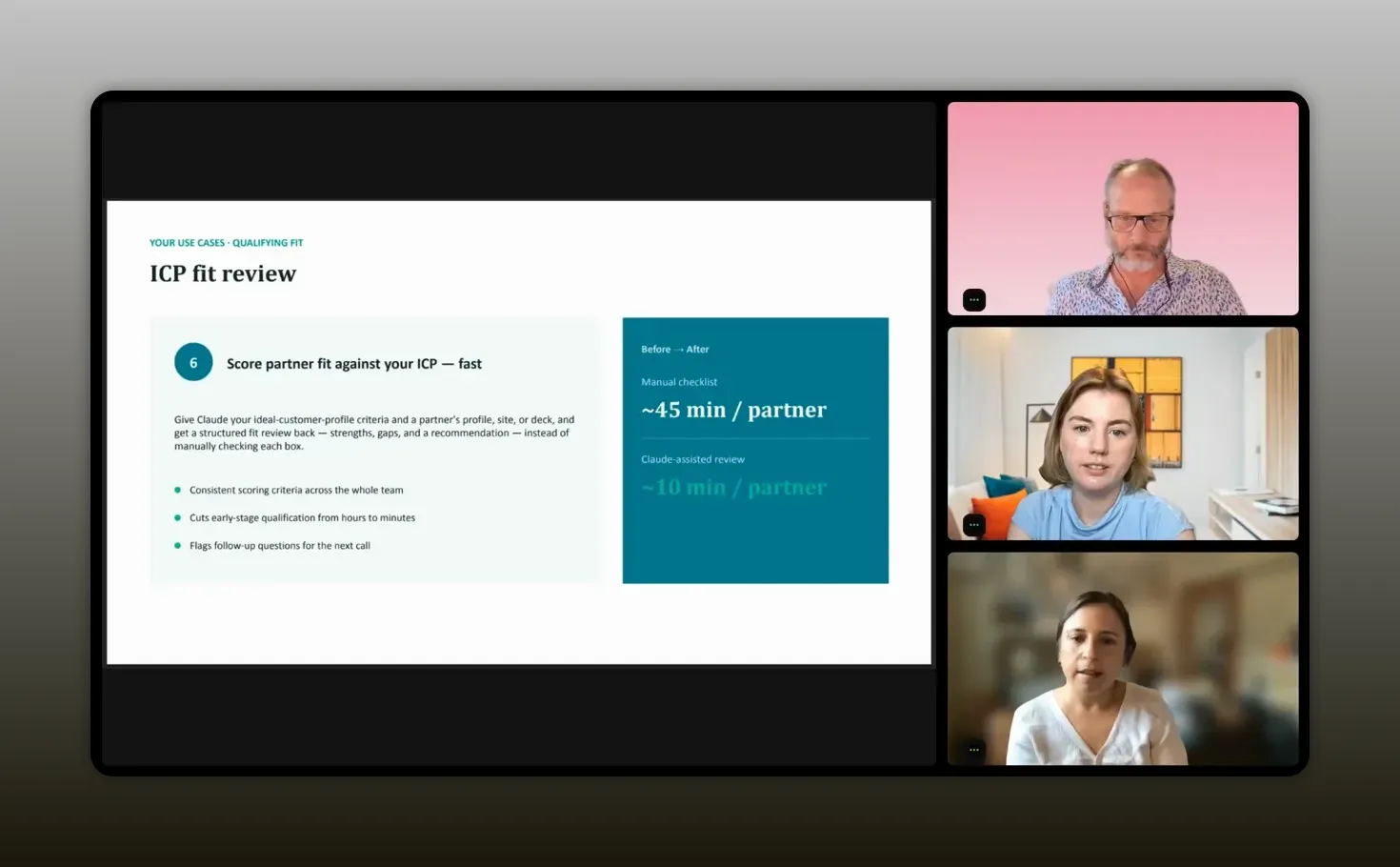
“Make your list live, changing, and updating based on new intelligence.” -Teddy
The principle is the same as the partner directory: better input produces better output. Define what fit means for your company. It could include company size, geography, customer profile, use case, technology environment, service capability, or commercial potential. Then consistently feed those criteria into the evaluation process.
Use AI with practical judgment and guardrails
Not every AI workflow needs to begin with an elaborate automation. You can start with a single internal task, test the quality, and build from there. This is especially important where security, legal review, customer information, and approved systems matter.
For example, Claude can help review a partner contract or NDA by identifying terms that may need attention. If your legal team has already told you which clauses are not acceptable, you can ask the tool to flag those clauses before you submit the agreement for formal review. You can then use it to draft a polite response explaining that a certain term cannot be accepted and asking the partner to check internally.
That does not replace legal counsel. It reduces unnecessary back-and-forth and helps you arrive at legal review with a clearer picture of the issues.
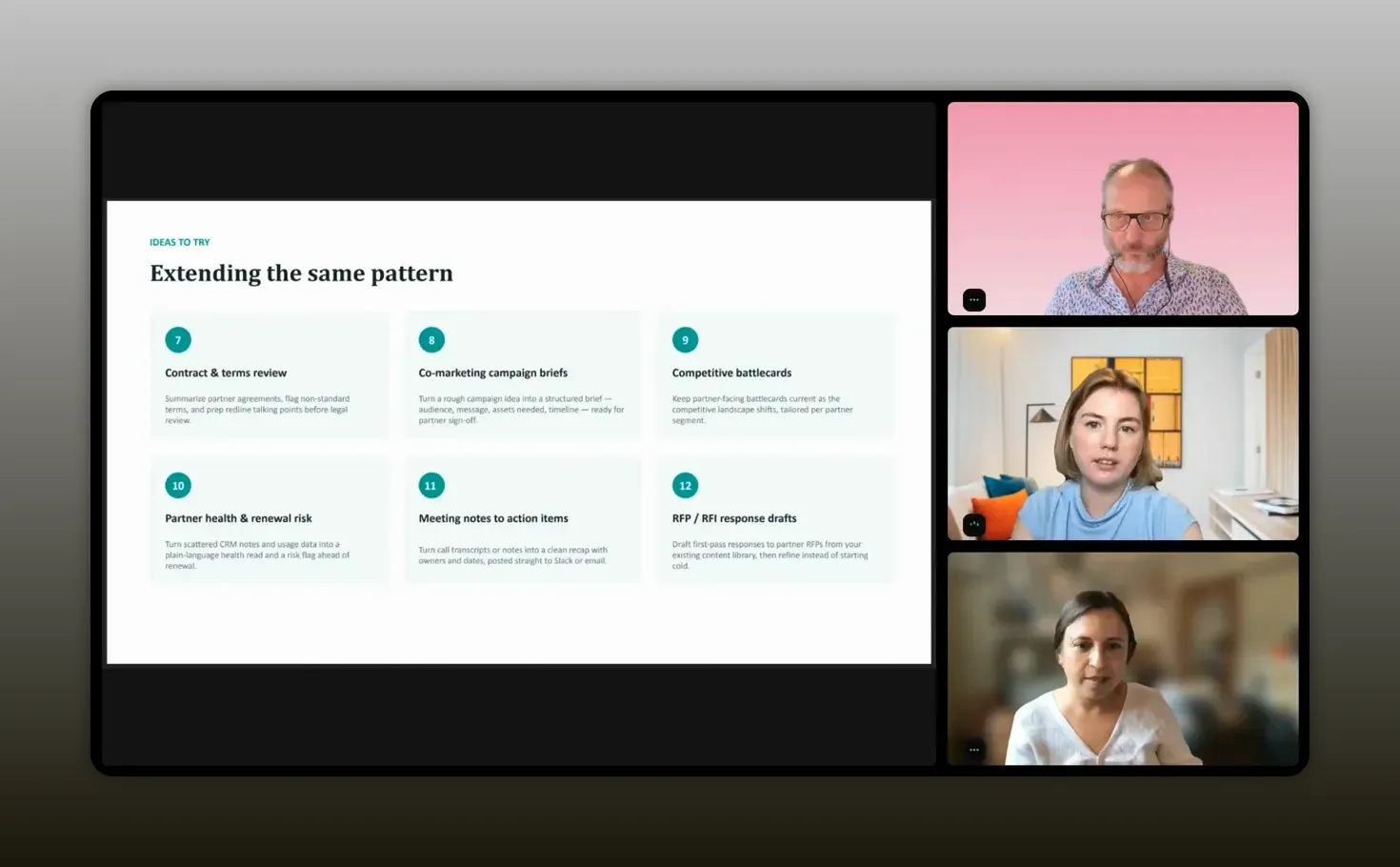
“AI can improve your productivity, but it does not replace your judgment.” -Thorunn
The same guardrail applies to meeting notes, outreach, and account research. AI can summarize action items, identify stated interests, and help tailor a meeting around what matters to the people in the room. Teddy also used publicly shared professional posts as context for making sessions more relevant. But review the result before acting. Make sure the facts are right, the tone is right, and the recommendation makes sense in the context of the relationship.
A safe progression for new workflows
- Start internally. Test a summary, content draft, or analysis on information already approved for internal use.
- Review the output closely. Check facts, terminology, tone, and anything that could affect a partner or customer relationship.
- Standardize what works. Turn successful prompts and inputs into a repeatable workflow.
- Automate selectively. Add integrations or agents only after you understand the process and its risks.
- Keep a human decision point. Do not allow convenience to replace accountability.
Recommended tools
You do not need every tool below. Choose the few that solve your most repetitive partnership problems and work within your company’s security and approval requirements.
- Claude: Best for drafting, analysis, personalized partner content, QBR skeletons, contract issue spotting, and working from uploaded or connected information.
- Slack AI: Best for turning busy deal and market channels into daily summaries, reminders, and action lists. Learn more through .
- Notion AI: Best for building an internal partner knowledge base, searchable content hub, and structured recommendation directory.
- Gong: Best for making call activity and tagged conversation signals easier to incorporate into partner workflows.
- Crossbeam: Best for ecosystem account overlap and shared account intelligence.
- Your existing partner platform: Best for keeping program operations, onboarding, and partner records connected to the systems your team already uses.
The biggest opportunity is rarely a perfect tool. It is a workflow where the right data, the right prompt, and the right human follow-up come together. You can explore a broader operating model in this guide to tracking partnerships at scale with Claude.
Conclusion
AI does not make EMEA less complex. It gives you a better way to operate inside that complexity. Use it to turn Slack noise into priorities, turn scattered QBR inputs into a coherent draft, turn generic enablement into account-specific value, and turn personal knowledge into a directory the whole company can use. Start small, test what helps, protect the human parts of partnership management, and share what you learn. You do not need to be an AI expert to build a more effective partner motion. You simply need to begin with a real problem worth solving.
FAQs
How can a partner manager use Claude day to day?
You can use Claude to summarize internal updates, prepare QBR drafts, create partner content, personalize joint value propositions, review ICP fit, organize partner information, and flag potential issues in partner agreements before formal review.
Can AI replace the relationship-building side of partnerships?
No. AI can reduce administrative work and improve preparation, but relationship building, trust, market awareness, judgment, and thoughtful communication remain central to a successful partner role.
What is the easiest AI workflow to start with in partnerships?
Start with a daily summary of internal deal channels, market channels, or outstanding messages. It is a low-complexity workflow that helps you identify where your time and partner intervention are most needed.
How can AI improve partner recommendations?
Build a structured partner directory with fields such as geography, capabilities, technology ecosystem, vertical experience, fit score, and competitive status. AI can then narrow suitable options based on a request, while you validate the final recommendation.
What should you check before sending AI-generated partner content?
Verify the factual accuracy, account context, approved brand language, confidentiality, commercial claims, and tone. AI should create a strong draft, but you should remain accountable for the final output.