Watch How AI Turns Crossbeam Data into $35M in Qualified Pipeline
Expert advice from Enrique Gutierrez (Co-founder and Head of GTM, Engineering).
Snapshot
You have a big opportunity sitting inside your partner ecosystem, but it only becomes valuable when it reaches the people who can act on it. Most teams use Crossbeam to check account overlaps manually, then leave the intelligence in a dashboard. That is where pipeline dies. The real advantage is building an ecosystem-led growth motion that turns partner data into prioritized accounts, the right contacts, timely context, useful outreach, meetings, pipeline, and revenue.
Enrique’s point is simple: every traditional growth channel eventually hits a ceiling. Paid acquisition gets more expensive, inbound plateaus, events require constant work, and outbound gets noisier. Partnerships can strengthen every one of those channels, but only when you operationalize the data instead of treating partnerships as a referral program.
Keep reading to see how Justin Zimmerman and Enrique Gutierrez can help you turn partner signals into qualified pipeline, stronger outreach, and scalable revenue operations.
“The partner ecosystem becomes powerful when the data is in the hands of the teams that can execute.” – Enrique Gutierrez
Table of Contents
- Snapshot
- Why ecosystem-led growth matters now
- Why partner data dies on dashboards
- The ELG operating system: chisel a useful list from the marble
- Use Crossbeam as a signal filter, not just an overlap viewer
- Qualify accounts with AI before you hand them to sales
- Find the right people, not just the right accounts
- Create personalized outreach without breaking trust
- Build feedback loops that improve the machine
- Recommended tools
- FAQs
- Conclusion
Why ecosystem-led growth matters now
The reason to care about ecosystem-led growth, or ELG, is not that partnerships are suddenly fashionable. It is that your existing go-to-market channels are under pressure. You can still run webinars, paid campaigns, outbound sequences, and inbound programs. You should. But each channel gets harder to scale efficiently when it operates without context.
Partner data gives you context. It can tell you whether a target account is already a customer of a strategic partner, whether a partner has an open opportunity there, whether a new product purchase has created a need for your service, or whether the account fits a better-together story.
That changes the entire nature of outreach. You are no longer starting with a cold, generic list and hoping a message lands. You are working from real signals that make a conversation more relevant.
Enrique has built partner-led outbound motions across three organizations. Those systems produced outcomes including $2 million in pipeline per month, 75 outbound meetings in three months, and 300 meetings in six months. The lesson is not that you should expect identical numbers. The lesson is that partner ecosystem data can become a real revenue channel when you design the operating system around it.
Partnerships also protect you from concentration risk. Enrique experienced this directly at an MSP where roughly 90% of leads came from one partner. When that partner ended the program, referrals dropped from approximately 150 per month to 10. Pipeline fell off a cliff. A single high-performing partner is great, but it is not a durable growth strategy if you do not build other ways to activate your ecosystem.
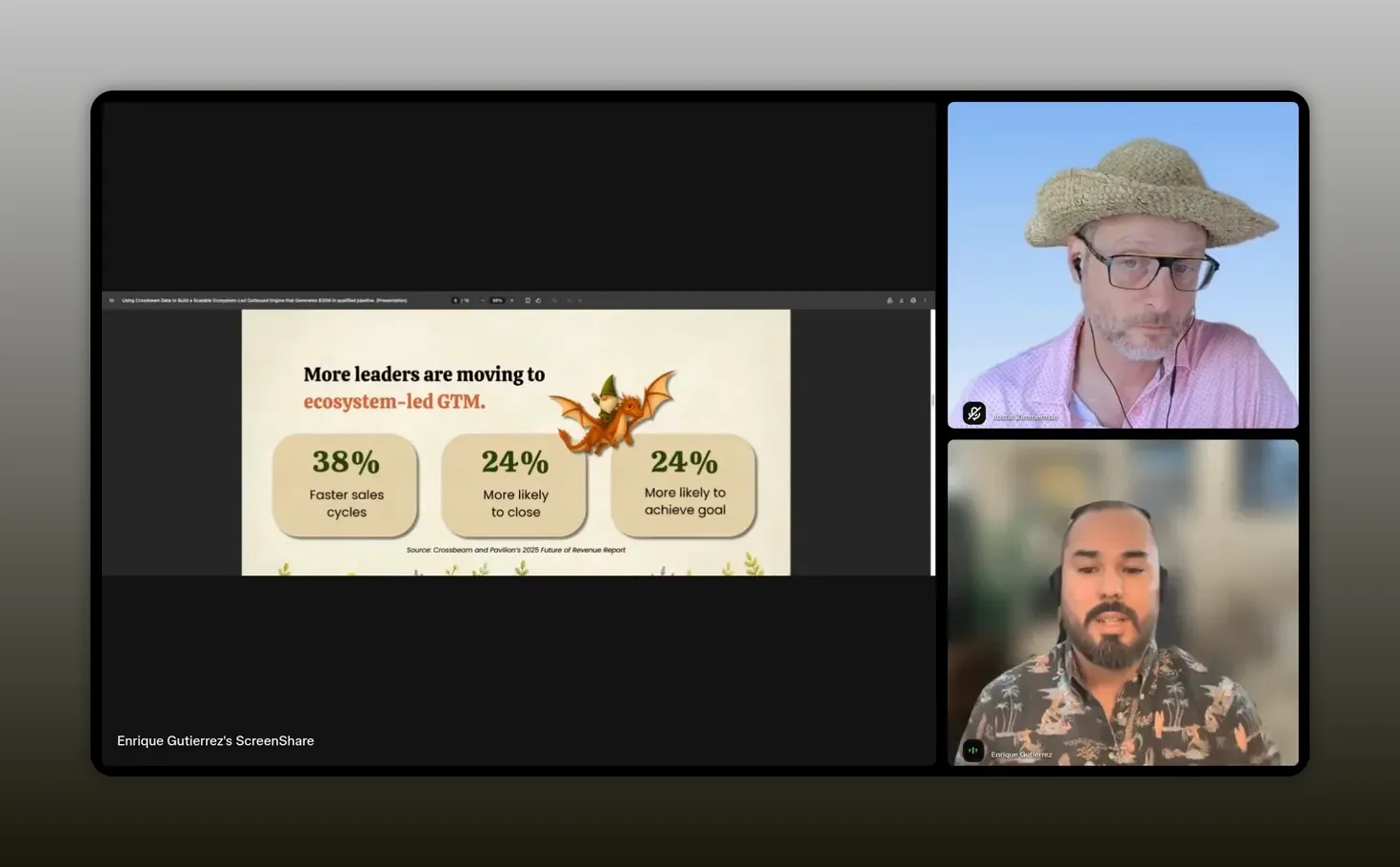
“Partnerships are way more than referrals. You can use them to scale growth across the go-to-market organization.” – Enrique Gutierrez
That is the bigger picture. Your ecosystem should not be a side channel run only by partnerships. It should improve demand generation, sales, customer success, business development, operations, and leadership visibility.
- Demand generation gets warmer account lists, better targeting, and more relevant messaging.
- Sales gets stronger co-selling context and insight from previous partner activity.
- Customer success can identify expansion opportunities and partner handoff possibilities.
- Revenue operations can route, score, measure, and improve the motion.
- Leadership gets a more complete view of how partnerships create pipeline and margin.
For a broader view of how partner data, disciplined workflows, and AI can shape revenue teams, explore this practical partnerships, data, and AI playbook.
Why partner data dies on dashboards
Most companies do not fail because their data is bad. They fail because the data does not make it into an executable workflow.
You may have a Crossbeam account, strong partners, meaningful overlap data, and a CRM full of target accounts. But if nobody owns the process from signal to action, your ecosystem intelligence becomes another dashboard people occasionally inspect.
That is the dangerous gap between “partnerships” and “revenue.” It is a bridge made up of many operational steps:
- Define the accounts you want to pursue.
- Identify partner overlaps and meaningful ecosystem signals.
- Clean and enrich account records.
- Score and segment accounts.
- Find and prioritize the right contacts.
- Route records to the people responsible for execution.
- Create scripts, messaging, and sequences.
- Capture outcomes and feed learnings back into the system.
Miss one or two of those pieces and the motion becomes fragile. Miss ownership and it becomes nobody’s job. Partnerships may generate the insight, but the work touches sales, marketing, BDRs, AEs, RevOps, DataOps, and executives. Someone needs to own the machine end to end.
Enrique spent 18 months building a self-created, scalable channel from partner data early in his work with ELG. That length of time is a reminder that this is not a one-click activation. It is a revenue system. The fastest path is to begin with a narrow, measurable use case rather than attempting to operationalize every partner and every signal at once.
Give the motion a clear owner
The owner does not need to do every task personally. But that person must be accountable for the flow of data, quality of targeting, enablement of the sales team, measurement, and iteration. Without that owner, partners blame sales, sales blames data, data blames process, and the opportunity disappears into a dashboard.
You need one person or a small cross-functional pod who can answer these questions:
- Which partner signals are worth acting on?
- Which accounts get priority and why?
- Who receives the accounts?
- What message will they use?
- What counts as a successful outcome?
- How will field feedback change the scoring and prompts?
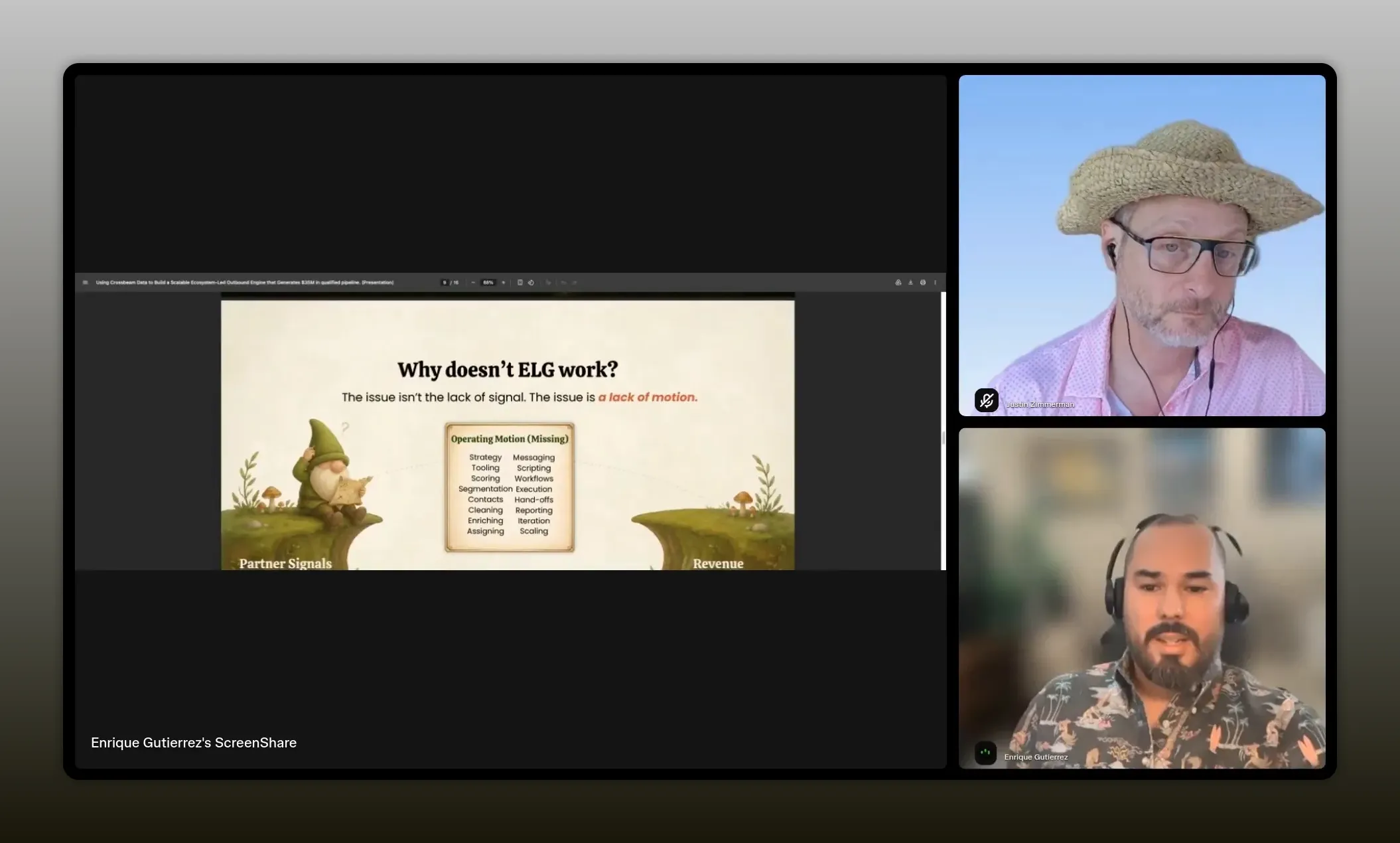
“Everyone wants to go from partnerships to revenue, but there’s a big bridge that needs to be built to fullfill that.” – Enrique Gutierrez
The ELG operating system: chisel a useful list from the marble
Enrique uses a great analogy. Your broad ICP list is a block of marble. It may contain lots of potentially relevant accounts, but it is still too broad to execute efficiently. Your job is to chisel it down until you have something precise enough for the field team to act on.
The raw material can come from cold ICP lists, account-based marketing targets, third-party intent, or indicators that companies are researching the products and services you or your partners provide. Bring that data into your CRM. In Enrique’s operating model, HubSpot acts as the central hub where the account records and outcomes live.
From there, the ecosystem-led workflow looks like this:
- Start with your broad market. Load target accounts and relevant intent data into the CRM.
- Connect Crossbeam to the CRM. Use partner overlap data to remove noise and uncover meaningful signals.
- Enrich and score with Clay. Classify companies, assess fit, identify contacts, and prepare routing logic.
- Keep humans in the loop. DataOps and GTM engineering validate record quality and improve the logic.
- Route to execution tools. Send approved accounts and contacts to sequencing and calling platforms.
- Measure field outcomes. Track meetings, pipeline, revenue, and gross-margin ROI.
- Feed learning back. Improve targeting, prompts, segmentation, and messaging based on what happens in the field.
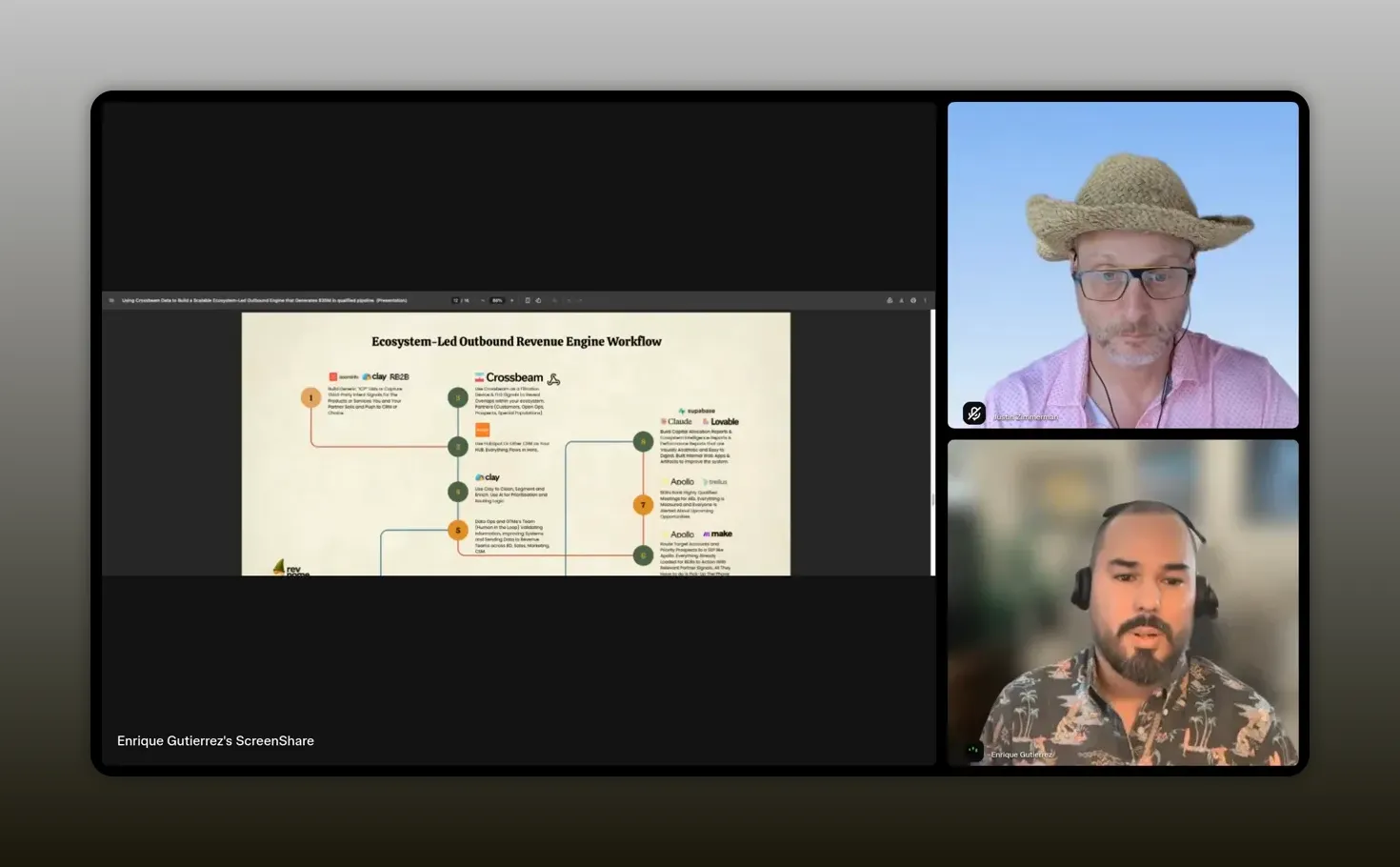
“The right accounts, the right people, the right context, and the right timing make everything downstream easier.” – Enrique Gutierrez
The important thing here is that AI does not replace the operational system. It accelerates the tasks inside it. You still need data standards, review processes, routing rules, owners, and measurement. AI makes a good process faster. It can also make a bad process produce more bad records at a frightening speed.
Use Crossbeam as a signal filter, not just an overlap viewer
Crossbeam becomes much more powerful when you stop thinking of it as a place to manually inspect account overlaps and start treating it as a filtration layer for your market.
Connect your CRM data and partner data, then identify overlaps across populations such as:
- Your prospects and your partner’s customers
- Your customers and your partner’s prospects
- Open opportunities on either side
- Custom account populations that matter to a specific play
That filtering process should narrow the universe into a few high-value segments. Enrique focuses on three practical categories:
- Net-new for you and your partner. Shared prospects where a coordinated story may create mutual value.
- Net-new for you. Your partner’s existing customers who may have a need for your offer.
- Open-opportunity interception. Accounts with active partner momentum where you may be able to help before the deal matures.
Webhooks add the timing dimension. Imagine you are a service partner for Snowflake. A partner signal can alert your CRM when Snowflake closes a new customer, along with useful deal context such as what the customer bought and who was involved. That does not mean you spray the account with a generic sales sequence. It means you have an informed reason to decide whether a timely, helpful conversation makes sense.
That timing is what makes the signal valuable. An account may match your ICP for years. A fresh platform purchase, an open opportunity, or a strategic change can create a window where your relevance is much higher.
Qualify accounts with AI before you hand them to sales
Even a filtered ecosystem list can be too large. Enrique gives the example of 1,500 overlapped accounts. With one or two BDRs, that can take more than six months to work through. If your team treats every overlap as equally important, you are still fishing in the ocean.
Clay is used in this workflow to clean, segment, enrich, and prioritize. The goal is not to produce a clever AI output. The goal is to make sure your team spends time on accounts that deserve attention.
Classify the business model
A useful first step is to identify whether the account is a service business, SaaS platform, hybrid company, or another relevant category. That classification helps you decide whether the account fits your offer and what kind of story will resonate.
For example, a service company may need a different partnership narrative from a software platform. Once you have buckets, you can create distinct messaging and prioritize based on the kind of value you can deliver.
Research fit from the company website
You can send an AI agent to review an account’s website and extract structured data points, such as primary industry, services, business model, customer profile, and evidence of relevance. This can help identify accounts that are competitors, poor fits, or unlikely to benefit from what you provide.
You can also look for signals of buying capacity. Enrique describes examining customer logos and market positioning to estimate the kinds of deal sizes an organization may support. A company serving enterprise brands may warrant a different priority than one whose customer base indicates a much smaller fit.
Do not treat these estimates as perfect truth. Use them as a prioritization input, then preserve the reasoning behind each decision. You want your team to understand why an account received a high score or why it was excluded.
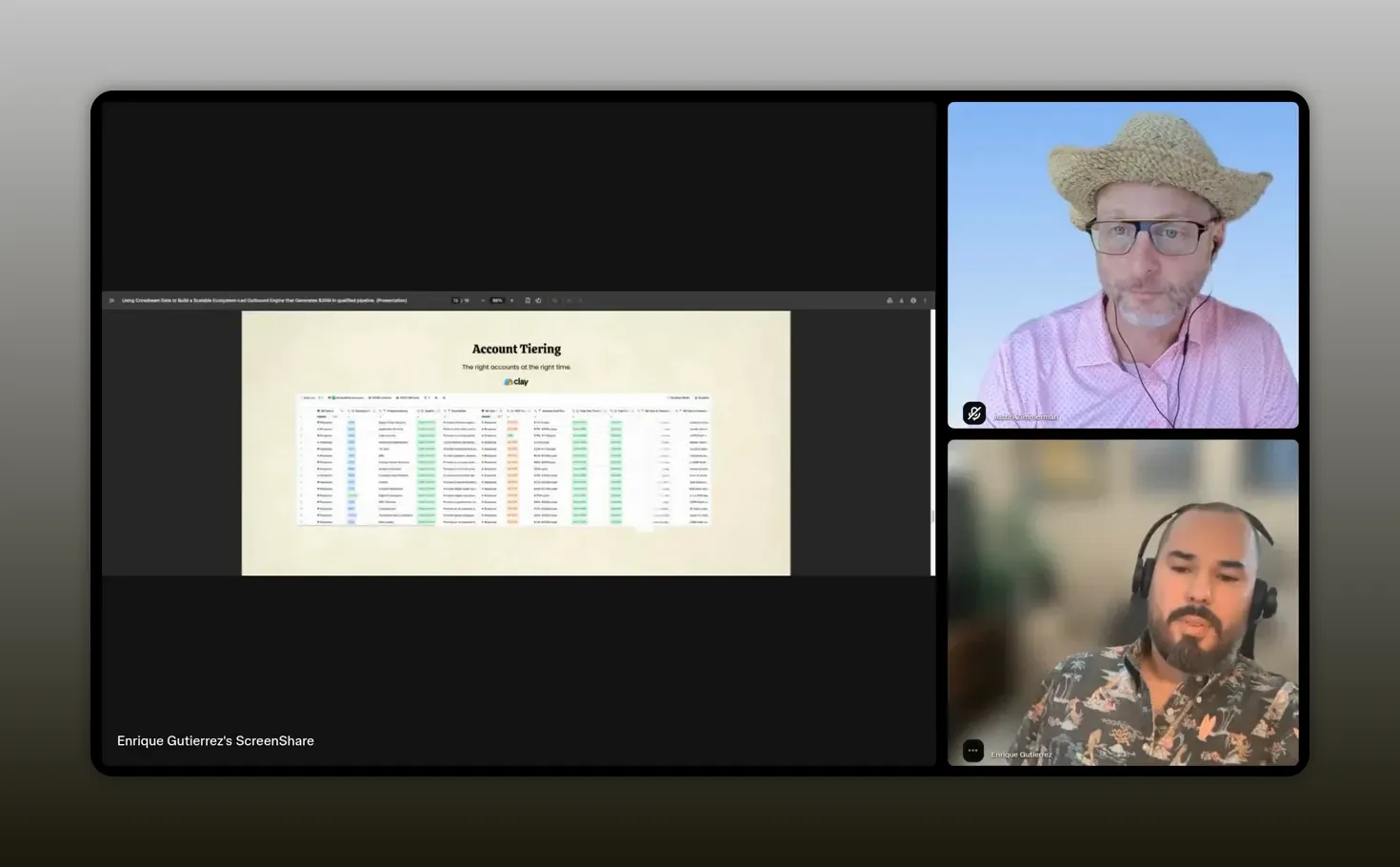
“You do not want to fish in the ocean. You want to fish in a small barrel.” – Enrique Gutierrez
This is where humans in the loop matter. DataOps and GTM engineering should review output quality, identify recurring issues, and adjust prompts or logic. A record that looks plausible is not always a record that should be sent to a BDR.
If you are building a broader partner-driven demand engine, the approach behind driving 1,000 or more webinar registrants with partners offers another example of turning ecosystem relationships into measurable outcomes.
Find the right people, not just the right accounts
An account does not book a meeting. A person does. And one account may have several possible stakeholders. This is why contact prioritization is just as important as account scoring.
After enriching contacts from sources such as LinkedIn, use AI to standardize messy job titles and classify each person by function and seniority. A title like “Head of Alliances and Strategic Ecosystems” should not disappear into a random title field. It should map into a usable category, such as partnerships or channels.
Your contact workflow can evaluate:
- Role and function
- Seniority
- Responsibility for the problem you solve
- Evidence from public profile information that the person discusses relevant priorities
- Connection to the partner-led use case you are pursuing
The goal is to route a small group of high-value contacts to the BDR, not dump a long spreadsheet into a sequence.
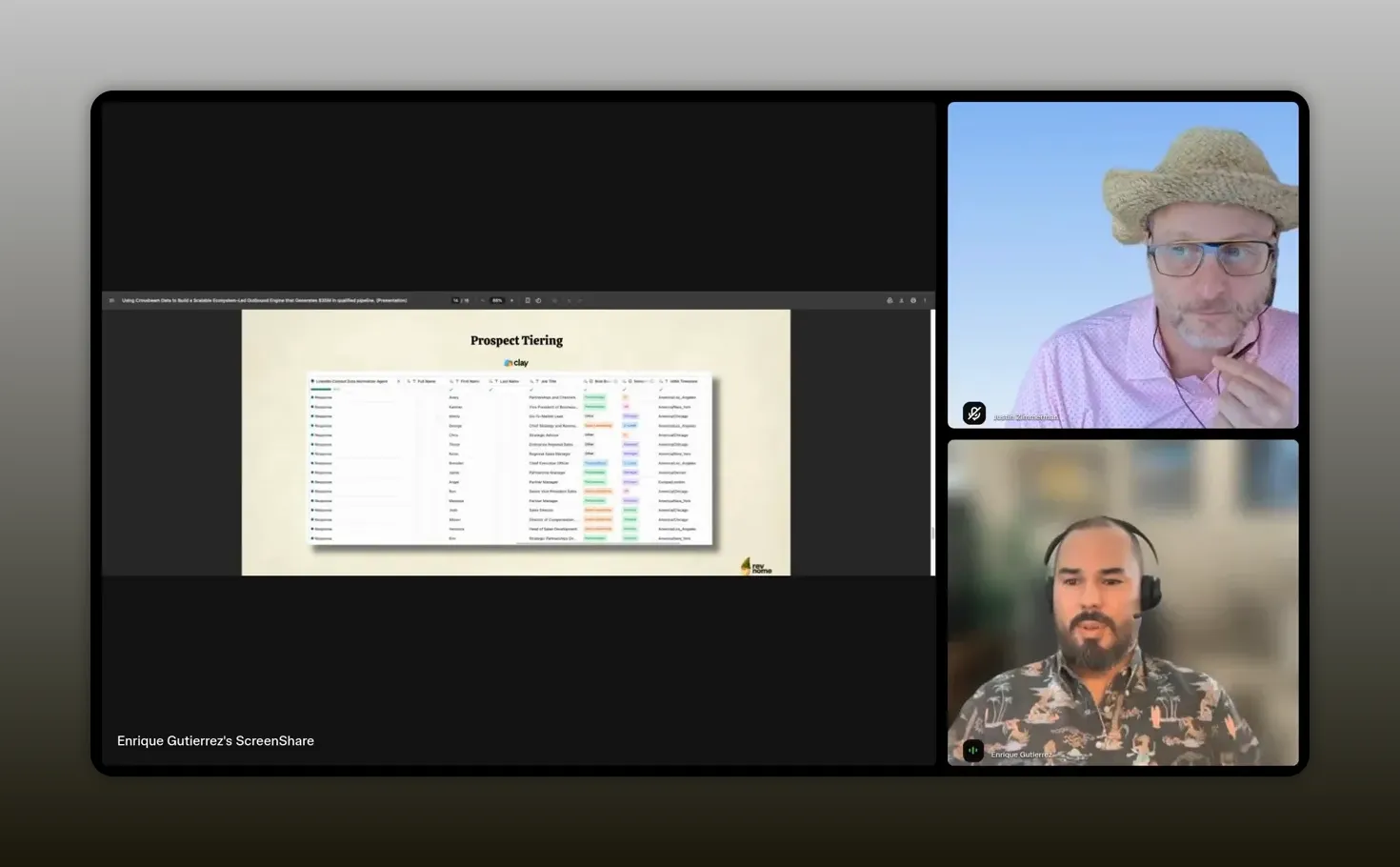
“Make sure your BDRs are spending their time with high-value accounts and high-value prospects.” – Enrique Gutierrez
Crossbeam’s MCP capability also points toward a more conversational way of working with ecosystem intelligence. Instead of hunting through several systems, you can ask questions using ecosystem data alongside internet research and enrichment data. The value is not the chat interface alone. The value is bringing the account, the person, the partner relationship, and the current signal into one research moment.
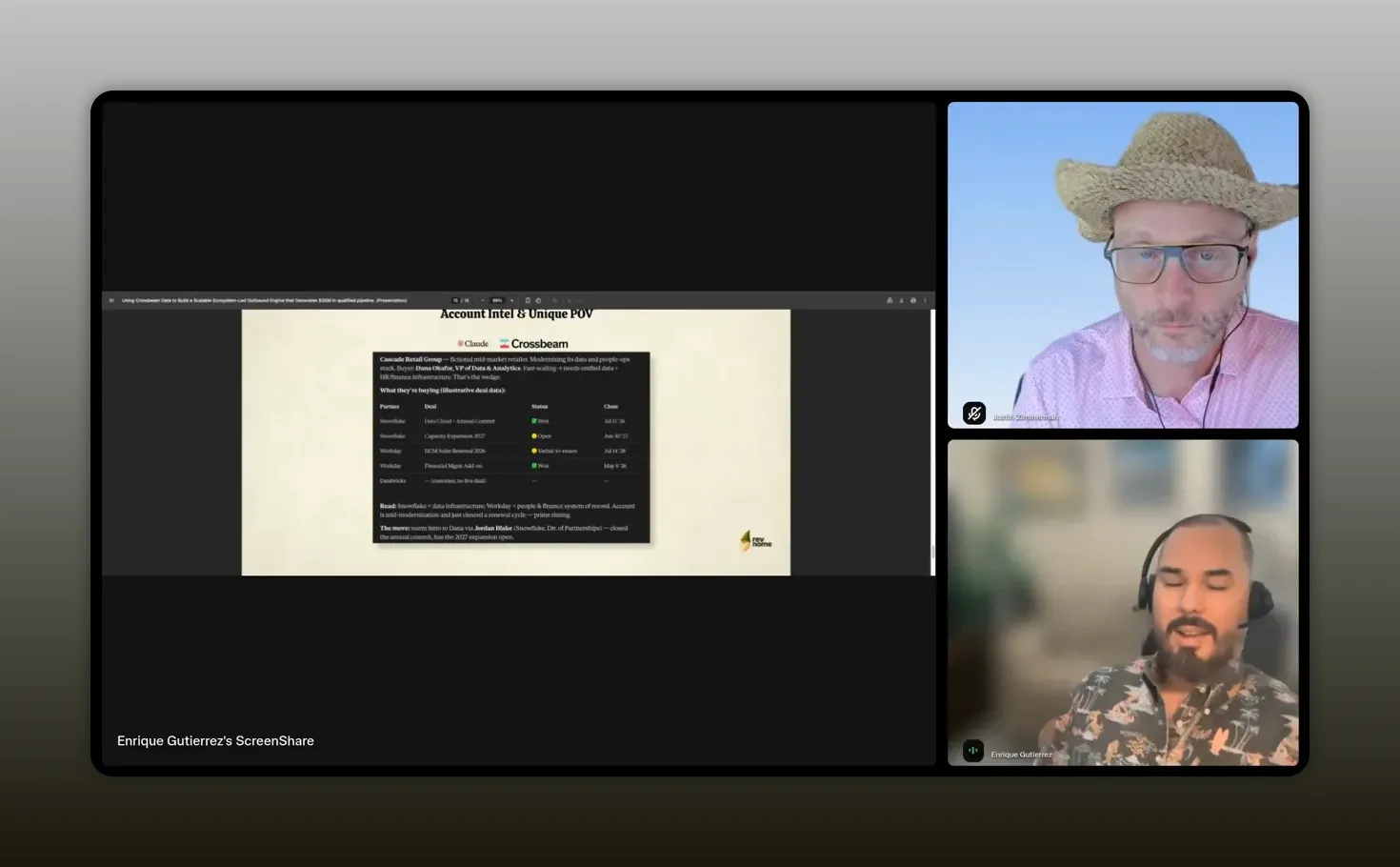
“Something just happened in this account, and that can make right now a great time to reach out.” – Enrique Gutierrez
Create personalized outreach without breaking trust
Here is the rule that matters most: you can use partner data to guide your outreach, but you should not announce that you have it.
Enrique calls it the first rule of Crossbeam: do not talk about Crossbeam in the outreach. If you call a prospect and say, “I saw in Crossbeam that you are using this platform,” you risk making the buyer uncomfortable and damaging the trust between you and your partner.
You may have the answers to the test. Do not tell the teacher you have them.
Instead, use the information to form a relevant hypothesis and invite the person into a useful conversation. For a company that works with platforms such as Snowflake, Workday, or Databricks, a phone-led opening might follow this structure:
- Introduce yourself and ask permission to take a moment.
- Reference the broad category of companies or platforms you commonly support.
- Describe a result or problem relevant to that environment.
- Ask whether the topic is relevant to the person.
- Offer information, education, or an empowerment session rather than a hard pitch.
You already know there may be a relevant platform relationship. But your prospect should have room to confirm, clarify, or redirect the conversation naturally.
This approach is particularly strong for MSPs and service businesses. You are not calling just to sell a service. You are connecting your expertise to technology the account may already use and offering a way to learn something useful. Enrique reports that a phone-led motion built this way converted 15% of connected calls into meetings.
Lead with informational value
The most effective partner-informed message does not sound like surveillance. It sounds like insight. You can offer a point of view on a problem, a practical framework, or an education session that helps the prospect get more value from their existing technology environment.
That is also why the data quality work matters. Generic personalization, such as adding a company name to a template, is not enough. Useful personalization comes from understanding the account’s model, likely priorities, relevant partner ecosystem, and the specific person’s role.
Build feedback loops that improve the machine
Once accounts reach the field, measure what happens. Otherwise, you will never know whether your data, prioritization, messaging, or routing is actually working.
Enrique’s system captures outcomes and stores learnings so they can be analyzed and used to improve the workflow. This is where tools such as Supabase, Claude, and Lovable can help create internal reports, dashboards, and applications around the data.
The core business measures are straightforward:
- Meetings created
- Pipeline generated
- Revenue closed
- Gross-margin ROI
But you should also measure the health of the operating system:
- How many overlapped accounts become qualified accounts?
- How quickly do qualified accounts reach BDRs or AEs?
- Which partner signals create the highest meeting rate?
- Which segments produce the best pipeline and closed revenue?
- Which messages create meaningful conversations?
- Where do reps reject records or report poor fit?
These inputs should return to your DataOps and GTM engineering team. If an account class consistently underperforms, revise the qualification criteria. If a particular partner signal creates high-quality meetings, increase its score. If reps find that a job-title classification is inaccurate, fix the enrichment logic.
Your ecosystem intelligence can also improve the way you understand your partners. By analyzing overlap patterns, you can learn more about partner ICPs, target better accounts, and sharpen the better-together narrative your team uses in the field.
Recommended tools
You do not need every tool on day one. You need a clean flow of data, clear ownership, and an execution path. Enrique’s example stack shows how each layer can play a specific role.
- Crossbeam: Reveal account overlaps, partner populations, ecosystem signals, and webhook-triggered events.
- HubSpot: Serve as the central CRM hub for accounts, records, lifecycle activity, and reporting.
- Clay: Clean, enrich, segment, score, and prioritize account and contact data with AI-assisted logic.
- Apollo: Load approved prospects into outbound sequences.
- Trellus: Support phone-led execution through a dialer workflow.
- Make: Route data between systems through automated workflows.
- Supabase: Store structured learnings and operational data.
- Claude and Lovable: Analyze information and create internal reports, dashboards, and applications.
The stack is not the strategy. Avoid buying tools to compensate for an unclear process. First decide which signal you will act on, who will act on it, what message they will use, and how success will be measured. Then add technology only where it removes friction.
FAQs
What is ecosystem-led growth?
Ecosystem-led growth is a go-to-market approach that uses partner relationships, account overlap data, and ecosystem signals to improve targeting, outreach, co-selling, expansion, and revenue generation. It is broader than partner referrals because it supports multiple functions across your business.
How does Crossbeam data create pipeline?
Crossbeam data creates pipeline when you connect overlap and partner signals to a complete operating process. That process includes account qualification, enrichment, contact prioritization, routing to sales teams, relevant outreach, measurement, and continuous iteration.
Should you tell prospects that you found them through Crossbeam?
No. Use ecosystem data to understand relevance and timing, not as a talking point. Directly revealing sensitive partner intelligence can undermine trust with both the prospect and the partner. Lead with a helpful, relevant business conversation instead.
What should you measure in an ELG motion?
Measure meetings, pipeline, closed revenue, and gross-margin ROI. Also track operational measures such as qualification rates, speed to routing, partner-signal performance, rep feedback, message performance, and conversion by segment.
Can a small BDR team run an ecosystem-led outbound motion?
Yes, but a small team should narrow aggressively. Use partner overlap data, fit criteria, enrichment, and contact scoring to create a focused list. The purpose is to give BDRs fewer, better opportunities so they can spend more time having conversations and less time researching.
Conclusion
Your partner ecosystem is not valuable because it contains a large number of logos. It is valuable when you turn the right partner signals into action at the right account, with the right person, context, and timing. Start small, assign clear ownership, keep humans in the loop, protect partner trust, and build feedback into every stage. When you do that, Crossbeam stops being a dashboard for checking overlaps and becomes a practical engine for meetings, pipeline, revenue, and durable ecosystem-led growth.