The Future of Partner Management… The One-Prompt Playbook
Expert advice from Tyler Calder (CMO, PartnerStack).
Snapshot
AI is no longer just a clever writing assistant that helps clean up an email or summarize a call. It has become an operating layer for partner programs, with the potential to improve recruitment, targeting, activation, account planning, QBRs, and daily execution. But there is a catch. If you use generic prompts with generic information, you will get generic output that sounds like everybody else. That creates more work, less trust, and a whole lot of AI theater.
Instead of using AI to replace the relationship work that makes partnerships valuable, use it to remove the repetitive operational work that gets in the way of it. Tyler’s approach is straightforward: connect the right systems, provide current and relevant context, turn repeatable tasks into reusable skills, and keep humans accountable for judgment, relationships, and business results.
Keep reading to learn how Justin Zimmerman and Tyler Calder can help you build stronger partner targeting, better partner intelligence, and more scalable partner operations.
“AI should create more room for the human work, not remove the human work.” – Tyler Calder
Table of Contents
- Snapshot
- Why AI partner management matters now
- AI maturity is moving from assistant to operating layer
- Measure value by revenue, not novelty
- Start with partner and account targeting
- Context is the difference between useful AI and generic AI
- Connect your partner data to the rest of the tech stack
- Build better prompts by defining the job clearly
- Move from manual prompting to proactive workflows
- Keep humans in the loop where humans matter most
- Use skills to turn playbooks into action
- Examples of one-prompt partner workflows
- Recommended tools
- FAQs
- Build the context before you chase the automation
Why AI partner management matters now
There has been a lot of AI hype in partnerships. You have probably seen it, heard it, tested it, and maybe even become a little tired of it. That is fair. The goal is not to use AI because everyone else is using it. The goal is to solve the actual problems slowing down your partner program.
Those problems are familiar:
- You have too much partner data scattered across too many systems.
- Your team spends hours preparing reports, QBRs, follow-ups, and account plans.
- Great partner opportunities are hiding inside call notes, Slack threads, CRM records, and spreadsheets.
- Partner managers are expected to build relationships and drive measurable revenue with limited time.
- Your program knowledge lives in people’s heads instead of reusable workflows.
Justin has spent months bringing together practical examples of partnership leaders actually putting AI to work. The pattern is becoming clear: the partner professionals who get hands-on, build workflows, connect their systems, and test the tools are creating results that used to feel unlikely.
The stakes are bigger than saving a few minutes on an email. If AI helps you spend less time on manual administration, you can spend more time finding better partners, creating better co-sell motions, helping partners win, and proving revenue impact. That is a much more valuable use of your time.
For a wider look at how AI is changing the partner profession, read the State of AI in Partnerships 2026.
AI maturity is moving from assistant to operating layer
Tyler frames the shift in a simple way. AI has moved through several stages, and your team may be operating in different stages at the same time.
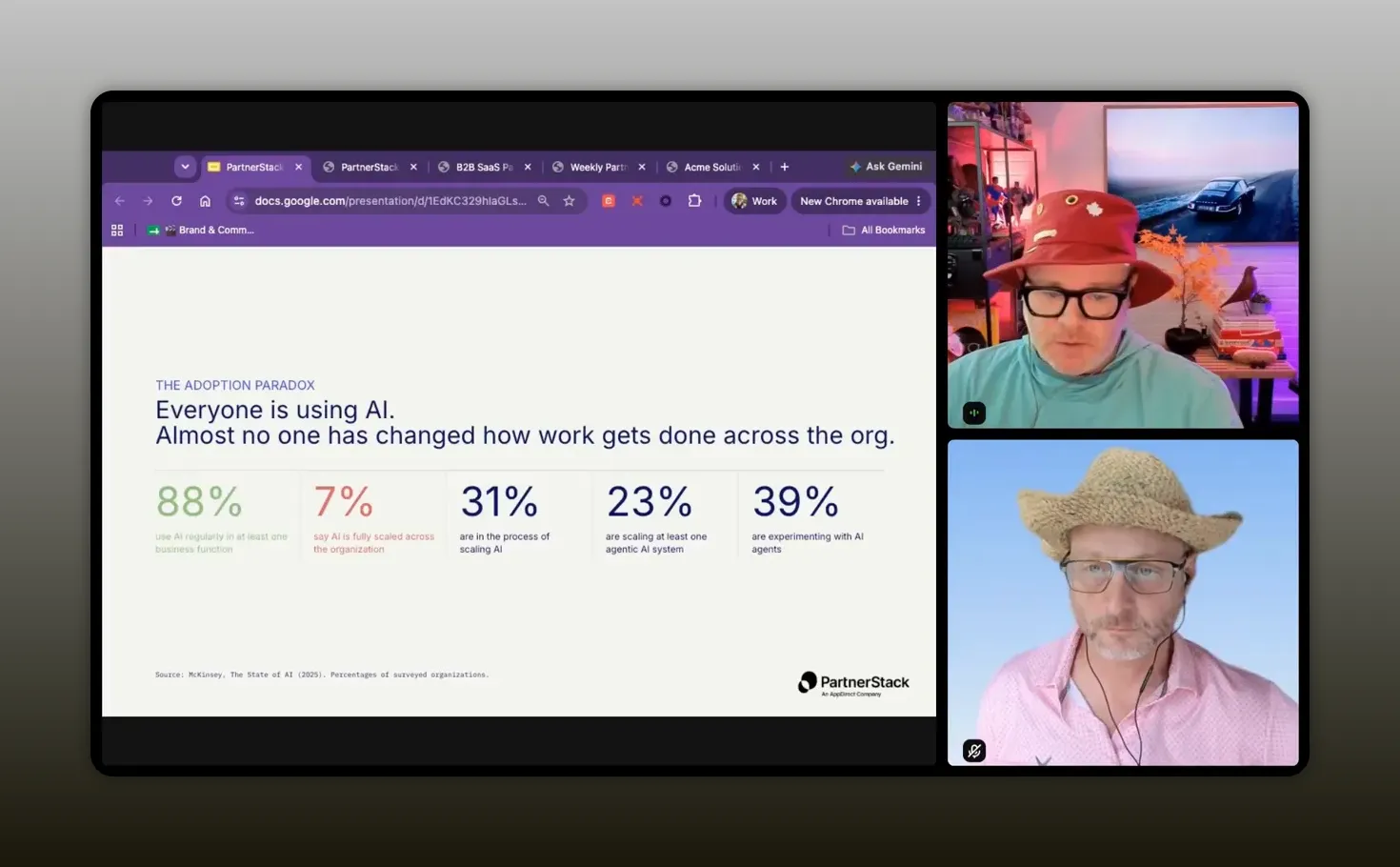
“Everybody is using AI, but very few organizations have scaled it across the business.” – Tyler Calder
- Search and synthesis: You ask AI to explain a concept, summarize research, or organize information.
- Content generation: You use it to draft emails, write partner communications, create content, or shape presentations.
- Analysis and recommendations: You provide data and ask AI to identify patterns, risks, or next best actions.
- Agentic workflows: You give an AI system enough context and clear enough instructions to run a repeatable workflow, escalating to you when human judgment is needed.
Most partner teams are somewhere between assistant and co-pilot. You ask a question, it answers. You give it a task, it works beside you. That is already useful. But it is not yet the same as an AI-enabled workflow that runs repeatedly with connected data and predictable outputs.
Tyler’s point is not that every partner program should race toward autonomy tomorrow. It is that you should understand where you are and build the next sensible layer. If you are still uploading a static report every week, that is okay. Start there. Then ask how you can connect live information, standardize the task, and create a workflow that returns useful recommendations without rebuilding everything from scratch.
The barbell approach to AI adoption
Do not make the mistake of treating AI as either magic or useless. The right approach looks more like a barbell.
- On one side, you keep testing, experimenting, and pushing the edges of what AI can do.
- On the other side, you hold onto the principles that will always matter: trust, relationship quality, good judgment, accountability, and real customer value.
Partnerships are not a factory line. You cannot automate trust. You cannot hand off the difficult tradeoffs in a strategic relationship. And you cannot expect an automated message to replace a thoughtful, well-informed conversation.
You can, however, automate the repetitive work surrounding those conversations.
Measure value by revenue, not novelty
When Tyler looks at AI adoption, he does not stop at time savings. Saving time matters, but it is not the final score. The question that matters is whether the time you save is being redirected into higher-value work that improves partner outcomes and revenue.
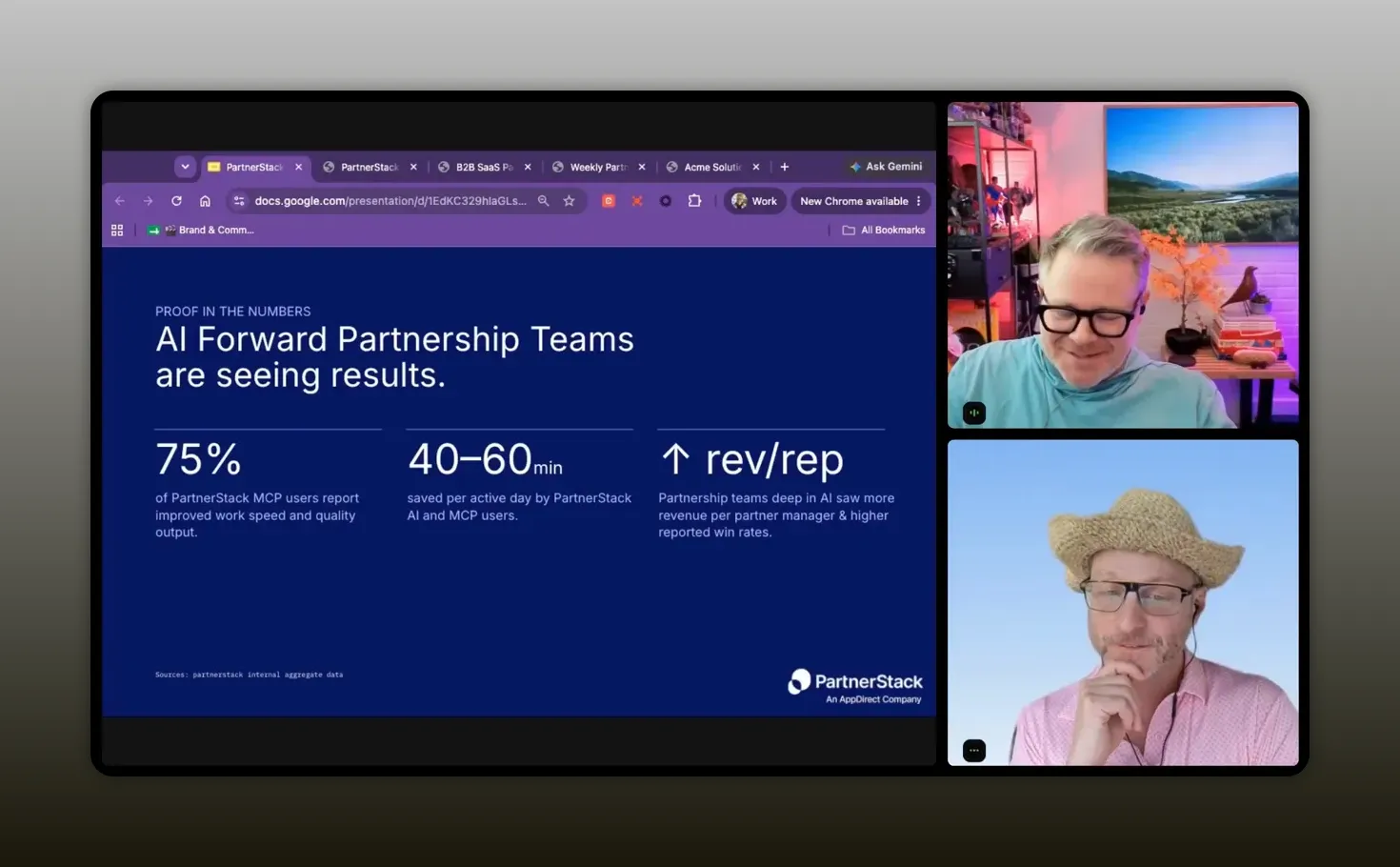
“The metric that matters is whether time saved turns into higher-value activity and more revenue.” – Tyler Calder
Among PartnerStack customers leaning into AI functionality, skills, and connected data, Tyler shared three useful signals:
- 75% reported higher-quality work completed more quickly.
- Teams saved roughly 40 to 60 minutes per day on repetitive work.
- Revenue per partner manager increased, which is the business metric that gets leadership’s attention.
These outcomes are not a promise that you can buy one tool and suddenly double your output. They are evidence that good partner technology, clear workflows, and meaningful context can improve execution.
Your CEO, CFO, and board will care that you work more efficiently. But they will care even more that your program identifies better partners, focuses on the right accounts, accelerates deals, and creates more revenue per person on the team.
Start with partner and account targeting
One of the most interesting findings Tyler shared is where go-to-market leaders expect AI to create the most value: identifying good-fit partners and good-fit accounts for co-selling and co-marketing.
That makes sense. Better targeting improves everything downstream. If you recruit the wrong partners, activation becomes a grind. If you chase the wrong joint accounts, your co-sell motion becomes noise. AI can help you process a much broader set of signals than any individual partner manager could reasonably inspect by hand.
For partner recruitment, your ideal partner profile should go beyond a loose description such as “agencies that sell into SaaS.” A useful profile considers signals such as:
- Customer segment and vertical focus
- Geographic coverage
- Business model and service offerings
- Technology compatibility
- Existing ecosystem relationships
- Sales motion and deal size
- Partner performance patterns
- Engagement with your program
Tyler explained that PartnerStack can use up to 60 different signals to predict whether a prospective partner is likely to be a strong fit. That is where AI becomes genuinely useful. It can organize and assess a high volume of evidence, but you still decide whether the fit is strategically meaningful.
This same logic applies to joint account targeting. You want to understand account tier, product usage, intent signals, champions, partner relationships, historical activity, and the likelihood that a partner can create a credible path to value.
If partner recruitment and account planning are priorities, the Claude for Beginners: Partnerships Edition guide provides a practical foundation for building AI-supported research and outreach workflows.
Context is the difference between useful AI and generic AI
This is the heart of the whole conversation. Better prompts help. But context is what changes the quality of your output.
If you enter an LLM and ask it to create a partner strategy, define your ideal partner profile, or build a QBR deck without meaningful context, you will get something polished but generic. It may look convincing for five minutes. Then you will realize it could apply to almost any company in almost any market.
That is not good enough.
“Context is everything the AI needs to make the best possible decision in that moment.” – Tyler Calder
The goal is not to dump every document your company has ever created into an AI tool. More context is not always better. The goal is to provide the right context at the right moment.
Three rules for useful context
- Relevant: The information must help answer the specific question or complete the task at hand.
- Structured: It should be organized so an AI system can reason through it rather than get lost in noise.
- Current: It must reflect today’s positioning, program rules, partner status, and priorities.
Old information is a quiet killer. If your AI system is working from an outdated partner tiering model, last year’s positioning, or commitments that no longer matter, it can confidently give you the wrong answer. You need a way to maintain your knowledge sources over time.
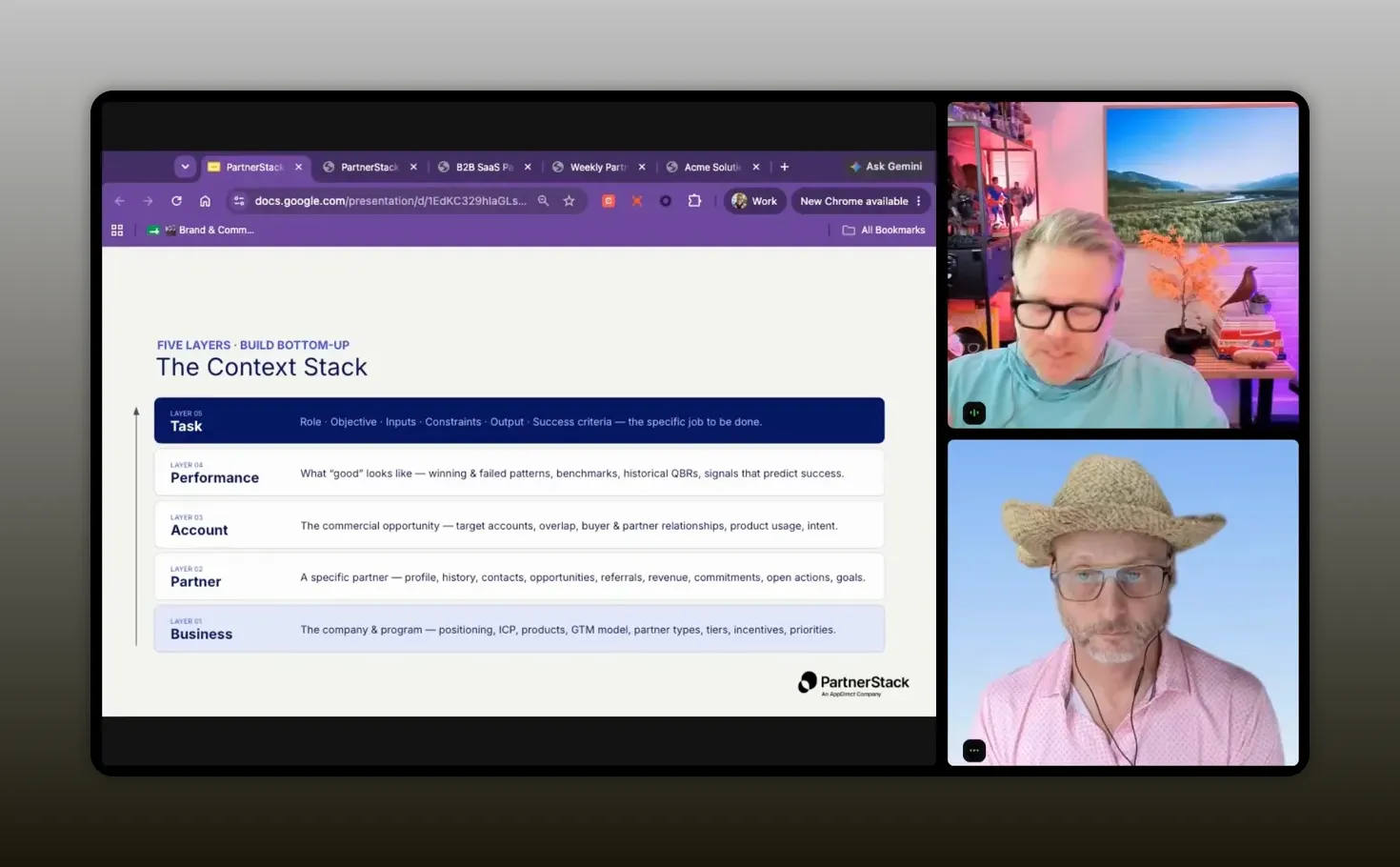
The five layers of a partner context stack
Tyler’s framework gives you a practical way to think about your context stack.
- Business context: Your company positioning, ICP, product information, go-to-market motion, partner types, partner tiers, incentives, and program structure.
- Partner context: The partner’s profile, people, history, opportunities, referrals, performance, commitments, QBR notes, and relationship activity.
- Account context: Joint target accounts, tiers, champions, intent, product usage, ecosystem data, and account-level signals.
- Performance context: Winning patterns, failed patterns, benchmarks, historical performance, and what “good” looks like in your program.
- Task context: The exact job you want done, constraints, inputs, format, success criteria, and where human approval is needed.
The first four layers tell the AI what it needs to know. The fifth tells it what to do with that knowledge.
Connect your partner data to the rest of the tech stack
A PRM is critical, but it should not be the only place your AI gets context. Tyler sees a major missed opportunity when partner teams only pull data from their PRM and ignore the rest of the stack.
At PartnerStack, relevant intelligence comes from several systems:
- PartnerStack for partner program data and partner performance
- Salesforce for CRM and sales information
- Notion for business and knowledge-base context
- Gmail and Slack for relationship activity and conversations
- Gong for call recordings and customer reality
- HubSpot for marketing automation and engagement
- Pendo for product usage information
- ZoomInfo and Crossbeam for account and ecosystem intelligence
- Looker and Snowflake for business intelligence and data storage
This is not a required shopping list. You do not need every tool. The principle is simple: connect the sources that carry meaningful information for the decision you are trying to make.
Why call data is especially valuable
Tyler is particularly bullish on call-recording data. Your CRM and PRM often represent what your team says is happening. That is useful, but it is also filtered through human optimism, incomplete notes, and normal bias.
Calls are closer to the truth. They can reveal hesitation, risk, competitor references, unmet needs, lack of urgency, and potential opportunities for a partner introduction.
Imagine a customer success call where a customer is struggling with a problem one of your partners solves well. An AI workflow with current partner context can flag that moment and suggest the best three partners to introduce. Or a sales call might surface a major deal risk that looks invisible in the CRM. Those are the kinds of insights that move AI beyond content generation and into useful partner intelligence.
Build better prompts by defining the job clearly
Prompting still matters. It is just not the whole game. Once you have the right context connected, you need to clearly define what you want the AI to do.
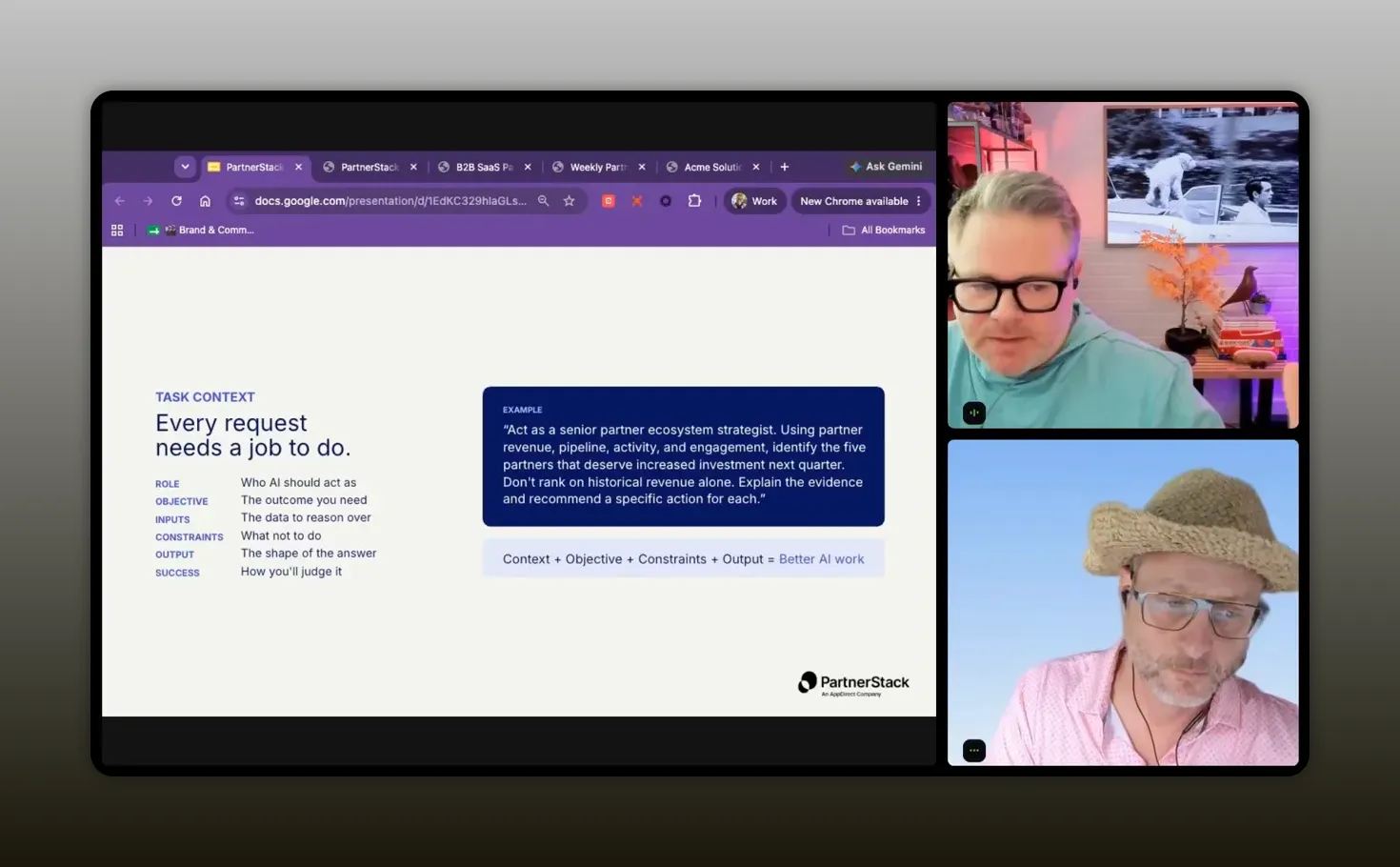
“A strong task definition includes the role, outcome, inputs, constraints, output, and success criteria.” – Tyler Calder
When you create a partner AI workflow, include these elements:
- Role: What specialist should the AI act like? For example, partner operations analyst, strategic alliance manager, or co-sell planner.
- Outcome: What specific result do you need?
- Inputs: Which records, documents, data points, and sources must it use?
- Constraints: What should it avoid, preserve, or escalate?
- Output format: Do you need a brief, a table, a QBR page, action list, or account plan?
- Success criteria: How will you evaluate whether the output is useful?
A vague request creates vague results. A repeatable task with clear inputs and a defined output can become a reusable skill.
That is the shift from “I asked Claude to help me” to “we have a reliable partner workflow that anybody on the team can run.”
Move from manual prompting to proactive workflows
There is a natural progression in how you can use AI in partnerships.
- Manual and ad hoc: Export a report, upload it, ask questions, and get a one-time answer.
- Reusable prompts: Save the instructions and repeat the same process more consistently.
- Connected context: Link your systems so AI can access current data across your workflow.
- Proactive intelligence: Let the system identify risks, opportunities, actions, and changes that deserve your attention.
Most teams are building toward stage three. That is a productive place to be. You are connecting data and beginning to create repeatable processes. The long-term direction is more proactive, where the system can flag a new partner application that appears fraudulent, identify a partner opportunity from a call, surface a QBR risk, or produce a weekly action digest.
You should not attempt to automate every partnership motion. Start with a workflow that is repetitive, time-consuming, and clear enough to define. Then improve it with better context and human feedback.
Keep humans in the loop where humans matter most
There is understandable anxiety around AI and jobs. But Tyler’s view is that the best use of AI is not to remove people from the process. It is to get people out of the busywork and into the judgment-heavy, relationship-heavy work where they add the most value.
Your responsibility as the human in the loop is to:
- Exercise judgment and make tradeoffs
- Own outcomes and performance
- Build, maintain, and repair relationships
- Decide what deserves strategic attention
- Review important outputs before action is taken
- Bring taste, credibility, and accountability to the work
Partnership professionals have always known that relationships matter. But relationships alone are not enough if revenue accountability is missing. AI can help you close that gap by freeing up capacity for partner strategy and relationship building while making program execution more measurable.
That is the real unlock: use automation to increase your ability to be more human where it counts.
Use skills to turn playbooks into action
Traditional playbooks are useful. You read them, take notes, adapt them, and eventually try something. Skills compress that journey. They are downloadable, reusable workflows that package expertise into a structured task you can run in your own AI environment.
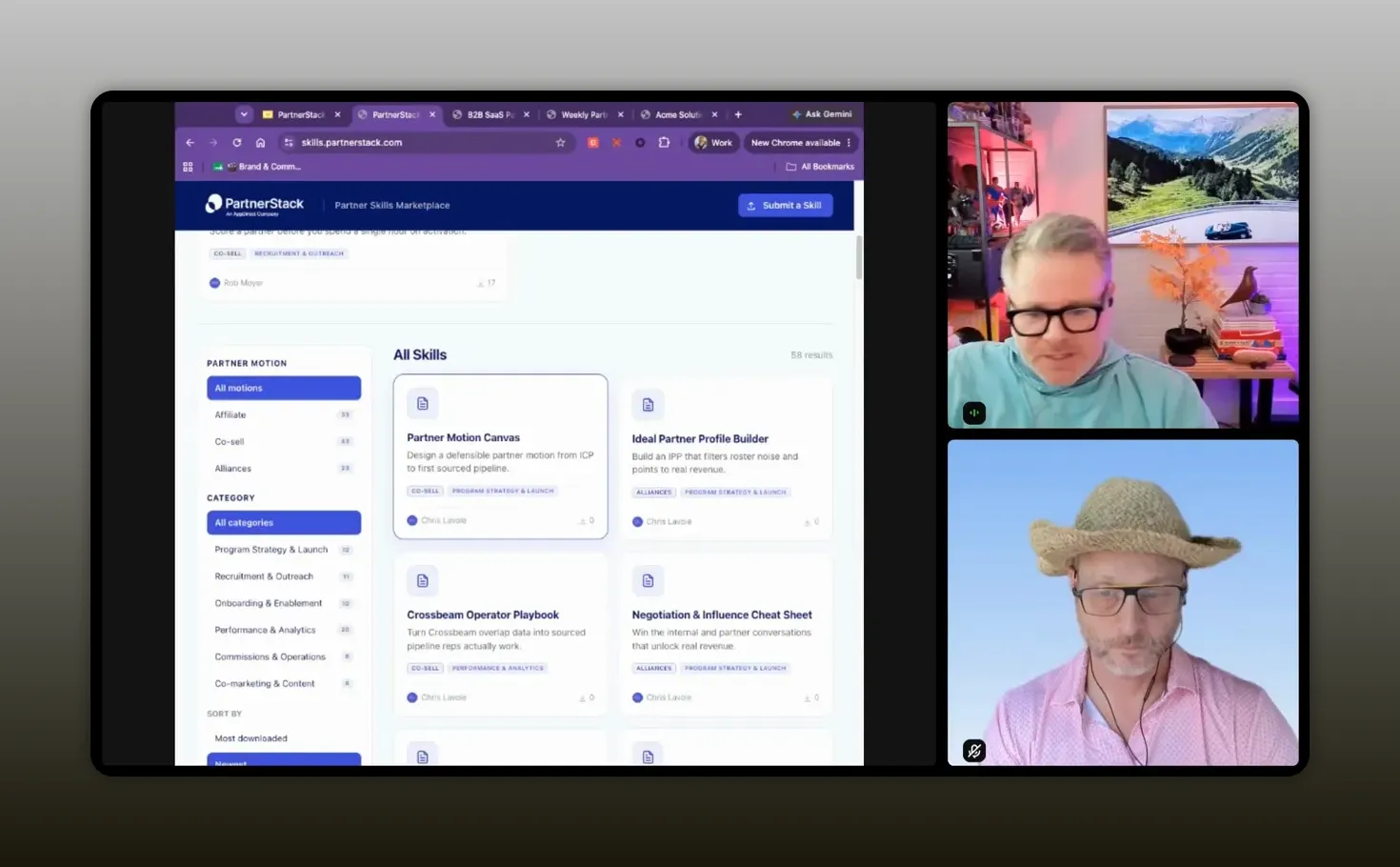
“The future of playbooks is not just content. It is reusable skills you can put to work.” – Tyler Calder
PartnerStack’s AI Skills Marketplace includes skills for common partner program needs, including:
- Ideal partner profile building
- Partner recruitment and qualification
- Partner onboarding and activation
- Partner payouts
- QBR preparation
- Partner performance benchmarking
- Crossbeam operator workflows
- Partner opportunity identification
The major benefit is consistency. A strong skill includes much of the task structure already: the role, the expected inputs, the process, the constraints, and the output. You are not starting from a blank page each time.
That also makes it easier to share institutional knowledge across your team. Instead of one experienced partner manager being the only person who knows how to build a useful partner brief, you can turn that best practice into a workflow others can use and improve.
For more principles on building useful AI workflows without sacrificing the relationship side of partnerships, explore 10 New Principles for AI in Partnerships.
Examples of one-prompt partner workflows
Tyler shared a few examples that show what this approach can look like when the underlying context is connected.
Weekly partner action digest
Instead of entering multiple systems to understand what needs attention, you can produce a weekly digest of partner actions. It can identify urgent follow-ups, new applications, potential fraud signals, partner performance changes, and the next actions that deserve attention.
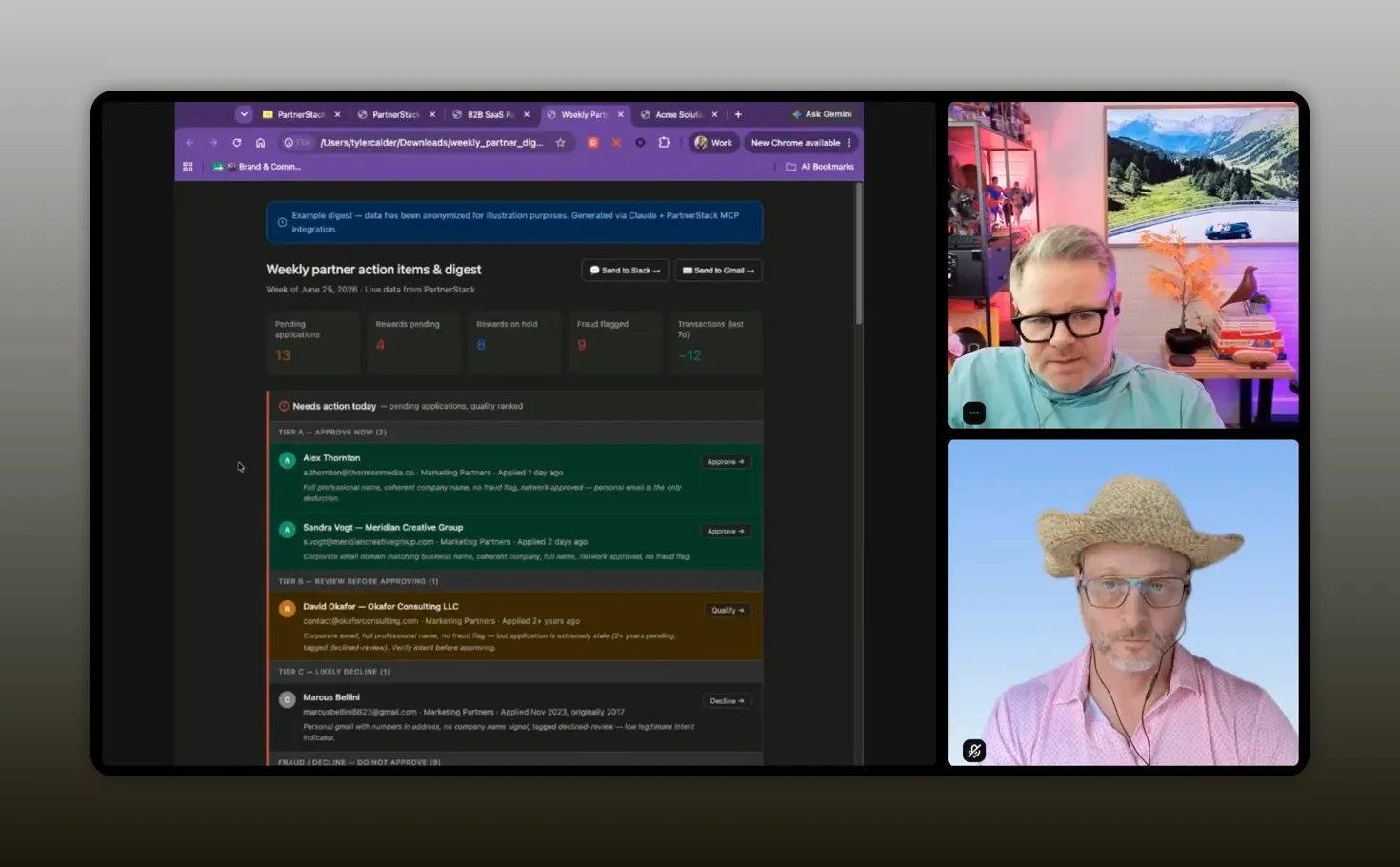
“The most useful workflows are the ones that bring the important actions to you.” – Tyler Calder
This does not mean you blindly approve everything the system recommends. It means you start Monday with a clearer view of where your judgment is needed.
Live partner QBRs instead of static decks
Static QBR decks get old quickly. Someone has to export the data, paste charts, update slides, and hope nothing changes before the meeting. A more scalable approach is to create a live HTML experience connected to current data. Your partner gets a clearer picture of performance, and your team spends less time maintaining presentations.
Benchmarking against comparable partner programs
Benchmarking is another strong use case. If you can compare your program performance against aggregated, anonymized patterns from similar organizations, you can identify where you are leading, where you are lagging, and what deserves investigation.
The important part is not simply having a benchmark number. It is using the benchmark to ask better questions. Why are referrals declining? Why is activation slower in one partner segment? Which incentives correlate with stronger outcomes? Where do your best partners behave differently?
Recommended tools
Your stack should serve your operating model, not the other way around. Still, several categories of tools are especially useful when you want to build AI-enabled partner workflows.
- AI workspace: Claude or ChatGPT for analysis, skills, research, content, and connected workflows. Learn more about Claude and its capabilities.
- Partner relationship management: A modern PRM that can store partner data and connect to your broader stack.
- CRM: Salesforce, HubSpot, or another system where joint opportunities and account activity live.
- Knowledge base: Notion or an equivalent system for maintaining current positioning, program rules, and internal documentation.
- Call intelligence: Gong, Attention, or another call-recording platform that captures what customers and partners are actually saying.
- Ecosystem intelligence: Crossbeam and ZoomInfo for account overlap, relationship signals, and targeting data.
- Business intelligence: Looker, Snowflake, or the reporting environment your organization uses to understand performance.
You do not need to connect everything immediately. Pick one workflow and identify the minimum useful sources of context. Then build from there.
FAQs
What is AI partner management?
AI partner management is the use of AI tools, connected partner data, and repeatable workflows to improve partner recruitment, activation, co-selling, account targeting, performance analysis, and partner operations. The goal is to reduce manual work while improving the quality and speed of partner decisions.
What is a one-prompt playbook?
A one-prompt playbook is a structured AI workflow that combines a defined task with the right context, instructions, constraints, and expected output. Rather than rebuilding a prompt each time, you use a reusable skill to complete a repeatable partnership task consistently.
Why does context matter so much in AI workflows?
Context gives AI the information it needs to produce a useful and specific answer. Without current business, partner, account, performance, and task information, AI tends to produce generic recommendations that are difficult to trust or act on.
Can AI replace partner managers?
AI can handle repeatable administrative and analytical work, but it cannot replace the judgment, accountability, trust-building, and strategic decision-making that make a strong partner manager valuable. The better goal is to use AI to create more capacity for those human responsibilities.
What partner workflow should you automate first?
Start with a workflow that is repetitive, time-consuming, and easy to define. Good starting points include weekly partner action summaries, partner research, ideal partner profile scoring, QBR preparation, partner application review, and identifying partner opportunities from call data.
Build the context before you chase the automation
The rush toward AI can make it tempting to look for the biggest possible automation first. Resist that urge. The best partner AI workflows are not the flashiest ones. They are the ones grounded in current, relevant information and connected to a real operating need.
Start with what your team already does every week. Find the work that drains time without requiring much creative judgment. Define the task. Connect the right context. Create a reusable skill. Keep a human accountable for the outcome. Then measure whether it improves execution and creates more room for relationships, strategy, and revenue.
That is how you move from AI experimentation to an AI-enabled partner program. You do not need to become fully autonomous overnight. You just need to make the next useful workflow possible.