$6,400,000 Gemini Powered Partner Pipeline
Expert advice from Forest Yule Donovan (Senior Director of Strategic Alliances, Fullstory).
Snapshot
Partner teams can finally punch above their weight. For years, event sponsorships have been expensive, noisy, and frustratingly hard to turn into real pipeline. You spend money to show up, compete with thousands of brands for attention, and then hope your team somehow finds the right people in a sea of registrations.
That model is breaking. With the right AI workflow, you can sort huge attendee lists, personalize outreach, prepare sellers for better conversations, and qualify opportunities faster without waiting on three other departments to rescue the program. That matters now because event costs are not dropping, buyer attention is not getting easier to win, and partner teams are still being asked to do more with less.
If you want to solve weak event targeting, generic outreach, and slow pipeline qualification, keep reading to see how Forest Yule Donovan and Justin Zimmerman can help you do it.
“Let the AI do the heavy lifting so you can focus on execution and relationships.”
Forest Yule Donovan
Table of Contents
- Snapshot
- Why event pipeline is so hard
- The Google Next challenge
- Step 1: Prioritize the right accounts
- Step 2: Personalize outreach at scale
- Step 3: Prepare sellers for better calls
- Step 4: Qualify opportunities faster
- Results by the numbers
- What made this work
- Lessons for partner teams
- Recommended tools
- FAQs
- Conclusion
Why event pipeline is so hard
Partner teams know the pattern. You sponsor a major conference, spend a meaningful budget, line up side events, and then get dropped into a chaotic environment where everybody is competing for the same slice of attention.
That is especially true at big ecosystem conferences. Google Next, Dreamforce, Adobe Summit, and similar events are packed with attendees, sponsors, internal sales teams, and overlapping agendas. Even when you have a strong offer, a good partner relationship, and a decent plan, the main problem remains the same: who exactly should you talk to first?
If you get that wrong, everything that follows gets weaker.
- Your invitations go to the wrong people.
- Your sellers waste time on low-fit meetings.
- Your event fills with curiosity instead of buying intent.
- Your post-event pipeline is harder to defend.
That is what makes Forest’s approach interesting. He did not start with copywriting or automation for its own sake. He started with the bottleneck that breaks most event programs: prioritization.
That idea lines up with a broader truth in partner-led growth. The event is not the strategy. The workflow behind it is. If you want a deeper framework for building partner events around revenue outcomes, this guide on planning, promoting, and profiting from partner events is a strong complement to this approach.
The Google Next challenge
At Fullstory, Forest manages hyperscaler partnerships with a strong focus on Google. That matters because the value of a sponsorship is not just booth traffic or logo placement. It is the ability to work with partner-aligned account teams and create reasons for the right prospects to engage.
Fullstory’s side event was not a generic happy hour. It was a tightly curated experience at a racetrack near Las Vegas where select prospects and customers could drive high-end supercars. That kind of offer gets attention, but it also raises the stakes.
When your per-person cost is high, you cannot afford sloppy targeting.
You do not want to fill the event with people who only like fast cars. You want people who have active problems you can solve, enough strategic alignment to warrant a discovery conversation, and ideally a relationship path through your partner ecosystem.
So the challenge looked like this:
- Sort through a list of more than 30,000 possible conference attendees.
- Find the tiny fraction that best matched Fullstory’s ideal customer profile.
- Understand which of those prospects had meaningful initiatives around AI, data, or digital experience.
- Identify which ones were likely engaged enough with Google that internal partner contacts could help create introductions.
- Reach out with messaging that felt personal and relevant, not mass-produced.
- Arm account executives with useful prep before the discovery calls.
- Use post-call intelligence to qualify opportunities quickly and objectively.
That is a lot of work if you try to do it manually. It is also exactly the sort of process AI is good at when you define the rubric clearly.
Step 1: Prioritize the right accounts
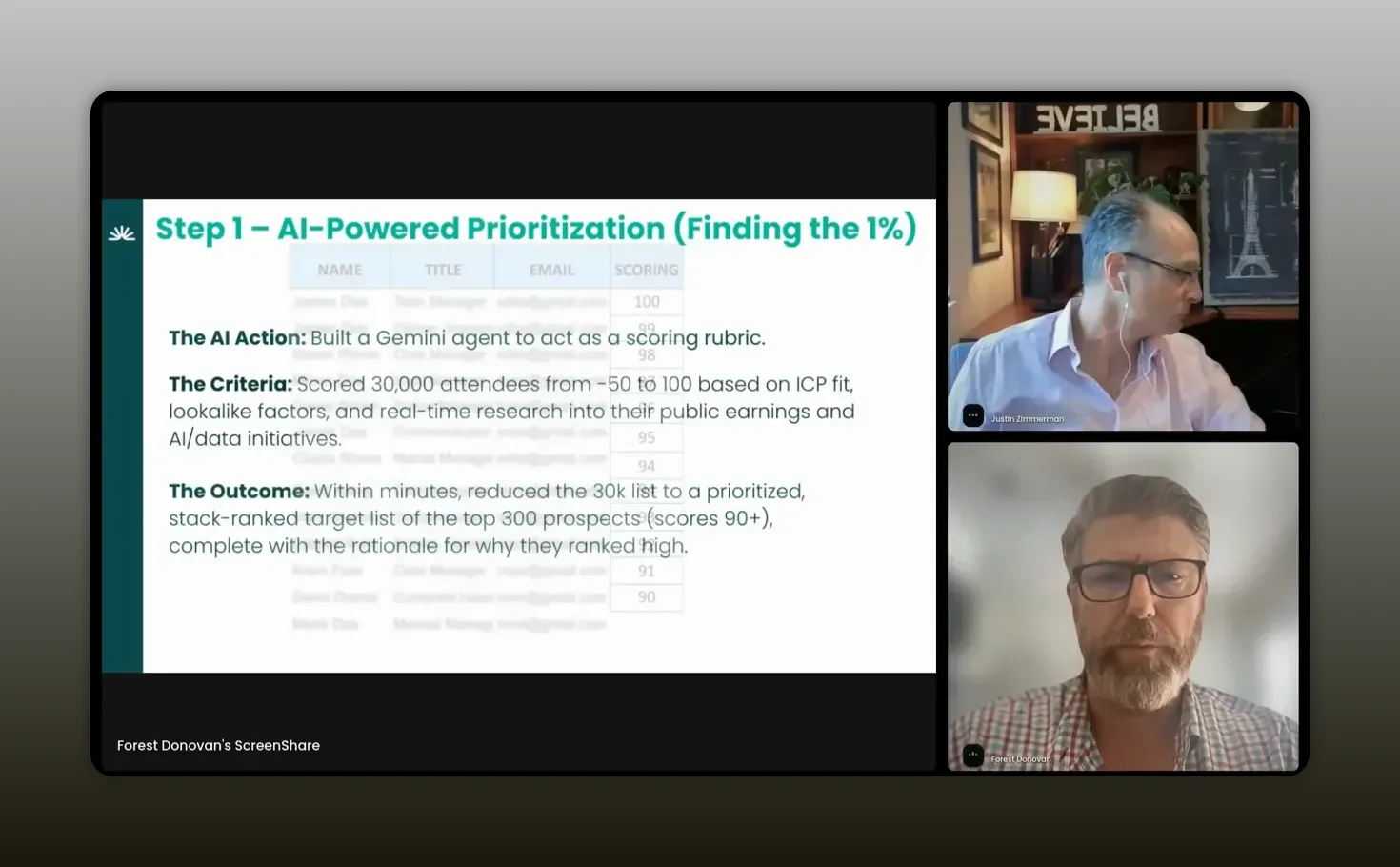
The first agent Forest built acted like a scoring system. Its job was to review the large attendee pool and rank each prospect on a spectrum from poor fit to excellent fit.
This was not a random score. It was based on a real rubric that reflected how Fullstory thinks about prospect quality. The agent evaluated things like:
- Alignment with the ideal customer profile
- Lookalike signals from strong existing customers
- Title and role relevance
- Public evidence of active data or AI initiatives
- Company context from earnings reports, press releases, and blog content
The payoff was speed and clarity. Instead of manually skimming 30,000 names, Forest got a ranked list back in minutes. The field narrowed quickly to about 300 top targets, with the highest-scoring prospects sitting at the top of the queue.
That sounds simple, but it changes the operating model.
When you have a ranked list with reasoning attached, your team can work in order of likely value. You stop making decisions on gut feel alone. You stop overvaluing recognizable logos while missing better-fit companies with stronger active pain. And you gain a useful record of why each account made the cut.
The best part is that the system did not just return a number. It also returned justification. That gave Forest and the team a transparent explanation for the ranking so they could sanity-check the output and use it downstream.
This is one of the biggest practical lessons from the whole workflow: if you want AI to help you make better decisions, do not just ask for answers. Ask for scored answers with reasons.
Why justification matters
A raw score is useful. A score with reasoning is operationally useful.
That reasoning can help you:
- Explain targeting choices internally
- Hand context to sales teams faster
- Improve prompts when the output feels off
- Spot patterns across high-fit accounts
This is also where partner teams can begin to build a durable advantage. The more clearly you define what a good account looks like in your ecosystem, the better your AI-assisted prioritization gets over time.
“No more eyeballing titles or companies. We could stack rank who mattered most.”
Forest Yule Donovan
Step 2: Personalize outreach at scale
Once the target list was ready, the next challenge was obvious. How do you contact a large number of people with messaging that still feels specific and thoughtful?
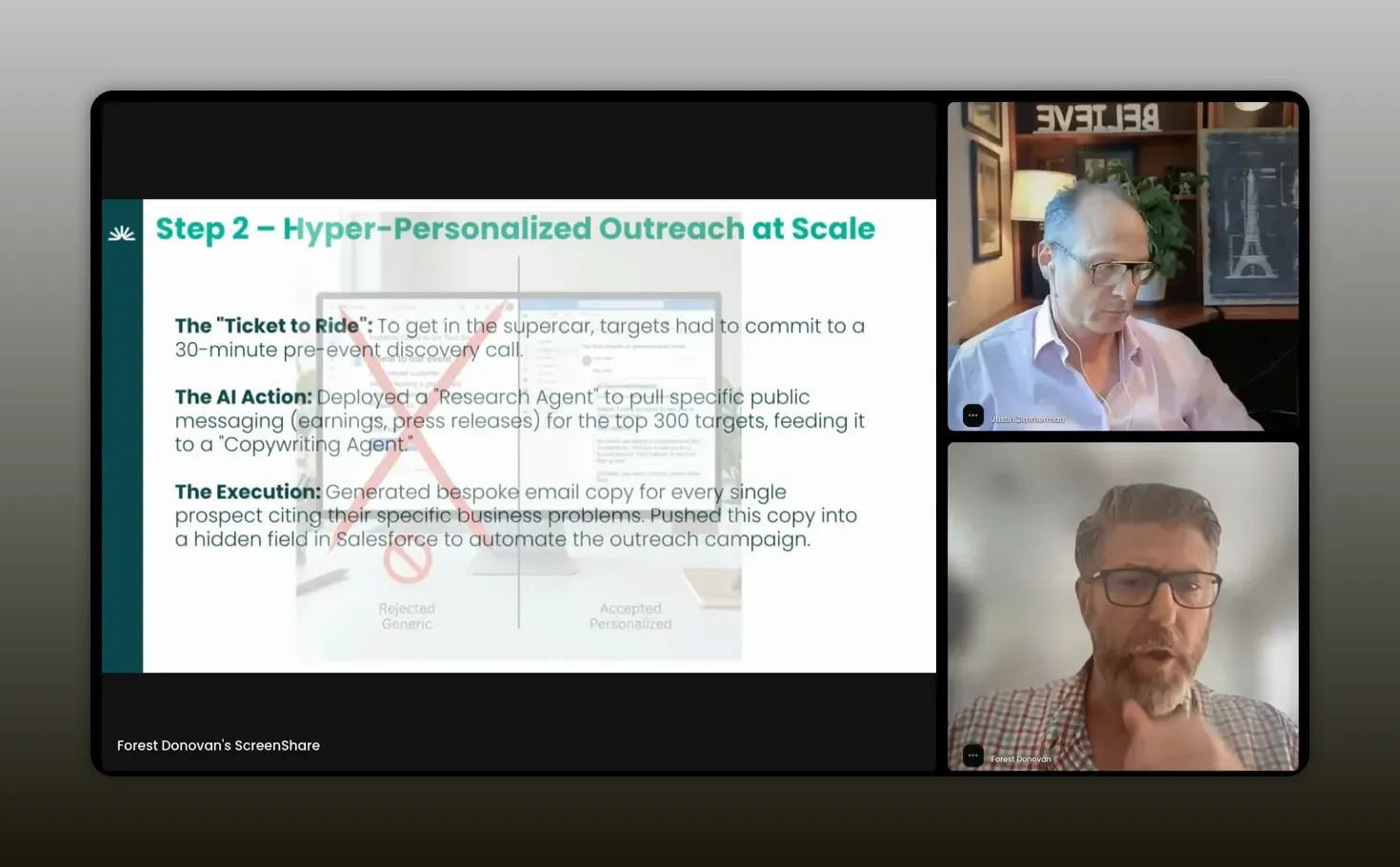
Forest’s answer was to build a second research flow and feed it into a copy generation process. The research agent pulled public information tied to each target company, including business initiatives and messaging visible in public sources. That context was then used to craft custom outreach.
The goal was not to write long emails. It was to write relevant ones.
That distinction matters. A lot of AI-generated outbound fails because it confuses personalization with volume. It dumps too much context into the message, gets wordy, and ends up sounding synthetic. Forest was careful to avoid that trap.
The outreach stayed concise. It highlighted one or two areas where Fullstory could likely create value, tied the invitation to that context, and gave the recipient a clear next step.
“Less is more. You do not want to blast people with AI slop.”
Forest Yule Donovan
What made the outreach work
There were a few smart constraints built into this process:
- The event offer was compelling on its own.
- The message tied the offer to a business reason to talk.
- The invitation required a 30-minute pre-event discovery call.
- The team deliberately avoided over-explaining.
That last point is important. The purpose of the email was not to prove everything. It was to earn the meeting.
Forest used Clay connected with Outreach and Salesforce to operationalize the sequence. During the Q&A, he also mentioned a clever implementation detail: generated output could be stored in a hidden or limited-access custom field so the system had the right context available for outreach workflows.
That may sound technical, but the principle is simple. If your AI-generated account context is worth creating, it is worth storing somewhere useful so other systems can act on it later.
If your team is working through how to align AI with internal process and data handling, this piece on winning budget and security approval for AI can help you think through those operational conversations.
A practical email rule worth stealing
Forest’s guidance here is one of those small details that can save you a lot of pain: keep the outbound short enough to be consumed instantly.
That means:
- One paragraph is often enough
- One or two relevant business points beat five generic ones
- A clean ask beats a complicated pitch
- The offer should support the message, not replace it
This is especially true when the email is tied to an event invitation. People are skimming quickly. Relevance wins before polish does.
Step 3: Prepare sellers for better calls
Strong outreach solves only part of the problem. If the discovery call is weak, the event does not turn into pipeline.
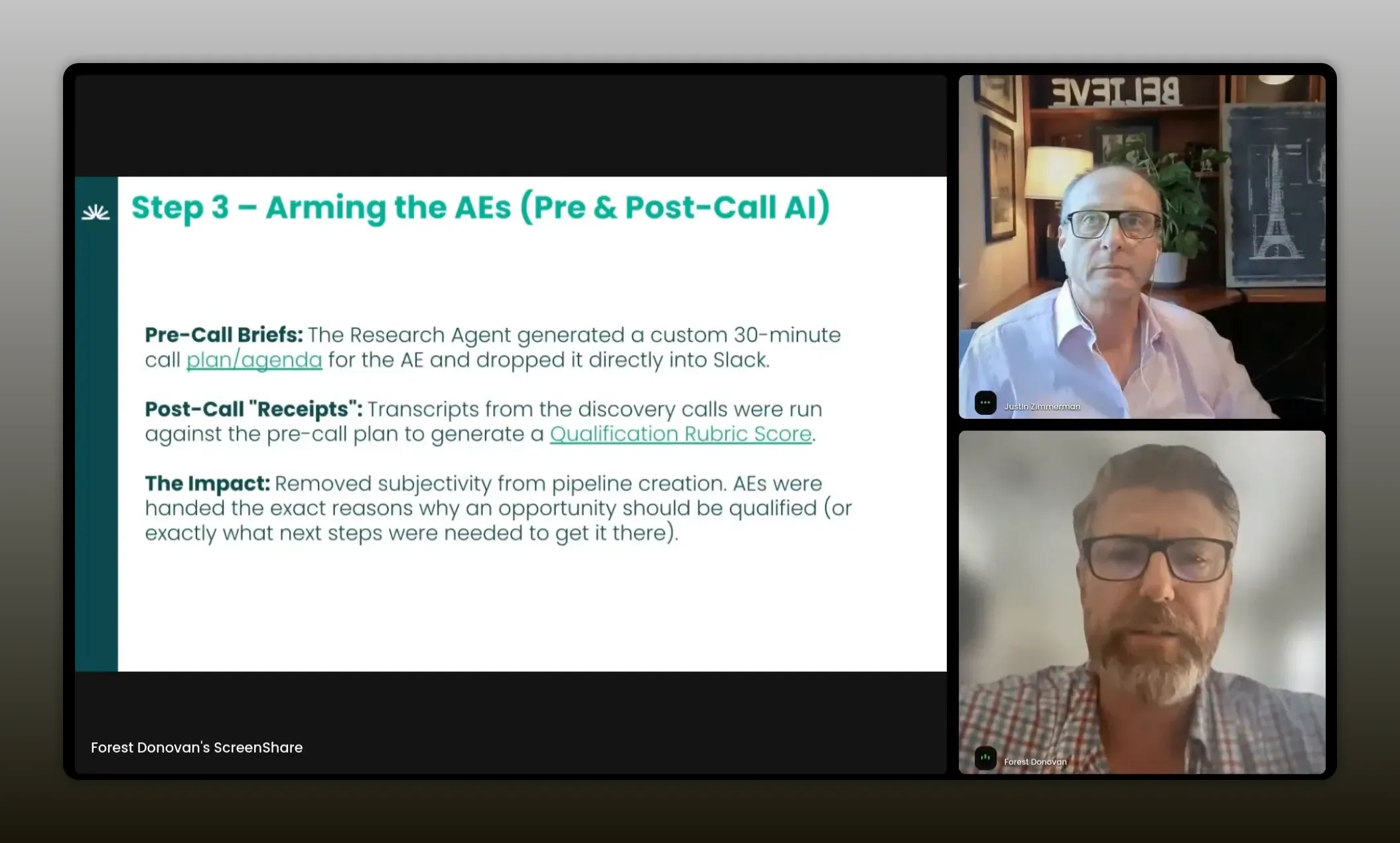
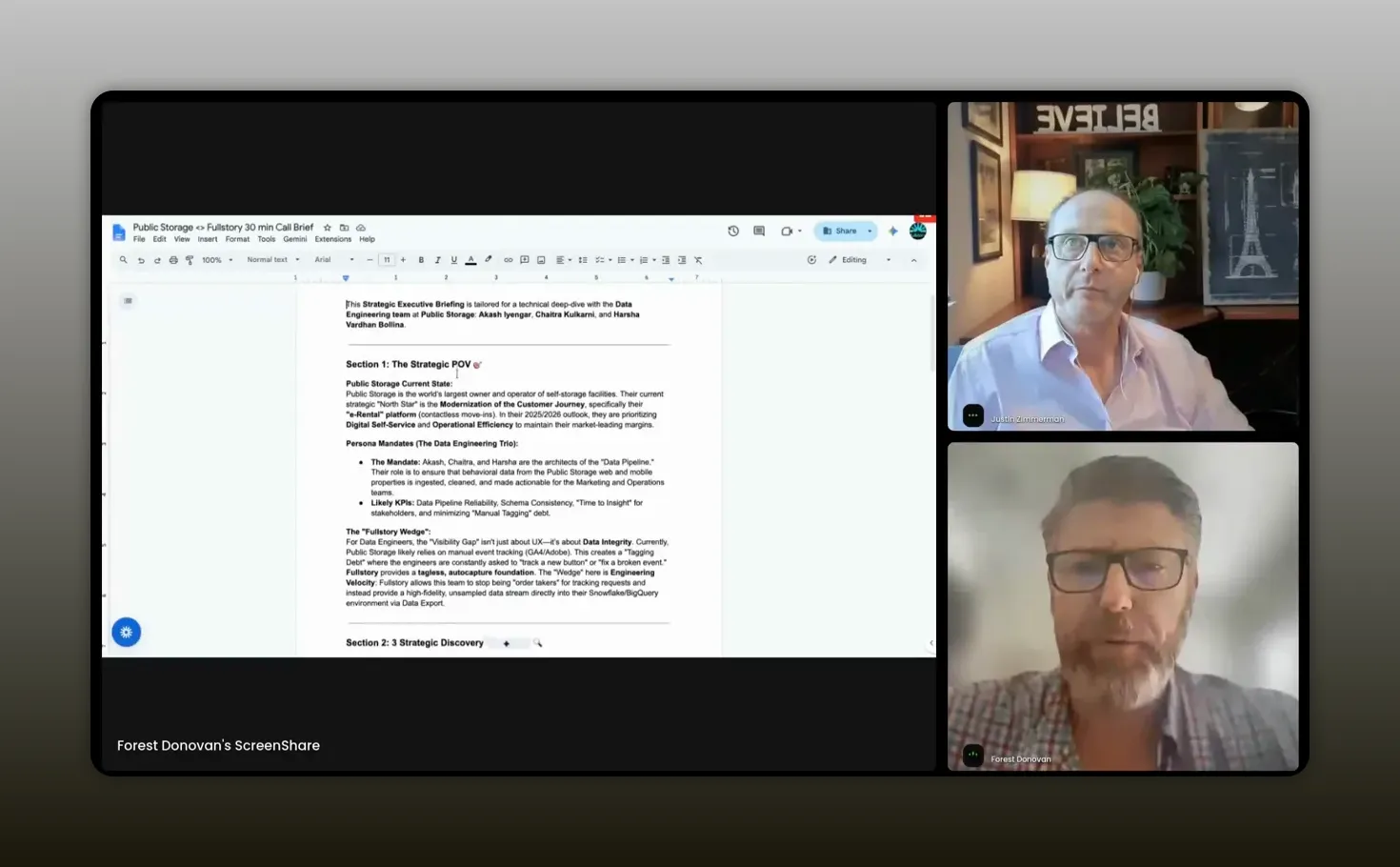
So Forest used the same research foundation to prepare account executives before each call. Instead of giving sellers a generic discovery template, the workflow generated a custom 30-minute agenda tailored to the account.
That call plan included:
- Context on the account and likely pain points
- The Fullstory angle or wedge for value creation
- Icebreaker prompts
- Suggested discovery questions
- Likely objections
- Recommended language to use
- Language to avoid
Then the agenda was sent directly into Slack for the seller who needed it.
“We did not want sellers showing up with a canned discovery script.”
Forest Yule Donovan
This is where a lot of teams still leave money on the table. They invest in top-of-funnel automation but fail to improve the quality of the human conversation that follows.
Forest did the opposite. He used AI to make the human part stronger.
That is the best use case. AI handled the research assembly and prep work so the AE could focus on listening, adapting, and building trust.
Why pre-call prep has such a big impact
When a seller walks into a conversation already knowing the company’s initiatives, likely objections, and relevance angle, three things happen:
- The conversation starts faster.
- The prospect feels understood earlier.
- The seller can spend more time exploring the real opportunity.
This also helps partner teams create credibility internally. If your sourced meetings are not just numerous but also well-prepared, sales becomes much more willing to engage.
That is a hidden benefit of operational AI in partnerships. It is not just pipeline generation. It is trust generation across teams.
Step 4: Qualify opportunities faster
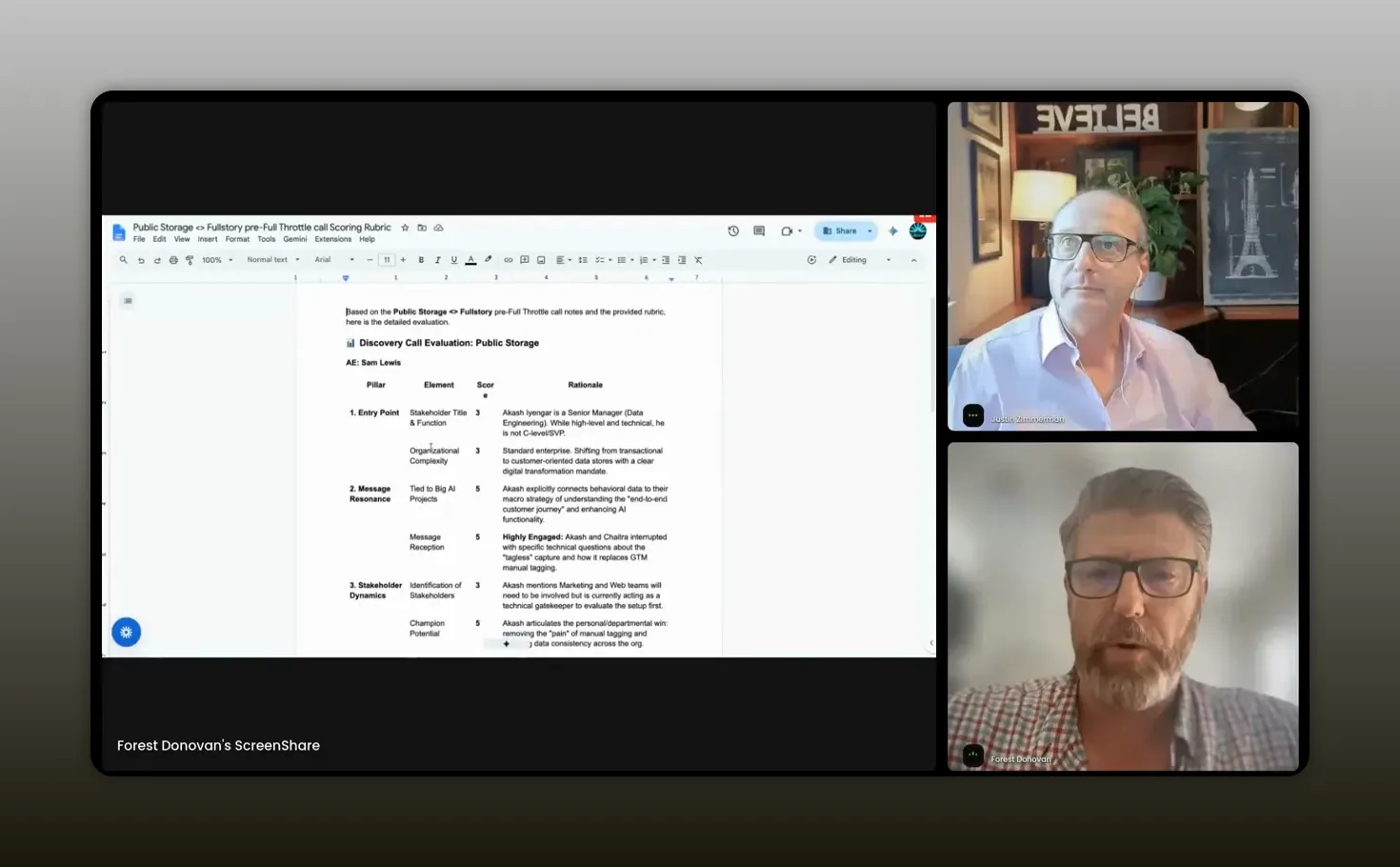
After the discovery calls, Forest ran another agent against the call recordings and notes. This one served as a qualification rubric.
The idea was straightforward: combine the original research, the planned discussion themes, and the actual call content to produce a more objective view of deal quality.
The resulting qualification output included several component scores, such as:
- Strength of the initial entry point
- How well the message resonated
- Stakeholder dynamics
- Competitive context
- Timing
- Overall deal health
“Removing subjectivity from qualification helped us move deals much faster.”
Forest Yule Donovan
That information was then pushed back to the AEs through Slack alongside next steps, risks, and opportunity areas.
Why is that such a big deal?
Because pipeline arguments inside organizations often get slowed down by ambiguity. One person says the deal is promising. Another says it is too early. Another wants more proof. When qualification depends mostly on memory and interpretation, speed suffers.
A structured scoring output does not eliminate judgment, but it does give the team a common frame.
For Forest, whose KPIs include pipeline creation through partnerships, that mattered a lot. Faster qualification meant faster internal movement from sourced conversation to recognized opportunity.
What this improves beyond speed
A qualification rubric also improves consistency. Over time, that can help you answer better questions:
- Which event-sourced opportunities really convert?
- Which messaging angles produce better deal health?
- Which partner motions create the strongest stakeholder access?
- Where are sellers getting stuck after the first call?
This is the kind of operational discipline that makes AI more than a novelty. It becomes a way to build repeatable revenue systems.
“We walked into the conference with millions of dollars in qualified pipeline.”
Forest Yule Donovan
Results by the numbers
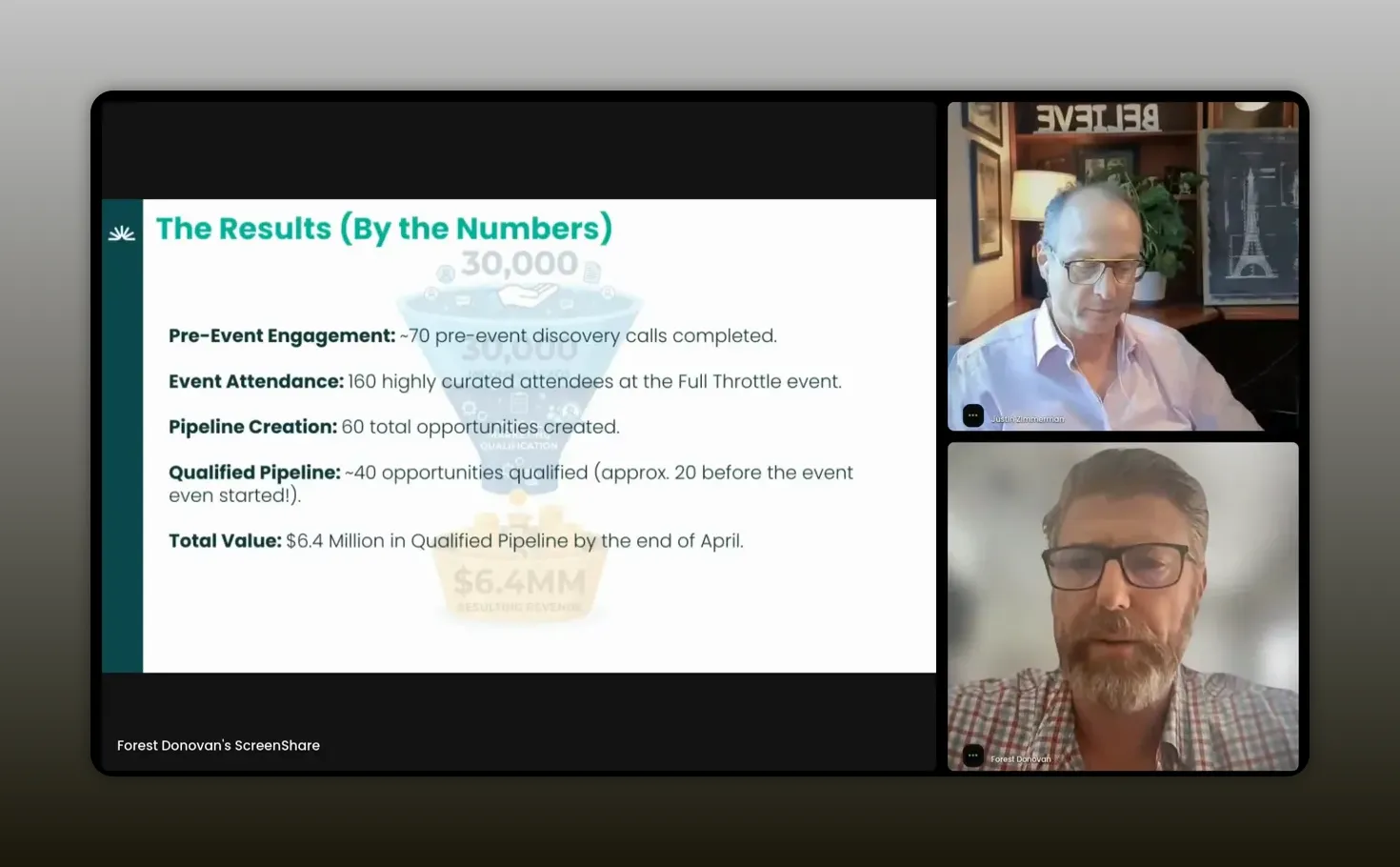
The outcome was not theoretical. The workflow produced measurable results.
- Roughly 1,500 invitations were sent from the much larger universe of possible attendees.
- About 160 individuals registered across around 70 companies.
- That led to 70 pre-event discovery calls.
- From those calls, 60 opportunities were created.
- 40 of those opportunities became qualified.
- About 20 were already qualified before the conference itself even started.
- The program generated about $6.4 million in qualified pipeline.
One of the clearest signals in those numbers is the conversion quality from call to opportunity. Forest read that as evidence that the initial scoring rubric was strong. The team did not spend much time talking to obviously unqualified prospects.
That is the dream for event marketing and partner teams alike. Not more meetings for the sake of meetings. Better meetings with a higher rate of commercial relevance.
What those numbers really mean
There are three strategic takeaways hidden inside the results:
- Filtering matters more than blasting. Starting with a huge audience is not the advantage. Narrowing intelligently is.
- Personalization works best when backed by relevance. The email did not win because it was custom. It won because the account selection was solid first.
- Pre-event qualification changes the economics of the conference. Entering the event with already-qualified opportunities makes the sponsorship far easier to justify.
That last point is especially useful for teams under pressure to prove ROI. If you can create real pipeline before the event floor gets crowded, you are not depending on chance encounters to make the program succeed.
What made this work
It is easy to look at a case like this and focus only on the tools. But the real success came from a few operating principles.
1. Forest started with a business problem, not a tool
The question was not, “How can we use AI at Google Next?”
The question was, “How do we avoid wasting an expensive white-glove event on the wrong people?”
That grounding matters. Good AI projects are usually attached to a painful bottleneck.
2. He used multiple narrow agents, not one giant magic prompt
The workflow had different stages:
- Scoring and ranking
- Research and outreach generation
- Pre-call planning
- Post-call qualification
Each stage had a clear job. That is a much better pattern than asking a single model to do everything at once.
3. He preserved the human role where it mattered
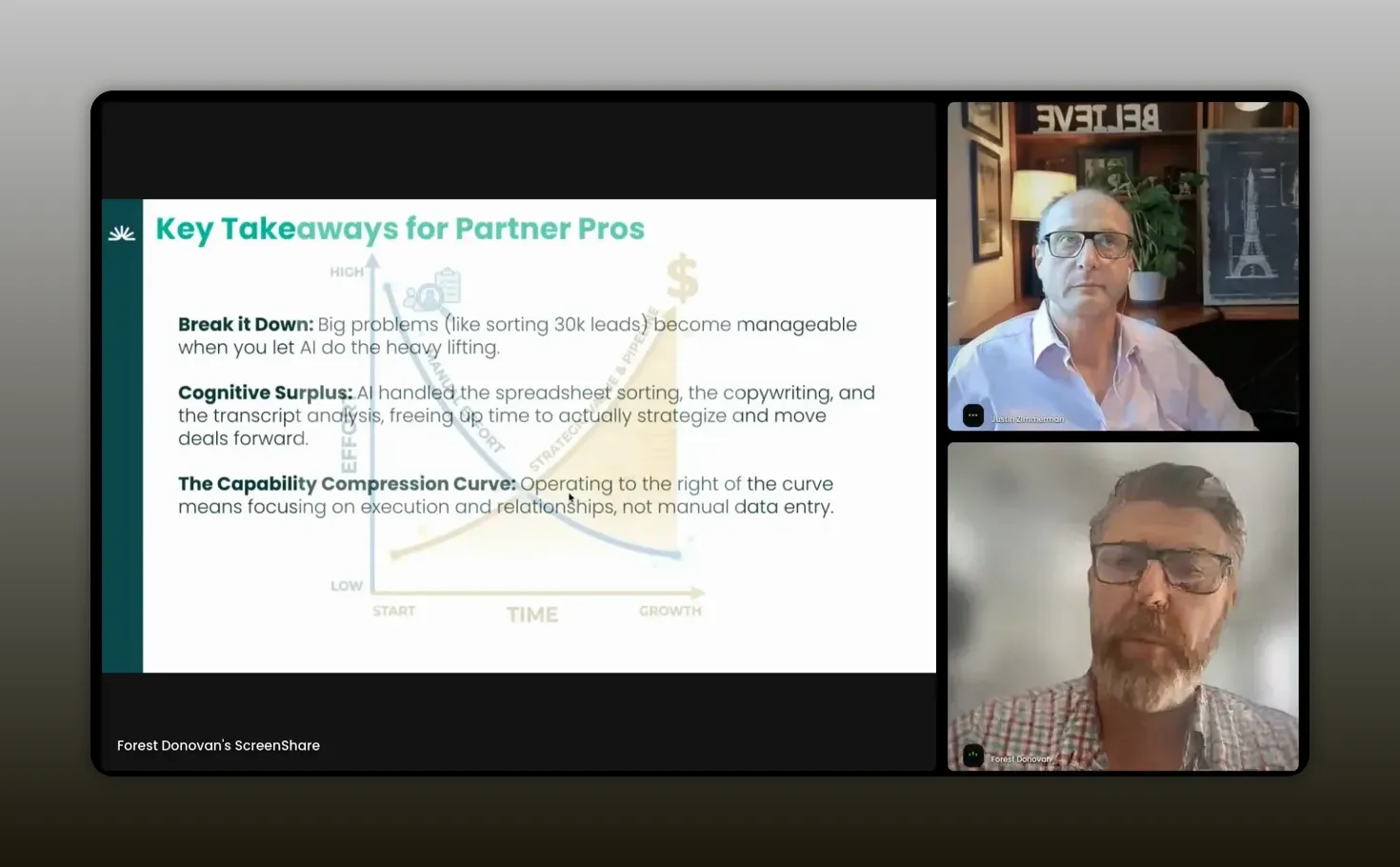
AI did the tedious work. People still owned strategy, judgment, and relationships.
That division is important. The best use of AI in go-to-market is often not replacement. It is compression. It shrinks the time spent on research, sorting, and formatting so you can spend more time on decisions and conversations.
4. He built around existing seller workflows
The outputs went where the team already worked, like Slack, Outreach, Salesforce, and Clay. That is part of why the system was useful. It fit the motion instead of forcing a separate one.
5. He stayed disciplined about message quality
Short, relevant, and value-led beat long and impressive-looking. That rule alone probably saved the team from the most common AI outbound mistake.
Lessons for partner teams
Forest framed this as a partner case study, but the lessons travel well. If you work in partnerships, ecosystem sales, co-selling, or field events, there is a lot here worth adapting.
Use AI to reduce dependency on other teams
One of Forest’s strongest points was that partner teams are often under-resourced. You may not be able to wait for marketing to write campaigns, RevOps to sort data, or another team to build the workflow for you.
AI can help you create motion without standing in line for support.
That does not mean going rogue. It means building enough capability to move faster while still respecting shared systems and governance.
Focus on cognitive surplus
Forest used the phrase in a way that gets to the heart of the opportunity. If AI handles the spreadsheets, list triage, and repetitive prep, you gain mental bandwidth for the work only you can do.
That includes:
- Relationship building with partner reps
- Strategy around which accounts matter
- Judgment on where to invest event budget
- Collaboration with sellers on active deals
That is a far better outcome than using AI only to produce more content.
Make event ROI visible earlier
One reason event programs get challenged internally is that value shows up too late or too vaguely. A workflow like this helps create evidence before, during, and immediately after the event.
That makes the business case much easier to defend.
Build with a crawl, walk, run mindset
You do not need to reproduce Forest’s exact stack on day one. Start smaller.
- Crawl with AI-assisted account research.
- Walk with personalized event outreach.
- Run with pre-call prep and post-call qualification scoring.
That staged approach is consistent with how strong revenue teams are adopting AI more broadly. If you want another practical example of that thinking in partnerships, this article on partnerships, data, and AI for revenue teams is worth your time.
“This let us focus on execution instead of the donkey work.”
Forest Yule Donovan
Recommended tools
Forest’s workflow depended on a combination of research, orchestration, and sales execution tools. The exact stack may vary for your team, but these were the notable components from the session:
- Gemini for research and scoring logic
- Clay for enrichment and workflow execution
- Salesforce for account context and field-based workflow support
- Outreach for sending personalized sequences
- Slack for delivering call prep and qualification outputs to sellers
If you are thinking about your own version of this workflow, here is the better question to ask before buying anything new: Where does your team already live?
Great automation usually rides on top of familiar systems. That is often more valuable than a theoretically perfect stack that nobody adopts.
For broader context on evaluating AI tooling and operational fit, the Gartner AI resource hub and Salesforce AI resources are useful starting points.
FAQs
Can you use this approach without sponsoring a major conference?
Yes. The same workflow can support webinars, executive dinners, regional roadshows, partner-hosted workshops, or account-based field events. The important part is not the size of the event. It is the sequence of prioritization, personalized outreach, seller prep, and qualification.
What was the biggest advantage of using AI in this program?
The biggest advantage was speed without losing specificity. Forest was able to sort a huge audience, tailor outreach, prep sellers, and score opportunities without relying on multiple departments for every step.
Why did the outreach stay short instead of highly detailed?
Because short, relevant messages are easier to consume and less likely to feel artificial. Forest was deliberate about avoiding overproduced AI output. The message only needed to show enough relevance to earn the discovery call.
How did the team avoid inviting people who only wanted the event perk?
The invitation required a 30-minute pre-event discovery conversation. That created a filter. If a prospect was not willing to engage around business value first, they were not the right fit for a costly white-glove experience.
What made the qualification rubric valuable after the calls?
It reduced subjectivity. Instead of relying only on impressions, the team had a scored summary of message fit, stakeholder dynamics, timing, competition, and overall deal health. That helped move opportunities forward faster.
Do you need a large RevOps team to build something similar?
No, but having at least some operational support helps, especially when storing generated context in CRM fields or cleaning up output formatting. Even so, the point of Forest’s example was that partner teams can now do much more on their own than they could a few years ago.
Conclusion
The real lesson here is not that AI can help you write better event emails. It is that AI can help you redesign the entire pipeline motion around an event.
Forest showed what that looks like in practice. Start with a large pool. Rank for fit. Personalize with restraint. Prepare sellers with context. Qualify with structure. Then use the time you saved to do the work that actually wins deals: strategy, execution, and relationships.
That is the big opportunity for partner teams right now. You may still be under-resourced. You may still be asked to prove more than anyone else. But you no longer have to do every painful part by hand.