Playbook: Zero to 20% Partner Sourced In 36 Months
Expert advice from Julia Guenier (Partner Manager, Lemlist) and Tyler Calder (CMO, PartnerStack).
Snapshot
There’s a growing split happening between partner teams right now. On one hand, we have the teams that are experimenting with AI inside real workflows. On the other, we have teams that are still treating it like a side topic. For the former, AI is becoming the operating layer that protects response times, improves partner support, spots revenue opportunities earlier, and preserves the human relationships that actually make partnerships work. This is especially crucial in a space where partner teams are usually lean and expected to deliver revenue without the luxury of adding headcount every time complexity rises.
Lemlist offers a strong example of what this looks like in practice. A lean team built systems that support hundreds of partners, contribute meaningful pipeline, and create space for more strategic one to one engagement instead of less.
If you want to solve partner support bottlenecks, reporting overload, and slow co-sell execution, keep reading to see how Justin Zimmerman and Julia Guenier can help you do it.
“AI is not replacing partnership relationships. It is creating room to protect them.” -Julia Guenier
Partnerships is entering a period where hands on operators are going to separate themselves from everyone else. Not because they talk more about AI, but because they use it to own better workflows and deliver better outcomes.
Table of Contents
- Snapshot
- Why this matters now
- What Lemlist built
- How partner revenue became a growth engine
- What a lean partner team is really up against
- Buddy, the AI assistant inside Slack
- The partner audit tool that surfaces ROI and upsell paths
- How call recording and CRM automation reduce manual work
- What PartnerStack MCP unlocks for reporting and ops
- Where AI experiments fail
- What next level partner teams will look like
- Recommended tools
- FAQs
- Conclusion
Why This Matters Now
That matters because partner teams rarely get unlimited resources. You are expected to support recruitment, enablement, co-selling, reporting, attribution, pipeline management, and partner experience, often with a tiny team. In that environment, process quality becomes a competitive advantage.
That is why examples like Lemlist matter. This is not a story about a huge org with a giant automation budget. It is a story about a fast growing company proving that a lean team can support a serious partner ecosystem by combining solid systems, strong operations, and selective use of AI.
If you have been trying to understand what practical AI for partnerships actually looks like, this is the kind of example worth studying.
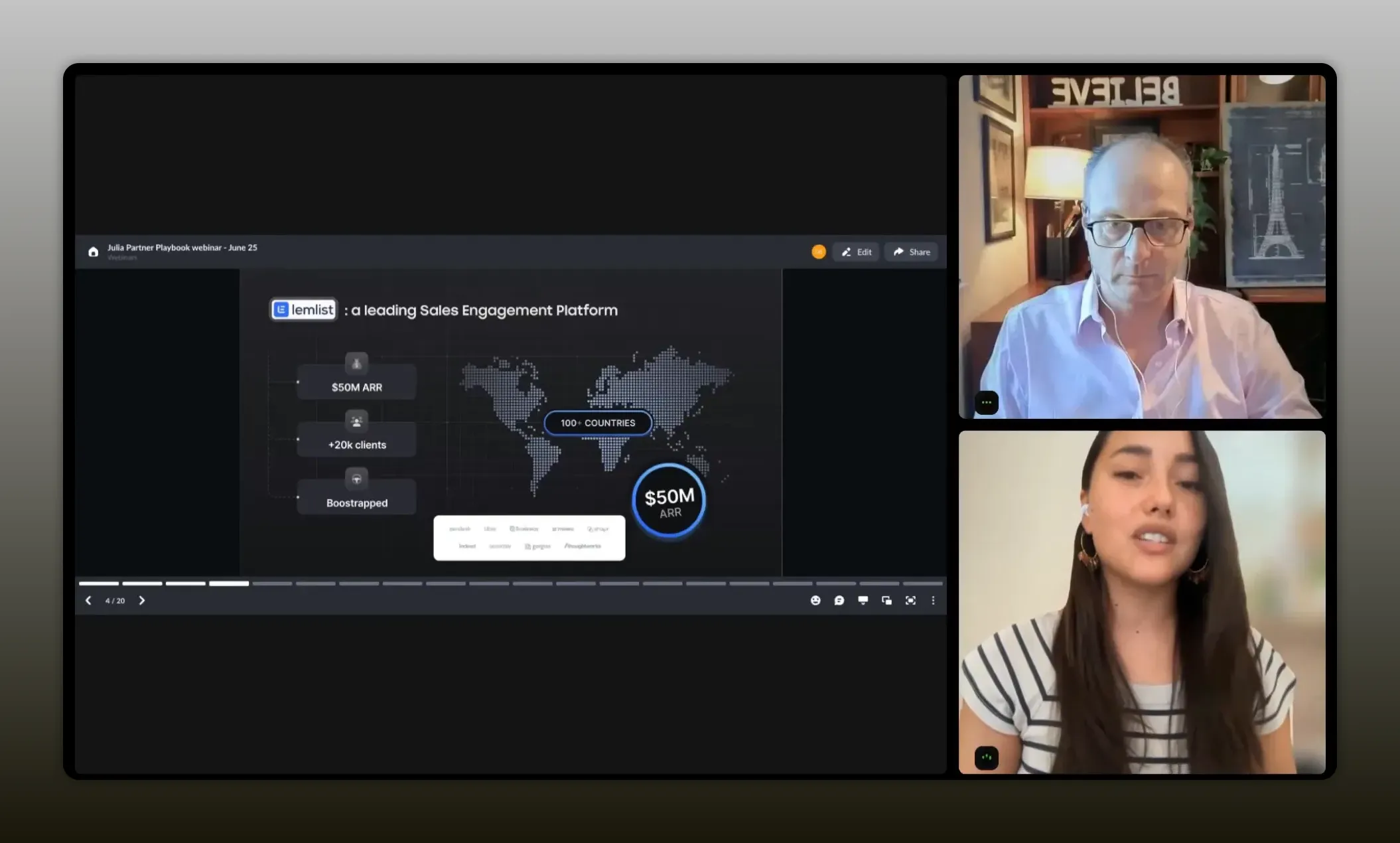
“We’re lean by design—because when you manage hundreds of partners without adding headcount, you have to build systems that absorb the repetitive load.” —Julia Guenier
What Lemlist built
Julia leads partnerships at Lemlist, a sales engagement platform that helps teams run outbound across channels like email, LinkedIn, calls, SMS, and WhatsApp from one place. The company serves more than 20,000 customers, crossed the $50 million ARR mark, and did it as a bootstrapped business.
What stands out is not just the company growth. It is the contribution of the partner channel.
- More than 2,500 total partners
- Around 400 service and solution partners under Julia’s direct care
- Roughly 20 percent of new business opportunities sourced through partnerships
- More than 15 percent of total revenue influenced by the partner motion
- Channel growth that kept climbing even during a broader company plateau
Those numbers do not happen by accident. They are the result of building the partner motion in layers.
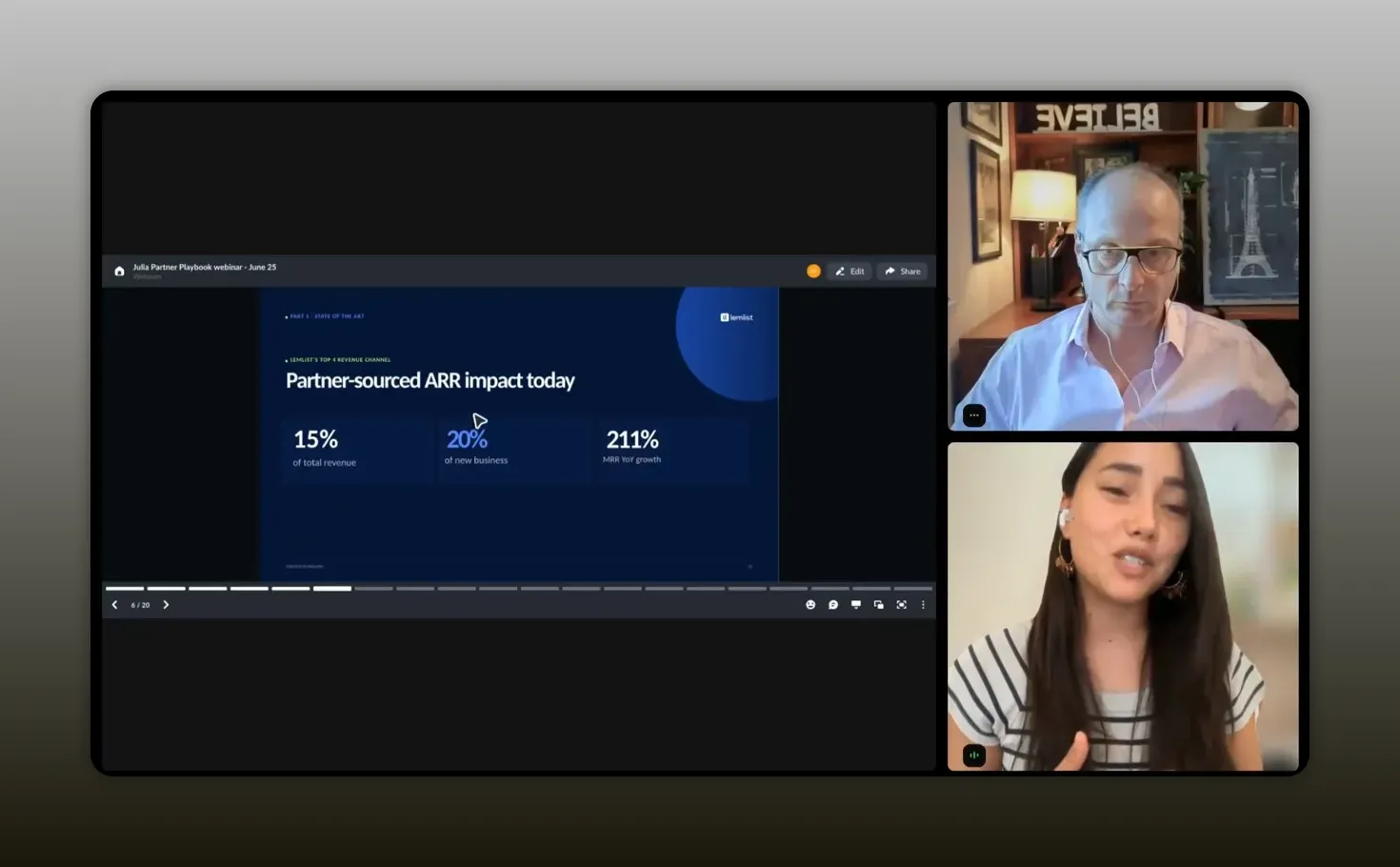
“A good partner channel does not just exist beside growth. It can carry growth when other motions flatten.” —Julia Guenier
How partner revenue became a growth engine
Lemlist did not begin with a complex partner structure. The team started with affiliates to prove that indirect revenue could work. That move gave them an early signal that the channel had real traction.
From there, the program evolved. Affiliates stayed important, but the team recognized that service and solution partners represented a different opportunity. These were agencies, RevOps firms, CRM integrators, B2B sales experts, and outbound specialists who could bring larger, higher value opportunities and participate in deeper relationships.
That shift changed the motion from one to many into something more strategic. Instead of simply letting partners run with a link, Lemlist invested in co-selling, co-marketing, direct support, and stronger one to one engagement with top partners.
It is a useful reminder that not all partners should be managed the same way. High leverage partner programs often need separate plays for:
- Affiliates who are largely self-serve and volume driven
- Service partners who need trust, enablement, and direct support
- Solution partners who can help expand deal size, technical fit, and long term adoption
That segmentation is one of the hidden reasons AI becomes so valuable. Once you stop treating every partner interaction the same way, you can automate the repeatable layer and reserve human attention for the partners where it matters most.
That is also consistent with broader AI adoption patterns in partnership teams. If you want more examples of that progression, this practical playbook on how AI will reshape partnerships complements Julia’s approach well.
What a lean partner team is really up against
One of the most useful parts of Julia’s explanation is how honest it is about the operating reality.
For a long stretch, she was effectively one person managing the service and solution side of the partner program. That meant supporting hundreds of partners, and behind those partners, hundreds or even thousands of client relationships.
Each partner can generate multiple requests at once:
- Product questions
- Campaign troubleshooting
- Technical setup issues
- Sales qualification help
- Client account audits
- Upgrade and expansion discussions
- Trust building and relationship management
That is where many partner teams break. They try to scale support with more manual effort. Eventually everything slows down. Response times slip. Strategic partners get less attention. Internal teams lose visibility. Reporting gets delayed. And the person in the middle becomes the bottleneck.
Lemlist chose a different route. Instead of trying to solve every scale problem with headcount, the team built systems that absorb the repetitive load.
Buddy, the AI assistant inside Slack
One of the clearest examples is Buddy, an AI assistant built into the partner Slack workspace.
The workspace includes roughly 900 members across about 400 agencies. That is a lot of inbound questions. Rather than funnel every question directly to Julia, partners can ask Buddy first.
Buddy handles the lower level support layer inside threads, answering common and moderately technical questions in seconds. That includes product guidance, workflow support, and issue triage. If a question needs human involvement, Buddy escalates it.
The impact is massive. Buddy handles more than 1,000 messages per month and saves several hours each day. That is not just convenience. That is operating capacity.
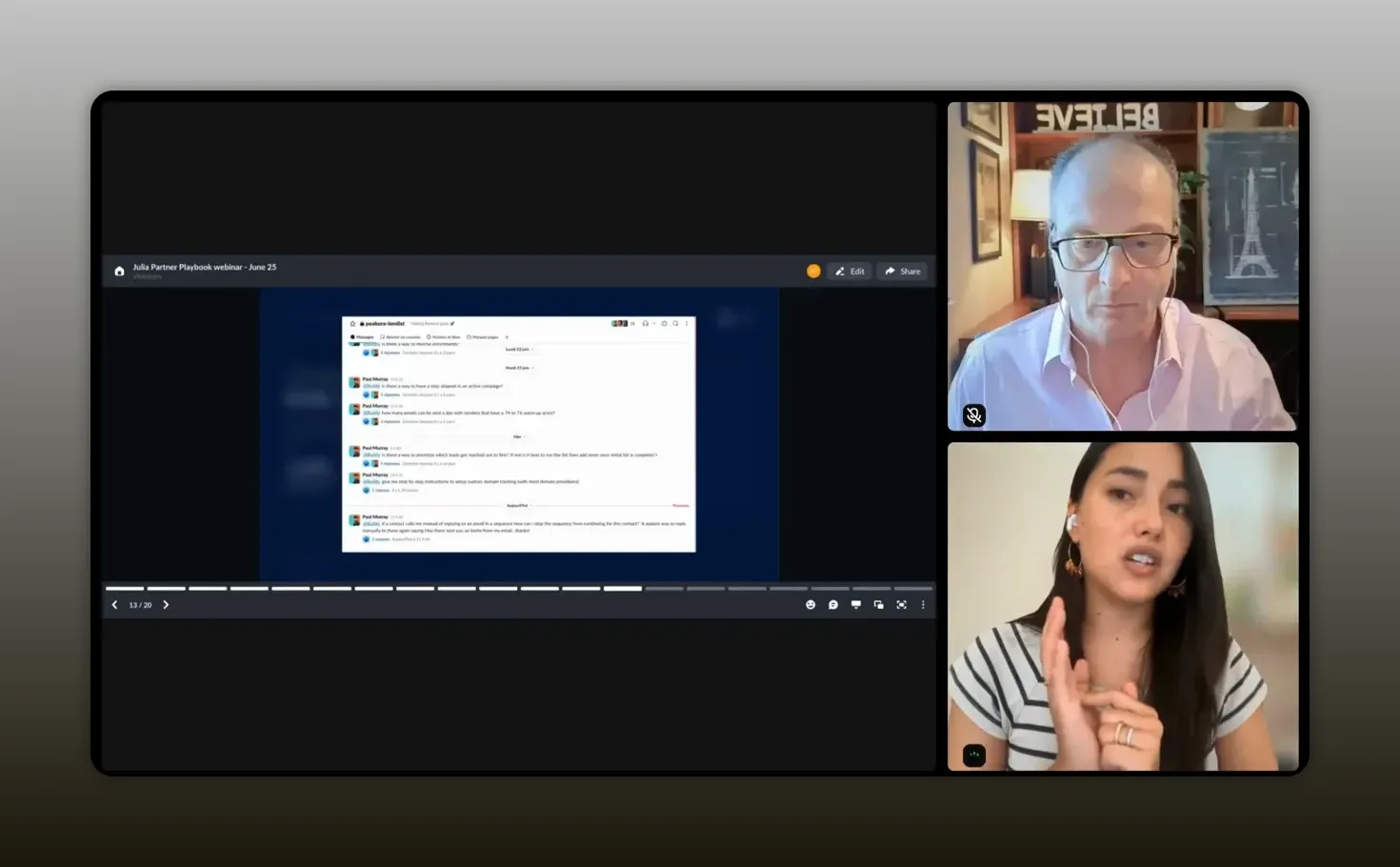
“When AI can answer the first layer fast, you can spend your time where your judgment matters most.” —Julia Guenier
There are a few important lessons in this setup.
1. The AI sits where partners already work
That matters. Instead of forcing partners into a new tool, Buddy meets them inside Slack. Friction stays low, and adoption stays high.
2. The assistant does not pretend to do everything
Buddy is useful because it knows when to help and when to escalate. The goal is not to replace the partner manager. The goal is to keep the partner manager from drowning in repetitive requests.
3. Speed improves partner experience
Even if you eventually step in personally, a partner who gets an immediate answer or triage path feels supported. That changes the quality of the relationship.
If you are building something similar, it helps to think in support tiers:
- Basic questions AI can answer immediately
- Moderately technical questions AI can resolve using approved knowledge
- Context heavy or strategic questions that require a human
That structure is simple, but it can dramatically improve response quality and team focus.
The partner audit tool that surfaces ROI and upsell paths
The second standout system is what Julia called Lemkody, now being reframed as the Lem Lab. This tool goes beyond support. It creates direct value for partners and clients.
Partners implementing Lemlist for clients need to prove outcomes. They need to explain campaign results, justify retainers, identify issues, and recommend next steps. A standard reporting screen inside the core product is useful, but it is not always enough for a partner managing the account on behalf of someone else.
So Lemlist built a private partner tool that produces deeper audits based on proprietary campaign history, internal expertise, and benchmark data.
The output does more than summarize open rates or response rates. It looks at:
- Campaign health
- Deliverability concerns
- Technical setup problems
- Optimization opportunities
- Upgrade and upsell signals
This is where AI becomes a revenue tool, not just a productivity tool. If the system detects a pattern that suggests a customer should move to a higher plan or add capabilities, the partner can surface that lead to the sales team.
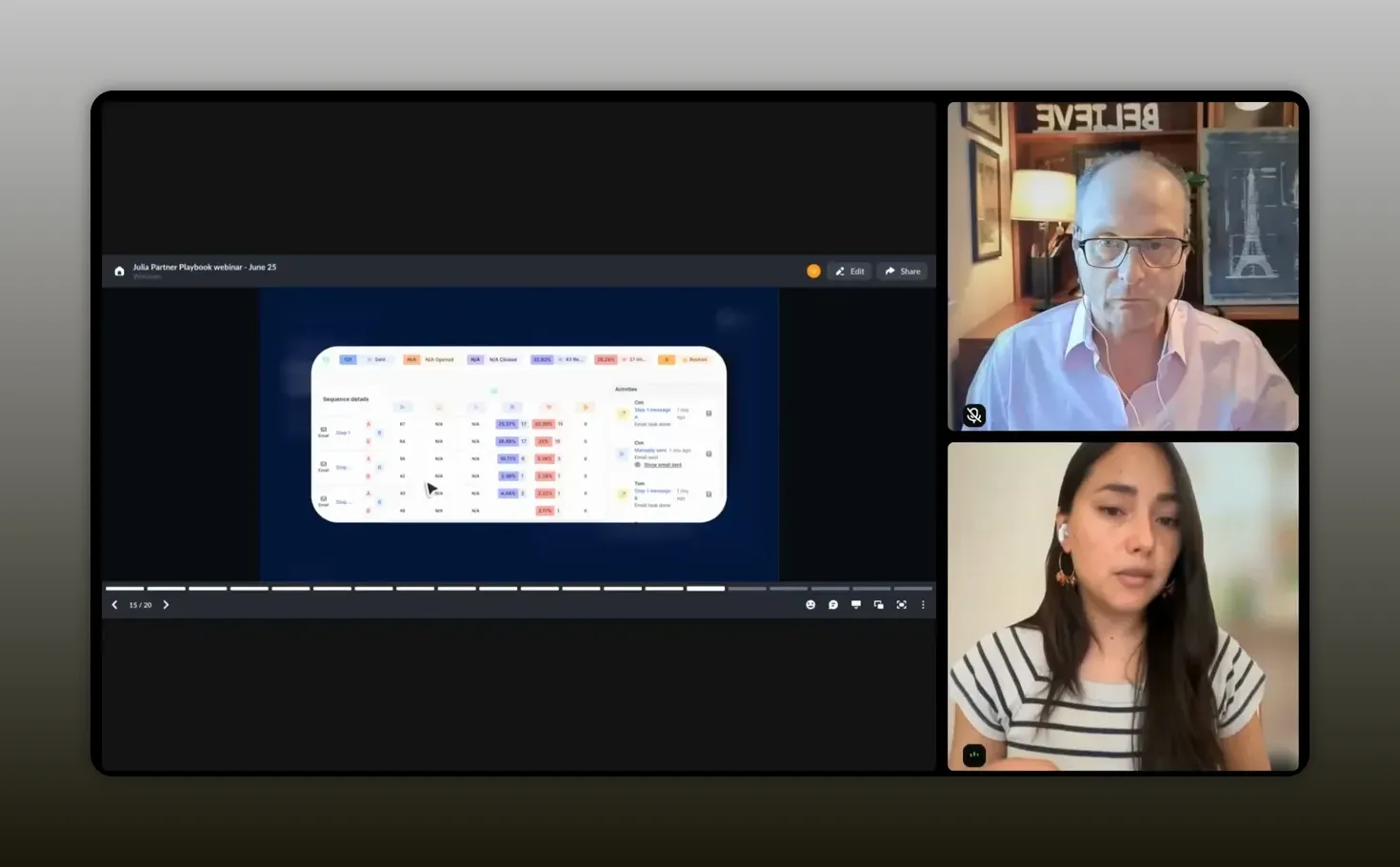
“The best AI tools do not just save time. They help partners create better outcomes for clients.” —Julia Guenier
That is a strong model for any partner team. A useful AI workflow does at least one of these:
- Reduce manual support
- Improve decision quality
- Expose expansion opportunities
- Give partners something tangible they can use with customers
The Lem Lab checks all four boxes.
How call recording and CRM automation reduce manual work
The next layer is less flashy but just as important. Julia also uses call recording and AI notes through Claap, which is one of Lemlist’s products, to automate the ugly middle of partner operations.
Think about what happens after a pipeline review or business review with a partner. Someone has to update HubSpot, connect the right notes to the right account, alert sales, track next steps, and maintain documentation. That sounds manageable until you do it repeatedly across dozens of active partner relationships.
By using AI to summarize calls, route relevant insights into HubSpot, update shared notes, and prepare follow-up material, the team removes a huge amount of administrative drag.
Julia called CRM autofill non negotiable, and that feels right. In co-sell motions especially, the cost of weak documentation is high. Deals stall, handoffs get messy, and partner trust takes a hit when internal teams are not aligned.
Good automation here does three things:
- Keeps the CRM current without manual copying
- Makes internal follow up faster and cleaner
- Preserves context for future partner conversations
If your team is still manually writing summaries after every partner call, this is one of the easiest areas to improve first.
What PartnerStack MCP unlocks for reporting and ops
Julia also highlighted the practical value of PartnerStack’s new MCP capabilities. Tyler Calder later expanded on that with several examples that show where this is going.
The short version is this: when your partner data becomes easier to query through AI tools like Claude, reporting and operations start to move much faster.
Instead of hunting through dashboards or waiting on manual exports, you can ask for:
- A daily recap of new partner driven clients
- Channel level attribution views
- Commission checks and audit prompts
- Pipeline stall detection
- Trend spotting across partner cohorts
- QBR drafts
- Ideal partner profile analysis based on historical winners
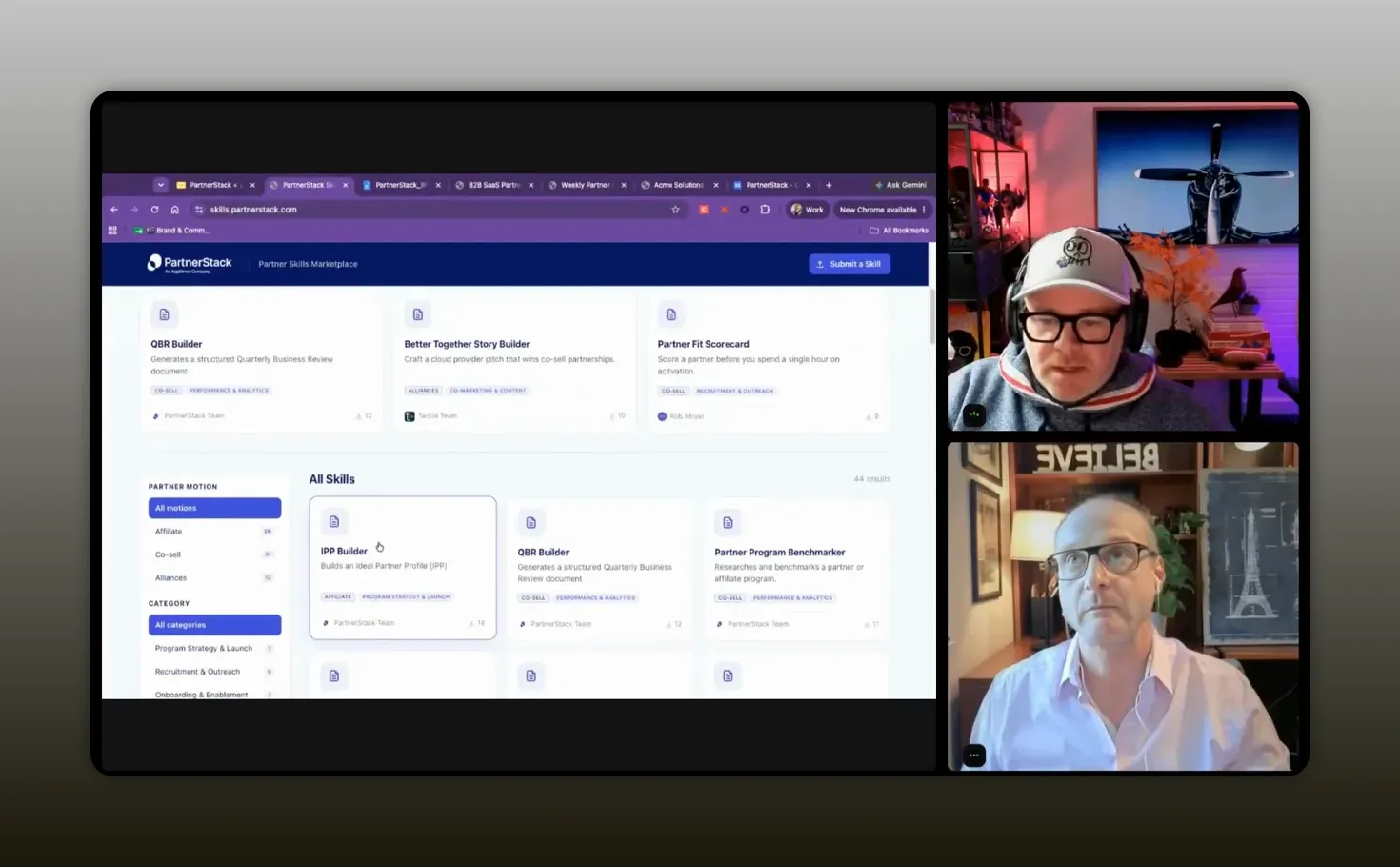
“Once your partner data is accessible to AI in the right way, reporting stops feeling like a separate job.” —Tyler Calder
Tyler’s examples made an especially good point. The value is not just a prettier report. The value is that the output becomes context for the next workflow.
For example:
- An ideal partner profile report can feed recruitment
- A benchmarking report can feed staffing and activation decisions
- A weekly digest can feed a partner manager’s action plan
- A stall detection system can feed sales follow up
That shift from static analytics to operational context is where a lot of teams will find leverage.
If you are comparing which assistant is best for these kinds of connected workflows, this breakdown of Claude vs ChatGPT vs Lovable for partnerships can help clarify where each tool fits.
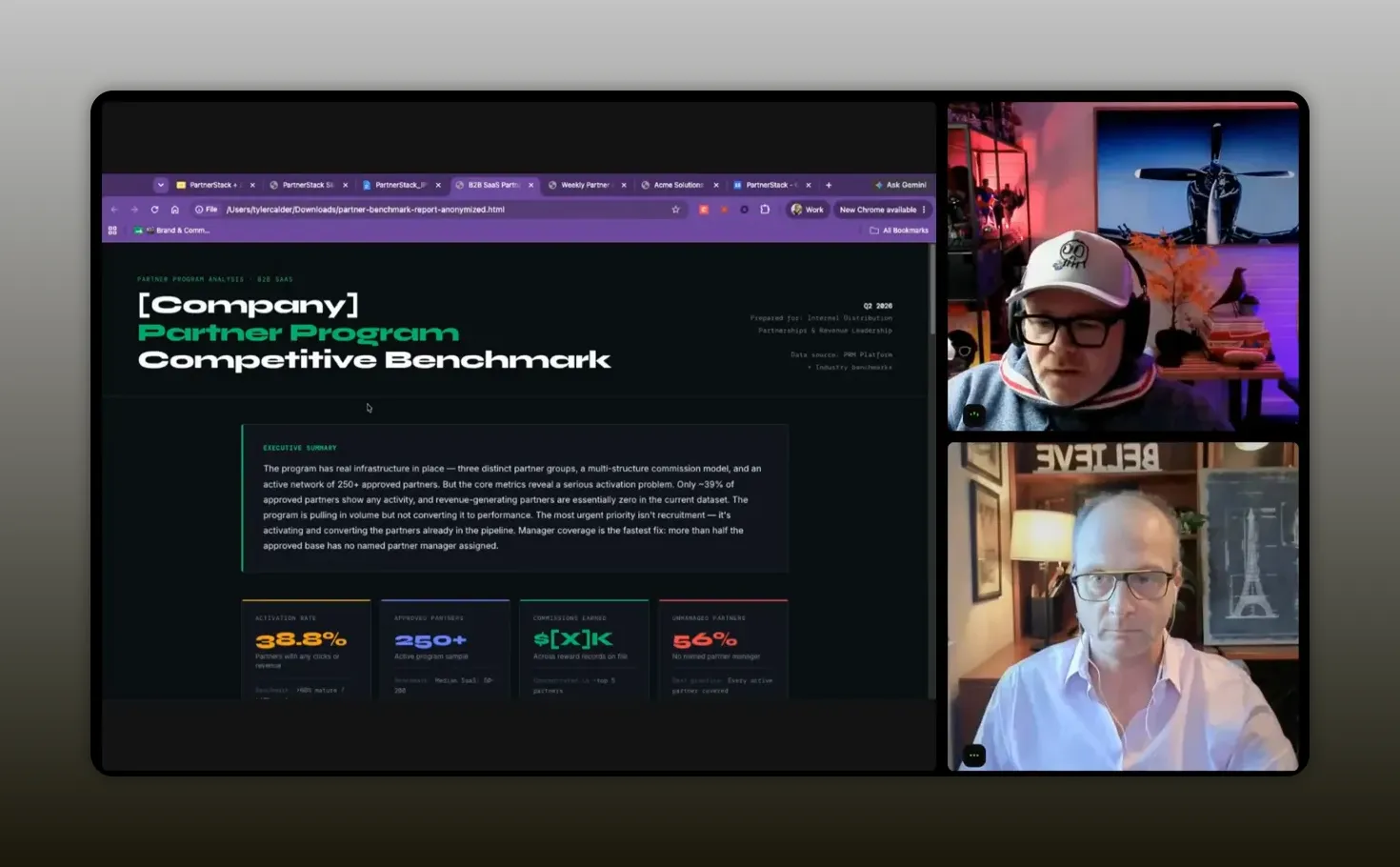
“The useful question is not whether AI can create a report. It is what that report should trigger next.” —Tyler Calder
Where AI experiments fail
One of the strongest parts of Julia’s session was that she did not pretend every AI experiment worked.
Some failed because they removed too much of the human element. A partner does not want every important interaction routed through a bot forever. That can damage trust rather than strengthen it.
Others failed because they created too much noise. A workflow that technically works but floods people with low value alerts is not a real win.
That honesty matters because a lot of AI content skips the messy middle. In reality, the best operating principle is probably this:
Use AI where speed, consistency, and pattern recognition matter most. Keep humans where judgment, trust, and strategic nuance matter most.
A few warning signs that an AI workflow needs rethinking:
- Partners start bypassing it
- Your team has to clean up its outputs constantly
- It creates more alerts than actions
- It blocks rather than accelerates a real conversation
- It saves time in one place but creates confusion elsewhere
This is why clean scoping matters. Julia’s team is not just piling AI on top of every process. They are narrowing in on workflows that generate actual value.
What next level partner teams will look like
Julia’s closing perspective is worth paying attention to. The goal is not to automate your way into a colder partner motion. The goal is to automate enough of the repetitive work that you can return to stronger human relationships at the top end.
That is the real promise here.
As the lower level support layer becomes more self-serve, partner managers can spend more time on:
- Strategic partner planning
- High value pipeline reviews
- Expansion plays
- One to one enablement
- Trust building with top accounts
- New market development
Lemlist is already thinking this way as it aims for its next stage of growth. The company believes partnerships can continue playing a meaningful role on the path toward $100 million ARR. That means recruiting more of the right partner profiles, doubling down in growth markets, and building a team that knows how to operate in an AI native environment.
Julia described the future role less as a traditional partner manager and more as an AI native partnership architect. That sounds right. The strongest people in this discipline will not just manage relationships. They will design systems that scale those relationships without flattening them.
If that idea resonates, these principles for AI in partnerships are a useful extension of the same mindset.
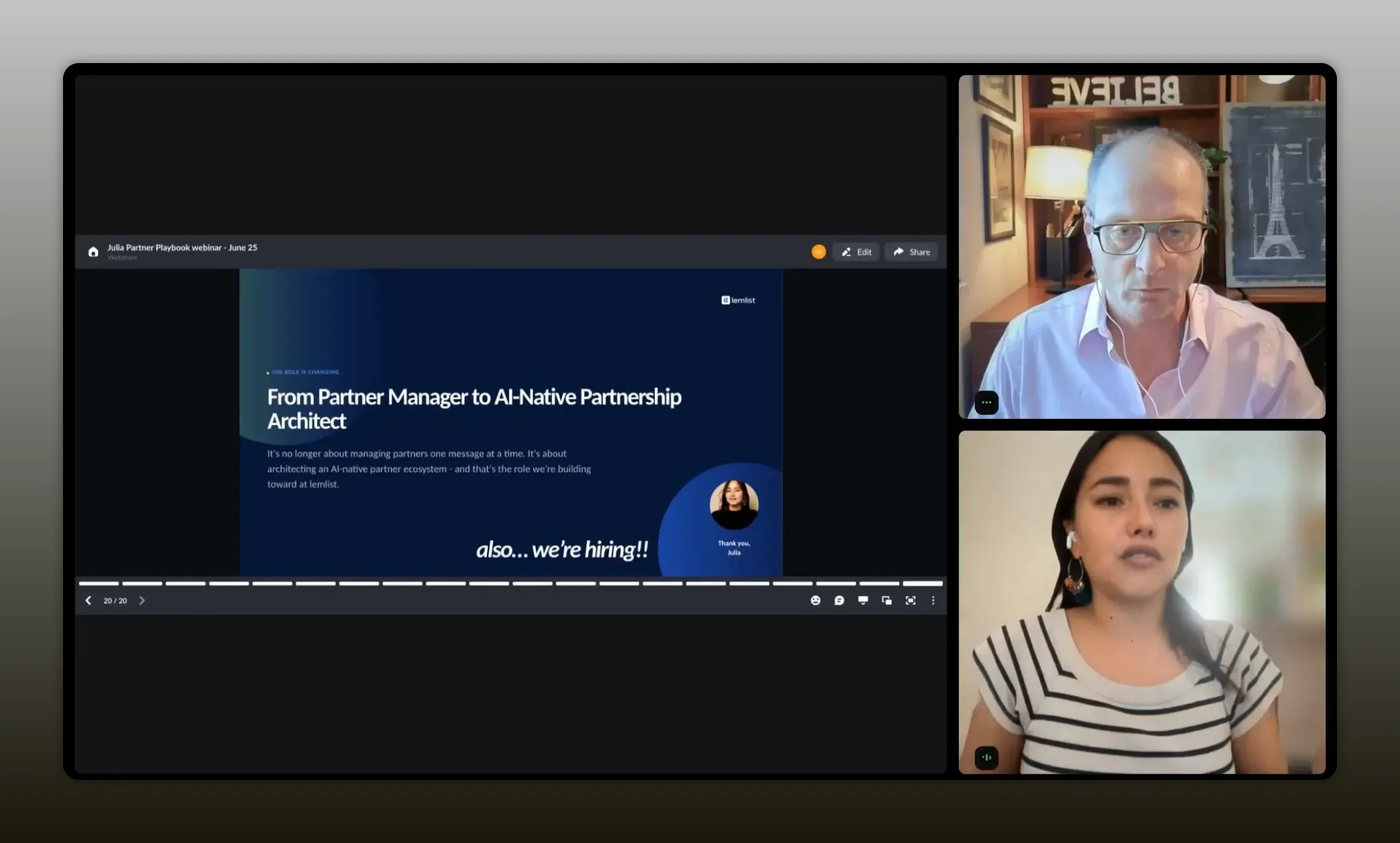
“Being an AI partnerships architect at Lemlist means designing the systems—Buddy, Lem Lab, and the rest—so partners can get fast answers and real ROI without losing the human trust that relationships require.” —Julia Guenier
Recommended tools
Here is the practical stack that surfaced most clearly from the session.
- PartnerStack for PRM infrastructure and partner data management
- HubSpot for CRM and sales alignment
- Slack for partner community and AI assisted support
- Claude for querying partner data, reporting, and generating operational summaries
- n8n for workflow automation and orchestration. You can learn more at n8n.io
- Claap for call recording, summaries, and CRM note automation
- Custom internal tools like Buddy and the Lem Lab for partner support and account audits
The broader lesson is not that you need this exact stack. It is that you need a connected stack. AI gets much more useful when it can move across your partner data, CRM, communication channels, and reporting workflows.
FAQs
Can one partner manager really support hundreds of partners with AI?
Yes, but only if the workflows are designed carefully. Julia’s example works because repetitive support, reporting, and documentation tasks are handled by systems like Buddy, CRM automation, and partner audit tools. The human role stays focused on strategic relationships and escalations.
What is the biggest AI use case for partnership teams right now?
Support triage and data access are two of the most immediate wins. If AI can answer common questions, summarize calls, update your CRM, and generate partner reports from live data, you reclaim a significant amount of time without reducing service quality.
Why did Lemlist start with affiliates before building a deeper service partner motion?
Starting with affiliates helped prove that indirect revenue had traction. Once that was clear, the team could invest more confidently in service and solution partners who bring larger opportunities and require a more strategic co-sell relationship.
What makes an AI workflow fail in partnerships?
The most common failure points are over-automation, poor scoping, and too much noise. If a system weakens trust, creates more alerts than actions, or forces partners away from natural workflows, it usually needs to be redesigned.
Is AI replacing relationship driven partnership work?
No. The better way to think about it is that AI removes repetitive operational drag so partner managers can spend more time on trust, strategy, and high value conversations. In that sense, AI can strengthen human relationships rather than weaken them.
Conclusion
The most important lesson from Lemlist is simple. AI is most valuable in partnerships when it clears space for better partnership work. It should reduce the load of repetitive questions, messy reporting, scattered notes, and slow internal follow up. It should help you identify patterns faster, support partners better, and surface revenue opportunities earlier. And if you use it well, it should give you more time to do the part of the job that machines cannot do well, which is building trust, guiding partners strategically, and creating momentum across people. That is the real operating shift happening now, and the teams that embrace it early are going to look very different from the ones that do not.