More Co-Marketing, Without the Headcount
Expert advice from Will Taylor (Co-Founder & CPO, AudienceLed).
Snapshot
You are being asked to produce more partner content, coordinate more stakeholders, prove more pipeline impact, and somehow do it with the same headcount or less. That is the reality in partner marketing right now. The pressure is not easing up. It is increasing. Marketing teams are overloaded, partnership teams are wearing too many hats, and the gap between strategy and execution is where most good partner ideas go to die.
That is also the opportunity. If you can bring more structure, more clarity, and smarter use of AI into your partner marketing workflow, you can unlock scale without waiting for another hire. Will’s core argument is simple: the teams that learn to delegate the messy work to AI, while giving humans clear incentives and deadlines, are going to move faster than everyone else. The ones that do not will keep drowning in requests, approvals, and unfinished campaigns.
Keep reading to learn how Will Taylor and Justin Zimmerman can help you achieve more partner participation, faster campaign execution, and stronger partner-sourced pipeline.
“Partnerships has all of those hats that they wear. But that means each of those hats can be delegated to an AI.” -Will Taylor
Table of Contents
- Snapshot
- The state of partner marketing
- Your two options: work harder or delegate
- Why clarity drives action
- How to align partner marketing with marketing
- The simple brief that unlocks execution
- A three-step engine for partner content
- What high participation and go-live rates really come from
- Will’s AI mental model
- How to give AI context, skills, and guardrails
- Where to start if you are a one-person team
- Recommended tools
- FAQs
- Conclusion
The state of partner marketing
Will has spent the last few years right in the middle of the modern partnerships wave. He came into partnerships by learning in public, creating content so he could understand the craft and do the job better. That path led him into Partner Hacker, which later became Nearbound, then into Reveal, and then Crossbeam after acquisition. Today he runs Audience Led, a demand generation agency focused on partner marketing.
That background matters because it gives weight to the main point he keeps coming back to: partner marketing is underbuilt almost everywhere.
Whether you are at a seed-stage startup or a public enterprise company with thousands of partners, the pattern is usually the same:
- One person owns too much
- Requests pile up faster than campaigns go live
- Marketing does not fully understand partnerships
- Partnerships does not always understand marketing operations well enough
- No one has enough time to be strategic
Will gave one especially telling example: a public company with thousands of partners and only one partner marketer. That person was buried in requests, stretched thin, and close to burnout. If that sounds familiar, the issue is not that you are bad at your job. The issue is that the function is usually under-resourced and loosely integrated.
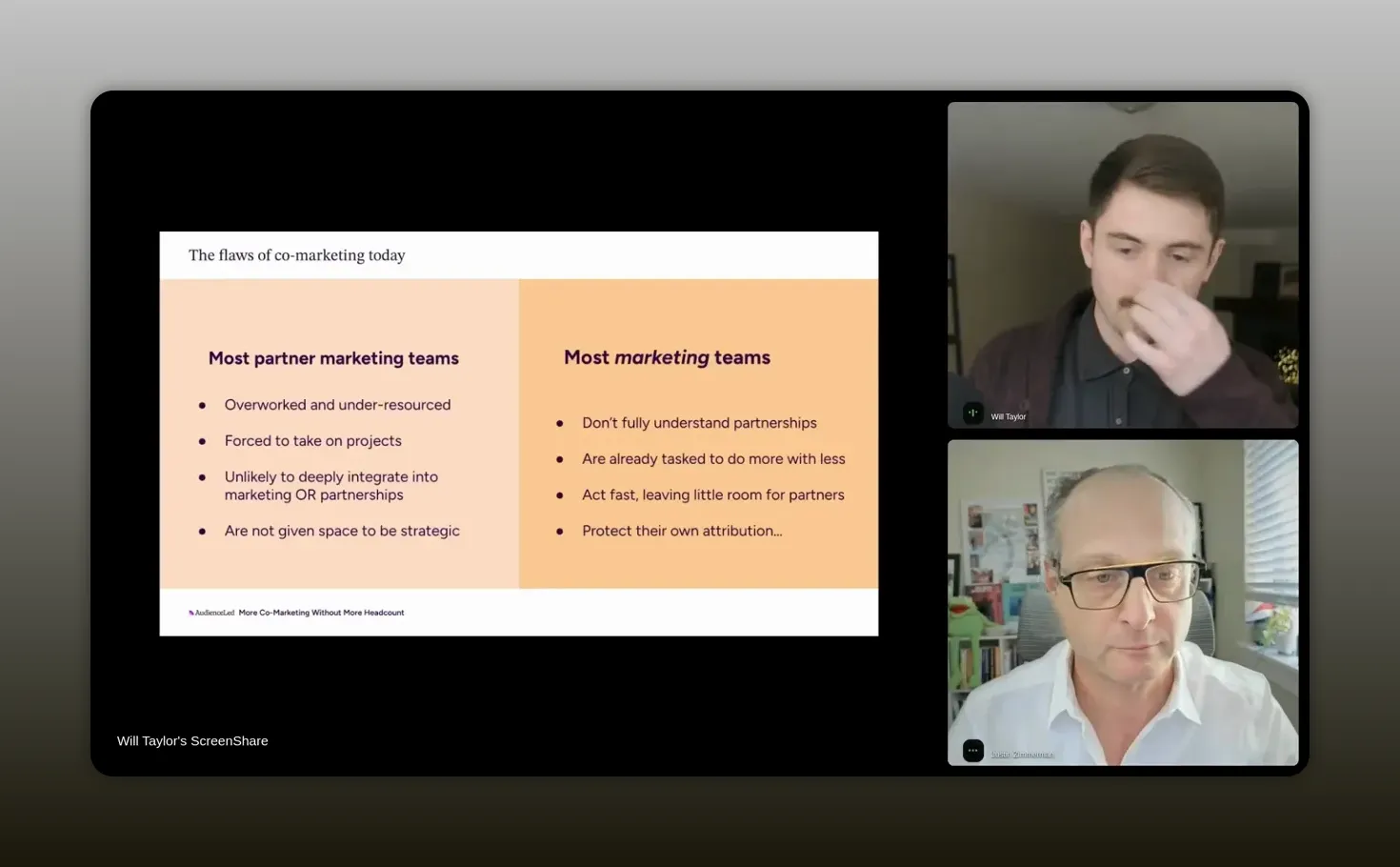
“Every partner marketing function is under-resourced.” -Will Taylor
That is exactly why AI matters here more than most teams realize. Partner teams tend to wear more hats than other functions. You might be strategist, operator, project manager, content lead, analyst, relationship manager, and internal evangelist all at once. The upside of that complexity is that a lot of those repeatable tasks can be delegated.
If you want a broader perspective on how small teams can operationalize this, this practical guide to partner marketing for tiny teams complements many of the same themes Will is pushing.
Your two options: work harder or delegate
Will boiled the path forward down to two options.
- Use the headcount you have and work harder
- Delegate
The first option is what most people default to. You squeeze more hours out of the week, absorb more requests, and hope a future hire solves the problem. Sometimes you do hire. Then the new person gets flooded with the same mess and the system stays broken.
That is why Will calls it a band-aid solution.
The second option is the scalable one. Delegate the busy work and the complexity. That can mean AI agents, automation, or outside support from agencies. Will is candid here. Yes, he runs an agency. But he also points out something important: marketing teams already outsource specialized work all the time. SEO, video, paid media, social, design, content ops. There is nothing strange about using outside support when internal teams are overloaded.
The broader principle is what matters. Stop assuming every step of partner marketing has to stay manual.
Ask yourself:
- What work actually requires your judgment?
- What work is repetitive and format-driven?
- What can be templated?
- What can be generated, drafted, summarized, or scheduled by AI?
If you are still trying to brute-force partner marketing with people-hours alone, you are fighting the wrong battle.
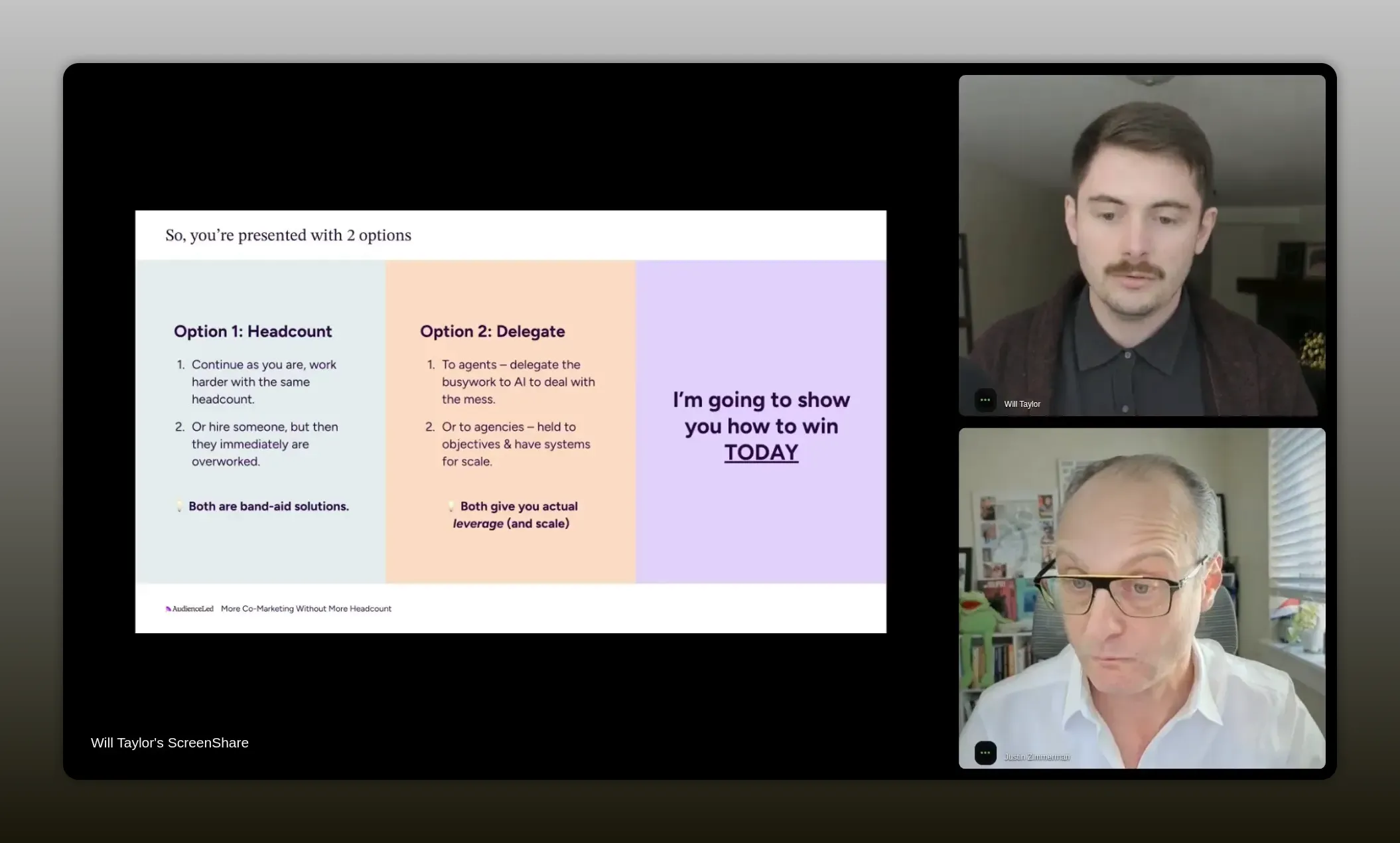
“You have two options: work harder—which is a band-aid—or delegate the messy work to AI, because partnerships has all those hats that each can be delegated.” -Will Taylor
Why clarity drives action
One of Will’s strongest ideas is also one of the simplest: clarity drives action.
Most partner campaigns stall because the people involved do not know exactly what to do, why to do it, or when it needs to happen. That applies to internal marketing teams, external partners, and even AI.
If there is no deadline, the task gets delayed.
If there is no incentive, the task gets ignored.
If there is no explicit step-by-step, people default back to their core priorities.
That is why the best partner marketers are not just idea people. They are clarity people. They turn ambiguous collaboration into an actionable plan.
According to Will, your job is to make participation feel like a no-brainer. That means being painfully specific about:
- The incentive
- The metric
- The deliverable
- The owner
- The date
- The system or channel being used
For example, saying “let’s do something together” is weak.
Saying “this campaign will generate leads for both of us, the copy is already written, it goes live next Thursday at 10 a.m., and here is the post plus calendar invite” is strong.
That level of specificity reduces decision-making friction. It also makes AI much more useful, because the model has the structure it needs to produce a high-quality output.
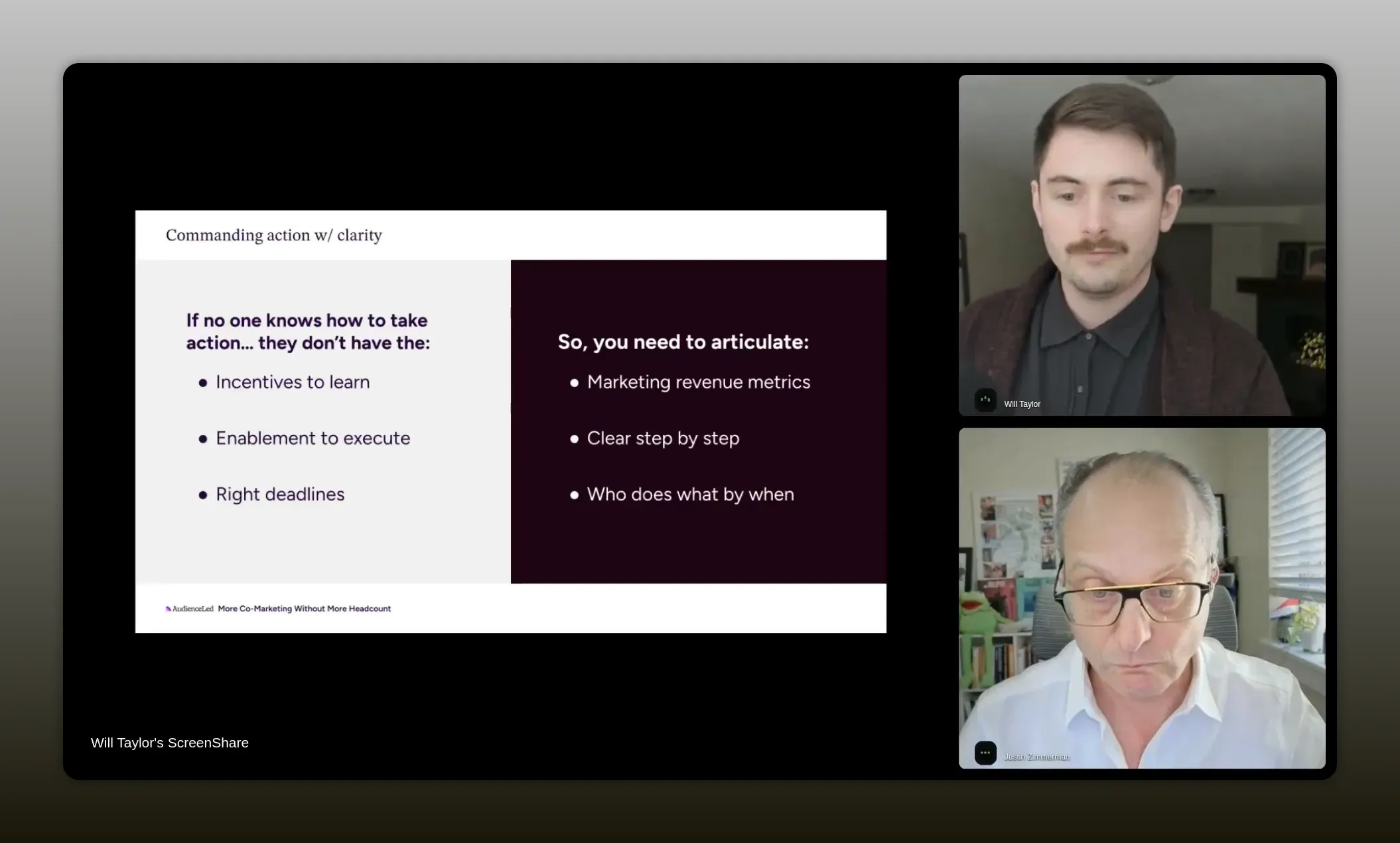
“Clarity is what turns uncertainty into action—when people know the incentive, steps, and deadline, they don’t just understand the task, they execute.” -Will Taylor
How to align partner marketing with marketing
If you want partner marketing to work, you cannot operate like a sidecar to the marketing team. You need enough fluency in how marketing works to plug partners into real business priorities.
Will highlights three areas you need to understand:
1. Goals
You need to know what marketing is trying to achieve right now. Not in a vague annual sense. In the next quarter or two.
Are they focused on:
- Pipeline creation
- Brand awareness
- Product launches
- Demand generation
- Expansion into a segment or category
If you know the current priorities, you can position partners as a practical lever instead of an extra project.
2. Calendar
You also need to know the marketing calendar. When are launches happening? What campaigns are already in motion? Where are the gaps?
This is where deadlines become real. Once you understand the calendar, you can place a partner activity into a live plan instead of throwing ideas over the wall.
3. Technology
You do not need to become a power user of every marketing system. But you do need enough familiarity to work within the stack. That includes things like:
- CRM and attribution systems
- Marketing automation
- Content management systems
- Scheduling and publishing workflows
Will specifically calls out attribution as an area worth understanding. Is the team using the CRM only? A platform like Dreamdata? Something else? If you cannot connect partner activity to the tools used for measurement, partner marketing stays fuzzy.
This is also where foundational operational discipline becomes important. If you need more on measurement, incentives, and proving partner impact, this recap on building a partner pipeline is a useful companion resource.
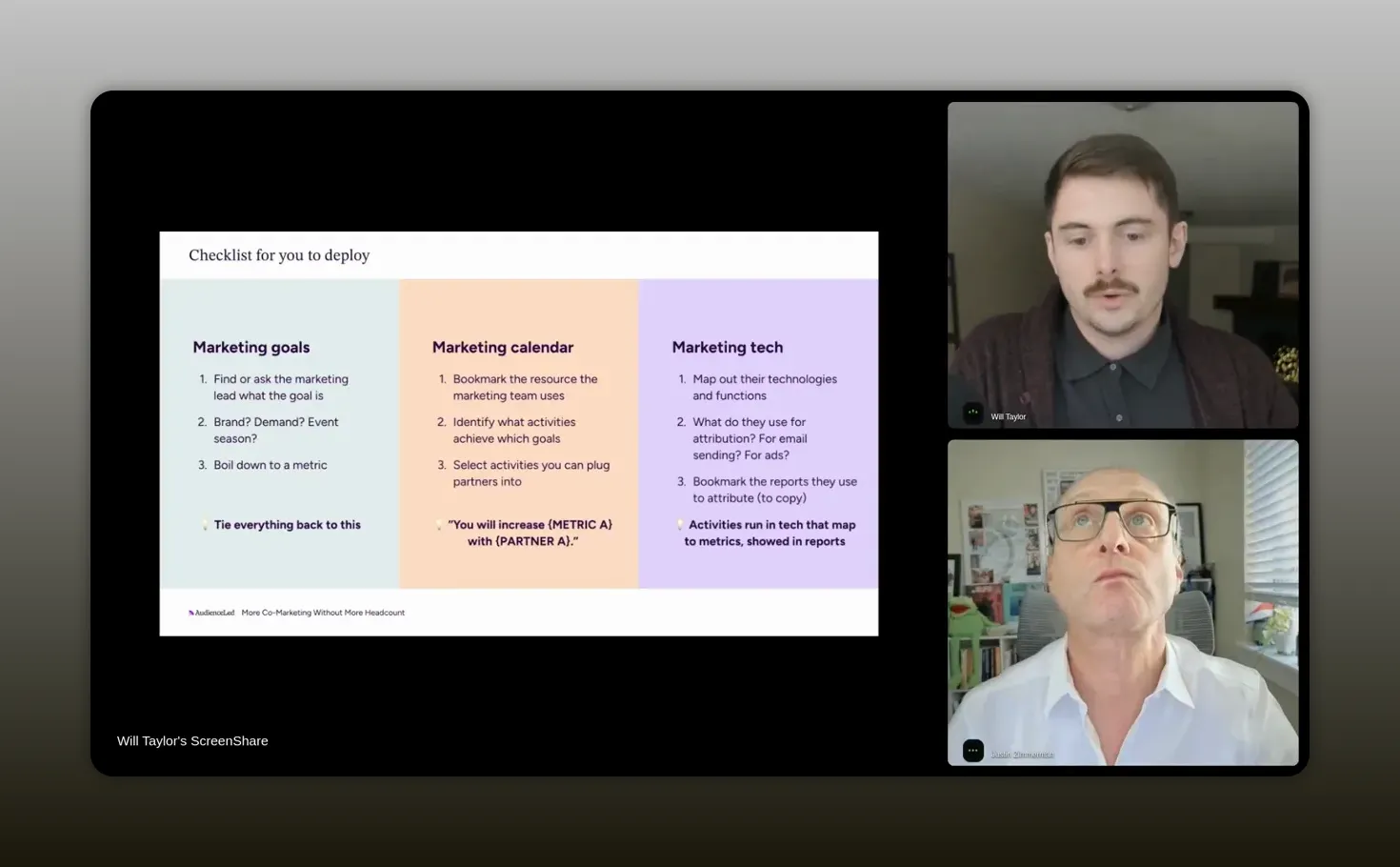
“Show why with metrics, when in the calendar, and how with the technology the team is already using.” -Will Taylor
The simple brief that unlocks execution
One of the most practical tactics Will shared is the use of a simple campaign brief.
It does not need to be fancy. It just needs to organize the core information clearly enough that both humans and AI can use it.
At minimum, your brief should cover:
- Overview: what the activity is
- Why: the goal and metric
- How: the workflow or technology involved
- When: the timeline and deadlines
- Partner role: what participants need to do
This sounds almost too basic, but that is the point. Simplicity is what makes it scalable.
A clear brief does three jobs at once:
- It aligns internal stakeholders
- It makes participation easier for partners
- It gives AI the context it needs to draft usable outputs
When Will talks about “doing the work for them,” this is what he means. If you can get a team or a partner 70 percent of the way there, you reduce friction. If you get them 99 percent of the way there, and all they need to do is copy, paste, and publish, execution rates go way up.
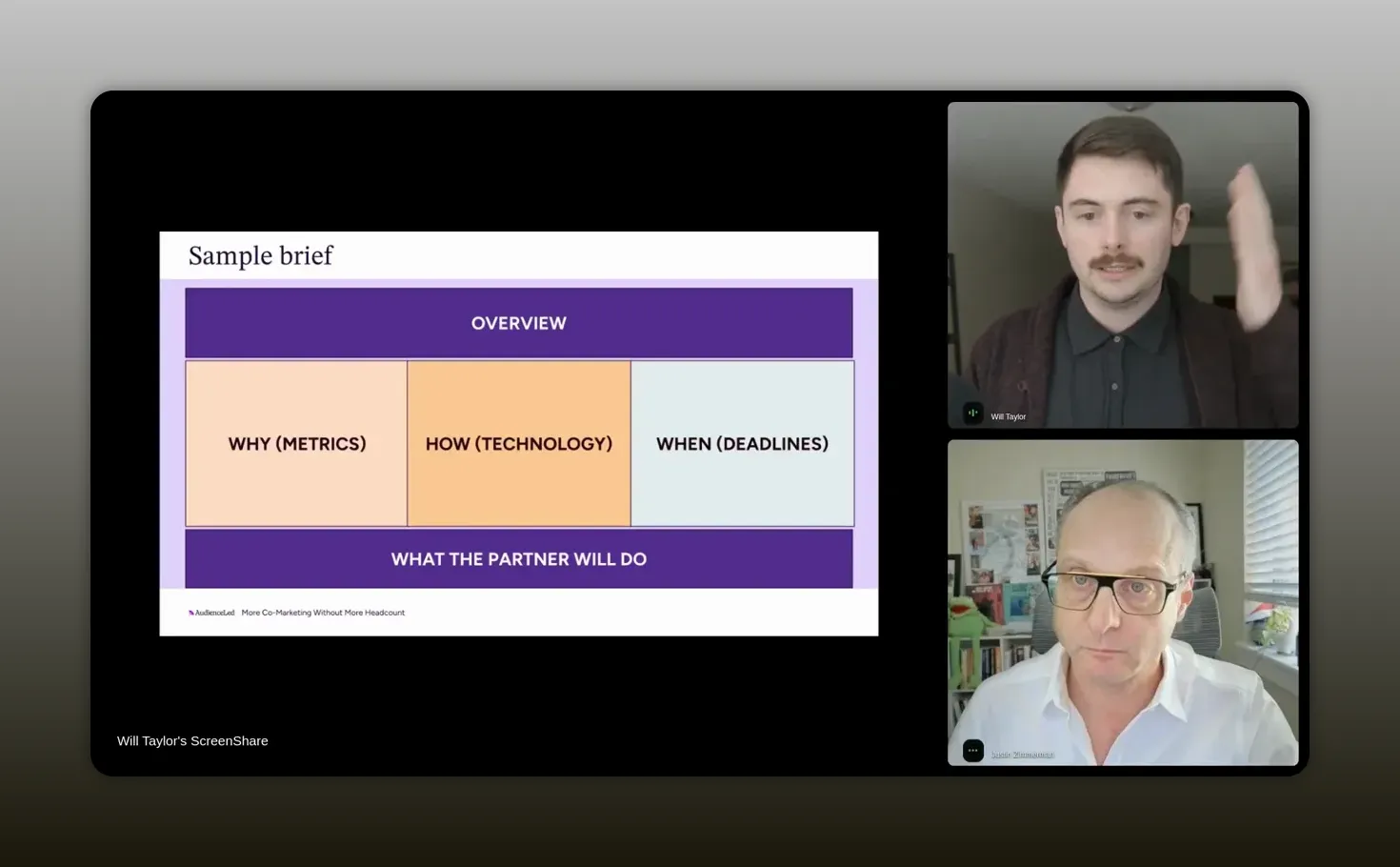
“If you organize this information simply, then you’ll be able to give this to an AI.” -Will Taylor
That is especially relevant if you are repurposing one recorded conversation into multiple formats. A strong brief becomes the operating system behind every downstream asset.
A three-step engine for partner content
Will’s agency runs partner marketing through a three-step process:
- Source
- Produce
- Deliver
Source the right partners
The first step is identifying the right partners for the topic and value proposition you want to bring to market. This is not random partner selection. It is a fit decision based on:
- The joint value proposition
- The campaign topic
- The audience you want to reach
- The likelihood the partner will participate
Then you create structure around the conversation. That can mean a form, a list of prompts, or a guided recording session.
Capture content efficiently
One of the strongest practical takeaways from Will’s process is this: you can often sit down for 30 minutes or less, record a structured conversation, and turn it into a full content package.
That single session can become:
- A blog post
- Multiple short videos
- Several social posts
- Email copy or snippets
That means one well-run recording session can feed a month of activation, depending on the topic and depth.
If webinars are part of your mix, this partner webinar playbook is another strong resource for turning one collaboration into repeatable demand generation assets.
Produce with AI doing the heavy lifting
Once the content is captured, AI can help identify themes, summarize the conversation, draft posts, pull clips, and adapt the material into multiple channels. But the quality of the output depends on the structure you gave it.
That is why Will keeps coming back to templates. AI is not replacing strategy. It is accelerating execution when strategy is already clear.
Deliver with precision
The final step is where most teams lose momentum. Content gets approved but never distributed. Drafts sit in folders. Partners mean to post but forget.
Will’s fix is straightforward: be prescriptive.
- Give the exact copy
- Give the exact date
- Give the exact time
- Give scheduling instructions
- Send the calendar invite
The easier you make publishing, the more likely it is to happen.
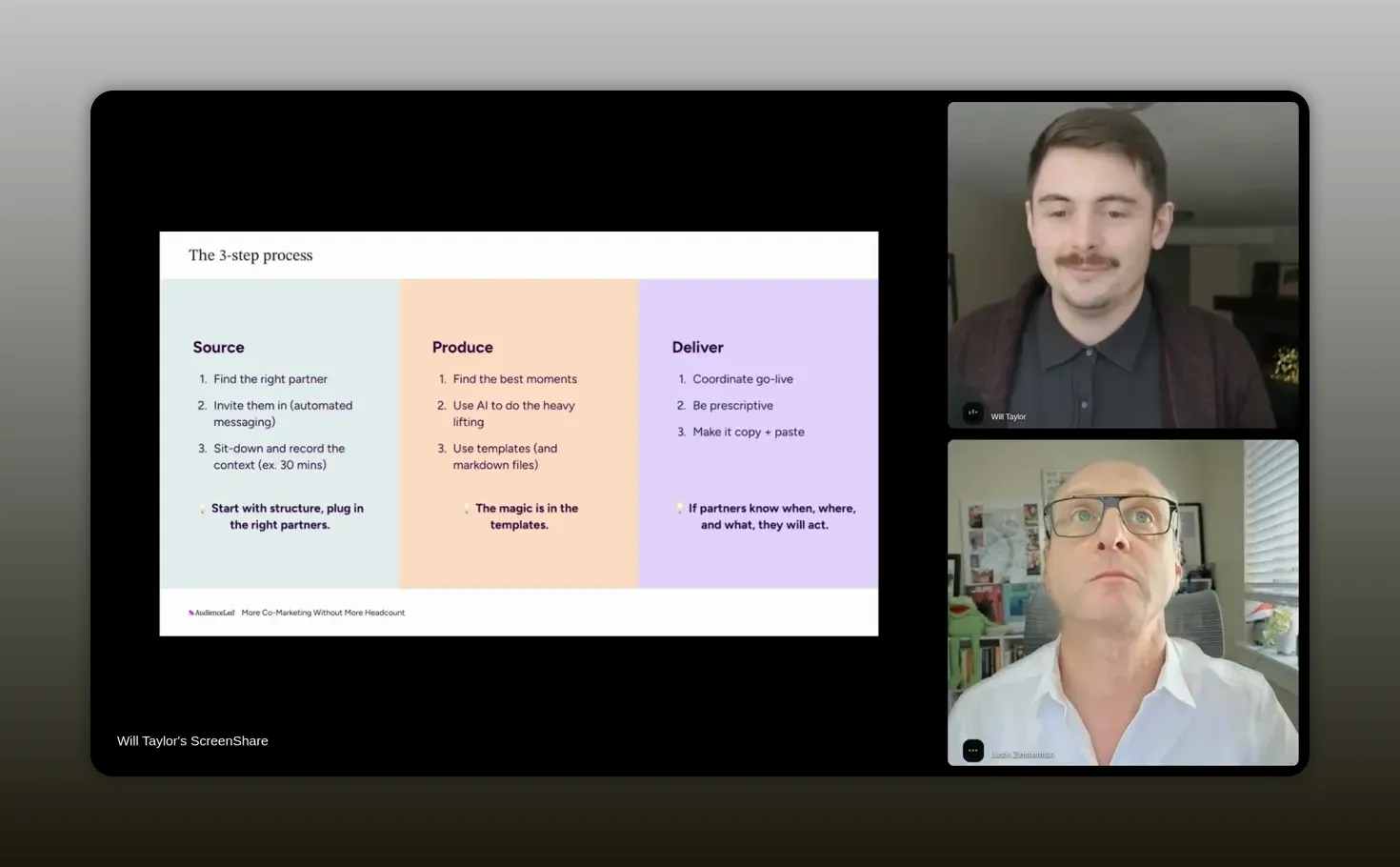
“If partners know when, where, and what to do, then they will act.” -Will Taylor
What high participation and go-live rates really come from
Will shared two numbers that stand out:
- 95% participation rate
- 98% go-live rate
That means when people see the outreach and understand the offer, they participate. And once the content is ready, it usually gets published.
Those numbers are especially interesting because they are not limited to formal, contracted partners. In many cases, the participants did not even know Will’s client existed before being invited into the content.
Why would someone do that?
Because the offer is strong:
- They get a platform to share their perspective
- They get ready-made assets
- They get distribution
- They get a simple path to participation
This is a smart reminder that partner marketing can be more than activation for existing alliances. It can also be a relationship-building mechanism. You can start collaboration through content, create value before a contract exists, and build momentum that later supports a formal partnership.
The follow-up matters too. Will is blunt about that. The magic is in the follow-up. If someone said yes, participated, and agreed to publish, you should keep following up until you get a clear answer. Not aggressively, but consistently.
Execution discipline is what turns content production into actual market activity.
Will’s AI mental model
After covering the workflow, Will moves into the AI architecture behind it. His mental model is useful because it strips away a lot of the hype and keeps the focus on what actually improves outputs.
According to Will, AI needs three things:
- Context
- Best practices
- Guardrails
Context
This is the rich background knowledge. Your value proposition. Why you partner. The goals of the campaign. The nuances from your conversations. The strategic mess that lives in your notes, calls, and documents.
Best practices
This is where “skills” come in. If you want AI to draft a social post, summarize a call, create a blog outline, or generate an email blurb, it helps to store the rules and examples for that specific task. That way the AI is not improvising from scratch every time.
Guardrails
This includes brand voice, formatting expectations, content templates, and any boundaries you want the AI to respect.
Will described these as markdown files, skills files, and question prompts. The exact format is less important than the concept. You are creating reusable operating instructions for your AI.
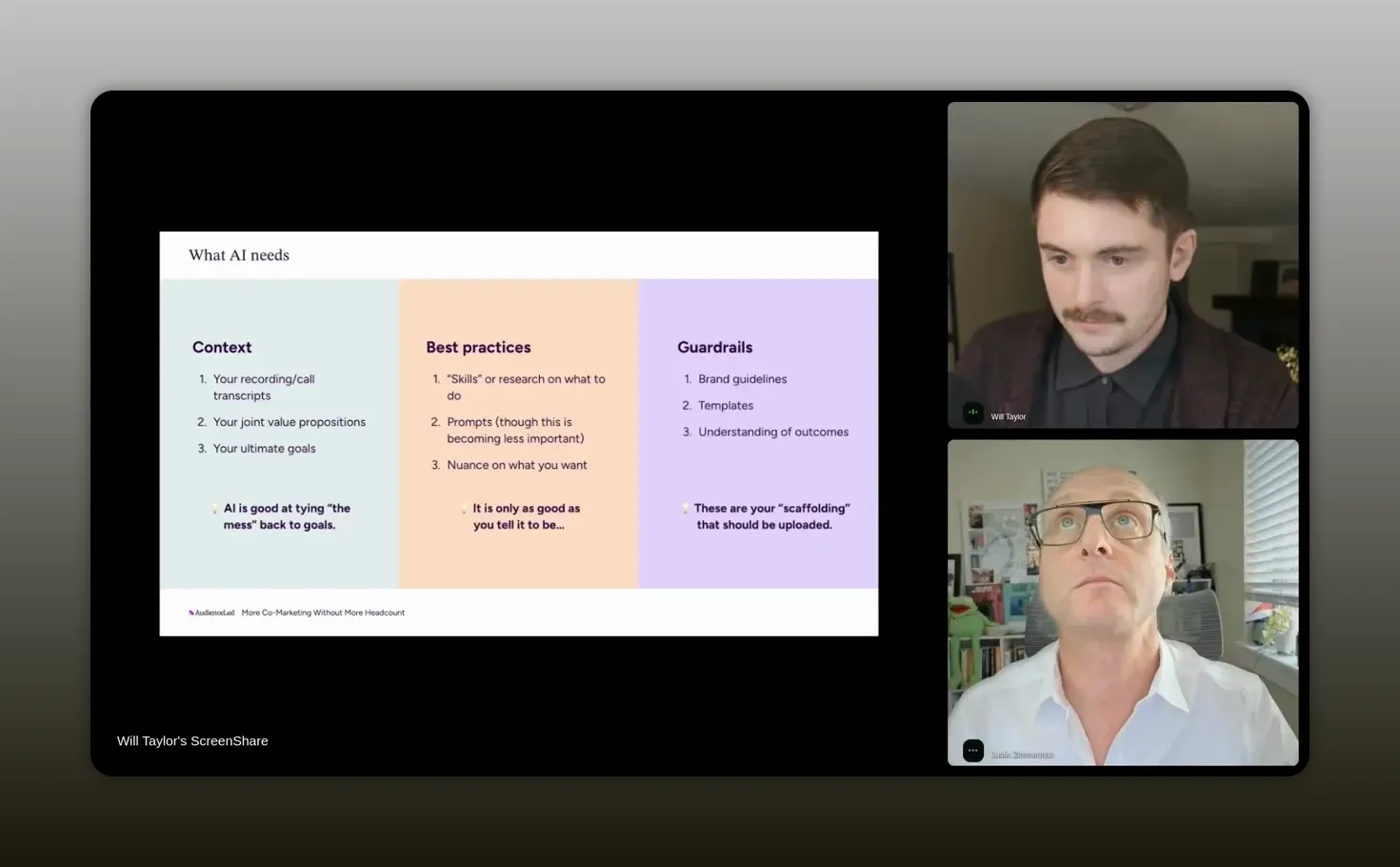
“AI needs context, best practices, and guardrails.” -Will Taylor
He also recommends telling your AI to ask follow-up questions. That one detail matters a lot. Good AI use is not just one-way prompting. It is collaborative refinement. If the model asks what audience, what channel, what tone, or what call to action you want, the final output gets much better.
How to give AI context, skills, and guardrails
Will uses a simple way to explain this setup:
- Markdown files are the brain
- Skills are the tools
- Questions are the guidance
You can think of it like this.
The brain
This is where your core context lives. Company positioning, partner strategy, campaign goals, messaging pillars, examples of past work, customer language, and anything else the AI should consistently know.
The tools
These are task-specific instructions. How to write a LinkedIn post. How to turn a call transcript into a blog draft. How to summarize a recording into partner-facing copy. How to create an email snippet from a webinar recap.
The guidance
This is your instruction for the AI to fill in gaps by asking you questions first. That extra loop helps avoid generic content and lets you tailor outputs to the campaign.
Will’s point is not that everyone needs a complicated AI stack overnight. It is that even simple structure can radically improve your speed and consistency.
Instead of starting every campaign from a blank page, you build a repeatable system.
Where to start if you are a one-person team
If you are a solo partner marketer or partner manager, this can feel like a lot. The best way to start is not to build a giant system. Start with one repeatable workflow.
For example:
- Choose one partner content format you run often
- Create a one-page brief template for it
- Record one structured 30-minute conversation
- Use AI to turn it into one blog draft, three social posts, and one email blurb
- Send each asset with exact publishing instructions and a specific date
- Track participation and go-live rates
That is enough to prove the model.
Once that works, build one more template. Then another. The goal is not to become an AI engineer. The goal is to stop doing the same mental labor from scratch every week.
Will’s approach is especially valuable if you sit between partnerships and marketing and feel like neither side fully owns the work. In that environment, your leverage comes from structure. The clearer you are, the easier it is to activate everyone else.
Recommended tools
Will did not push a giant software stack. He focused more on principles than logos, which is honestly the right move. But based on his guidance, these are the categories you should care about:
- AI writing and reasoning tools: large language models such as Claude or another LLM you already use
- Call recording and conversation capture: a tool that can record structured partner interviews and give you usable transcripts or summaries
- CRM and attribution: your CRM, plus tools like Dreamdata if your team uses more advanced attribution
- Marketing automation: whatever platform your marketing team already uses for email, nurture, and campaign coordination
- Content management and publishing: the CMS and scheduling tools your team already trusts
- Ecosystem intelligence: platforms like Crossbeam can support partner overlap and account mapping efforts
The key is not buying new software just to feel modern. The key is understanding the stack your team already uses and designing partner workflows that fit inside it.
FAQs
What is the biggest bottleneck in partner marketing today?
The biggest bottleneck is not a lack of ideas. It is a lack of structure and capacity. Teams are under-resourced, requests pile up, and partner marketing often sits between departments without deep operational support from either side.
Why is AI especially useful for partnerships and partner marketing?
Because partner professionals wear so many hats. Strategy, outreach, content, coordination, follow-up, and reporting all create repeatable work. AI helps you delegate those repeatable parts so you can spend more time on judgment, relationships, and campaign design.
What does Will mean by clarity drives action?
He means that people act when the task is obvious. If you give partners and internal teams a clear incentive, exact steps, a deadline, and ready-to-use assets, they are much more likely to participate and publish.
How long should a partner content capture session be?
Will says you can often get what you need in 30 minutes or less if the conversation is structured well. That one session can then be repurposed into a blog post, multiple social posts, video snippets, and email copy.
Do you need formal signed partners for this approach to work?
No. One of the surprising takeaways from Will’s experience is that this method also works with informal partners who did not even know the client beforehand. Good enablement and a valuable content offer can create collaboration before a formal agreement exists.
What should you give AI to improve the quality of outputs?
You should give it context, best practices, and guardrails. In practical terms, that means background information, examples or templates for specific tasks, and clear instructions around brand voice, format, and objectives.
What is the easiest place to start?
Start with one workflow. Build a simple brief, capture one structured partner conversation, and use AI to repurpose that recording into a small set of assets. Then tighten your distribution process so publishing is easy and deadline-driven.
Conclusion
Partner marketing does not fail because the channel lacks potential. It fails because too much of the work is still handled like a custom project every single time. Will’s playbook is a strong reminder that scale does not come from hustle alone. It comes from repeatability.
If you give people clarity, connect partner activity to real marketing goals, and train AI with the right context and templates, you can do a lot more than just keep up. You can build a partner marketing engine that produces assets faster, gets more partners to participate, and creates more partner-sourced pipeline without waiting for the perfect org chart.
That is the big opportunity right now. The teams that build these systems early will have an unfair advantage.