Event Playbook: Planning, Promoting, and Profiting from Partner Events
Expert advice from Kristiana Mane (Partner Enablement, HubSpot).
Snapshot
You are running events—webinars, local dinners, half-day workshops, or large online summits—and you need them to produce measurable business outcomes! But without a repeatable system that connects planning, targeting, data enrichment, and sales follow-up, a great experience can still look like a failed investment on a CFO’s spreadsheet.
However, the right repeatable approach turns attention into demand and one-off registration numbers into reliable pipeline. If you want to solve low ROI from events, poor lead quality, and lack of attribution, keep reading to see how Justin Zimmerman designs single source of truth and a registration-to-revenue workflow that creates repeatable ROI (that makes your partners and sales team champions of your events).
I always emphasize that planning is what turns the day of the event into a memorable moment—not a miracle. -Justin Zimmerman
Table of Contents
- Snapshot
- Table of contents
- Planning: align goals, KPIs, and formats
- Choosing an event format that matches your goals
- Realistic timelines and the 90-day rule
- Single source of truth: briefs, speaker onboarding, and roles
- Designing a registration flow that qualifies and converts
- Enriching registrations with data and automation
- Promotion tactics: email, LinkedIn, SMS, and geo-targeting
- In-person engagement hacks that capture attention and data
- Pre-event, in-event, and post-event offers that drive conversions
- Scoring, lead handoff, and sales enablement
- Recommended tools
- FAQs
- Conclusion
- Social post
Planning: align goals, KPIs, and formats
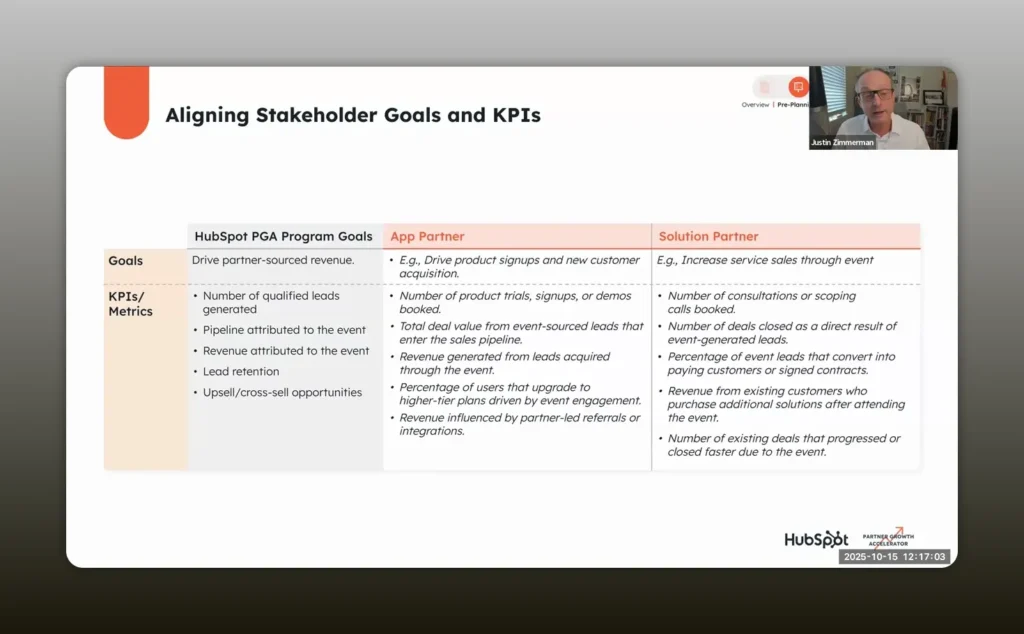
Every event should start with a single question: what does success look like in dollars, meetings, or trials? Justin Zimmerman’s most consistent advice is to sit down with your partner and define the joint KPIs before a single vendor is booked or a landing page goes live.
Work through the practical distinctions between app partners and solutions partners. App partners often target trials, installs, or activations; solutions partners typically want high-quality, high-ACV demos and meetings. Define those outcomes, document them, and place them in a shared brief. That lets creative and procurement decisions flow from the desired business results rather than from “what would be fun.”
Ask these planning questions together:
- Who is the primary ICP and which role/title matters most?
- Which 3 KPIs will determine whether this succeeds for finance and sales?
- What is the offer or reason to attend that is compelling to that ICP?
- What is the agreed follow-up/responsibility matrix for registered and attended people?
Make the brief visible to stakeholders. Justin and Kristiana recommend a single Google Doc or shared drive as the event’s source of truth so everyone knows where timeline, budgets, speaker notes, and promotional assets live.
Get alignment on the KPIs before you buy anything—then the budget earns a job. -Justin Zimmerman
Choosing an event format that matches your goals
Events exist on a spectrum of scale, cost, and attention. Choose the format that maps to your objective and to the audience you need to attract.
- Webinars and virtual events: higher volume, scalable reach, best for awareness and mid-funnel engagement. Expect attendees in the hundreds if you amplify properly.
- Executive dinners and VIP meetups: small groups (8–15), high quality, high conversion potential for solution sales. Budget varies, but these are often in the $5,000–$25,000 range depending on venue and exclusivity.
- Half-day workshops and hands-on sessions: higher investment, useful for solving bottom-of-funnel problems like onboarding, pricing, or co-selling playbooks.
- Experiential retreats or multi-day leadership experiences: highest impact for strong relationship building, sponsorships, and strategic partner introductions.
Match the format to decision-maker behaviors. A busy director may respond to a targeted workshop promising specific outcomes; a marketing manager might click into a webinar that solves a tactical pain.
Realistic timelines and the 90-day rule
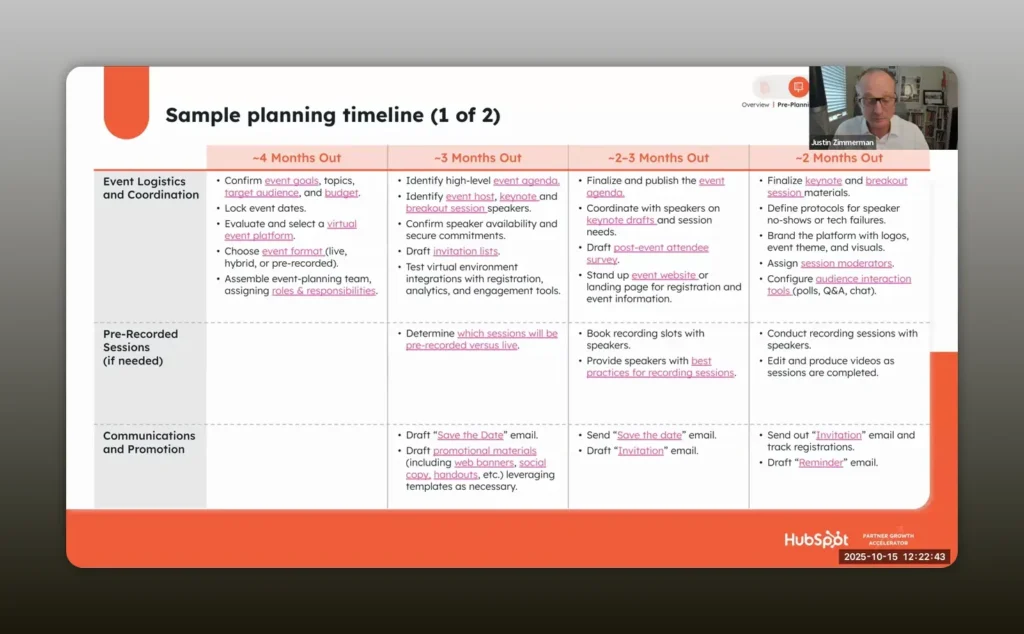
Justin stresses that solid events require time. A reliable planning window is roughly 90 days. That covers target list assembly, speaker recruitment, budget approvals, venue booking, and a thoughtful promotion cadence.
Time buys control. When you rush, you abdicate targeting and data work. When you plan ahead, you can run enrichment, qualify attendees, and create offers that convert before the event.
Events are compound engines: time and consistency are what make them profitable. -Justin Zimmerman
Single source of truth: briefs, speaker onboarding, and roles
Create a single collaborative document and populate it with everything: timeline, the mission, KPIs, speaker bios, session briefs, promotional content, marketing links, assets, and roles with named owners. This reduces friction and avoids the classic “I didn’t know” or “I didn’t get the asset” problems that derail outcomes.
Justin’s recommended template tabs include:
- Speaker onboarding and bios
- Session planning and objectives
- Promo content and messaging library
- Promo links, landing pages, and preregistration materials
- Forms, recordings, graphics, and post-event collateral
- Roles and contact list with timelines and task owners
Keep the brief editable and visible to partners. A shared Google Doc or equivalent prevents information from scattering across Slack channels and project management tools.
Designing a registration flow that qualifies and converts
Registration is not just RSVP capture. It’s your first conversion event and the place to collect the data that turns a registrant into a qualified lead. Justin’s rule: when you ask more, you get more—provided your ask is relevant.
Key fields to capture and why:
- Role and title: immediate ICP indicator.
- Company name and size: helps establish purchase capacity.
- Personal city or IP-derived location: essential for local invites and in-person targeting.
- Pain points or desired outcomes: qualitative signals that feed post-event messaging and segmentation.
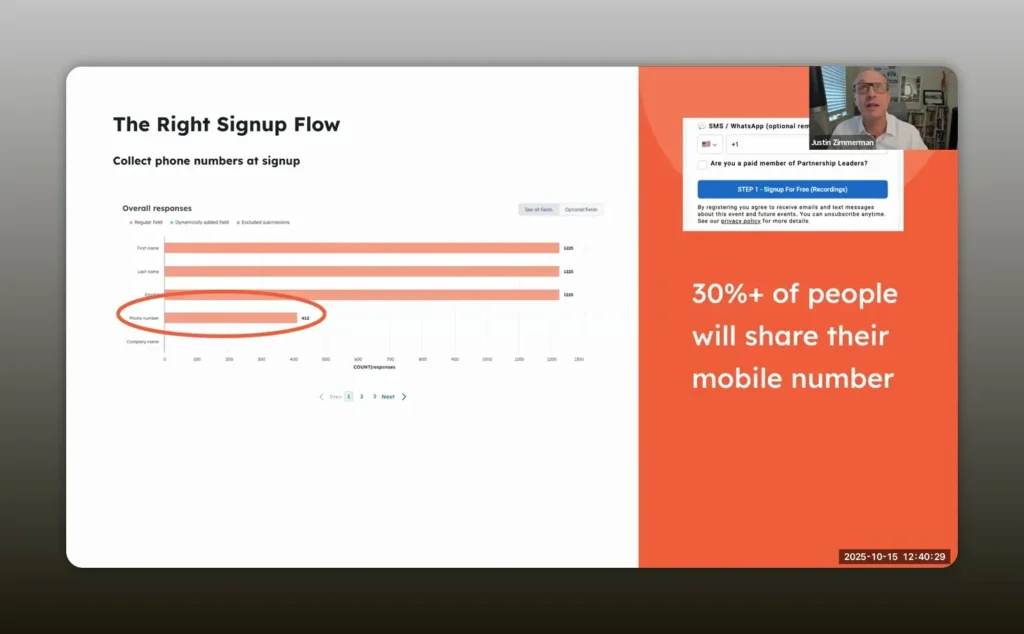
- Phone number (SMS/WhatsApp): a high-value field that enables one-to-one outreach and often lifts show rates significantly.
Turn registration into a micro-qualification. Ask 3–5 quick questions that let sales know whether to engage and how. For high-exclusivity events, make the sign-up feel like an application: “Tell us why we should invite you.” That both screens for fit and creates a sense of scarcity and acceptance.
People will give you phone numbers for real experiences. Use that permission wisely. -Justin Zimmerman
Enriching registrations with data and automation
A registration form only gives you what the attendee submits. Add automated enrichment in your workflow. Justin lays out a simple approach: pass the LinkedIn profile URL into a reliable enrichment tool via Zapier to get role, company size, city, and contact attributes.
Why enrichment matters:
- Sales needs quick access to LinkedIn to send connection requests and personalize outreach.
- Company size and employee count help prioritize AEs and route leads to the right rep.
- IP and Person City fields let you run effective local campaigns without buying new lists.
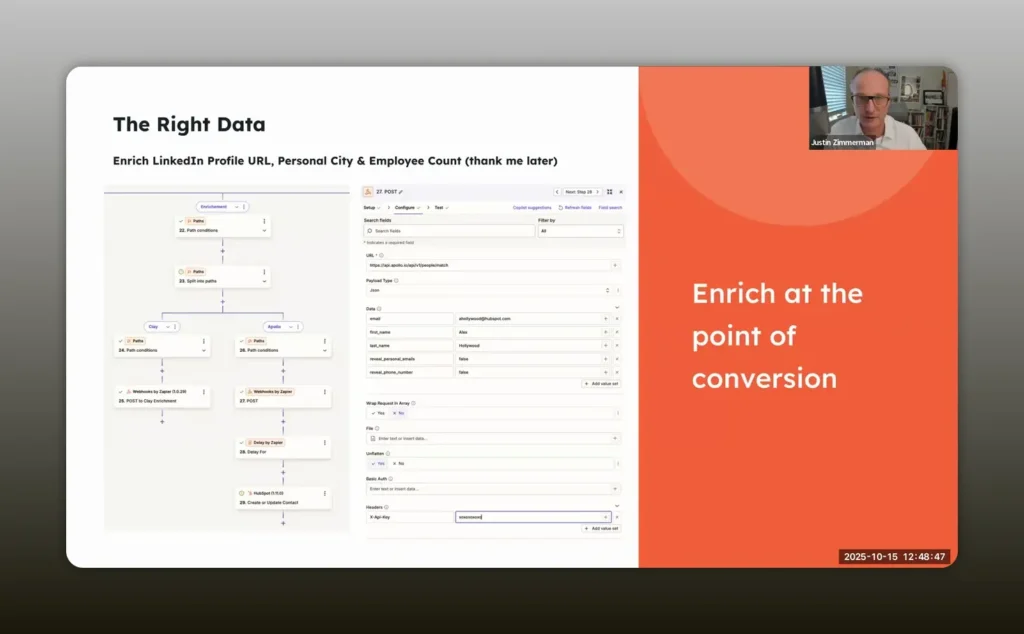
Enrichment is the bridge from “someone who clicked” to “someone my AE can sell to.” -Justin Zimmerman
Simple automation example:
- Form submission triggers a Zapier workflow.
- Zap queries an enrichment API (Apollo, Clay) with the LinkedIn URL or email.
- Enriched profile returns company size, role, city, and other signals into your CRM.
- CRM segments and notifies AEs for outreach and scoring updates.
Promotion tactics: email, LinkedIn, SMS, and geo-targeting
Promotion is about cadence, relevance, and channel mix. Justin recommends a “2×2 by 2” framework for digital events and a longer cadence for in-person events. Combine targeted email, LinkedIn organic and paid posts, and SMS to reach people where they pay attention.
High-impact promotional moves:
- Personalized email subject lines: use the role and title in the subject to increase opens—“VP of Sales: event in Denver.”
- HubSpot sequences: a more personal, inbox-delivered approach rather than a mass marketing blast.
- SMS and phone outreach: for local or VIP lists, text messages produced the largest lift in attendance in Justin’s projects—up to 65% of live attendees on some local events.
- LinkedIn organic posts and boosted posts: craft a local, personal post and boost it for $50–$200 to get impressions among target roles in your city.
- Speaker network reach: use speakers’ followers and second-degree connections as a targeted audience pool.
Hints that work:
- Use pre-filled registration buttons to reduce friction and improve conversion.
- Send calendar invites with a personalized touch for small executive events; people value that human invitation.
- Ask registrants for a favor to share the event and supply ready-to-post social images for speakers.
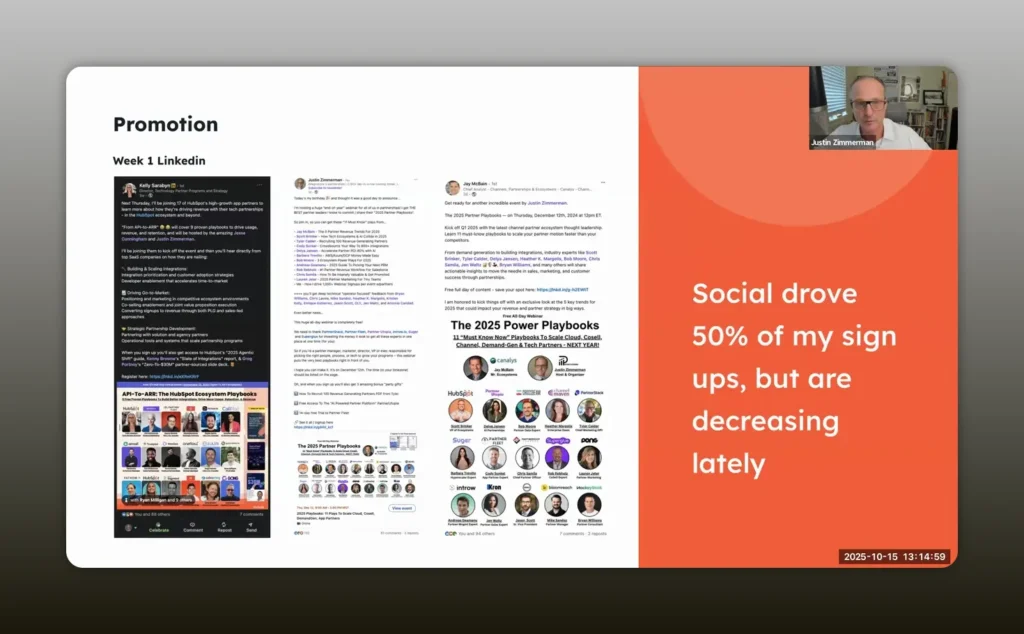
A $50 boost on a personal LinkedIn post can massively extend reach in a single city. -Justin Zimmerman
In-person engagement hacks that capture attention and data
Co-sponsored happy hours and sponsored lunches often fail because sponsors don’t control registration, list quality, or the registration flow. If you are hosting the event, add active engagement points that force a micro-commitment and create a trackable signal.
Practical in-room tactics:
- Stop the room: early in the gathering, get attention. Do a short presentation, a toast, or a quick demo—then ask for commitments.
- Bring a mini projector: a $500 projector lets you show a slide deck that connects the experience to the product and offers a clear CTA.
- Offer a valuable takeaway: a one-page strategy guide or a short playbook tied to the audience’s pain will outperform swag every time.
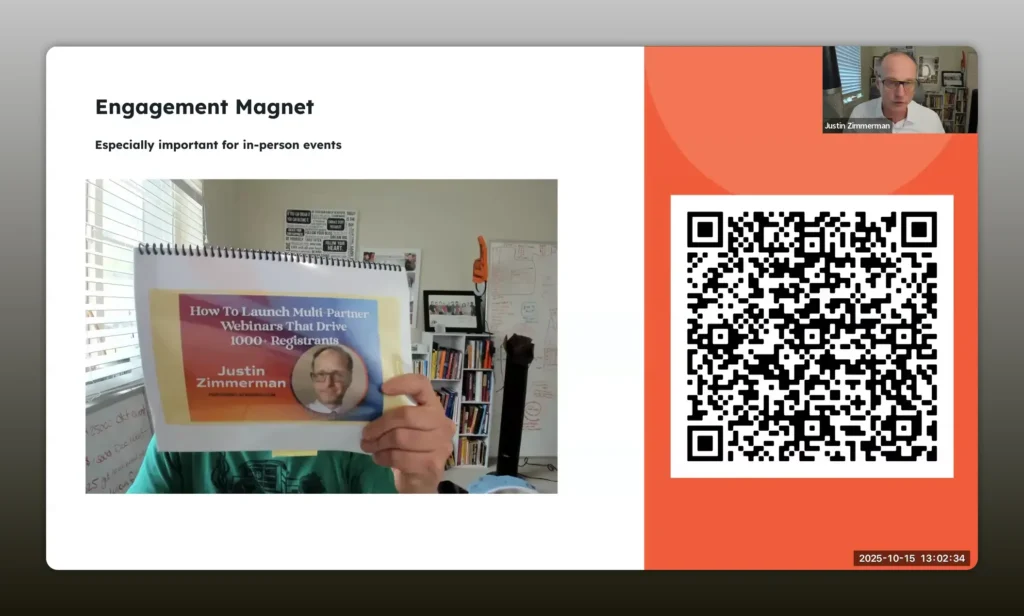
- Use an engagement magnet: a QR or email-to link that captures their address or triggers an immediate email draft works better than a tiny QR code on a table card.
- Capture who’s paying attention: record poll responses, who asks questions, and who rises to follow up post-event.
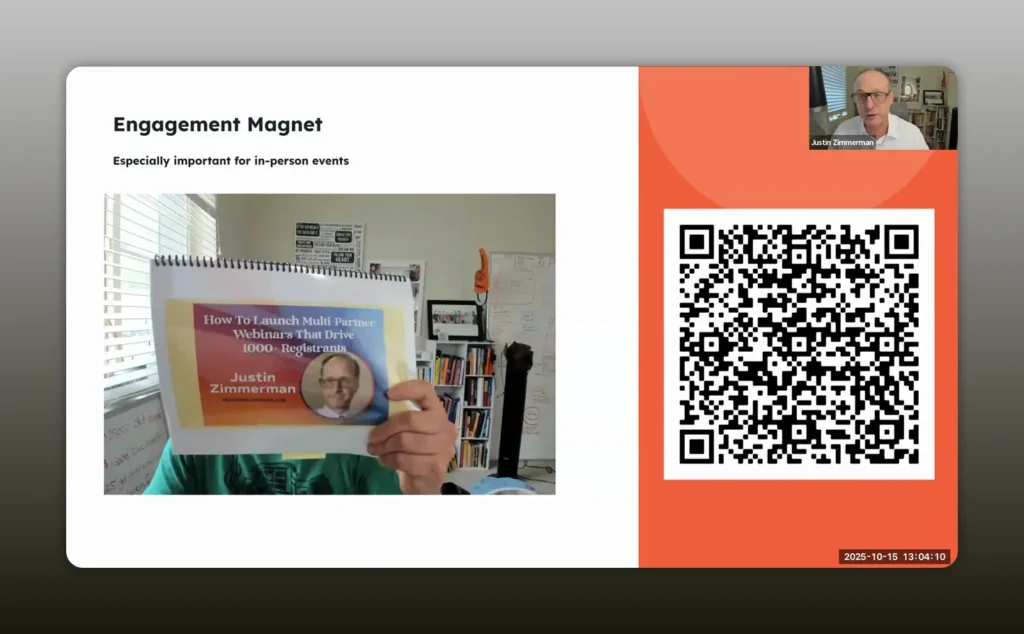
If you don’t command attention for a few minutes, the event becomes only social and not commercial. -Justin Zimmerman
Pre-event, in-event, and post-event offers that drive conversions
Events must be engineered for conversion, not just for atmosphere. That starts in the registration flow and continues into the in-event and post-event experience.
Pre-event offers:
- Present trial or beta access choices on the registration page. People will take them and convert prior to the event, giving you measurable results to report.
- Create a joint value-prop video with your partner that explains what attendees will gain and what to do if they can’t make it.
In-event offers:
- Friction removal: offers that reduce the cost, effort, or risk of switching to your product (migrations support, data import assistance, white-glove onboarding).
- Guaranteed outcome challenges: short-term outcome guarantees or challenges with clear deliverables by a specific date to overcome disbelief.
- Scale partner bundles: joint packaged offers that combine the strengths of an app partner and a solutions partner into a single compelling purchase.
Post-event offers and sequences:
Segment the event audience based on registration data and enrichment scores. Run a follow-up sequence that invites qualified attendees to a lower-pressure group demo or strategy session. Use these steps:
- Score and segment registrants to identify the top 20% who fit ICP.
- Run a targeted post-event email and SMS sequence that highlights the three key pain points gathered during registration.
- Offer group demos or office hours to reduce pressure and create an easier path to a sales discussion.
Put the offer where the attention is—at registration and during the live moment. -Justin Zimmerman
Scoring, lead handoff, and sales enablement
Make sure sales knows what a qualified lead looks like and give them the exact data they need to act. Justin recommends making the enriched profile and LinkedIn URL available to AEs in the CRM so they can do quick, personalized outreach.
Essential handoff items:
- Clear lead score and reason code for the score (e.g., role match, company size, expressed pain).
- LinkedIn profile link and personal city for rapid prospecting and local outreach.
- Access to registration answers that reveal specific pain points.
- Recommended follow-up sequence templates for AEs and SDRs.
When sales is confident in the lead quality, marketing gets credit and events stop being a discretionary expense. Align measurement: attribute pipeline, influenced opportunities, and closed-won revenue back to event-driven sources in your CRM.
Recommended tools
Use tools that make data capture, enrichment, and follow-up simple. Justin and Kristiana use a lean MarTech stack and recommend picking reliable integrations over one-off point solutions.
- Hubilo — event manager for both in-person and virtual events; simple landing pages and registration workflows.
- HubSpot forms and sequences — capture registrations, store IP data (IP city), and run multi-step follow up.
- Apollo — affordable enrichment and people data for role, company size, and LinkedIn URL lookup.
- Clay — alternative enrichment for LinkedIn profile data and personal location fields.
- Zapier — glue logic between forms, enrichment APIs, and your CRM or event tools.
- SalesMessage — text messaging platform integrated with CRM for localized SMS campaigns.
- SmartLeads — lightweight cold campaign tool if you need a low-cost outbound option.
- Typeform — flexible registration forms with conditional flows and optional phone capture.
- Google Calendar and Calendly — for personal invites and human-feeling calendar interactions.
FAQs
How far in advance should I plan a partner event?
Plan at least 90 days for most events. This allows time to align KPIs with partners, book venues or speakers, build targeted lists, run enrichment, and execute a full promotion cadence. For smaller local meetups you can compress this but still leave several weeks for outreach and qualifying registrants.
What data should I capture on the event registration form?
Capture role, title, company name, company size, location (personal city or IP city), pain points or outcomes desired, and an optional phone number (SMS/WhatsApp). Those fields let you qualify attendees and target follow-up precisely.
Should I collect phone numbers and use text messaging?
Yes. Collecting SMS/WhatsApp numbers from event registrants is one of the highest-impact tactics to increase attendance and create rapid conversions. Use text respectfully and ensure you only message people who opted in or where you have a legitimate business relationship.
Is sponsoring an event as effective as running your own?
Sponsoring can increase visibility but often leaves you without control of the guest list, registration flow, and post-event data. Running or co-owning the event gives you control of qualification, offers, data capture, and measurable outcomes.
How do I make events profitable and measurable?
Design events with measurable offers in registration (trials, demos, vouchers), enrich registrations for qualification, score leads, and run a tight post-event sales sequence. Tie outcomes back to pipeline and closed revenue and report those metrics to stakeholders.
Which event formats yield the best ROI?
It depends on your objective. Executive dinners and targeted workshops typically yield higher-conversion, high-ACV opportunities. Webinars scale awareness and can produce many mid-funnel leads. Choose the format that maps to the outcomes you need.
How do I ensure sales will follow up after the event?
Agree on lead definitions and handoff rules with sales beforehand. Provide enriched profiles, LinkedIn URLs, and a prioritized lead score. Give AEs exhibit-ready messaging templates and a low-friction path to book follow-ups.
What should I budget for a small executive dinner?
Executive dinners often run from $5,000 to $25,000 depending on venue, food, and guest curation. The real cost is in the time to identify and personally invite the right 8–15 participants.
Conclusion
Events are an investment of time, money, and attention. When you treat them like campaigns rather than parties, you create repeatable outcomes that justify continued investment. Start with aligned KPIs, pick the format that matches your ICP, build a registration flow that qualifies, enrich registrations with data, and create offers at registration and at the moment of attention. Personal invitations, SMS follow-up, and tailored offers shift events from “fun” to “profitable.” Keep the single source of truth and make sales an active partner in the process. Execute these steps consistently and your events will compound into predictable pipeline and revenue.
Share This Article – Social post
Announcing a new playbook for marketing managers, partnership managers, and growth leads… Introducing Event Playbook: Planning, Promoting, and Profiting from Partner Events!
Inside it you will find a clear path to design events that produce measurable business outcomes, not just applause. You will learn how to align partners, capture the right data, and build offers that convert before the first attendee joins. This is about the big opportunity: turning attention into revenue and protecting jobs by delivering accountable, attributable events.
- Low ROI from untracked event spend
- Poor lead quality from mass registration
- No connection between registration and sales follow-up
- Lost opportunity from sponsorships with no list control
- High no-show rates and wasted budgets
- Difficulty reaching senior, busy decision-makers
- Lack of a repeatable, scalable event process
Grab this playbooks if you are a marketing manager, partnership manager, or growth lead and want to learn what Justin Zimmerman and Kristiana do, so you can achieve measurable pipeline, higher-quality demos, and scalable partner-led revenue. The playbooks are free, no form-fill required, no optin required.
Make your events accountable to the people paying the bills—plan for outcomes before you plan the party. -Justin Zimmerman