How to Generate Partner-Sourced Pipeline: Forecastable’s Playbook
Expert advice from Alex Buckles at Forecastable.
Snapshot
We are at a turning point: the cheap-money-fueled growth playbook of the past few years—unlimited SDRs, huge marketing splurges, and sponsorship-driven pipeline—no longer buys the outcomes it used to.
Budgets are tighter, acquisition costs are creeping up, and one-off tactics deliver flashy but fleeting results. What matters now is a repeatable, low-cost customer acquisition motion you can run and measure quarter after quarter: predictable touchpoints, predictable conversion rates, and predictable revenue.
Partnerships are the channel that can deliver that if—and only if—you stop treating them as informal favors and start treating them as an operational discipline.
That means wiring together the right data (account overlap + network signals), program-level playbooks, role-based training, and a relentless human follow-through function so partner signals turn into meetings, meetings turn into pipeline, and pipeline turns into closed deals.
If you prefer faster time-to-pipeline, a lower CAC than marketing-heavy approaches, and a scalable source of revenue you can forecast; keep reading to learn more about generating predictable partner-sourced revenue.
Partner-sourced pipeline isn’t a nice-to-have — it’s the lowest-cost, highest-leverage growth channel when you turn partner signals into predictable, forecastable revenue. — Alex Buckles
Table of Contents
- Forecastable’s mission and model
- The three components of the managed service
- How cohorts and training accelerate results
- Data sources you must leverage
- Activation playbook: what actually gets done
- Roles and personas: what each group needs
- Case studies and practical examples
- Launch timeline and expected milestones
- Pricing, ROI, and headcount comparison
- How to get started and next steps
- Common objections and how to overcome them
- FAQs
- Conclusion
Forecastable’s mission and model
Alex runs Forecastable, a managed services provider built specifically to convert partner relationships into predictable pipeline. The idea is simple: instead of selling more tools, sell an outcome. You rent an infrastructure that runs your partnerships like an extension of your GTM motion. That infrastructure combines strategic advising, operational execution, and a technology backbone that monitors and surfaces opportunity signals to sales teams.
This model solves two persistent problems:
- Sales adoption — sales reps rarely use raw partner data effectively. They need a guided, account-level pull mechanism that shows them how to use the signals in their real accounts.
- Operational follow-through — partner referrals and overlaps create a lot of potential, but without consistent follow-up and choreography, those opportunities evaporate.
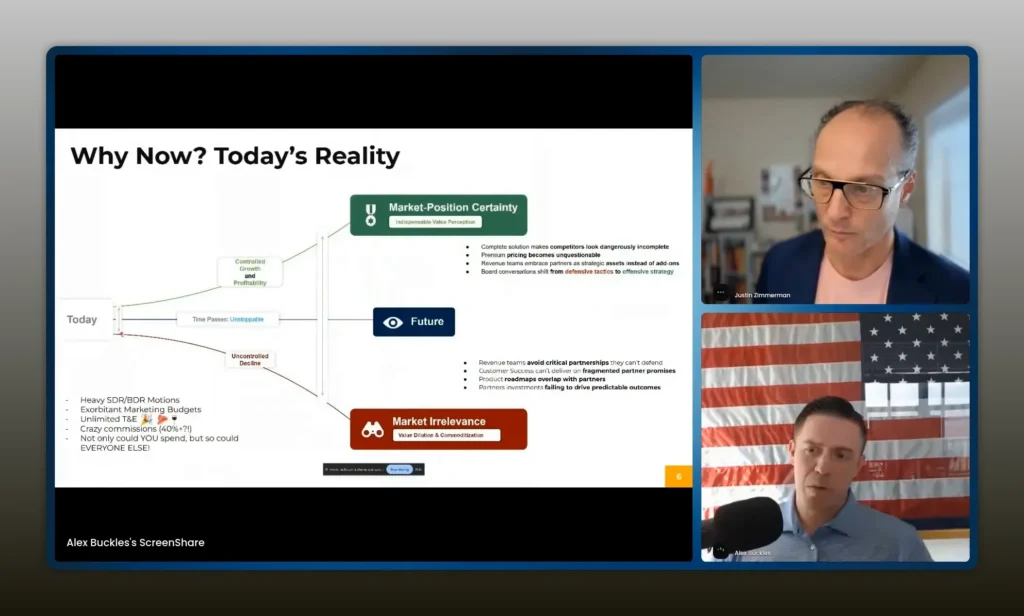
Our mission is simple: turn partner relationships into predictable pipeline. Our model rents the infrastructure — advisor, tech, and execution — so customers buy outcomes, not another tool. — Alex Buckles
The three components of the managed service
When you buy Forecastable, you are effectively renting three capabilities that work together:
- Senior advisor (up to eight hours per month) — a weekly strategic cadence focused on which partnerships are producing, where to get executive alignment, and what tactical plays to run next.
- Technology monitoring and data layer — a managed tech stack that integrates Crossbeam-style account overlap with professional network signals such as ComSource (LinkedIn-derived data), all monitored 24/7 and surfaced to reps.
- Dedicated co-sell alignment specialist (40 hours per week) — a full-time execution resource that does the in-between work: research, meeting booking, follow-ups, slide prep, and partner communications.
That combination lets you run multiple partner activation campaigns without adding headcount on your side, and it gives you a repeatable path from overlap data to qualified pipeline.
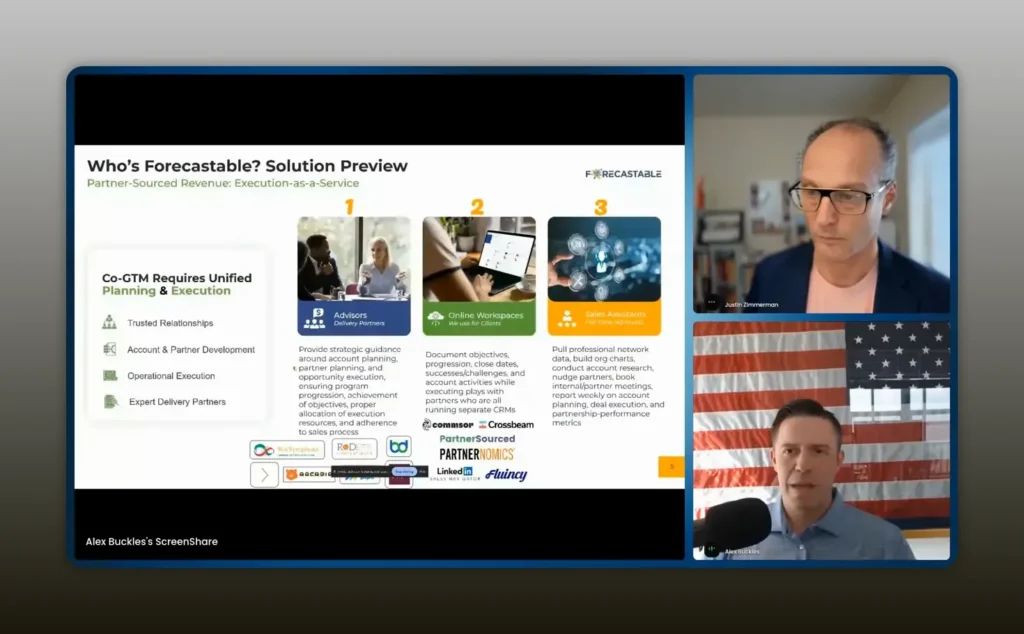
When people buy us, they rent our infrastructure. We manage Crossbeam data, network data, and the human follow-up so sales can close. — Alex Buckles
How cohorts and training accelerate results
Training alone rarely moves the needle. Sales reps need to see the motion executed in their real accounts, live. Forecastable’s approach is cohort-based and hands-on:
- Sales rep cohorts — reps bring target account lists, Crossbeam overlap is pulled, and LinkedIn network data is used to identify warm introductions. The cohort focuses on generating pipeline and wins in 60 days or less.
- Manager cohorts — separate sessions for front-line managers teach them how to coach reps, unblock deals, and run plays with partner teams. Managers learn how to embed partner plays into weekly cadences and forecast reviews.
- Partner pro resources — for partnership professionals, the cohorts include playbooks, slide decks, and templates to get sales leadership’s attention and demonstrate real ROI to the C-suite.
Running reps and managers in separate tracks removes social friction. Managers often won’t ask the same questions in mixed groups; they need a safe space to learn how to support reps.
John Barrows is leading a kickoff where sales teams will learn to use Crossbeam and network data to accelerate open deals. — Alex Buckles
Data sources you must leverage
Two categories of data drive modern partner GTM playbooks:
- Account overlap data — tools like Crossbeam reveal which accounts you and your partners both have influence in. That overlap is your starter kit for co-sell opportunities.
- Network-level signals — professional network data shows who in those overlapping accounts has a warm relationship with your partner or with you. ComSource and LinkedIn-derived signals tell you which introductions are feasible and who can credibly make them.
Combine both and you get the practical truth: an overlap without a warm path in is a cold opportunity; a warm path without overlap may not have mutual relevance. The orchestrated use of both data types is what turns introductions into meetings and meetings into pipeline.
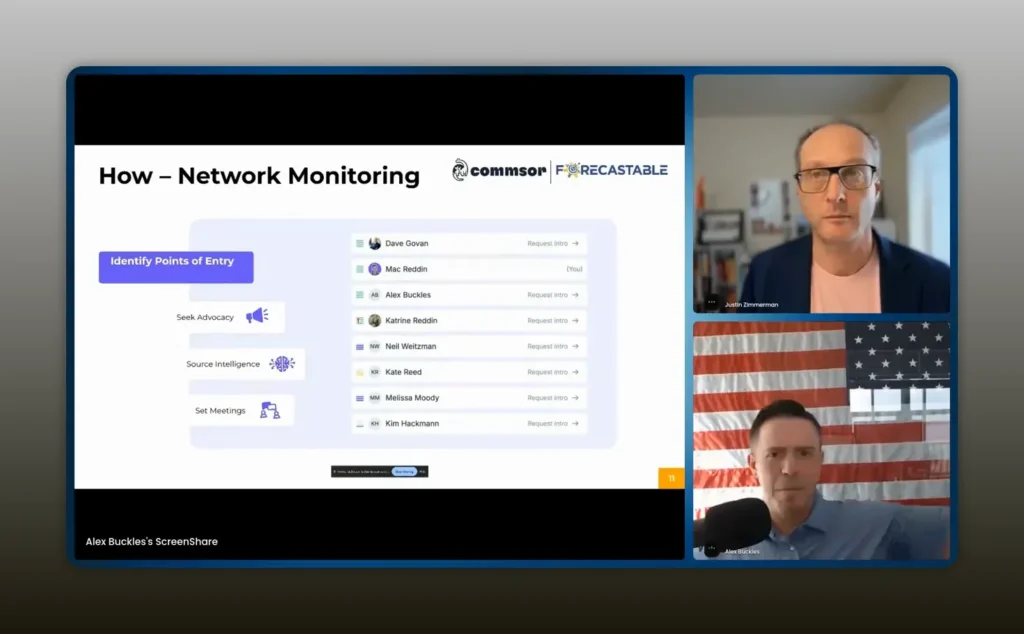
Think of Crossbeam as account overlap data and Commsor as network overlap data. Use both to find warm introductions into target accounts. — Alex Buckles
Activation playbook: what actually gets done
The activation sequence Forecastable uses is tactical and replicable. Here is the distilled playbook you can adopt or replicate with partners and internal teams:
- Data gathering — load account lists, pull Crossbeam overlap, enrich with network signals, and prioritize accounts by fit and warm-path probability.
- Discovery with frontline managers — set a discovery call with the partner’s frontline manager to learn their priorities for the year and identify mutual objectives.
- Custom presentation — deliver a tailored slide deck that addresses the frontline manager’s team priorities and shows a clear path to pipeline. Choreograph who talks and what outcomes you expect from the session.
- Immediate pipeline asks — close the first call with explicit asks: lead sources, accounts to target, and next-step commitments. Get alignment on specific owners and timelines.
- Operational follow-up — the co-sell alignment specialist executes the plan: research, meeting scheduling, and partner touchpoints. Keep a 30/60/90 day follow-up cadence to protect momentum.
- Measure and iterate — track referral conversion, pipeline creation, and closed revenue. Use weekly advisor sessions to decide which plays to double down on and which to kill.
Every step is designed to remove ambiguity from sales reps and partners so they take clear, repeatable actions in-market.
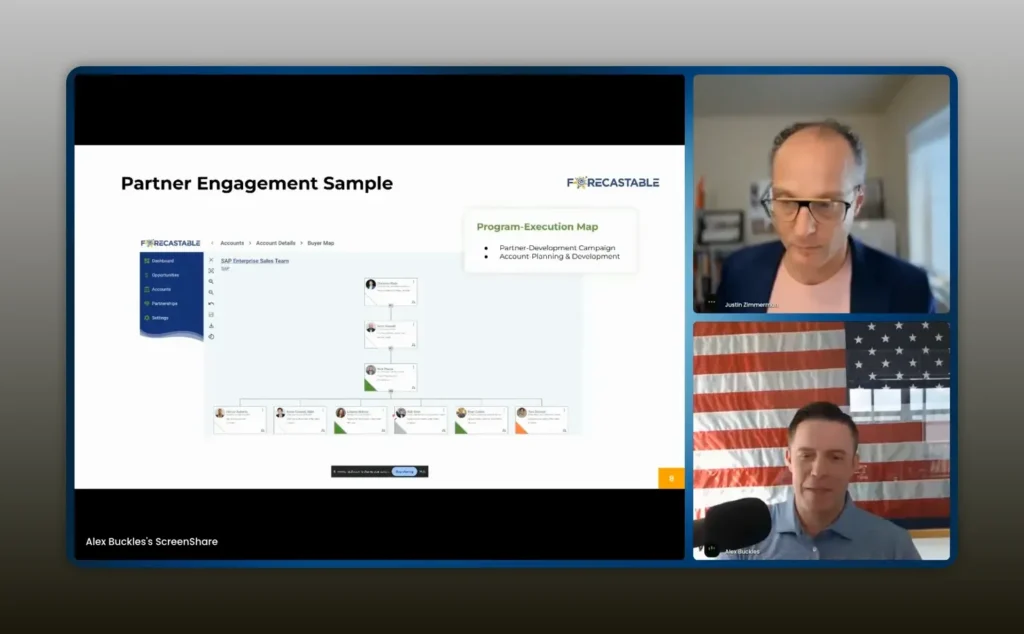
We get into granular detail: slide deck, choreography, tone of voice. Drive pipeline on the first presentation and follow up relentlessly. — Alex Buckles
Roles and personas: what each group needs
It is helpful to split responsibilities and expectations by persona. Forecastable structures cohorts and programs for each role:
- Sales reps — need account-level pulls, warm introductions, and clear plays that they can execute in their named accounts. They learn by seeing the play executed in their pipelines.
- Sales managers — need coaching on how to enable reps, how to remove blockers, and how to include partner plays in weekly forecast reviews.
- Partner professionals — need playbooks, C-suite talking points, and ways to prove ROI quickly so they can unlock budget and executive attention.
- Partners — need to be invited into the play and trained on the single ask: how to enable reps to take the next step. If partners don’t execute, the program underperforms.
Designing separate sessions for each persona eliminates noise and helps each group focus on the micro-actions that compound into pipeline growth.
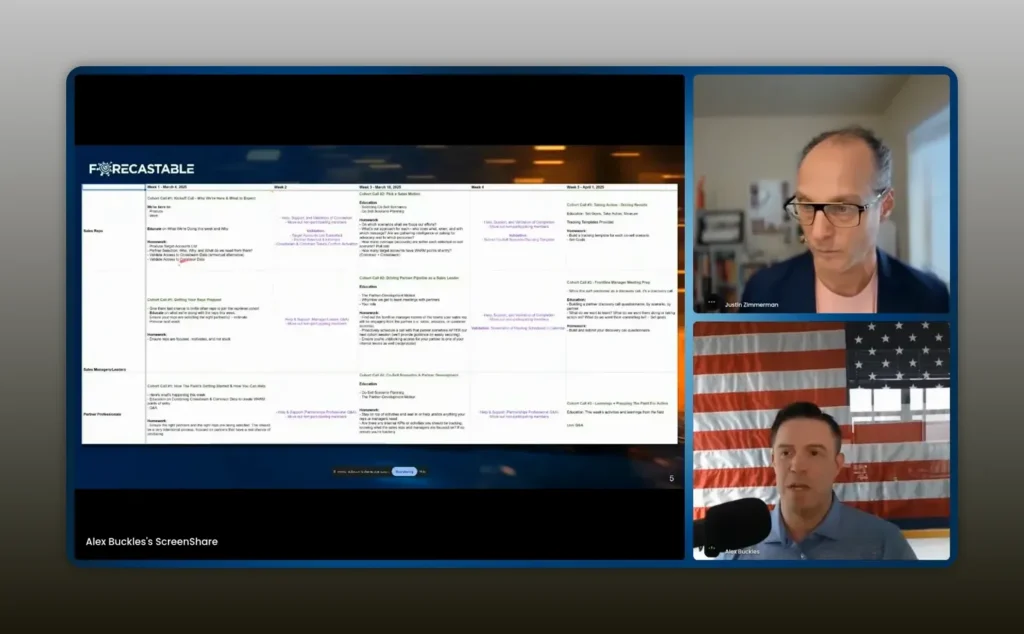
We’re giving partner professionals everything they need to get the attention of leadership. Get wins, then unlock budget. — Alex Buckles
Case studies and practical examples
Concrete examples help make the abstract tactical. Forecastable’s playbook has led to multiple real-world outcomes across different ecosystems:
- Professional services in the Adobe ecosystem — within a single quarter, a team activated over 40 enterprise account executives, which helped flip a company and double revenue in under two years by leaning into co-sell motions.
- HubSpot ecosystem agencies — small specialized agencies, when coached to present value to enterprise sales teams, converted into larger deals and sustained referral streams because they demonstrated contextual relevance to specific verticals.
- Formstack and Salesforce partnerships — ISVs that learned to navigate a complex partner landscape with hundreds of systems integrators found repeatable ways to get AVP/RVP attention and build consistent pipeline.
- QuotaPath and services partners — a SaaS vendor that turned commission and CRM behavior insights into partner-facing value propositions, enabling services partners to sell QuotaPath as part of a broader change story.
Across each case, the common thread is the same: execute the playbook in real accounts with a follow-through function that keeps the partner relationship active and monetizable.
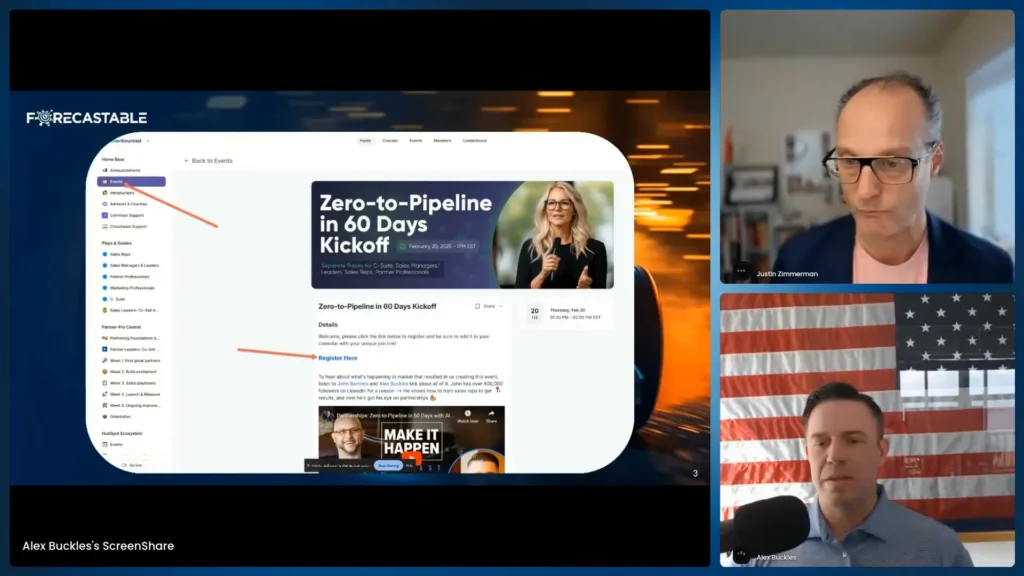
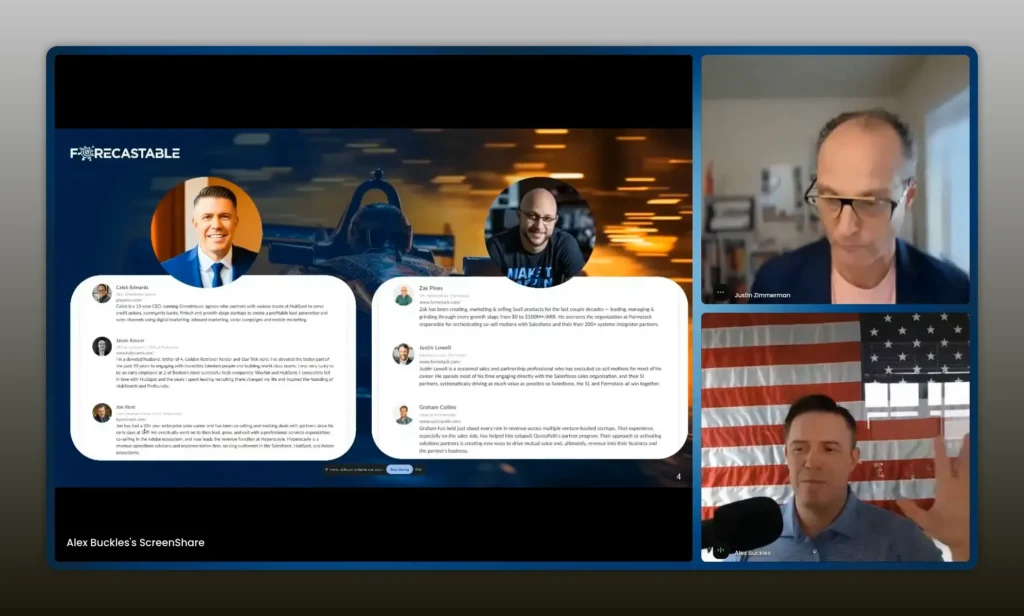
Hear from customers and revenue pros so sales teams understand how this works in the field. — Alex Buckles
Launch timeline and expected milestones
The timeline Forecastable presents is predictable and fast-moving. Typical milestones include:
- Week 0–4 (Setup) — data gathering, Crossbeam and network integration, priority account selection, kickoff with senior advisor.
- Day 30–60 (First pipeline) — meetings scheduled, initial pipeline generation, warm introductions convert into discovery meetings.
- Month 3 (Full swing) — campaigns are in repeatable motion, activities are scaled to multiple partner teams, and you should see a steady referral inflow.
Forecastable emphasizes that pipeline often appears by day 45–60 and the engine reaches full speed by month three. That speed matters when you need to demonstrate quick wins to secure further investment in partnerships.
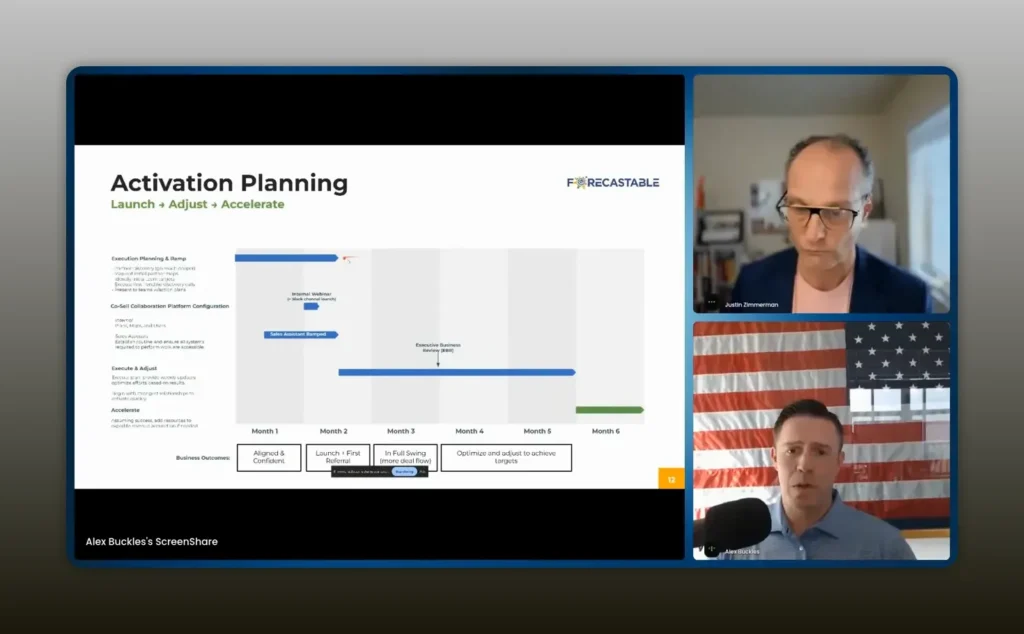
We launch in three months. Pipeline shows up around day 45 to 60; month three is when you get full swing. — Alex Buckles
Pricing, ROI, and headcount comparison
One of the most persuasive ROI arguments is: what is this versus hiring? Forecastable’s offering is positioned to be less expensive than hiring a single full-time sales rep or partner professional, while delivering a multi-person capability (advisor + tech + full-time sales assistant).
Consider this simple math:
- Cost to hire one experienced partner or co-sell rep (fully burdened) vs. monthly managed service fee
- Time-to-first-pipeline with service (45–60 days) vs. ramp time for a new hire (3–6 months)
- Operational leverage: one advisor and one specialist can activate 20–40 partner teams sequentially or in parallel, something a single hire cannot scale to alone
When you factor in opportunity cost and speed to revenue, renting a dedicated infrastructure for partnerships frequently outperforms backfilling headcount.
How to get started and next steps
To convert intentions into action, take these steps:
- Identify a short list of high-priority partners and target accounts that match your value story.
- Pull Crossbeam or equivalent overlap and enrich with network data to validate warm-path potential.
- Run a focused cohort for a small group of reps and one manager to prove out the motion in 60 days.
- Measure conversion metrics: meetings booked, pipeline created, conversion to opportunities, and closed revenue.
- If proof is positive, scale to additional reps and partner teams, replicating the playbook and keeping the cadence with a senior advisor.
Every organization that treats partnerships as a craft and operationalizes follow-up will see steady returns. The trick is to prioritize execution, not tools alone.
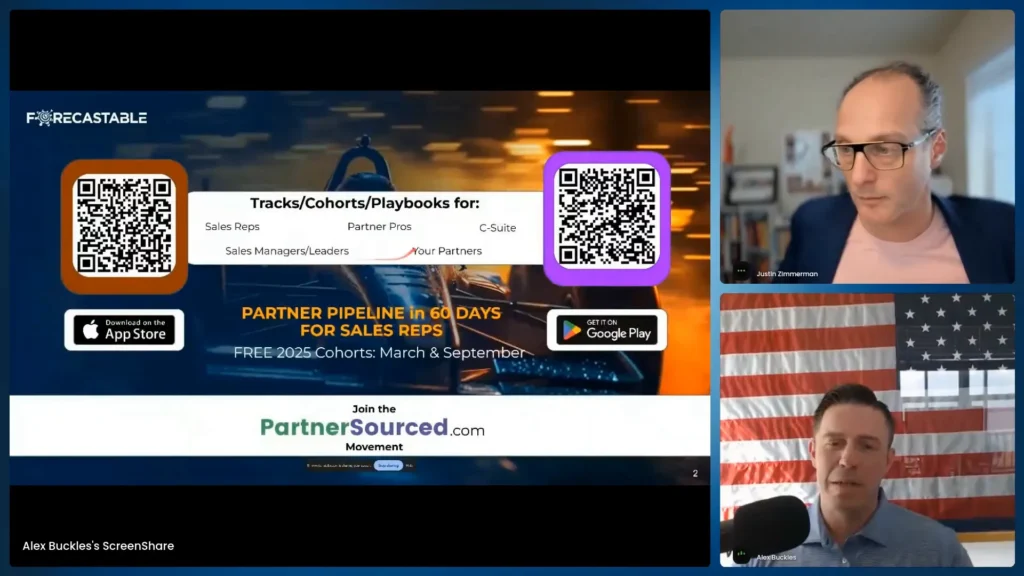
Download the partnersource.com app and bring your sales managers and reps into cohorts that produce wins in 60 days or less. — Alex Buckles
Common objections and how to overcome them
Objection: “We do not have budget or headcount.” Response: Demonstrate proof-of-concept in 60 days and use created wins to unlock budget from leadership.
Objection: “Sales won’t adopt partner leads.” Response: Pair partner leads with warm network introductions and a playbook so reps see clear, easy next steps in their accounts.
Objection: “Partners are inconsistent.” Response: Invite partners into structured cohorts and make the ask simple. If partners don’t participate, exclude them from priority plays while doubling down on those who do.
FAQs
How quickly can I expect pipeline from partner activation?
You should expect initial pipeline activity around day 45 to 60 after launch, with full program velocity by month three when the cadence, follow-ups, and data monitoring are fully operational.
What data sources are essential to this approach?
Account overlap data like Crossbeam and professional network data such as ComSource/LinkedIn-derived signals are essential. Use overlap to identify mutual accounts and network data to find warm introductions into those accounts.
Do you need to integrate into our CRM?
Not initially. The service is designed to manage data and operations externally and surface actionable insights to reps. CRM integration can be added later if you want to capture activity and outcomes inside your systems of record.
Will sales reps actually use partner-sourced leads?
Yes, when the leads come with clear context, warm introductions, and a low-effort next step. Reps adopt faster when they see the play executed in their own accounts instead of abstract theory.
What level of partner engagement is required?
You will get the best results with partners who are willing to commit to the small, repeatable plays and introductions. Forecastable provides scripts, decks, and choreography to make it easy for partners to participate.
How does this compare to hiring a partner manager?
This managed service delivers advisor-level strategy plus an execution specialist plus a technology monitoring layer at a cost often below a fully burdened hire, and it scales to support multiple partner teams and campaigns concurrently.
Conclusion
You can no longer treat partner programs as a nice-to-have. They are a primary engine for low-cost, repeatable customer acquisition if you operationalize them properly. The path to results is not about buying one more tool or running sporadic partner events; it is about orchestrating overlap and network data, coaching reps and managers in separate focused cohorts, and providing the relentless follow-through that keeps partner referrals converting into real pipeline.
Start small, prove quickly, and scale what works. Invite partners into a structured play, equip sales with warm introductions, and give the execution work to someone whose job it is to follow up. When you run the right process at account level, you convert partnerships from hope to predictable revenue.